Question 23
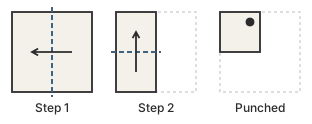
MediumOriginal questionThe figure shows two folds made one after the other, then a punch through every layer. Choose the unfolded sheet.
Show the answer and explanation
Correct answer: D
Explanation
Open the folds in reverse order. Opening a fold adds the mirror image of every hole across that fold line, because each hole went through both layers.
Opening step 2 (the horizontal fold) gives holes at (1, 2), (4, 2) (row, column).
Opening step 1 (the vertical fold) gives holes at (1, 2), (1, 3), (4, 2), (4, 3) (row, column).
Figure 4 shows these 4 holes.
Worth noting
The folded sheet has 4 layers, so each punch makes 4 holes. A figure with fewer holes has left a fold closed; one with the right number in the wrong places has opened a fold about the wrong line.
- Concept
- Unfolding a punched sheet: reflect the holes across each fold line
- Typical timeTypical
- 70 s
- Your timeYours
- —
Ten questions from Non-verbal Reasoning, at your own pace.