EduFarming
Your list · 0हिं

Type at least two letters. Press Esc to close.

↑↓ navigate↵ openTAB cycle filter

Central Problems and the PPC for CUET Economics

About 5 min to learn · 87 questions

Every economy has less than it wants, so it must choose. This lesson explains scarcity, the three central problems (what, how and for whom to produce), the production possibility curve and why it bows outward, opportunity cost and the marginal rate of transformation, and how market, planned and mixed economies decide, with worked examples and the traps CUET sets.

Syllabus area
Introductory Microeconomics
On this page · 10 sections
  1. 01The core idea
  2. 02Micro and macro
  3. 03The central problems
  4. 04The production possibility curve
  5. 05Opportunity cost and MRT
  6. 06Economic systems
  7. 07Exam shortcuts
  8. 08Common mistakes
  9. 09Quick revision
  10. 10Check your understanding

The core idea

Wants are unlimited, but the land, labour, capital and skills to meet them are limited, and each of them can be used in more than one way. So every economy, rich or poor, has to choose. Economics is the study of those choices.

Two questions decide most marks in this chapter: what a point on, inside or outside the PPC means, and what the PPC's shape says about opportunity cost.

Micro and macro

What does microeconomics study?

Microeconomics studies individual units: one consumer, one firm, one market. How the price of onions is set, or how a family spends its income, are micro questions. Macroeconomics studies the economy as a whole through aggregates: national income, the general price level, total employment.

Watch out

The branch is decided by the unit studied, not by the good. One family's spending on petrol is micro; the inflation rate is macro, even though both involve prices.

The central problems

Why must every economy choose?

Because resources are scarce relative to wants and have alternative uses. Scarcity does not mean absence: even a rich country cannot have everything at once.

What are the three central problems?

ProblemThe questionExample
What to produceWhich goods, and how much of each?More medicines or more cars?
How to produceWhich technique?Labour-intensive or capital-intensive?
For whom to produceHow is output shared?Depends on how income is distributed

Two further problems sit beside them: making full use of resources, and helping the economy's capacity grow.

Exam shortcut

"How" always comes after "what": a technique can only be chosen once the good to be made is known.

The production possibility curve

What does a PPC show?

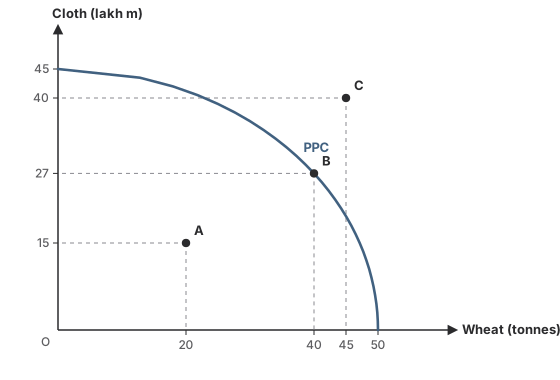
A production possibility curve shows the combinations of two goods an economy can produce when it uses its given resources and technology fully and efficiently. It is also called the production possibility frontier.

A PPC for wheat and cloth, bowed out from the origin, from 45 lakh metres of cloth to 50 tonnes of wheat. Point A (20, 15) lies inside the curve, B (40, 27) on it, and C (45, 40) outside it.
A: resources idle. B: full and efficient use. C: out of reach with today's resources.
PointWhere it isWhat it means
On the curveBResources fully and efficiently used
InsideAUnemployment or waste of resources
OutsideCNot attainable with current resources and technology

Moving from A to B gives more of both goods without giving anything up, because A had idle resources. Moving along the curve, more of one good always means less of the other.

Why does the PPC bow outward?

Resources are not equally good at producing both goods. The first resources moved into wheat are those best suited to it; later ones are less suited, so each extra tonne of wheat costs more and more cloth. A rising cost makes the curve steeper as it goes right: concave to the origin.

What shifts the PPC?

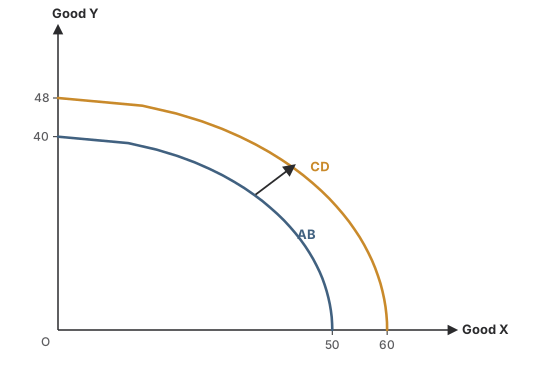
  • Outward shift: more resources (a larger labour force, new capital) or better technology for both goods.
  • Inward shift: loss of resources, as in a war, flood or earthquake.
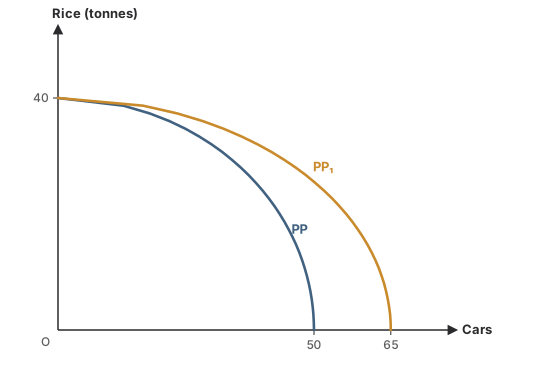
  • Rotation: better technology for one good only moves that good's end of the curve.

Watch out

Unemployment does not shift the PPC. The workers still exist; the economy is simply at a point inside the curve.

Opportunity cost and MRT

What is opportunity cost?

The value of the next best alternative given up. If a plot could grow wheat worth ₹40,000, rice worth ₹55,000 or pulses worth ₹48,000, the opportunity cost of wheat is ₹55,000, the best alternative, not the sum of the two.

What is the marginal rate of transformation?

The units of one good given up to produce one more unit of the other. It is the slope of the PPC.

Marginal rate of transformation

MRT=ΔYΔX=units of Y given upextra unit of X\text{MRT} = \frac{\Delta Y}{\Delta X} = \frac{\text{units of Y given up}}{\text{extra unit of X}}

Example 1 · MRT from a schedule

An economy can produce these combinations: wheat 0, 1, 2, 3, 4 tonnes with cloth 20, 18, 15, 11, 6 lakh metres. Find the MRT at each step.

  1. Cloth given up per extra tonne of wheat: 20 − 18 = 2, 18 − 15 = 3, 15 − 11 = 4, 11 − 6 = 5.

  2. The MRT rises: 2, 3, 4, 5. So the PPC is concave to the origin.

Answer

MRT = 2, 3, 4, 5: increasing opportunity cost

A straight-line PPC has a constant MRT: every extra unit of X costs the same amount of Y. That happens only if resources are equally efficient in both goods.

Economic systems

How do different economies solve the central problems?

SystemWho decidesMain motive
Market economyThe price mechanism: demand and supplyProfit
Centrally planned economyA central authority (the government)Social welfare
Mixed economyBoth the market and the governmentBoth

India is a mixed economy: public and private sectors produce side by side, and the government regulates some markets.

What are positive and normative statements?

A positive statement says what is, and can be checked: "Unemployment rose last year." A normative statement says what ought to be, and carries a value judgement: "The government should give free electricity to farmers." Words like should, ought and fair mark a normative statement.

Exam shortcuts

  • Inside the PPC = idle resources; outside = unattainable; on it = efficient.
  • Concave PPC ⇔ rising MRT; straight PPC ⇔ constant MRT.
  • Only growth of resources or technology shifts the PPC outward.

Common mistakes

  • Adding up all the alternatives given up. Opportunity cost is only the best one.
  • Saying unemployment shifts the PPC inward. It is a point inside an unchanged curve.
  • Confusing MRT (production, slope of the PPC) with MRS (consumption, slope of an indifference curve).

Quick revision

Central problems

  • What, how and for whom to produce
  • Arise from scarcity and alternative uses
  • Solved by prices, a plan, or both

PPC

  • On: efficient; inside: waste; outside: unattainable
  • Concave because MRT rises
  • Shifts out with more resources or better technology

Statements

  • Positive: what is, testable
  • Normative: what ought to be, opinion

The consumer's choices begin in utility and consumer's equilibrium.

Next · 09Quick revision

Check your understanding

87 questions, grouped by type, easy to hard. Pick an answer and check it. The worked solution opens when you ask for it.

Microeconomics and macroeconomicsQ1 of 87Q1

Microeconomics and macroeconomics

11 questions

Microeconomics studies

Options for question 1

Show the explanationHide the explanation

AnswerB · the behaviour of individual units such as a consumer, a firm or one market

  1. 'Micro' means small: microeconomics looks at one decision-maker or one market at a time.

  2. Totals for the whole economy, such as national income, belong to macroeconomics.

Worth noting

The economy-as-a-whole option describes macroeconomics, the other branch.

Which of these is studied in microeconomics?

Options for question 2

Show the explanationHide the explanation

AnswerD · How the price of onions is set in a market

  1. The price of one good in one market is an individual market, which is microeconomics.

  2. Inflation, national income and total unemployment are economy-wide aggregates, studied in macroeconomics.

Which of these is a macroeconomic variable?

Options for question 3

Show the explanationHide the explanation

AnswerA · Aggregate demand of the economy

  1. Macroeconomics deals with aggregates: totals for the whole economy.

  2. Aggregate demand adds up all spending in the economy, so it is a macro variable; the others are single units.

The word 'economy' in economics means

Options for question 4

Show the explanationHide the explanation

AnswerB · a system by which people earn their living and use resources to meet their wants

  1. An economy is the whole set of arrangements for producing, exchanging and consuming goods and services.

Worth noting

'Economy' in daily speech can mean thrift, but in economics it names a system.

A study of how a rise in the price of petrol changes one family's spending on bus fares is an example of

Options for question 5

Show the explanationHide the explanation

AnswerC · microeconomics, because it looks at one household's choice

  1. What decides the branch is the unit studied, not the good involved.

  2. One family's spending decision is an individual unit, so this is microeconomics.

Worth noting

Prices appear in both branches; a single good's price and a single family's choice are micro.

Which pair is correctly matched with its branch of economics?

Options for question 6

Show the explanationHide the explanation

AnswerC · Determination of the price of a good — microeconomics

  1. A single good's price is set in its own market, a microeconomic question.

  2. The general price level and national income are aggregates (macro); one firm's cost is micro.

Read the two statements and choose the correct option.

I. Microeconomics is also called price theory.

II. Macroeconomics is also called income theory.

Options for question 7

Show the explanationHide the explanation

AnswerC · Both I and II

  1. Microeconomics centres on how the prices of goods and factors are set, so it is called price theory.

  2. Macroeconomics centres on how national income and employment are determined, so it is called income theory.

Assertion (A): The study of the total output of an economy belongs to macroeconomics.

Reason (R): Macroeconomics studies the economy as a whole, through aggregates.

Options for question 8

Show the explanationHide the explanation

AnswerA · Both A and R are true, and R is the correct explanation of A.

  1. Total output is an aggregate of every producer's output, so A is true.

  2. R states what macroeconomics does, and that is exactly why total output falls in it, so R explains A.

Assertion (A): The study of the wage rate fixed for one industry is part of macroeconomics.

Reason (R): Microeconomics studies individual units such as one industry or one market.

Options for question 9

Show the explanationHide the explanation

AnswerD · A is false, but R is true.

  1. One industry's wage is an individual market, which is microeconomics, so A is false.

  2. R correctly describes microeconomics.

Which of these questions would a macroeconomist study?

Options for question 10

Show the explanationHide the explanation

AnswerA · Why did the country's total employment fall this year?

  1. Total employment for the whole country is an aggregate, so it is a macroeconomic question.

  2. A factory, a family and one fruit's price are individual units: microeconomics.

Microeconomics and macroeconomics are best described as

Options for question 11

Show the explanationHide the explanation

AnswerD · complementary: the study of the parts and of the whole support each other

  1. Aggregates are built from individual units, and individual choices are shaped by economy-wide conditions.

  2. So the two branches complete each other.

Scarcity and the central problems

16 questions

The basic economic problem arises because

Options for question 12

Show the explanationHide the explanation

AnswerA · resources are scarce and have alternative uses, while wants are unlimited

  1. Unlimited wants meet limited resources, so not every want can be met.

  2. Because each resource can be used in more than one way, society has to choose: this choice is the economic problem.

Which of these is NOT one of the three central problems of an economy?

Options for question 13

Show the explanationHide the explanation

AnswerD · How much money to print

  1. The three central problems are what to produce, how to produce and for whom to produce.

  2. Printing money is a matter of monetary policy, not one of the three.

Scarcity of resources means

Options for question 14

Show the explanationHide the explanation

AnswerD · resources are limited compared with the wants they could satisfy

  1. Scarcity is relative: there is not enough to satisfy every want, though resources exist.

Worth noting

Scarce does not mean absent; even a rich country faces scarcity.

Economising resources means

Options for question 15

Show the explanationHide the explanation

AnswerB · using them so that the most is obtained from what is available

  1. Since resources are scarce, the aim is to put each to the use that gives the greatest return.

Read the two statements and choose the correct option.

I. Human wants are unlimited.

II. Resources to satisfy wants are unlimited.

Options for question 16

Show the explanationHide the explanation

AnswerA · Only I

  1. Wants keep growing as old ones are met, so statement I is true.

  2. Resources are limited; that is the root of scarcity, so II is false.

Deciding whether to use more labour or more machines to make cloth is the problem of

Options for question 17

Show the explanationHide the explanation

AnswerC · how to produce

  1. 'How to produce' is the choice of technique: labour-intensive or capital-intensive.

  2. The good (cloth) is already chosen, so 'what' is settled; the open question is the method.

The problem 'for whom to produce' is about

Options for question 18

Show the explanationHide the explanation

AnswerA · how the output is shared among the people of the economy

  1. 'For whom' is the problem of distribution: who gets how much of what is produced.

  2. It depends on how income is distributed among the owners of land, labour, capital and enterprise.

A government decides to produce more medicines and fewer luxury cars. Which central problem is it solving?

Options for question 19

Show the explanationHide the explanation

AnswerB · What to produce

  1. Choosing which goods, and how much of each, is the problem of what to produce.

Worth noting

It may look like 'for whom' because medicines help the sick, but the decision is about the mix of goods.

Every economy faces the central problems because

Options for question 20

Show the explanationHide the explanation

AnswerA · resources everywhere are scarce relative to wants

  1. Scarcity is universal, so every economy, whether market, planned or mixed, must decide what, how and for whom.

Which of these is a problem of how to produce?

Options for question 21

Show the explanationHide the explanation

AnswerD · Whether to harvest wheat by hand or with combine harvesters

  1. Hand labour versus machines is a choice of technique, which is 'how to produce'.

  2. Choosing the crop is 'what'; choosing who gets it is 'for whom'.

Assertion (A): The central problems arise in every economy, rich or poor.

Reason (R): In a market economy, prices guide how resources are used.

Options for question 22

Show the explanationHide the explanation

AnswerB · Both A and R are true, but R is not the correct explanation of A.

  1. A is true: scarcity of resources relative to wants exists in every economy.

  2. R is true too, but it describes how one kind of economy solves the problems, not why the problems arise.

Worth noting

The reason the problems arise is scarcity; R answers a different question.

Match each decision with the central problem it answers.

List IList II
A. Grow more pulses and less cottonI. For whom to produce
B. Use drip irrigation instead of flooding fieldsII. What to produce
C. Give free food grains to poor householdsIII. Full use of resources
D. Use idle land and workers to raise outputIV. How to produce
Options for question 23

Show the explanationHide the explanation

AnswerC · A-II, B-IV, C-I, D-III

  1. Pulses versus cotton is the mix of goods: what to produce.

  2. Drip irrigation is a method: how to produce. Free grain to the poor is distribution: for whom.

  3. Bringing idle resources into use moves the economy towards its PPC: full use of resources.

Which of these is NOT a feature of resources that gives rise to the economic problem?

Options for question 24

Show the explanationHide the explanation

AnswerB · They are freely available in unlimited quantity

  1. The problem arises because resources are limited and have alternative uses.

  2. Resources free and unlimited would remove the problem, not cause it.

A choice between labour-intensive and capital-intensive technique is made after deciding

Options for question 25

Show the explanationHide the explanation

AnswerC · what to produce

  1. The method can be chosen only once the good to be made is known.

  2. So 'how' follows 'what'.

Read the two statements and choose the correct option.

I. The problem of what to produce also includes how much of each good to produce.

II. The problem of for whom to produce is about choosing the technique of production.

Options for question 26

Show the explanationHide the explanation

AnswerA · Only I

  1. I is true: deciding what to produce means deciding the goods and their quantities.

  2. II is false: technique is 'how to produce'; 'for whom' is about distribution.

A country shifts land from growing food grains to growing flowers for export. Which central problem is it answering?

Options for question 27

Show the explanationHide the explanation

AnswerC · What to produce

  1. The land is being moved from one product to another, changing the mix of goods.

  2. Changing the mix of goods answers what to produce.

Worth noting

Exporting does not make it 'for whom': the decision is still about which good the land produces.

The production possibility curve

25 questions

A production possibility curve shows

Options for question 28

Show the explanationHide the explanation

AnswerC · the combinations of two goods an economy can produce with given resources and technology, using them fully and efficiently

  1. The PPC is the boundary of what can be produced when resources are fully used with the given technology.

  2. Combinations a consumer can buy are shown by the budget line, not the PPC.

Worth noting

The consumer option describes the budget line, a different curve met in consumer theory.

In the graph, point A shows that

A PPC for wheat (tonnes) and cloth (lakh metres), bowed out from the origin, from 45 lakh m of cloth with no wheat to 50 tonnes of wheat with no cloth. Point A (20 wheat, 15 cloth) lies inside the curve, point B (40 wheat, 27 cloth) lies on it, and point C (45 wheat, 40 cloth) lies outside it.
Options for question 29

Show the explanationHide the explanation

AnswerB · some resources are unemployed or used inefficiently

  1. A lies inside the PPC: the economy could produce more of both goods with what it has.

  2. A point inside the curve means underutilisation of resources.

In the graph, point C is

A PPC for wheat (tonnes) and cloth (lakh metres), bowed out from the origin, from 45 lakh m of cloth with no wheat to 50 tonnes of wheat with no cloth. Point A (20 wheat, 15 cloth) lies inside the curve, point B (40 wheat, 27 cloth) lies on it, and point C (45 wheat, 40 cloth) lies outside it.
Options for question 30

Show the explanationHide the explanation

AnswerD · unattainable with the existing resources and technology

  1. C (45 wheat, 40 cloth) lies outside the PPC, beyond what current resources can produce.

  2. Only growth in resources or better technology, which shifts the PPC out, could make it attainable.

Which of these would shift a country's PPC inward?

Options for question 31

Show the explanationHide the explanation

AnswerA · A flood that destroys factories and farmland

  1. Destruction of resources lowers what the economy can produce, so the PPC moves in.

  2. The other three add to resources or improve technology, which shift it out.

In the graph, moving from point A to point B means that

A PPC for wheat (tonnes) and cloth (lakh metres), bowed out from the origin, from 45 lakh m of cloth with no wheat to 50 tonnes of wheat with no cloth. Point A (20 wheat, 15 cloth) lies inside the curve, point B (40 wheat, 27 cloth) lies on it, and point C (45 wheat, 40 cloth) lies outside it.
Options for question 32

Show the explanationHide the explanation

AnswerA · more of both goods is produced without giving up anything, by using idle resources

  1. From A (20, 15) to B (40, 27) wheat rises by 20 tonnes and cloth by 12 lakh m.

  2. Nothing is sacrificed because A had idle resources; there is no opportunity cost for this move.

Worth noting

A trade-off exists only between points on the curve; from inside it, both can rise.

In the graph, what is the most cloth the economy can produce if it produces no wheat?

A PPC for wheat (tonnes) and cloth (lakh metres), bowed out from the origin, from 45 lakh m of cloth with no wheat to 50 tonnes of wheat with no cloth. Point A (20 wheat, 15 cloth) lies inside the curve, point B (40 wheat, 27 cloth) lies on it, and point C (45 wheat, 40 cloth) lies outside it.
Options for question 33

Show the explanationHide the explanation

AnswerC · 45 lakh metres

  1. Where the PPC meets the cloth axis, wheat is zero; that point is 45 lakh metres.

Worth noting

50 is the most wheat, on the other axis.

A PPC is usually concave (bowed out) to the origin because

Options for question 34

Show the explanationHide the explanation

AnswerD · the marginal rate of transformation increases as more of one good is produced

  1. Resources are not equally suited to both goods, so each extra unit of one good costs more and more of the other.

  2. A rising MRT means the slope gets steeper along the curve, which makes it concave.

Worth noting

A constant MRT would make the PPC a straight line, not a curve.

The PPC shifts from AB to CD as shown. The most likely cause is

Two PPCs for goods X and Y. The inner curve AB runs from 40 units of Y to 50 units of X; the outer curve CD runs from 48 units of Y to 60 units of X. An arrow points from AB out to CD.
Options for question 35

Show the explanationHide the explanation

AnswerA · an increase in resources or better technology for both goods

  1. The whole curve moves out: both maximum outputs rise (X from 50 to 60, Y from 40 to 48).

  2. That happens when the economy's capacity grows: more resources or better technology.

Worth noting

Unemployment moves the economy inside the curve; it does not shift the curve.

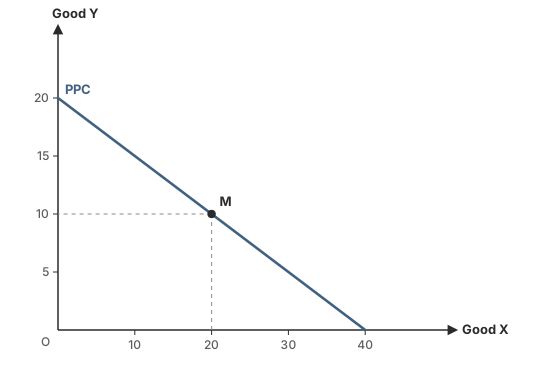
The PPC in the graph is a straight line. What is the marginal rate of transformation of X into Y?

A straight-line PPC for goods X and Y, from 20 units of Y (no X) to 40 units of X (no Y). Point M (20 X, 10 Y) lies on it.
Options for question 36

Show the explanationHide the explanation

AnswerB · 0.5 unit of Y for each unit of X

  1. The line runs from 20 units of Y to 40 units of X: giving up all 20 Y gains 40 X.

  2. MRT = ΔY / ΔX = 20 / 40 = 0.5 unit of Y per unit of X, the same everywhere on a straight line.

Worth noting

2 is the inverse: X given up per unit of Y.

A straight-line PPC means that

Options for question 37

Show the explanationHide the explanation

AnswerB · the opportunity cost of each extra unit stays the same

  1. A straight line has the same slope everywhere, and the slope of a PPC is the MRT.

  2. So each extra unit of one good costs the same amount of the other: constant opportunity cost.

In the graph, how much of Y must be given up to move from point M to 30 units of X along the PPC?

A straight-line PPC for goods X and Y, from 20 units of Y (no X) to 40 units of X (no Y). Point M (20 X, 10 Y) lies on it.
Options for question 38

Show the explanationHide the explanation

AnswerA · 5 units

  1. At M the economy makes 20 X and 10 Y; the MRT is 0.5 Y per X.

  2. Ten more units of X cost 10 × 0.5 = 5 units of Y, leaving 5 Y.

The PPC is also called the

Options for question 39

Show the explanationHide the explanation

AnswerD · production possibility frontier

  1. It marks the frontier, or boundary, between what can and cannot be produced, so it is also called the production possibility frontier or boundary.

Assertion (A): A PPC slopes downward from left to right.

Reason (R): With resources fully used, more of one good can be produced only by producing less of the other.

Options for question 40

Show the explanationHide the explanation

AnswerA · Both A and R are true, and R is the correct explanation of A.

  1. Along the PPC, more X always comes with less Y, so the curve slopes down: A is true.

  2. That trade-off is exactly what R states, so R explains A.

Read the two statements and choose the correct option.

I. Every point on a PPC shows full and efficient use of resources.

II. A point outside the PPC can be reached by using resources more fully.

Options for question 41

Show the explanationHide the explanation

AnswerA · Only I

  1. Statement I is true: the curve is drawn for full, efficient use.

  2. II is false: resources are already fully used on the curve; a point outside needs more resources or better technology.

Which assumption is made when drawing a PPC?

Options for question 42

Show the explanationHide the explanation

AnswerB · Resources and technology are given and fixed

  1. A PPC is drawn for a given stock of resources and a given state of technology, with both goods produced.

  2. It also assumes the resources are fully and efficiently employed.

Which of these is shown by a movement ALONG a PPC?

Options for question 43

Show the explanationHide the explanation

AnswerD · Reallocating resources from one good to the other

  1. Along the curve, resources stay fully used; only their division between the two goods changes.

  2. Growth and better technology shift the curve; unemployment is a point inside it.

The slope of a PPC measures

Options for question 44

Show the explanationHide the explanation

AnswerD · the marginal rate of transformation

  1. Slope = ΔY ÷ ΔX: the units of Y given up for one more unit of X, which is the MRT.

Worth noting

The MRS is the slope of an indifference curve, in consumer theory.

A PPC would be a straight line if

Options for question 45

Show the explanationHide the explanation

AnswerA · resources were equally efficient in producing both goods

  1. If every resource were equally good at making both goods, moving it would always give up the same amount: constant MRT.

  2. A constant MRT gives a straight-line PPC.

Assertion (A): A new irrigation technique for wheat shifts the PPC outward along the wheat axis only.

Reason (R): The technique raises the most wheat the economy can produce, but not the most cloth.

Options for question 46

Show the explanationHide the explanation

AnswerA · Both A and R are true, and R is the correct explanation of A.

  1. A technique for one good moves only that good's end of the curve, so A is true.

  2. R gives exactly that reason, so it explains A.

In the graph, the PPC moves from PP to PP₁. What has happened?

Two PPCs for cars and rice (tonnes). Both start at 40 tonnes of rice. PP ends at 50 cars and PP₁ ends at 65 cars.
Options for question 47

Show the explanationHide the explanation

AnswerC · Technology has improved in making cars only

  1. The maximum rice stays at 40 tonnes, but the maximum cars rise from 50 to 65.

  2. A curve that swings out along one axis only shows progress in producing that good alone.

Unemployment of half the workers in an economy would be shown by

Options for question 48

Show the explanationHide the explanation

AnswerC · a point inside the PPC

  1. The workers still exist; they are only idle. The capacity, and so the curve, is unchanged.

  2. Producing below capacity puts the economy at a point inside its PPC.

Worth noting

The PPC shifts in only when resources are lost, as in a war or disaster; idle resources are a point inside it.

Assertion (A): A PPC is convex to the origin.

Reason (R): The marginal rate of transformation rises along a PPC.

Options for question 49

Show the explanationHide the explanation

AnswerD · A is false, but R is true.

  1. A rising MRT makes the PPC concave (bowed out) to the origin, not convex, so A is false.

  2. R is the standard reason for the PPC's shape and is true.

Worth noting

Convex to the origin describes an indifference curve, which has a falling MRS.

Read the two statements and choose the correct option.

I. Growth of resources shifts the PPC to the right.

II. Better use of existing resources shifts the PPC to the right.

Options for question 50

Show the explanationHide the explanation

AnswerA · Only I

  1. I is true: more resources raise capacity and push the curve out.

  2. II is false: using idle resources moves the economy from inside the curve onto it; the curve itself does not move.

In the graph, the economy moves from B to a point with 45 tonnes of wheat on the PPC. Which statement is correct?

A PPC for wheat (tonnes) and cloth (lakh metres), bowed out from the origin, from 45 lakh m of cloth with no wheat to 50 tonnes of wheat with no cloth. Point A (20 wheat, 15 cloth) lies inside the curve, point B (40 wheat, 27 cloth) lies on it, and point C (45 wheat, 40 cloth) lies outside it.
Options for question 51

Show the explanationHide the explanation

AnswerA · Cloth output must fall below 27 lakh m

  1. B (40, 27) is on the PPC, so resources are fully used there.

  2. More wheat along the curve is possible only by giving up some cloth.

Worth noting

C has 45 tonnes of wheat too, but with 40 lakh m of cloth it lies outside the curve.

Match each event with what it does to an economy's PPC.

List IList II
A. Many new skilled workers enter the labour forceI. A point inside the PPC
B. Half the factories lie idle in a slumpII. The PPC rotates out along the rice axis
C. A war destroys roads and bridgesIII. The PPC shifts outward
D. A better seed raises only rice outputIV. The PPC shifts inward
Options for question 52

Show the explanationHide the explanation

AnswerC · A-III, B-I, C-IV, D-II

  1. More skilled workers add to resources: an outward shift.

  2. Idle factories are unemployed resources: a point inside the curve.

  3. Destroyed roads are lost resources: an inward shift. A seed for one crop rotates the curve along that crop's axis.

Opportunity cost and MRT

20 questions

Opportunity cost of a choice is

Options for question 53

Show the explanationHide the explanation

AnswerD · the value of the next best alternative given up

  1. Choosing one use of a resource means giving up its other uses; only the best of those is counted.

Worth noting

Adding up every alternative overstates it: you could only have taken one of them.

Marginal rate of transformation (MRT) is

Options for question 54

Show the explanationHide the explanation

AnswerB · the units of one good given up to produce one more unit of the other

  1. MRT = ΔY ÷ ΔX: what production of Y is sacrificed for an extra unit of X.

  2. It is the slope of the PPC.

Worth noting

The consumer's version, about giving up consumption, is the MRS.

A farmer can grow wheat worth ₹40,000, rice worth ₹55,000 or pulses worth ₹48,000 on a plot. He grows wheat. What is the opportunity cost of growing wheat?

Options for question 55

Show the explanationHide the explanation

AnswerC · ₹55,000

  1. The alternatives given up are rice (₹55,000) and pulses (₹48,000).

  2. The next best of these is rice, so the opportunity cost is ₹55,000.

Worth noting

₹1,03,000 adds both alternatives; only the best one forgone counts.

Riya leaves a job paying ₹18,000 a month to study full-time. What is the monthly opportunity cost of her studies, leaving aside fees?

Options for question 56

Show the explanationHide the explanation

AnswerC · ₹18,000

  1. By studying she gives up the salary she could have earned.

  2. That forgone salary, ₹18,000 a month, is the opportunity cost.

The table shows an economy's production possibilities.

CombinationWheat (tonnes)Cloth (lakh m)
A020
B118
C215
D311
E46

What is the marginal rate of transformation when the economy moves from C to D?

Options for question 57

Show the explanationHide the explanation

AnswerB · 4 lakh m of cloth per tonne of wheat

  1. From C to D wheat rises from 2 to 3 tonnes (ΔX = 1) and cloth falls from 15 to 11 (ΔY = 4).

  2. MRT = 4 ÷ 1 = 4 lakh m of cloth per tonne of wheat.

Worth noting

3 is the MRT from B to C; 11 is the cloth left at D, not the cloth given up.

The table shows an economy's production possibilities.

CombinationWheat (tonnes)Cloth (lakh m)
A020
B118
C215
D311
E46

What is the opportunity cost of the fourth tonne of wheat?

Options for question 58

Show the explanationHide the explanation

AnswerB · 5 lakh m of cloth

  1. The fourth tonne takes wheat from 3 to 4, from D to E.

  2. Cloth falls from 11 to 6, so 5 lakh m are given up.

Worth noting

14 is the total cloth given up for all four tonnes (20 − 6).

The table shows an economy's production possibilities.

CombinationWheat (tonnes)Cloth (lakh m)
A020
B118
C215
D311
E46

The economy produces 2 tonnes of wheat and 12 lakh m of cloth. This shows

Options for question 59

Show the explanationHide the explanation

AnswerA · underutilisation of resources, because 15 lakh m of cloth were possible with 2 tonnes of wheat

  1. With 2 tonnes of wheat the PPC allows 15 lakh m of cloth (combination C).

  2. Producing only 12 means the point lies inside the PPC: some resources are idle or wasted.

The table shows an economy's production possibilities.

CombinationWheat (tonnes)Cloth (lakh m)
A020
B118
C215
D311
E46

Can the economy produce 3 tonnes of wheat and 13 lakh m of cloth?

Options for question 60

Show the explanationHide the explanation

AnswerB · No: with 3 tonnes of wheat, at most 11 lakh m of cloth can be produced

  1. Combination D says 3 tonnes of wheat leave room for only 11 lakh m of cloth.

  2. 13 lakh m is more than that, so the point lies outside the PPC and cannot be reached.

The table shows an economy's production possibilities.

CombinationWheat (tonnes)Cloth (lakh m)
A020
B118
C215
D311
E46

How much cloth in all must be given up to move from A to D?

Options for question 61

Show the explanationHide the explanation

AnswerB · 9 lakh m

  1. At A cloth is 20; at D it is 11.

  2. Cloth given up = 20 − 11 = 9 lakh m, for 3 tonnes of wheat.

The table shows an economy's production possibilities.

CombinationGood XGood Y
P030
Q520
R1010
S150

What is the MRT of X into Y?

Options for question 62

Show the explanationHide the explanation

AnswerD · 2 units of Y per unit of X, at every step

  1. Each step adds 5 units of X and gives up 10 units of Y.

  2. MRT = 10 ÷ 5 = 2 units of Y per unit of X, the same at every step, so the PPC is a straight line.

Worth noting

10 is the Y given up per step of 5 X, not per unit of X.

An economy can produce these combinations of guns and butter.

Guns012345
Butter (tonnes)504844383020

What is the opportunity cost of the fifth gun?

Options for question 63

Show the explanationHide the explanation

AnswerB · 10 tonnes of butter

  1. Going from 4 to 5 guns, butter falls from 30 to 20 tonnes.

  2. So the fifth gun costs 10 tonnes of butter.

Worth noting

20 is the butter left; 30 is the total butter given up for all five guns.

Why does the opportunity cost of a good usually rise as more of it is produced?

Options for question 64

Show the explanationHide the explanation

AnswerC · Resources are not equally efficient in producing all goods

  1. The first resources moved into a good are those best suited to it; later ones are less suited.

  2. Less suited resources produce less of the new good for each unit of the old good they stop producing, so the cost rises.

Assertion (A): Opportunity cost exists only when resources are scarce.

Reason (R): When resources are scarce, using them for one thing means not using them for another.

Options for question 65

Show the explanationHide the explanation

AnswerA · Both A and R are true, and R is the correct explanation of A.

  1. Without scarcity, nothing would have to be given up, so A is true.

  2. R states the sacrifice that scarcity forces, which is what opportunity cost measures, so R explains A.

Which of these has an opportunity cost of zero?

Options for question 66

Show the explanationHide the explanation

AnswerB · Putting idle land to use

  1. Idle land produces nothing now, so using it gives up nothing.

  2. Each of the others gives up a real alternative.

Read the two statements and choose the correct option.

I. Opportunity cost can be measured in units of a good, not only in money.

II. Along a concave PPC, the opportunity cost of a good falls as more of it is produced.

Options for question 67

Show the explanationHide the explanation

AnswerA · Only I

  1. I is true: the MRT is itself an opportunity cost in units of the other good.

  2. II is false: on a concave PPC the opportunity cost rises.

An economy can produce these combinations of guns and butter.

Guns012345
Butter (tonnes)504844383020

What is the MRT when the economy moves from 2 guns to 3 guns?

Options for question 68

Show the explanationHide the explanation

AnswerB · 6 tonnes of butter per gun

  1. Butter falls from 44 to 38 tonnes as guns rise from 2 to 3.

  2. MRT = 6 ÷ 1 = 6 tonnes of butter per gun.

The table shows an economy's production possibilities.

CombinationWheat (tonnes)Cloth (lakh m)
A020
B118
C215
D311
E46

What shape will the PPC drawn from this table have, and why?

Options for question 69

Show the explanationHide the explanation

AnswerC · Concave to the origin, because the cloth given up per extra tonne rises: 2, 3, 4, 5

  1. Cloth given up per tonne: A→B 2, B→C 3, C→D 4, D→E 5.

  2. A rising MRT gives a curve that gets steeper as wheat rises: concave to the origin.

An economy can produce these combinations of guns and butter.

Guns012345
Butter (tonnes)504844383020

What happens to the MRT as more guns are produced, and what does it tell you?

Options for question 70

Show the explanationHide the explanation

AnswerA · It rises (2, 4, 6, 8, 10), so the PPC is concave to the origin

  1. Butter given up per extra gun: 2, 4, 6, 8, 10 tonnes.

  2. An MRT that rises along the curve makes the PPC concave to the origin.

Assertion (A): Moving from a point inside the PPC to a point on it has no opportunity cost.

Reason (R): The MRT is constant along every PPC.

Options for question 71

Show the explanationHide the explanation

AnswerC · A is true, but R is false.

  1. A is true: idle resources are put to work, and nothing is given up.

  2. R is false: the MRT is constant only on a straight-line PPC; on the usual concave PPC it rises.

A firm uses its own building, which it could rent out for ₹30,000 a month, instead of renting it. In deciding whether the business pays, this ₹30,000 is

Options for question 72

Show the explanationHide the explanation

AnswerB · an opportunity cost that should be counted

  1. By using the building, the firm gives up the rent it could have earned.

  2. That forgone rent is a real cost of the choice even though no cash changes hands.

Economic systems; positive and normative

15 questions

In a market economy, the central problems are solved mainly by

Options for question 73

Show the explanationHide the explanation

AnswerB · the price mechanism, through the free play of demand and supply

  1. In a market economy buyers and sellers act freely, and the prices that result guide what, how and for whom.

In a centrally planned economy, the central problems are decided by

Options for question 74

Show the explanationHide the explanation

AnswerC · the government or a central authority

  1. A central authority plans what goods are made, by which methods, and how they are shared.

An economy in which both the government and the market decide what, how and for whom to produce is a

Options for question 75

Show the explanationHide the explanation

AnswerA · mixed economy

  1. A mixed economy combines the market's price mechanism with the government's planning and regulation.

  2. India has a mixed economy.

Worth noting

A closed economy is one that does not trade with other countries, a different idea.

Positive economics deals with

Options for question 76

Show the explanationHide the explanation

AnswerA · what is: facts that can be checked

  1. A positive statement describes how things are and can be tested against evidence.

  2. Statements about what ought to be belong to normative economics.

In a market economy, who gets the goods produced is decided mainly by

Options for question 77

Show the explanationHide the explanation

AnswerD · people's purchasing power, that is, their incomes

  1. In a market, goods go to those willing and able to pay the price.

  2. So 'for whom' is answered by the distribution of income.

The main motive of producers in a market economy is

Options for question 78

Show the explanationHide the explanation

AnswerC · to earn profit

  1. Private producers decide what to make by what earns them the most profit.

  2. Social welfare is the main aim in a centrally planned economy.

Read the two statements and choose the correct option.

I. In a centrally planned economy, the means of production are owned mainly by the state.

II. In a market economy, the means of production are owned mainly by private individuals.

Options for question 79

Show the explanationHide the explanation

AnswerC · Both I and II

  1. Both describe the standard ownership pattern of each system, so both are true.

Assertion (A): India is a mixed economy.

Reason (R): In India, both public and private sectors produce goods and services.

Options for question 80

Show the explanationHide the explanation

AnswerA · Both A and R are true, and R is the correct explanation of A.

  1. Both statements are true.

  2. The coexistence of public and private sectors is what makes an economy mixed, so R explains A.

Which of these is a normative statement?

Options for question 81

Show the explanationHide the explanation

AnswerB · The government should give free electricity to farmers.

  1. A normative statement says what ought to be, and contains a value judgement: 'should'.

  2. The other three can be checked against facts, so they are positive.

Which of these is a positive statement?

Options for question 82

Show the explanationHide the explanation

AnswerD · When the price of tea rises, people buy less tea.

  1. It describes a cause-and-effect relation that can be tested with data.

  2. 'Should', 'unfair' and 'ought to' carry opinions, so those are normative.

Which of these is a feature of a market economy?

Options for question 83

Show the explanationHide the explanation

AnswerA · Freedom of choice for consumers and producers

  1. In a market economy, consumers spend as they choose and producers make what they choose, guided by prices.

  2. Central plans, state ownership and fixed prices belong to a centrally planned economy.

In a centrally planned economy, a good that is important for society but not profitable

Options for question 84

Show the explanationHide the explanation

AnswerD · can still be produced, because the authority decides on social welfare

  1. The central authority plans by what society needs, not by profit.

  2. So it can choose to produce goods like vaccines even if they would not pay in a market.

Match each statement with its kind.

List IList II
A. India's GDP grew last year.I. Feature of a centrally planned economy
B. Rich people should pay higher taxes.II. Feature of a market economy
C. Prices guide production in a market economy.III. Normative statement
D. A central authority makes all production decisions.IV. Positive statement
Options for question 85

Show the explanationHide the explanation

AnswerC · A-IV, B-III, C-II, D-I

  1. GDP growth can be checked: positive. 'Should' is a judgement: normative.

  2. Prices guiding production is the market economy; a central authority deciding is central planning.

Read the two statements and choose the correct option.

I. Every real economy is either purely market or purely centrally planned.

II. In a mixed economy, the government may produce some goods itself and regulate the market for others.

Options for question 86

Show the explanationHide the explanation

AnswerB · Only II

  1. I is false: most real economies mix market and government decisions.

  2. II is true: that combination of producing and regulating is what a mixed economy does.

Assertion (A): 'Inflation should be kept below 4%' is a positive statement.

Reason (R): A normative statement expresses an opinion about what ought to be.

Options for question 87

Show the explanationHide the explanation

AnswerD · A is false, but R is true.

  1. The word 'should' makes it a judgement about what ought to be, so it is normative and A is false.

  2. R correctly defines a normative statement.

NTA's Economics syllabus is three courses: Introductory Microeconomics, Introductory Macroeconomics and Indian Economic Development, each split into units with a list of topics. It prints no chapters and no split of the 50 questions across the courses. So the areas here are NTA's three courses, and the chapters inside them are ours: a unit that covers several ideas, such as consumer behaviour and demand, is split into a chapter for each, so that a chapter can be practised in one sitting. All three courses are here.