On this page · 9 sections 01 The core idea 02 Total and marginal utility 03 Diminishing marginal utility 04 Equilibrium with one good 05 Equilibrium with two goods 06 Exam shortcuts 07 Common mistakes 08 Quick revision 09 Check your understanding A consumer spends a fixed income on goods to get as much satisfaction as possible. The utility approach measures that satisfaction in units called utils and asks one question at every purchase: is the next rupee better spent here, somewhere else, or kept?
Utility is a good's power to satisfy a want. Total utility (TU) is the satisfaction from all the units consumed. Marginal utility (MU) is the change in TU from one more unit.
Example 1 · From TU to MU
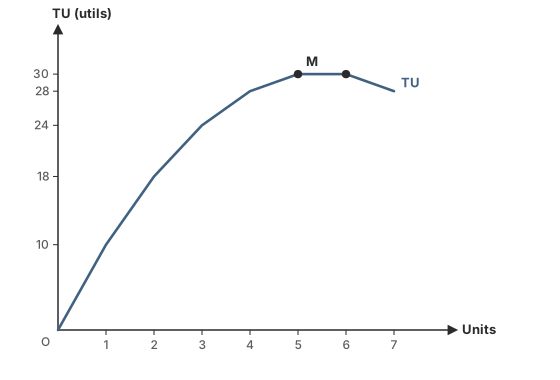
A consumer's TU from 1 to 7 units of ice cream is 10, 18, 24, 28, 30, 30, 28 utils. Find the MU of each unit.
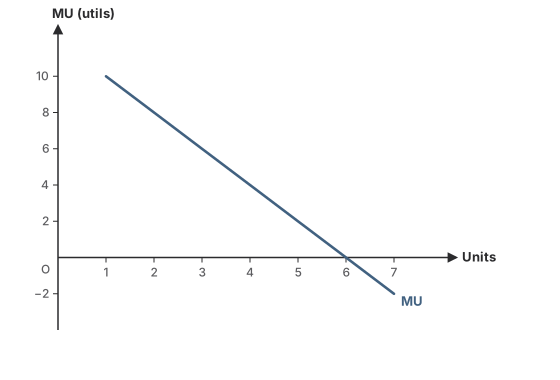
Subtract each TU from the next: 10, 8, 6, 4, 2, 0, −2.
TU is highest (30) where MU becomes 0, at the 6th unit; the 7th unit has negative MU and TU falls.
Answer MU = 10, 8, 6, 4, 2, 0, −2
MU falls with every unit, crosses zero at the point of saturation and then turns negative. MU is TU is Positive and falling Rising at a diminishing rate Zero At its maximum (saturation) Negative Falling
As a consumer takes more units of a good, the utility from each extra unit falls. The first glass of water to a thirsty person is worth far more than the third.
The law assumes the units are taken one after another without a long gap, are of the same size and quality, the consumer's tastes do not change, and he is rational. Break the "no long gap" assumption and the want returns, so MU need not fall.
TU does not fall just because MU falls. TU keeps rising as long as MU is positive.
When the last rupee spent on the good gives as much utility as a rupee kept.
When MU is measured in rupees this becomes simple: buy every unit whose MU (in ₹) is at least the price, and stop where MU = price.
Example 2 · How many units?
MU of good X in rupees for units 1 to 5: ₹30, ₹25, ₹20, ₹15, ₹10. The price is ₹15. How many units does he buy?
Units 1 to 3 are worth more than ₹15 to him; the 4th is worth exactly ₹15.
The 5th is worth only ₹10, less than its price.
Lower the price to ₹10 and he buys 5 units; raise it to ₹20 and he buys 3. The MU schedule in rupees is his demand schedule, which is why diminishing MU gives a downward-sloping demand curve.
With two goods, the consumer is in equilibrium when the MU per rupee is the same for both and the whole income is spent.
If MUₓ ÷ Pₓ is greater, a rupee moved from Y to X raises satisfaction; he buys more X (its MU falls) and less Y (its MU rises) until the ratios are equal.
Example 3 · Spending ₹20 on two goods
Pₓ = ₹4 and Pᵧ = ₹2. MU of X for units 1 to 5: 20, 16, 12, 8, 4. MU of Y: 12, 10, 8, 6, 4. Income is ₹20.
MU per rupee for X: 5, 4, 3, 2, 1. For Y: 6, 5, 4, 3, 2.
Both ratios are 3 at 3 units of X and 4 units of Y.
Spending: 3 × ₹4 + 4 × ₹2 = ₹20, the whole income.
Answer 3 units of X and 4 units of Y
It is utility per rupee that must be equal, not utility. Equal MUs are right only when the two prices are equal.
MU = 0 ⇒ TU at its maximum; MU negative ⇒ TU falls.
One good: buy until MU (in ₹) = price.
Two goods: equalise MU ÷ P, and spend the whole income.
Using TU instead of MU to decide the next purchase.
Comparing MUs directly when the prices differ.
Stopping where MU = 0 when the good has a price. That is where a free good would stop.
Utility
MU = change in TU from one more unit
TU = sum of MUs
MU = 0 at saturation, where TU peaks
Equilibrium
One good: MUₓ ÷ Pₓ = MUₘ
Two goods: MUₓ ÷ Pₓ = MUᵧ ÷ Pᵧ
Whole income spent
The same choice drawn with budget lines and indifference curves is in budget line and optimal choice .
Next · 08 Quick revision → Check your understanding 73 questions, grouped by type, easy to hard. Pick an answer and check it. The worked solution opens when you ask for it.
Total and marginal utility Q1 of 73 Q1
Total and marginal utility 26 questions Options for question 1 A Option A its usefulness for society B Option B its want-satisfying capacity C Option C its price D Option D its cost of production
Skip Check Show the explanation Hide the explanation Next question Try again
Show the explanation Hide the explanation Answer B · its want-satisfying capacity
In economics, utility is the power of a good to satisfy a want, whether or not the want is good for the person.
Worth noting
Utility is not the same as usefulness: a cigarette has utility for a smoker.
Options for question 2 A Option A the total utility divided by the number of units B Option B the utility from the first unit only C Option C the sum of utilities from all units D Option D the change in total utility from consuming one more unit
Skip Check Show the explanation Hide the explanation Next question Try again
Show the explanation Hide the explanation Answer D · the change in total utility from consuming one more unit
MUₙ = TUₙ − TUₙ₋₁: the extra utility the nth unit adds.
The sum of the utilities from all units is total utility.
Options for question 3 A Option A the sum of the marginal utilities of all units consumed B Option B the utility from the last unit consumed C Option C marginal utility multiplied by price D Option D the highest marginal utility
Skip Check Show the explanation Hide the explanation Next question Try again
Show the explanation Hide the explanation Answer A · the sum of the marginal utilities of all units consumed
TUₙ = MU₁ + MU₂ + … + MUₙ.
Worth noting
The utility from the last unit alone is marginal utility.
Utility is measured in cardinal analysis in
Options for question 4 A Option A rupees only B Option B ranks such as first and second C Option C utils D Option D kilograms
Skip Check Show the explanation Hide the explanation Next question Try again
Show the explanation Hide the explanation Answer C · utils
The cardinal approach assumes utility can be counted in units called utils.
Ranking without numbers is the ordinal approach, used with indifference curves.
Read the two statements and choose the correct option.
I. Utility is subjective: the same good can give different utility to different people.
II. Utility depends on the price of the good.
Options for question 5 A Option A Only I B Option B Only II C Option C Both I and II D Option D Neither I nor II
Skip Check Show the explanation Hide the explanation Next question Try again
Show the explanation Hide the explanation Answer A · Only I
I is true: utility depends on the person's want and how strong it is.
II is false: utility is a matter of satisfaction, not of the price paid.
The table shows a consumer's total utility from ice cream.
Units of ice cream 1 2 3 4 5 6 7 Total utility (utils) 10 18 24 28 30 30 28
What is the marginal utility of the 3rd unit?
Options for question 6 A Option A 6 utils B Option B 8 utils C Option C 10 utils D Option D 24 utils
Skip Check Show the explanation Hide the explanation Next question Try again
Show the explanation Hide the explanation Answer A · 6 utils
MU₃ = TU₃ − TU₂ = 24 − 18 = 6 utils.
Worth noting
24 is the total utility of 3 units, not the utility the 3rd unit adds.
The table shows a consumer's total utility from ice cream.
Units of ice cream 1 2 3 4 5 6 7 Total utility (utils) 10 18 24 28 30 30 28
What is the marginal utility of the 7th unit?
Options for question 7 A Option A −2 utils B Option B 0 utils C Option C 2 utils D Option D 28 utils
Skip Check Show the explanation Hide the explanation Next question Try again
Show the explanation Hide the explanation Answer A · −2 utils
MU₇ = TU₇ − TU₆ = 28 − 30 = −2 utils.
A negative MU means the 7th unit lowers satisfaction.
The table shows a consumer's total utility from ice cream.
Units of ice cream 1 2 3 4 5 6 7 Total utility (utils) 10 18 24 28 30 30 28
At which unit does marginal utility become zero, and what is total utility there?
Options for question 8 A Option A The 5th unit, where TU is 30 B Option B The 7th unit, where TU is 28 C Option C The 6th unit, where TU is at its maximum of 30 D Option D The 1st unit, where TU is 10
Skip Check Show the explanation Hide the explanation Next question Try again
Show the explanation Hide the explanation Answer C · The 6th unit, where TU is at its maximum of 30
MU₆ = TU₆ − TU₅ = 30 − 30 = 0: the 6th unit adds nothing.
TU is at its maximum where MU becomes zero; after that MU is negative and TU falls to 28.
Worth noting
TU is already 30 at 5 units, but the 5th unit's MU is 2, not 0.
The table shows a consumer's total utility from ice cream.
Units of ice cream 1 2 3 4 5 6 7 Total utility (utils) 10 18 24 28 30 30 28
What is the total utility of the first 4 units, and how is it found from marginal utilities?
Options for question 9 A Option A 4 utils, the MU of the 4th unit B Option B 28 utils = 10 + 8 + 6 + 4 C Option C 40 utils = 10 × 4 D Option D 24 utils = 10 + 8 + 6
Skip Check Show the explanation Hide the explanation Next question Try again
Show the explanation Hide the explanation Answer B · 28 utils = 10 + 8 + 6 + 4
The MUs of units 1 to 4 are 10, 8, 6 and 4.
TU₄ = 10 + 8 + 6 + 4 = 28 utils, matching the table.
When marginal utility is positive but falling, total utility
Options for question 10 A Option A rises at a diminishing rate B Option B falls C Option C is at its maximum D Option D rises at an increasing rate
Skip Check Show the explanation Hide the explanation Next question Try again
Show the explanation Hide the explanation Answer A · rises at a diminishing rate
Each extra unit still adds to TU because MU is positive.
But each adds less than the one before, so TU rises more and more slowly.
In the graph, between 5 and 6 units the TU curve is flat. This shows that
Options for question 11 A Option A the 6th unit adds the most utility B Option B MU is negative C Option C the consumer stops liking ice cream at once D Option D the 6th unit adds no utility: MU is zero
Skip Check Show the explanation Hide the explanation Next question Try again
Show the explanation Hide the explanation Answer D · the 6th unit adds no utility: MU is zero
TU stays at 30 utils from 5 to 6 units, so the 6th unit adds 30 − 30 = 0.
A flat TU curve means MU = 0: the point of saturation.
In the graph, the TU curve falls after 6 units because
Options for question 12 A Option A the marginal utility of the 7th unit is zero B Option B the price of ice cream has risen C Option C the marginal utility of the 7th unit is negative D Option D the consumer's income has fallen
Skip Check Show the explanation Hide the explanation Next question Try again
Show the explanation Hide the explanation Answer C · the marginal utility of the 7th unit is negative
TU falls from 30 to 28, so MU₇ = 28 − 30 = −2 utils.
Whenever MU is negative, TU declines.
In the graph, which unit's marginal utility is exactly zero?
Options for question 13 A Option A The 6th unit B Option B The 5th unit C Option C The 7th unit D Option D The 1st unit
Skip Check Show the explanation Hide the explanation Next question Try again
Show the explanation Hide the explanation Answer A · The 6th unit
The MU curve meets the zero line at 6 units.
At 5 units MU is still 2; at 7 units it is −2.
Read the two statements and choose the correct option.
I. When total utility is at its maximum, marginal utility is zero.
II. Marginal utility can never be negative.
Options for question 14 A Option A Only I B Option B Only II C Option C Both I and II D Option D Neither I nor II
Skip Check Show the explanation Hide the explanation Next question Try again
Show the explanation Hide the explanation Answer A · Only I
I is true: TU stops rising exactly when the extra unit adds nothing.
II is false: beyond saturation, an extra unit lowers TU, so MU is negative.
Assertion (A): Total utility rises as long as marginal utility is positive.
Reason (R): Total utility is the sum of the marginal utilities.
Options for question 15 A Option A Both A and R are true, and R is the correct explanation of A. B Option B Both A and R are true, but R is not the correct explanation of A. C Option C A is true, but R is false. D Option D A is false, but R is true.
Skip Check Show the explanation Hide the explanation Next question Try again
Show the explanation Hide the explanation Answer A · Both A and R are true, and R is the correct explanation of A.
Adding a positive number to a sum raises it, so A is true.
R is the reason: TU is built by adding each MU, so a positive MU raises it.
If total utility from 3 units is 45 utils and from 4 units is 52 utils, the marginal utility of the 4th unit is
Options for question 16 A Option A 7 utils B Option B 13 utils C Option C 52 utils D Option D 97 utils
Skip Check Show the explanation Hide the explanation Next question Try again
Show the explanation Hide the explanation Answer A · 7 utils
MU₄ = TU₄ − TU₃ = 52 − 45 = 7 utils.
The marginal utilities of the first three units of a good are 15, 12 and 9 utils. What is the total utility of 3 units?
Options for question 17 A Option A 9 utils B Option B 27 utils C Option C 36 utils D Option D 45 utils
Skip Check Show the explanation Hide the explanation Next question Try again
Show the explanation Hide the explanation Answer C · 36 utils
TU₃ = 15 + 12 + 9 = 36 utils.
Worth noting
27 adds only the last two; 45 multiplies the first MU by 3.
Assertion (A): When marginal utility is zero, total utility is zero.
Reason (R): Total utility is at its maximum when marginal utility is zero.
Options for question 18 A Option A Both A and R are true, and R is the correct explanation of A. B Option B Both A and R are true, but R is not the correct explanation of A. C Option C A is true, but R is false. D Option D A is false, but R is true.
Skip Check Show the explanation Hide the explanation Next question Try again
Show the explanation Hide the explanation Answer D · A is false, but R is true.
A is false: at zero MU, total utility is at its highest, not zero (for example, 30 utils for a consumer whose MU runs 10, 8, 6, 4, 2, 0).
R is true.
Assertion (A): Marginal utility can be negative.
Reason (R): Total utility can never fall.
Options for question 19 A Option A Both A and R are true, and R is the correct explanation of A. B Option B Both A and R are true, but R is not the correct explanation of A. C Option C A is true, but R is false. D Option D A is false, but R is true.
Skip Check Show the explanation Hide the explanation Next question Try again
Show the explanation Hide the explanation Answer C · A is true, but R is false.
A is true: consuming past saturation lowers satisfaction.
R is false: when MU is negative, TU falls.
Read the two statements and choose the correct option.
I. The TU curve rises from the origin as long as MU is positive.
II. The MU curve slopes downward under the law of diminishing marginal utility.
Options for question 20 A Option A Only I B Option B Only II C Option C Both I and II D Option D Neither I nor II
Skip Check Show the explanation Hide the explanation Next question Try again
Show the explanation Hide the explanation Answer C · Both I and II
I is true: positive MU means TU keeps rising.
II is true: each unit adds less, so the MU curve falls.
The table shows a consumer's total utility from ice cream.
Units of ice cream 1 2 3 4 5 6 7 Total utility (utils) 10 18 24 28 30 30 28
Between which units does total utility rise by the most?
Options for question 21 A Option A From 1 to 2 units B Option B From 4 to 5 units C Option C From 0 to 1 unit D Option D From 5 to 6 units
Skip Check Show the explanation Hide the explanation Next question Try again
Show the explanation Hide the explanation Answer C · From 0 to 1 unit
The rise in TU from one unit to the next is the MU: 10, 8, 6, 4, 2, 0, −2.
The largest is 10 utils, for the 1st unit.
The table shows a consumer's total utility from ice cream.
Units of ice cream 1 2 3 4 5 6 7 Total utility (utils) 10 18 24 28 30 30 28
How many units should the consumer take if the ice cream were free?
Options for question 22 A Option A 6 units, where total utility is at its maximum B Option B 7 units, all of them C Option C 1 unit, the most satisfying D Option D 3 units, half way
Skip Check Show the explanation Hide the explanation Next question Try again
Show the explanation Hide the explanation Answer A · 6 units, where total utility is at its maximum
With no price, the only question is satisfaction: he takes units until MU reaches 0.
MU is 0 at the 6th unit (TU 30); the 7th would cut TU to 28.
In the graph, what is the total utility of 5 units?
Options for question 23 A Option A 2 utils B Option B 28 utils C Option C 30 utils D Option D 50 utils
Skip Check Show the explanation Hide the explanation Next question Try again
Show the explanation Hide the explanation Answer C · 30 utils
Read the MU of each of the first 5 units: 10, 8, 6, 4, 2.
TU = 10 + 8 + 6 + 4 + 2 = 30 utils.
Worth noting
2 is the MU of the 5th unit alone; 50 multiplies the first MU by 5.
A consumer's total utility from 5 units of a good is 40 utils, and the 6th unit has a marginal utility of −3 utils. What is the total utility from 6 units?
Options for question 24 A Option A −3 utils B Option B 37 utils C Option C 40 utils D Option D 43 utils
Skip Check Show the explanation Hide the explanation Next question Try again
Show the explanation Hide the explanation Answer B · 37 utils
TU₆ = TU₅ + MU₆ = 40 + (−3) = 37 utils.
A negative MU pulls total utility down.
Assertion (A): Total utility can rise even when marginal utility is falling.
Reason (R): Marginal utility is the slope of the total utility curve.
Options for question 25 A Option A Both A and R are true, and R is the correct explanation of A. B Option B Both A and R are true, but R is not the correct explanation of A. C Option C A is true, but R is false. D Option D A is false, but R is true.
Skip Check Show the explanation Hide the explanation Next question Try again
Show the explanation Hide the explanation Answer B · Both A and R are true, but R is not the correct explanation of A.
A is true: while MU stays positive, each unit still adds to TU.
R is true too, but it does not explain A; the reason for A is that MU is still above zero.
Read the two statements and choose the correct option.
I. Total utility from 0 units is the same as the marginal utility of the 1st unit.
II. Total utility from 1 unit is the same as the marginal utility of the 1st unit.
Options for question 26 A Option A Only I B Option B Only II C Option C Both I and II D Option D Neither I nor II
Skip Check Show the explanation Hide the explanation Next question Try again
Show the explanation Hide the explanation Answer B · Only II
I is false: TU from no units is zero.
II is true: MU₁ = TU₁ − TU₀ = TU₁ − 0 = TU₁.
Diminishing marginal utility 13 questions The law of diminishing marginal utility says that
Options for question 27 A Option A total utility always falls as more is consumed B Option B as more units of a good are consumed, the utility from each extra unit falls C Option C the price of a good falls as more is bought D Option D marginal utility stays the same for every unit
Skip Check Show the explanation Hide the explanation Next question Try again
Show the explanation Hide the explanation Answer B · as more units of a good are consumed, the utility from each extra unit falls
Each successive unit satisfies a want that is already partly met, so it adds less.
TU keeps rising while MU is positive; it is MU that diminishes.
Worth noting
Total utility falls only after MU turns negative, not as soon as MU falls.
Which curve slopes downward because of the law of diminishing marginal utility?
Options for question 28 A Option A The total utility curve B Option B The marginal utility curve C Option C The supply curve D Option D The production possibility curve
Skip Check Show the explanation Hide the explanation Next question Try again
Show the explanation Hide the explanation Answer B · The marginal utility curve
Diminishing MU means each unit's MU is below the one before: a falling MU curve.
The TU curve still rises until saturation.
The law of diminishing marginal utility assumes that
Options for question 29 A Option A the consumer's tastes change between units B Option B each unit is bigger than the one before C Option C the good is consumed once a year D Option D the units are consumed one after another without a long gap, and are of the same size and quality
Skip Check Show the explanation Hide the explanation Next question Try again
Show the explanation Hide the explanation Answer D · the units are consumed one after another without a long gap, and are of the same size and quality
If there were a long gap, the want would return and MU would not fall.
If units differed in size or quality, the comparison would not be fair.
Which of these is an example of diminishing marginal utility?
Options for question 30 A Option A A thirsty person enjoys the first glass of water more than the third B Option B A person enjoys every glass of water equally C Option C A person drinks more water as its price rises D Option D A person stops drinking water for a week
Skip Check Show the explanation Hide the explanation Next question Try again
Show the explanation Hide the explanation Answer A · A thirsty person enjoys the first glass of water more than the third
The first glass meets the strongest thirst; each later glass adds less satisfaction.
Assertion (A): The marginal utility of a good falls as more of it is consumed.
Reason (R): A particular want can be fully satisfied.
Options for question 31 A Option A Both A and R are true, and R is the correct explanation of A. B Option B Both A and R are true, but R is not the correct explanation of A. C Option C A is true, but R is false. D Option D A is false, but R is true.
Skip Check Show the explanation Hide the explanation Next question Try again
Show the explanation Hide the explanation Answer A · Both A and R are true, and R is the correct explanation of A.
A is the law of diminishing marginal utility, which holds under its assumptions.
R is the basis of the law: as a want gets more and more satisfied, extra units matter less, so R explains A.
Read the two statements and choose the correct option.
I. The law of diminishing marginal utility explains why a demand curve slopes downward.
II. The law of diminishing marginal utility applies to money as well, in cardinal analysis.
Options for question 32 A Option A Only I B Option B Only II C Option C Both I and II D Option D Neither I nor II
Skip Check Show the explanation Hide the explanation Next question Try again
Show the explanation Hide the explanation Answer A · Only I
I is true: because each extra unit is worth less, a consumer buys more only at a lower price.
II is false: cardinal analysis assumes the marginal utility of money stays constant.
Which of these is an exception people often give to the law of diminishing marginal utility?
Options for question 33 A Option A A hungry person eating chapatis one after another B Option B A thirsty person drinking glasses of water C Option C A child eating sweets one after another D Option D A collector who wants each new stamp more as the collection nears completion
Skip Check Show the explanation Hide the explanation Next question Try again
Show the explanation Hide the explanation Answer D · A collector who wants each new stamp more as the collection nears completion
For a collector, the stamp that completes a set can matter more than the earlier ones.
The other three are textbook cases where each extra unit adds less.
Assertion (A): The law of diminishing marginal utility applies even if the units are consumed a week apart.
Reason (R): The law assumes continuous consumption.
Options for question 34 A Option A Both A and R are true, and R is the correct explanation of A. B Option B Both A and R are true, but R is not the correct explanation of A. C Option C A is true, but R is false. D Option D A is false, but R is true.
Skip Check Show the explanation Hide the explanation Next question Try again
Show the explanation Hide the explanation Answer D · A is false, but R is true.
A is false: with a week's gap the want returns, so the law need not hold.
R is true and is the assumption that A breaks.
Read the two statements and choose the correct option.
I. The law of diminishing marginal utility assumes that the consumer's tastes do not change.
II. The law of diminishing marginal utility assumes that the consumer is rational.
Options for question 35 A Option A Only I B Option B Only II C Option C Both I and II D Option D Neither I nor II
Skip Check Show the explanation Hide the explanation Next question Try again
Show the explanation Hide the explanation Answer C · Both I and II
Both are standard assumptions of the law.
A change in tastes or irrational behaviour would break the steady fall in MU.
A consumer gets 50, 40, 30 and 20 utils from the 1st to 4th cups of tea. If the units were consumed with a gap of a full day between them, the most likely change is that
Options for question 36 A Option A marginal utility would fall faster B Option B total utility would become negative C Option C the price of tea would fall D Option D marginal utility would not fall in this way, because an assumption of the law is broken
Skip Check Show the explanation Hide the explanation Next question Try again
Show the explanation Hide the explanation Answer D · marginal utility would not fall in this way, because an assumption of the law is broken
The law assumes continuous consumption. After a day, the desire for tea returns.
So each day's cup can give about as much satisfaction as the first.
The marginal utility of a good falls by 5 utils with each unit, and the 1st unit gives 25 utils. Which unit has a marginal utility of zero?
Options for question 37 A Option A The 5th unit B Option B The 25th unit C Option C The 6th unit D Option D The 4th unit
Skip Check Show the explanation Hide the explanation Next question Try again
Show the explanation Hide the explanation Answer C · The 6th unit
MU runs 25, 20, 15, 10, 5, 0 for units 1 to 6.
So the 6th unit adds nothing: that is where TU is at its maximum.
Assertion (A): The law of diminishing marginal utility is the basis of the law of demand.
Reason (R): A consumer buys more of a good only when its price falls, because each extra unit is worth less to him.
Options for question 38 A Option A Both A and R are true, and R is the correct explanation of A. B Option B Both A and R are true, but R is not the correct explanation of A. C Option C A is true, but R is false. D Option D A is false, but R is true.
Skip Check Show the explanation Hide the explanation Next question Try again
Show the explanation Hide the explanation Answer A · Both A and R are true, and R is the correct explanation of A.
Both are true.
R spells out how diminishing MU leads to a downward-sloping demand curve, so it explains A.
Read the two statements and choose the correct option.
I. Under the law of diminishing marginal utility, total utility must eventually become negative.
II. Under the law of diminishing marginal utility, marginal utility can become zero.
Options for question 39 A Option A Only I B Option B Only II C Option C Both I and II D Option D Neither I nor II
Skip Check Show the explanation Hide the explanation Next question Try again
Show the explanation Hide the explanation Answer B · Only II
I is false: TU falls after saturation but stays positive for a long while; nothing forces it below zero.
II is true: MU reaches zero at the point of saturation.
Equilibrium with one good 16 questions A consumer is in equilibrium when he
Options for question 40 A Option A spends his whole income on one good B Option B gets the most satisfaction from his income, and has no reason to change his purchases C Option C buys the cheapest good D Option D saves all his income
Skip Check Show the explanation Hide the explanation Next question Try again
Show the explanation Hide the explanation Answer B · gets the most satisfaction from his income, and has no reason to change his purchases
Equilibrium is a position of rest: satisfaction is as high as the income and prices allow.
With one good X, a consumer is in equilibrium where
Options for question 41 A Option A MUₓ = 0 B Option B TUₓ is at its maximum C Option C MUₓ ÷ Pₓ = MUₘ, the marginal utility of a rupee D Option D Pₓ = 0
Skip Check Show the explanation Hide the explanation Next question Try again
Show the explanation Hide the explanation Answer C · MUₓ ÷ Pₓ = MUₘ, the marginal utility of a rupee
The last rupee spent on X must give as much utility as a rupee kept: MUₓ ÷ Pₓ = MUₘ.
With MU in rupees, this becomes MU of the last unit = its price.
Worth noting
TU is at its maximum only when the good is free; with a price, the consumer stops earlier.
A consumer's marginal utility from good X, measured in rupees, is:
Unit of good X 1 2 3 4 5 MU (in ₹) 30 25 20 15 10
If the price of X is ₹15, how many units will he buy?
Options for question 42 A Option A 2 units B Option B 3 units C Option C 4 units D Option D 5 units
Skip Check Show the explanation Hide the explanation Next question Try again
Show the explanation Hide the explanation Answer C · 4 units
He buys a unit as long as its MU (in ₹) is at least the price.
The 4th unit's MU is ₹15 = price; the 5th gives only ₹10 < ₹15. So he buys 4.
A consumer's marginal utility from good X, measured in rupees, is:
Unit of good X 1 2 3 4 5 MU (in ₹) 30 25 20 15 10
If the price of X falls from ₹20 to ₹10, how does the quantity bought change?
Options for question 43 A Option A It rises from 2 to 4 units B Option B It falls from 5 to 3 units C Option C It rises from 3 to 5 units D Option D It does not change
Skip Check Show the explanation Hide the explanation Next question Try again
Show the explanation Hide the explanation Answer C · It rises from 3 to 5 units
At ₹20 he stops where MU = 20: the 3rd unit.
At ₹10 he goes on to the 5th unit, where MU = 10. A lower price, a larger quantity: the law of demand.
Assertion (A): A consumer buying one good stops where the MU of the last unit, in rupees, equals its price.
Reason (R): Beyond that point, each extra unit would give less utility than the money paid for it.
Options for question 44 A Option A Both A and R are true, and R is the correct explanation of A. B Option B Both A and R are true, but R is not the correct explanation of A. C Option C A is true, but R is false. D Option D A is false, but R is true.
Skip Check Show the explanation Hide the explanation Next question Try again
Show the explanation Hide the explanation Answer A · Both A and R are true, and R is the correct explanation of A.
Both are true.
Because MU diminishes, an extra unit past that point is worth less than its price, which is why he stops: R explains A.
In the cardinal approach, the marginal utility of money is assumed to be
Options for question 45 A Option A zero B Option B diminishing C Option C increasing D Option D constant
Skip Check Show the explanation Hide the explanation Next question Try again
Show the explanation Hide the explanation Answer D · constant
Money is the measuring rod of utility, so its own utility per rupee is assumed not to change.
A consumer buys a good where its marginal utility in rupees is ₹12 and its price is ₹10. He should
Options for question 46 A Option A buy less of the good B Option B stop buying the good C Option C keep buying the same amount D Option D buy more of the good
Skip Check Show the explanation Hide the explanation Next question Try again
Show the explanation Hide the explanation Answer D · buy more of the good
The last unit is worth ₹12 to him but costs only ₹10, so another unit is still a gain.
He goes on until MU falls to ₹10, the price.
Assertion (A): If MU in rupees is less than the price, the consumer should buy less of the good.
Reason (R): Buying less raises the marginal utility of the last unit bought.
Options for question 47 A Option A Both A and R are true, and R is the correct explanation of A. B Option B Both A and R are true, but R is not the correct explanation of A. C Option C A is true, but R is false. D Option D A is false, but R is true.
Skip Check Show the explanation Hide the explanation Next question Try again
Show the explanation Hide the explanation Answer A · Both A and R are true, and R is the correct explanation of A.
A is true: the last unit is worth less than it costs.
R is true and explains how cutting back restores MU = price: with fewer units, the last one has a higher MU.
Read the two statements and choose the correct option.
I. A rise in the price of a good lowers the quantity a consumer buys in one-good equilibrium.
II. A rise in the price of a good raises the marginal utility of each unit.
Options for question 48 A Option A Only I B Option B Only II C Option C Both I and II D Option D Neither I nor II
Skip Check Show the explanation Hide the explanation Next question Try again
Show the explanation Hide the explanation Answer A · Only I
I is true: with a higher price he stops at an earlier unit, where MU is higher.
II is false: price does not change the utility a unit gives.
A consumer's marginal utility from good X, measured in rupees, is:
Unit of good X 1 2 3 4 5 MU (in ₹) 30 25 20 15 10
If the price of X is ₹25, how much will he spend on X?
Options for question 49 A Option A ₹25 B Option B ₹50 C Option C ₹55 D Option D ₹75
Skip Check Show the explanation Hide the explanation Next question Try again
Show the explanation Hide the explanation Answer B · ₹50
At ₹25 he buys up to the unit whose MU is ₹25: the 2nd unit.
Spending = 2 × ₹25 = ₹50.
Worth noting
₹55 adds the MUs of 2 units; spending is quantity times price.
A consumer pays ₹8 for a good. The MU of his last unit, in rupees, is ₹8. What should he do?
Options for question 50 A Option A Keep buying the same quantity: he is in equilibrium B Option B Buy one more unit C Option C Buy one unit less D Option D Stop buying the good
Skip Check Show the explanation Hide the explanation Next question Try again
Show the explanation Hide the explanation Answer A · Keep buying the same quantity: he is in equilibrium
MU in rupees = price is the one-good equilibrium condition.
Any change would lower his net satisfaction.
A consumer's marginal utility from good X, measured in rupees, is:
Unit of good X 1 2 3 4 5 MU (in ₹) 30 25 20 15 10
At a price of ₹20, how much more is the consumer willing to pay for the 3 units than he actually pays?
Options for question 51 A Option A ₹0 B Option B ₹15 C Option C ₹60 D Option D ₹75
Skip Check Show the explanation Hide the explanation Next question Try again
Show the explanation Hide the explanation Answer B · ₹15
Willing to pay for 3 units = 30 + 25 + 20 = ₹75.
Actually pays 3 × ₹20 = ₹60. The difference is ₹75 − ₹60 = ₹15.
Worth noting
This gap is called consumer's surplus; it is a step beyond the CUET list, worked here only as arithmetic.
A consumer is buying good X where MUₓ ÷ Pₓ is greater than MUₘ. To reach equilibrium, he should
Options for question 52 A Option A buy less of X B Option B buy more of X, which lowers MUₓ until the two are equal C Option C stop buying X D Option D keep his purchases as they are
Skip Check Show the explanation Hide the explanation Next question Try again
Show the explanation Hide the explanation Answer B · buy more of X, which lowers MUₓ until the two are equal
A rupee spent on X now gives more utility than a rupee kept, so spending more on X raises satisfaction.
As he buys more, MUₓ falls (diminishing MU) until MUₓ ÷ Pₓ = MUₘ.
For a good with MU in utils, MUₓ = 24 utils, Pₓ = ₹6 and MUₘ = 4 utils. Is the consumer in equilibrium?
Options for question 53 A Option A No, because MUₓ is greater than Pₓ B Option B Yes, because MUₓ ÷ Pₓ = 24 ÷ 6 = 4 = MUₘ C Option C No, because MUₓ ÷ Pₓ is 6 D Option D No, because MUₘ should be zero
Skip Check Show the explanation Hide the explanation Next question Try again
Show the explanation Hide the explanation Answer B · Yes, because MUₓ ÷ Pₓ = 24 ÷ 6 = 4 = MUₘ
Utility per rupee from X = 24 ÷ 6 = 4 utils.
That equals the utility of a rupee kept, so the condition MUₓ ÷ Pₓ = MUₘ holds.
Worth noting
Comparing 24 utils with ₹6 directly mixes units; divide by price first.
Assertion (A): A consumer in equilibrium with one good gets the maximum possible total utility from that good.
Reason (R): At the one-good equilibrium, MU in rupees equals the price.
Options for question 54 A Option A Both A and R are true, and R is the correct explanation of A. B Option B Both A and R are true, but R is not the correct explanation of A. C Option C A is true, but R is false. D Option D A is false, but R is true.
Skip Check Show the explanation Hide the explanation Next question Try again
Show the explanation Hide the explanation Answer D · A is false, but R is true.
A is false: TU would be highest at MU = 0, but the consumer stops earlier, where MU = price, because money has other uses.
R is true.
A consumer's marginal utility from good X, measured in rupees, is:
Unit of good X 1 2 3 4 5 MU (in ₹) 30 25 20 15 10
Which price–quantity pairs from this table lie on his demand curve for X?
Options for question 55 A Option A ₹30 → 5, ₹25 → 4, ₹20 → 3, ₹15 → 2, ₹10 → 1 B Option B ₹20 → 1 to 5, at every price C Option C ₹100 → 5 D Option D ₹30 → 1, ₹25 → 2, ₹20 → 3, ₹15 → 4, ₹10 → 5
Skip Check Show the explanation Hide the explanation Next question Try again
Show the explanation Hide the explanation Answer D · ₹30 → 1, ₹25 → 2, ₹20 → 3, ₹15 → 4, ₹10 → 5
At each price he buys up to the unit whose MU equals that price.
So the MU schedule in rupees is his demand schedule: higher price, fewer units.
Equilibrium with two goods 18 questions The law of equi-marginal utility says that a consumer buying two goods is in equilibrium when
Options for question 56 A Option A the marginal utility per rupee is the same for both goods B Option B the marginal utility of both goods is the same C Option C the prices of both goods are the same D Option D he buys equal quantities of both goods
Skip Check Show the explanation Hide the explanation Next question Try again
Show the explanation Hide the explanation Answer A · the marginal utility per rupee is the same for both goods
Condition: MUₓ ÷ Pₓ = MUᵧ ÷ Pᵧ = MUₘ, with the whole income spent.
It is the utility per rupee that must be equal, not the utility itself.
Worth noting
Equal MUs would be right only if the two prices were equal.
The price of X is ₹4 and the price of Y is ₹2. A consumer's marginal utilities are:
Units 1 2 3 4 5 MU of X (utils) 20 16 12 8 4 MU of Y (utils) 12 10 8 6 4
With an income of ₹20, which combination puts the consumer in equilibrium?
Options for question 57 A Option A 2 units of X and 3 units of Y B Option B 4 units of X and 2 units of Y C Option C 5 units of X and 0 units of Y D Option D 3 units of X and 4 units of Y
Skip Check Show the explanation Hide the explanation Next question Try again
Show the explanation Hide the explanation Answer D · 3 units of X and 4 units of Y
MU per rupee for X: 20/4, 16/4, 12/4, … = 5, 4, 3, 2, 1. For Y: 12/2, 10/2, 8/2, … = 6, 5, 4, 3, 2.
At 3 X and 4 Y both ratios are 3, and spending = 3 × ₹4 + 4 × ₹2 = ₹20, the whole income.
Worth noting
2 X and 3 Y also equalise the ratios (at 4) but spend only ₹14, leaving income unspent.
The price of X is ₹4 and the price of Y is ₹2. A consumer's marginal utilities are:
Units 1 2 3 4 5 MU of X (utils) 20 16 12 8 4 MU of Y (utils) 12 10 8 6 4
With an income of ₹14, what is the equilibrium combination?
Options for question 58 A Option A 2 units of X and 3 units of Y B Option B 3 units of X and 4 units of Y C Option C 1 unit of X and 5 units of Y D Option D 3 units of X and 1 unit of Y
Skip Check Show the explanation Hide the explanation Next question Try again
Show the explanation Hide the explanation Answer A · 2 units of X and 3 units of Y
At 2 X the ratio is 16/4 = 4; at 3 Y it is 8/2 = 4. The ratios are equal.
Spending = 2 × ₹4 + 3 × ₹2 = ₹14, the whole income.
The price of X is ₹4 and the price of Y is ₹2. A consumer's marginal utilities are:
Units 1 2 3 4 5 MU of X (utils) 20 16 12 8 4 MU of Y (utils) 12 10 8 6 4
The consumer has bought 1 unit of X and has income left for one more unit of either good. Which should it be?
Options for question 59 A Option A The 2nd unit of X, which gives 16 utils against 12 for Y B Option B Either, because both give the same utility C Option C The 1st unit of Y, which gives 6 utils per rupee against 4 for the 2nd unit of X D Option D Neither, because MU is falling
Skip Check Show the explanation Hide the explanation Next question Try again
Show the explanation Hide the explanation Answer C · The 1st unit of Y, which gives 6 utils per rupee against 4 for the 2nd unit of X
Compare utility per rupee, not utility: the 2nd X gives 16 ÷ 4 = 4; the 1st Y gives 12 ÷ 2 = 6.
Each rupee buys more satisfaction in Y, so Y comes first.
Worth noting
Judging by 16 against 12 ignores that X costs twice as much.
A consumer finds that MUₓ ÷ Pₓ is greater than MUᵧ ÷ Pᵧ. To raise his satisfaction he should
Options for question 60 A Option A spend more on Y and less on X B Option B spend more on X and less on Y C Option C spend equal amounts on both D Option D stop buying both
Skip Check Show the explanation Hide the explanation Next question Try again
Show the explanation Hide the explanation Answer B · spend more on X and less on Y
A rupee moved from Y to X gains more utility than it loses.
As he buys more X its MU falls, and as he buys less Y its MU rises, until the two ratios are equal.
Assertion (A): A consumer may buy more units of a cheaper good even if the costlier good gives higher utility per unit.
Reason (R): The consumer compares marginal utility per rupee, not marginal utility alone.
Options for question 61 A Option A Both A and R are true, and R is the correct explanation of A. B Option B Both A and R are true, but R is not the correct explanation of A. C Option C A is true, but R is false. D Option D A is false, but R is true.
Skip Check Show the explanation Hide the explanation Next question Try again
Show the explanation Hide the explanation Answer A · Both A and R are true, and R is the correct explanation of A.
Both are true.
Because what matters is utility per rupee, a cheap good with lower MU can still be the better buy: R explains A.
Match each term with its meaning.
List I List II A. Total utility I. Where MU becomes zero B. Marginal utility II. Sum of satisfaction from all units C. Point of saturation III. MU per rupee equal across goods D. Equi-marginal condition IV. Addition to TU from one more unit
Options for question 62 A Option A A-II, B-IV, C-I, D-III B Option B A-I, B-II, C-III, D-IV C Option C A-II, B-I, C-IV, D-III D Option D A-III, B-IV, C-I, D-II
Skip Check Show the explanation Hide the explanation Next question Try again
Show the explanation Hide the explanation Answer A · A-II, B-IV, C-I, D-III
TU adds up all units; MU is the addition from one more.
Saturation is where MU reaches zero and TU peaks; the equi-marginal condition equalises MU per rupee.
Assertion (A): The law of equi-marginal utility is also called the law of maximum satisfaction.
Reason (R): Spending so that MU per rupee is equal across goods gives the most total satisfaction from a given income.
Options for question 63 A Option A Both A and R are true, and R is the correct explanation of A. B Option B Both A and R are true, but R is not the correct explanation of A. C Option C A is true, but R is false. D Option D A is false, but R is true.
Skip Check Show the explanation Hide the explanation Next question Try again
Show the explanation Hide the explanation Answer A · Both A and R are true, and R is the correct explanation of A.
Both are true.
R states why the law earns that name, so R explains A.
Assertion (A): If MUₓ ÷ Pₓ = MUᵧ ÷ Pᵧ but some income is left unspent, the consumer is in equilibrium.
Reason (R): Equilibrium also requires the whole income to be spent.
Options for question 64 A Option A Both A and R are true, and R is the correct explanation of A. B Option B Both A and R are true, but R is not the correct explanation of A. C Option C A is true, but R is false. D Option D A is false, but R is true.
Skip Check Show the explanation Hide the explanation Next question Try again
Show the explanation Hide the explanation Answer D · A is false, but R is true.
A is false: with income left, buying more of both raises satisfaction.
R is true and is the condition A ignores.
Read the two statements and choose the correct option.
I. If Pₓ = ₹5, Pᵧ = ₹10 and MUₓ = 20, then at equilibrium MUᵧ = 40.
II. If Pₓ = ₹5, Pᵧ = ₹10 and MUₓ = 20, then at equilibrium MUₘ = 4.
Options for question 65 A Option A Only I B Option B Only II C Option C Both I and II D Option D Neither I nor II
Skip Check Show the explanation Hide the explanation Next question Try again
Show the explanation Hide the explanation Answer C · Both I and II
MUₓ ÷ Pₓ = 20 ÷ 5 = 4, so MUₘ = 4 and II is true.
MUᵧ ÷ 10 must also be 4, so MUᵧ = 40 and I is true.
Pₓ = ₹2 and Pᵧ = ₹3. At a consumer's current purchases MUₓ = 10 and MUᵧ = 12. Is he in equilibrium?
Options for question 66 A Option A No: Y gives more utility, so he should buy more Y B Option B Yes: both goods have positive MU C Option C No: X gives 5 utils per rupee and Y gives 4, so he should buy more X D Option D Yes: MUᵧ is greater than MUₓ
Skip Check Show the explanation Hide the explanation Next question Try again
Show the explanation Hide the explanation Answer C · No: X gives 5 utils per rupee and Y gives 4, so he should buy more X
MUₓ ÷ Pₓ = 10 ÷ 2 = 5; MUᵧ ÷ Pᵧ = 12 ÷ 3 = 4.
The ratios are unequal and X's is higher, so shifting spending from Y to X raises satisfaction.
Worth noting
Y's higher MU (12) is misleading because Y costs more.
The price of X is ₹4 and the price of Y is ₹2. A consumer's marginal utilities are:
Units 1 2 3 4 5 MU of X (utils) 20 16 12 8 4 MU of Y (utils) 12 10 8 6 4
With an income of ₹26, what is the marginal utility of a rupee at the equilibrium?
Options for question 67 A Option A 2 utils B Option B 3 utils C Option C 4 utils D Option D 8 utils
Skip Check Show the explanation Hide the explanation Next question Try again
Show the explanation Hide the explanation Answer A · 2 utils
₹26 buys 4 X and 5 Y: 4 × ₹4 + 5 × ₹2 = ₹26.
There MUₓ ÷ Pₓ = 8 ÷ 4 = 2 and MUᵧ ÷ Pᵧ = 4 ÷ 2 = 2, so MUₘ = 2 utils.
Worth noting
8 is the MU of the 4th unit of X in utils, before dividing by its price.
A consumer is in equilibrium with two goods. The price of X now rises. What happens first?
Options for question 68 A Option A MUₓ ÷ Pₓ rises, so he buys more of X B Option B MUₓ ÷ Pₓ falls below MUᵧ ÷ Pᵧ, so he buys less of X C Option C Nothing changes, because MU does not depend on price D Option D He buys less of Y
Skip Check Show the explanation Hide the explanation Next question Try again
Show the explanation Hide the explanation Answer B · MUₓ ÷ Pₓ falls below MUᵧ ÷ Pᵧ, so he buys less of X
A higher Pₓ lowers the utility per rupee from X.
X is now a worse use of money than Y, so he cuts his purchase of X: the law of demand.
Read the two statements and choose the correct option.
I. At the consumer's equilibrium, the whole income is spent.
II. At the consumer's equilibrium, the marginal utilities of the two goods are equal.
Options for question 69 A Option A Only I B Option B Only II C Option C Both I and II D Option D Neither I nor II
Skip Check Show the explanation Hide the explanation Next question Try again
Show the explanation Hide the explanation Answer A · Only I
I is true: the equal-ratio condition is applied together with the whole income being spent.
II is false in general: MU per rupee is equal; MUs themselves are equal only if prices are equal.
Assertion (A): At equilibrium with two goods, the consumer buys equal quantities of both.
Reason (R): At equilibrium, MU per rupee is equal for both goods.
Options for question 70 A Option A Both A and R are true, and R is the correct explanation of A. B Option B Both A and R are true, but R is not the correct explanation of A. C Option C A is true, but R is false. D Option D A is false, but R is true.
Skip Check Show the explanation Hide the explanation Next question Try again
Show the explanation Hide the explanation Answer D · A is false, but R is true.
A is false: with Pₓ = ₹4 and Pᵧ = ₹2, a consumer can well be in equilibrium buying 3 X and 4 Y, unequal quantities.
R is the true condition.
Read the two statements and choose the correct option.
I. A fall in the price of X, with everything else unchanged, makes a consumer in equilibrium buy more of X.
II. A fall in the price of X lowers MUₓ ÷ Pₓ.
Options for question 71 A Option A Only I B Option B Only II C Option C Both I and II D Option D Neither I nor II
Skip Check Show the explanation Hide the explanation Next question Try again
Show the explanation Hide the explanation Answer A · Only I
I is true: X now gives more utility per rupee, so he shifts spending towards it.
II is false: a lower Pₓ raises MUₓ ÷ Pₓ.
The price of X is ₹4 and the price of Y has risen to ₹4. A consumer's marginal utilities are:
Units 1 2 3 4 5 MU of X (utils) 20 16 12 8 4 MU of Y (utils) 12 10 8 6 4
With an income of ₹16, what is the equilibrium combination?
Options for question 72 A Option A 2 units of X and 2 units of Y B Option B 3 units of X and 1 unit of Y C Option C 1 unit of X and 3 units of Y D Option D 4 units of X and 0 units of Y
Skip Check Show the explanation Hide the explanation Next question Try again
Show the explanation Hide the explanation Answer B · 3 units of X and 1 unit of Y
With both prices at ₹4, X's ratios are 5, 4, 3, 2, 1 and Y's are 3, 2.5, 2, 1.5, 1.
At 3 X and 1 Y both ratios are 3, and spending = 3 × ₹4 + 1 × ₹4 = ₹16.
Worth noting
Equal quantities (2 and 2) spend ₹16 too, but leave X at 4 utils per rupee against Y's 2.5.
Pₓ = ₹4 and Pᵧ = ₹2. For units 1 to 5, the MU of X is 20, 16, 12, 8, 4 and the MU of Y is 12, 10, 8, 6, 4 utils. Match each income with its equilibrium combination.
List I List II A. ₹8 I. 2 X and 3 Y B. ₹14 II. 4 X and 5 Y C. ₹20 III. 1 X and 2 Y D. ₹26 IV. 3 X and 4 Y
Options for question 73 A Option A A-III, B-IV, C-I, D-II B Option B A-II, B-I, C-IV, D-III C Option C A-III, B-I, C-IV, D-II D Option D A-I, B-II, C-III, D-IV
Skip Check Show the explanation Hide the explanation Back to start Try again
Show the explanation Hide the explanation Answer C · A-III, B-I, C-IV, D-II
Equal ratios at 5: 1 X, 2 Y costs ₹4 + ₹4 = ₹8. At 4: 2 X, 3 Y costs ₹14.
At 3: 3 X, 4 Y costs ₹20. At 2: 4 X, 5 Y costs ₹26.
Question types · easy to hard
NTA's Economics syllabus is three courses: Introductory Microeconomics, Introductory Macroeconomics and Indian Economic Development, each split into units with a list of topics. It prints no chapters and no split of the 50 questions across the courses. So the areas here are NTA's three courses, and the chapters inside them are ours: a unit that covers several ideas, such as consumer behaviour and demand, is split into a chapter for each, so that a chapter can be practised in one sitting. All three courses are here.