On this page · 8 sections 01 The core idea 02 Equilibrium price 03 Shifts in equilibrium 04 Price ceiling and price floor 05 Exam shortcuts 06 Common mistakes 07 Quick revision 08 Check your understanding The market price settles where the quantity buyers want equals the quantity sellers offer. At any other price there is a gap, and the gap itself pushes the price back. Questions here are mostly of three kinds: solve for the equilibrium, say which way it moves after a shift, and work out the shortage or surplus a price control creates.
Set quantity demanded equal to quantity supplied.
Example 1 · Solving a market
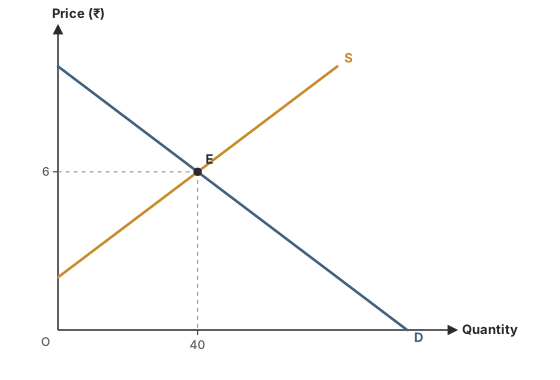
Qd = 100 − 10P and Qs = 10P − 20. Find the equilibrium price and quantity.
100 − 10P = 10P − 20, so 20P = 120 and P = ₹6.
Q = 100 − 60 = 40 (check: 60 − 20 = 40).
E is the only price at which nothing is left over and no buyer goes short. Price Situation What happens Below equilibrium Excess demand (shortage) Buyers bid the price up Above equilibrium Excess supply (surplus) Sellers cut the price
As the price moves back, quantity demanded and supplied move along their curves until the gap closes.
Supernormal profit draws firms in and losses drive them out, so in the long run the price settles at minimum AC . Quantity sold is read from demand at that price, and the number of firms is that quantity divided by each firm's output at minimum AC.
Change Price Quantity Demand increases Up Up Demand decreases Down Down Supply increases Down Up Supply decreases Up Down
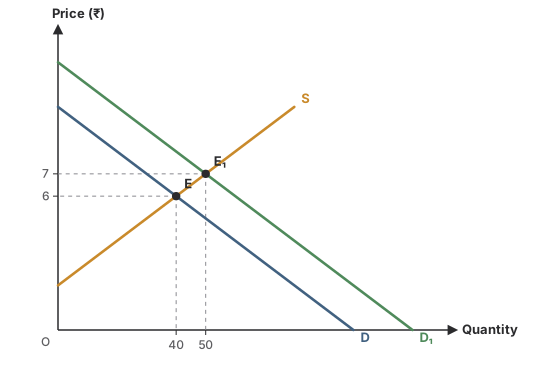
An increase in demand raises both price and quantity. The direction of one variable is certain and the other depends on the sizes:
Both curves Certain Uncertain Increase together Quantity up Price Decrease together Quantity down Price Demand up, supply down Price up Quantity Demand down, supply up Price down Quantity
If demand and supply increase by the same amount, quantity rises and price is unchanged.
A maximum price set below equilibrium to keep an essential good affordable. It creates a shortage, so the good must be rationed (as through ration shops) and some is sold illegally above the ceiling in a black market.
Example 2 · A ceiling
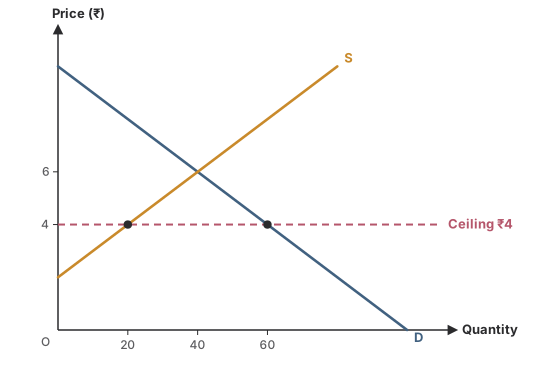
With Qd = 100 − 10P and Qs = 10P − 20, a ceiling is set at ₹4. Find the shortage.
At ₹4: Qd = 60, Qs = 20.
Shortage = 60 − 20 = 40 units; only 20 are actually traded.
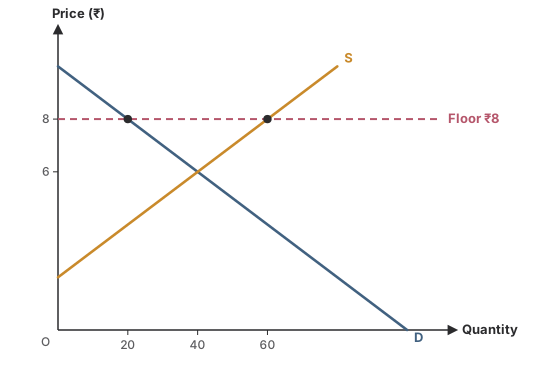
A minimum price set above equilibrium to protect producers. It creates a surplus that the government usually buys and stores. India's minimum support price (MSP) for crops is a floor, and the grain bought becomes buffer stock; a minimum wage is a floor in the labour market.
A floor at ₹8 leaves 40 units unsold at that price.
A ceiling above equilibrium, or a floor below it, does nothing: the market price is already on the allowed side.
Equilibrium: set Qd = Qs, solve for P, then put P back for Q.
Demand shifts move P and Q together; supply shifts move them apart.
Ceiling below equilibrium: shortage. Floor above it: surplus.
Reading the traded quantity under a ceiling as quantity demanded. Only the smaller of the two is traded.
Saying a ceiling causes a surplus, or a floor a shortage.
Claiming certainty about both price and quantity when both curves shift.
Equilibrium
Qd = Qs; stable because gaps push the price back
Free entry: long-run price = minimum AC
Shifts
Demand up: P up, Q up. Supply up: P down, Q up
Two shifts: one variable certain
Controls
Ceiling below: shortage, rationing, black market
Floor above: surplus, buffer stocks (MSP)
This completes Introductory Microeconomics. Practise the whole course in the Microeconomics area .
Next · 07 Quick revision → Check your understanding 52 questions, grouped by type, easy to hard. Pick an answer and check it. The worked solution opens when you ask for it.
Equilibrium price and quantity Q1 of 52 Q1
Equilibrium price and quantity 13 questions Market equilibrium occurs at the price where
Options for question 1 A Option A demand is at its maximum B Option B quantity demanded equals quantity supplied C Option C supply is at its maximum D Option D the price is lowest
Skip Check Show the explanation Hide the explanation Next question Try again
Show the explanation Hide the explanation Answer B · quantity demanded equals quantity supplied
At the equilibrium price, every buyer who wants the good at that price gets it and every seller sells what he offers.
A market's demand and supply schedules are given.
Price (₹) 2 4 6 8 10 Quantity demanded 80 60 40 20 0 Quantity supplied 0 20 40 60 80
What is the equilibrium price?
Options for question 2 A Option A ₹4 B Option B ₹6 C Option C ₹8 D Option D ₹10
Skip Check Show the explanation Hide the explanation Next question Try again
Show the explanation Hide the explanation Answer B · ₹6
At ₹6, 40 are demanded and 40 supplied: the two match.
In the graph, what are the equilibrium price and quantity?
Options for question 3 A Option A ₹4 and 60 units B Option B ₹8 and 20 units C Option C ₹10 and 0 units D Option D ₹6 and 40 units
Skip Check Show the explanation Hide the explanation Next question Try again
Show the explanation Hide the explanation Answer D · ₹6 and 40 units
Set Qd = Qs: 100 − 10P = 10P − 20, so 20P = 120 and P = ₹6.
Q = 100 − 60 = 40 units (check: 60 − 20 = 40).
Demand is Qd = 200 − 4P and supply is Qs = 6P. What is the equilibrium price?
Options for question 4 A Option A ₹20 B Option B ₹33.33 C Option C ₹50 D Option D ₹120
Skip Check Show the explanation Hide the explanation Next question Try again
Show the explanation Hide the explanation Answer A · ₹20
200 − 4P = 6P, so 10P = 200 and P = ₹20.
Equilibrium quantity = 6 × 20 = 120.
Worth noting
120 is the equilibrium quantity, not the price.
Demand is Qd = 50 − 2P and supply is Qs = 3P − 10. What is the equilibrium quantity?
Options for question 5 A Option A 12 B Option B 26 C Option C 40 D Option D 50
Skip Check Show the explanation Hide the explanation Next question Try again
Show the explanation Hide the explanation Answer B · 26
50 − 2P = 3P − 10, so 5P = 60 and P = ₹12.
Q = 50 − 24 = 26 (check: 36 − 10 = 26).
Worth noting
12 is the equilibrium price.
Why is the equilibrium price called a stable price?
Options for question 6 A Option A At any other price, excess demand or excess supply pushes the price back towards it B Option B The government fixes it C Option C It never changes once reached, whatever happens to demand or supply D Option D Sellers agree to keep it
Skip Check Show the explanation Hide the explanation Next question Try again
Show the explanation Hide the explanation Answer A · At any other price, excess demand or excess supply pushes the price back towards it
Above it, unsold stock makes sellers cut prices; below it, unmet demand makes buyers bid prices up.
So the market keeps returning to the equilibrium until demand or supply itself changes.
Worth noting
The equilibrium does move when demand or supply shifts; it is stable, not fixed.
Assertion (A): At the equilibrium price, there is neither excess demand nor excess supply.
Reason (R): At the equilibrium price, quantity demanded equals quantity supplied.
Options for question 7 A Option A Both A and R are true, and R is the correct explanation of A. B Option B Both A and R are true, but R is not the correct explanation of A. C Option C A is true, but R is false. D Option D A is false, but R is true.
Skip Check Show the explanation Hide the explanation Next question Try again
Show the explanation Hide the explanation Answer A · Both A and R are true, and R is the correct explanation of A.
Both are true, and R is why A holds: equal quantities leave nothing short and nothing over.
Read the two statements and choose the correct option.
I. Under perfect competition with free entry and exit, the long-run equilibrium price equals minimum AC.
II. Under free entry and exit, firms earn supernormal profit in the long run.
Options for question 8 A Option A Only I B Option B Only II C Option C Both I and II D Option D Neither I nor II
Skip Check Show the explanation Hide the explanation Next question Try again
Show the explanation Hide the explanation Answer A · Only I
I is true: entry pushes price down to minimum AC, exit pulls it up to it.
II is false: at price = minimum AC firms earn only normal profit.
Demand is Qd = 120 − 3P and supply is Qs = 2P + 20. What is the equilibrium price?
Options for question 9 A Option A ₹20 B Option B ₹28 C Option C ₹60 D Option D ₹100
Skip Check Show the explanation Hide the explanation Next question Try again
Show the explanation Hide the explanation Answer A · ₹20
120 − 3P = 2P + 20, so 5P = 100 and P = ₹20.
Quantity = 120 − 60 = 60.
Worth noting
60 is the equilibrium quantity.
A market's demand and supply schedules are given.
Price (₹) 2 4 6 8 10 Quantity demanded 80 60 40 20 0 Quantity supplied 0 20 40 60 80
If the price were ₹10, what would happen?
Options for question 10 A Option A 80 units would be unsold, so the price would fall B Option B There would be a shortage of 80 units C Option C The market would be in equilibrium D Option D Demand would be 80 units
Skip Check Show the explanation Hide the explanation Next question Try again
Show the explanation Hide the explanation Answer A · 80 units would be unsold, so the price would fall
At ₹10, quantity demanded is 0 and quantity supplied is 80.
The whole 80 is excess supply, which pushes the price down.
Assertion (A): Equilibrium price is determined by demand alone.
Reason (R): Equilibrium is where the demand and supply curves intersect.
Options for question 11 A Option A Both A and R are true, and R is the correct explanation of A. B Option B Both A and R are true, but R is not the correct explanation of A. C Option C A is true, but R is false. D Option D A is false, but R is true.
Skip Check Show the explanation Hide the explanation Next question Try again
Show the explanation Hide the explanation Answer D · A is false, but R is true.
A is false: both demand and supply decide the price, like the two blades of a pair of scissors.
R is true.
In a market with free entry and exit, every firm has minimum AC of ₹12. Market demand is Qd = 600 − 20P. In long-run equilibrium, how much is sold?
Options for question 12 A Option A 12 units B Option B 240 units C Option C 360 units D Option D 600 units
Skip Check Show the explanation Hide the explanation Next question Try again
Show the explanation Hide the explanation Answer C · 360 units
With free entry and exit, the long-run price settles at minimum AC: ₹12.
Quantity = 600 − 20 × 12 = 360 units.
In the case above (minimum AC ₹12, 360 units sold), each firm produces 20 units at minimum AC. How many firms are there in the long run?
Options for question 13 A Option A 12 B Option B 18 C Option C 20 D Option D 30
Skip Check Show the explanation Hide the explanation Next question Try again
Show the explanation Hide the explanation Answer B · 18
Number of firms = market quantity ÷ output per firm = 360 ÷ 20 = 18.
Excess demand and excess supply 8 questions Excess demand exists when
Options for question 14 A Option A quantity supplied is greater than quantity demanded B Option B demand equals supply C Option C quantity demanded is greater than quantity supplied at the current price D Option D demand is zero
Skip Check Show the explanation Hide the explanation Next question Try again
Show the explanation Hide the explanation Answer C · quantity demanded is greater than quantity supplied at the current price
Excess demand is a shortage: buyers want more than sellers offer at that price.
It happens at prices below the equilibrium price.
A market's demand and supply schedules are given.
Price (₹) 2 4 6 8 10 Quantity demanded 80 60 40 20 0 Quantity supplied 0 20 40 60 80
At a price of ₹4, what is the excess demand?
Options for question 15 A Option A 0 units B Option B 20 units C Option C 40 units D Option D 60 units
Skip Check Show the explanation Hide the explanation Next question Try again
Show the explanation Hide the explanation Answer C · 40 units
At ₹4, quantity demanded is 60 and quantity supplied is 20.
Excess demand = 60 − 20 = 40 units.
A market's demand and supply schedules are given.
Price (₹) 2 4 6 8 10 Quantity demanded 80 60 40 20 0 Quantity supplied 0 20 40 60 80
At a price of ₹8, what is the market like?
Options for question 16 A Option A Excess demand of 40 units, so the price tends to rise B Option B Excess supply of 40 units, so the price tends to fall C Option C In equilibrium D Option D Excess supply of 60 units
Skip Check Show the explanation Hide the explanation Next question Try again
Show the explanation Hide the explanation Answer B · Excess supply of 40 units, so the price tends to fall
At ₹8, 20 are demanded and 60 supplied: 40 units are left unsold.
Sellers compete to clear the stock, so the price falls towards ₹6.
When there is excess demand in a market, the price tends to
Options for question 17 A Option A fall B Option B stay the same C Option C rise D Option D fall to zero
Skip Check Show the explanation Hide the explanation Next question Try again
Show the explanation Hide the explanation Answer C · rise
Buyers who cannot get the good offer more; as the price rises, demand contracts and supply extends until the gap closes.
Assertion (A): At a price below equilibrium, there is excess supply.
Reason (R): Below equilibrium, quantity demanded is greater than quantity supplied.
Options for question 18 A Option A Both A and R are true, and R is the correct explanation of A. B Option B Both A and R are true, but R is not the correct explanation of A. C Option C A is true, but R is false. D Option D A is false, but R is true.
Skip Check Show the explanation Hide the explanation Next question Try again
Show the explanation Hide the explanation Answer D · A is false, but R is true.
A is false: below equilibrium there is excess demand.
R is true, and it describes excess demand.
A market's demand and supply schedules are given.
Price (₹) 2 4 6 8 10 Quantity demanded 80 60 40 20 0 Quantity supplied 0 20 40 60 80
At a price of ₹2, what is the excess demand?
Options for question 19 A Option A 0 units B Option B 40 units C Option C 60 units D Option D 80 units
Skip Check Show the explanation Hide the explanation Next question Try again
Show the explanation Hide the explanation Answer D · 80 units
At ₹2, 80 are demanded and 0 supplied: excess demand = 80.
When the price is above equilibrium,
Options for question 20 A Option A buyers cannot get all they want, and they bid the price up B Option B the market is in equilibrium C Option C sellers cannot sell all they offer, and competition among them lowers the price D Option D supply falls to zero
Skip Check Show the explanation Hide the explanation Next question Try again
Show the explanation Hide the explanation Answer C · sellers cannot sell all they offer, and competition among them lowers the price
Above equilibrium, quantity supplied exceeds quantity demanded.
Unsold stock makes sellers cut prices until the gap disappears.
Read the two statements and choose the correct option.
I. As the price falls from above equilibrium, quantity demanded extends and quantity supplied contracts.
II. As the price rises from below equilibrium, demand curve shifts to the left.
Options for question 21 A Option A Only I B Option B Only II C Option C Both I and II D Option D Neither I nor II
Skip Check Show the explanation Hide the explanation Next question Try again
Show the explanation Hide the explanation Answer A · Only I
I is true: these movements along the curves close the gap.
II is false: a price change moves buyers along the demand curve; it does not shift it.
When demand or supply shifts 15 questions A decrease in demand, with supply unchanged, leads to
Options for question 22 A Option A a rise in both equilibrium price and quantity B Option B a fall in price and a rise in quantity C Option C a fall in both equilibrium price and quantity D Option D a rise in price and a fall in quantity
Skip Check Show the explanation Hide the explanation Next question Try again
Show the explanation Hide the explanation Answer C · a fall in both equilibrium price and quantity
Demand shifts left along an unchanged supply curve, so the new crossing point is lower and to the left.
A decrease in supply, with demand unchanged, leads to
Options for question 23 A Option A a rise in equilibrium price and a fall in quantity B Option B a fall in both price and quantity C Option C a rise in both price and quantity D Option D no change in price
Skip Check Show the explanation Hide the explanation Next question Try again
Show the explanation Hide the explanation Answer A · a rise in equilibrium price and a fall in quantity
Supply shifts left along an unchanged demand curve: the new point is higher and to the left.
In the graph, demand rises from D to D₁ while supply stays at S. What happens to the equilibrium?
Options for question 24 A Option A Price rises from ₹6 to ₹7 and quantity from 40 to 50 B Option B Price falls from ₹6 to ₹5 and quantity rises to 50 C Option C Price rises but quantity falls D Option D Nothing changes
Skip Check Show the explanation Hide the explanation Next question Try again
Show the explanation Hide the explanation Answer A · Price rises from ₹6 to ₹7 and quantity from 40 to 50
New equilibrium: 120 − 10P = 10P − 20, so P = ₹7 and Q = 50.
An increase in demand, with supply unchanged, raises both price and quantity.
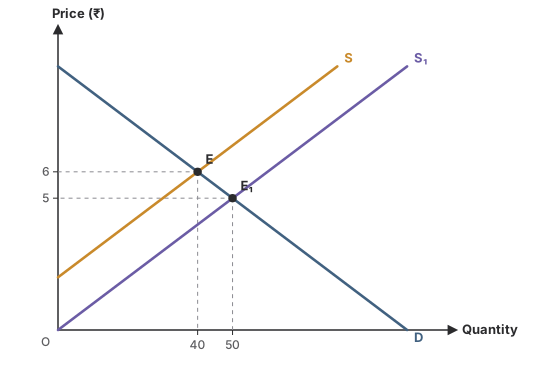
In the graph, supply rises from S to S₁ while demand stays at D. What happens to the equilibrium?
Options for question 25 A Option A Price rises from ₹6 to ₹7 and quantity rises to 50 B Option B Price and quantity both fall C Option C Price falls but quantity stays at 40 D Option D Price falls from ₹6 to ₹5 and quantity rises from 40 to 50
Skip Check Show the explanation Hide the explanation Next question Try again
Show the explanation Hide the explanation Answer D · Price falls from ₹6 to ₹5 and quantity rises from 40 to 50
New equilibrium: 100 − 10P = 10P, so P = ₹5 and Q = 50.
An increase in supply, with demand unchanged, lowers price and raises quantity.
Demand is Qd = 100 − 10P and supply is Qs = 10P − 20. A rise in incomes changes demand to Qd = 140 − 10P. What is the new equilibrium price?
Options for question 26 A Option A ₹6 B Option B ₹7 C Option C ₹8 D Option D ₹14
Skip Check Show the explanation Hide the explanation Next question Try again
Show the explanation Hide the explanation Answer C · ₹8
140 − 10P = 10P − 20, so 20P = 160 and P = ₹8.
Quantity = 140 − 80 = 60, up from 40.
Assertion (A): A bumper harvest lowers the price of wheat.
Reason (R): A bumper harvest increases the supply of wheat.
Options for question 27 A Option A Both A and R are true, and R is the correct explanation of A. B Option B Both A and R are true, but R is not the correct explanation of A. C Option C A is true, but R is false. D Option D A is false, but R is true.
Skip Check Show the explanation Hide the explanation Next question Try again
Show the explanation Hide the explanation Answer A · Both A and R are true, and R is the correct explanation of A.
Both are true.
More supply at every price (R), with demand unchanged, means a lower equilibrium price (A).
Better technology lowers the cost of making mobile phones. Other things the same, the market for phones sees
Options for question 28 A Option A a higher price and a larger quantity B Option B a lower price and a larger quantity C Option C a lower price and a smaller quantity D Option D no change
Skip Check Show the explanation Hide the explanation Next question Try again
Show the explanation Hide the explanation Answer B · a lower price and a larger quantity
Lower costs increase supply: the supply curve shifts right.
With demand unchanged, price falls and quantity rises.
Demand is Qd = 100 − 10P and supply changes from Qs = 10P − 20 to Qs = 10P − 40 after a rise in input costs. What is the new equilibrium?
Options for question 29 A Option A ₹5 and 50 units B Option B ₹7 and 30 units C Option C ₹6 and 40 units D Option D ₹8 and 20 units
Skip Check Show the explanation Hide the explanation Next question Try again
Show the explanation Hide the explanation Answer B · ₹7 and 30 units
100 − 10P = 10P − 40, so 20P = 140 and P = ₹7.
Q = 100 − 70 = 30: price up, quantity down after a decrease in supply.
Assertion (A): A rise in the price of tea, a substitute for coffee, raises the equilibrium price of coffee.
Reason (R): Dearer tea increases the demand for coffee.
Options for question 30 A Option A Both A and R are true, and R is the correct explanation of A. B Option B Both A and R are true, but R is not the correct explanation of A. C Option C A is true, but R is false. D Option D A is false, but R is true.
Skip Check Show the explanation Hide the explanation Next question Try again
Show the explanation Hide the explanation Answer A · Both A and R are true, and R is the correct explanation of A.
Both are true, and R explains A: higher demand for coffee with supply unchanged raises its price.
Demand and supply both increase by the same amount. Which is certain?
Options for question 31 A Option A Price rises; quantity stays the same B Option B Equilibrium quantity rises; price stays the same C Option C Both price and quantity fall D Option D Price falls; quantity stays the same
Skip Check Show the explanation Hide the explanation Next question Try again
Show the explanation Hide the explanation Answer B · Equilibrium quantity rises; price stays the same
Both shifts push quantity up.
The demand shift pushes price up and the supply shift pushes it down by the same amount, so price is unchanged.
Demand increases by more than supply increases. The result is
Options for question 32 A Option A a fall in price and a rise in quantity B Option B a rise in price and a fall in quantity C Option C no change in either D Option D a rise in both equilibrium price and quantity
Skip Check Show the explanation Hide the explanation Next question Try again
Show the explanation Hide the explanation Answer D · a rise in both equilibrium price and quantity
Both shifts raise quantity.
The larger demand shift pushes price up more than the supply shift pushes it down, so price rises.
Demand for a good increases and its supply decreases at the same time. Which is certain?
Options for question 33 A Option A The equilibrium price rises B Option B The equilibrium quantity rises C Option C The equilibrium quantity falls D Option D The equilibrium price falls
Skip Check Show the explanation Hide the explanation Next question Try again
Show the explanation Hide the explanation Answer A · The equilibrium price rises
Both changes push the price up, so the price certainly rises.
Quantity is pushed up by demand and down by supply; which wins depends on the sizes.
Read the two statements and choose the correct option.
I. If supply is perfectly inelastic, an increase in demand raises only the price.
II. If supply is perfectly elastic, an increase in demand raises only the quantity.
Options for question 34 A Option A Only I B Option B Only II C Option C Both I and II D Option D Neither I nor II
Skip Check Show the explanation Hide the explanation Next question Try again
Show the explanation Hide the explanation Answer C · Both I and II
Vertical supply: quantity cannot change, so all the effect is on price. I is true.
Horizontal supply: price cannot change, so all the effect is on quantity. II is true.
Match each change (other things equal) with its effect on the equilibrium.
List I List II A. Demand increases I. Price down, quantity down B. Supply increases II. Price up, quantity up C. Demand decreases III. Price up, quantity down D. Supply decreases IV. Price down, quantity up
Options for question 35 A Option A A-II, B-I, C-IV, D-III B Option B A-I, B-II, C-IV, D-III C Option C A-IV, B-III, C-II, D-I D Option D A-II, B-IV, C-I, D-III
Skip Check Show the explanation Hide the explanation Next question Try again
Show the explanation Hide the explanation Answer D · A-II, B-IV, C-I, D-III
Demand shifts move price and quantity in the same direction.
Supply shifts move them in opposite directions.
Demand for a good falls and its supply rises at the same time. Which is certain?
Options for question 36 A Option A The equilibrium price falls B Option B The equilibrium quantity falls C Option C The equilibrium quantity rises D Option D The equilibrium price rises
Skip Check Show the explanation Hide the explanation Next question Try again
Show the explanation Hide the explanation Answer A · The equilibrium price falls
Both changes push the price down.
Quantity is pulled down by demand and up by supply, so its direction depends on which shift is larger.
Price ceiling and price floor 16 questions Options for question 37 A Option A a minimum price set by the government, above the equilibrium price B Option B a maximum price set by the government, below the equilibrium price C Option C the equilibrium price D Option D a tax on each unit
Skip Check Show the explanation Hide the explanation Next question Try again
Show the explanation Hide the explanation Answer B · a maximum price set by the government, below the equilibrium price
A ceiling caps the price to keep an essential good affordable; to matter, it must be below equilibrium.
Options for question 38 A Option A a maximum price set by the government B Option B a minimum price set by the government, above the equilibrium price C Option C the lowest price ever charged D Option D the cost of production
Skip Check Show the explanation Hide the explanation Next question Try again
Show the explanation Hide the explanation Answer B · a minimum price set by the government, above the equilibrium price
A floor stops the price falling below a set level, to protect producers such as farmers.
In the graph, the government sets a price ceiling of ₹4. What is the result?
Options for question 39 A Option A A surplus of 40 units B Option B No effect, because ₹4 is below equilibrium C Option C A shortage of 40 units: 60 demanded, 20 supplied D Option D A shortage of 20 units
Skip Check Show the explanation Hide the explanation Next question Try again
Show the explanation Hide the explanation Answer C · A shortage of 40 units: 60 demanded, 20 supplied
At ₹4: Qd = 100 − 40 = 60; Qs = 40 − 20 = 20.
Excess demand = 60 − 20 = 40 units, which the price is not allowed to clear.
A price ceiling below the equilibrium price commonly leads to
Options for question 40 A Option A unsold stocks and buffer stocks B Option B a fall in demand C Option C queues, rationing and black markets D Option D a rise in supply
Skip Check Show the explanation Hide the explanation Next question Try again
Show the explanation Hide the explanation Answer C · queues, rationing and black markets
The shortage means not everyone who wants the good at the ceiling price can get it.
The government rations it (as through ration shops), and some is sold illegally above the ceiling.
Worth noting
Unsold stocks come with a price floor, not a ceiling.
In the graph, the government sets a price floor of ₹8. What is the result?
Options for question 41 A Option A A shortage of 40 units B Option B No effect, because ₹8 is above equilibrium C Option C A surplus of 60 units D Option D A surplus of 40 units: 60 supplied, 20 demanded
Skip Check Show the explanation Hide the explanation Next question Try again
Show the explanation Hide the explanation Answer D · A surplus of 40 units: 60 supplied, 20 demanded
At ₹8: Qd = 100 − 80 = 20; Qs = 80 − 20 = 60.
Excess supply = 60 − 20 = 40 units, which the government usually has to buy and store.
The minimum support price (MSP) for wheat in India is an example of
Options for question 42 A Option A a price floor B Option B a price ceiling C Option C an equilibrium price D Option D a subsidy to consumers
Skip Check Show the explanation Hide the explanation Next question Try again
Show the explanation Hide the explanation Answer A · a price floor
MSP is the price at which the government stands ready to buy, so farmers need not sell below it.
A guaranteed lower limit on price is a price floor.
A minimum wage set above the equilibrium wage in a labour market can cause
Options for question 43 A Option A a shortage of workers B Option B a fall in the wage C Option C no change in the labour market D Option D more workers seeking jobs than employers want to hire
Skip Check Show the explanation Hide the explanation Next question Try again
Show the explanation Hide the explanation Answer D · more workers seeking jobs than employers want to hire
A minimum wage is a price floor in the labour market.
Above equilibrium, more labour is offered than demanded: a surplus of labour.
Assertion (A): A price ceiling set above the equilibrium price has no effect on the market.
Reason (R): The market price can settle at equilibrium, which is below the ceiling.
Options for question 44 A Option A Both A and R are true, and R is the correct explanation of A. B Option B Both A and R are true, but R is not the correct explanation of A. C Option C A is true, but R is false. D Option D A is false, but R is true.
Skip Check Show the explanation Hide the explanation Next question Try again
Show the explanation Hide the explanation Answer A · Both A and R are true, and R is the correct explanation of A.
Both are true, and R explains A: a cap above where the price would be anyway never bites.
Read the two statements and choose the correct option.
I. Selling essential goods through ration shops at a controlled price is linked to a price ceiling.
II. Buffer stocks of food grains are linked to a price floor.
Options for question 45 A Option A Only I B Option B Only II C Option C Both I and II D Option D Neither I nor II
Skip Check Show the explanation Hide the explanation Next question Try again
Show the explanation Hide the explanation Answer C · Both I and II
Ration shops distribute a good whose price is held below equilibrium: a ceiling. I is true.
Grain bought at MSP to hold the price up becomes buffer stock: a floor. II is true.
In the graph, how many units are actually bought and sold at the ceiling of ₹4?
Options for question 46 A Option A 60 units, the quantity demanded B Option B 40 units C Option C 80 units D Option D 20 units, the quantity supplied
Skip Check Show the explanation Hide the explanation Next question Try again
Show the explanation Hide the explanation Answer D · 20 units, the quantity supplied
Buyers cannot buy more than sellers offer: the smaller of the two quantities is traded.
At ₹4 sellers offer only 20, so only 20 change hands; 40 units of demand go unmet.
In the graph, at the floor of ₹8, how many units do buyers actually purchase?
Options for question 47 A Option A 20 units B Option B 40 units C Option C 60 units D Option D 80 units
Skip Check Show the explanation Hide the explanation Next question Try again
Show the explanation Hide the explanation Answer A · 20 units
At ₹8, buyers want only 20 units.
Sellers offer 60; the other 40 are surplus that buyers do not take.
Assertion (A): A price ceiling helps consumers who manage to buy the good.
Reason (R): Under a ceiling, the good sells below its equilibrium price.
Options for question 48 A Option A Both A and R are true, and R is the correct explanation of A. B Option B Both A and R are true, but R is not the correct explanation of A. C Option C A is true, but R is false. D Option D A is false, but R is true.
Skip Check Show the explanation Hide the explanation Next question Try again
Show the explanation Hide the explanation Answer A · Both A and R are true, and R is the correct explanation of A.
Both are true, and R explains A: those who get the good pay less than the market would charge.
Demand is Qd = 200 − 5P and supply is Qs = 5P. The government sets a ceiling of ₹15. What is the shortage?
Options for question 49 A Option A 50 units B Option B 75 units C Option C 100 units D Option D 125 units
Skip Check Show the explanation Hide the explanation Next question Try again
Show the explanation Hide the explanation Answer A · 50 units
Equilibrium: 200 − 5P = 5P, so P = ₹20; the ceiling of ₹15 is below it and binds.
At ₹15: Qd = 200 − 75 = 125; Qs = 75. Shortage = 125 − 75 = 50 units.
Demand is Qd = 200 − 5P and supply is Qs = 5P. The government sets a floor of ₹25 and buys any surplus. How much does it buy?
Options for question 50 A Option A 25 units B Option B 50 units C Option C 75 units D Option D 125 units
Skip Check Show the explanation Hide the explanation Next question Try again
Show the explanation Hide the explanation Answer B · 50 units
At ₹25: Qs = 125 and Qd = 200 − 125 = 75.
Surplus = 125 − 75 = 50 units, which the government buys.
Assertion (A): A price floor above equilibrium leads to a shortage.
Reason (R): Above equilibrium, quantity supplied exceeds quantity demanded.
Options for question 51 A Option A Both A and R are true, and R is the correct explanation of A. B Option B Both A and R are true, but R is not the correct explanation of A. C Option C A is true, but R is false. D Option D A is false, but R is true.
Skip Check Show the explanation Hide the explanation Next question Try again
Show the explanation Hide the explanation Answer D · A is false, but R is true.
A is false: a floor above equilibrium causes a surplus.
R is true and describes that surplus.
Read the two statements and choose the correct option.
I. A price floor set below the equilibrium price causes a surplus.
II. A price ceiling set above the equilibrium price causes a shortage.
Options for question 52 A Option A Only I B Option B Only II C Option C Both I and II D Option D Neither I nor II
Skip Check Show the explanation Hide the explanation Back to start Try again
Show the explanation Hide the explanation Answer D · Neither I nor II
A floor below equilibrium does not bind: the market price is already above it. I is false.
A ceiling above equilibrium does not bind either. II is false.
Question types · easy to hard
NTA's Economics syllabus is three courses: Introductory Microeconomics, Introductory Macroeconomics and Indian Economic Development, each split into units with a list of topics. It prints no chapters and no split of the 50 questions across the courses. So the areas here are NTA's three courses, and the chapters inside them are ours: a unit that covers several ideas, such as consumer behaviour and demand, is split into a chapter for each, so that a chapter can be practised in one sitting. All three courses are here.