On this page · 9 sections 01 The core idea 02 Perfect competition 03 The firm's supply 04 Supply and its shifts 05 Elasticity of supply 06 Exam shortcuts 07 Common mistakes 08 Quick revision 09 Check your understanding Under perfect competition no single firm can move the price: it takes the market price and decides only how much to produce. Its answer, P = MC on the rising part of MC, is what traces out its supply curve.
A very large number of buyers and sellers.
A homogeneous product: every firm's output looks the same to buyers.
Free entry and exit of firms.
Perfect knowledge of prices.
So each firm is a price taker facing a horizontal (perfectly elastic) demand curve at the market price, while the market demand curve itself slopes downward. There is no point in advertising, and in the long run free entry and exit leave firms with only normal profit.
Where P = MC, with MC rising. That is the MC = MR rule with MR equal to the price.
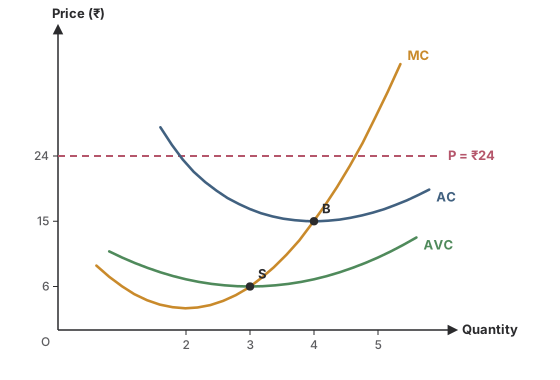
S is the shut-down point, B the break-even point; above ₹15 the firm earns supernormal profit. Price In the short run the firm Above minimum AC (₹15) Produces at P = MC and earns supernormal profit Equal to minimum AC Breaks even: normal profit (point B) Between minimum AVC and minimum AC Produces at a loss, covering AVC and part of fixed cost Below minimum AVC (₹6) Shuts down (point S)
In the short run fixed cost is lost whether or not the firm produces, so it stays open as long as price covers AVC. In the long run all costs are variable, so it must cover AC.
At the break-even point profit is "zero" only in the sense that TR = TC. Normal profit is counted inside cost, so the firm is earning normal profit there.
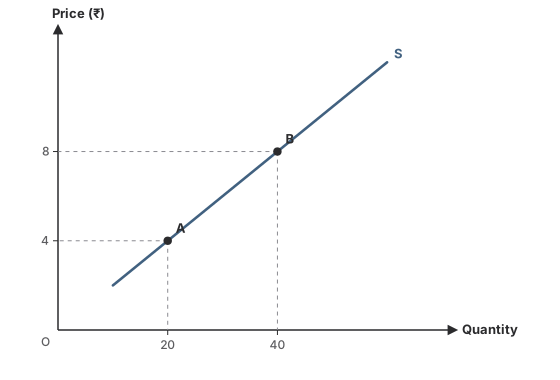
Other things the same, a higher price raises the quantity supplied: a movement up the supply curve (extension); a lower price, a movement down (contraction).
Change Supply Better technology Increases (right) Input prices rise Decreases (left) Per-unit tax Decreases Subsidy Increases More firms Market supply increases Price of another good the same resources can make rises Decreases Price expected to rise Decreases today
Market supply is the horizontal sum of the firms' supply curves.
It is positive, because price and quantity supplied move together.
Example 1 · Elasticity of supply
Price rises from ₹10 to ₹12; quantity supplied rises from 100 to 130. Find eₛ.
% change in quantity = 30%. % change in price = 20%.
eₛ = 30 ÷ 20 = 1.5.
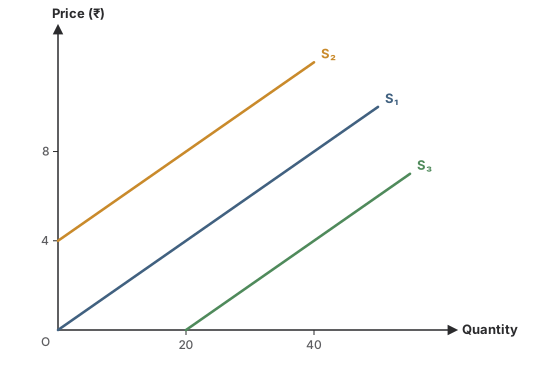
For a straight supply curve: through the origin, eₛ = 1 everywhere; cutting the price axis, eₛ > 1; cutting the quantity axis, eₛ < 1. Supply is more elastic in the long run and for goods that can be stored, less for perishables such as fresh fish.
Price taker: produce where P = MC, MC rising.
Shut down below minimum AVC (short run); leave below minimum AC (long run).
Straight supply curve: origin 1, price axis > 1, quantity axis < 1.
Using AC instead of AVC for the short-run shut-down decision.
Calling a rise in own price an increase in supply; it is an extension.
Saying the market demand curve is horizontal under perfect competition; only the firm's is.
Perfect competition
Many firms, identical product, free entry, perfect knowledge
Firm: price taker, horizontal demand
Firm's supply
P = MC, MC rising
Shut-down: min AVC; break-even: min AC
Supply
Shifts: technology, input prices, taxes, firms, expectations
eₛ = % change in Qs ÷ % change in P
Demand and supply meet in market equilibrium and price controls .
Next · 08 Quick revision → Check your understanding 52 questions, grouped by type, easy to hard. Pick an answer and check it. The worked solution opens when you ask for it.
Features of perfect competition Q1 of 52 Q1
Features of perfect competition 10 questions Which of these is a feature of perfect competition?
Options for question 1 A Option A A single seller B Option B A large number of buyers and sellers of a homogeneous product C Option C Products differentiated by brand D Option D Barriers to entry
Skip Check Show the explanation Hide the explanation Next question Try again
Show the explanation Hide the explanation Answer B · A large number of buyers and sellers of a homogeneous product
Perfect competition has many buyers and sellers, identical products, free entry and exit, and perfect knowledge.
Under perfect competition, a firm is a
Options for question 2 A Option A price maker B Option B monopolist C Option C price leader D Option D price taker
Skip Check Show the explanation Hide the explanation Next question Try again
Show the explanation Hide the explanation Answer D · price taker
Each firm is too small a part of the market to change the price; it takes the market price as given.
Under perfect competition, the price of a good is set by
Options for question 3 A Option A the market (industry) demand and supply B Option B each firm separately C Option C the largest firm D Option D the buyers alone
Skip Check Show the explanation Hide the explanation Next question Try again
Show the explanation Hide the explanation Answer A · the market (industry) demand and supply
The industry's demand and supply fix the price; each firm then sells at that price.
Free entry and exit of firms under perfect competition means that, in the long run, firms earn
Options for question 4 A Option A supernormal profit B Option B losses C Option C only normal profit D Option D profit only if they advertise
Skip Check Show the explanation Hide the explanation Next question Try again
Show the explanation Hide the explanation Answer C · only normal profit
Supernormal profit draws new firms in, raising supply and lowering price; losses drive firms out, raising price.
This continues until price equals minimum AC: only normal profit remains.
A homogeneous product means that
Options for question 5 A Option A each firm sells a different brand B Option B buyers see every firm's product as identical C Option C only one firm makes the product D Option D the product is a luxury
Skip Check Show the explanation Hide the explanation Next question Try again
Show the explanation Hide the explanation Answer B · buyers see every firm's product as identical
Because the products are identical, no buyer will pay more to one firm than to another.
That is one reason every firm must sell at the same market price.
Assertion (A): A firm under perfect competition cannot sell any output above the market price.
Reason (R): Buyers have perfect knowledge and the products are identical.
Options for question 6 A Option A Both A and R are true, and R is the correct explanation of A. B Option B Both A and R are true, but R is not the correct explanation of A. C Option C A is true, but R is false. D Option D A is false, but R is true.
Skip Check Show the explanation Hide the explanation Next question Try again
Show the explanation Hide the explanation Answer A · Both A and R are true, and R is the correct explanation of A.
Both are true.
Knowing every price and seeing no difference in products (R), buyers simply go to another firm if one charges more (A).
Read the two statements and choose the correct option.
I. Under perfect competition, the demand curve facing the firm is horizontal.
II. Under perfect competition, the market demand curve is horizontal.
Options for question 7 A Option A Only I B Option B Only II C Option C Both I and II D Option D Neither I nor II
Skip Check Show the explanation Hide the explanation Next question Try again
Show the explanation Hide the explanation Answer A · Only I
I is true: the firm can sell any amount at the market price.
II is false: the market demand curve slopes downward, by the law of demand.
Perfect knowledge under perfect competition means that
Options for question 8 A Option A every firm knows its rivals' secrets B Option B the government sets the price C Option C advertising is needed D Option D buyers and sellers know the market price everywhere
Skip Check Show the explanation Hide the explanation Next question Try again
Show the explanation Hide the explanation Answer D · buyers and sellers know the market price everywhere
With full information about prices, no seller can charge more and no buyer will pay more than the market price.
Which market comes closest to perfect competition in practice?
Options for question 9 A Option A The market for branded soft drinks B Option B Local railway services C Option C A large wholesale market for wheat of one grade D Option D The market for a patented medicine
Skip Check Show the explanation Hide the explanation Next question Try again
Show the explanation Hide the explanation Answer C · A large wholesale market for wheat of one grade
Many farmers sell an identical product to many buyers, and no single farmer can move the price.
Brands, a single railway and a patent all give some control over price.
Assertion (A): In perfect competition, firms spend heavily on advertising.
Reason (R): Products of all firms are identical.
Options for question 10 A Option A Both A and R are true, and R is the correct explanation of A. B Option B Both A and R are true, but R is not the correct explanation of A. C Option C A is true, but R is false. D Option D A is false, but R is true.
Skip Check Show the explanation Hide the explanation Next question Try again
Show the explanation Hide the explanation Answer D · A is false, but R is true.
A is false: with identical products and a given price, advertising cannot win a firm a higher price.
R is true, and it is why advertising is pointless here.
Profit maximisation and the firm's supply 14 questions A price-taking firm maximises profit where
Options for question 11 A Option A price = AVC B Option B price = AFC C Option C price = MC, with MC rising D Option D MC is at its minimum
Skip Check Show the explanation Hide the explanation Next question Try again
Show the explanation Hide the explanation Answer C · price = MC, with MC rising
For a price taker MR = P, so the MC = MR rule becomes P = MC, on the rising part of MC.
In the graph, the shut-down point of the firm in the short run is
Options for question 12 A Option A S, the lowest point of AVC, at a price of ₹6 B Option B B, the lowest point of AC, at a price of ₹15 C Option C where price is ₹24 D Option D where MC is lowest
Skip Check Show the explanation Hide the explanation Next question Try again
Show the explanation Hide the explanation Answer A · S, the lowest point of AVC, at a price of ₹6
In the short run a firm keeps producing as long as price covers AVC, because fixed cost must be paid anyway.
Below ₹6, the minimum AVC, it loses less by shutting down: S is the shut-down point.
In the graph, the break-even point of the firm is
Options for question 13 A Option A S, the lowest point of AVC, at a price of ₹6 B Option B where price is ₹24 C Option C where MC is lowest D Option D B, the lowest point of AC, at a price of ₹15
Skip Check Show the explanation Hide the explanation Next question Try again
Show the explanation Hide the explanation Answer D · B, the lowest point of AC, at a price of ₹15
At B, price = minimum AC = ₹15, so TR = TC: the firm earns only normal profit.
Above ₹15 it earns supernormal profit; below it, a loss.
The short-run supply curve of a firm under perfect competition is
Options for question 14 A Option A the whole of its AC curve B Option B the rising part of its MC curve above minimum AVC C Option C its AVC curve D Option D a horizontal line at the market price
Skip Check Show the explanation Hide the explanation Next question Try again
Show the explanation Hide the explanation Answer B · the rising part of its MC curve above minimum AVC
At each price the firm supplies where P = MC, so MC traces out the quantities supplied.
Below minimum AVC it supplies nothing, so the curve starts at that point.
The long-run supply curve of a firm under perfect competition is
Options for question 15 A Option A the rising part of MC above minimum AVC B Option B its AFC curve C Option C a vertical line D Option D the rising part of its long-run MC curve above minimum long-run AC
Skip Check Show the explanation Hide the explanation Next question Try again
Show the explanation Hide the explanation Answer D · the rising part of its long-run MC curve above minimum long-run AC
In the long run all costs are variable, so the firm must cover its whole AC or leave.
So its supply starts at minimum long-run AC.
Assertion (A): A firm shuts down in the short run if price falls below minimum AC.
Reason (R): Minimum AVC is the short-run shut-down point.
Options for question 16 A Option A Both A and R are true, and R is the correct explanation of A. B Option B Both A and R are true, but R is not the correct explanation of A. C Option C A is true, but R is false. D Option D A is false, but R is true.
Skip Check Show the explanation Hide the explanation Next question Try again
Show the explanation Hide the explanation Answer D · A is false, but R is true.
A is false: in the short run the test is AVC, not AC.
R is true.
Read the two statements and choose the correct option.
I. At the break-even point, total revenue equals total cost.
II. At the break-even point, the firm earns zero normal profit.
Options for question 17 A Option A Only I B Option B Only II C Option C Both I and II D Option D Neither I nor II
Skip Check Show the explanation Hide the explanation Next question Try again
Show the explanation Hide the explanation Answer A · Only I
I is true: P = AC means TR = TC.
II is false: normal profit is counted as part of cost, so at break-even the firm earns normal profit, not zero.
A price-taking firm's MC curve above minimum AVC is its supply curve because
Options for question 18 A Option A the firm always produces where MC is lowest B Option B MC equals AFC C Option C the firm sets the price D Option D at each price the firm produces where price = MC
Skip Check Show the explanation Hide the explanation Next question Try again
Show the explanation Hide the explanation Answer D · at each price the firm produces where price = MC
For each market price, reading across to the rising MC curve gives the quantity the firm offers.
That price–quantity pairing is exactly what a supply curve is.
A firm's profit is zero at the break-even point. In economics, this means it earns
Options for question 19 A Option A supernormal profit B Option B a loss that will make it leave at once C Option C normal profit, enough to keep it in the industry D Option D nothing at all, so it must shut down
Skip Check Show the explanation Hide the explanation Next question Try again
Show the explanation Hide the explanation Answer C · normal profit, enough to keep it in the industry
Costs in economics include the normal return the owner could earn elsewhere.
So TR = TC means the owner earns exactly that normal return: normal profit.
Read the two statements and choose the correct option.
I. In the short run, a firm must cover at least its AVC to stay open.
II. In the long run, a firm must cover its whole AC to stay in the industry.
Options for question 20 A Option A Only I B Option B Only II C Option C Both I and II D Option D Neither I nor II
Skip Check Show the explanation Hide the explanation Next question Try again
Show the explanation Hide the explanation Answer C · Both I and II
Both are true: short run, AVC is the bar; long run, all costs are variable, so AC is the bar.
In the graph, at a market price of ₹24, the firm
Options for question 21 A Option A shuts down, since ₹24 is above minimum AVC B Option B produces at the lowest point of AC C Option C produces where MC = ₹24 and earns supernormal profit, since ₹24 is above minimum AC D Option D makes a loss but stays open
Skip Check Show the explanation Hide the explanation Next question Try again
Show the explanation Hide the explanation Answer C · produces where MC = ₹24 and earns supernormal profit, since ₹24 is above minimum AC
The firm goes up its MC curve to where MC = ₹24.
At that output AC is below ₹24 (its minimum is ₹15), so price exceeds AC: supernormal profit.
In the graph, if the market price is ₹13, what does the firm do in the short run?
Options for question 22 A Option A Produces at a loss, because ₹13 covers AVC but not AC B Option B Shuts down, because ₹13 is below AC C Option C Earns supernormal profit D Option D Earns exactly normal profit
Skip Check Show the explanation Hide the explanation Next question Try again
Show the explanation Hide the explanation Answer A · Produces at a loss, because ₹13 covers AVC but not AC
₹13 lies between minimum AVC (₹6) and minimum AC (₹15).
Producing covers all variable cost and part of fixed cost; shutting down would lose all the fixed cost. So it produces at a smaller loss.
Assertion (A): In the short run, a firm may continue production even when price is below AC.
Reason (R): In the short run, fixed cost has to be paid even if output is zero.
Options for question 23 A Option A Both A and R are true, and R is the correct explanation of A. B Option B Both A and R are true, but R is not the correct explanation of A. C Option C A is true, but R is false. D Option D A is false, but R is true.
Skip Check Show the explanation Hide the explanation Next question Try again
Show the explanation Hide the explanation Answer A · Both A and R are true, and R is the correct explanation of A.
Both are true.
Since fixed cost is lost either way (R), producing is better as long as price covers AVC, even if not AC (A).
In the graph, if the market price falls to ₹5, what does the firm do in the short run?
Options for question 24 A Option A Produces at a loss B Option B Shuts down, because ₹5 is below minimum AVC of ₹6 C Option C Earns normal profit D Option D Produces where MC = ₹15
Skip Check Show the explanation Hide the explanation Next question Try again
Show the explanation Hide the explanation Answer B · Shuts down, because ₹5 is below minimum AVC of ₹6
Below minimum AVC, producing cannot even cover variable cost.
Shutting down limits the loss to the fixed cost, so the firm supplies nothing.
Determinants of supply; movement and shift 16 questions The law of supply states that, other things remaining the same,
Options for question 25 A Option A the quantity supplied of a good rises when its price rises B Option B the quantity supplied falls when its price rises C Option C supply does not depend on price D Option D demand rises when supply rises
Skip Check Show the explanation Hide the explanation Next question Try again
Show the explanation Hide the explanation Answer A · the quantity supplied of a good rises when its price rises
A higher price makes production more profitable, so firms offer more: price and quantity supplied move together.
Market supply of a good is
Options for question 26 A Option A the sum of the quantities supplied by all firms at each price B Option B the supply of the largest firm C Option C the average supply of the firms D Option D the quantity demanded by all buyers
Skip Check Show the explanation Hide the explanation Next question Try again
Show the explanation Hide the explanation Answer A · the sum of the quantities supplied by all firms at each price
Like market demand, it is the horizontal sum of the individual curves.
In the graph, the price rises from ₹4 to ₹8. This is shown as
Options for question 27 A Option A a shift of the supply curve to the right B Option B a contraction of supply C Option C a decrease in supply D Option D a movement up the supply curve from A to B: an extension of supply
Skip Check Show the explanation Hide the explanation Next question Try again
Show the explanation Hide the explanation Answer D · a movement up the supply curve from A to B: an extension of supply
A change in the good's own price moves sellers along the same supply curve.
Quantity supplied rises from 20 to 40: an extension of supply.
Which of these shifts the supply curve of a good to the right?
Options for question 28 A Option A A rise in the price of an input B Option B An improvement in the technology of producing it C Option C A new tax on each unit D Option D A rise in the good's own price
Skip Check Show the explanation Hide the explanation Next question Try again
Show the explanation Hide the explanation Answer B · An improvement in the technology of producing it
Better technology lowers the cost of each unit, so firms offer more at every price.
Dearer inputs and a unit tax raise costs (shift left); own price moves along the curve.
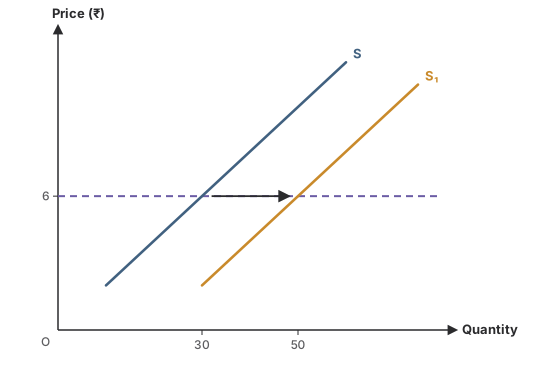
The supply curve moves from S to S₁ as shown. Which event could cause this?
Options for question 29 A Option A The price of the good rises B Option B Wages of workers rise C Option C More firms enter the industry D Option D A per-unit tax is imposed
Skip Check Show the explanation Hide the explanation Next question Try again
Show the explanation Hide the explanation Answer C · More firms enter the industry
At ₹6, supply rises from 30 to 50: more is offered at the same price, so supply has increased.
More firms add to market supply. Higher wages or a tax would shift it left; own price moves along it.
A per-unit tax is imposed on a good. Its supply curve
Options for question 30 A Option A shifts to the right B Option B does not move C Option C shifts to the left (upward) D Option D becomes horizontal
Skip Check Show the explanation Hide the explanation Next question Try again
Show the explanation Hide the explanation Answer C · shifts to the left (upward)
The tax adds to the cost of each unit, so firms need a higher price to offer the same quantity.
That is a leftward (upward) shift: a decrease in supply.
A farmer can grow wheat or mustard on the same land. The price of mustard rises sharply. The supply of wheat
Options for question 31 A Option A increases: the wheat supply curve shifts right B Option B decreases: the wheat supply curve shifts left C Option C does not change D Option D moves along its curve
Skip Check Show the explanation Hide the explanation Next question Try again
Show the explanation Hide the explanation Answer B · decreases: the wheat supply curve shifts left
Mustard is now the more rewarding use of the land, so some land moves out of wheat.
Less wheat is offered at every wheat price: a decrease in supply.
Sellers expect the price of their good to rise next month. Their supply today
Options for question 32 A Option A increases B Option B does not change C Option C becomes perfectly elastic D Option D decreases, as they hold back stock to sell later
Skip Check Show the explanation Hide the explanation Next question Try again
Show the explanation Hide the explanation Answer D · decreases, as they hold back stock to sell later
Selling later at a higher price pays more, so sellers offer less today.
Two firms have supply functions q₁ = 2P and q₂ = 3P − 5 (for P ≥ ₹2). What is market supply at P = ₹10?
Options for question 33 A Option A 20 B Option B 25 C Option C 45 D Option D 50
Skip Check Show the explanation Hide the explanation Next question Try again
Show the explanation Hide the explanation Answer C · 45
q₁ = 2 × 10 = 20; q₂ = 3 × 10 − 5 = 25.
Market supply = 20 + 25 = 45.
Assertion (A): A rise in the price of an input shifts the supply curve to the left.
Reason (R): A dearer input raises the marginal cost of producing each unit.
Options for question 34 A Option A Both A and R are true, and R is the correct explanation of A. B Option B Both A and R are true, but R is not the correct explanation of A. C Option C A is true, but R is false. D Option D A is false, but R is true.
Skip Check Show the explanation Hide the explanation Next question Try again
Show the explanation Hide the explanation Answer A · Both A and R are true, and R is the correct explanation of A.
Both are true.
A firm's supply curve is its MC curve; higher MC at every output (R) means less offered at every price (A).
Assertion (A): An increase in supply is caused by a rise in the good's own price.
Reason (R): A rise in the good's own price causes an extension of supply.
Options for question 35 A Option A Both A and R are true, and R is the correct explanation of A. B Option B Both A and R are true, but R is not the correct explanation of A. C Option C A is true, but R is false. D Option D A is false, but R is true.
Skip Check Show the explanation Hide the explanation Next question Try again
Show the explanation Hide the explanation Answer D · A is false, but R is true.
A is false: an increase in supply is a rightward shift, caused by something other than own price.
R is true: own price moves sellers along the curve.
Read the two statements and choose the correct option.
I. A subsidy to producers shifts the supply curve to the right.
II. A fall in the number of firms shifts the market supply curve to the right.
Options for question 36 A Option A Only I B Option B Only II C Option C Both I and II D Option D Neither I nor II
Skip Check Show the explanation Hide the explanation Next question Try again
Show the explanation Hide the explanation Answer A · Only I
I is true: a subsidy lowers producers' cost per unit.
II is false: fewer firms supply less at each price, a leftward shift.
Match each change with its effect on the supply of rice.
List I List II A. A new high-yield seed I. Extension of supply B. A rise in fertiliser prices II. Increase in supply C. A rise in the price of rice III. Decrease in supply (fewer sellers) D. Many farmers leave rice farming IV. Decrease in supply (costlier input)
Options for question 37 A Option A A-II, B-I, C-IV, D-III B Option B A-III, B-IV, C-I, D-II C Option C A-I, B-II, C-IV, D-III D Option D A-II, B-IV, C-I, D-III
Skip Check Show the explanation Hide the explanation Next question Try again
Show the explanation Hide the explanation Answer D · A-II, B-IV, C-I, D-III
A better seed is better technology: supply increases. Dearer fertiliser raises cost: supply decreases.
Rice's own price rising is an extension; fewer farmers is a decrease.
Two firms supply a market.
Price (₹) 10 20 30 40 Firm A supplies 5 10 15 20 Firm B supplies 0 8 16 24
What is market supply at ₹30?
Options for question 38 A Option A 15 B Option B 16 C Option C 31 D Option D 45
Skip Check Show the explanation Hide the explanation Next question Try again
Show the explanation Hide the explanation Answer C · 31
At ₹30: 15 + 16 = 31.
Which of these causes a contraction of supply?
Options for question 39 A Option A A rise in input costs B Option B A fall in the good's own price C Option C A new tax D Option D Fewer firms
Skip Check Show the explanation Hide the explanation Next question Try again
Show the explanation Hide the explanation Answer B · A fall in the good's own price
Contraction is a movement down the same supply curve, caused only by a fall in own price.
The others shift the curve left: a decrease in supply.
Two firms supply a market.
Price (₹) 10 20 30 40 Firm A supplies 5 10 15 20 Firm B supplies 0 8 16 24
By what percentage does market supply rise when the price rises from ₹20 to ₹40?
Options for question 40 A Option A About 144% B Option B About 100% C Option C About 44% D Option D About 200%
Skip Check Show the explanation Hide the explanation Next question Try again
Show the explanation Hide the explanation Answer A · About 144%
Market supply: at ₹20, 10 + 8 = 18; at ₹40, 20 + 24 = 44.
Rise = (44 − 18) ÷ 18 × 100 ≈ 144%. Price rose 100%, so supply is elastic here (eₛ ≈ 1.44).
Price elasticity of supply 12 questions Price elasticity of supply is
Options for question 41 A Option A percentage change in quantity supplied ÷ percentage change in price B Option B percentage change in price ÷ percentage change in quantity supplied C Option C change in quantity supplied ÷ change in demand D Option D price × quantity supplied
Skip Check Show the explanation Hide the explanation Next question Try again
Show the explanation Hide the explanation Answer A · percentage change in quantity supplied ÷ percentage change in price
eₛ = (ΔQ ÷ Q) ÷ (ΔP ÷ P). It is positive, since price and quantity supplied move together.
The price of a good rises from ₹10 to ₹12 and the quantity supplied rises from 100 to 130 units. What is the price elasticity of supply?
Options for question 42 A Option A 0.67 B Option B 1.5 C Option C 3 D Option D 15
Skip Check Show the explanation Hide the explanation Next question Try again
Show the explanation Hide the explanation Answer B · 1.5
% change in quantity supplied = 30 ÷ 100 = 30%. % change in price = 2 ÷ 10 = 20%.
eₛ = 30 ÷ 20 = 1.5: elastic supply.
Supply of a good has an elasticity of 0.5. If its price rises by 20%, the quantity supplied will rise by
Options for question 43 A Option A 0.5% B Option B 10% C Option C 20% D Option D 40%
Skip Check Show the explanation Hide the explanation Next question Try again
Show the explanation Hide the explanation Answer B · 10%
% change in quantity supplied = 0.5 × 20% = 10%.
In the graph, which supply curve has unitary elasticity at every point?
Options for question 44 A Option A S₂, which starts on the price axis B Option B S₃, which starts on the quantity axis C Option C S₁, which starts at the origin D Option D None of them
Skip Check Show the explanation Hide the explanation Next question Try again
Show the explanation Hide the explanation Answer C · S₁, which starts at the origin
A straight supply curve through the origin has eₛ = 1 everywhere, whatever its slope.
On it, quantity and price change in the same proportion.
Supply of a perishable good such as fresh fish on a given day tends to be
Options for question 45 A Option A elastic B Option B inelastic C Option C perfectly elastic D Option D unitary elastic
Skip Check Show the explanation Hide the explanation Next question Try again
Show the explanation Hide the explanation Answer B · inelastic
The day's catch is fixed and cannot be stored, so the quantity offered hardly responds to price.
Supply tends to be more elastic in the long run because
Options for question 46 A Option A firms have time to change all inputs and new firms can enter B Option B prices are fixed in the long run C Option C demand falls in the long run D Option D costs rise in the long run
Skip Check Show the explanation Hide the explanation Next question Try again
Show the explanation Hide the explanation Answer A · firms have time to change all inputs and new firms can enter
Given time, producers can expand plants and others can join, so output responds more to price.
Assertion (A): Price elasticity of supply is usually positive.
Reason (R): Price and quantity supplied move in the same direction.
Options for question 47 A Option A Both A and R are true, and R is the correct explanation of A. B Option B Both A and R are true, but R is not the correct explanation of A. C Option C A is true, but R is false. D Option D A is false, but R is true.
Skip Check Show the explanation Hide the explanation Next question Try again
Show the explanation Hide the explanation Answer A · Both A and R are true, and R is the correct explanation of A.
Both are true, and R explains A: same-direction changes give a positive ratio.
A 10% rise in price raises quantity supplied by 4%. Supply is
Options for question 48 A Option A elastic, eₛ = 2.5 B Option B unitary elastic C Option C perfectly elastic D Option D inelastic, eₛ = 0.4
Skip Check Show the explanation Hide the explanation Next question Try again
Show the explanation Hide the explanation Answer D · inelastic, eₛ = 0.4
eₛ = 4% ÷ 10% = 0.4, less than 1: inelastic.
Assertion (A): Supply of a good that is easy to store is more elastic.
Reason (R): Stocks can be released when the price rises and held back when it falls.
Options for question 49 A Option A Both A and R are true, and R is the correct explanation of A. B Option B Both A and R are true, but R is not the correct explanation of A. C Option C A is true, but R is false. D Option D A is false, but R is true.
Skip Check Show the explanation Hide the explanation Next question Try again
Show the explanation Hide the explanation Answer A · Both A and R are true, and R is the correct explanation of A.
Both are true, and R explains A: storage lets quantity offered respond to price.
In the graph, which supply curve is elastic (eₛ > 1)?
Options for question 50 A Option A S₃, which meets the quantity axis B Option B S₂, which meets the price axis C Option C S₁, which passes through the origin D Option D All three
Skip Check Show the explanation Hide the explanation Next question Try again
Show the explanation Hide the explanation Answer B · S₂, which meets the price axis
A straight supply curve that cuts the price axis has eₛ > 1 at every point.
One that cuts the quantity axis has eₛ < 1; through the origin, eₛ = 1.
Read the two statements and choose the correct option.
I. A vertical supply curve is perfectly inelastic.
II. A horizontal supply curve is perfectly elastic.
Options for question 51 A Option A Only I B Option B Only II C Option C Both I and II D Option D Neither I nor II
Skip Check Show the explanation Hide the explanation Next question Try again
Show the explanation Hide the explanation Answer C · Both I and II
Vertical: the quantity does not change with price, eₛ = 0. I is true.
Horizontal: any quantity at one price, eₛ = ∞. II is true.
At ₹50, 200 units are supplied. The elasticity of supply is 2. If the price rises to ₹55, how much is supplied?
Options for question 52 A Option A 210 B Option B 220 C Option C 240 D Option D 400
Skip Check Show the explanation Hide the explanation Back to start Try again
Show the explanation Hide the explanation Answer C · 240
% change in price = 5 ÷ 50 = 10%.
% change in quantity = 2 × 10% = 20%, so supply = 200 × 1.2 = 240.
Question types · easy to hard
NTA's Economics syllabus is three courses: Introductory Microeconomics, Introductory Macroeconomics and Indian Economic Development, each split into units with a list of topics. It prints no chapters and no split of the 50 questions across the courses. So the areas here are NTA's three courses, and the chapters inside them are ours: a unit that covers several ideas, such as consumer behaviour and demand, is split into a chapter for each, so that a chapter can be practised in one sitting. All three courses are here.