On this page · 8 sections 01 The core idea 02 Total, average and marginal revenue 03 Revenue at a given price 04 Producer's equilibrium 05 Exam shortcuts 06 Common mistakes 07 Quick revision 08 Check your understanding A firm's aim is the largest profit , TR − TC, not the largest sales or the lowest cost. The working rule: keep producing while the next unit adds more to revenue than to cost, and stop where the two are equal.
AR is always the price, so the AR curve is the firm's demand curve.
Example 1 · A falling price
To sell 1 to 6 units the price must be ₹20, 18, 16, 14, 12, 10. Find TR and MR.
TR = price × quantity: 20, 36, 48, 56, 60, 60.
MR = change in TR: 20, 16, 12, 8, 4, 0.
TR is highest (₹60) where MR falls to 0.
Answer MR is below the price at every unit after the first
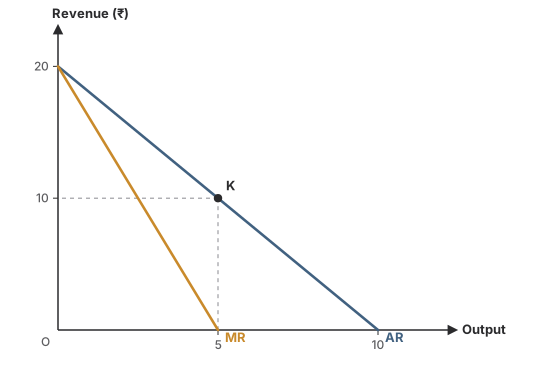
To sell one more unit the firm lowers the price on all its units, so MR is less than AR. For a straight-line AR, the MR line starts at the same point and is twice as steep.
MR reaches zero at 5 units, where TR is at its maximum; the price there is read from AR, ₹10. MR is TR is Positive Rising Zero At its maximum Negative Falling
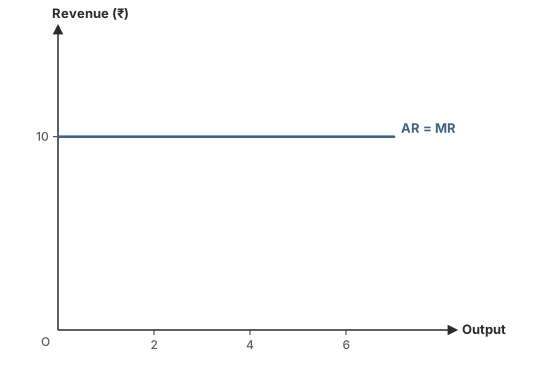
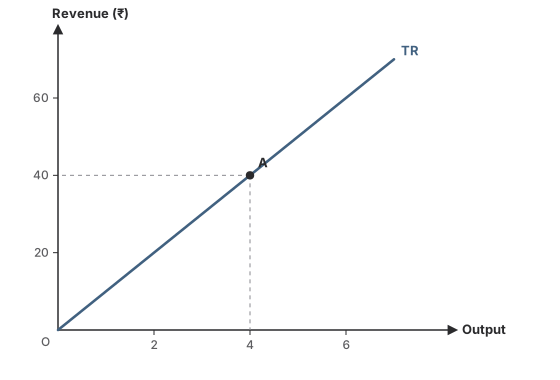
A firm that can sell any quantity at the market price earns that price on every unit: AR = MR = P, a single horizontal line. Its TR is a straight line from the origin whose slope is the price; a higher price makes it steeper.
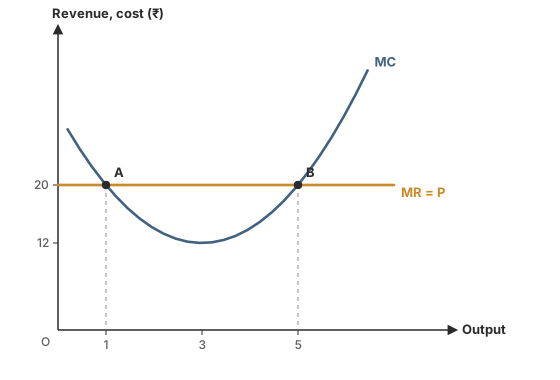
While MR > MC each unit adds to profit; once MR < MC each unit subtracts. Where MC = MR on the falling part of MC, profit is at its lowest, not its highest, because the units just after it still add profit.
The firm produces at B, where MC = MR and MC is rising; A is not the equilibrium. Example 2 · From a cost schedule
A firm sells at ₹20. TC for 0 to 6 units: ₹20, 35, 45, 57, 77, 103, 135. Find the equilibrium output and profit.
MC: 15, 10, 12, 20, 26, 32. MR = ₹20 for every unit.
MC = MR at the 4th unit, and MC is rising there.
Profit at 4 units = 80 − 77 = ₹3; the 5th unit would cost ₹26 for ₹20 of revenue.
For a price taker MR = P, so the rule becomes P = MC . A higher price moves the firm up its MC curve to a larger output.
Maximum TR is not maximum profit. TR peaks where MR = 0; profit peaks where MR = MC.
AR = price, always. AR = MR only when the price is fixed for the firm.
MR = 0: TR at its maximum.
Equilibrium: MC = MR with MC rising; for a price taker, P = MC.
Subtracting ARs to find MR: work out the totals first.
Choosing the MC = MR point where MC is falling.
Reading the price off the MR curve instead of the AR curve.
Revenue
TR = P × q; AR = P; MR = change in TR
Falling price: MR below AR, twice as steep
Price taker: AR = MR = P, horizontal
Equilibrium
MC = MR, MC rising
Price taker: P = MC
Profit = TR − TC at that output
How a price taker's equilibrium gives its supply curve is in perfect competition and supply .
Next · 07 Quick revision → Check your understanding 55 questions, grouped by type, easy to hard. Pick an answer and check it. The worked solution opens when you ask for it.
Total, average and marginal revenue Q1 of 55 Q1
Total, average and marginal revenue 22 questions Total revenue of a firm is
Options for question 1 A Option A price ÷ quantity sold B Option B price × quantity sold C Option C total cost + profit only D Option D the price of one unit
Skip Check Show the explanation Hide the explanation Next question Try again
Show the explanation Hide the explanation Answer B · price × quantity sold
TR = P × q: everything the firm receives from its sales.
Average revenue is always equal to
Options for question 2 A Option A marginal revenue B Option B total revenue C Option C average cost D Option D price
Skip Check Show the explanation Hide the explanation Next question Try again
Show the explanation Hide the explanation Answer D · price
AR = TR ÷ q = (P × q) ÷ q = P, when every unit sells at the same price.
So the AR curve is the firm's demand curve.
Worth noting
AR equals MR only when price is fixed for the firm, as under perfect competition.
Options for question 3 A Option A the change in total revenue from selling one more unit B Option B total revenue ÷ quantity C Option C the price of the first unit D Option D revenue minus cost
Skip Check Show the explanation Hide the explanation Next question Try again
Show the explanation Hide the explanation Answer A · the change in total revenue from selling one more unit
MRₙ = TRₙ − TRₙ₋₁.
A firm can sell more only by lowering its price.
Output 1 2 3 4 5 6 Price (₹) 20 18 16 14 12 10
What is the total revenue from selling 4 units?
Options for question 4 A Option A ₹8 B Option B ₹14 C Option C ₹56 D Option D ₹80
Skip Check Show the explanation Hide the explanation Next question Try again
Show the explanation Hide the explanation Answer C · ₹56
At 4 units the price is ₹14, and every unit sells at that price.
TR = 14 × 4 = ₹56.
Worth noting
₹80 multiplies the first price (₹20) by 4; the price has fallen to ₹14 by the 4th unit.
A firm can sell more only by lowering its price.
Output 1 2 3 4 5 6 Price (₹) 20 18 16 14 12 10
What is the marginal revenue of the 3rd unit?
Options for question 5 A Option A ₹12 B Option B ₹16 C Option C ₹18 D Option D ₹48
Skip Check Show the explanation Hide the explanation Next question Try again
Show the explanation Hide the explanation Answer A · ₹12
TR₂ = 18 × 2 = ₹36; TR₃ = 16 × 3 = ₹48.
MR₃ = 48 − 36 = ₹12, less than the price of ₹16.
Worth noting
₹16 is the price (AR) of the 3rd unit; MR is lower because the first two units now also sell for less.
A firm can sell more only by lowering its price.
Output 1 2 3 4 5 6 Price (₹) 20 18 16 14 12 10
At what output is total revenue at its maximum?
Options for question 6 A Option A At 1 unit, where the price is highest B Option B At 3 units, ₹48 C Option C At 5 and 6 units, ₹60, where MR falls to 0 D Option D At 6 units only, ₹72
Skip Check Show the explanation Hide the explanation Next question Try again
Show the explanation Hide the explanation Answer C · At 5 and 6 units, ₹60, where MR falls to 0
TR: 20, 36, 48, 56, 60, 60. MR: 20, 16, 12, 8, 4, 0.
TR peaks at ₹60 and the 6th unit adds nothing (MR = 0).
TR from selling 9 units is ₹270 and from 10 units is ₹290. What are the AR at 10 units and the MR of the 10th unit?
Options for question 7 A Option A AR ₹30, MR ₹20 B Option B AR ₹29, MR ₹20 C Option C AR ₹29, MR ₹29 D Option D AR ₹20, MR ₹29
Skip Check Show the explanation Hide the explanation Next question Try again
Show the explanation Hide the explanation Answer B · AR ₹29, MR ₹20
AR₁₀ = 290 ÷ 10 = ₹29.
MR₁₀ = 290 − 270 = ₹20.
In the graph, at what output is TR at its maximum, and what is the price there?
Options for question 8 A Option A 10 units, at a price of ₹0 B Option B 5 units, at a price of ₹0 C Option C 5 units, at a price of ₹10 D Option D 1 unit, at a price of ₹20
Skip Check Show the explanation Hide the explanation Next question Try again
Show the explanation Hide the explanation Answer C · 5 units, at a price of ₹10
TR rises while MR is positive and is highest where MR = 0, at 5 units.
The price is read from AR at 5 units: ₹10 (point K). TR = 10 × 5 = ₹50.
Worth noting
MR is 0 at 5 units, but the price is read from AR, not MR.
In the graph, why does the MR line lie below the AR line?
Options for question 9 A Option A To sell one more unit the firm must lower the price on all units, so each extra unit adds less than its price B Option B Costs rise as output rises C Option C AR is always twice MR D Option D The government taxes each unit
Skip Check Show the explanation Hide the explanation Next question Try again
Show the explanation Hide the explanation Answer A · To sell one more unit the firm must lower the price on all units, so each extra unit adds less than its price
The extra unit brings in its price, but the price cut on the earlier units takes some of that away.
So MR < AR whenever AR is falling; for a straight-line AR, MR is twice as steep.
Assertion (A): When MR is negative, TR falls.
Reason (R): MR is the change in TR from one more unit sold.
Options for question 10 A Option A Both A and R are true, and R is the correct explanation of A. B Option B Both A and R are true, but R is not the correct explanation of A. C Option C A is true, but R is false. D Option D A is false, but R is true.
Skip Check Show the explanation Hide the explanation Next question Try again
Show the explanation Hide the explanation Answer A · Both A and R are true, and R is the correct explanation of A.
Both are true, and R explains A: a negative change in TR is a fall in TR.
Read the two statements and choose the correct option.
I. When AR is falling, MR is less than AR.
II. When AR is constant, MR equals AR.
Options for question 11 A Option A Only I B Option B Only II C Option C Both I and II D Option D Neither I nor II
Skip Check Show the explanation Hide the explanation Next question Try again
Show the explanation Hide the explanation Answer C · Both I and II
I is true: a price cut on all units makes MR fall below AR.
II is true: if every unit sells at the same price, each extra unit adds exactly that price.
Options for question 12 A Option A TR is zero B Option B AR is zero C Option C profit is at its maximum D Option D TR is at its maximum
Skip Check Show the explanation Hide the explanation Next question Try again
Show the explanation Hide the explanation Answer D · TR is at its maximum
TR stops rising exactly when the extra unit adds nothing.
Profit is a different matter: it depends on cost too.
Read the two statements and choose the correct option.
I. TR is the sum of the MRs of all units sold.
II. AR is TR ÷ quantity.
Options for question 13 A Option A Only I B Option B Only II C Option C Both I and II D Option D Neither I nor II
Skip Check Show the explanation Hide the explanation Next question Try again
Show the explanation Hide the explanation Answer C · Both I and II
Both are true: each MR is a step in TR, and AR is TR per unit.
A firm can sell more only by lowering its price.
Output 1 2 3 4 5 6 Price (₹) 20 18 16 14 12 10
What is the average revenue when 5 units are sold?
Options for question 14 A Option A ₹4 B Option B ₹12 C Option C ₹14 D Option D ₹60
Skip Check Show the explanation Hide the explanation Next question Try again
Show the explanation Hide the explanation Answer B · ₹12
AR = price = ₹12 at 5 units (TR = 60, and 60 ÷ 5 = 12).
Worth noting
₹4 is the MR of the 5th unit (60 − 56).
A firm can sell more only by lowering its price.
Output 1 2 3 4 5 6 Price (₹) 20 18 16 14 12 10
What is the marginal revenue of the 6th unit?
Options for question 15 A Option A ₹0 B Option B ₹4 C Option C ₹10 D Option D ₹60
Skip Check Show the explanation Hide the explanation Next question Try again
Show the explanation Hide the explanation Answer A · ₹0
TR₅ = 12 × 5 = ₹60; TR₆ = 10 × 6 = ₹60.
MR₆ = 60 − 60 = ₹0: the 6th unit adds nothing to revenue.
Worth noting
₹10 is the price of the 6th unit; MR is lower because all six now sell at ₹10.
A firm's AR is ₹50 at every level of output. Its MR is
Options for question 16 A Option A ₹25 B Option B zero C Option C ₹50 at every level of output D Option D falling with output
Skip Check Show the explanation Hide the explanation Next question Try again
Show the explanation Hide the explanation Answer C · ₹50 at every level of output
If every unit sells for ₹50, each extra unit adds exactly ₹50 to TR.
A constant AR means MR = AR.
In the graph, what is MR at 5 units, and what does it tell you about TR?
Options for question 17 A Option A MR is ₹10, so TR is rising B Option B MR is 0, so TR is at its maximum there C Option C MR is ₹20, so TR is falling D Option D MR is 0, so TR is zero
Skip Check Show the explanation Hide the explanation Next question Try again
Show the explanation Hide the explanation Answer B · MR is 0, so TR is at its maximum there
The MR line meets the quantity axis at 5 units: MR = 0.
TR rises while MR > 0 and falls once MR < 0, so it peaks at 5 units.
Worth noting
₹10 is AR (the price) at 5 units, not MR.
Assertion (A): The AR curve of a firm is its demand curve.
Reason (R): AR equals the price at which each quantity can be sold.
Options for question 18 A Option A Both A and R are true, and R is the correct explanation of A. B Option B Both A and R are true, but R is not the correct explanation of A. C Option C A is true, but R is false. D Option D A is false, but R is true.
Skip Check Show the explanation Hide the explanation Next question Try again
Show the explanation Hide the explanation Answer A · Both A and R are true, and R is the correct explanation of A.
Both are true, and R explains A: a curve of the price at each quantity is the demand curve facing the firm.
A firm's AR is ₹15 at 4 units and ₹14 at 5 units. What is the MR of the 5th unit?
Options for question 19 A Option A ₹−1 B Option B ₹10 C Option C ₹14 D Option D ₹70
Skip Check Show the explanation Hide the explanation Next question Try again
Show the explanation Hide the explanation Answer B · ₹10
TR₄ = 15 × 4 = ₹60; TR₅ = 14 × 5 = ₹70.
MR₅ = 70 − 60 = ₹10.
Worth noting
Subtracting the ARs gives −1; marginal revenue needs the totals.
A firm can sell more only by lowering its price.
Output 1 2 3 4 5 6 Price (₹) 20 18 16 14 12 10
If the firm could sell a 7th unit only by cutting the price to ₹8, what would the MR of the 7th unit be?
Options for question 20 A Option A ₹−4 B Option B ₹0 C Option C ₹8 D Option D ₹56
Skip Check Show the explanation Hide the explanation Next question Try again
Show the explanation Hide the explanation Answer A · ₹−4
TR₇ = 8 × 7 = ₹56; TR₆ = ₹60.
MR₇ = 56 − 60 = ₹−4: selling the 7th unit lowers total revenue.
A firm's demand (AR) is P = 30 − 2Q. What is TR when it sells 5 units?
Options for question 21 A Option A ₹20 B Option B ₹50 C Option C ₹100 D Option D ₹150
Skip Check Show the explanation Hide the explanation Next question Try again
Show the explanation Hide the explanation Answer C · ₹100
At Q = 5, P = 30 − 10 = ₹20.
TR = 20 × 5 = ₹100.
Worth noting
₹20 is the price (AR); ₹150 uses the top price of ₹30.
Read the two statements and choose the correct option.
I. When TR is rising at a diminishing rate, MR is positive and falling.
II. When MR is falling, AR must be rising.
Options for question 22 A Option A Only I B Option B Only II C Option C Both I and II D Option D Neither I nor II
Skip Check Show the explanation Hide the explanation Next question Try again
Show the explanation Hide the explanation Answer A · Only I
I is true: MR is the slope of TR; a flattening rise means a falling but positive slope.
II is false: with a falling price, MR and AR fall together, MR faster.
Revenue at a price set by the market 10 questions For a price-taking firm, the AR and MR curves are
Options for question 23 A Option A downward-sloping lines, MR below AR B Option B upward-sloping lines C Option C vertical lines D Option D the same horizontal line at the market price
Skip Check Show the explanation Hide the explanation Next question Try again
Show the explanation Hide the explanation Answer D · the same horizontal line at the market price
The firm can sell any quantity at the market price, so every unit earns that price: AR = MR = P.
In the graph, the firm sells at ₹10 a unit. What is the slope of its TR line?
Options for question 24 A Option A 0 B Option B 40 C Option C 10, equal to the price D Option D It changes along the line
Skip Check Show the explanation Hide the explanation Next question Try again
Show the explanation Hide the explanation Answer C · 10, equal to the price
TR = 10 × q: each extra unit adds ₹10.
The slope of TR is MR, which equals the price, so TR is a straight line from the origin with slope 10.
Worth noting
40 is the TR at point A, not the slope.
In the graph, the TR line passes through the origin because
Options for question 25 A Option A when nothing is sold, revenue is zero B Option B fixed cost is zero C Option C the price is zero D Option D the firm makes no profit
Skip Check Show the explanation Hide the explanation Next question Try again
Show the explanation Hide the explanation Answer A · when nothing is sold, revenue is zero
TR = P × q, and q = 0 gives TR = 0.
A price-taking firm sells 50 units at ₹12 each. What are its TR, AR and the MR of the 50th unit?
Options for question 26 A Option A TR ₹600, AR ₹12, MR ₹0 B Option B TR ₹600, AR ₹12, MR ₹12 C Option C TR ₹62, AR ₹12, MR ₹12 D Option D TR ₹600, AR ₹50, MR ₹12
Skip Check Show the explanation Hide the explanation Next question Try again
Show the explanation Hide the explanation Answer B · TR ₹600, AR ₹12, MR ₹12
TR = 12 × 50 = ₹600; AR = 600 ÷ 50 = ₹12.
The 50th unit sells for ₹12 like the rest, so MR = ₹12.
Assertion (A): A firm under perfect competition faces a perfectly elastic demand curve.
Reason (R): The firm is too small to affect the market price.
Options for question 27 A Option A Both A and R are true, and R is the correct explanation of A. B Option B Both A and R are true, but R is not the correct explanation of A. C Option C A is true, but R is false. D Option D A is false, but R is true.
Skip Check Show the explanation Hide the explanation Next question Try again
Show the explanation Hide the explanation Answer A · Both A and R are true, and R is the correct explanation of A.
Both are true.
Because it cannot move the price (R), it can sell all it wants at that price and nothing above it: a horizontal demand (AR) curve (A).
A price-taking firm's TR rises by ₹25 for every extra unit it sells. What is the market price?
Options for question 28 A Option A ₹25 B Option B ₹50 C Option C ₹12.50 D Option D It cannot be found
Skip Check Show the explanation Hide the explanation Next question Try again
Show the explanation Hide the explanation Answer A · ₹25
The rise in TR per unit is MR, and for a price taker MR = P.
So the price is ₹25.
A price-taking firm's TR from 20 units is ₹800. What is its MR?
Options for question 29 A Option A ₹20 B Option B ₹40 C Option C ₹800 D Option D ₹16,000
Skip Check Show the explanation Hide the explanation Next question Try again
Show the explanation Hide the explanation Answer B · ₹40
Price = TR ÷ q = 800 ÷ 20 = ₹40.
For a price taker MR = price = ₹40.
If the market price rises, the TR line of a price-taking firm
Options for question 30 A Option A becomes flatter B Option B becomes steeper C Option C shifts up in parallel D Option D does not change
Skip Check Show the explanation Hide the explanation Next question Try again
Show the explanation Hide the explanation Answer B · becomes steeper
The slope of the TR line is the price; a higher price makes it steeper, still from the origin.
Read the two statements and choose the correct option.
I. For a price taker, TR rises at a constant rate as output rises.
II. For a price taker, TR reaches a maximum and then falls.
Options for question 31 A Option A Only I B Option B Only II C Option C Both I and II D Option D Neither I nor II
Skip Check Show the explanation Hide the explanation Next question Try again
Show the explanation Hide the explanation Answer A · Only I
I is true: MR equals the fixed price, so TR rises by the same amount each unit.
II is false: with MR always positive, TR never stops rising.
Assertion (A): A price-taking firm's TR curve is a straight line through the origin.
Reason (R): A price-taking firm's MR is constant and equal to the price.
Options for question 32 A Option A Both A and R are true, and R is the correct explanation of A. B Option B Both A and R are true, but R is not the correct explanation of A. C Option C A is true, but R is false. D Option D A is false, but R is true.
Skip Check Show the explanation Hide the explanation Next question Try again
Show the explanation Hide the explanation Answer A · Both A and R are true, and R is the correct explanation of A.
Both are true, and R explains A: a constant slope (MR) from zero revenue at zero output gives a straight line through the origin.
Producer's equilibrium: MC = MR 23 questions A producer is in equilibrium when
Options for question 33 A Option A it sells the largest possible output B Option B its total revenue is at its maximum C Option C its costs are at their lowest D Option D it earns the maximum profit and has no reason to change its output
Skip Check Show the explanation Hide the explanation Next question Try again
Show the explanation Hide the explanation Answer D · it earns the maximum profit and has no reason to change its output
Equilibrium is the output that maximises profit, TR − TC.
Neither the most sales nor the lowest cost on its own is the aim.
By the MR–MC approach, the two conditions of producer's equilibrium are
Options for question 34 A Option A MC = MR, and MC is rising (cuts MR from below) B Option B MC = MR, and MC is falling C Option C AC = AR, and AC is rising D Option D TR is at its maximum, and TC at its minimum
Skip Check Show the explanation Hide the explanation Next question Try again
Show the explanation Hide the explanation Answer A · MC = MR, and MC is rising (cuts MR from below)
While MR > MC, an extra unit adds to profit; while MR < MC, it subtracts. Profit peaks where they are equal.
MC must also be rising there, or the next units would add profit again.
In the graph, MC equals MR at A and at B. At which point is the firm in equilibrium?
Options for question 35 A Option A At A (1 unit), where MC is falling B Option B At both A and B C Option C At 3 units, where MC is lowest D Option D At B (5 units), where MC is rising
Skip Check Show the explanation Hide the explanation Next question Try again
Show the explanation Hide the explanation Answer D · At B (5 units), where MC is rising
After A, MC drops below MR, so producing more adds to profit: A is a point of least profit, not most.
At B, MC = MR and MC is rising: beyond B each unit costs more than it brings in. Equilibrium is at 5 units.
A firm sells at a market price of ₹20 a unit. Its total cost schedule is:
Output 0 1 2 3 4 5 6 Total cost (₹) 20 35 45 57 77 103 135
What is the marginal cost of the 4th unit?
Options for question 36 A Option A ₹12 B Option B ₹19.25 C Option C ₹20 D Option D ₹77
Skip Check Show the explanation Hide the explanation Next question Try again
Show the explanation Hide the explanation Answer C · ₹20
MC₄ = TC₄ − TC₃ = 77 − 57 = ₹20.
Worth noting
₹19.25 is AC at 4 units (77 ÷ 4).
A firm sells at a market price of ₹20 a unit. Its total cost schedule is:
Output 0 1 2 3 4 5 6 Total cost (₹) 20 35 45 57 77 103 135
At what output is the firm in equilibrium?
Options for question 37 A Option A 2 units, where MC is lowest B Option B 6 units, the largest output C Option C 4 units, where MC = MR = ₹20 and MC is rising D Option D 1 unit, where MC is ₹15
Skip Check Show the explanation Hide the explanation Next question Try again
Show the explanation Hide the explanation Answer C · 4 units, where MC = MR = ₹20 and MC is rising
MC: 15, 10, 12, 20, 26, 32. MR = price = ₹20 for every unit.
MC = MR at the 4th unit, and MC is rising there (12 → 20 → 26). So output is 4 units.
By the TR–TC approach, a firm is in equilibrium at the output where
Options for question 38 A Option A TR is largest B Option B the gap TR − TC is largest C Option C TC is smallest D Option D TR equals TC
Skip Check Show the explanation Hide the explanation Next question Try again
Show the explanation Hide the explanation Answer B · the gap TR − TC is largest
Profit is TR − TC, so the firm picks the output where that gap is widest.
Where TR = TC the firm only breaks even.
Assertion (A): A firm does not stop where MC = MR if MC is falling there.
Reason (R): If MC is falling, the next units cost less than they bring in.
Options for question 39 A Option A Both A and R are true, and R is the correct explanation of A. B Option B Both A and R are true, but R is not the correct explanation of A. C Option C A is true, but R is false. D Option D A is false, but R is true.
Skip Check Show the explanation Hide the explanation Next question Try again
Show the explanation Hide the explanation Answer A · Both A and R are true, and R is the correct explanation of A.
Both are true.
Beyond a point where falling MC meets MR, MC drops below MR, so more output adds profit (R); that is why the firm goes on (A).
Read the two statements and choose the correct option.
I. At equilibrium, a price-taking firm produces where price = MC.
II. At equilibrium, a price-taking firm always makes a profit.
Options for question 40 A Option A Only I B Option B Only II C Option C Both I and II D Option D Neither I nor II
Skip Check Show the explanation Hide the explanation Next question Try again
Show the explanation Hide the explanation Answer A · Only I
I is true: for a price taker MR = P, so MC = MR becomes P = MC.
II is false: equilibrium is the best it can do, which may be a normal profit or even a loss in the short run.
Match each situation with what the firm should do.
List I List II A. MR > MC I. Stay: equilibrium B. MR < MC II. Produce more C. MR = MC, MC rising III. Keep expanding: not the equilibrium D. MR = MC, MC falling IV. Produce less
Options for question 41 A Option A A-II, B-IV, C-I, D-III B Option B A-II, B-I, C-III, D-IV C Option C A-I, B-II, C-IV, D-III D Option D A-III, B-IV, C-I, D-II
Skip Check Show the explanation Hide the explanation Next question Try again
Show the explanation Hide the explanation Answer A · A-II, B-IV, C-I, D-III
MR > MC: the next unit adds profit; MR < MC: the last unit loses money.
MR = MC with rising MC is the equilibrium; with falling MC, more output still pays.
A firm sells at a market price of ₹20 a unit. Its total cost schedule is:
Output 0 1 2 3 4 5 6 Total cost (₹) 20 35 45 57 77 103 135
What is the firm's profit if it produces 6 units?
Options for question 42 A Option A ₹−15 B Option B ₹3 C Option C ₹15 D Option D ₹120
Skip Check Show the explanation Hide the explanation Next question Try again
Show the explanation Hide the explanation Answer A · ₹−15
TR = 20 × 6 = ₹120; TC = ₹135.
Profit = 120 − 135 = ₹−15: going past the equilibrium turns profit into a loss.
A firm sells at a market price of ₹20 a unit. Its total cost schedule is:
Output 0 1 2 3 4 5 6 Total cost (₹) 20 35 45 57 77 103 135
Why should the firm not produce the 5th unit?
Options for question 43 A Option A Its MC of ₹26 is more than its MR of ₹20 B Option B Its MC of ₹26 is less than its MR C Option C TR falls at 5 units D Option D AC is lowest at 5 units
Skip Check Show the explanation Hide the explanation Next question Try again
Show the explanation Hide the explanation Answer A · Its MC of ₹26 is more than its MR of ₹20
MC₅ = 103 − 77 = ₹26, while the unit sells for ₹20.
It adds ₹6 more to cost than to revenue, cutting profit from ₹3 to ₹−3.
At the profit-maximising output, a firm's MR is ₹40. Which must be true?
Options for question 44 A Option A MC is ₹40 and falling B Option B AC is ₹40 C Option C Profit is ₹40 D Option D MC is ₹40 and rising
Skip Check Show the explanation Hide the explanation Next question Try again
Show the explanation Hide the explanation Answer D · MC is ₹40 and rising
Profit is maximised where MC = MR with MC rising.
AC and the size of profit are not fixed by this condition.
In the graph, if the market price rose above ₹20, the equilibrium output would
Options for question 45 A Option A fall below 5 units B Option B stay at 5 units C Option C rise above 5 units, along the rising MC curve D Option D move to point A
Skip Check Show the explanation Hide the explanation Next question Try again
Show the explanation Hide the explanation Answer C · rise above 5 units, along the rising MC curve
A higher MR line cuts the rising part of MC further to the right.
So the firm produces more when the price is higher.
Assertion (A): At the profit-maximising output, total profit is greatest.
Reason (R): At that output, the profit from the last unit (MR − MC) is greatest.
Options for question 46 A Option A Both A and R are true, and R is the correct explanation of A. B Option B Both A and R are true, but R is not the correct explanation of A. C Option C A is true, but R is false. D Option D A is false, but R is true.
Skip Check Show the explanation Hide the explanation Next question Try again
Show the explanation Hide the explanation Answer C · A is true, but R is false.
A is true by definition.
R is false: at the profit-maximising output, the last unit adds zero profit (MR = MC).
Read the two statements and choose the correct option.
I. A producer's equilibrium can be found by comparing TR and TC.
II. A producer's equilibrium can be found by comparing MR and MC.
Options for question 47 A Option A Only I B Option B Only II C Option C Both I and II D Option D Neither I nor II
Skip Check Show the explanation Hide the explanation Next question Try again
Show the explanation Hide the explanation Answer C · Both I and II
Both approaches give the same answer: the largest TR − TC is where MR = MC with MC rising.
In the graph, between 1 and 5 units of output, MR is above MC. What does that mean for profit?
Options for question 48 A Option A Each unit in this range lowers profit B Option B Each unit in this range adds to profit, so the firm should produce them C Option C Profit is at its maximum throughout D Option D The firm should shut down
Skip Check Show the explanation Hide the explanation Next question Try again
Show the explanation Hide the explanation Answer B · Each unit in this range adds to profit, so the firm should produce them
Profit changes by MR − MC with each unit.
Positive MR − MC means each of these units raises profit, which is why the firm goes on to B.
A firm sells at a market price of ₹20 a unit. Its total cost schedule is:
Output 0 1 2 3 4 5 6 Total cost (₹) 20 35 45 57 77 103 135
What is the firm's profit at its equilibrium output?
Options for question 49 A Option A ₹0 B Option B ₹3 C Option C ₹23 D Option D ₹80
Skip Check Show the explanation Hide the explanation Next question Try again
Show the explanation Hide the explanation Answer B · ₹3
At 4 units, TR = 20 × 4 = ₹80 and TC = ₹77.
Profit = 80 − 77 = ₹3. No other output gives more (₹3 at 3 units too, less elsewhere).
A firm sells at a market price of ₹20 a unit. Its total cost schedule is:
Output 0 1 2 3 4 5 6 Total cost (₹) 20 35 45 57 77 103 135
The 4th unit adds the same to revenue as to cost. Why is 4 units still the equilibrium rather than 3?
Options for question 50 A Option A The 4th unit raises profit by ₹20 B Option B At 3 units the firm makes a loss C Option C Producing up to MC = MR follows the rule; the 4th unit leaves profit unchanged at ₹3 D Option D At 3 units MC is above MR
Skip Check Show the explanation Hide the explanation Next question Try again
Show the explanation Hide the explanation Answer C · Producing up to MC = MR follows the rule; the 4th unit leaves profit unchanged at ₹3
Profit at 3 units = 60 − 57 = ₹3; at 4 units = 80 − 77 = ₹3: the 4th unit adds 20 − 20 = 0.
By convention the equilibrium is placed where MC = MR, here the 4th unit; profit is the same.
A firm that must lower its price to sell more has this MR and MC.
Output 1 2 3 4 5 MR (₹) 20 16 12 8 4 MC (₹) 14 10 12 15 20
What is its equilibrium output?
Options for question 51 A Option A 2 units B Option B 1 unit C Option C 5 units D Option D 3 units
Skip Check Show the explanation Hide the explanation Next question Try again
Show the explanation Hide the explanation Answer D · 3 units
MC = MR = ₹12 at the 3rd unit, and MC is rising there (10 → 12 → 15).
The 4th unit would add ₹8 of revenue for ₹15 of cost, so the firm stops at 3.
Assertion (A): A firm is in equilibrium where its total revenue is at its maximum.
Reason (R): Profit is total revenue minus total cost.
Options for question 52 A Option A Both A and R are true, and R is the correct explanation of A. B Option B Both A and R are true, but R is not the correct explanation of A. C Option C A is true, but R is false. D Option D A is false, but R is true.
Skip Check Show the explanation Hide the explanation Next question Try again
Show the explanation Hide the explanation Answer D · A is false, but R is true.
A is false: maximum TR ignores cost; the firm wants maximum TR − TC.
R is true and shows why A is wrong.
A firm sells at a market price of ₹20 a unit. Its total cost schedule is:
Output 0 1 2 3 4 5 6 Total cost (₹) 20 35 45 57 77 103 135
If the market price rose to ₹28, how many units would the firm now produce?
Options for question 53 A Option A 3 units B Option B 4 units C Option C 5 units D Option D 6 units
Skip Check Show the explanation Hide the explanation Next question Try again
Show the explanation Hide the explanation Answer C · 5 units
MC: 15, 10, 12, 20, 26, 32. With MR = ₹28, the 5th unit adds ₹28 of revenue for ₹26 of cost, so it is produced.
The 6th unit would cost ₹32 for ₹28 of revenue, so the firm stops at 5: a higher price moves it up its MC curve to a larger output.
A firm's MR is ₹30 at every output and its MC for units 1 to 5 is ₹40, ₹28, ₹25, ₹30, ₹38. What is its equilibrium output?
Options for question 54 A Option A 2 units B Option B 3 units C Option C 4 units D Option D 5 units
Skip Check Show the explanation Hide the explanation Next question Try again
Show the explanation Hide the explanation Answer C · 4 units
MC = MR = ₹30 at the 4th unit, and MC is rising there (25 → 30 → 38).
The 5th unit costs ₹38 but earns only ₹30, so the firm stops at 4.
A firm sells at ₹20 and its total cost for 0 to 6 units is ₹20, 35, 45, 57, 77, 103, 135. Match each output with its profit.
List I List II A. 2 units I. ₹3 B. 4 units II. ₹−15 C. 5 units III. ₹−5 D. 6 units IV. ₹−3
Options for question 55 A Option A A-III, B-IV, C-II, D-I B Option B A-IV, B-III, C-I, D-II C Option C A-II, B-I, C-IV, D-III D Option D A-III, B-I, C-IV, D-II
Skip Check Show the explanation Hide the explanation Back to start Try again
Show the explanation Hide the explanation Answer D · A-III, B-I, C-IV, D-II
Profit = 20q − TC: 2 units 40 − 45 = −5; 4 units 80 − 77 = 3.
5 units 100 − 103 = −3; 6 units 120 − 135 = −15.
Question types · easy to hard
NTA's Economics syllabus is three courses: Introductory Microeconomics, Introductory Macroeconomics and Indian Economic Development, each split into units with a list of topics. It prints no chapters and no split of the 50 questions across the courses. So the areas here are NTA's three courses, and the chapters inside them are ours: a unit that covers several ideas, such as consumer behaviour and demand, is split into a chapter for each, so that a chapter can be practised in one sitting. All three courses are here.