EduFarming
Your list · 0हिं

Type at least two letters. Press Esc to close.

↑↓ navigate↵ openTAB cycle filter

Cost Curves for CUET Economics

About 5 min to learn · 62 questions

What it costs a firm to produce in the short run. This lesson covers fixed and variable cost, total, average and marginal cost and how to compute them from a schedule, the shapes of the cost curves, why marginal cost meets AVC and AC at their lowest points, and why the minimum of AC comes after that of AVC, with worked examples and a graph of all four curves.

Syllabus area
Introductory Microeconomics
On this page · 8 sections
  1. 01The core idea
  2. 02Fixed and variable cost
  3. 03Average and marginal cost
  4. 04Shapes of the cost curves
  5. 05Exam shortcuts
  6. 06Common mistakes
  7. 07Quick revision
  8. 08Check your understanding

The core idea

In the short run a firm has two kinds of cost: fixed costs it pays whatever it produces (rent, interest, a permanent manager's salary, depreciation) and variable costs that rise with output (raw materials, wages of daily workers, fuel). Every cost curve in this chapter is built from those two.

Fixed and variable cost

How do the total costs relate?

Total cost

TC=TFC+TVC\text{TC} = \text{TFC} + \text{TVC}
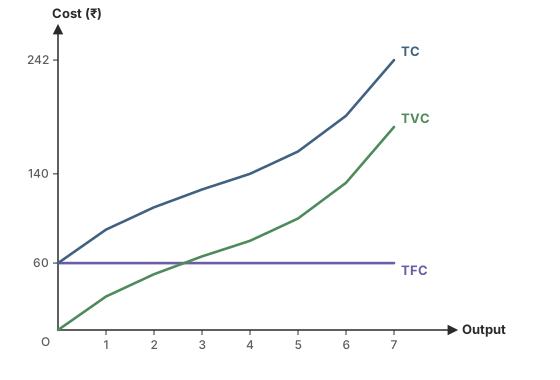
  • TFC is a horizontal line: the same at every output, including zero.
  • TVC starts at the origin and rises.
  • TC starts at TFC and runs parallel to TVC, always TFC above it.

In the long run every input can be varied, so there are no fixed costs.

Average and marginal cost

What are AFC, AVC, AC and MC?

Per-unit costs

AFC=TFCqAVC=TVCqAC=TCq=AFC+AVCMCn=TCn−TCn−1\text{AFC} = \frac{\text{TFC}}{q} \qquad \text{AVC} = \frac{\text{TVC}}{q} \qquad \text{AC} = \frac{\text{TC}}{q} = \text{AFC} + \text{AVC} \qquad \text{MC}_n = \text{TC}_n - \text{TC}_{n-1}

Because TFC does not change, MC is also the change in TVC, and TVC is the sum of the MCs.

Example 1 · From a TC schedule

TC for 0 to 7 units: ₹60, 90, 110, 126, 140, 160, 192, 242. Find TFC, MC, AVC and AC.

  1. TFC = TC at zero output = ₹60.

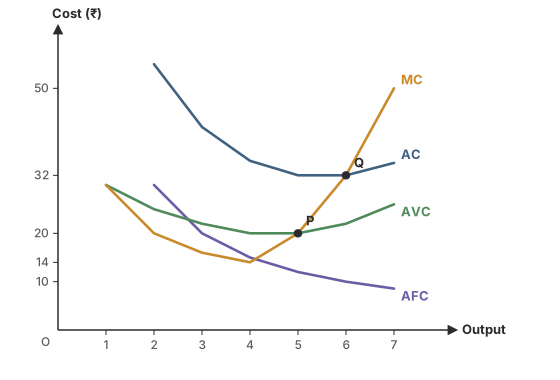
  2. MC: 30, 20, 16, 14, 20, 32, 50.

  3. AVC (TVC ÷ q): 30, 25, 22, 20, 20, 22, 26.

  4. AC (TC ÷ q): 90, 55, 42, 35, 32, 32, 34.57.

Answer

MC lowest at 4 units (₹14); AVC lowest ₹20 at 4–5 units; AC lowest ₹32 at 5–6 units

AFC, AVC, AC and MC from the schedule. MC is lowest at 4 units and meets AVC at P (5 units, ₹20) and AC at Q (6 units, ₹32). AFC keeps falling.
MC turns up first, then cuts AVC at its minimum (P) and AC at its minimum (Q).

Shapes of the cost curves

Why are AVC, AC and MC U-shaped?

Because of the law of variable proportions. While the marginal product of the variable input rises, each extra unit of output needs less of it, so MC and AVC fall. Once marginal product diminishes, each extra unit needs more, so they rise. MC is lowest where MP is highest.

Why does MC cut the averages at their lowest points?

An extra unit that costs less than the average pulls the average down; one that costs more pulls it up. So while MC is below AVC (or AC), the average falls; once MC is above it, the average rises. They are equal exactly at the bottom of the average.

Why does AC reach its minimum after AVC?

AC = AFC + AVC. Past AVC's minimum, AVC starts to rise but AFC is still falling, so AC keeps falling a little longer.

CurveShape
TFCHorizontal line
AFCRectangular hyperbola, never touching the axes
AVC, AC, MCU-shaped
Gap AC − AVCEquals AFC, narrowing as output rises

Watch out

AC and AVC come closer as output rises but never meet: the gap is AFC, which is never zero while there is a fixed cost.

Exam shortcuts

  • TFC at zero output = TC at zero output.
  • Order of minimum points as output rises: MC, then AVC, then AC.
  • A rise in fixed cost moves TFC, TC, AFC and AC; not TVC, AVC or MC.

Common mistakes

  • Subtracting averages to find MC: multiply up to totals first.
  • Saying MC cuts AC from above. It cuts from below, at AC's minimum.
  • Forgetting that MC is unaffected by fixed cost.

Quick revision

Totals

  • TC = TFC + TVC
  • TFC flat; TVC from the origin; TC parallel to TVC

Per unit

  • AFC = TFC ÷ q; AVC = TVC ÷ q; AC = AFC + AVC
  • MC = change in TC

Shapes

  • U-shaped from variable proportions
  • MC cuts AVC and AC at their minimum, from below

What the firm earns from its output is in revenue and producer's equilibrium.

Next · 07Quick revision

Check your understanding

62 questions, grouped by type, easy to hard. Pick an answer and check it. The worked solution opens when you ask for it.

Fixed and variable costQ1 of 62Q1

Fixed and variable cost

18 questions

Total fixed cost is the cost that

Options for question 1

Show the explanationHide the explanation

AnswerB · does not change with output in the short run

  1. Fixed costs, such as rent on the factory or interest on a loan, must be paid even if output is zero.
Which of these is a variable cost?

Options for question 2

Show the explanationHide the explanation

AnswerD · Raw materials

  1. Raw materials are bought in proportion to output, so their cost varies with it.

  2. Rent, a permanent salary and insurance stay the same whatever is produced.

Total cost is

Options for question 3

Show the explanationHide the explanation

AnswerA · total fixed cost + total variable cost

  1. TC = TFC + TVC at every level of output.

Which of these is usually treated as a fixed cost in the short run?

Options for question 4

Show the explanationHide the explanation

AnswerA · Depreciation of machinery

  1. Depreciation is the wear of the capital stock over time, charged whatever is produced.

  2. Fuel, packing and casual wages rise and fall with output: variable.

A firm's short-run total cost schedule is given.

Output (units)01234567
Total cost (₹)6090110126140160192242

What is the total fixed cost?

Options for question 5

Show the explanationHide the explanation

AnswerC · ₹60

  1. At zero output there is no variable cost, so the whole TC of ₹60 is fixed cost.

A firm's short-run total cost schedule is given.

Output (units)01234567
Total cost (₹)6090110126140160192242

What is the total variable cost of producing 4 units?

Options for question 6

Show the explanationHide the explanation

AnswerC · ₹80

  1. TVC = TC − TFC = 140 − 60 = ₹80.

Worth noting

₹20 is the average variable cost at 4 units (80 ÷ 4).

In the graph, the TC curve and the TVC curve

TFC is a horizontal line at ₹60. TVC starts at 0 and rises: 30, 50, 66, 80, 100, 132, 182 for 1 to 7 units. TC starts at ₹60 and runs ₹60 above TVC at every output, reaching ₹242 at 7 units.
Options for question 7

Show the explanationHide the explanation

AnswerC · are the same shape, with TC always ₹60 above TVC

  1. TC = TVC + TFC, and TFC is the same ₹60 at every output.

  2. So the vertical gap between them never changes: the curves are parallel.

In the graph, why does the TC curve start at ₹60 rather than at zero?

TFC is a horizontal line at ₹60. TVC starts at 0 and rises: 30, 50, 66, 80, 100, 132, 182 for 1 to 7 units. TC starts at ₹60 and runs ₹60 above TVC at every output, reaching ₹242 at 7 units.
Options for question 8

Show the explanationHide the explanation

AnswerB · Fixed cost of ₹60 must be paid even when nothing is produced

  1. At zero output TVC = 0, so TC = TFC = ₹60.

Assertion (A): The TFC curve is a horizontal straight line.

Reason (R): Fixed cost does not change with output.

Options for question 9

Show the explanationHide the explanation

AnswerA · Both A and R are true, and R is the correct explanation of A.

  1. Both are true, and a cost that stays the same at every output is drawn as a horizontal line: R explains A.

Assertion (A): Fixed costs exist in the long run.

Reason (R): In the long run all inputs can be varied.

Options for question 10

Show the explanationHide the explanation

AnswerD · A is false, but R is true.

  1. A is false: when every input can be varied, every cost can be varied; there are no fixed costs.

  2. R is true and is the reason A fails.

Read the two statements and choose the correct option.

I. Total variable cost is zero when output is zero.

II. Total cost is zero when output is zero, in the short run.

Options for question 11

Show the explanationHide the explanation

AnswerA · Only I

  1. I is true: no output, no variable inputs.

  2. II is false: fixed cost is still there, so TC = TFC.

Match each cost with its type for a small bakery in the short run.

List IList II
A. FlourI. Fixed cost (rent)
B. Monthly rent of the shopII. Fixed cost (interest)
C. Gas for the ovensIII. Variable cost (an ingredient)
D. Interest on the loan for the ovensIV. Variable cost (fuel used per batch)
Options for question 12

Show the explanationHide the explanation

AnswerA · A-III, B-I, C-IV, D-II

  1. Flour and gas rise with the number of loaves: variable.

  2. Rent and loan interest are paid whatever is baked: fixed.

If TFC rises (say the rent goes up) and nothing else changes, which curves move?

Options for question 13

Show the explanationHide the explanation

AnswerD · TFC, TC, AFC and AC; not TVC, AVC or MC

  1. A higher fixed cost raises every total or average that includes it: TFC, TC, AFC and AC.

  2. TVC, AVC and MC contain no fixed cost, so they stay where they are.

A firm's short-run total cost schedule is given.

Output (units)01234567
Total cost (₹)6090110126140160192242

What is the total variable cost of producing 7 units?

Options for question 14

Show the explanationHide the explanation

AnswerC · ₹182

  1. TVC₇ = TC₇ − TFC = 242 − 60 = ₹182.

Worth noting

₹50 is the MC of the 7th unit; ₹26 is AVC at 7 units.

The TVC curve starts from the origin because

Options for question 15

Show the explanationHide the explanation

AnswerC · no variable inputs are used when output is zero

  1. Variable cost is spent only on producing; with nothing produced, it is zero.

Read the two statements and choose the correct option.

I. The vertical distance between TC and TVC equals TFC at every output.

II. The vertical distance between AC and AVC equals AFC at every output.

Options for question 16

Show the explanationHide the explanation

AnswerC · Both I and II

  1. TC − TVC = TFC: I is true, and that gap is constant.

  2. AC − AVC = AFC: II is true, and that gap shrinks as output rises.

Assertion (A): Explicit costs are payments made to outsiders for inputs.

Reason (R): The owner's own capital used in the business has no cost.

Options for question 17

Show the explanationHide the explanation

AnswerC · A is true, but R is false.

  1. A is true: wages, rent paid and raw materials bought are explicit costs.

  2. R is false: the owner's capital could have earned interest elsewhere; that forgone interest is an implicit cost.

A shopkeeper works in his own shop instead of taking a job paying ₹15,000 a month. In economics, this ₹15,000 is

Options for question 18

Show the explanationHide the explanation

AnswerB · an implicit cost of running the shop

  1. No money is paid out, but the owner gives up a salary he could have earned.

  2. A forgone earning of the owner's own input is an implicit cost.

Average and marginal cost

23 questions

Marginal cost is

Options for question 19

Show the explanationHide the explanation

AnswerC · the change in total cost from producing one more unit

  1. MCₙ = TCₙ − TCₙ₋₁. Since TFC does not change, it is also TVCₙ − TVCₙ₋₁.

Average cost is

Options for question 20

Show the explanationHide the explanation

AnswerA · total cost ÷ output, which equals AFC + AVC

  1. AC = TC ÷ q = (TFC + TVC) ÷ q = AFC + AVC.

Worth noting

TFC ÷ output alone is average fixed cost, one part of AC.

Read the two statements and choose the correct option.

I. TVC is the sum of the marginal costs of all units produced.

II. TC is the sum of the marginal costs of all units produced.

Options for question 21

Show the explanationHide the explanation

AnswerA · Only I

  1. I is true: each MC is a step in TVC.

  2. II is false: TC also includes TFC, which no MC contains.

A firm's short-run total cost schedule is given.

Output (units)01234567
Total cost (₹)6090110126140160192242

What is the marginal cost of the 3rd unit?

Options for question 22

Show the explanationHide the explanation

AnswerA · ₹16

  1. MC₃ = TC₃ − TC₂ = 126 − 110 = ₹16.

Worth noting

₹42 is the AC at 3 units; ₹22 is the AVC.

A firm's short-run total cost schedule is given.

Output (units)01234567
Total cost (₹)6090110126140160192242

What is the average cost of producing 5 units?

Options for question 23

Show the explanationHide the explanation

AnswerC · ₹32

  1. AC₅ = TC₅ ÷ 5 = 160 ÷ 5 = ₹32.

  2. Check: AFC₅ = 60 ÷ 5 = 12 and AVC₅ = 100 ÷ 5 = 20; 12 + 20 = 32.

A firm's short-run total cost schedule is given.

Output (units)01234567
Total cost (₹)6090110126140160192242

What is the average fixed cost at 6 units?

Options for question 24

Show the explanationHide the explanation

AnswerA · ₹10

  1. AFC = TFC ÷ q = 60 ÷ 6 = ₹10.

A firm's short-run total cost schedule is given.

Output (units)01234567
Total cost (₹)6090110126140160192242

At what output is marginal cost lowest?

Options for question 25

Show the explanationHide the explanation

AnswerD · 4 units, where MC is ₹14

  1. MC: 30, 20, 16, 14, 20, 32, 50 for units 1 to 7.

  2. The lowest is ₹14, for the 4th unit; after that MC rises.

AFC = ₹25 and AVC = ₹40 at a certain output. What is AC there?

Options for question 26

Show the explanationHide the explanation

AnswerC · ₹65

  1. AC = AFC + AVC = 25 + 40 = ₹65.

Total cost of producing 10 units is ₹600 and of 11 units is ₹640. What is the marginal cost of the 11th unit?

Options for question 27

Show the explanationHide the explanation

AnswerA · ₹40

  1. MC₁₁ = TC₁₁ − TC₁₀ = 640 − 600 = ₹40.

Worth noting

₹58.18 is AC at 11 units (640 ÷ 11); ₹60 is AC at 10 units.

A firm's short-run total cost schedule is given.

Output (units)01234567
Total cost (₹)6090110126140160192242

At what output is average cost lowest?

Options for question 28

Show the explanationHide the explanation

AnswerD · At 5 and 6 units, ₹32

  1. AC: 90, 55, 42, 35, 32, 32, 34.57.

  2. The lowest is ₹32 at 5 and 6 units; the MC of the 6th unit is also ₹32.

Assertion (A): Marginal cost is unaffected by fixed cost.

Reason (R): Fixed cost does not change when one more unit is produced.

Options for question 29

Show the explanationHide the explanation

AnswerA · Both A and R are true, and R is the correct explanation of A.

  1. Both are true, and R explains A: MC is a change in cost, and fixed cost does not change.

A firm's short-run total cost schedule is given.

Output (units)01234567
Total cost (₹)6090110126140160192242

What is the marginal cost of the 6th unit?

Options for question 30

Show the explanationHide the explanation

AnswerC · ₹32

  1. MC₆ = TC₆ − TC₅ = 192 − 160 = ₹32.

  2. This equals AC at 6 units (192 ÷ 6 = 32): MC meets AC at its minimum.

Worth noting

₹22 is AVC at 6 units; ₹10 is AFC.

A firm's short-run total cost schedule is given.

Output (units)01234567
Total cost (₹)6090110126140160192242

What is the average variable cost of producing 2 units?

Options for question 31

Show the explanationHide the explanation

AnswerB · ₹25

  1. TVC₂ = 110 − 60 = ₹50; AVC₂ = 50 ÷ 2 = ₹25.

Worth noting

₹55 is AC (110 ÷ 2), which includes fixed cost.

A firm's TFC is ₹500. What is AFC at 25 units of output?

Options for question 32

Show the explanationHide the explanation

AnswerA · ₹20

  1. AFC = TFC ÷ q = 500 ÷ 25 = ₹20.

TVC = 5q + q² for a firm. What is the MC of the 3rd unit?

Options for question 33

Show the explanationHide the explanation

AnswerB · ₹10

  1. TVC₃ = 15 + 9 = ₹24; TVC₂ = 10 + 4 = ₹14.

  2. MC₃ = 24 − 14 = ₹10.

Worth noting

₹8 is AVC at 3 units (24 ÷ 3).

Assertion (A): When AVC is constant, MC equals AVC.

Reason (R): An average stays the same only if each new unit costs exactly the average.

Options for question 34

Show the explanationHide the explanation

AnswerA · Both A and R are true, and R is the correct explanation of A.

  1. Both are true, and R explains A.

Read the two statements and choose the correct option.

I. AC is always greater than AVC in the short run.

II. AC and AVC meet at high levels of output.

Options for question 35

Show the explanationHide the explanation

AnswerA · Only I

  1. I is true: AC = AVC + AFC, and AFC is always positive.

  2. II is false: AFC never reaches zero, so the curves come closer but never meet.

A firm's short-run total cost schedule is given.

Output (units)01234567
Total cost (₹)6090110126140160192242

At what output is average variable cost lowest, and how does MC compare with AVC there?

Options for question 36

Show the explanationHide the explanation

AnswerC · At 4 and 5 units, AVC = ₹20; at 5 units MC is also ₹20

  1. AVC: 30, 25, 22, 20, 20, 22, 26. The lowest is ₹20, at 4 and 5 units.

  2. MC of the 5th unit is ₹20 = AVC: MC meets AVC at its minimum.

A firm's TFC is ₹200. At 10 units, its AC is ₹50. What is its TVC at 10 units?

Options for question 37

Show the explanationHide the explanation

AnswerB · ₹300

  1. TC = AC × q = 50 × 10 = ₹500.

  2. TVC = TC − TFC = 500 − 200 = ₹300.

Worth noting

₹30 is AVC (300 ÷ 10); ₹500 is TC.

The AVC of producing 4 units is ₹15 and of producing 5 units is ₹16. What is the MC of the 5th unit?

Options for question 38

Show the explanationHide the explanation

AnswerC · ₹20

  1. TVC₄ = 4 × 15 = ₹60; TVC₅ = 5 × 16 = ₹80.

  2. MC₅ = TVC₅ − TVC₄ = 80 − 60 = ₹20.

Worth noting

₹1 subtracts the averages; marginal cost needs the totals.

The MCs of the first four units are ₹10, ₹8, ₹9 and ₹13. TFC is ₹20. What is the AC of 4 units?

Options for question 39

Show the explanationHide the explanation

AnswerC · ₹15

  1. TVC = sum of MCs = 10 + 8 + 9 + 13 = ₹40.

  2. TC = 20 + 40 = ₹60; AC = 60 ÷ 4 = ₹15.

Worth noting

₹10 is AVC (40 ÷ 4), leaving out fixed cost.

A firm's short-run total cost schedule is given.

Output (units)01234567
Total cost (₹)6090110126140160192242

By how much does AFC fall when output rises from 2 to 4 units?

Options for question 40

Show the explanationHide the explanation

AnswerB · ₹15

  1. AFC₂ = 60 ÷ 2 = ₹30; AFC₄ = 60 ÷ 4 = ₹15.

  2. It halves when output doubles: a fall of ₹15.

At 8 units AC = ₹30 and at 9 units AC = ₹29. What is the MC of the 9th unit?

Options for question 41

Show the explanationHide the explanation

AnswerB · ₹21

  1. TC₈ = 8 × 30 = ₹240; TC₉ = 9 × 29 = ₹261.

  2. MC₉ = 261 − 240 = ₹21. Since MC (₹21) is below AC, AC falls, as it did.

The shapes of the cost curves

21 questions

The short-run AVC, AC and MC curves are usually

Options for question 42

Show the explanationHide the explanation

AnswerA · U-shaped

  1. They fall at first and rise later, because the marginal product of the variable input first rises and then diminishes.

The AFC curve is a rectangular hyperbola because

Options for question 43

Show the explanationHide the explanation

AnswerB · AFC × output always equals the same TFC

  1. AFC = TFC ÷ q, so AFC × q = TFC, a constant.

  2. A curve on which the product of the two coordinates is constant is a rectangular hyperbola: it keeps falling but never touches either axis.

In the graph, why does the gap between AC and AVC narrow as output rises?

Short-run cost curves from the schedule. MC is 30, 20, 16, 14, 20, 32, 50 for the 1st to 7th unit, lowest at 14 for the 4th. AVC is 30, 25, 22, 20, 20, 22, 26, lowest at 20 for 4 and 5 units. AC (from 2 units) is 55, 42, 35, 32, 32, 34.57, lowest at 32 for 5 and 6 units. AFC falls from 30 at 2 units to 8.57 at 7. MC meets AVC at P (5 units, ₹20) and AC at Q (6 units, ₹32).
Options for question 44

Show the explanationHide the explanation

AnswerD · The gap is AFC, which falls as the fixed cost is spread over more units

  1. AC − AVC = AFC. At 2 units the gap is 55 − 25 = 30; at 6 units it is 32 − 22 = 10.

  2. The total fixed cost stays ₹60, but per unit it shrinks as output grows.

Worth noting

TFC itself does not fall; only its share per unit does.

In the graph, MC cuts AVC at P and AC at Q. Which statement is correct?

Short-run cost curves from the schedule. MC is 30, 20, 16, 14, 20, 32, 50 for the 1st to 7th unit, lowest at 14 for the 4th. AVC is 30, 25, 22, 20, 20, 22, 26, lowest at 20 for 4 and 5 units. AC (from 2 units) is 55, 42, 35, 32, 32, 34.57, lowest at 32 for 5 and 6 units. AFC falls from 30 at 2 units to 8.57 at 7. MC meets AVC at P (5 units, ₹20) and AC at Q (6 units, ₹32).
Options for question 45

Show the explanationHide the explanation

AnswerA · MC cuts both at their lowest points, from below

  1. P (5 units, ₹20) is the lowest AVC; Q (6 units, ₹32) is the lowest AC.

  2. Below them MC is less than the average, pulling it down; above them MC is more, pulling it up.

In the graph, the lowest AVC (at 4–5 units) comes before the lowest AC (at 5–6 units). Why?

Short-run cost curves from the schedule. MC is 30, 20, 16, 14, 20, 32, 50 for the 1st to 7th unit, lowest at 14 for the 4th. AVC is 30, 25, 22, 20, 20, 22, 26, lowest at 20 for 4 and 5 units. AC (from 2 units) is 55, 42, 35, 32, 32, 34.57, lowest at 32 for 5 and 6 units. AFC falls from 30 at 2 units to 8.57 at 7. MC meets AVC at P (5 units, ₹20) and AC at Q (6 units, ₹32).
Options for question 46

Show the explanationHide the explanation

AnswerD · Even after AVC starts rising, falling AFC keeps pulling AC down for a while

  1. AC = AFC + AVC. Past 5 units AVC rises, but AFC is still falling.

  2. AC keeps falling until the rise in AVC outweighs the fall in AFC, so its minimum comes later.

The graph shows the usual short-run cost curves. As output rises, in what order are the minimum points of MC, AVC and AC reached?

Short-run cost curves from the schedule. MC is 30, 20, 16, 14, 20, 32, 50 for the 1st to 7th unit, lowest at 14 for the 4th. AVC is 30, 25, 22, 20, 20, 22, 26, lowest at 20 for 4 and 5 units. AC (from 2 units) is 55, 42, 35, 32, 32, 34.57, lowest at 32 for 5 and 6 units. AFC falls from 30 at 2 units to 8.57 at 7. MC meets AVC at P (5 units, ₹20) and AC at Q (6 units, ₹32).
Options for question 47

Show the explanationHide the explanation

AnswerB · Minimum MC, then minimum AVC, then minimum AC

  1. MC turns up first. AVC keeps falling until rising MC reaches it, and AC until MC reaches it.

The U shape of the short-run AVC curve is explained by

Options for question 48

Show the explanationHide the explanation

AnswerC · the law of variable proportions

  1. While the marginal product of the variable input rises, each unit of output needs less of it, so AVC falls.

  2. Once marginal product diminishes, each unit needs more of it, so AVC rises.

Assertion (A): When MC is below AC, AC falls.

Reason (R): An extra unit that costs less than the average lowers the average.

Options for question 49

Show the explanationHide the explanation

AnswerA · Both A and R are true, and R is the correct explanation of A.

  1. Both are true, and R is the general reason for A.

Assertion (A): The AFC curve touches the quantity axis at a large enough output.

Reason (R): TFC is positive in the short run.

Options for question 50

Show the explanationHide the explanation

AnswerD · A is false, but R is true.

  1. A is false: AFC = TFC ÷ q is never zero while TFC is positive; it only approaches the axis.

  2. R is true.

Read the two statements and choose the correct option.

I. AVC can be falling while MC is rising.

II. AC can be falling while AVC is rising.

Options for question 51

Show the explanationHide the explanation

AnswerC · Both I and II

  1. I is true: between MC's minimum and AVC's minimum, MC rises but is still below AVC.

  2. II is true: between AVC's minimum and AC's minimum, falling AFC still pulls AC down.

Match each cost curve with its usual shape.

List IList II
A. TFCI. U-shaped
B. AFCII. Horizontal line
C. AVCIII. Rising from the origin, first at a falling then at a rising rate
D. TVCIV. Rectangular hyperbola
Options for question 52

Show the explanationHide the explanation

AnswerB · A-II, B-IV, C-I, D-III

  1. TFC is constant: horizontal. AFC = TFC ÷ q: a rectangular hyperbola.

  2. AVC is U-shaped; TVC starts at zero and rises, slowly at first and then faster.

MC first falls and then rises because

Options for question 53

Show the explanationHide the explanation

AnswerA · the marginal product of the variable input first rises and then falls

  1. MC = wage ÷ MP of labour. While MP rises, each extra unit needs less labour, so MC falls.

  2. Once MP diminishes, each extra unit needs more labour, so MC rises.

In the graph, what is the AFC at 7 units of output?

Short-run cost curves from the schedule. MC is 30, 20, 16, 14, 20, 32, 50 for the 1st to 7th unit, lowest at 14 for the 4th. AVC is 30, 25, 22, 20, 20, 22, 26, lowest at 20 for 4 and 5 units. AC (from 2 units) is 55, 42, 35, 32, 32, 34.57, lowest at 32 for 5 and 6 units. AFC falls from 30 at 2 units to 8.57 at 7. MC meets AVC at P (5 units, ₹20) and AC at Q (6 units, ₹32).
Options for question 54

Show the explanationHide the explanation

AnswerA · ₹8.57

  1. AFC = TFC ÷ q = 60 ÷ 7 ≈ ₹8.57.

  2. Check: AC − AVC = 34.57 − 26 = 8.57.

In the graph, between 4 and 5 units, MC rises from ₹14 to ₹20 while AVC stays at ₹20. What does that show?

Short-run cost curves from the schedule. MC is 30, 20, 16, 14, 20, 32, 50 for the 1st to 7th unit, lowest at 14 for the 4th. AVC is 30, 25, 22, 20, 20, 22, 26, lowest at 20 for 4 and 5 units. AC (from 2 units) is 55, 42, 35, 32, 32, 34.57, lowest at 32 for 5 and 6 units. AFC falls from 30 at 2 units to 8.57 at 7. MC meets AVC at P (5 units, ₹20) and AC at Q (6 units, ₹32).
Options for question 55

Show the explanationHide the explanation

AnswerC · The 5th unit costs exactly the average, so AVC does not change

  1. The 5th unit's MC is ₹20, equal to AVC, so adding it leaves the average at ₹20.

  2. This is the bottom of AVC, where MC crosses it.

The long-run average cost curve is usually U-shaped because of

Options for question 56

Show the explanationHide the explanation

AnswerB · increasing and then decreasing returns to scale

  1. In the long run all inputs vary, so the shape comes from returns to scale, not from a fixed input.

  2. Increasing returns lower average cost as the firm grows; decreasing returns raise it later.

Worth noting

The law of variable proportions explains the short-run curves, where one input is fixed.

In the graph, at 3 units of output, MC is ₹16 and AVC is ₹22. What is happening to AVC?

Short-run cost curves from the schedule. MC is 30, 20, 16, 14, 20, 32, 50 for the 1st to 7th unit, lowest at 14 for the 4th. AVC is 30, 25, 22, 20, 20, 22, 26, lowest at 20 for 4 and 5 units. AC (from 2 units) is 55, 42, 35, 32, 32, 34.57, lowest at 32 for 5 and 6 units. AFC falls from 30 at 2 units to 8.57 at 7. MC meets AVC at P (5 units, ₹20) and AC at Q (6 units, ₹32).
Options for question 57

Show the explanationHide the explanation

AnswerC · It is falling, because MC is below it

  1. The 3rd unit costs ₹16, less than the ₹25 average so far, so the average falls to ₹22.

  2. Whenever MC is below an average, that average is falling.

Assertion (A): The minimum point of AC lies to the right of the minimum point of AVC.

Reason (R): AFC keeps falling as output rises.

Options for question 58

Show the explanationHide the explanation

AnswerA · Both A and R are true, and R is the correct explanation of A.

  1. Both are true: in the schedule AVC is lowest at 4–5 units and AC at 5–6 units.

  2. Because AFC is still falling when AVC starts to rise (R), AC goes on falling a little longer (A).

When marginal product of labour is at its maximum, marginal cost is

Options for question 59

Show the explanationHide the explanation

AnswerD · at its minimum

  1. MC = wage ÷ MP. The largest MP gives the smallest MC.

Assertion (A): The minimum of the MC curve comes before the minimum of the AVC curve.

Reason (R): AVC keeps falling as long as MC is below it, even after MC starts to rise.

Options for question 60

Show the explanationHide the explanation

AnswerA · Both A and R are true, and R is the correct explanation of A.

  1. Both are true: in the schedule MC is lowest at 4 units (₹14), AVC at 4–5 units (₹20).

  2. R explains A: rising MC keeps pulling AVC down until it reaches AVC.

Read the two statements and choose the correct option.

I. When AC is at its minimum, AC = MC.

II. When AVC is at its minimum, AVC = AFC.

Options for question 61

Show the explanationHide the explanation

AnswerA · Only I

  1. I is true: MC cuts AC at AC's minimum.

  2. II is false: at AVC's minimum it is MC that equals AVC; AFC has no special relation there.

A firm's total cost for 0 to 7 units is ₹60, 90, 110, 126, 140, 160, 192 and 242. Match each output with a correct fact.

List IList II
A. 4 unitsI. MC is above AC, so AC rises
B. 5 unitsII. MC = AC = ₹32
C. 6 unitsIII. MC = AVC = ₹20
D. 7 unitsIV. MC is at its lowest (₹14)
Options for question 62

Show the explanationHide the explanation

AnswerD · A-IV, B-III, C-II, D-I

  1. MC: 14 at the 4th unit (lowest), 20 at the 5th (= AVC), 32 at the 6th (= AC).

  2. At the 7th unit MC = ₹50 > AC, so AC rises from 32 to 34.57.

NTA's Economics syllabus is three courses: Introductory Microeconomics, Introductory Macroeconomics and Indian Economic Development, each split into units with a list of topics. It prints no chapters and no split of the 50 questions across the courses. So the areas here are NTA's three courses, and the chapters inside them are ours: a unit that covers several ideas, such as consumer behaviour and demand, is split into a chapter for each, so that a chapter can be practised in one sitting. All three courses are here.