EduFarming
Your list · 0हिं

Type at least two letters. Press Esc to close.

↑↓ navigate↵ openTAB cycle filter

Production Function, TP, MP and AP for CUET Economics

About 5 min to learn · 62 questions

How output responds to inputs. This lesson covers the production function, the short run and the long run, total, marginal and average product and how to compute them from a schedule, the shapes of their curves, the three phases of the law of variable proportions, and returns to scale, with worked examples and the traps CUET sets.

Syllabus area
Introductory Microeconomics
On this page · 9 sections
  1. 01The core idea
  2. 02Short run and long run
  3. 03Total, marginal and average product
  4. 04The law of variable proportions
  5. 05Returns to scale
  6. 06Exam shortcuts
  7. 07Common mistakes
  8. 08Quick revision
  9. 09Check your understanding

The core idea

A production function is a technical relation: for each combination of inputs, the most output the technology allows, q = f(L, K). In the short run some input, usually capital, is fixed, so output changes only through the variable input. In the long run every input can change.

Short run and long run

What separates them?

Not a number of months, but flexibility. The short run is any period in which at least one input is fixed; the long run is long enough to change them all. A tea stall's long run may be days; a steel plant's, years.

Total, marginal and average product

What are TP, MP and AP?

Product concepts

MPL=TPn−TPn−1APL=TPLTP=∑MP\text{MP}_L = \text{TP}_n - \text{TP}_{n-1} \qquad \text{AP}_L = \frac{\text{TP}}{L} \qquad \text{TP} = \sum \text{MP}

Example 1 · From a TP schedule

With capital fixed, labour 1 to 9 gives TP: 10, 24, 39, 52, 60, 66, 70, 70, 63. Find MP and AP.

  1. MP (each TP minus the one before): 10, 14, 15, 13, 8, 6, 4, 0, −7.

  2. AP (TP ÷ L): 10, 12, 13, 13, 12, 11, 10, 8.75, 7.

  3. AP is highest (13) at 3 and 4 workers; at 4 workers MP = AP = 13.

Answer

MP rises to 15, then falls to 0 and −7; AP peaks at 13

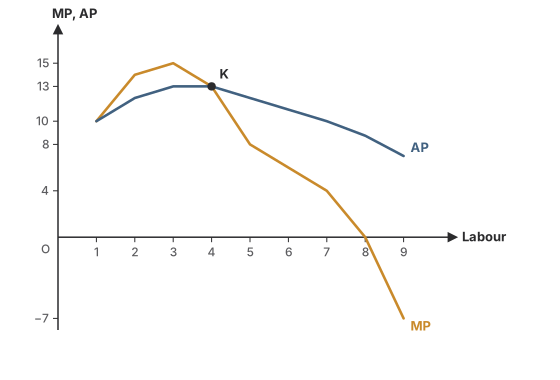
Marginal and average product curves. MP is 10, 14, 15, 13, 8, 6, 4, 0 and −7; AP is 10, 12, 13, 13, 12, 11, 10, 8.75 and 7. They meet at K, 4 workers, where MP = AP = 13.
MP cuts AP at AP's highest point, K.
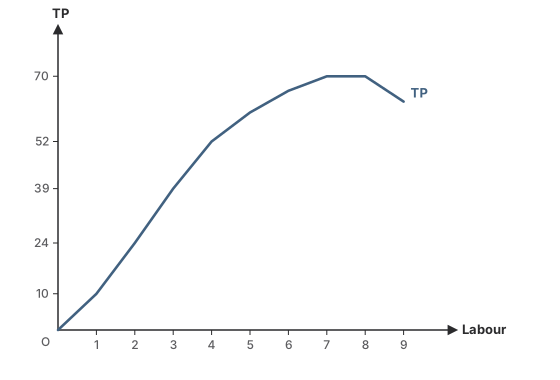
  • MP and TP: MP is the slope of TP. Positive MP, TP rises; zero MP, TP is at its peak; negative MP, TP falls.
  • MP and AP: while MP is above AP, AP rises; when MP is below AP, AP falls; MP cuts AP at AP's maximum.
  • AP stays positive as long as TP is positive, even when MP is negative.

Watch out

A falling MP does not mean a falling AP. MP can fall while still above AP, and then AP keeps rising.

The law of variable proportions

What are its three phases?

PhaseMPTP
FirstRisingRises at an increasing rate
SecondFalling but positiveRises at a diminishing rate, peaks where MP = 0
ThirdNegativeFalls

In the schedule above, the first phase is workers 1 to 3, the second 4 to 8, and the third from the 9th worker.

Why does MP eventually diminish?

The fixed input is shared among more and more workers. Once it is fully used, each extra worker has less of it to work with and adds less. The workers are assumed to be equally skilled, so lower skill is not the reason.

A rational firm operates in the second phase: in the first, hiring more always pays more; in the third, extra workers reduce output.

Returns to scale

What happens when all inputs grow together?

Returns to scale compare the rise in output with a proportional rise in every input, a long-run idea.

Inputs doubled, outputReturns to scale
More than doublesIncreasing
Exactly doublesConstant
Less than doublesDecreasing

For q = Lᵃ Kᵇ, add the exponents: a + b > 1 increasing, = 1 constant, < 1 decreasing. For q = L⁰·⁵ K⁰·⁵, doubling both inputs doubles output.

Watch out

Diminishing returns to a factor and returns to scale are different laws. q = L⁰·⁵ K⁰·⁵ has diminishing MP of labour but constant returns to scale.

Exam shortcuts

  • MP = 0: TP at its maximum. MP = AP: AP at its maximum.
  • Three phases: MP rising, MP falling but positive, MP negative.
  • Returns to scale: sum of exponents compared with 1.

Common mistakes

  • Dividing averages to find MP: work out totals first.
  • Treating the third phase as starting where MP falls; it starts where MP turns negative.
  • Applying returns to scale when only one input changes.

Quick revision

Products

  • MP = change in TP; AP = TP ÷ L
  • MP above AP: AP rises; MP cuts AP at its peak

Variable proportions

  • One input fixed, short run
  • Phases: MP rising, falling, negative
  • Rational firm: second phase

Returns to scale

  • All inputs vary, long run
  • Increasing, constant, decreasing

What these products cost the firm is the subject of cost curves.

Next · 08Quick revision

Check your understanding

62 questions, grouped by type, easy to hard. Pick an answer and check it. The worked solution opens when you ask for it.

Short run and long runQ1 of 62Q1

Short run and long run

7 questions

A production function shows

Options for question 1

Show the explanationHide the explanation

AnswerB · the technical relation between inputs and the most output they can produce

  1. q = f(L, K): for each combination of labour and capital, the most output the technology allows.
The short run is a period in which

Options for question 2

Show the explanationHide the explanation

AnswerD · at least one factor of production is fixed

  1. In the short run a firm can change some inputs, such as labour, but not others, such as its factory.

  2. In the long run every input can be varied.

In the long run,

Options for question 3

Show the explanationHide the explanation

AnswerA · all factors of production are variable

  1. Given enough time, a firm can change even its plant and machinery.

Which of these is usually a fixed factor in the short run?

Options for question 4

Show the explanationHide the explanation

AnswerC · The size of the factory building

  1. A building cannot be enlarged at short notice; workers, materials and power can be changed with output.

The short run and the long run are distinguished by

Options for question 5

Show the explanationHide the explanation

AnswerB · whether all inputs can be varied, not by a fixed number of months

  1. The line is drawn by flexibility, not the calendar: a tea stall's long run can be days, a steel plant's years.

Read the two statements and choose the correct option.

I. The law of variable proportions applies in the short run.

II. Returns to scale apply in the long run.

Options for question 6

Show the explanationHide the explanation

AnswerC · Both I and II

  1. Variable proportions: one input varies while another is fixed, so it is a short-run law. I is true.

  2. Returns to scale: all inputs vary together, which is possible only in the long run. II is true.

A tailor can hire extra helpers within a day but needs a year to rent a bigger shop. For this tailor, the long run is

Options for question 7

Show the explanationHide the explanation

AnswerB · a period of a year or more

  1. The long run is long enough to change every input, including the shop, which takes about a year here.

Total, marginal and average product

26 questions

Marginal product of labour is

Options for question 8

Show the explanationHide the explanation

AnswerC · the change in total product from employing one more unit of labour

  1. MPₗ = TPₙ − TPₙ₋₁, the output the extra worker adds.

  2. TP divided by labour is the average product.

Average product of labour is

Options for question 9

Show the explanationHide the explanation

AnswerA · total product ÷ units of labour

  1. APₗ = TP ÷ L: output per worker.

Capital is fixed and labour is varied. The table shows total product.

Labour (units)123456789
Total product102439526066707063

What is the marginal product of the 3rd unit of labour?

Options for question 10

Show the explanationHide the explanation

AnswerC · 15

  1. MP₃ = TP₃ − TP₂ = 39 − 24 = 15.

Worth noting

13 is the average product at 3 units (39 ÷ 3).

Capital is fixed and labour is varied. The table shows total product.

Labour (units)123456789
Total product102439526066707063

What is the average product when 5 units of labour are employed?

Options for question 11

Show the explanationHide the explanation

AnswerB · 12

  1. AP₅ = TP₅ ÷ 5 = 60 ÷ 5 = 12.

Worth noting

8 is the marginal product of the 5th unit (60 − 52).

Capital is fixed and labour is varied. The table shows total product.

Labour (units)123456789
Total product102439526066707063

At which unit of labour does MP become zero, and what is TP there?

Options for question 12

Show the explanationHide the explanation

AnswerD · The 8th unit, where TP is at its maximum of 70

  1. MP₈ = TP₈ − TP₇ = 70 − 70 = 0: the 8th worker adds nothing.

  2. TP is at its maximum (70) where MP becomes zero; after that MP is negative and TP falls to 63.

Worth noting

TP is already 70 at the 7th unit, but the 7th worker's MP is 4, not 0.

Capital is fixed and labour is varied. The table shows total product.

Labour (units)123456789
Total product102439526066707063

What is the marginal product of the 9th unit of labour?

Options for question 13

Show the explanationHide the explanation

AnswerA · −7

  1. MP₉ = TP₉ − TP₈ = 63 − 70 = −7.

  2. Too many workers on the fixed capital get in each other's way, so output falls.

Worth noting

7 is the average product at 9 units (63 ÷ 9), with no minus sign.

Total product of 4 workers is 80 units. The marginal product of the 5th worker is 10. What is the average product of 5 workers?

Options for question 14

Show the explanationHide the explanation

AnswerB · 18

  1. TP₅ = TP₄ + MP₅ = 80 + 10 = 90.

  2. AP₅ = 90 ÷ 5 = 18.

Worth noting

20 is the average of 4 workers (80 ÷ 4); 90 is the total, not the average.

The marginal products of the first three workers are 8, 12 and 10. What is the total product of 3 workers?

Options for question 15

Show the explanationHide the explanation

AnswerC · 30

  1. TP is the sum of the marginal products: 8 + 12 + 10 = 30.

In the graph, where do the MP and AP curves meet?

Marginal and average product curves. MP is 10, 14, 15, 13, 8, 6, 4, 0 and −7 for the 1st to 9th labourer. AP is 10, 12, 13, 13, 12, 11, 10, 8.75 and 7. The curves meet at K, where 4 labourers give MP = AP = 13.
Options for question 16

Show the explanationHide the explanation

AnswerC · At 4 units of labour, where AP is at its maximum of 13

  1. At 4 units, MP = 13 and AP = 52 ÷ 4 = 13.

  2. MP cuts AP at the highest point of AP: before it AP rises, after it AP falls.

Worth noting

Both curves start at 10 for the first worker, since AP₁ = MP₁ = TP₁; that is a starting point, not a crossing.

In the graph, while MP is above AP,

Marginal and average product curves. MP is 10, 14, 15, 13, 8, 6, 4, 0 and −7 for the 1st to 9th labourer. AP is 10, 12, 13, 13, 12, 11, 10, 8.75 and 7. The curves meet at K, where 4 labourers give MP = AP = 13.
Options for question 17

Show the explanationHide the explanation

AnswerA · AP is rising

  1. From 1 to 3 workers, MP (14, 15) is above AP, and AP rises from 10 to 13.

  2. An extra worker who adds more than the average pulls the average up.

In the graph, TP is still rising at 6 workers even though MP is falling. Why?

Marginal and average product curves. MP is 10, 14, 15, 13, 8, 6, 4, 0 and −7 for the 1st to 9th labourer. AP is 10, 12, 13, 13, 12, 11, 10, 8.75 and 7. The curves meet at K, where 4 labourers give MP = AP = 13.
Options for question 18

Show the explanationHide the explanation

AnswerB · MP is still positive (6), so each worker still adds to output

  1. TP rises whenever MP is positive, however small.

  2. A falling MP only means TP rises more slowly.

In the graph, the TP curve rises more and more steeply up to 3 workers. This is because

A total product curve: TP is 10 with 1 labourer, then 24, 39, 52, 60, 66, 70 with 7, stays at 70 with 8, and falls to 63 with 9.
Options for question 19

Show the explanationHide the explanation

AnswerD · MP is rising: 10, 14, 15

  1. The slope of TP is MP. MP rising means each worker adds more than the last, so TP rises at an increasing rate.

  2. With few workers on the fixed capital, specialisation and better use of the capital raise each worker's addition.

Assertion (A): When MP is falling, AP must also be falling.

Reason (R): AP falls only when MP is below AP.

Options for question 20

Show the explanationHide the explanation

AnswerD · A is false, but R is true.

  1. A is false: MP can fall while it is still above AP, and then AP does not fall. In the schedule, MP falls from 15 to 13 at the 4th worker, yet AP stays at 13.

  2. R is true: what matters is whether MP is above or below AP, not whether MP is rising.

Assertion (A): Average product can be positive when marginal product is negative.

Reason (R): AP is total product per worker, and TP stays positive even as it falls.

Options for question 21

Show the explanationHide the explanation

AnswerA · Both A and R are true, and R is the correct explanation of A.

  1. Both are true: at 9 workers MP is −7 but AP is 63 ÷ 9 = 7.

  2. R explains A: AP can only turn negative if TP does, and TP is still positive.

Read the two statements and choose the correct option.

I. When MP is zero, TP is at its maximum.

II. When AP is at its maximum, MP equals AP.

Options for question 22

Show the explanationHide the explanation

AnswerC · Both I and II

  1. I is true: TP stops rising exactly when the extra worker adds nothing.

  2. II is true: MP cuts AP from above at AP's highest point.

Capital is fixed and labour is varied. The table shows total product.

Labour (units)123456789
Total product102439526066707063

At how many units of labour is average product at its maximum?

Options for question 23

Show the explanationHide the explanation

AnswerB · At 3 and 4 units, where AP is 13

  1. AP: 10, 12, 13, 13, 12, 11, 10, 8.75, 7.

  2. The highest is 13, at both 3 and 4 units; at 4 units MP also equals 13, where MP crosses AP.

Read the two statements and choose the correct option.

I. The TP curve starts from the origin in the short run.

II. MP can be read as the slope of the TP curve.

Options for question 24

Show the explanationHide the explanation

AnswerC · Both I and II

  1. With no variable input there is no output, so TP starts at zero: I is true.

  2. MP = ΔTP ÷ ΔL, which is the slope of TP: II is true.

Assertion (A): When MP is greater than AP, AP rises.

Reason (R): An addition above the average pulls the average up.

Options for question 25

Show the explanationHide the explanation

AnswerA · Both A and R are true, and R is the correct explanation of A.

  1. Both are true, and R is the general rule behind A.

Capital is fixed and labour is varied. The table shows total product.

Labour (units)123456789
Total product102439526066707063

What is the marginal product of the 6th unit of labour?

Options for question 26

Show the explanationHide the explanation

AnswerA · 6

  1. MP₆ = TP₆ − TP₅ = 66 − 60 = 6.

Worth noting

11 is AP at 6 units (66 ÷ 6).

Capital is fixed and labour is varied. The table shows total product.

Labour (units)123456789
Total product102439526066707063

What is the average product when 9 units of labour are employed?

Options for question 27

Show the explanationHide the explanation

AnswerB · 7

  1. AP₉ = 63 ÷ 9 = 7.

Worth noting

−7 is MP of the 9th unit; 8.75 is AP at 8 units.

Assertion (A): TP is at its maximum when MP is zero.

Reason (R): MP is the slope of the TP curve.

Options for question 28

Show the explanationHide the explanation

AnswerA · Both A and R are true, and R is the correct explanation of A.

  1. Both are true, and R explains A: a curve is at its peak where its slope is zero.

Read the two statements and choose the correct option.

I. AP can never be negative.

II. MP can never be negative.

Options for question 29

Show the explanationHide the explanation

AnswerA · Only I

  1. I is true: AP = TP ÷ L, and TP is not negative.

  2. II is false: in the third phase MP is negative (−7 for the 9th worker in the schedule).

The average product of 6 workers is 15, and of 7 workers is 14. What is the marginal product of the 7th worker?

Options for question 30

Show the explanationHide the explanation

AnswerB · 8

  1. TP₆ = 6 × 15 = 90; TP₇ = 7 × 14 = 98.

  2. MP₇ = 98 − 90 = 8.

Worth noting

−1 subtracts the averages; marginal product needs the totals first.

In the graph, between 7 and 8 workers the TP curve is flat. At 8 workers, what is the average product?

A total product curve: TP is 10 with 1 labourer, then 24, 39, 52, 60, 66, 70 with 7, stays at 70 with 8, and falls to 63 with 9.
Options for question 31

Show the explanationHide the explanation

AnswerB · 8.75

  1. TP at 8 workers is 70.

  2. AP = 70 ÷ 8 = 8.75. The flat stretch means MP = 0, but AP is still positive.

Worth noting

0 is the MP of the 8th worker; 10 is the AP at 7 workers.

A firm's TP with 1, 2 and 3 workers is 20, 50 and 75. Which statement is correct?

Options for question 32

Show the explanationHide the explanation

AnswerC · MP is 20, 30, 25 and AP is 20, 25, 25

  1. MP: 20, 50 − 20 = 30, 75 − 50 = 25.

  2. AP: 20 ÷ 1 = 20, 50 ÷ 2 = 25, 75 ÷ 3 = 25.

The total product of 5 workers is 100. If a 6th worker is hired, the average product falls to 18. What is the marginal product of the 6th worker?

Options for question 33

Show the explanationHide the explanation

AnswerB · 8

  1. TP₆ = 6 × 18 = 108.

  2. MP₆ = 108 − 100 = 8. It is below the old average (20), which is why AP fell.

The law of variable proportions

16 questions

The law of variable proportions describes what happens to output when

Options for question 34

Show the explanationHide the explanation

AnswerA · more of one input is used with a fixed amount of another

  1. Adding a variable input to a fixed one changes the proportion between them, which is why the law has its name.

  2. All inputs rising together is the subject of returns to scale.

The law of variable proportions is also called

Options for question 35

Show the explanationHide the explanation

AnswerD · the law of diminishing marginal product (returns to a factor)

  1. Its central claim is that, after a point, each extra unit of the variable input adds less: diminishing marginal product.

In the first phase of the law of variable proportions,

Options for question 36

Show the explanationHide the explanation

AnswerB · TP rises at an increasing rate and MP rises

  1. At first the fixed input is under-used, so adding workers raises output more than in proportion.

  2. In the schedule, MP rises from 10 to 15 over the first 3 workers.

In the second phase of the law of variable proportions,

Options for question 37

Show the explanationHide the explanation

AnswerC · TP rises at a diminishing rate while MP falls but stays positive

  1. Each extra worker now adds less than the one before, but still adds something.

  2. The phase ends where MP reaches zero and TP is at its maximum.

In the third phase of the law of variable proportions,

Options for question 38

Show the explanationHide the explanation

AnswerC · MP is negative and TP falls

  1. Too much of the variable input crowds the fixed input, so an extra unit lowers output.

  2. No rational firm hires into this phase.

Why does marginal product eventually diminish when more labour is added to fixed capital?

Options for question 39

Show the explanationHide the explanation

AnswerD · Each worker has less of the fixed input to work with

  1. The fixed input is shared among more and more workers.

  2. Once it is fully used, each extra worker adds less: the proportion between inputs has moved past its best.

Capital is fixed and labour is varied. The table shows total product.

Labour (units)123456789
Total product102439526066707063

Over which range of labour does the first phase (rising MP) last?

Options for question 40

Show the explanationHide the explanation

AnswerA · From the 1st to the 3rd unit

  1. MP: 10, 14, 15 for units 1 to 3, then 13, 8, 6, 4, 0, −7.

  2. MP rises only up to the 3rd unit; from the 4th it falls.

Assertion (A): The law of variable proportions does not apply when all inputs are increased together.

Reason (R): The law needs at least one input to be fixed.

Options for question 41

Show the explanationHide the explanation

AnswerA · Both A and R are true, and R is the correct explanation of A.

  1. Both are true.

  2. If every input rises together, their proportion does not change, so there is nothing for the law to describe: R explains A.

Read the two statements and choose the correct option.

I. In the second phase, TP is still rising.

II. In the second phase, AP is rising.

Options for question 42

Show the explanationHide the explanation

AnswerA · Only I

  1. I is true: MP is positive, so TP rises.

  2. II is false as a rule: AP rises only while MP is above it; in the table AP holds at 13 and then falls from the 5th worker, all within the second phase.

Match each phase or point with what happens to TP.

List IList II
A. MP risingI. TP is at its maximum
B. MP falling but positiveII. TP rises at an increasing rate
C. MP = 0III. TP falls
D. MP negativeIV. TP rises at a diminishing rate
Options for question 43

Show the explanationHide the explanation

AnswerA · A-II, B-IV, C-I, D-III

  1. MP is the slope of TP: rising MP, steepening TP; falling but positive MP, flattening but rising TP.

  2. Zero MP is the top of TP; negative MP means TP falls.

Assertion (A): Diminishing marginal product sets in because the variable input becomes less skilled.

Reason (R): The law assumes all units of the variable input are identical.

Options for question 44

Show the explanationHide the explanation

AnswerD · A is false, but R is true.

  1. A is false: the workers are assumed equally skilled; MP falls because the fixed input is spread thinner.

  2. R is true and is why skill cannot be the reason.

A farmer keeps adding fertiliser to a fixed plot of land. After a point, each extra bag raises the harvest by less. This is an example of

Options for question 45

Show the explanationHide the explanation

AnswerA · diminishing marginal product

  1. One input (fertiliser) rises while another (land) is fixed, and each extra unit adds less.

Which input combination is subject to the law of variable proportions?

Options for question 46

Show the explanationHide the explanation

AnswerA · More workers on a fixed number of machines

  1. The law needs one input varied while another stays fixed.

Read the two statements and choose the correct option.

I. In the first phase, AP is rising.

II. In the third phase, AP is rising.

Options for question 47

Show the explanationHide the explanation

AnswerA · Only I

  1. I is true: in the first phase MP is rising and above AP, so AP rises.

  2. II is false: in the third phase MP is negative, far below AP, so AP falls.

Which phase of the law of variable proportions would a rational firm operate in?

Options for question 48

Show the explanationHide the explanation

AnswerB · The second phase, where MP falls but is positive

  1. In the first phase each extra worker adds more than the last, so it pays to keep hiring.

  2. In the third phase extra workers lower output. So the firm settles in the second phase.

Capital is fixed and labour is varied. The table shows total product.

Labour (units)123456789
Total product102439526066707063

The third phase is where MP is negative. From which unit of labour does it begin?

Options for question 49

Show the explanationHide the explanation

AnswerD · The 9th unit, where MP becomes negative

  1. The third phase is where TP falls, i.e. MP is negative.

  2. TP falls from 70 to 63 at the 9th unit (MP = −7).

Worth noting

At the 8th unit MP is exactly zero: that is the end of the second phase, where TP peaks.

Returns to scale

13 questions

Returns to scale describe what happens to output when

Options for question 50

Show the explanationHide the explanation

AnswerC · all inputs are increased in the same proportion

  1. Returns to scale compare the rise in output with the proportional rise in every input together, a long-run idea.

If all inputs are doubled and output more than doubles, there are

Options for question 51

Show the explanationHide the explanation

AnswerB · increasing returns to scale

  1. Output rising by a larger proportion than inputs is increasing returns to scale.

A firm raises labour and capital by 50% each, and its output rises by 50%. It has

Options for question 52

Show the explanationHide the explanation

AnswerB · constant returns to scale

  1. Output rising in exactly the same proportion as inputs is constant returns to scale.

A firm doubles all its inputs and its output rises from 100 to 170 units. It has

Options for question 53

Show the explanationHide the explanation

AnswerA · decreasing returns to scale

  1. Doubling inputs would give 200 under constant returns; 170 is less than double.

  2. Output rising by a smaller proportion than inputs is decreasing returns to scale.

Worth noting

'Diminishing returns to a factor' needs one input fixed; here every input was doubled.

Read the two statements and choose the correct option.

I. Returns to scale can be studied only in the long run.

II. Returns to scale assume that one factor is fixed.

Options for question 54

Show the explanationHide the explanation

AnswerA · Only I

  1. I is true: all inputs can vary together only in the long run.

  2. II is false: under returns to scale no factor is fixed.

Which is a common reason for increasing returns to scale?

Options for question 55

Show the explanationHide the explanation

AnswerD · Greater division of labour and specialisation in a larger firm

  1. A bigger firm can split work into specialised tasks and use larger, more efficient machines.

  2. Management difficulties are a reason for decreasing returns to scale.

Which is a reason for decreasing returns to scale?

Options for question 56

Show the explanationHide the explanation

AnswerB · Problems of co-ordinating and supervising a very large organisation

  1. As a firm grows very large, management becomes harder and output may rise less than inputs.

  2. The other three are sources of increasing returns.

All inputs are doubled. Match each result with its name.

List IList II
A. Output rises from 100 to 250I. Constant returns to scale
B. Output rises from 100 to 200II. Not a returns-to-scale case: one input changed
C. Output rises from 100 to 160III. Increasing returns to scale
D. Only labour doubles and output rises from 100 to 160IV. Decreasing returns to scale
Options for question 57

Show the explanationHide the explanation

AnswerD · A-III, B-I, C-IV, D-II

  1. 250 is more than double: increasing; 200 is exactly double: constant; 160 is less: decreasing.

  2. If only labour doubles, it is a question of returns to a factor, not of scale.

Assertion (A): Constant returns to scale mean average cost stays the same as the firm grows, if input prices are fixed.

Reason (R): Under constant returns, doubling inputs and cost exactly doubles output.

Options for question 58

Show the explanationHide the explanation

AnswerA · Both A and R are true, and R is the correct explanation of A.

  1. Both are true, and R explains A: cost and output rise in the same proportion, so cost per unit is unchanged.

For the production function q = L^0.5 K^0.5, doubling both L and K

Options for question 59

Show the explanationHide the explanation

AnswerD · doubles output: constant returns to scale

  1. (2L)^0.5 (2K)^0.5 = 2^(0.5 + 0.5) L^0.5 K^0.5 = 2q.

  2. The exponents add to 1, so output doubles: constant returns to scale.

For q = L^0.6 K^0.6, the firm has

Options for question 60

Show the explanationHide the explanation

AnswerC · increasing returns to scale, since 0.6 + 0.6 > 1

  1. Scaling both inputs by t multiplies output by t^(0.6 + 0.6) = t^1.2.

  2. t^1.2 > t for t > 1, so output rises more than in proportion.

Worth noting

Each exponent below 1 means diminishing returns to each factor alone, not decreasing returns to scale.

Assertion (A): A firm can face diminishing returns to a factor and constant returns to scale at the same time.

Reason (R): Returns to a factor and returns to scale describe different changes in inputs.

Options for question 61

Show the explanationHide the explanation

AnswerA · Both A and R are true, and R is the correct explanation of A.

  1. Both are true: q = L^0.5 K^0.5 has diminishing MP of labour alone but constant returns when both double.

  2. R explains A: one law varies one input, the other varies all, so they need not agree.

For q = 2L^0.3 K^0.5, doubling both inputs

Options for question 62

Show the explanationHide the explanation

AnswerC · raises output by less than double: decreasing returns to scale

  1. The exponents add to 0.3 + 0.5 = 0.8, less than 1.

  2. Output rises by 2^0.8 ≈ 1.74 times: less than double. The constant 2 in front does not affect returns to scale.

NTA's Economics syllabus is three courses: Introductory Microeconomics, Introductory Macroeconomics and Indian Economic Development, each split into units with a list of topics. It prints no chapters and no split of the 50 questions across the courses. So the areas here are NTA's three courses, and the chapters inside them are ours: a unit that covers several ideas, such as consumer behaviour and demand, is split into a chapter for each, so that a chapter can be practised in one sitting. All three courses are here.