On this page · 9 sections 01 The core idea 02 The percentage method 03 The total expenditure method 04 Degrees of elasticity 05 What decides elasticity 06 Exam shortcuts 07 Common mistakes 08 Quick revision 09 Check your understanding The law of demand says quantity falls when price rises. Elasticity says by how much . It compares percentage changes, so it does not depend on whether quantity is counted in kilograms or tonnes, and the elasticities of different goods can be compared.
The value is negative because price and quantity move in opposite directions; it is usually read without the sign. Percentage changes are taken from the starting values.
Example 1 · A price fall
Price falls from ₹10 to ₹8; quantity rises from 40 to 50. Find eₚ.
% change in quantity = 10 ÷ 40 × 100 = 25%.
% change in price = −2 ÷ 10 × 100 = −20%.
eₚ = 25 ÷ 20 = 1.25.
Example 2 · Predicting quantity
A good sells 100 units at ₹10, with eₚ = 1.5. How many sell at ₹8?
Price falls 20%.
Quantity rises 1.5 × 20% = 30%.
100 × 1.30 = 130 units.
Spending on a good = price × quantity. Watch what happens to it when the price changes.
When price falls, spending When price rises, spending Demand is Rises Falls Elastic (eₚ > 1) Stays the same Stays the same Unitary (eₚ = 1) Falls Rises Inelastic (eₚ < 1)
The rule in one line: if price and spending move in opposite directions, demand is elastic; in the same direction, inelastic.
Example 3 · Spending test
At ₹6, 40 units are bought; at ₹4, 60. Is demand elastic over this range?
Spending at ₹6 = ₹240; at ₹4 = ₹240.
Spending does not change.
A big rise in quantity alone does not make demand elastic. What matters is whether spending rose or fell.
eₚ Name Curve 0 Perfectly inelastic Vertical Between 0 and 1 Inelastic Steep 1 Unitary elastic Rectangular hyperbola Greater than 1 Elastic Flat Infinite Perfectly elastic Horizontal
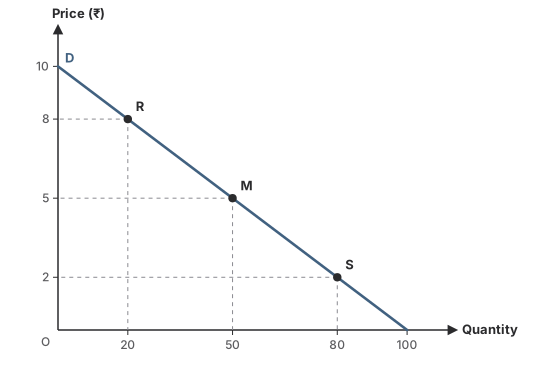
The slope of a straight line is constant, but elasticity multiplies the slope term by P ÷ Q, and that ratio falls as you move down the line.
eₚ is 4 at R, 1 at the midpoint M and 0.25 at S. For Qd = 100 − 10P, eₚ = 10 × P ÷ Q: at R, 10 × 8 ÷ 20 = 4; at M, 10 × 5 ÷ 50 = 1; at S, 10 × 2 ÷ 80 = 0.25. It is infinite where the line meets the price axis and zero where it meets the quantity axis.
Two parallel straight-line demand curves do not have the same elasticity at the same price. The curve further out has a larger quantity, so a smaller P ÷ Q and a lower elasticity.
Elastic when the good Inelastic when the good Has close substitutes Has none (life-saving medicine) Is a luxury Is a necessity (salt) Takes a large share of income Takes a tiny share (matchboxes) Has many uses (electricity) Has one use Can be postponed Is habit-forming Is viewed over a long period Is viewed over a short period
Opposite movement of price and spending: elastic. Same direction: inelastic. No change: unitary.
Midpoint of a straight-line demand curve: eₚ = 1.
Vertical curve: 0. Horizontal: infinite.
Inverting the formula: price change over quantity change.
Treating a constant slope as a constant elasticity.
Judging elasticity by the size of the quantity change instead of by spending.
Methods
eₚ = % change in Q ÷ % change in P
Spending test: opposite = elastic, same = inelastic
Degrees
0 vertical; 1 rectangular hyperbola; ∞ horizontal
Straight line: above midpoint > 1, below < 1
Determinants
Substitutes, luxury, big share, many uses, time: more elastic
The supply side of the market begins with production: production function, TP, MP and AP .
Next · 08 Quick revision → Check your understanding 62 questions, grouped by type, easy to hard. Pick an answer and check it. The worked solution opens when you ask for it.
The percentage method Q1 of 62 Q1
The percentage method 21 questions Price elasticity of demand measures
Options for question 1 A Option A how much the price changes when supply changes B Option B how much the quantity demanded responds to a change in the good's price C Option C how much demand responds to income D Option D the slope of the supply curve
Skip Check Show the explanation Hide the explanation Next question Try again
Show the explanation Hide the explanation Answer B · how much the quantity demanded responds to a change in the good's price
It is the degree of responsiveness of quantity demanded to the good's own price.
By the percentage method, eₚ =
Options for question 2 A Option A percentage change in price ÷ percentage change in quantity demanded B Option B change in quantity ÷ change in price C Option C price × quantity D Option D percentage change in quantity demanded ÷ percentage change in price
Skip Check Show the explanation Hide the explanation Next question Try again
Show the explanation Hide the explanation Answer D · percentage change in quantity demanded ÷ percentage change in price
eₚ = (ΔQ ÷ Q × 100) ÷ (ΔP ÷ P × 100), which simplifies to (ΔQ ÷ ΔP) × (P ÷ Q).
It is usually read without its minus sign, since price and quantity move in opposite directions.
Worth noting
Change in quantity ÷ change in price is the slope term alone; elasticity also needs P ÷ Q.
The price of a good falls from ₹10 to ₹8 and its quantity demanded rises from 40 to 50 units. What is the price elasticity of demand?
Options for question 3 A Option A 0.8 B Option B 1.25 C Option C 2 D Option D 5
Skip Check Show the explanation Hide the explanation Next question Try again
Show the explanation Hide the explanation Answer B · 1.25
% change in quantity = (50 − 40) ÷ 40 × 100 = 25%.
% change in price = (8 − 10) ÷ 10 × 100 = −20%.
eₚ = 25 ÷ 20 = 1.25 (ignoring the sign).
Worth noting
0.8 inverts the ratio: price change over quantity change.
The price of a good rises from ₹5 to ₹6 and the quantity demanded falls from 100 to 90 units. What is the price elasticity of demand?
Options for question 4 A Option A 0.5 B Option B 1 C Option C 2 D Option D 10
Skip Check Show the explanation Hide the explanation Next question Try again
Show the explanation Hide the explanation Answer A · 0.5
% change in quantity = −10 ÷ 100 × 100 = −10%.
% change in price = 1 ÷ 5 × 100 = 20%.
eₚ = 10 ÷ 20 = 0.5: demand is inelastic.
When the price of a good rises from ₹20 to ₹25, the quantity demanded falls from 200 to 150 units. Demand is
Options for question 5 A Option A unitary elastic, eₚ = 1 B Option B elastic, eₚ = 1.25 C Option C inelastic, eₚ = 0.8 D Option D perfectly inelastic
Skip Check Show the explanation Hide the explanation Next question Try again
Show the explanation Hide the explanation Answer A · unitary elastic, eₚ = 1
% change in quantity = −50 ÷ 200 = −25%. % change in price = 5 ÷ 20 = 25%.
eₚ = 25 ÷ 25 = 1: unitary elastic.
The price elasticity of demand for a good is 2. If its price falls by 10%, its quantity demanded will
Options for question 6 A Option A rise by 5% B Option B fall by 20% C Option C rise by 20% D Option D rise by 12%
Skip Check Show the explanation Hide the explanation Next question Try again
Show the explanation Hide the explanation Answer C · rise by 20%
% change in quantity = eₚ × % change in price = 2 × 10% = 20%.
A price fall raises the quantity demanded, so it rises by 20%.
The price elasticity of demand for a good is 0.8. If its price rises by 5%, its quantity demanded will
Options for question 7 A Option A fall by 6.25% B Option B fall by 4% C Option C rise by 4% D Option D fall by 0.8%
Skip Check Show the explanation Hide the explanation Next question Try again
Show the explanation Hide the explanation Answer B · fall by 4%
% change in quantity = 0.8 × 5% = 4%.
A price rise lowers the quantity demanded, so it falls by 4%.
For a demand function Qd = 100 − 10P, what is the price elasticity of demand at a price of ₹8?
Options for question 8 A Option A 0.25 B Option B 1 C Option C 4 D Option D 10
Skip Check Show the explanation Hide the explanation Next question Try again
Show the explanation Hide the explanation Answer C · 4
At P = 8, Q = 100 − 80 = 20. The slope term ΔQ ÷ ΔP = 10 (ignoring the sign).
eₚ = (ΔQ ÷ ΔP) × (P ÷ Q) = 10 × 8 ÷ 20 = 4.
Why is price elasticity of demand measured in percentages rather than in units?
Options for question 9 A Option A So that it does not depend on the units in which price and quantity are measured B Option B Because percentages are always larger C Option C Because prices are always in rupees D Option D So that it is always equal to 1
Skip Check Show the explanation Hide the explanation Next question Try again
Show the explanation Hide the explanation Answer A · So that it does not depend on the units in which price and quantity are measured
A change of 1 kg or 1,000 g is the same change, but the raw numbers differ; percentages do not.
A unit-free measure lets the elasticities of different goods be compared.
Assertion (A): Price elasticity of demand is usually negative in sign.
Reason (R): Price and quantity demanded move in opposite directions.
Options for question 10 A Option A Both A and R are true, and R is the correct explanation of A. B Option B Both A and R are true, but R is not the correct explanation of A. C Option C A is true, but R is false. D Option D A is false, but R is true.
Skip Check Show the explanation Hide the explanation Next question Try again
Show the explanation Hide the explanation Answer A · Both A and R are true, and R is the correct explanation of A.
Both are true.
Because a price rise comes with a fall in quantity (R), the ratio of their percentage changes is negative (A).
A 20% fall in the price of a good raises its quantity demanded by 10%. Demand is
Options for question 11 A Option A elastic, eₚ = 2 B Option B inelastic, eₚ = 0.5 C Option C unitary elastic D Option D perfectly elastic
Skip Check Show the explanation Hide the explanation Next question Try again
Show the explanation Hide the explanation Answer B · inelastic, eₚ = 0.5
eₚ = 10% ÷ 20% = 0.5, less than 1: inelastic.
At a price of ₹40, 500 units are demanded. When the price falls to ₹36, demand rises to 600 units. What is eₚ?
Options for question 12 A Option A 0.5 B Option B 1 C Option C 2 D Option D 25
Skip Check Show the explanation Hide the explanation Next question Try again
Show the explanation Hide the explanation Answer C · 2
% change in quantity = 100 ÷ 500 = 20%. % change in price = 4 ÷ 40 = 10%.
eₚ = 20 ÷ 10 = 2.
A 5% fall in price leaves quantity demanded unchanged. What is eₚ?
Options for question 13 A Option A 1 B Option B 0 C Option C 5 D Option D Infinite
Skip Check Show the explanation Hide the explanation Next question Try again
Show the explanation Hide the explanation Answer B · 0
% change in quantity = 0, so eₚ = 0 ÷ 5 = 0: perfectly inelastic.
Read the two statements and choose the correct option.
I. If eₚ = 1.5, a 2% price rise lowers quantity demanded by 3%.
II. If eₚ = 0.5, a 2% price rise lowers quantity demanded by 4%.
Options for question 14 A Option A Only I B Option B Only II C Option C Both I and II D Option D Neither I nor II
Skip Check Show the explanation Hide the explanation Next question Try again
Show the explanation Hide the explanation Answer A · Only I
1.5 × 2% = 3%: I is true.
0.5 × 2% = 1%, not 4%: II is false.
A good sells 100 units at ₹10. Its price elasticity of demand is 1.5. If the price falls to ₹8, how many units will be demanded?
Options for question 15 A Option A 115 B Option B 120 C Option C 130 D Option D 150
Skip Check Show the explanation Hide the explanation Next question Try again
Show the explanation Hide the explanation Answer C · 130
% change in price = (8 − 10) ÷ 10 = −20%.
% change in quantity = 1.5 × 20% = 30%, a rise.
New quantity = 100 × 1.30 = 130 units.
A firm sells 400 units at ₹50. Demand has a price elasticity of 2. By how much must it cut its price to sell 480 units?
Options for question 16 A Option A By ₹10, to ₹40 B Option B By ₹2.50, to ₹47.50 C Option C By ₹5, to ₹45 D Option D By ₹20, to ₹30
Skip Check Show the explanation Hide the explanation Next question Try again
Show the explanation Hide the explanation Answer C · By ₹5, to ₹45
% change in quantity = (480 − 400) ÷ 400 = 20%.
% change in price needed = 20% ÷ 2 = 10%.
10% of ₹50 is ₹5, so the price must fall to ₹45.
At a price of ₹4, 120 units are demanded. When the price rises, the quantity falls to 90 units. If eₚ = 1, what is the new price?
Options for question 17 A Option A ₹4.50 B Option B ₹5 C Option C ₹5.33 D Option D ₹6
Skip Check Show the explanation Hide the explanation Next question Try again
Show the explanation Hide the explanation Answer B · ₹5
% change in quantity = (90 − 120) ÷ 120 = −25%.
With eₚ = 1, price must have risen by 25%: 4 × 1.25 = ₹5.
The price elasticity of demand for a good is 1.2. Its price rises by 10%. If 1,000 units were sold before, how many are sold now?
Options for question 18 A Option A 880 B Option B 900 C Option C 988 D Option D 1,120
Skip Check Show the explanation Hide the explanation Next question Try again
Show the explanation Hide the explanation Answer A · 880
% change in quantity = 1.2 × 10% = 12%, a fall.
New quantity = 1,000 × 0.88 = 880.
Assertion (A): A demand curve with eₚ = 0.4 is elastic.
Reason (R): Demand is elastic when eₚ is greater than 1.
Options for question 19 A Option A Both A and R are true, and R is the correct explanation of A. B Option B Both A and R are true, but R is not the correct explanation of A. C Option C A is true, but R is false. D Option D A is false, but R is true.
Skip Check Show the explanation Hide the explanation Next question Try again
Show the explanation Hide the explanation Answer D · A is false, but R is true.
A is false: 0.4 is less than 1, so demand is inelastic.
R correctly states the rule.
Qd = 60 − 4P. What is the price elasticity of demand at P = ₹5?
Options for question 20 A Option A 0.5 B Option B 1 C Option C 2 D Option D 4
Skip Check Show the explanation Hide the explanation Next question Try again
Show the explanation Hide the explanation Answer A · 0.5
At P = 5, Q = 60 − 20 = 40; the slope term ΔQ ÷ ΔP = 4.
eₚ = 4 × 5 ÷ 40 = 0.5.
Qd = 60 − 4P. At what price is demand unitary elastic?
Options for question 21 A Option A ₹5 B Option B ₹7.50 C Option C ₹15 D Option D ₹30
Skip Check Show the explanation Hide the explanation Next question Try again
Show the explanation Hide the explanation Answer B · ₹7.50
eₚ = 4P ÷ (60 − 4P) = 1 when 4P = 60 − 4P, so P = ₹7.50.
That is the midpoint of the line, where Q = 30.
The total expenditure method 13 questions Under the total expenditure method, if the price of a good falls and total spending on it rises, demand is
Options for question 22 A Option A inelastic (eₚ < 1) B Option B unitary elastic (eₚ = 1) C Option C perfectly inelastic D Option D elastic (eₚ > 1)
Skip Check Show the explanation Hide the explanation Next question Try again
Show the explanation Hide the explanation Answer D · elastic (eₚ > 1)
Spending = price × quantity. If spending rises when price falls, quantity rose by a larger percentage than price fell.
That is elastic demand.
Under the total expenditure method, if total spending stays the same when price changes, demand is
Options for question 23 A Option A elastic B Option B inelastic C Option C unitary elastic D Option D perfectly elastic
Skip Check Show the explanation Hide the explanation Next question Try again
Show the explanation Hide the explanation Answer C · unitary elastic
Unchanged spending means quantity changed by exactly the same percentage as price, in the opposite direction: eₚ = 1.
The price of salt rises from ₹20 to ₹25 a kg and a household's purchase falls from 5 kg to 4.8 kg a month. By the total expenditure method, its demand for salt is
Options for question 24 A Option A inelastic, because spending rises from ₹100 to ₹120 B Option B elastic, because spending rises from ₹100 to ₹120 C Option C unitary elastic, because the quantity hardly changes D Option D elastic, because the price rose
Skip Check Show the explanation Hide the explanation Next question Try again
Show the explanation Hide the explanation Answer A · inelastic, because spending rises from ₹100 to ₹120
Spending before = 20 × 5 = ₹100; after = 25 × 4.8 = ₹120.
Price and spending move in the same direction, so demand is inelastic.
A demand schedule is given.
Price (₹) Quantity demanded 10 20 8 30 6 40 4 60 2 100
By the total expenditure method, what is demand like when the price falls from ₹10 to ₹8?
Options for question 25 A Option A Inelastic: spending falls from ₹240 to ₹200 B Option B Elastic: spending rises from ₹200 to ₹240 C Option C Unitary: spending stays at ₹200 D Option D Inelastic: spending rises from ₹200 to ₹240
Skip Check Show the explanation Hide the explanation Next question Try again
Show the explanation Hide the explanation Answer B · Elastic: spending rises from ₹200 to ₹240
Spending at ₹10 = 10 × 20 = ₹200; at ₹8 = 8 × 30 = ₹240.
Price falls and spending rises: elastic.
A demand schedule is given.
Price (₹) Quantity demanded 10 20 8 30 6 40 4 60 2 100
By the total expenditure method, what is demand like when the price falls from ₹6 to ₹4?
Options for question 26 A Option A Elastic: spending rises B Option B Inelastic: spending falls C Option C Perfectly inelastic: quantity is fixed D Option D Unitary elastic: spending stays at ₹240
Skip Check Show the explanation Hide the explanation Next question Try again
Show the explanation Hide the explanation Answer D · Unitary elastic: spending stays at ₹240
Spending at ₹6 = 6 × 40 = ₹240; at ₹4 = 4 × 60 = ₹240.
Spending is unchanged, so demand is unitary elastic over this range.
A demand schedule is given.
Price (₹) Quantity demanded 10 20 8 30 6 40 4 60 2 100
By the total expenditure method, what is demand like when the price falls from ₹4 to ₹2?
Options for question 27 A Option A Inelastic: spending falls from ₹240 to ₹200 B Option B Elastic: quantity rises from 60 to 100 C Option C Unitary: spending stays the same D Option D Elastic: spending falls
Skip Check Show the explanation Hide the explanation Next question Try again
Show the explanation Hide the explanation Answer A · Inelastic: spending falls from ₹240 to ₹200
Spending at ₹4 = ₹240; at ₹2 = 2 × 100 = ₹200.
Price falls and spending falls too: inelastic.
Worth noting
A big rise in quantity is not enough: what matters is whether spending rose or fell.
A shopkeeper lowers the price of a good and finds that his total sales revenue from it falls. Demand for the good is
Options for question 28 A Option A elastic B Option B unitary elastic C Option C perfectly elastic D Option D inelastic
Skip Check Show the explanation Hide the explanation Next question Try again
Show the explanation Hide the explanation Answer D · inelastic
Buyers' spending is the seller's revenue. Price down and spending down means demand is inelastic.
Read the two statements and choose the correct option.
I. If demand is elastic, a rise in price lowers total expenditure on the good.
II. If demand is inelastic, a rise in price lowers total expenditure on the good.
Options for question 29 A Option A Only I B Option B Only II C Option C Both I and II D Option D Neither I nor II
Skip Check Show the explanation Hide the explanation Next question Try again
Show the explanation Hide the explanation Answer A · Only I
I is true: with elastic demand, quantity falls by a larger percentage than price rises.
II is false: with inelastic demand, quantity falls less, so spending rises.
Assertion (A): A government that wants more tax revenue from a sales tax should tax goods with inelastic demand.
Reason (R): When demand is inelastic, quantity bought falls only a little when the price rises.
Options for question 30 A Option A Both A and R are true, and R is the correct explanation of A. B Option B Both A and R are true, but R is not the correct explanation of A. C Option C A is true, but R is false. D Option D A is false, but R is true.
Skip Check Show the explanation Hide the explanation Next question Try again
Show the explanation Hide the explanation Answer A · Both A and R are true, and R is the correct explanation of A.
Both are true.
Because sales hardly fall when the tax raises the price (R), the tax keeps a large base and brings in more revenue (A).
Spending on a good is ₹1,000 at ₹10 and ₹1,200 at ₹12. By the total expenditure method, demand is
Options for question 31 A Option A elastic B Option B unitary elastic C Option C perfectly elastic D Option D perfectly inelastic: 100 units at both prices
Skip Check Show the explanation Hide the explanation Next question Try again
Show the explanation Hide the explanation Answer D · perfectly inelastic: 100 units at both prices
Quantity: 1,000 ÷ 10 = 100 and 1,200 ÷ 12 = 100. Spending rises exactly in proportion to price.
Quantity has not changed at all: eₚ = 0.
Assertion (A): A firm facing elastic demand can raise its revenue by cutting its price.
Reason (R): With elastic demand, quantity rises by a larger percentage than price falls.
Options for question 32 A Option A Both A and R are true, and R is the correct explanation of A. B Option B Both A and R are true, but R is not the correct explanation of A. C Option C A is true, but R is false. D Option D A is false, but R is true.
Skip Check Show the explanation Hide the explanation Next question Try again
Show the explanation Hide the explanation Answer A · Both A and R are true, and R is the correct explanation of A.
Both are true, and R explains A: revenue = price × quantity, and the quantity gain outweighs the price cut.
Assertion (A): If a good's demand is unitary elastic, total expenditure on it is the same at every price.
Reason (R): A unitary elastic demand curve is a rectangular hyperbola.
Options for question 33 A Option A Both A and R are true, and R is the correct explanation of A. B Option B Both A and R are true, but R is not the correct explanation of A. C Option C A is true, but R is false. D Option D A is false, but R is true.
Skip Check Show the explanation Hide the explanation Next question Try again
Show the explanation Hide the explanation Answer A · Both A and R are true, and R is the correct explanation of A.
Both are true.
On a rectangular hyperbola, price × quantity is constant at every point, which is exactly why spending never changes: R explains A.
A good's price falls from ₹50 to ₹40 and the quantity demanded rises from 100 to 125. By the total expenditure method, demand is
Options for question 34 A Option A elastic: spending rises B Option B inelastic: spending falls C Option C unitary elastic: spending stays at ₹5,000 D Option D perfectly elastic: quantity rises
Skip Check Show the explanation Hide the explanation Next question Try again
Show the explanation Hide the explanation Answer C · unitary elastic: spending stays at ₹5,000
Before: 50 × 100 = ₹5,000. After: 40 × 125 = ₹5,000.
Unchanged spending: unitary elastic.
Worth noting
The percentage method from the starting point gives 25% ÷ 20% = 1.25; the two methods can differ over a large change, and the question asks for the total expenditure method.
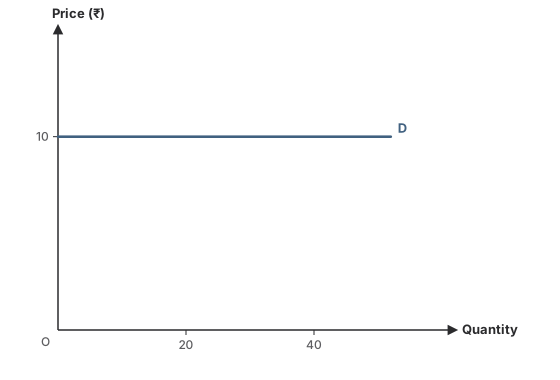
Degrees of elasticity 14 questions The demand curve in the graph is horizontal. Its price elasticity of demand is
Options for question 35 A Option A zero: perfectly inelastic B Option B infinite: perfectly elastic C Option C one: unitary elastic D Option D less than one
Skip Check Show the explanation Hide the explanation Next question Try again
Show the explanation Hide the explanation Answer B · infinite: perfectly elastic
At ₹10 buyers take any quantity; at the slightest rise above ₹10 they take nothing.
An infinite response to a tiny price change is perfectly elastic demand.
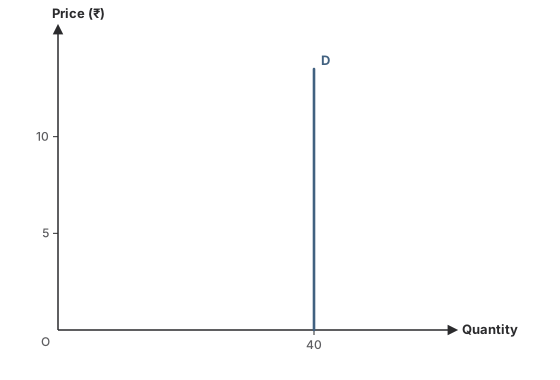
The demand curve in the graph is vertical. Its price elasticity of demand is
Options for question 36 A Option A infinite: perfectly elastic B Option B one: unitary elastic C Option C zero: perfectly inelastic D Option D greater than one
Skip Check Show the explanation Hide the explanation Next question Try again
Show the explanation Hide the explanation Answer C · zero: perfectly inelastic
Whatever the price, the quantity demanded stays at 40.
No change in quantity means a percentage change of 0, so eₚ = 0.
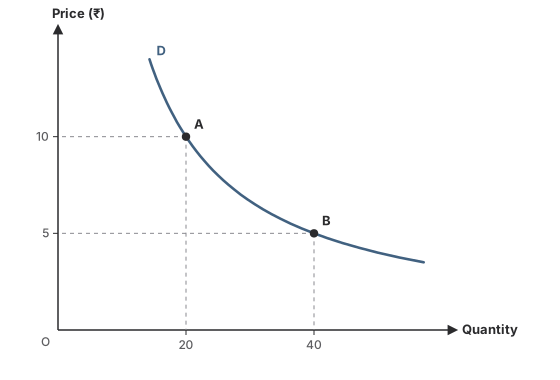
In the graph, by the total expenditure method, what is demand like along the curve?
Options for question 37 A Option A Elastic, because quantity doubles from A to B B Option B Inelastic, because price halves from A to B C Option C Unitary elastic, because spending is ₹200 at every point D Option D Perfectly inelastic, because the curve bends
Skip Check Show the explanation Hide the explanation Next question Try again
Show the explanation Hide the explanation Answer C · Unitary elastic, because spending is ₹200 at every point
At A: 10 × 20 = ₹200. At B: 5 × 40 = ₹200. Spending is the same at every point of the curve.
Unchanged spending when price changes is unitary elasticity; such a curve is a rectangular hyperbola.
Worth noting
Doubling quantity alone says nothing; what matters is that spending did not change.
Demand is called elastic when
Options for question 38 A Option A the percentage change in quantity demanded is less than the percentage change in price B Option B the percentage change in quantity demanded is greater than the percentage change in price C Option C quantity demanded does not change D Option D price does not change
Skip Check Show the explanation Hide the explanation Next question Try again
Show the explanation Hide the explanation Answer B · the percentage change in quantity demanded is greater than the percentage change in price
eₚ > 1 means quantity responds more than in proportion to price.
Match each value of eₚ with its name.
List I List II A. eₚ = 0 I. Unitary elastic B. 0 < eₚ < 1 II. Perfectly inelastic C. eₚ = 1 III. Perfectly elastic D. eₚ = ∞ IV. Inelastic
Options for question 39 A Option A A-II, B-I, C-III, D-IV B Option B A-I, B-III, C-II, D-IV C Option C A-IV, B-III, C-II, D-I D Option D A-II, B-IV, C-I, D-III
Skip Check Show the explanation Hide the explanation Next question Try again
Show the explanation Hide the explanation Answer D · A-II, B-IV, C-I, D-III
0 is perfectly inelastic; between 0 and 1 is inelastic.
1 is unitary; infinity is perfectly elastic.
In the graph, what is the price elasticity of demand at the midpoint M of the straight-line demand curve?
Options for question 40 A Option A 0 B Option B 0.5 C Option C 1 D Option D 4
Skip Check Show the explanation Hide the explanation Next question Try again
Show the explanation Hide the explanation Answer C · 1
For Qd = 100 − 10P, eₚ = 10 × P ÷ Q.
At M, P = 5 and Q = 50: eₚ = 10 × 5 ÷ 50 = 1. The midpoint of a straight-line demand curve always has unitary elasticity.
Read the two statements and choose the correct option.
I. A perfectly inelastic demand curve is parallel to the price axis.
II. A perfectly elastic demand curve is parallel to the quantity axis.
Options for question 41 A Option A Only I B Option B Only II C Option C Both I and II D Option D Neither I nor II
Skip Check Show the explanation Hide the explanation Next question Try again
Show the explanation Hide the explanation Answer C · Both I and II
A vertical curve runs parallel to the price (vertical) axis: perfectly inelastic. I is true.
A horizontal curve runs parallel to the quantity (horizontal) axis: perfectly elastic. II is true.
In the graph, what is the price elasticity of demand at point R?
Options for question 42 A Option A 0.25 B Option B 1 C Option C 4 D Option D 8
Skip Check Show the explanation Hide the explanation Next question Try again
Show the explanation Hide the explanation Answer C · 4
At R, P = 8 and Q = 20.
eₚ = 10 × 8 ÷ 20 = 4: elastic, as everywhere above the midpoint.
A demand curve along which total spending is the same at every price is
Options for question 43 A Option A a rectangular hyperbola, with eₚ = 1 throughout B Option B a straight line with eₚ = 1 throughout C Option C a vertical line D Option D a horizontal line
Skip Check Show the explanation Hide the explanation Next question Try again
Show the explanation Hide the explanation Answer A · a rectangular hyperbola, with eₚ = 1 throughout
Constant P × Q is the definition of a rectangular hyperbola, and it means unitary elasticity everywhere.
A straight line has eₚ = 1 only at its midpoint.
In the graph, what is the price elasticity of demand at point S?
Options for question 44 A Option A 0.25 B Option B 1 C Option C 2 D Option D 4
Skip Check Show the explanation Hide the explanation Next question Try again
Show the explanation Hide the explanation Answer A · 0.25
At S, P = 2 and Q = 80.
eₚ = 10 × 2 ÷ 80 = 0.25: inelastic, as everywhere below the midpoint.
Worth noting
4 is the elasticity at R, above the midpoint.
In the graph, along a straight-line demand curve, elasticity is
Options for question 45 A Option A different at each point: above 1 above the midpoint, below 1 below it B Option B the same at every point, because the slope is constant C Option C 1 at every point D Option D 0 at every point
Skip Check Show the explanation Hide the explanation Next question Try again
Show the explanation Hide the explanation Answer A · different at each point: above 1 above the midpoint, below 1 below it
Elasticity = slope term × P ÷ Q. The slope term is fixed, but P ÷ Q falls as we move down the line.
So eₚ is 4 at R, 1 at M and 0.25 at S: infinite where the line meets the price axis, zero where it meets the quantity axis.
Worth noting
A constant slope is not a constant elasticity: slope uses changes, elasticity uses percentage changes.
Assertion (A): Two parallel straight-line demand curves have the same elasticity at the same price.
Reason (R): Parallel lines have the same slope.
Options for question 46 A Option A Both A and R are true, and R is the correct explanation of A. B Option B Both A and R are true, but R is not the correct explanation of A. C Option C A is true, but R is false. D Option D A is false, but R is true.
Skip Check Show the explanation Hide the explanation Next question Try again
Show the explanation Hide the explanation Answer D · A is false, but R is true.
A is false: at the same price, the curve further out has a larger quantity, so P ÷ Q, and hence elasticity, is smaller.
R is true, but equal slopes do not give equal elasticities.
On a straight-line demand curve, at which point is the price elasticity of demand zero?
Options for question 47 A Option A Where the curve meets the quantity axis B Option B Where the curve meets the price axis C Option C At the midpoint D Option D Nowhere
Skip Check Show the explanation Hide the explanation Next question Try again
Show the explanation Hide the explanation Answer A · Where the curve meets the quantity axis
At the quantity axis, P = 0, so eₚ = slope term × 0 ÷ Q = 0.
At the price axis, Q = 0, so eₚ is infinite.
In the graph, between R and M, demand is
Options for question 48 A Option A inelastic B Option B unitary elastic throughout C Option C elastic, since every point above the midpoint has eₚ > 1 D Option D perfectly elastic
Skip Check Show the explanation Hide the explanation Next question Try again
Show the explanation Hide the explanation Answer C · elastic, since every point above the midpoint has eₚ > 1
On a straight-line demand curve, eₚ falls from infinity at the price axis to 1 at the midpoint.
R (eₚ = 4) to M (eₚ = 1) is all on the upper half, so demand is elastic there.
What decides elasticity 14 questions Demand for a good with many close substitutes tends to be
Options for question 49 A Option A inelastic B Option B perfectly inelastic C Option C zero D Option D elastic
Skip Check Show the explanation Hide the explanation Next question Try again
Show the explanation Hide the explanation Answer D · elastic
If its price rises, buyers can easily switch to a substitute, so quantity falls a lot.
The demand for a necessity such as salt is usually
Options for question 50 A Option A inelastic B Option B elastic C Option C perfectly elastic D Option D unitary elastic
Skip Check Show the explanation Hide the explanation Next question Try again
Show the explanation Hide the explanation Answer A · inelastic
Necessities are bought in roughly the same amounts whatever the price, so quantity responds little.
Salt is also a tiny share of the budget, which makes demand even less elastic.
Demand for a good on which buyers spend a large share of their income tends to be
Options for question 51 A Option A less elastic B Option B perfectly inelastic C Option C more elastic D Option D unaffected by price
Skip Check Show the explanation Hide the explanation Next question Try again
Show the explanation Hide the explanation Answer C · more elastic
A price change on a big item makes a big dent in the budget, so buyers react strongly.
Demand for a good tends to be more elastic in the long run than in the short run because
Options for question 52 A Option A prices are fixed in the long run B Option B buyers have more time to find substitutes and change habits C Option C incomes fall in the long run D Option D goods become necessities in the long run
Skip Check Show the explanation Hide the explanation Next question Try again
Show the explanation Hide the explanation Answer B · buyers have more time to find substitutes and change habits
Right after a price rise people may keep buying out of habit; given time, they adjust and switch.
A good that can be put to many uses, such as electricity, has demand that is
Options for question 53 A Option A perfectly inelastic B Option B relatively elastic C Option C zero at all prices D Option D unrelated to price
Skip Check Show the explanation Hide the explanation Next question Try again
Show the explanation Hide the explanation Answer B · relatively elastic
When its price falls, it is used in more ways, and when it rises, the less important uses are dropped.
So quantity responds more to price than for a single-use good.
Which good is likely to have the most elastic demand?
Options for question 54 A Option A A particular brand of biscuits B Option B Salt C Option C Life-saving medicine D Option D Matchboxes
Skip Check Show the explanation Hide the explanation Next question Try again
Show the explanation Hide the explanation Answer A · A particular brand of biscuits
One brand of biscuits has many close substitutes in other brands.
Salt and matchboxes are cheap necessities and life-saving medicine has no substitute, so their demand is inelastic.
Demand for a habit-forming good, such as cigarettes for a regular smoker, tends to be
Options for question 55 A Option A elastic B Option B perfectly elastic C Option C unitary elastic D Option D inelastic
Skip Check Show the explanation Hide the explanation Next question Try again
Show the explanation Hide the explanation Answer D · inelastic
A habit keeps buyers purchasing much the same quantity even when the price rises.
Assertion (A): The demand for salt is inelastic.
Reason (R): Salt has many close substitutes.
Options for question 56 A Option A Both A and R are true, and R is the correct explanation of A. B Option B Both A and R are true, but R is not the correct explanation of A. C Option C A is true, but R is false. D Option D A is false, but R is true.
Skip Check Show the explanation Hide the explanation Next question Try again
Show the explanation Hide the explanation Answer C · A is true, but R is false.
A is true: salt is a cheap necessity.
R is false: salt has no close substitute, which is one reason its demand is inelastic.
Assertion (A): Demand for luxuries is usually more elastic than demand for necessities.
Reason (R): Luxuries can be given up when prices rise; necessities cannot.
Options for question 57 A Option A Both A and R are true, and R is the correct explanation of A. B Option B Both A and R are true, but R is not the correct explanation of A. C Option C A is true, but R is false. D Option D A is false, but R is true.
Skip Check Show the explanation Hide the explanation Next question Try again
Show the explanation Hide the explanation Answer A · Both A and R are true, and R is the correct explanation of A.
Both are true.
Being able to go without a luxury (R) is exactly what makes its quantity respond strongly to price (A).
Match each good with the most likely elasticity of its demand.
List I List II A. A brand of soap among many I. Nearly perfectly inelastic B. Insulin for a diabetic II. Elastic, as a postponable luxury C. A wheat farmer's output in a large market III. Elastic D. Air travel for holidays IV. Perfectly elastic for the single farmer
Options for question 58 A Option A A-III, B-IV, C-I, D-II B Option B A-IV, B-III, C-I, D-II C Option C A-II, B-I, C-IV, D-III D Option D A-III, B-I, C-IV, D-II
Skip Check Show the explanation Hide the explanation Next question Try again
Show the explanation Hide the explanation Answer D · A-III, B-I, C-IV, D-II
A soap brand has close substitutes: elastic. Insulin has none and is vital: nearly perfectly inelastic.
One farmer can sell all he wants at the market price: perfectly elastic for him. Holiday flights can be postponed: elastic.
Which factor would make the demand for petrol more elastic over time?
Options for question 59 A Option A Petrol becoming a smaller share of income B Option B More people switching to electric vehicles and public transport C Option C Fewer substitutes for petrol D Option D A stronger habit of driving
Skip Check Show the explanation Hide the explanation Next question Try again
Show the explanation Hide the explanation Answer B · More people switching to electric vehicles and public transport
More substitutes let buyers cut back more when the price rises.
Read the two statements and choose the correct option.
I. The demand for a broad category, such as food, is less elastic than the demand for one brand of biscuits.
II. The demand for a broad category has more substitutes than the demand for one brand.
Options for question 60 A Option A Only I B Option B Only II C Option C Both I and II D Option D Neither I nor II
Skip Check Show the explanation Hide the explanation Next question Try again
Show the explanation Hide the explanation Answer A · Only I
I is true: food as a whole has no substitute; one brand has many.
II is false for the same reason.
Purchases of a good can be postponed easily, as with a new washing machine. Its demand is likely to be
Options for question 61 A Option A inelastic B Option B perfectly inelastic C Option C elastic D Option D zero
Skip Check Show the explanation Hide the explanation Next question Try again
Show the explanation Hide the explanation Answer C · elastic
If the price rises, buyers can wait for a better time, so current purchases drop sharply.
Read the two statements and choose the correct option.
I. A good that takes a tiny share of income has inelastic demand.
II. A good with no close substitute has elastic demand.
Options for question 62 A Option A Only I B Option B Only II C Option C Both I and II D Option D Neither I nor II
Skip Check Show the explanation Hide the explanation Back to start Try again
Show the explanation Hide the explanation Answer A · Only I
I is true: a price change on a tiny item barely affects the budget.
II is false: without a substitute, buyers have nowhere to switch, so demand is inelastic.
Question types · easy to hard
NTA's Economics syllabus is three courses: Introductory Microeconomics, Introductory Macroeconomics and Indian Economic Development, each split into units with a list of topics. It prints no chapters and no split of the 50 questions across the courses. So the areas here are NTA's three courses, and the chapters inside them are ours: a unit that covers several ideas, such as consumer behaviour and demand, is split into a chapter for each, so that a chapter can be practised in one sitting. All three courses are here.