EduFarming
Your list · 0हिं

Type at least two letters. Press Esc to close.

↑↓ navigate↵ openTAB cycle filter

Blood Relations for CUET General Aptitude

About 10 min to learn · 67 questions

A blood relation question gives a chain of family links and asks how the two people at its ends are related. Every one falls to the same method: draw the family as a small tree, mark who is male and who is female, and read the answer off the drawing. This lesson covers drawing the tree, relation words by generation, in-laws, pointing statements, examiners' conventions, coded relations, multi-clue family puzzles and when 'cannot be determined' is right.

Syllabus area
Logical and Analytical Reasoning
On this page · 8 sections
  1. 01The core idea
  2. 02Drawing the tree
  3. 03Pointing statements and codes
  4. 04Family puzzles
  5. 05Exam shortcuts
  6. 06Common mistakes
  7. 07Quick revision
  8. 08Check your understanding

The core idea

Draw the family; do not hold it in your head. A tree takes fifteen seconds and removes most mistakes. Put each generation on its own row, join married couples sideways, join parents to children with a vertical line, and mark each person male, female or unknown.

Then answer the exact question asked. "How is A related to B?" asks what A is to B, and the answer turned round is always among the options.

Drawing the tree

How do you solve a blood relation question quickly?

Draw the tree as you read, one link at a time, and look at the question only once the whole tree is on paper. Use the same marks every time, so you never have to think about them.

MarkMeaning
+Male
−Female
?Gender not given
Double lineMarried couple
Vertical lineParent above, child below
Bar over a rowBrothers and sisters

Example 1 · An uncle by marriage

Ananya is the daughter of Vikas. Vikas is the brother of Leela. Leela's husband is Omkar. How is Omkar related to Ananya?

  1. Vikas and Leela are brother and sister, so Leela is Ananya's aunt, her father's sister.

  2. Omkar is married to Ananya's aunt.

Answer

Omkar is Ananya's uncle

Exam shortcut

The tree answers every other question about the same family too, which is exactly what a family puzzle with three or four questions needs.

What do the relation words mean, generation by generation?

Place every relation word in a generation: yours, one above, one below, and so on. An answer in the wrong generation is wrong, however good it sounds.

GenerationMaleFemaleEither
Two aboveGrandfatherGrandmotherGrandparent
One aboveFather, uncle, father-in-lawMother, aunt, mother-in-lawParent
YoursBrother, husband, brother-in-lawSister, wife, sister-in-lawCousin, sibling
One belowSon, nephew, son-in-lawDaughter, niece, daughter-in-lawChild
Two belowGrandsonGranddaughterGrandchild

Words that need care

  • Paternal means through the father, maternal through the mother: your mother's brother is your maternal uncle.
  • An uncle is a parent's brother or a parent's sister's husband; an aunt is a parent's sister or a parent's brother's wife.
  • A nephew or niece is the child of your brother or sister, or of your spouse's.
  • A cousin is your uncle's or aunt's child, the same word for boys and girls.
  • Each extra "grand" or "great" adds a generation.

How do in-law relations work?

An in-law is a relative through marriage. There are three ideas: your spouse's parents, your child's spouse, and the brothers and sisters on both sides.

WhoRelation to you
Your spouse's father or motherFather-in-law or mother-in-law
Your daughter's husbandSon-in-law
Your son's wifeDaughter-in-law
Your spouse's brother, or your sister's husbandBrother-in-law
Your spouse's sister, or your brother's wifeSister-in-law

Example 2 · An in-law

Nitin's wife is Charu. Charu's father is Balwant. Balwant's son is Kishore. How is Kishore related to Nitin?

  1. Kishore is Balwant's son, so he is Charu's brother.

  2. The brother of Nitin's wife is Nitin's brother-in-law.

Answer

Brother-in-law

Balwant is Nitin's father-in-law. Read which person the question names.

Pointing statements and codes

How do you decode "only son" and other pointing statements?

Start from the speaker, work from the innermost phrase outwards, and replace each phrase by the one person it names. "Only" usually points back to someone you already know, often the speaker or a parent.

PhraseWho it is
My father's only son, said by a manThe speaker himself
My father's only son, said by a womanHer only brother
My mother's only daughter, said by a womanThe speaker herself
The only son of my father's motherMy father
The only daughter of my mother's fatherMy mother
The only child of my husband's fatherMy husband

Example 3 · A pointing statement

Pointing to a girl, Harpreet said, "She is the granddaughter of the only son of my father's father." Harpreet is a man with no brothers or sisters. How is the girl related to him?

  1. "The only son of my father's father" is Harpreet's father.

  2. The girl is a granddaughter of Harpreet's father, so she is a child of one of his children.

  3. Harpreet has no brothers or sisters, so she is his own child.

Answer

His daughter

Watch out

Without "only", a chain can split. "His father is my father's father" makes him a son of your grandfather, which could be your father or your uncle. When a phrase can name two people, the answer is "cannot be determined".

What conventions do examiners assume?

Use a few standard assumptions, but only as far as the stem allows, and never add a fact it does not give.

  • Different names are different people.
  • Your mother's husband is your father, and brothers and sisters share both parents.
  • A married couple is a man and a woman, so "X is the husband of Y" makes Y a woman.
  • A name does not tell you a gender. Wait for he, she, his, her, or a gendered word such as son, sister or uncle.

Watch out

Names like Kiran, Jyoti, Gurpreet or Lalit are used for boys and girls, and letter names like P and Q never carry a gender.

How do you solve coded relations?

Translate each symbol into words, write the chain as a sentence, then draw the tree. In "X ⊕ Y means X is the father of Y", the symbol describes X, the person on the left; it says nothing about Y's gender.

Example 4 · A coded chain

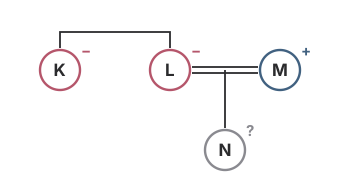
In a code, A ◆ B means A is the sister of B, A ◇ B means A is the father of B, and A ○ B means A is the wife of B. In K ◆ L ○ M ◇ N, how is K related to N?

  1. K ◆ L: K is L's sister. L ○ M: L is M's wife. M ◇ N: M is N's father.

  2. So L and M are N's parents, and L is N's mother.

  3. K is L's sister.

Answer

K is N's maternal aunt

A family tree: K and L joined as sisters, L married to M, and N below L and M. K and L are marked female, M male, and N with a question mark.
K ◆ L ○ M ◇ N drawn as a tree. N's gender is never given.

Exam shortcut

Only the left-hand person of each symbol gets a gender. N above never does, so "How is N related to K?" would be "cannot be determined": nephew or niece. For "which expression shows…" questions, decode every option.

Family puzzles

How do you solve a family puzzle with several clues?

Read all the clues once, start the tree from the clue that fixes the most people, usually a marriage or a grandparent, and fit the rest around it. For an indirect clue such as "P is the father-in-law of S", ask where in the family it forces each person.

Example 5 · Six people, four clues

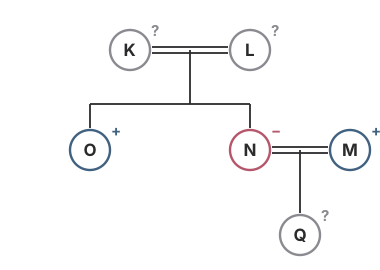
A family of six, K, L, M, N, O and Q, is an elderly couple, their son, their daughter, the daughter's husband and the daughter's only child. M is the son-in-law of L. K is married to L. N is married to M. O is the uncle of Q. How are they related?

  1. A son-in-law is a daughter's husband, so M is the daughter's husband and L is one of the elderly couple.

  2. K is L's spouse, the other elderly person. N is M's wife, so N is the daughter.

  3. O is an uncle, so O is the son, and Q is the daughter's child.

Answer

K and L are the couple, O their son, N their daughter married to M, and Q the child of N and M

O is Q's maternal uncle. But "How is K related to M?" cannot be determined: K is M's father-in-law or mother-in-law, and no clue says which of K and L is the man.

A family tree: K married to L at the top, with two children O and N. N is married to M, and Q is the child of N and M. O and M are marked male, N female, and K, L and Q with question marks.
The family in Example 5. K, L and Q have no gender given.

When is "cannot be determined" the right answer?

Only when two families that both fit every statement give different answers. If every family that fits gives the same answer, it is determined, even if some fact in the middle of the chain is missing.

  • "R is the son of S, and S is the sister of T." R is T's nephew, whatever T's gender. Determined.
  • "R is a child of S, and S is the sister of T." R could be a nephew or a niece. Cannot be determined.
  • "M is the grandmother of J, and H is J's father" does not say whether M is H's mother or mother-in-law.

Exam shortcuts

  • Tree first, question second.
  • Generation check. Count rows before you choose.
  • Left-hand person. In a code, only they get a gender.
  • "Only". It usually points back to the speaker or a parent.
  • Try both. Before "cannot be determined", test both possibilities.

Common mistakes

  • Assuming a gender. "A is B's brother" makes A male, not B.
  • Reading a gender from a name.
  • Forgetting that "my father's only son" can be me.
  • Answering for the wrong person. If B is A's uncle, A is B's nephew or niece.
  • Ignoring the side. Maternal and paternal are different answers.
  • Skipping a generation. A grandparent's brother is not an uncle.
  • Mixing up in-laws. A brother's wife is a sister-in-law; a son's wife a daughter-in-law.
  • Choosing "cannot be determined" too early.
  • Assuming a grandfather is the father's father.

Quick revision

The tree

  • Row per generation, double line for marriage
    • male, − female, ? unknown
  • Draw everything, then read the question

Words

  • Paternal: father's side. Maternal: mother's side
  • In-laws: spouse's family, child's spouse, siblings' spouses
  • Cousin: uncle's or aunt's child

Codes and pointing

  • Symbol describes the left-hand person
  • Work pointing phrases inside out
  • "Cannot be determined" only if two trees disagree

The same draw-before-you-think habit pays in direction sense, seating arrangement and puzzles.

Next · 07Quick revision

Check your understanding

67 questions, grouped by type, easy to hard. Pick an answer and check it. The worked solution opens when you ask for it.

Relations from statementsQ1 of 67Q1

Relations from statements

19 questions

Kavya's mother is the only sister of Rohan's father. How is Rohan related to Kavya?

Options for question 1

Show the explanationHide the explanation

AnswerB · Cousin

  1. Kavya's mother and Rohan's father are sister and brother.

  2. The children of a brother and a sister are cousins.

  3. So Rohan is Kavya's cousin. 'Cousin' is the same word for a boy or a girl, so no gender is needed.

Worth noting

Brother would need Kavya and Rohan to share a parent; they share only grandparents. Maternal uncle is what Rohan's father is to Kavya, one generation too high.

Deepa is Arjun's wife, and Mahesh is Arjun's father. How is Deepa related to Mahesh?

Options for question 2

Show the explanationHide the explanation

AnswerC · Daughter-in-law

  1. Mahesh is the father of Deepa's husband.

  2. The wife of a person's son is that person's daughter-in-law.

Worth noting

Sister-in-law is what Deepa would be to Arjun's brother or sister, not to his father.

Salim is the brother of Nargis, and Nargis is Ayaan's mother. How is Salim related to Ayaan?

Options for question 3

Show the explanationHide the explanation

AnswerD · Maternal uncle

  1. Salim is the brother of Ayaan's mother.

  2. A mother's brother is a maternal uncle.

Worth noting

'Paternal' would mean the father's side. Salim is linked to Ayaan through his mother, so the uncle is maternal.

Pema is Tenzin's mother, and Dorjee is Pema's father. How is Dorjee related to Tenzin?

Options for question 4

Show the explanationHide the explanation

AnswerA · Maternal grandfather

  1. Dorjee is the father of Tenzin's mother.

  2. A mother's father is the maternal grandfather.

Worth noting

Paternal grandfather is the father's father. The link here runs through Tenzin's mother.

Karthik is Meenakshi's brother, and Lakshmi is Karthik's wife. How is Lakshmi related to Meenakshi?

Options for question 5

Show the explanationHide the explanation

AnswerB · Sister-in-law

  1. Lakshmi is the wife of Meenakshi's brother.

  2. A brother's wife is a sister-in-law.

Worth noting

Daughter-in-law is what Lakshmi is to Karthik's parents, not to his sister.

Sonal is Vivek's wife. Rakesh is Sonal's father, and Manav is Rakesh's son. How is Manav related to Vivek?

Options for question 6

Show the explanationHide the explanation

AnswerB · Brother-in-law

  1. Manav is Rakesh's son, so he is Sonal's brother.

  2. The brother of one's wife is a brother-in-law.

Worth noting

Son-in-law is what Vivek is to Rakesh. It describes the husband of a daughter, not the daughter's brother.

Suresh is Hema's father-in-law, and Suresh has only one child, a son named Dinesh. How is Dinesh related to Hema?

Options for question 7

Show the explanationHide the explanation

AnswerC · Husband

  1. A father-in-law is the father of one's spouse, so Hema's spouse is a child of Suresh.

  2. Suresh has only one child, Dinesh, so Dinesh is Hema's husband.

Worth noting

Brother-in-law would need Suresh to have a second child for Hema to be married to. 'Only one child' rules that out.

A is B's brother. C is A's mother. D is C's father. How is B related to D?

Options for question 8

Show the explanationHide the explanation

AnswerC · Grandchild

  1. A and B are siblings, so C, who is A's mother, is B's mother too.

  2. D is C's father, so D is the grandfather of C's children.

  3. B is therefore D's grandchild.

  4. Nothing in the question tells us whether B is male or female, so the answer must not assume one.

Worth noting

"A is B's brother" fixes A's gender, not B's. Grandson and granddaughter each guess, and a guess is wrong half the time.

Maria's husband is Joseph. Maria's only brother, Thomas, has a son named Kevin. How is Kevin related to Joseph?

Options for question 9

Show the explanationHide the explanation

AnswerC · Nephew

  1. Thomas is Maria's brother, so he is Joseph's brother-in-law.

  2. Kevin is the son of Joseph's wife's brother.

  3. The son of a spouse's brother or sister is a nephew.

Worth noting

Brother-in-law is Thomas, not his son. Cousin is what Kevin is to Joseph's children.

M is the sister of N, and P is a child of N. How is P related to M?

Options for question 10

Show the explanationHide the explanation

AnswerD · Cannot be determined

  1. P is a child of M's brother or sister N, so P is M's nephew if P is a boy and M's niece if P is a girl.

  2. The statements never say whether P is male or female.

  3. Two families fit the facts and give different answers, so the relation cannot be determined.

Worth noting

Nephew and niece each guess P's gender. Daughter would need M to be P's parent; M is N's sister.

Shakuntala has exactly two children: a son, who is Anand's father, and a daughter named Gita. How is Gita related to Anand?

Options for question 11

Show the explanationHide the explanation

AnswerA · Paternal aunt

  1. Anand's father and Gita are brother and sister, both children of Shakuntala.

  2. A father's sister is a paternal aunt.

Worth noting

Gita cannot be Anand's mother: she is his father's sister. 'Maternal' would need the link to run through Anand's mother.

A is the father of B. B is the sister of C. D is the wife of C, and E is the son of D. How is A related to E?

Options for question 12

Show the explanationHide the explanation

AnswerD · Paternal grandfather

  1. D is C's wife, so C is a man and E's father.

  2. B and C are siblings, so A, B's father, is C's father too.

  3. A is the father of E's father, that is, E's paternal grandfather.

Worth noting

Maternal grandfather would be D's father. A is linked to E through C, E's father.

A is the brother of B, and C is the father of A. D is the brother of E, and E is the daughter of B. How is D related to C?

Options for question 13

Show the explanationHide the explanation

AnswerA · Grandson

  1. C is A's father, and A and B are siblings, so C is B's father too.

  2. E is B's daughter and D is E's brother, so D is B's son.

  3. D is the son of C's child, so D is C's grandson.

Worth noting

B's gender is never stated, but it does not matter: whether B is C's son or daughter, B's son is C's grandson. Choose 'Cannot be determined' only when the ANSWER changes with the missing fact.

X's mother is the only daughter of Y's paternal grandfather. How is Y's father related to X?

Options for question 14

Show the explanationHide the explanation

AnswerC · Maternal uncle

  1. Y's father is a son of Y's paternal grandfather.

  2. X's mother is that grandfather's daughter, so she and Y's father are sister and brother.

  3. A mother's brother is a maternal uncle.

Worth noting

Paternal uncle is the father's brother. Here the link to X runs through X's mother.

Raghav and his wife Uma have three children: two sons and a daughter. Each son is married and has two children. The daughter is married and has one child. How many grandchildren do Raghav and Uma have?

Options for question 15

Show the explanationHide the explanation

AnswerC · 5

  1. The two sons have 2 children each: 2+2=42 + 2 = 4.

  2. The daughter's child is also their grandchild: 4+1=54 + 1 = 5.

Worth noting

4 forgets that a daughter's child is as much a grandchild as a son's. 3 counts children, not grandchildren.

Gopal has two children, Asha and Vinay. Vinay's wife is Rekha, and Asha's son is Pranav. How is Rekha related to Pranav?

Options for question 16

Show the explanationHide the explanation

AnswerA · Aunt

  1. Asha and Vinay are siblings, so Vinay is Pranav's uncle.

  2. Rekha is the wife of Pranav's uncle.

  3. The wife of an uncle is an aunt.

Worth noting

Sister-in-law is what Rekha is to Asha, one generation up from Pranav. The trap is answering for the wrong person.

P is the grandmother of R, and Q is the father of R. How is Q related to P?

Options for question 17

Show the explanationHide the explanation

AnswerD · Cannot be determined

  1. P could be R's father's mother. Then Q, R's father, is P's son.

  2. P could equally be R's mother's mother. Then Q is married to P's daughter, so he is P's son-in-law.

  3. Both families fit the two facts and give different answers, so the relation cannot be determined.

Worth noting

The tempting answer is son, which silently assumes P is the paternal grandmother. The statement never says which side she is on.

A is B's sister, and C is B's mother. D is C's father, and E is D's mother. How is A related to E?

Options for question 18

Show the explanationHide the explanation

AnswerB · Great-granddaughter

  1. A and B are siblings, so C is A's mother too.

  2. D is A's grandfather (her mother's father).

  3. E is D's mother, one generation above D, so E is A's great-grandmother.

  4. A is a girl, so she is E's great-granddaughter.

Worth noting

Great-grandmother is E's relation to A, the question turned round. Count the generations: A, C, D, E is three steps up.

P's father is Q's son. R is Q's only daughter, and S is R's husband. T is the son of S and R. How is T related to P?

Options for question 19

Show the explanationHide the explanation

AnswerD · Cousin

  1. P's father and R are both children of Q, so they are brother and sister.

  2. R is P's aunt, and her husband S is P's uncle.

  3. T is a child of P's aunt and uncle, so T is P's cousin.

Worth noting

Uncle is S, T's father. Brother would need T and P to share a parent; they share only the grandparent Q.

Pointing and introducing

17 questions

Pointing to an elderly man, Fatima said, "He is the husband of my father's mother." How is the man related to Fatima?

Options for question 20

Show the explanationHide the explanation

AnswerA · Paternal grandfather

  1. Fatima's father's mother is her paternal grandmother.

  2. The husband of that grandmother is Fatima's father's father, her paternal grandfather.

Worth noting

Maternal grandfather is the mother's father; this chain runs through Fatima's father.

Pointing to a girl, Ravi said, "She is the daughter of my wife's only brother." How is the girl related to Ravi?

Options for question 21

Show the explanationHide the explanation

AnswerB · Niece

  1. Ravi's wife's brother is Ravi's brother-in-law.

  2. The daughter of a spouse's brother is a niece.

Worth noting

Sister-in-law is the brother-in-law's wife, not his daughter. Cousin is what the girl is to Ravi's children.

At a wedding, Rubina pointed to a man and told her son, "He is your only maternal uncle." How is the man related to Rubina?

Options for question 22

Show the explanationHide the explanation

AnswerB · Brother

  1. Rubina is speaking to her son, so she is the boy's mother.

  2. A maternal uncle is the mother's brother, so the man is Rubina's brother.

Worth noting

Brother-in-law would be right only if the boy's father were speaking. Who is talking decides which side 'maternal' refers to.

Pointing to a young man, Divya said, "He is the son of the only son of my father's mother." How is the young man related to Divya?

Options for question 23

Show the explanationHide the explanation

AnswerC · Brother

  1. Divya's father's mother has only one son, and Divya's father is one of her sons, so that son is Divya's father.

  2. The son of Divya's father is Divya's brother.

Worth noting

Father is the middle link, not the man pointed at. Cousin would need the only son to be an uncle, but 'only son' leaves no room for one.

Pointing to a girl, Joseph said, "Her mother is my wife's sister." How is Joseph related to the girl?

Options for question 24

Show the explanationHide the explanation

AnswerD · Uncle

  1. The girl's mother is the sister of Joseph's wife, so the girl's aunt is Joseph's wife.

  2. Joseph is the husband of the girl's aunt, and an aunt's husband is an uncle.

Worth noting

The question asks for Joseph's relation to the girl, not hers to him. Brother-in-law is what Joseph is to the girl's mother.

Pointing to a photograph, a man said, "She is the daughter of the only son of my grandfather." How is the woman in the photograph related to the man?

Options for question 25

Show the explanationHide the explanation

AnswerA · His sister

  1. Work outwards from the innermost phrase. 'My grandfather' is the man's grandfather.

  2. 'The only son of my grandfather' must therefore be the man's own father.

  3. 'The daughter of' his father is his sister.

Worth noting

The word "only" is doing real work. Without it the grandfather might have several sons, and the woman could be a cousin instead — which is what the cousin answer is testing.

Meera pointed to a boy and said that her mother's only son is the boy's father. How is the boy related to Meera?

Options for question 26

Show the explanationHide the explanation

AnswerD · Nephew

  1. Meera is a woman, so her mother's only son is not Meera herself: he is Meera's brother.

  2. The boy's father is Meera's brother, so the boy is Meera's nephew.

Worth noting

Son would be the answer only if the speaker were her mother's only son herself, which a woman cannot be. Brother stops one generation too early.

Introducing a woman to his friends, Arjun said, "Her mother is my mother's only daughter." How is the woman related to Arjun?

Options for question 27

Show the explanationHide the explanation

AnswerA · Niece

  1. Arjun is a man ('his friends'), so his mother's only daughter is his sister.

  2. The woman's mother is Arjun's sister, so the woman is Arjun's niece.

Worth noting

Daughter would be correct only if the speaker were a woman, because then 'my mother's only daughter' is the speaker herself. Always fix the speaker's gender first.

Pointing to a woman in a photograph, Tenzin told his friend, "She is the only daughter of the father of my sister's brother." How is the woman related to Tenzin?

Options for question 28

Show the explanationHide the explanation

AnswerB · Sister

  1. Tenzin is a boy, so his sister's brother is Tenzin himself (or another brother of theirs); either way, his father is Tenzin's father.

  2. The only daughter of Tenzin's father is Tenzin's sister.

Worth noting

Mother is the wife of that father, not his daughter. Long chains like this often loop back to the speaker's own family.

Pointing to a boy, Shalini said, "He is the son of the only child of my husband's father." How is the boy related to Shalini?

Options for question 29

Show the explanationHide the explanation

AnswerC · Son

  1. Shalini's husband is a child of his own father. If that father has only one child, the only child is Shalini's husband.

  2. The son of Shalini's husband is Shalini's son.

Worth noting

Nephew assumes the only child is somebody else, such as a brother of the husband. 'Only child' means the husband himself.

Looking at a portrait of a man, Gurpreet told her daughter, "His only brother is your father." How is the man related to Gurpreet?

Options for question 30

Show the explanationHide the explanation

AnswerA · Brother-in-law

  1. Gurpreet is the girl's mother, so the girl's father is Gurpreet's husband.

  2. The man is the brother of Gurpreet's husband.

  3. A husband's brother is a brother-in-law.

Worth noting

Husband is the man's brother, not the man in the portrait. Brother would need the man to share Gurpreet's parents.

Swati has one brother and no sister. Pointing to a man, she said, "He is the father of my brother's only sister." How is the man related to Swati?

Options for question 31

Show the explanationHide the explanation

AnswerB · Father

  1. Swati has no sister, so her brother's only sister is Swati herself.

  2. The man is the father of Swati, so he is her father.

Worth noting

Uncle and grandfather treat 'my brother's only sister' as some other woman. With no sisters in the family, it can only be the speaker.

Pointing to a woman, Sanjay said, "She is the mother-in-law of the wife of my father's only son." How is the woman related to Sanjay?

Options for question 32

Show the explanationHide the explanation

AnswerC · Mother

  1. Sanjay's father's only son is Sanjay himself (or, if Sanjay were a woman, her only brother).

  2. The mother-in-law of that son's wife is that son's mother.

  3. Either way, she is the mother of Sanjay's father's children, so she is Sanjay's mother.

Worth noting

Mother-in-law is her relation to the wife in the chain, not to Sanjay. Peel the chain from the inside and the whole sentence collapses to 'my mother'.

Pointing to Revathi, Naveen said, "She is the only daughter of my mother's father." How is Revathi related to Naveen?

Options for question 33

Show the explanationHide the explanation

AnswerD · Mother

  1. Naveen's mother is a daughter of her own father.

  2. If that father has only one daughter, she must be Naveen's mother, so Revathi is Naveen's mother.

Worth noting

Maternal aunt assumes the only daughter is somebody other than Naveen's mother, but 'only' leaves no second daughter.

Pointing to a man in a photograph, Lalremsiami said, "His father is my father's father." How is the man related to Lalremsiami?

Options for question 34

Show the explanationHide the explanation

AnswerD · Cannot be determined

  1. The man's father is Lalremsiami's paternal grandfather, so the man is a son of that grandfather.

  2. Lalremsiami's own father is one such son; if the grandfather has another son, he is her paternal uncle.

  3. Nothing says whether the grandfather has one son or more, so the man may be her father or her paternal uncle: it cannot be determined.

Worth noting

Compare this with 'the ONLY son of my father's father', which would settle it as the father. Without 'only', both answers fit.

Introducing Suman to his colleagues, Kabir said, "She is the wife of my grandfather's only grandson." How is Suman related to Kabir?

Options for question 35

Show the explanationHide the explanation

AnswerA · Wife

  1. Kabir is a man, so he is himself a grandson of his grandfather.

  2. If the grandfather has only one grandson, that grandson is Kabir.

  3. So Suman is the wife of Kabir: his wife.

Worth noting

Sister-in-law and cousin both imagine another grandson. 'Only grandson', said by a man, points back to the speaker.

Pointing to a man, Pooja said, "His wife's father-in-law is my father's only brother." How is the man related to Pooja?

Options for question 36

Show the explanationHide the explanation

AnswerC · Cousin

  1. A wife's father-in-law is her husband's father, so the man's father is Pooja's father's only brother.

  2. The man's father is Pooja's paternal uncle.

  3. The son of Pooja's uncle is Pooja's cousin.

Worth noting

Uncle is the man's father, one step too high. Brother would need the man's father to be Pooja's father.

Coded relations

14 questions

In a code, X + Y means X is the mother of Y; X − Y means X is the brother of Y; X × Y means X is the husband of Y; and X ÷ Y means X is the daughter of Y.

Using this code, if R + S − T, how is R related to T?

Options for question 37

Show the explanationHide the explanation

AnswerA · Mother

  1. R + S: R is the mother of S.

  2. S − T: S is the brother of T, so S and T have the same mother.

  3. R is therefore T's mother.

Worth noting

Aunt would need R to be a sibling of T's parent. Brothers and sisters share a mother.

In a code, X @ Y means X is the father of Y; X # Y means X is the sister of Y; X & Y means X is the wife of Y; and X % Y means X is the son of Y.

If P @ Q # R holds in this code, how is P related to R?

Options for question 38

Show the explanationHide the explanation

AnswerA · Father

  1. P @ Q: P is Q's father.

  2. Q # R: Q is R's sister, so they have the same father.

  3. P is R's father.

Worth noting

Uncle would need P to be a brother of R's parent; P is R's parent.

In a code, X @ Y means X is the father of Y; X # Y means X is the sister of Y; X & Y means X is the wife of Y; and X % Y means X is the son of Y.

Given K % L & M, how is K related to M?

Options for question 39

Show the explanationHide the explanation

AnswerB · Son

  1. K % L: K is L's son.

  2. L & M: L is M's wife, so M is the father of L's son.

  3. K is M's son.

Worth noting

Son-in-law mixes up the marriage link: it is L, K's mother, who is married to M.

In a code, X @ Y means X is the father of Y; X # Y means X is the sister of Y; X & Y means X is the wife of Y; and X % Y means X is the son of Y.

In this code, D # E & F. What is D's relation to F?

Options for question 40

Show the explanationHide the explanation

AnswerC · Sister-in-law

  1. D # E: D is E's sister.

  2. E & F: E is F's wife.

  3. D is the sister of F's wife, so she is F's sister-in-law.

Worth noting

Wife is E's relation to F. D is E's sister, one link further.

In a code, X ★ Y means X is the son of Y; X ● Y means X is the wife of Y; X ▲ Y means X is the brother of Y; and X ■ Y means X is the mother of Y.

If J ▲ K ■ L, how is J related to L?

Options for question 41

Show the explanationHide the explanation

AnswerB · Maternal uncle

  1. J ▲ K: J is K's brother.

  2. K ■ L: K is L's mother.

  3. J is the brother of L's mother, so J is L's maternal uncle.

Worth noting

Paternal uncle would be the father's brother; the link here runs through L's mother.

In a code, X ★ Y means X is the son of Y; X ● Y means X is the wife of Y; X ▲ Y means X is the brother of Y; and X ■ Y means X is the mother of Y.

What is R's relation to P when P ■ Q ★ R?

Options for question 42

Show the explanationHide the explanation

AnswerD · Husband

  1. P ■ Q: P is Q's mother.

  2. Q ★ R: Q is R's son, so R is Q's other parent, his father.

  3. The father of P's son is P's husband.

Worth noting

Father is R's relation to Q, not to P.

In a code, X + Y means X is the mother of Y; X − Y means X is the brother of Y; X × Y means X is the husband of Y; and X ÷ Y means X is the daughter of Y.

If D − E ÷ F × G in this code, how is D related to G?

Options for question 43

Show the explanationHide the explanation

AnswerB · Son

  1. D − E: D is E's brother.

  2. E ÷ F: E is F's daughter, so D is F's son too.

  3. F × G: F is G's husband, so G is the mother of F's children.

  4. D is G's son.

Worth noting

Son-in-law would need D to be married to G's daughter. D is E's brother, a child of the same couple.

In a code, X + Y means X is the mother of Y; X − Y means X is the brother of Y; X × Y means X is the husband of Y; and X ÷ Y means X is the daughter of Y.

Which expression means that M is the grandmother of Q?

Options for question 44

Show the explanationHide the explanation

AnswerB · M + N + Q

  1. M + N + Q: M is the mother of N, and N is the mother of Q, so M is Q's grandmother.

  2. M + N − Q makes N Q's brother, so M is Q's mother; M + N × Q makes N Q's husband, so M is Q's mother-in-law.

  3. M ÷ N + Q makes M and Q both children of N, so M is Q's sister.

Worth noting

Test every expression by writing its links out in words. Only one gives two parent steps in a row.

In a code, X + Y means X is the mother of Y; X − Y means X is the brother of Y; X × Y means X is the husband of Y; and X ÷ Y means X is the daughter of Y.

Given J + K − L × M, what relation is J to M?

Options for question 45

Show the explanationHide the explanation

AnswerC · Mother-in-law

  1. J + K: J is K's mother.

  2. K − L: K is L's brother, so J is L's mother as well.

  3. L × M: L is M's husband.

  4. J is the mother of M's husband, that is, M's mother-in-law.

Worth noting

Mother would need M to be J's own child. M has married into the family.

In a code, X @ Y means X is the father of Y; X # Y means X is the sister of Y; X & Y means X is the wife of Y; and X % Y means X is the son of Y.

Which expression means that T is the nephew of V?

Options for question 46

Show the explanationHide the explanation

AnswerD · T % U # V

  1. T % U # V: T is U's son, and U is V's sister, so T is V's nephew.

  2. T % U @ V makes U the father of both, so T is V's brother; T @ U # V makes T V's father.

  3. T # U % V makes T a woman (a sister) and a child of V, so T is V's daughter.

Worth noting

A nephew is a SON of a sibling, so the expression needs a son link and a sibling link, in that order from T.

In a code, X @ Y means X is the father of Y; X # Y means X is the sister of Y; X & Y means X is the wife of Y; and X % Y means X is the son of Y.

Decode M @ N # O & P. How is P related to M?

Options for question 47

Show the explanationHide the explanation

AnswerA · Son-in-law

  1. M @ N: M is N's father.

  2. N # O: N is O's sister, so M is O's father too.

  3. O & P: O is P's wife.

  4. P is the husband of M's daughter, that is, M's son-in-law.

Worth noting

Brother-in-law is P's relation to N, O's sister, not to their father.

In a code, X ★ Y means X is the son of Y; X ● Y means X is the wife of Y; X ▲ Y means X is the brother of Y; and X ■ Y means X is the mother of Y.

Given S ★ T ● U ▲ V, how is S related to V?

Options for question 48

Show the explanationHide the explanation

AnswerC · Nephew

  1. S ★ T: S is T's son.

  2. T ● U: T is U's wife, so U is S's father.

  3. U ▲ V: U is V's brother, so V is S's uncle or aunt.

  4. S is a boy, so S is V's nephew whatever V's gender.

Worth noting

V's gender is never stated, but the question asks about S, whose gender is: a son.

In a code, X + Y means X is the mother of Y; X − Y means X is the brother of Y; X × Y means X is the husband of Y; and X ÷ Y means X is the daughter of Y.

Decode R + T − U × V ÷ W. How is W related to U?

Options for question 49

Show the explanationHide the explanation

AnswerD · Cannot be determined

  1. U × V: U is V's husband.

  2. V ÷ W: V is W's daughter, so W is a parent of U's wife.

  3. W is U's father-in-law if W is a man and U's mother-in-law if W is a woman.

  4. No symbol ever states W's gender, so the relation cannot be determined.

Worth noting

Only the LEFT person of each symbol gets a gender. W appears only on the right, so W's gender is never fixed.

In a code, X ★ Y means X is the son of Y; X ● Y means X is the wife of Y; X ▲ Y means X is the brother of Y; and X ■ Y means X is the mother of Y.

Decode A ● B ★ C ■ D ▲ E and find how A is related to E.

Options for question 50

Show the explanationHide the explanation

AnswerA · Sister-in-law

  1. A ● B: A is B's wife.

  2. B ★ C: B is C's son.

  3. C ■ D and D ▲ E: D and E are both C's children, so E is B's brother or sister.

  4. A is the wife of E's brother, so A is E's sister-in-law.

Worth noting

Daughter-in-law is A's relation to C, the mother. Keep track of which person the question asks about.

Family puzzles

17 questions

Seven people belong to one family: Harish, Kamala, Arvind, Sunitha, Rohan, Meghna and Varun.

1. Kamala is Harish's wife.

2. Arvind is the only child of Harish and Kamala.

3. Sunitha is the daughter-in-law of Harish.

4. Rohan is Sunitha's son, and Meghna is Rohan's sister.

5. Varun is Kamala's only brother.

Using the clues about Harish's family, how is Varun related to Arvind?

Options for question 51

Show the explanationHide the explanation

AnswerB · Maternal uncle

  1. Arvind is the child of Harish and Kamala, so Kamala is Arvind's mother.

  2. Varun is Kamala's brother, that is, the brother of Arvind's mother: his maternal uncle.

Worth noting

Brother-in-law is what Varun is to Harish, Kamala's husband.

Seven people belong to one family: Harish, Kamala, Arvind, Sunitha, Rohan, Meghna and Varun.

1. Kamala is Harish's wife.

2. Arvind is the only child of Harish and Kamala.

3. Sunitha is the daughter-in-law of Harish.

4. Rohan is Sunitha's son, and Meghna is Rohan's sister.

5. Varun is Kamala's only brother.

From the family described, what relation does Meghna bear to Kamala?

Options for question 52

Show the explanationHide the explanation

AnswerC · Granddaughter

  1. Meghna is Rohan's sister, so she is also Sunitha's child.

  2. Sunitha is Arvind's wife (clue 3 and clue 2), so Meghna is Arvind's daughter.

  3. Arvind is Kamala's son, so Meghna is Kamala's granddaughter.

Worth noting

Daughter-in-law is Sunitha, Meghna's mother. Meghna is one generation further down.

Seven people belong to one family: Harish, Kamala, Arvind, Sunitha, Rohan, Meghna and Varun.

1. Kamala is Harish's wife.

2. Arvind is the only child of Harish and Kamala.

3. Sunitha is the daughter-in-law of Harish.

4. Rohan is Sunitha's son, and Meghna is Rohan's sister.

5. Varun is Kamala's only brother.

Which word correctly describes Sunitha's relation to Kamala?

Options for question 53

Show the explanationHide the explanation

AnswerD · Daughter-in-law

  1. Harish and Kamala have only one child, Arvind, so Harish's daughter-in-law Sunitha must be Arvind's wife.

  2. The wife of Kamala's son is Kamala's daughter-in-law.

Worth noting

Sister-in-law would be the wife of Kamala's brother Varun. Sunitha married Kamala's son.

Eight members of a family are A, B, C, D, E, F, G and H.

1. A is the grandfather of G and F.

2. B is A's wife and the mother of their daughter D.

3. C is A's only son, and he is married to E.

4. G and F are the children of E; F is a girl and G is a boy.

5. D is unmarried and has only one brother.

6. H is E's only brother.

In the eight-member family, how is H related to G?

Options for question 54

Show the explanationHide the explanation

AnswerC · Maternal uncle

  1. G is a child of E, so E is G's mother.

  2. H is E's brother, so H is G's maternal uncle.

Worth noting

Paternal uncle would be C's brother, and C is A's only son.

Seven members of a family, L, M, N, O, P, Q and R, are an elderly couple, their son, their unmarried daughter, the son's wife and the son's two children.

1. O is the daughter-in-law of N.

2. M is the niece of R.

3. Q is M's brother.

4. P is Q's grandmother.

5. L has exactly one sister.

Which member of the family is M's father?

Options for question 55

Show the explanationHide the explanation

AnswerA · L

  1. P is Q's grandmother, so P is the elderly woman and N, whose daughter-in-law is O, is the elderly man.

  2. M and Q are the grandchildren, and R is the daughter, which leaves L as the son.

  3. The son is the father of the two grandchildren, so L is M's father.

Worth noting

N is M's grandfather. Q is M's brother.

Seven people belong to one family: Harish, Kamala, Arvind, Sunitha, Rohan, Meghna and Varun.

1. Kamala is Harish's wife.

2. Arvind is the only child of Harish and Kamala.

3. Sunitha is the daughter-in-law of Harish.

4. Rohan is Sunitha's son, and Meghna is Rohan's sister.

5. Varun is Kamala's only brother.

Who is Meghna's paternal grandmother?

Options for question 56

Show the explanationHide the explanation

AnswerB · Kamala

  1. Meghna's father is Arvind (Sunitha's husband).

  2. Arvind's mother is Kamala, so Kamala is Meghna's paternal grandmother.

Worth noting

Sunitha is Meghna's mother. Harish is her paternal grandfather, not grandmother.

A family of six, P, Q, R, S, T and U, is made up of an elderly couple, their only son, the son's wife and the son's two children.

1. T is the grandmother of Q.

2. P is the father-in-law of S.

3. U is married to S.

4. R is the brother of Q.

In the family of P, Q, R, S, T and U, how is T related to S?

Options for question 57

Show the explanationHide the explanation

AnswerA · Mother-in-law

  1. P is S's father-in-law, so S is married to P's child. P's only child is the son, so P is the grandfather and S is the son's wife.

  2. U is married to S, so U is the son.

  3. T is a grandmother (of Q), so T is the elderly woman, the son's mother.

  4. The mother of S's husband is S's mother-in-law.

Worth noting

Grandmother is T's relation to Q and R. S married into the family, so to S she is a mother-in-law.

A family of six, P, Q, R, S, T and U, is made up of an elderly couple, their only son, the son's wife and the son's two children.

1. T is the grandmother of Q.

2. P is the father-in-law of S.

3. U is married to S.

4. R is the brother of Q.

In the family of P, Q, R, S, T and U, who is R's paternal grandfather?

Options for question 58

Show the explanationHide the explanation

AnswerA · P

  1. From clues 2 and 3, P is the elderly man and U is his son; S is U's wife.

  2. R is Q's brother, and Q is a grandchild (clue 1), so R is also a child of U.

  3. The father of R's father U is P.

Worth noting

U is R's father, one generation short. T is the grandmother, not the grandfather.

Eight members of a family are A, B, C, D, E, F, G and H.

1. A is the grandfather of G and F.

2. B is A's wife and the mother of their daughter D.

3. C is A's only son, and he is married to E.

4. G and F are the children of E; F is a girl and G is a boy.

5. D is unmarried and has only one brother.

6. H is E's only brother.

What relation is D to F in this family?

Options for question 59

Show the explanationHide the explanation

AnswerD · Paternal aunt

  1. F's mother is E, and E's husband C is F's father.

  2. D is A and B's daughter, so she is C's sister.

  3. The sister of F's father is F's paternal aunt.

Worth noting

Maternal aunt would be a sister of E. D is linked to F through C, the father.

Eight members of a family are A, B, C, D, E, F, G and H.

1. A is the grandfather of G and F.

2. B is A's wife and the mother of their daughter D.

3. C is A's only son, and he is married to E.

4. G and F are the children of E; F is a girl and G is a boy.

5. D is unmarried and has only one brother.

6. H is E's only brother.

Which term describes H's relation to C?

Options for question 60

Show the explanationHide the explanation

AnswerC · Brother-in-law

  1. C is married to E.

  2. H is E's brother, so H is the brother of C's wife: C's brother-in-law.

Worth noting

Brother would need H to be A's son, but C is A's only son.

Eight members of a family are A, B, C, D, E, F, G and H.

1. A is the grandfather of G and F.

2. B is A's wife and the mother of their daughter D.

3. C is A's only son, and he is married to E.

4. G and F are the children of E; F is a girl and G is a boy.

5. D is unmarried and has only one brother.

6. H is E's only brother.

How should B be described with respect to E?

Options for question 61

Show the explanationHide the explanation

AnswerD · Mother-in-law

  1. B is A's wife, so she is the mother of A's son C.

  2. E is C's wife, so B is the mother of E's husband: E's mother-in-law.

Worth noting

Sister-in-law is D's relation to E. B is one generation above.

Seven members of a family, L, M, N, O, P, Q and R, are an elderly couple, their son, their unmarried daughter, the son's wife and the son's two children.

1. O is the daughter-in-law of N.

2. M is the niece of R.

3. Q is M's brother.

4. P is Q's grandmother.

5. L has exactly one sister.

Using the clues, how is R related to O?

Options for question 62

Show the explanationHide the explanation

AnswerA · Sister-in-law

  1. O is N's daughter-in-law, so O is the son's wife.

  2. M is R's niece, and M is a grandchild, so R is M's aunt: the unmarried daughter.

  3. R is the sister of O's husband, so R is O's sister-in-law.

Worth noting

Aunt is R's relation to M and Q. Daughter-in-law is O's own relation to N.

Seven members of a family, L, M, N, O, P, Q and R, are an elderly couple, their son, their unmarried daughter, the son's wife and the son's two children.

1. O is the daughter-in-law of N.

2. M is the niece of R.

3. Q is M's brother.

4. P is Q's grandmother.

5. L has exactly one sister.

What relation is N to O?

Options for question 63

Show the explanationHide the explanation

AnswerC · Father-in-law

  1. O is N's daughter-in-law (clue 1), so O is married to N's son.

  2. The father of O's husband is O's father-in-law.

Worth noting

Husband is L, N's son. The clue already reads the relation the other way round: turn it, don't change it.

A family has six members: S, T, U, V, W and X.

1. S is the mother of T and U.

2. V is the husband of S.

3. W is T's husband.

4. X is a child of W and T.

5. U is T's brother.

What relation does U have to X, according to the clues?

Options for question 64

Show the explanationHide the explanation

AnswerD · Maternal uncle

  1. X is a child of W and T, and T is a woman (W is her husband), so T is X's mother.

  2. U is T's brother, so U is the brother of X's mother: X's maternal uncle.

Worth noting

Paternal uncle would be a brother of W. U is T's brother.

A family of six, P, Q, R, S, T and U, is made up of an elderly couple, their only son, the son's wife and the son's two children.

1. T is the grandmother of Q.

2. P is the father-in-law of S.

3. U is married to S.

4. R is the brother of Q.

In the family of P, Q, R, S, T and U, how many members are definitely female?

Options for question 65

Show the explanationHide the explanation

AnswerB · 2

  1. The elderly woman T and the son's wife S are female.

  2. P, U and R are male (father-in-law, husband, brother).

  3. Q is a grandchild, but no clue says whether Q is a boy or a girl, so Q cannot be counted.

  4. Definitely female: T and S, that is, 2.

Worth noting

3 assumes Q is a girl because R is called Q's brother. 'Brother' fixes R's gender, not Q's.

A family has six members: S, T, U, V, W and X.

1. S is the mother of T and U.

2. V is the husband of S.

3. W is T's husband.

4. X is a child of W and T.

5. U is T's brother.

In the family of S, T, U, V, W and X, how is X related to S?

Options for question 66

Show the explanationHide the explanation

AnswerD · Cannot be determined

  1. T is S's daughter, and X is a child of T and W, so X is S's grandchild.

  2. No clue says whether X is a boy or a girl.

  3. X is S's grandson or granddaughter depending on a fact we do not have, so the relation cannot be determined.

Worth noting

The relation is certainly 'grandchild', but grandson and granddaughter each assume a gender the passage never gives.

A family has six members: S, T, U, V, W and X.

1. S is the mother of T and U.

2. V is the husband of S.

3. W is T's husband.

4. X is a child of W and T.

5. U is T's brother.

In the family of S, T, U, V, W and X, how many members are definitely male?

Options for question 67

Show the explanationHide the explanation

AnswerC · 3

  1. V and W are husbands, so they are male.

  2. U is T's brother, so he is male.

  3. S and T are female, and X's gender is never stated.

  4. Definitely male: V, W and U, that is, 3.

Worth noting

4 counts X as a boy. 2 forgets that 'U is T's brother' fixes U's gender.

The area names are NTA's. The chapters inside them are EduFarming's own division, not NTA's.