Direction sense questions describe a walk, a set of turns, a shadow or a few places on a map, and ask where someone ends up or which way they face. None needs a formula beyond Pythagoras. What they test is whether you keep track of the heading after every turn and read 'from' the right way round. This lesson covers the eight directions, left and right turns, net turns, tracking a walk with coordinates, straight-line distance, shadows, relative positions and coded directions.
Every direction question is a walk to keep track of. Two habits settle almost all of them: turn from the direction you are facing, never from the page, and keep a running east–west total and north–south total instead of trying to picture the whole path.
At the end, those two totals give everything: the direction of the end point, its straight-line distance by Pythagoras, and the direction back. A ten-second sketch or a small table beats doing it in your head.
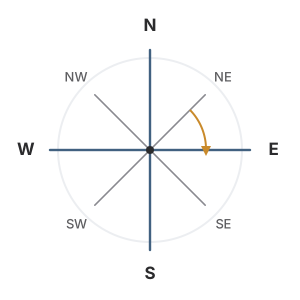
There are four main directions, north, east, south and west, and four in between: north-east, south-east, south-west and north-west. On paper north is up, east right, south down and west left. Going clockwise from north, each step is 45°.
Clockwise from north: N, NE, E, SE, S, SW, W, NW. Each step is 45°, so a right turn moves two steps.
A right turn is 90° clockwise and a left turn 90° anticlockwise, measured from the direction you face at that moment. So "left" points to a different compass direction depending on which way you face.
Facing
After a right turn
After a left turn
After an about-turn
North
East
West
South
East
South
North
West
South
West
East
North
West
North
South
East
North-east
South-east
North-west
South-west
South-west
North-west
South-east
North-east
Watch out
Facing south, your right hand points west and your left hand east, the reverse of the map. If in doubt, turn the paper so that the way you are walking points up, and read left and right off your own hands.
Turn every turn into degrees, clockwise as plus and anticlockwise as minus, add them, and make one turn from the starting direction. Right is +90°, left −90°, an about-turn 180°, and a full 360° changes nothing.
Example 1 · Net turn
Arjun faces west. He turns 45° clockwise, then 180°, then 90° anticlockwise. Which way does he face?
Net turn: 45+180−90=135∘ clockwise.
Clockwise from west: north-west at 45°, north at 90°, north-east at 135°.
Answer
North-east
Exam shortcut
With left and right turns only, count lefts minus rights. Two net lefts is an about-turn, three net lefts equal one right, and four bring you back.
Treat the start as (0,0), with east as +x and north as +y. For each leg, first update the heading, then add the distance to the right total. At the end, (x,y) tells you everything.
Example 2 · A four-leg walk
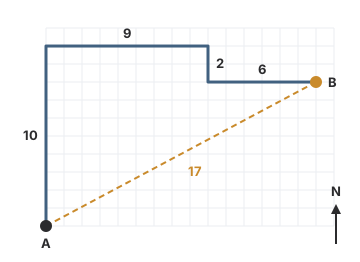
Manpreet walks 10 km north, turns right and walks 9 km, turns right and walks 2 km, then turns left and walks 6 km. Where does she end, and how far is she from the start?
North 10: (0,10). Right, so east 9: (9,10).
Right, so south 2: (9,8). Left from south is east, 6: (15,8).
Distance: 152+82=289=17 km.
Answer
15 km east and 8 km north of the start, 17 km away
The path walked is 27 km. The straight line from A to B is 17 km, by the 8-15-17 triple.
Exam shortcut
Writing each leg's heading before adding any distance is the one habit that prevents most errors. The small table takes twenty seconds, and you cannot lose a turn in it.
Net the east–west legs into one number and the north–south legs into another, then use Pythagoras. Opposite legs subtract, legs at right angles combine through Pythagoras, and legs in the same direction add.
Legs
Distance
Multiples
3 and 4
5
6 and 8 give 10; 9 and 12 give 15
5 and 12
13
10 and 24 give 26
8 and 15
17
16 and 30 give 34
7 and 24
25
k and k
k2
5 and 5 give 52
Example 3 · Netting the legs
A tractor goes 7 km south, turns left and goes 12 km, turns left and goes 12 km. How far is it from the start?
Left from south is east: 12 km east. Left from east is north: 12 km north.
North–south: 7 south and 12 north, net 5 km north. East–west: 12 km east.
Distance: 122+52=13 km.
Answer
13 km
Watch out
The total distance walked, 31 km here, is a different quantity and almost always a wrong option. And a leg can overshoot the start: 3 km east then 8 km west leaves you 5 km west, not east.
Look at the signs of the final (x,y). If one is zero, the answer is a main direction: (0,positive) is north. If both have the same size, it is an exact diagonal: (5,5) is north-east. If the sizes differ, such as (5,2), questions ask for the general direction, and (5,2) counts as north-east.
Watch out
"Where is the start from the end?" is the opposite of "where is the end from the start?". If you are 6 km north of home, home is 6 km south of you. A diagonal leg of k2 km north-east moves you k km east and k km north; split it and carry on.
A shadow always points away from the sun. In the morning after sunrise the sun is in the east, so shadows fall west; in the evening before sunset the sun is in the west, so shadows fall east.
Person faces
Morning shadow, west, is
Evening shadow, east, is
North
To the left
To the right
East
Behind
In front
South
To the right
To the left
West
In front
Behind
Example 4 · A shadow on the left
In the evening before sunset, Priyanka's shadow falls exactly to her left. Which way is she facing?
An evening shadow points east, so east is on her left.
Put one place at (0,0), usually the one mentioned most, and write every other place as coordinates from the clues. Then subtract coordinates to get the direction or distance between any two places.
Example 5 · Places on a map
The hospital is 9 km west of the college. The stadium is 12 km south of the college. The mall is 9 km west of the stadium. Where is the mall from the hospital?
College (0,0), hospital (−9,0), stadium (0,−12), mall (−9,−12).
Mall minus hospital: (0,−12).
Answer
12 km south of the hospital
Watch out
"P is 4 km north of Q" means P = Q + (0,4), which puts Q south of P. Many wrong answers read it the other way round.
Treat the code as a rotation of the compass, occasionally a mirror. Work out how far the example turns a real direction, check it on a second pair if one is given, and apply the same turn. To decode, turn the other way.
"North is called east, east is called south…" is a 90° clockwise rotation, so north-west is called north-east.
"South-east is called north" is a 135° anticlockwise rotation.
"East and west swap, north and south stay" is a mirror: only the east–west part changes, so south-east becomes south-west.
Example 6 · Decoding
In a code, every direction is named after the direction 90° clockwise from it. A note says the bank is "north" of the park. What is the real direction?
Coded name = real direction turned 90° clockwise.
Undo it: turn "north" 90° anticlockwise, which gives west.
Aarav leaves his house and cycles 6 km east. He then turns left and cycles 8 km. How far is he from his house now, in a straight line?
Show the explanationHide the explanation
AnswerB · 10 km
Turning left from east means he now faces north, so the two legs are at right angles.
Straight-line distance =62+82=36+64=100=10 km.
Worth noting
14 km adds the two legs, which is the distance travelled, not the distance from home. 100 km forgets the square root. 6-8-10 is the 3-4-5 triple doubled.
Kavitha walks 2 km west, turns left and walks 5 km, turns left again and walks 2 km, then turns left once more and walks 1 km. Where is she now compared with her starting point?
Show the explanationHide the explanation
AnswerC · 4 km south
Left from west is south, left from south is east, left from east is north.
East–west: 2 km west, then 2 km east, so they cancel.
North–south: 5 km south, then 1 km north, leaving 4 km south.
She is 4 km south of the start.
Worth noting
6 km south adds the 1 km north leg instead of subtracting it; 10 km is the total walked.
Joseph jogs 3 km north, turns right and jogs 4 km, turns right and jogs 3 km, then turns right again and jogs 4 km. How far is he from where he started?
Show the explanationHide the explanation
AnswerA · 0 km
The turns take him north, east, south and then west.
3 km north cancels 3 km south, and 4 km east cancels 4 km west.
He is back at the start, so the distance is 0 km.
Worth noting
14 km is the distance jogged, and 5 km is the diagonal of the rectangle he ran round. Four right turns bring him back to where he began.
A man walks 5 km north, turns right and walks 3 km, then turns right again and walks 5 km. How far is he from his starting point, and in which direction?
Show the explanationHide the explanation
AnswerA · 3 km east
Facing north and turning right means he now faces east, so the second leg is 3 km east.
Turning right again from east means he faces south, so the third leg is 5 km south.
The 5 km north and the 5 km south cancel exactly, leaving only the 3 km east.
He is 3 km east of where he began.
Worth noting
A rough sketch settles this faster than tracking the turns in your head. The path is three sides of a rectangle, and the missing fourth side is the answer.
Sandeep walks 3 km east, turns left and walks 5 km, then turns left again and walks 8 km. How far and in which direction is he from his starting point?
Show the explanationHide the explanation
AnswerA · 52 km north-west
Left from east is north; left from north is west.
East–west: 3 km east, then 8 km west, leaving 5 km west.
North–south: 5 km north.
5 km west and 5 km north are equal, so he is exactly north-west of the start, at 52+52=52 km.
Worth noting
North-east comes from missing that the 8 km west carries him past the start. 10 km adds 5+5 instead of using Pythagoras.
Gurpreet walks 4 km north from the temple, turns right and walks 6 km, turns right and walks 9 km, and turns right again and walks 6 km. Where is she now with respect to the temple?
Show the explanationHide the explanation
AnswerD · 5 km south
Her headings are north, east, south, west.
East 6 km and west 6 km cancel.
North 4 km and south 9 km leave 5 km south.
She is 5 km south of the temple.
Worth noting
13 km adds the north and south legs; 25 km is the whole walk.
Lalremsiami walks 9 km south from a school gate, turns right and walks 6 km, then turns right again and walks 3 km. How far and in which direction is she from the school gate?
Show the explanationHide the explanation
AnswerD · 62 km south-west
Right from south is west; right from west is north.
North–south: 9 km south, then 3 km north, leaving 6 km south.
East–west: 6 km west.
6 km south and 6 km west are equal, so she is exactly south-west, at 62 km.
Worth noting
South-east comes from thinking that right from south is east. Facing south, your right hand points west.
A cyclist rides 5 km north, turns right and rides 2 km, turns left and rides 7 km, then turns right and rides 3 km. How far is the cyclist from the starting point?
Show the explanationHide the explanation
AnswerC · 13 km
Headings: north, east, north, east.
Total north =5+7=12 km; total east =2+3=5 km.
Distance =122+52=169=13 km.
Worth noting
17 km is the total ridden. A zigzag of legs going only north and east can always be collapsed into one north total and one east total.
Kavya walks 10 km east from a petrol pump, turns left and walks 3 km, then turns left and walks 10 km. How far, and in which direction, must she now walk to reach the petrol pump by the shortest path?
Show the explanationHide the explanation
AnswerB · 3 km south
Left from east is north; left from north is west.
10 km east and 10 km west cancel, so she is 3 km north of the pump.
To get back she walks 3 km south.
Worth noting
3 km north is where she is, seen from the pump. The question asks which way she must walk to get back.
Tenzin walks 8 km west from his village, turns right and walks 6 km, then turns right again and walks 8 km. He now wants to look towards his village. In which direction should he look?
Show the explanationHide the explanation
AnswerC · South
Right from west is north; right from north is east.
8 km west and 8 km east cancel, so Tenzin is 6 km north of the village.
If Tenzin is north of the village, the village is south of Tenzin.
Worth noting
North is the direction of Tenzin from the village. The question asks the reverse: the village as seen from where he stands.
Starting from a bus depot, a van travels 4 km west, turns left and travels 7 km, turns left and travels 12 km, then turns right and travels 8 km. What is the straight-line distance between the van and the depot?
Show the explanationHide the explanation
AnswerB · 17 km
Left from west is south; left from south is east; right from east is south.
East–west: 4 km west, then 12 km east, leaving 8 km east.
North–south: 7+8=15 km south.
Distance =82+152=289=17 km (the 8-15-17 triple).
Worth noting
31 km is the distance driven, and 23 km adds 8 and 15. The common slip is treating the last right turn (from east) as a turn to north; facing east, your right hand points south.
Neha stands facing south. She turns right and walks 6 km, turns left and walks 6 km, then turns left again and walks 12 km. How far and in which direction is she from her starting point?
Show the explanationHide the explanation
AnswerC · 62 km south-east
Facing south, her right is west: 6 km west.
Facing west, her left is south: 6 km south.
Facing south, her left is east: 12 km east, which takes her from 6 km west to 6 km east.
She is 6 km east and 6 km south, so 62 km south-east.
Worth noting
When you face south, left and right are the reverse of the map: right is west, left is east. Swapping every turn gives south-west. North-west is the start as seen from Neha, measured the wrong way round.
Bikram leaves home facing east and walks 3 km. He turns left and walks 2 km, turns right and walks 7 km, turns right and walks 8 km, and then turns right and walks 10 km. Where is he now compared with his home?
Show the explanationHide the explanation
AnswerD · 6 km south
Headings in order: east, north, east, south, west.
East–west: 3+7=10 km east, then 10 km west, so they cancel.
North–south: 2 km north, then 8 km south, leaving 6 km south.
He is 6 km south of home.
Worth noting
With five legs, write the heading of every leg before adding anything. 10 km east forgets the final 10 km west leg; 30 km is the whole walk.
A person facing north turns 90∘ clockwise, then 180∘, and then 90∘ anticlockwise. Which direction is the person now facing?
Show the explanationHide the explanation
AnswerB · South
Starting from north, a 90∘ clockwise turn faces east.
A 180∘ turn reverses that, so the person now faces west.
From west, a 90∘ anticlockwise turn goes west to south, because anticlockwise runs north, west, south, east.
The person ends up facing south.
Worth noting
The clockwise and anticlockwise quarter-turns cancel, so the 180∘ turn alone decides the answer: the opposite of north is south. Seeing that first saves the whole trace.
A bus heading east takes a left turn, a left turn, a right turn and a left turn at four junctions. Which direction is it heading after the fourth junction?
Show the explanationHide the explanation
AnswerA · West
Three lefts and one right leave two net left turns.
Two left turns make 180∘, so the bus heads opposite to east.
It is heading west.
Worth noting
Counting net turns is faster than tracking each junction: lefts minus rights, then turn that many times.
In a treasure-hunt code, north is called east, east is called south, south is called west and west is called north. The in-between directions follow the same pattern. What is north-west called?
Show the explanationHide the explanation
AnswerD · North-east
Each direction is renamed as the direction 90∘ clockwise from it.
90∘ clockwise from north-west is north-east.
So north-west is called north-east.
Worth noting
South-west rotates the wrong way. Check with a cardinal: north becomes east, which is clockwise.
In a game, directions are renamed as if seen in a mirror lying along the east–west line: north is called south, south is called north, while east and west keep their names. The in-between directions follow the same rule. What is north-east called?
Show the explanationHide the explanation
AnswerC · South-east
North-east is made of north and east.
North becomes south; east stays east.
So north-east becomes south-east.
Worth noting
South-west is a half turn, which would also swap east and west. A mirror changes only the part of the direction across the mirror line.
Tariq walks 4 km east, turns left and walks 6 km, turns left and walks 10 km, then turns left and walks 12 km. He then turns to face his starting point. Which direction is he facing?
Show the explanationHide the explanation
AnswerD · North-east
Headings: east, north, west, south.
East–west: 4 km east, 10 km west, net 6 km west. North–south: 6 km north, 12 km south, net 6 km south.
He is 6 km west and 6 km south of the start, exactly south-west of it.
Looking back to the start he faces the opposite way: north-east.
Worth noting
South-west is where Tariq is, seen from the start. Facing the start reverses that direction.
In the morning after sunrise, Ananya is waiting at a bus stop and her shadow falls exactly to her left. Which direction is she facing?
Show the explanationHide the explanation
AnswerB · North
Morning shadows fall west, so west is on her left.
If west is on your left, you are facing north (facing north: left is west, right is east).
Worth noting
South is the answer if the shadow were on her right. Test the answer: face north in the morning and the sun is on your right, so the shadow falls on your left.
In the morning after sunrise, Mohan walks 3 km straight towards his shadow. He then turns right and walks another 4 km. On which side of him does his shadow fall now?
Show the explanationHide the explanation
AnswerD · To his left
Walking towards his morning shadow means walking west.
Right from west is north, so he now faces north.
The shadow still points west, and facing north, west is on his left.
Worth noting
The shadow does not move with him: it always points west in the morning. Only which side of his body it is on changes.
In the morning after sunrise, a boy stands exactly at the tip of the shadow of a water tank and looks towards the base of the tank. Which direction is he looking?
Show the explanationHide the explanation
AnswerA · East
Morning shadows fall west, so the tip of the shadow lies west of the tank.
From a point west of the tank, looking at the tank means looking east.
Worth noting
West is the direction of the shadow from the tank. He is looking back along the shadow, which is the reverse.
In the evening before sunset, Kabir walks 6 km with his shadow falling directly behind him. He then turns left and walks 8 km. How far is he from his starting point, and on which side of him does his shadow fall now?
Show the explanationHide the explanation
AnswerD · 10 km; to his left
Evening shadows fall east. With the shadow behind him, Kabir walks west for 6 km.
Left from west is south, so he walks 8 km south.
Distance from the start =62+82=10 km.
Facing south, east is on his left, so the shadow falls to his left.
Worth noting
14 km adds the legs. Facing south, left and right are reversed from the map: east is on the left.
In the morning after sunrise, the shadow of lamp post P points straight at lamp post Q, which is 12 m away. Lamp post R stands 12 m north of Q. In which direction is R from P?
Show the explanationHide the explanation
AnswerC · North-west
Morning shadows fall west, so Q is 12 m west of P.
R is 12 m north of Q, so R is 12 m west and 12 m north of P.
Equal west and north distances put R exactly north-west of P.
Worth noting
South-east is P as seen from R, the reverse. North-east comes from putting Q on the east of P, the evening rule.
Village Kheri is 9 km south of village Lohra, and village Moti is 12 km west of Lohra. What is the straight-line distance between Kheri and Moti?
Show the explanationHide the explanation
AnswerD · 15 km
From Lohra, one village is due south and the other due west, so the line joining them is the hypotenuse of a right triangle.
Distance =92+122=225=15 km.
Worth noting
9 km or 12 km uses only one of the two distances, and 3 km subtracts them; the two villages are on different sides of a right angle, so use Pythagoras.
Rukhsana and Vikram start from the same crossing. Rukhsana walks 7 km north, then turns right and walks 9 km. Vikram walks 5 km south, then turns left and walks 4 km. How far apart are they now?
Show the explanationHide the explanation
AnswerA · 13 km
Rukhsana: right from north is east, so she is 9 km east and 7 km north of the crossing.
Vikram: left from south is east, so he is 4 km east and 5 km south.
Gap: east–west 9−4=5 km; north–south 7+5=12 km (they are on opposite sides).
Distance =52+122=13 km.
Worth noting
17 km adds 5 and 12. 25 km adds everyone's walking. Facing south, a left turn points east, not west.
The bank is 8 km east of the school, and the park is 6 km north of the school. The bus stand is 6 km north of the bank. How far is the bus stand from the school, in a straight line?
Show the explanationHide the explanation
AnswerC · 10 km
The bus stand is 8 km east and 6 km north of the school.
Distance =82+62=10 km.
Worth noting
The park is extra information: it is 8 km from the bus stand, which is not what is asked. 14 km is the road distance through the bank.
Pillar A is 10 m north of pillar B. Pillar C is 10 m east of A, pillar D is 20 m south of C, and pillar E is 10 m west of D. Where is E with respect to B?
Show the explanationHide the explanation
AnswerA · 10 m south
With B at the origin: A=10 m north; C=10 m east, 10 m north; D=10 m east, 10 m south; E=0 east, 10 m south.
So E is 10 m directly south of B.
Worth noting
102 m south-east is where D is. 20 m south forgets that A started 10 m north of B.
Shop Q is 5 km east of shop P, and shop R is 2 km north of Q. In which general direction is R from P? (A general direction such as north-east means anywhere between north and east.)
Show the explanationHide the explanation
AnswerD · North-east
From P, R is 5 km east and 2 km north.
It is neither due east (it has a north part) nor due north (it has an east part).
It lies between north and east, so its general direction is north-east.
Worth noting
East ignores the 2 km north. Under the 'general direction' convention, any point with both an east part and a north part is north-east.
Two petrol pumps, X and Y, are 16 km apart, with Y due east of X. A dhaba Z is 6 km due north of the point midway between X and Y. How far is Z from X?
Show the explanationHide the explanation
AnswerA · 10 km
The midpoint is 8 km east of X.
Z is 8 km east and 6 km north of X.
Distance =82+62=10 km.
Worth noting
273 km uses the full 16 km instead of half of it. 14 km and 22 km add the legs.
In a map game, the names east and west are swapped, while north and south keep their names; in-between directions follow the same rule. A clue says the well is 'south-east' of the banyan tree. In which real direction is the well from the tree?
Show the explanationHide the explanation
AnswerC · South-west
South stays south.
East in the game means real west.
So 'south-east' in the game is real south-west.
Worth noting
North-west turns the whole direction around, which also swaps north and south. Only the east–west part is swapped here.
In a code, every direction is given the name of the direction 90∘ anticlockwise from it: north is called west, west is called south, and so on. Using this code, Asha says the library is 'east' of her house. In which real direction is the library from her house?
Show the explanationHide the explanation
AnswerB · South
Coded name = real direction turned 90∘ anticlockwise.
So to decode, turn the coded name 90∘ clockwise.
90∘ clockwise from east is south: the library is to the south.
Worth noting
North applies the code again instead of undoing it. Check: real south turned 90∘ anticlockwise is east, which matches what Asha said.
Sneha and Rahul start from the same gate. Sneha walks 5 km north, turns right and walks 3 km. Rahul walks 3 km south, turns left and walks 9 km. How far apart are they now?
Show the explanationHide the explanation
AnswerB · 10 km
Sneha: right from north is east, so she is 3 km east and 5 km north of the gate.
Rahul: left from south is east, so he is 9 km east and 3 km south.
Gap: east–west 9−3=6 km; north–south 5+3=8 km.
Distance =62+82=10 km.
Worth noting
413 km comes from sending Rahul west: facing south, your left hand points east. 14 km adds 6 and 8.
The area names are NTA's. The chapters inside them are EduFarming's own division, not NTA's.