EduFarming
Your list · 0हिं

Type at least two letters. Press Esc to close.

↑↓ navigate↵ openTAB cycle filter

Lines, Triangles and Circles for CUET General Aptitude

About 15 min to learn · 67 questions

CUET geometry uses Class 8–10 facts: angles on lines and parallels, the triangle angle sum, similarity and Pythagoras, polygon angles and six circle theorems. There is no proof work. What costs marks is picking the wrong rule, such as calling two angles equal when they add up to 180°. This lesson gives every rule with a diagram or a worked example, and the traps that go with it.

Syllabus area
Reasoning
On this page · 10 sections
  1. 01The core idea
  2. 02Lines and angles
  3. 03Triangles
  4. 04Similarity and Pythagoras
  5. 05Quadrilaterals and polygons
  6. 06Circles
  7. 07Exam shortcuts
  8. 08Common mistakes
  9. 09Quick revision
  10. 10Check your understanding

The core idea

Every geometry question in CUET is settled by one or two standard facts. The skill is choosing the right fact, and the most common wrong choice is mixing up "equal" with "adds up to 180°".

Two habits prevent most errors. First, sketch the figure from the words before you calculate, because a point drawn on the wrong side of a line changes the answer. Second, read angle names carefully: in ∠ABC\angle ABC the middle letter, B, is the vertex, and the angle sits between the rays BA and BC.

Lines and angles

What are complementary, supplementary and vertically opposite angles?

Two angles are complementary if they add up to 90°, and supplementary if they add up to 180°. When two straight lines cross, the angles facing each other are vertically opposite and always equal.

  • The complement of xx is 90∘−x90^\circ - x, and its supplement is 180∘−x180^\circ - x.
  • Angles on a straight line add up to 180°. Angles all the way round a point add up to 360°.
  • The supplement of an angle is always 90° more than its complement.

Example 1 · Complement and supplement

The supplement of an angle is four times its complement. Find the angle.

  1. Write the condition: 180−x=4(90−x)180 - x = 4(90 - x).

  2. Expand and solve: 180−x=360−4x180 - x = 360 - 4x, so 3x=1803x = 180 and x=60x = 60.

Answer

60°

To check: the supplement is 120°, the complement is 30°, and 120=4×30120 = 4 \times 30.

Which angles are equal when a transversal cuts two parallel lines?

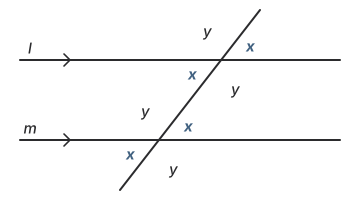
Corresponding angles are equal, and alternate angles are equal. Co-interior angles, the two angles between the lines on the same side of the transversal, add up to 180°. All three facts need the lines to be parallel.

Two parallel lines, l and m, crossed by a slanting transversal. At each crossing the two acute angles are marked x and the two obtuse angles are marked y.
At each crossing there are only two sizes of angle. Every acute angle is x, every obtuse angle is y, and x + y = 180°.
Pair of anglesWhere they sitRule
CorrespondingSame position at each crossingEqual
AlternateBetween the lines, on opposite sides of the transversal (a Z shape)Equal
Co-interiorBetween the lines, on the same side of the transversal (a C shape)Add up to 180°

Exam shortcut

You rarely need the names. Any two acute angles in the figure are equal, any two obtuse angles are equal, and an acute angle and an obtuse angle add up to 180°.

Example 2 · Co-interior angles

Two parallel lines are cut by a transversal. The two co-interior angles are (3x+20)∘(3x + 20)^\circ and (2x+10)∘(2x + 10)^\circ. Find both angles.

  1. Co-interior angles add up to 180°: (3x+20)+(2x+10)=180(3x + 20) + (2x + 10) = 180.

  2. Solve: 5x+30=1805x + 30 = 180, so x=30x = 30.

  3. Put xx back: 3×30+20=1103 \times 30 + 20 = 110 and 2×30+10=702 \times 30 + 10 = 70.

Answer

110° and 70°

Watch out

The question asks for the angles, and 30 is only xx. The value of xx is almost always one of the options.

Common variation: a point between two parallel lines

Suppose AB is parallel to CD, and a point E between them is joined to B and to D. If the angles at B and D both open towards E, then ∠BED\angle BED is their sum. If both open away from E, so that both are obtuse, the three angles add up to 360°.

Either way, the reliable method is to draw a third line through E, parallel to the other two, and use alternate angles twice.

Triangles

What are the angle rules for a triangle?

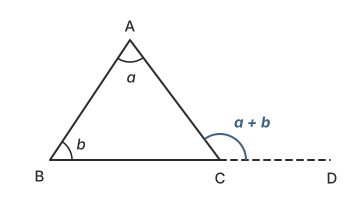
The three angles of a triangle add up to 180°. An exterior angle, made by extending one side, equals the sum of the two interior angles opposite it. In an isosceles triangle, the angles opposite the equal sides are equal, and in an equilateral triangle every angle is 60°.

Triangle ABC with side BC extended beyond C to D. The interior angles at A and B are marked a and b, and the exterior angle ACD is marked a + b.
The exterior angle at C equals the two opposite interior angles added together.

Example 3 · Exterior angle

In triangle KLM, side LM is extended beyond M to N, and ∠KMN=128∘\angle KMN = 128^\circ. If ∠K=∠L\angle K = \angle L, find ∠K\angle K.

  1. The exterior angle equals the two opposite interior angles: ∠K+∠L=128∘\angle K + \angle L = 128^\circ.

  2. The two angles are equal, so ∠K=128∘÷2=64∘\angle K = 128^\circ \div 2 = 64^\circ.

Answer
∠K=64∘\angle K = 64^\circ

To check: ∠KML=180∘−128∘=52∘\angle KML = 180^\circ - 128^\circ = 52^\circ, and 64+64+52=18064 + 64 + 52 = 180.

Three results for bisectors

  • The bisectors of ∠B\angle B and ∠C\angle C meet at an angle of 90∘+12∠A90^\circ + \tfrac{1}{2}\angle A.
  • The bisectors of the exterior angles at B and C meet at an angle of 90∘−12∠A90^\circ - \tfrac{1}{2}\angle A.
  • The angle between the altitude and the angle bisector from A is 12(∠B−∠C)\tfrac{1}{2}(\angle B - \angle C), taking the larger angle first.
Why the first one works

In triangle BIC, the angles at B and C are half of ∠B\angle B and half of ∠C\angle C. So ∠BIC=180∘−12(∠B+∠C)\angle BIC = 180^\circ - \tfrac{1}{2}(\angle B + \angle C). Since ∠B+∠C=180∘−∠A\angle B + \angle C = 180^\circ - \angle A, this is 180∘−90∘+12∠A=90∘+12∠A180^\circ - 90^\circ + \tfrac{1}{2}\angle A = 90^\circ + \tfrac{1}{2}\angle A.

How do the sides of a triangle relate to its angles?

The longest side is opposite the largest angle, and the shortest side is opposite the smallest angle. Any two sides must add up to more than the third side. This is the triangle inequality.

So if two sides are aa and bb, with aa the larger, the third side lies strictly between a−ba - b and a+ba + b. With sides 9 cm and 4 cm, the third side is more than 5 cm and less than 13 cm. As a whole number of centimetres it can be 6 to 12, which is 7 lengths.

Watch out

The inequality is strict. Sticks of 2, 9 and 11 cm do not make a triangle: they lie flat, because 2+92 + 9 only equals 11.

When are two triangles congruent, and when are they only similar?

Two triangles are congruent, the same shape and size, if they match by SSS, SAS, ASA, AAS or RHS (right angle, hypotenuse, side). They are similar, the same shape at any size, if their angles match (AA) or their sides are all in one ratio.

Watch out

Three equal angles (AAA) prove only similarity, never congruence. SSA, two sides with an angle that is not between them, is not a valid test either.

Similarity and Pythagoras

How do ratios work in similar triangles?

In similar triangles every length scales by the same factor kk: sides, altitudes, medians and perimeters. Areas scale by k2k^2. If the sides are in the ratio 2:32 : 3, the areas are in the ratio 4:94 : 9. If the areas are 16:4916 : 49, the sides are 4:74 : 7.

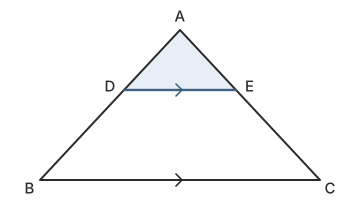
If a line parallel to BC cuts AB at D and AC at E, it divides both sides in the same ratio, and the small triangle ADE is similar to ABC. This is the basic proportionality theorem.

Triangle ABC with a line DE drawn parallel to BC, D on AB and E on AC. The small triangle ADE at the top is shaded.
DE is parallel to BC, so AD : DB = AE : EC, and triangle ADE is a scaled copy of triangle ABC.

Example 4 · Area of the part below a parallel line

In triangle ABC, DE is parallel to BC, with D on AB and E on AC. AD=3AD = 3 cm and DB=5DB = 5 cm. Find the ratio of the area of triangle ADE to the area of the part DBCE.

  1. The scale factor uses the whole side: AD:AB=3:8AD : AB = 3 : 8.

  2. Areas scale by the square: triangle ADE : triangle ABC =9:64= 9 : 64.

  3. The part DBCE is what is left: 64−9=5564 - 9 = 55 parts.

Answer
9:559 : 55

Watch out

The scale factor for lengths such as DE is AD:ABAD : AB, not AD:DBAD : DB. And 9:649 : 64 compares the small triangle with the whole triangle, not with the part below the line.

Exam shortcut

Shadows are similar triangles. At any moment, height ÷ shadow is the same for every upright object in the sun.

What is Pythagoras' theorem, and which triplets should you know?

In a right-angled triangle, the square of the hypotenuse equals the sum of the squares of the other two sides. The hypotenuse is the side opposite the right angle and is always the longest side.

Pythagoras' theorem

hypotenuse2=leg12+leg22\text{hypotenuse}^2 = \text{leg}_1^2 + \text{leg}_2^2

Knowing these triplets, and their multiples, saves square-root work:

TripletCommon multiples
3, 4, 56, 8, 10 · 9, 12, 15 · 15, 20, 25
5, 12, 1310, 24, 26
8, 15, 1716, 30, 34
7, 24, 2514, 48, 50
20, 21, 29—
9, 40, 41—

Example 5 · Height from a slant length

A kite string is let out to 50 m, and the kite is directly above a point 14 m from the child holding it. How high is the kite?

  1. The string is the hypotenuse: height=502−142\text{height} = \sqrt{50^2 - 14^2}.

  2. Calculate: 2500−196=2304=48\sqrt{2500 - 196} = \sqrt{2304} = 48.

Answer

48 m

This is the 7, 24, 25 triplet doubled.

Common variation: the altitude to the hypotenuse

If the altitude is drawn from the right angle to the hypotenuse:

  • altitude == leg ×\times leg ÷ hypotenuse;
  • each leg squared == hypotenuse ×\times the part of the hypotenuse next to that leg;
  • the median to the hypotenuse is half the hypotenuse.

For legs 6 and 8, the hypotenuse is 10, the altitude is 48÷10=4.848 \div 10 = 4.8, and the median is 5.

Quadrilaterals and polygons

What are the key properties of parallelograms, rhombuses, rectangles and trapeziums?

In a parallelogram, opposite sides are equal and parallel, opposite angles are equal, adjacent angles add up to 180°, and the diagonals bisect each other. The special shapes add more facts.

ShapeExtra facts
RectangleAll angles 90°. Diagonals equal
RhombusAll sides equal. Diagonals meet at 90° and bisect the angles
SquareEverything above
TrapeziumOne pair of parallel sides. The angles along each slanted side add up to 180°
KiteTwo pairs of equal adjacent sides. Diagonals meet at 90°

Exam shortcut

In a rhombus, half of each diagonal and one side form a right-angled triangle, so side2=(d12)2+(d22)2\text{side}^2 = (\tfrac{d_1}{2})^2 + (\tfrac{d_2}{2})^2. Diagonals of 16 and 30 give a side of 17.

Key idea

In a parallelogram, the bisector of an angle cuts off an isosceles triangle, because the alternate angle equals the half-angle.

How do you find the angles of a polygon and count its diagonals?

For a polygon with nn sides, the interior angles add up to (n−2)×180∘(n - 2) \times 180^\circ, and the exterior angles always add up to 360°. In a regular polygon, each exterior angle is 360∘÷n360^\circ \div n, and each interior angle is 180° minus that. A polygon has n(n−3)2\tfrac{n(n - 3)}{2} diagonals.

SidesAngle sumEach angle (regular)Each exteriorDiagonals
5540°108°72°5
6720°120°60°9
81080°135°45°20
91260°140°40°27
101440°144°36°35
121800°150°30°54

Example 6 · Sides from an angle condition

Each exterior angle of a regular polygon is one-fifth of each interior angle. How many sides does it have?

  1. Interior =5×= 5 \times exterior, and interior ++ exterior =180∘= 180^\circ. So 6×6 \times exterior =180∘= 180^\circ.

  2. Each exterior angle is 30°, so n=360÷30=12n = 360 \div 30 = 12.

Answer

12 sides

Exam shortcut

To find nn from an interior angle, subtract it from 180° and divide 360° by the result. For 156°: 180−156=24180 - 156 = 24, and 360÷24=15360 \div 24 = 15 sides. That is much faster than solving (n−2)×180=156n(n - 2) \times 180 = 156n.

Circles

What are the circle theorems you need?

Six facts cover CUET:

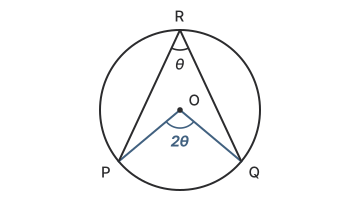
  • The angle at the centre is twice the angle at the circumference standing on the same arc.
  • Angles in the same segment are equal.
  • The angle in a semicircle is 90°.
  • Opposite angles of a cyclic quadrilateral add up to 180°.
  • A tangent is perpendicular to the radius at the point where it touches.
  • The two tangents from an outside point are equal in length.
A circle with centre O. Points P and Q are on the lower part of the circle and R is at the top. Angle POQ at the centre is marked 2θ and angle PRQ at R is marked θ.
Both angles stand on arc PQ, so the angle at the centre is twice the angle at the circumference.

Example 7 · Which arc?

Arc PQ of a circle makes an angle of 110° at the centre. Find the angle it makes at a point on the major arc, and at a point on the minor arc.

  1. A point on the major arc stands on arc PQ, so it sees half the centre angle: 110∘÷2=55∘110^\circ \div 2 = 55^\circ.

  2. A point on the minor arc stands on the other arc, whose centre angle is 360∘−110∘=250∘360^\circ - 110^\circ = 250^\circ. So it sees 250∘÷2=125∘250^\circ \div 2 = 125^\circ.

Answer

55° on the major arc, 125° on the minor arc.

The two add up to 180°, because together the points form a cyclic quadrilateral.

Example 8 · Cyclic quadrilateral

Points A, B, C and D lie on a circle in that order. ∠BAC=30∘\angle BAC = 30^\circ and ∠CAD=55∘\angle CAD = 55^\circ. Find ∠BCD\angle BCD.

  1. The angle at A in the quadrilateral is ∠BAD=30∘+55∘=85∘\angle BAD = 30^\circ + 55^\circ = 85^\circ.

  2. ABCD is cyclic, so opposite angles add up to 180°: ∠BCD=180∘−85∘=95∘\angle BCD = 180^\circ - 85^\circ = 95^\circ.

Answer
∠BCD=95∘\angle BCD = 95^\circ

Tangent facts

  • With tangents PA and PB from P to a circle with centre O, the angles OAP and OBP are both 90°, so ∠AOB+∠APB=180∘\angle AOB + \angle APB = 180^\circ.
  • If all four sides of a quadrilateral touch a circle inside it, the tangents from each corner are equal, so AB+CD=BC+DAAB + CD = BC + DA.

How do you find the length of a chord or a tangent?

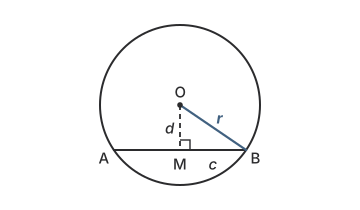
Use a right-angled triangle. The perpendicular from the centre to a chord bisects it, so the half-chord, the distance from the centre and the radius form a right triangle. For a tangent from a point P, the tangent, the radius and the line OP form one too.

A circle with centre O and a chord AB. A dashed perpendicular from O meets the chord at its midpoint M. The distance OM is marked d, the half-chord MB is marked c, and the radius OB is marked r.
The perpendicular from the centre bisects the chord: c² + d² = r², where c is half the chord.

Example 9 · Radius from a chord

A chord 40 cm long is 21 cm from the centre of a circle. Find the radius.

  1. The half-chord is 20 cm.

  2. Use Pythagoras: r=202+212=400+441=841=29r = \sqrt{20^2 + 21^2} = \sqrt{400 + 441} = \sqrt{841} = 29.

Answer

29 cm

This is the 20, 21, 29 triplet.

Exam shortcut

For a tangent from P: tangent2+r2=OP2\text{tangent}^2 + r^2 = OP^2. A point 13 cm from the centre of a circle of radius 5 cm has tangents of 12 cm.

Watch out

For two parallel chords, add their distances from the centre if they are on opposite sides, and subtract if they are on the same side. And remember the right triangle gives half the chord: double it at the end.

Exam shortcuts

  • Two sizes of angle. With parallel lines, every acute angle is equal and every obtuse angle is its supplement.
  • Exterior angle first. It gives the sum of two angles in one step, without finding the third.
  • Polygon from an angle. n=360÷(180−interior angle)n = 360 \div (180 - \text{interior angle}).
  • Learn the triplets. 3-4-5, 5-12-13, 8-15-17, 7-24-25 and 20-21-29, with their multiples.
  • Square for areas, root for lengths. Similar figures scale lengths by kk and areas by k2k^2.

Common mistakes

  • Equal or supplementary? Alternate and corresponding angles are equal. Co-interior angles, and opposite angles of a cyclic quadrilateral, add up to 180°.
  • Complement or supplement? 90° or 180°. Read the word twice.
  • Answering with xx. After finding xx, put it back to get the angle.
  • Whole side or part of it? In the proportionality theorem, lengths scale by AD:ABAD : AB, not AD:DBAD : DB.
  • Using an area ratio on a length. Square a length ratio to get areas, and take the root of an area ratio to get lengths.
  • Half-chord or chord? The right triangle gives half the chord.
  • Median or altitude? In a right triangle, half the hypotenuse is the median. The altitude, leg × leg ÷ hypotenuse, is shorter.
  • Which arc? A point on the minor arc sees 180° minus the angle seen from the major arc.
  • Doubling the sides. Doubling nn does not double the angle sum, because the − 2 in (n−2)×180∘(n - 2) \times 180^\circ does not double.
  • Strict inequality. A third side equal to the sum of the other two gives a flat line, not a triangle.

Quick revision

Lines

  • Complementary: 90°. Supplementary: 180°. Vertically opposite: equal
  • Parallel lines: corresponding and alternate angles equal, co-interior angles add up to 180°

Triangles

  • Angle sum 180°. Exterior angle = sum of the two opposite interior angles
  • Longest side opposite the largest angle
  • Third side strictly between a−ba - b and a+ba + b
  • Congruence: SSS, SAS, ASA, AAS, RHS. Not AAA, not SSA

Similarity and Pythagoras

  • Lengths scale by kk, areas by k2k^2
  • A line parallel to one side divides the other two in the same ratio
  • hypotenuse2=leg12+leg22\text{hypotenuse}^2 = \text{leg}_1^2 + \text{leg}_2^2

Polygons

  • Angle sum (n−2)×180∘(n - 2) \times 180^\circ. Exterior angles add up to 360°
  • Regular polygon: each exterior angle 360∘÷n360^\circ \div n
  • Diagonals: n(n−3)2\tfrac{n(n - 3)}{2}

Circles

  • Centre angle = 2 × angle at the circumference on the same arc
  • Angle in a semicircle: 90°. Cyclic quadrilateral: opposite angles add up to 180°
  • A tangent is perpendicular to the radius. Tangents from one point are equal
  • Chord: (half-chord)2+d2=r2(\text{half-chord})^2 + d^2 = r^2

Ratios come back in ratio and proportion, and areas and volumes in mensuration.

Next · 09Quick revision

Check your understanding

67 questions, grouped by type, easy to hard. Pick an answer and check it. The worked solution opens when you ask for it.

Lines and anglesQ1 of 67Q1

Lines and angles

13 questions

Two angles are complementary, and one of them is 18° more than the other. What is the smaller angle?

Options for question 1

Show the explanationHide the explanation

AnswerA · 36°

  1. Complementary angles add up to 90°.

  2. Let the smaller angle be xx. Then x+(x+18∘)=90∘x + (x + 18^\circ) = 90^\circ, so 2x=72∘2x = 72^\circ and x=36∘x = 36^\circ.

Worth noting

54° is the larger angle, and 81° comes from using 180° (supplementary) instead of 90°.

An angle is 38° less than its supplement. What is the angle?

Options for question 2

Show the explanationHide the explanation

AnswerB · 71°

  1. Let the angle be xx. Its supplement is 180∘−x180^\circ - x.

  2. x=(180∘−x)−38∘x = (180^\circ - x) - 38^\circ, so 2x=142∘2x = 142^\circ and x=71∘x = 71^\circ.

  3. Check: the supplement is 109°, and 109∘−71∘=38∘109^\circ - 71^\circ = 38^\circ.

Worth noting

109° is the supplement itself, and 26° comes from using 90° (complement) instead of 180°.

Lines AB and CD cross at O. ∠AOC=(3x+10)∘\angle AOC = (3x + 10)^\circ and ∠BOD=(5x−30)∘\angle BOD = (5x - 30)^\circ. What is ∠BOC\angle BOC?

Options for question 3

Show the explanationHide the explanation

AnswerD · 110°

  1. ∠AOC\angle AOC and ∠BOD\angle BOD are vertically opposite, so they are equal: 3x+10=5x−303x + 10 = 5x - 30, giving x=20x = 20.

  2. So ∠AOC=3×20+10=70∘\angle AOC = 3 \times 20 + 10 = 70^\circ.

  3. ∠BOC\angle BOC sits next to ∠AOC\angle AOC on the straight line AB, so ∠BOC=180∘−70∘=110∘\angle BOC = 180^\circ - 70^\circ = 110^\circ.

Worth noting

70° is ∠AOC\angle AOC, not ∠BOC\angle BOC. 85° and 95° come from wrongly treating the two vertically opposite angles as supplementary (8x−20=180)(8x - 20 = 180).

Parallel lines l and m are cut by a transversal. One of the two interior angles on the same side of the transversal is 64°. What is the other one?

Options for question 4

Show the explanationHide the explanation

AnswerC · 116°

  1. Interior angles on the same side of a transversal (co-interior angles) add up to 180° when the lines are parallel.

  2. Other angle = 180∘−64∘=116∘180^\circ - 64^\circ = 116^\circ.

Worth noting

Co-interior angles are supplementary, not equal. 64° would be right for alternate or corresponding angles.

Lines p and q are parallel, and a transversal crosses both. Two corresponding angles measure (2x+15)∘(2x + 15)^\circ and (3x−20)∘(3x - 20)^\circ. What is the size of each of these angles?

Options for question 5

Show the explanationHide the explanation

AnswerB · 85°

  1. Corresponding angles between parallel lines are equal: 2x+15=3x−202x + 15 = 3x - 20.

  2. So x=35x = 35.

  3. Each angle = 2×35+15=85∘2 \times 35 + 15 = 85^\circ.

Worth noting

35 is the value of xx, not the angle. 89° comes from wrongly adding the two angles to 180°.

The supplement of an angle is five times its complement. What is the angle?

Options for question 6

Show the explanationHide the explanation

AnswerC · 67.5°

  1. Let the angle be xx. Supplement = 180∘−x180^\circ - x, complement = 90∘−x90^\circ - x.

  2. 180−x=5(90−x)=450−5x180 - x = 5(90 - x) = 450 - 5x.

  3. 4x=2704x = 270, so x=67.5∘x = 67.5^\circ.

Worth noting

22.5° is the complement and 112.5° is the supplement of the answer. Check: 112.5=5×22.5112.5 = 5 \times 22.5.

Lines AB and CD are parallel, with AB above CD, A to the left of B and C to the left of D. A point E lies between the two lines, to the left of both B and D, and is joined to B and to D. If ∠ABE=40∘\angle ABE = 40^\circ and ∠CDE=55∘\angle CDE = 55^\circ, what is ∠BED\angle BED?

Options for question 7

Show the explanationHide the explanation

AnswerC · 95°

  1. Draw a line through E parallel to AB (and so to CD). It splits ∠BED\angle BED into two parts.

  2. The upper part equals ∠ABE=40∘\angle ABE = 40^\circ (alternate angles).

  3. The lower part equals ∠CDE=55∘\angle CDE = 55^\circ (alternate angles).

  4. ∠BED=40∘+55∘=95∘\angle BED = 40^\circ + 55^\circ = 95^\circ.

Worth noting

When the point sits between the parallel lines and the angles open towards it, the angle at the point is the SUM of the two angles. 265° is the reflex angle at E.

Two parallel lines are cut by a transversal. One of the interior angles on the same side of the transversal is 124°. The bisectors of these two co-interior angles meet at P. What is the angle between the bisectors at P?

Options for question 8

Show the explanationHide the explanation

AnswerB · 90°

  1. The two co-interior angles are 124° and 180∘−124∘=56∘180^\circ - 124^\circ = 56^\circ.

  2. Their halves are 62° and 28°.

  3. These halves are two angles of the triangle formed at P, so the angle at P=180∘−62∘−28∘=90∘P = 180^\circ - 62^\circ - 28^\circ = 90^\circ.

Worth noting

It is always 90°: the two halves always add to 90° because the full angles add to 180°.

XOY is a straight line. Rays OP and OQ are drawn on the same side of it so that ∠XOP\angle XOP, ∠POQ\angle POQ and ∠QOY\angle QOY are in the ratio 3:4:53 : 4 : 5. What is ∠XOP\angle XOP?

Options for question 9

Show the explanationHide the explanation

AnswerA · 45°

  1. The three angles together make the straight angle XOY=180∘XOY = 180^\circ.

  2. Total parts = 3+4+5=123 + 4 + 5 = 12, so one part = 180∘÷12=15∘180^\circ \div 12 = 15^\circ.

  3. ∠XOP=3×15∘=45∘\angle XOP = 3 \times 15^\circ = 45^\circ.

Worth noting

60° and 75° are ∠POQ\angle POQ and ∠QOY\angle QOY. 90° comes from sharing 360° instead of 180°.

Two parallel lines are cut by a transversal. Of the two interior angles on the same side of the transversal, one is 30° less than twice the other. What is the larger of these two angles?

Options for question 10

Show the explanationHide the explanation

AnswerD · 110°

  1. Co-interior angles between parallel lines add up to 180°.

  2. Let the smaller be xx; the larger is 2x−302x - 30. So x+2x−30=180x + 2x - 30 = 180, giving x=70x = 70.

  3. Larger angle = 2×70−30=110∘2 \times 70 - 30 = 110^\circ.

Worth noting

70° is the smaller angle. 30° comes from setting the angles equal, and 50° from making them add to 90°.

The complement of an angle and the supplement of the same angle add up to 130°. What is the angle?

Options for question 11

Show the explanationHide the explanation

AnswerA · 70°

  1. Complement + supplement = (90∘−x)+(180∘−x)=270∘−2x(90^\circ - x) + (180^\circ - x) = 270^\circ - 2x.

  2. 270−2x=130270 - 2x = 130, so 2x=1402x = 140 and x=70∘x = 70^\circ.

  3. Check: complement 20°, supplement 110°, total 130°.

Worth noting

140° is 2x2x; remember to halve it. 110° is the supplement of the answer.

Lines AB and CD are parallel, with AB above CD, A to the left of B and C to the left of D. A point E lies between the two lines, to the right of both B and D, and is joined to B and to D. If ∠ABE=150∘\angle ABE = 150^\circ and ∠CDE=140∘\angle CDE = 140^\circ, what is ∠BED\angle BED (the angle less than 180°)?

Options for question 12

Show the explanationHide the explanation

AnswerB · 70°

  1. Since E is to the right, ∠ABE\angle ABE is measured from BA (pointing left) round to BE, so the angle between BE and the rightward part of AB is 180∘−150∘=30∘180^\circ - 150^\circ = 30^\circ.

  2. Similarly at D, the angle between DE and the rightward part of CD is 180∘−140∘=40∘180^\circ - 140^\circ = 40^\circ.

  3. Draw a line through E parallel to AB. By alternate angles, ∠BED=30∘+40∘=70∘\angle BED = 30^\circ + 40^\circ = 70^\circ.

  4. Equivalently, ∠BED=360∘−150∘−140∘=70∘\angle BED = 360^\circ - 150^\circ - 140^\circ = 70^\circ.

Worth noting

The 'add the two angles' rule works only when the angles open towards E. Here they open away from E, so the three angles add to 360°. 290° is the sum of the two given angles, not ∠BED\angle BED.

AOB is a straight line. Rays OP and OQ lie on the same side of AB with ∠AOP=40∘\angle AOP = 40^\circ and ∠BOQ=70∘\angle BOQ = 70^\circ. Ray OR bisects ∠POQ\angle POQ. What is ∠AOR\angle AOR?

Options for question 13

Show the explanationHide the explanation

AnswerC · 75°

  1. The three angles ∠AOP\angle AOP, ∠POQ\angle POQ, ∠QOB\angle QOB make the straight angle: ∠POQ=180∘−40∘−70∘=70∘\angle POQ = 180^\circ - 40^\circ - 70^\circ = 70^\circ.

  2. OR bisects it, so ∠POR=35∘\angle POR = 35^\circ.

  3. ∠AOR=∠AOP+∠POR=40∘+35∘=75∘\angle AOR = \angle AOP + \angle POR = 40^\circ + 35^\circ = 75^\circ.

Worth noting

35° is only ∠POR\angle POR, and 105° is ∠BOR\angle BOR (70∘+35∘)(70^\circ + 35^\circ). Check: 75∘+105∘=180∘75^\circ + 105^\circ = 180^\circ.

Triangles

15 questions

The three angles of a triangle are in the ratio 2:3:42 : 3 : 4. What is the largest angle?

Options for question 14

Show the explanationHide the explanation

AnswerC · 80∘80^\circ

  1. The angles of any triangle add to 180∘180^\circ.

  2. The ratio has 2+3+4=92 + 3 + 4 = 9 parts, so one part is 180∘÷9=20∘180^\circ \div 9 = 20^\circ.

  3. The largest angle has 4 parts: 4×20∘=80∘4 \times 20^\circ = 80^\circ.

  4. Check: 40∘+60∘+80∘=180∘40^\circ + 60^\circ + 80^\circ = 180^\circ.

Worth noting

The largest angle is under 90∘90^\circ, so this is an acute-angled triangle. The 90∘90^\circ on offer assumes a ratio like this must produce a right angle; it does not.

In triangle PQR, ∠P=48∘\angle P = 48^\circ and ∠Q=67∘\angle Q = 67^\circ. What is ∠R\angle R?

Options for question 15

Show the explanationHide the explanation

AnswerB · 65°

  1. The angles of a triangle add up to 180°.

  2. ∠R=180∘−48∘−67∘=65∘\angle R = 180^\circ - 48^\circ - 67^\circ = 65^\circ.

Worth noting

115° is ∠P+∠Q\angle P + \angle Q, which is the exterior angle at R, not ∠R\angle R itself.

In an isosceles triangle, the angle between the two equal sides is 40°. What is each of the other two angles?

Options for question 16

Show the explanationHide the explanation

AnswerD · 70°

  1. The two base angles are equal and add up to 180∘−40∘=140∘180^\circ - 40^\circ = 140^\circ.

  2. Each base angle = 140∘÷2=70∘140^\circ \div 2 = 70^\circ.

Worth noting

50° comes from sharing 90∘−40∘90^\circ - 40^\circ instead of 180∘−40∘180^\circ - 40^\circ. 20° is just half the given angle.

Each of the two equal angles of an isosceles triangle measures 52°. What is the third angle?

Options for question 17

Show the explanationHide the explanation

AnswerC · 76°

  1. The two equal angles total 2×52∘=104∘2 \times 52^\circ = 104^\circ.

  2. Third angle = 180∘−104∘=76∘180^\circ - 104^\circ = 76^\circ.

Worth noting

64° comes from wrongly treating 52° as the apex angle. 128° is 180∘−52∘180^\circ - 52^\circ, forgetting there are two equal angles.

Naveen has four bundles of three sticks each. He wants to join the three sticks of one bundle end to end to make a triangle. Which bundle will work?

Options for question 18

Show the explanationHide the explanation

AnswerD · 4 cm, 7 cm, 10 cm

  1. In a triangle, the two shorter sides must add up to MORE than the longest side.

  2. 3+4=73 + 4 = 7 is less than 8; 5+6=115 + 6 = 11 is less than 12; 2+9=112 + 9 = 11 only equals 11, so those sticks lie flat.

  3. 4+7=114 + 7 = 11 is more than 10, so 4 cm, 7 cm and 10 cm make a triangle.

Worth noting

Equal is not enough: when the two shorter sides add up to exactly the longest side, the 'triangle' collapses into a straight line.

In triangle ABC, the exterior angle at C is 110∘110^\circ and the interior angle at A is 45∘45^\circ. What is the measure of angle B?

Options for question 19

Show the explanationHide the explanation

AnswerB · 65∘65^\circ

  1. The exterior angle of a triangle equals the sum of the two interior angles not adjacent to it.

  2. The exterior angle at C is therefore A+BA + B, so 110∘=45∘+B110^\circ = 45^\circ + B.

  3. This gives B=65∘B = 65^\circ.

  4. Check by the longer route: the interior angle at C is 180∘−110∘=70∘180^\circ - 110^\circ = 70^\circ, and 45∘+65∘+70∘=180∘45^\circ + 65^\circ + 70^\circ = 180^\circ.

Worth noting

The 70∘70^\circ on offer is the interior angle at C, which the check above computes on the way. It is the right number for the wrong vertex.

The angles of triangle ABC are ∠A=(x+15)∘\angle A = (x + 15)^\circ, ∠B=(2x−10)∘\angle B = (2x - 10)^\circ and ∠C=(3x+25)∘\angle C = (3x + 25)^\circ. What is ∠B\angle B?

Options for question 20

Show the explanationHide the explanation

AnswerB · 40°

  1. Angle sum: (x+15)+(2x−10)+(3x+25)=180(x + 15) + (2x - 10) + (3x + 25) = 180.

  2. 6x+30=1806x + 30 = 180, so x=25x = 25.

  3. ∠B=2×25−10=40∘\angle B = 2 \times 25 - 10 = 40^\circ. (∠A\angle A is also 40° and ∠C\angle C is 100°.)

Worth noting

25 is xx, not the angle, and 50 is 2x2x before subtracting 10. Since ∠A=∠B\angle A = \angle B, this triangle is isosceles.

In triangle ABC, side BC is extended beyond C to a point D. ∠ACD=115∘\angle ACD = 115^\circ, and ∠A:∠B=3:2\angle A : \angle B = 3 : 2. What is ∠A\angle A?

Options for question 21

Show the explanationHide the explanation

AnswerD · 69°

  1. The exterior angle equals the sum of the two opposite interior angles: ∠A+∠B=115∘\angle A + \angle B = 115^\circ.

  2. Split 115° in the ratio 3:23 : 2: one part = 115∘÷5=23∘115^\circ \div 5 = 23^\circ.

  3. ∠A=3×23∘=69∘\angle A = 3 \times 23^\circ = 69^\circ.

Worth noting

46° is ∠B\angle B. 65° is ∠ACB\angle ACB (180∘−115∘)(180^\circ - 115^\circ), and 39° comes from wrongly sharing that 65° in the ratio 3:23 : 2.

In triangle XYZ, ∠X=72∘\angle X = 72^\circ and ∠Y=45∘\angle Y = 45^\circ. Which side of the triangle is the longest?

Options for question 22

Show the explanationHide the explanation

AnswerA · YZ

  1. ∠Z=180∘−72∘−45∘=63∘\angle Z = 180^\circ - 72^\circ - 45^\circ = 63^\circ.

  2. The largest angle is ∠X=72∘\angle X = 72^\circ.

  3. The longest side is the one opposite the largest angle, which is YZ.

Worth noting

The side opposite ∠X\angle X is the one that does not touch X, which is YZ. Students often pick XY or XZ because they contain the letter X.

In triangle ABC, AB=ACAB = AC and ∠A=36∘\angle A = 36^\circ. A point D on side AC is chosen so that BD=BCBD = BC. What is ∠DBC\angle DBC?

Options for question 23

Show the explanationHide the explanation

AnswerA · 36°

  1. AB=ACAB = AC, so ∠ABC=∠ACB=(180∘−36∘)÷2=72∘\angle ABC = \angle ACB = (180^\circ - 36^\circ) \div 2 = 72^\circ.

  2. In triangle BDC, BD=BCBD = BC, so ∠BDC=∠BCD=72∘\angle BDC = \angle BCD = 72^\circ.

  3. ∠DBC=180∘−72∘−72∘=36∘\angle DBC = 180^\circ - 72^\circ - 72^\circ = 36^\circ.

Worth noting

72° is ∠ABC\angle ABC, the whole angle at B. Only part of it lies inside triangle BDC.

In triangle ABC, ∠A=70∘\angle A = 70^\circ. The bisectors of ∠B\angle B and ∠C\angle C meet at I. What is ∠BIC\angle BIC?

Options for question 24

Show the explanationHide the explanation

AnswerC · 125°

  1. ∠B+∠C=180∘−70∘=110∘\angle B + \angle C = 180^\circ - 70^\circ = 110^\circ, so half of each together = 55°.

  2. In triangle BIC, ∠BIC=180∘−55∘=125∘\angle BIC = 180^\circ - 55^\circ = 125^\circ.

  3. Shortcut: ∠BIC=90∘+12∠A=90∘+35∘=125∘\angle BIC = 90^\circ + \frac{1}{2}\angle A = 90^\circ + 35^\circ = 125^\circ.

Worth noting

55° is ∠IBC+∠ICB\angle IBC + \angle ICB, and 110° is ∠B+∠C\angle B + \angle C. The angle at I is what is left of 180°.

For triangles ABC and PQR, which of these sets of equal parts is NOT enough to prove that the two triangles are congruent?

Options for question 25

Show the explanationHide the explanation

AnswerC · ∠A=∠P\angle A = \angle P, ∠B=∠Q\angle B = \angle Q and ∠C=∠R\angle C = \angle R

  1. Three equal sides (SSS), two sides with the included angle (SAS), and two angles with a side (ASA or AAS) each prove congruence.

  2. Three equal angles only fix the SHAPE, not the size: a small and a large equilateral triangle have the same angles.

  3. So ∠A=∠P\angle A = \angle P, ∠B=∠Q\angle B = \angle Q and ∠C=∠R\angle C = \angle R is not enough.

Worth noting

AAA proves the triangles are similar, not congruent.

In triangle ABC, ∠A=70∘\angle A = 70^\circ. The bisectors of the exterior angles at B and C meet at J. What is ∠BJC\angle BJC?

Options for question 26

Show the explanationHide the explanation

AnswerB · 55°

  1. The exterior angle at B is 180∘−∠B180^\circ - \angle B and at C is 180∘−∠C180^\circ - \angle C. Their halves are 90∘−12∠B90^\circ - \tfrac{1}{2}\angle B and 90∘−12∠C90^\circ - \tfrac{1}{2}\angle C.

  2. In triangle BJC, ∠BJC=180∘−(90∘−12∠B)−(90∘−12∠C)=12(∠B+∠C)\angle BJC = 180^\circ - (90^\circ - \tfrac{1}{2}\angle B) - (90^\circ - \tfrac{1}{2}\angle C) = \tfrac{1}{2}(\angle B + \angle C).

  3. ∠B+∠C=110∘\angle B + \angle C = 110^\circ, so ∠BJC=55∘\angle BJC = 55^\circ.

  4. Shortcut: ∠BJC=90∘−12∠A=90∘−35∘=55∘\angle BJC = 90^\circ - \frac{1}{2}\angle A = 90^\circ - 35^\circ = 55^\circ.

Worth noting

125° is the answer for the INTERNAL bisectors (90∘+12∠A)(90^\circ + \tfrac{1}{2}\angle A). For exterior bisectors it is 90∘−12∠A90^\circ - \tfrac{1}{2}\angle A.

In triangle ABC, ∠B=74∘\angle B = 74^\circ and ∠C=36∘\angle C = 36^\circ. D is the point on BC with AD perpendicular to BC, and E is the point on BC where the bisector of ∠A\angle A meets it. What is ∠DAE\angle DAE?

Options for question 27

Show the explanationHide the explanation

AnswerC · 19°

  1. ∠A=180∘−74∘−36∘=70∘\angle A = 180^\circ - 74^\circ - 36^\circ = 70^\circ, so ∠BAE=35∘\angle BAE = 35^\circ.

  2. In right triangle ABD, ∠BAD=90∘−74∘=16∘\angle BAD = 90^\circ - 74^\circ = 16^\circ.

  3. D lies between B and E, so ∠DAE=∠BAE−∠BAD=35∘−16∘=19∘\angle DAE = \angle BAE - \angle BAD = 35^\circ - 16^\circ = 19^\circ.

  4. Shortcut: ∠DAE=12(∠B−∠C)=12(74∘−36∘)=19∘\angle DAE = \tfrac{1}{2}(\angle B - \angle C) = \tfrac{1}{2}(74^\circ - 36^\circ) = 19^\circ.

Worth noting

16° is ∠BAD\angle BAD and 35° is ∠BAE\angle BAE; the angle asked for is the gap between them.

Two sides of a triangle are 6 cm and 11 cm. The third side is a whole number of centimetres. How many different lengths are possible for the third side?

Options for question 28

Show the explanationHide the explanation

AnswerA · 11

  1. The third side must be greater than 11−6=511 - 6 = 5 and less than 11+6=1711 + 6 = 17.

  2. So it can be 6, 7, 8, …, 16 cm.

  3. That is 16−6+1=1116 - 6 + 1 = 11 lengths.

Worth noting

Both limits are strict: 5 cm and 17 cm would make the sticks lie flat. Counting either limit gives 12, counting both gives 13.

Similarity and Pythagoras

13 questions

A straight wire runs from the top of a 24 m vertical pole to a peg in level ground 10 m from the foot of the pole. How long is the wire?

Options for question 29

Show the explanationHide the explanation

AnswerC · 26 m

  1. The pole, the ground and the wire form a right triangle with the wire as the hypotenuse.

  2. Wire = 242+102=576+100=676=26\sqrt{24^2 + 10^2} = \sqrt{576 + 100} = \sqrt{676} = 26 m.

Worth noting

10, 24, 26 is the 5, 12, 13 triplet doubled. 14 m and 34 m come from subtracting or adding the sides instead of squaring.

Which of these sets of three numbers can be the side lengths of a right-angled triangle?

Options for question 30

Show the explanationHide the explanation

AnswerD · 20, 21, 29

  1. Check whether the squares of the two smaller numbers add up to the square of the largest.

  2. 202+212=400+441=841=29220^2 + 21^2 = 400 + 441 = 841 = 29^2, so 20, 21, 29 works.

  3. The others miss by one: 92+402=4129^2 + 40^2 = 41^2, 112+602=61211^2 + 60^2 = 61^2 and 122+162=20212^2 + 16^2 = 20^2, so 42, 62 and 21 are wrong.

Worth noting

Each wrong set is a real triplet with the last number changed, so recognising 'nearly familiar' numbers is a trap. Always square and check.

In triangle ABC, D is on AB and E is on AC with DE parallel to BC. AD=4AD = 4 cm, DB=6DB = 6 cm and AE=5AE = 5 cm. What is EC?

Options for question 31

Show the explanationHide the explanation

AnswerC · 7.5 cm

  1. By the basic proportionality theorem, AD:DB=AE:ECAD : DB = AE : EC.

  2. 46=5EC\frac{4}{6} = \frac{5}{EC}, so EC=5×64=7.5EC = \frac{5 \times 6}{4} = 7.5 cm.

Worth noting

3133\frac{1}{3} cm comes from flipping the ratio, and 12.5 cm is the whole side AC, not EC.

Two triangular sails have exactly the same shape, and each side of the smaller sail is 35\frac{3}{5} of the matching side of the larger sail. What is the ratio of their areas, smaller to larger?

Options for question 32

Show the explanationHide the explanation

AnswerA · 9:259 : 25

  1. The sails are similar triangles with side ratio 3:53 : 5.

  2. Areas of similar triangles are in the ratio of the squares of their sides: 32:52=9:253^2 : 5^2 = 9 : 25.

Worth noting

3:53 : 5 is the ratio of the sides, not the areas. 27:12527 : 125 would be the ratio of volumes of similar solids.

The areas of two similar triangles are 25 cm² and 64 cm². An altitude of the smaller triangle is 10 cm. What is the matching altitude of the larger triangle?

Options for question 33

Show the explanationHide the explanation

AnswerC · 16 cm

  1. Ratio of areas = 25:6425 : 64, so the ratio of matching lengths = 25:64=5:8\sqrt{25} : \sqrt{64} = 5 : 8.

  2. Larger altitude = 10×85=1610 \times \frac{8}{5} = 16 cm.

Worth noting

25.6 cm uses the area ratio directly on a length. Altitudes, medians and sides all scale by the square root of the area ratio.

At a certain moment Harleen, who is 1.8 m tall, casts a shadow 2.4 m long. At the same moment a water tower casts a shadow 36 m long. How tall is the tower?

Options for question 34

Show the explanationHide the explanation

AnswerA · 27 m

  1. Harleen and her shadow, and the tower and its shadow, form similar right triangles (the sun's rays make the same angle).

  2. Height ÷ shadow is the same: h36=1.82.4=34\frac{h}{36} = \frac{1.8}{2.4} = \frac{3}{4}.

  3. h=36×34=27h = 36 \times \frac{3}{4} = 27 m.

Worth noting

48 m comes from flipping the ratio (shadow ÷ height). A quick check: her shadow is longer than she is, so the tower must be shorter than its 36 m shadow.

The two shorter sides of a right-angled triangle are 15 cm and 20 cm. What is the length of the perpendicular from the right-angle vertex to the hypotenuse?

Options for question 35

Show the explanationHide the explanation

AnswerA · 12 cm

  1. Hypotenuse = 152+202=625=25\sqrt{15^2 + 20^2} = \sqrt{625} = 25 cm.

  2. Area = 12×15×20=150\frac{1}{2} \times 15 \times 20 = 150 cm², and also 12×25×h\frac{1}{2} \times 25 \times h.

  3. So h=15×2025=12h = \frac{15 \times 20}{25} = 12 cm.

Worth noting

12.5 cm is half the hypotenuse, which is the MEDIAN to the hypotenuse, not the altitude. The altitude is always shorter.

Triangle ABC is right-angled at B, with AB=9AB = 9 cm and BC=12BC = 12 cm. D is the point on AC such that BD is perpendicular to AC. What is DC?

Options for question 36

Show the explanationHide the explanation

AnswerD · 9.6 cm

  1. AC = 92+122=15\sqrt{9^2 + 12^2} = 15 cm.

  2. Triangles BDC and ABC are similar (they share ∠C\angle C and each has a right angle), so DCBC=BCAC\frac{DC}{BC} = \frac{BC}{AC}.

  3. DC=12215=14415=9.6DC = \frac{12^2}{15} = \frac{144}{15} = 9.6 cm.

Worth noting

5.4 cm is AD (92÷15)(9^2 \div 15), 7.2 cm is BD, and 7.5 cm is simply half of AC. DC is next to the longer leg, so it is the longer part.

Two vertical poles, 11 m and 6 m tall, stand on level ground 12 m apart. How far is the top of one pole from the top of the other?

Options for question 37

Show the explanationHide the explanation

AnswerB · 13 m

  1. Join the tops. Drop a horizontal line from the top of the shorter pole to the taller pole: it is 12 m long and meets the taller pole 11−6=511 - 6 = 5 m below its top.

  2. Distance between tops = 122+52=169=13\sqrt{12^2 + 5^2} = \sqrt{169} = 13 m.

Worth noting

Use the DIFFERENCE of the heights. Adding them gives 433\sqrt{433} m, and 17 m is 5+125 + 12 added without squaring.

In triangle PQR, S is on PQ and T is on PR with ST parallel to QR. PS:SQ=2:3PS : SQ = 2 : 3 and QR=20QR = 20 cm. What is ST?

Options for question 38

Show the explanationHide the explanation

AnswerA · 8 cm

  1. ST∥QRST \parallel QR, so triangle PST is similar to triangle PQR.

  2. PS:PQ=2:(2+3)=2:5PS : PQ = 2 : (2 + 3) = 2 : 5.

  3. ST = 20×25=820 \times \frac{2}{5} = 8 cm.

Worth noting

The scale factor uses the WHOLE side PQ (2+3=52 + 3 = 5 parts), not SQ. Using 2:32 : 3 gives 131313\frac{1}{3} cm.

In triangle LMN, X is on LM and Y is on LN with XY parallel to MN, and LX:XM=3:4LX : XM = 3 : 4. What is the ratio of the area of triangle LXY to the area of the quadrilateral XMNY?

Options for question 39

Show the explanationHide the explanation

AnswerB · 9:409 : 40

  1. Triangle LXY is similar to triangle LMN with LX:LM=3:7LX : LM = 3 : 7.

  2. Area ratio = 32:72=9:493^2 : 7^2 = 9 : 49.

  3. The quadrilateral XMNY is what is left: 49−9=4049 - 9 = 40 parts.

  4. So area of LXY : area of XMNY = 9:409 : 40.

Worth noting

9:499 : 49 compares the small triangle with the WHOLE triangle, and 9:169 : 16 wrongly uses 3:43 : 4 as the scale factor.

A 25 m ladder leans against a vertical wall with its top 24 m above the ground. The top slips 4 m down the wall. By how much does the foot of the ladder move away from the wall?

Options for question 40

Show the explanationHide the explanation

AnswerC · 8 m

  1. At first the foot is 252−242=49=7\sqrt{25^2 - 24^2} = \sqrt{49} = 7 m from the wall.

  2. Now the top is at 20 m, so the foot is 252−202=225=15\sqrt{25^2 - 20^2} = \sqrt{225} = 15 m from the wall.

  3. The foot moves 15−7=815 - 7 = 8 m.

Worth noting

The foot does not move by the same 4 m as the top. 15 m is the new distance, not the change.

Triangle ABC is right-angled at C, with AC=6AC = 6 cm and BC=8BC = 8 cm. D is the midpoint of BC. What is the length of AD?

Options for question 41

Show the explanationHide the explanation

AnswerB · 2132\sqrt{13} cm

  1. CD=8÷2=4CD = 8 \div 2 = 4 cm, and triangle ACD is right-angled at C.

  2. AD=62+42=52=213AD = \sqrt{6^2 + 4^2} = \sqrt{52} = 2\sqrt{13} cm (about 7.2 cm).

Worth noting

5 cm is the median from C to the hypotenuse (half of AB=10AB = 10 cm). 73\sqrt{73} cm is the median from B to AC. Read which midpoint is named.

Quadrilaterals and polygons

12 questions

The floor of a garden gazebo is a regular decagon (10 equal sides and angles). What is each interior angle of the floor?

Options for question 42

Show the explanationHide the explanation

AnswerD · 144°

  1. Each exterior angle = 360∘÷10=36∘360^\circ \div 10 = 36^\circ.

  2. Each interior angle = 180∘−36∘=144∘180^\circ - 36^\circ = 144^\circ.

Worth noting

36° is the exterior angle. 108° belongs to a regular pentagon and 140° to a regular nonagon (9 sides).

Tsering draws a polygon with 12 sides and then joins every pair of vertices that are not next to each other. How many diagonals does he draw?

Options for question 43

Show the explanationHide the explanation

AnswerB · 54

  1. From each vertex you can draw a diagonal to every vertex except itself and its two neighbours: 12−3=912 - 3 = 9.

  2. 12 vertices × 9 counts every diagonal twice, so diagonals = 12×92=54\frac{12 \times 9}{2} = 54.

Worth noting

66 is the number of ways to join two of the 12 vertices, which includes the 12 sides. 108 forgets to halve.

Each interior angle of a regular polygon is 156°. How many sides does it have?

Options for question 44

Show the explanationHide the explanation

AnswerB · 15

  1. Each exterior angle = 180∘−156∘=24∘180^\circ - 156^\circ = 24^\circ.

  2. The exterior angles add up to 360°, so the number of sides = 360÷24=15360 \div 24 = 15.

Worth noting

24 is the exterior angle, not the number of sides.

In parallelogram PQRS, ∠P\angle P is three times ∠Q\angle Q. What is ∠S\angle S?

Options for question 45

Show the explanationHide the explanation

AnswerA · 45°

  1. Adjacent angles of a parallelogram add up to 180°: ∠P+∠Q=180∘\angle P + \angle Q = 180^\circ.

  2. 3∠Q+∠Q=180∘3\angle Q + \angle Q = 180^\circ, so ∠Q=45∘\angle Q = 45^\circ and ∠P=135∘\angle P = 135^\circ.

  3. ∠S\angle S is opposite ∠Q\angle Q, so ∠S=45∘\angle S = 45^\circ.

Worth noting

∠S\angle S is opposite ∠Q\angle Q, not ∠P\angle P, so it is the smaller angle. 60° comes from dividing 180° by 3 instead of by 4.

The diagonals of a rhombus are 16 cm and 30 cm long. What is the length of each side?

Options for question 46

Show the explanationHide the explanation

AnswerA · 17 cm

  1. The diagonals of a rhombus bisect each other at right angles, giving four right triangles with legs 8 cm and 15 cm.

  2. Side = 82+152=289=17\sqrt{8^2 + 15^2} = \sqrt{289} = 17 cm.

Worth noting

34 cm comes from using the full diagonals instead of their halves.

The interior angles of a polygon add up to 1980°. How many diagonals does it have?

Options for question 47

Show the explanationHide the explanation

AnswerB · 65

  1. (n−2)×180=1980(n - 2) \times 180 = 1980, so n−2=11n - 2 = 11 and n=13n = 13.

  2. Diagonals = 13×(13−3)2=1302=65\frac{13 \times (13 - 3)}{2} = \frac{130}{2} = 65.

Worth noting

44 comes from forgetting the '− 2' and taking 11 sides. 78 counts all pairs of vertices, sides included.

ABCD is a trapezium with AB parallel to DC. ∠A=65∘\angle A = 65^\circ and ∠B=50∘\angle B = 50^\circ. What is ∠C\angle C?

Options for question 48

Show the explanationHide the explanation

AnswerD · 130°

  1. AB∥DCAB \parallel DC, and BC is a transversal, so ∠B\angle B and ∠C\angle C are co-interior angles: ∠B+∠C=180∘\angle B + \angle C = 180^\circ.

  2. ∠C=180∘−50∘=130∘\angle C = 180^\circ - 50^\circ = 130^\circ. (Similarly ∠D=180∘−65∘=115∘\angle D = 180^\circ - 65^\circ = 115^\circ.)

Worth noting

In a trapezium the angles along each non-parallel side add to 180°. ∠C\angle C pairs with ∠B\angle B, not with ∠A\angle A, so 115° is ∠D\angle D.

In a regular polygon, each interior angle is 7 times each exterior angle. How many sides does the polygon have?

Options for question 49

Show the explanationHide the explanation

AnswerC · 16

  1. Interior + exterior = 180°, and interior = 7 × exterior, so 8 × exterior = 180°.

  2. Exterior angle = 22.5°.

  3. Number of sides = 360÷22.5=16360 \div 22.5 = 16.

Worth noting

22.5 is the exterior angle, and 8 is just 7+17 + 1. Finish the last step: sides = 360 ÷ exterior angle.

The diagonals of rectangle ABCD meet at O, and ∠AOB=118∘\angle AOB = 118^\circ. What is ∠OBC\angle OBC?

Options for question 50

Show the explanationHide the explanation

AnswerB · 59°

  1. The diagonals of a rectangle are equal and bisect each other, so OA=OBOA = OB.

  2. In isosceles triangle AOB, ∠OBA=(180∘−118∘)÷2=31∘\angle OBA = (180^\circ - 118^\circ) \div 2 = 31^\circ.

  3. ∠ABC=90∘\angle ABC = 90^\circ, so ∠OBC=90∘−31∘=59∘\angle OBC = 90^\circ - 31^\circ = 59^\circ.

Worth noting

31° is ∠OBA\angle OBA, the part of the right angle at B on the other side of the diagonal.

The five interior angles of a pentagon are x°, (x+20)∘(x + 20)^\circ, (x+40)∘(x + 40)^\circ, (x+60)∘(x + 60)^\circ and (x+80)∘(x + 80)^\circ. What is the largest angle?

Options for question 51

Show the explanationHide the explanation

AnswerD · 148°

  1. Angle sum of a pentagon = (5−2)×180∘=540∘(5 - 2) \times 180^\circ = 540^\circ.

  2. 5x+200=5405x + 200 = 540, so x=68x = 68.

  3. Largest angle = 68+80=148∘68 + 80 = 148^\circ.

Worth noting

68° is the smallest angle, and 108° is the interior angle of a REGULAR pentagon, which this is not.

In parallelogram ABCD, AB=14AB = 14 cm and AD=5AD = 5 cm. The bisector of ∠A\angle A meets side DC at E. What is EC?

Options for question 52

Show the explanationHide the explanation

AnswerD · 9 cm

  1. AB∥DCAB \parallel DC, so ∠BAE=∠AED\angle BAE = \angle AED (alternate angles).

  2. AE bisects ∠A\angle A, so ∠DAE=∠BAE=∠AED\angle DAE = \angle BAE = \angle AED. Triangle ADE is therefore isosceles with DE=AD=5DE = AD = 5 cm.

  3. DC=AB=14DC = AB = 14 cm, so EC=14−5=9EC = 14 - 5 = 9 cm.

Worth noting

5 cm is DE, and 7 cm assumes the bisector hits the midpoint of DC. An angle bisector in a parallelogram cuts off an isosceles triangle.

Each interior angle of a regular polygon is 140°. What is the sum of the interior angles of a polygon with twice as many sides?

Options for question 53

Show the explanationHide the explanation

AnswerC · 2,880°

  1. Exterior angle = 180∘−140∘=40∘180^\circ - 140^\circ = 40^\circ, so the polygon has 360÷40=9360 \div 40 = 9 sides.

  2. Twice as many sides = 18.

  3. Angle sum = (18−2)×180∘=16×180∘=2,880∘(18 - 2) \times 180^\circ = 16 \times 180^\circ = 2{,}880^\circ.

Worth noting

Doubling the sides does not double the angle sum: 2×1,260∘=2,520∘2 \times 1{,}260^\circ = 2{,}520^\circ is wrong because the '− 2' is not doubled. 3,240° forgets the '− 2' altogether.

Circles

14 questions

A circle has radius 17 cm. A chord of the circle is 8 cm from the centre. How long is the chord?

Options for question 54

Show the explanationHide the explanation

AnswerD · 30 cm

  1. The perpendicular from the centre to a chord bisects the chord.

  2. Half the chord = 172−82=289−64=225=15\sqrt{17^2 - 8^2} = \sqrt{289 - 64} = \sqrt{225} = 15 cm.

  3. Full chord = 2×15=302 \times 15 = 30 cm.

Worth noting

15 cm is only half the chord. Always double at the end.

AB is a diameter of a circle and C is another point on the circle. If ∠CAB=34∘\angle CAB = 34^\circ, what is ∠CBA\angle CBA?

Options for question 55

Show the explanationHide the explanation

AnswerA · 56°

  1. The angle in a semicircle is a right angle, so ∠ACB=90∘\angle ACB = 90^\circ.

  2. ∠CBA=180∘−90∘−34∘=56∘\angle CBA = 180^\circ - 90^\circ - 34^\circ = 56^\circ.

Worth noting

146° is 180∘−34∘180^\circ - 34^\circ, forgetting the right angle at C.

A point P is 26 cm from the centre of a circle of radius 10 cm. How long is a tangent drawn from P to the circle?

Options for question 56

Show the explanationHide the explanation

AnswerD · 24 cm

  1. The radius to the point of contact is perpendicular to the tangent, so the radius, the tangent and the line to the centre make a right triangle.

  2. Tangent length = 262−102=676−100=576=24\sqrt{26^2 - 10^2} = \sqrt{676 - 100} = \sqrt{576} = 24 cm.

Worth noting

16 cm is 26−1026 - 10, subtracting lengths instead of squares.

PT is a tangent to a circle with centre O, touching it at T. If ∠TOP=58∘\angle TOP = 58^\circ, what is ∠OPT\angle OPT?

Options for question 57

Show the explanationHide the explanation

AnswerA · 32°

  1. The radius OT is perpendicular to the tangent, so ∠OTP=90∘\angle OTP = 90^\circ.

  2. ∠OPT=180∘−90∘−58∘=32∘\angle OPT = 180^\circ - 90^\circ - 58^\circ = 32^\circ.

Worth noting

122° is 180∘−58∘180^\circ - 58^\circ, forgetting the right angle at T.

O is the centre of a circle, and P and Q are points on it with ∠POQ=124∘\angle POQ = 124^\circ (the angle at the centre facing the minor arc PQ). R is a point on the minor arc PQ. What is ∠PRQ\angle PRQ?

Options for question 58

Show the explanationHide the explanation

AnswerD · 118°

  1. Since R is on the minor arc, ∠PRQ\angle PRQ stands on the MAJOR arc PQ.

  2. The angle at the centre on the major arc is 360∘−124∘=236∘360^\circ - 124^\circ = 236^\circ.

  3. ∠PRQ=236∘÷2=118∘\angle PRQ = 236^\circ \div 2 = 118^\circ.

Worth noting

62° is the angle at a point on the MAJOR arc. The two answers always add to 180° because P, R, Q and a point on the major arc form a cyclic quadrilateral.

ABCD is a cyclic quadrilateral with ∠B=(3x+5)∘\angle B = (3x + 5)^\circ and ∠D=(2x+25)∘\angle D = (2x + 25)^\circ. What is ∠D\angle D?

Options for question 59

Show the explanationHide the explanation

AnswerC · 85°

  1. Opposite angles of a cyclic quadrilateral add up to 180°: (3x+5)+(2x+25)=180(3x + 5) + (2x + 25) = 180.

  2. 5x+30=1805x + 30 = 180, so x=30x = 30.

  3. ∠D=2×30+25=85∘\angle D = 2 \times 30 + 25 = 85^\circ. (∠B=95∘\angle B = 95^\circ, and 85+95=18085 + 95 = 180.)

Worth noting

Opposite angles of a cyclic quadrilateral are supplementary, not equal. Setting them equal gives 65°.

Points A, B, C and D lie on a circle in that order. ∠BAC=35∘\angle BAC = 35^\circ and ∠CAD=40∘\angle CAD = 40^\circ. What is ∠BCD\angle BCD?

Options for question 60

Show the explanationHide the explanation

AnswerD · 105°

  1. ∠BAD=∠BAC+∠CAD=35∘+40∘=75∘\angle BAD = \angle BAC + \angle CAD = 35^\circ + 40^\circ = 75^\circ.

  2. ABCD is a cyclic quadrilateral, so ∠BCD=180∘−∠BAD=105∘\angle BCD = 180^\circ - \angle BAD = 105^\circ.

  3. Check with angles in the same segment: ∠BDC=∠BAC=35∘\angle BDC = \angle BAC = 35^\circ and ∠DBC=∠DAC=40∘\angle DBC = \angle DAC = 40^\circ, so ∠BCD=180∘−75∘=105∘\angle BCD = 180^\circ - 75^\circ = 105^\circ.

Worth noting

75° is ∠BAD\angle BAD, the angle opposite ∠BCD\angle BCD. In a cyclic quadrilateral the opposite angles add to 180°.

PA and PB are tangents from an outside point P to a circle with centre O, touching it at A and B. If ∠APB=50∘\angle APB = 50^\circ, what is ∠OAB\angle OAB?

Options for question 61

Show the explanationHide the explanation

AnswerA · 25°

  1. Tangents from one point are equal, PA=PBPA = PB, so ∠PAB=∠PBA=(180∘−50∘)÷2=65∘\angle PAB = \angle PBA = (180^\circ - 50^\circ) \div 2 = 65^\circ.

  2. The radius OA is perpendicular to the tangent PA, so ∠OAP=90∘\angle OAP = 90^\circ.

  3. ∠OAB=90∘−65∘=25∘\angle OAB = 90^\circ - 65^\circ = 25^\circ.

Worth noting

65° is ∠PAB\angle PAB, and 130° is ∠AOB\angle AOB. A neat check: ∠OAB=12∠APB\angle OAB = \tfrac{1}{2}\angle APB.

ABCD is a cyclic quadrilateral. Side AB is extended beyond B to a point E, and ∠CBE=78∘\angle CBE = 78^\circ. What is ∠ADC\angle ADC?

Options for question 62

Show the explanationHide the explanation

AnswerB · 78°

  1. ∠ABC=180∘−78∘=102∘\angle ABC = 180^\circ - 78^\circ = 102^\circ (angles on the straight line AE).

  2. Opposite angles of a cyclic quadrilateral are supplementary: ∠ADC=180∘−102∘=78∘\angle ADC = 180^\circ - 102^\circ = 78^\circ.

Worth noting

Shortcut: an exterior angle of a cyclic quadrilateral equals the interior opposite angle. 102° is ∠ABC\angle ABC.

AB is a diameter of a circle with centre O, and C is a point on the circle with ∠BOC=70∘\angle BOC = 70^\circ. What is ∠ABC\angle ABC?

Options for question 63

Show the explanationHide the explanation

AnswerB · 55°

  1. OB and OC are radii, so triangle OBC is isosceles.

  2. ∠OBC=∠OCB=(180∘−70∘)÷2=55∘\angle OBC = \angle OCB = (180^\circ - 70^\circ) \div 2 = 55^\circ.

  3. O lies on AB, so ∠ABC=∠OBC=55∘\angle ABC = \angle OBC = 55^\circ.

Worth noting

35° is ∠BAC\angle BAC (half of ∠BOC\angle BOC). Check: 35∘+55∘=90∘35^\circ + 55^\circ = 90^\circ, because ∠ACB\angle ACB is an angle in a semicircle.

All four sides of quadrilateral ABCD touch a circle drawn inside it. AB=15AB = 15 cm, BC=8BC = 8 cm and CD=9CD = 9 cm. What is DA?

Options for question 64

Show the explanationHide the explanation

AnswerD · 16 cm

  1. From each vertex the two tangents to the circle are equal. Adding them up shows that opposite sides have equal sums: AB+CD=BC+DAAB + CD = BC + DA.

  2. 15+9=8+DA15 + 9 = 8 + DA, so DA=16DA = 16 cm.

Worth noting

Opposite sides are not equal (that gives 8 cm); their SUMS are. 14 cm and 2 cm pair up the wrong sides.

In a circle of radius 17 cm, two parallel chords measure 16 cm and 30 cm. They lie on opposite sides of the centre. What is the distance between the chords?

Options for question 65

Show the explanationHide the explanation

AnswerD · 23 cm

  1. Distance of the 16 cm chord from the centre = 172−82=15\sqrt{17^2 - 8^2} = 15 cm.

  2. Distance of the 30 cm chord from the centre = 172−152=8\sqrt{17^2 - 15^2} = 8 cm.

  3. On opposite sides of the centre the distances add: 15+8=2315 + 8 = 23 cm.

Worth noting

7 cm is the answer when both chords are on the SAME side of the centre. Read which case the question describes.

Points A, B, C and D lie on a circle in that order, with AB=BCAB = BC and ∠ABC=110∘\angle ABC = 110^\circ. What is ∠BDC\angle BDC?

Options for question 66

Show the explanationHide the explanation

AnswerA · 35°

  1. AB=BCAB = BC, so in triangle ABC, ∠BAC=∠BCA=(180∘−110∘)÷2=35∘\angle BAC = \angle BCA = (180^\circ - 110^\circ) \div 2 = 35^\circ.

  2. ∠BDC\angle BDC and ∠BAC\angle BAC stand on the same arc BC and lie in the same segment, so they are equal.

  3. ∠BDC=35∘\angle BDC = 35^\circ.

Worth noting

70° is ∠ADC\angle ADC (180∘−110∘)(180^\circ - 110^\circ), the whole angle at D. ∠BDC\angle BDC is only the part of it that faces arc BC.

Two circles of radii 20 cm and 13 cm intersect, and their common chord is 24 cm long. The centres lie on opposite sides of the common chord. How far apart are the centres?

Options for question 67

Show the explanationHide the explanation

AnswerC · 21 cm

  1. The line joining the centres is the perpendicular bisector of the common chord, so half the chord = 12 cm.

  2. Distance of the first centre from the chord = 202−122=16\sqrt{20^2 - 12^2} = 16 cm.

  3. Distance of the second centre from the chord = 132−122=5\sqrt{13^2 - 12^2} = 5 cm.

  4. Centres on opposite sides: 16+5=2116 + 5 = 21 cm.

Worth noting

11 cm would be right only if both centres were on the same side of the chord. 7 cm and 33 cm are the difference and sum of the radii, which do not apply here.

The area names are NTA's. The chapters inside them are EduFarming's own division, not NTA's.