CUET mensuration uses the Class 8–10 formulas for lengths, areas and volumes: rectangles and triangles, circles and sectors, cuboids, cylinders, cones and spheres, and solids that are melted down or joined together. The formulas are few. What costs marks is a diameter used as a radius, a slant height used as a height, or centimetres mixed with metres. This lesson gives every formula in a table, with worked examples and the traps beside them.
Every mensuration question asks for one of three things: a length (m), an area (m²) or a volume (m³). Decide which one before you pick a formula.
Three habits save most marks. Write the unit next to every number. Convert everything to one unit before you multiply. And when a question says to take π=722, expect the dimensions to be multiples of 7 so that the 7 cancels. If your working leaves an ugly decimal, check the formula before you check the arithmetic.
Perimeter is the length of the boundary, and area is the space inside. For a rectangle of length l and breadth b, the perimeter is 2(l+b) and the area is lb. For a triangle, the area is half the base times the height, where the height is perpendicular to the base.
Figure
Perimeter
Area
Rectangle, l by b
2(l+b)
lb
Square, side a
4a
a2
Triangle
Sum of the three sides
21×base×height
Right triangle, legs p and q
p+q+hypotenuse
21pq
Equilateral triangle, side a
3a
43a2
A rectangle's diagonal is l2+b2.
Example 1 · Perimeter and area
A badminton court is 18 m long and 11 m wide. Find its perimeter and area.
Perimeter: 2×(18+11)=58 m.
Area: 18×11=198 m².
Answer
58 m and 198 m²
Exam shortcut
Fencing, a border or a walk all round needs the perimeter. Carpeting, tiling or painting a floor needs the area. A cost question adds one step: cost = quantity × rate.
Use Heron's formula. Find the semi-perimeter s, half the sum of the sides, then take the square root of s(s−a)(s−b)(s−c).
Heron's formula
Area=s(s−a)(s−b)(s−c),s=2a+b+c
Example 2 · Heron's formula
Find the area of a triangle with sides 9 cm, 10 cm and 17 cm.
The semi-perimeter is s=(9+10+17)÷2=18.
Then s−a, s−b and s−c are 9, 8 and 1.
Area: 18×9×8×1=1296=36.
Answer
36 cm²
Watch out
Check first whether the triangle is right-angled, as with 5, 12, 13 or 8, 15, 17. If it is, the area is simply half the product of the two shorter sides. If it is not, you cannot multiply two sides and halve.
Exam shortcut
For an isosceles triangle, drop the height to the unequal side. It cuts that side in half, and Pythagoras gives the height.
A parallelogram's area is base × height. A rhombus's area is half the product of its diagonals. A trapezium's area is half the sum of the parallel sides times the distance between them.
Figure
Area
Useful fact
Parallelogram
base×height
Either pair of sides can be the base, each with its own height
Rhombus, diagonals d1 and d2
21d1d2
Side =(2d1)2+(2d2)2
Trapezium, parallel sides a and b, height h
21(a+b)h
The height is never a slanted side
Key idea
A parallelogram has one area but two heights. Base × height gives the same area with either pair of sides, so the longer sides are closer together.
Subtract the smaller area from the bigger one. A path of width w outside a rectangle adds 2w to each dimension, not w, because it runs along both sides. A path inside takes 2w off each dimension.
Example 3 · Path around a garden
A garden 10 m by 8 m has a path 1 m wide all round it on the outside. Find the area of the path.
The outer rectangle is (10+2) by (8+2), so 12 m by 10 m, with area 120 m².
The garden's area is 10×8=80 m².
The path is the difference: 120−80=40 m².
Answer
40 m²
Watch out
For two roads crossing in the middle of a park, add the two road areas, then subtract the square where they cross once. It was counted in both roads.
For a circle of radius r, the circumference is 2πr and the area is πr2. A sector with angle θ at the centre is the fraction 360∘θ of the circle, so its arc and its area are that fraction of the circumference and the area.
Shape
Boundary
Area
Circle
2πr
πr2
Semicircle
πr+2r
21πr2
Quadrant
21πr+2r
41πr2
Sector, angle θ
arc+2r
360∘θ×πr2, or 21×arc×r
Ring, radii R and r
2πR+2πr
π(R2−r2)
Minor segment
arc+chord
Sector − triangle
Example 4 · Sector
A sector has radius 28 cm and an angle of 135° at the centre. Find its arc length and area. Take π=722.
For the full circle: circumference =2×722×28=176 cm, and area =722×28×28=2464 cm².
The sector is 360135=83 of the circle.
Arc: 83×176=66 cm. Area: 83×2464=924 cm².
Answer
Arc 66 cm, area 924 cm²
With π=722, these values come up again and again. Knowing them means a circumference of 132 tells you r=21 at once.
Radius
Circumference
Area
3.5
22
38.5
7
44
154
14
88
616
21
132
1,386
28
176
2,464
35
220
3,850
Wheels, clock hands and tethered animals
One turn of a wheel covers one circumference, so turns = distance ÷ circumference, both in the same unit.
A minute hand turns 6° a minute, so in t minutes it sweeps 60t of a circle.
An animal tied at the corner of a rectangular field grazes a quadrant. Tied halfway along a straight fence, it grazes a semicircle.
Watch out
When a wire is bent into a new shape, its length stays the same. The perimeter is kept, not the area. And for a ring, R2−r2 is not (R−r)2: square each radius first.
For a cuboid with length l, breadth b and height h, the volume is lbh and the total surface area is 2(lb+bh+hl). For a cube of edge a, the volume is a3 and the total surface area is 6a2.
Solid
Volume
Total surface
Four walls only
Diagonal
Cuboid
lbh
2(lb+bh+hl)
2h(l+b)
l2+b2+h2
Cube
a3
6a2
4a2
a3
Example 5 · Cuboid
A cuboid is 11 cm by 7 cm by 5 cm. Find its volume, its total surface area, and the area of its four side faces.
Volume: 11×7×5=385 cm³.
Total surface: 2×(77+35+55)=2×167=334 cm².
Four side faces: 2×5×(11+7)=180 cm².
Answer
385 cm³, 334 cm² and 180 cm²
Unit links you must know
1 m³ = 1,000 litres, and 1 litre = 1,000 cm³.
1 m = 100 cm, so 1 m² = 10,000 cm² and 1 m³ = 10,00,000 cm³.
Rain of depth d on an area A gives a volume A×d. Convert the depth to metres first.
Watch out
When packing small boxes into a big one, count how many fit along each edge, round each count down, and multiply. Dividing the volumes gives too many whenever an edge does not divide exactly.
Common variation: three face areas
If the three faces that meet at one corner have areas x, y and z, then xyz=lb×bh×hl=(lbh)2. So the volume is xyz. For faces of 48, 60 and 80 cm², the volume is 230400=480 cm³.
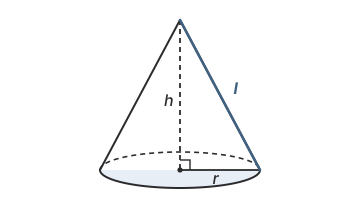
A cylinder's volume is πr2h. A cone on the same base and height holds exactly one-third of that. A sphere's volume is 34πr3 and its surface area is 4πr2. A cone's curved surface uses its slant height l=r2+h2.
The volume uses the vertical height h. The curved surface uses the slant height l, where l² = r² + h².
Solid
Curved surface
Total surface
Volume
Cylinder
2πrh
2πr(r+h)
πr2h
Hollow cylinder, radii R and r
2πh(R+r)
Add 2π(R2−r2) for the rims
πh(R2−r2)
Cone
πrl
πr(l+r)
31πr2h
Sphere
4πr2
4πr2
34πr3
Solid hemisphere
2πr2
3πr2
32πr3
Example 6 · Cone
A cone has radius 14 cm and height 48 cm. Find its curved surface area and its volume. Take π=722.
Slant height: l=142+482=2500=50 cm.
Curved surface: 722×14×50=2200 cm².
Volume: 31×722×14×14×48=9856 cm³.
Answer
Curved surface 2,200 cm², volume 9,856 cm³
Exam shortcut
Slant heights often come from triplets: (7, 24, 25), (8, 15, 17), (20, 21, 29) and (12, 35, 37). Spotting one saves a square root.
When every length is multiplied by k, every area is multiplied by k2 and every volume by k3. So two spheres with surface areas in the ratio 4:25 have radii in the ratio 2:5 and volumes in the ratio 8:125.
Watch out
Take the square root of an area ratio before you cube it. Cubing 4:25 directly, or squaring it, gives the wrong ratio, and both wrong answers are usually among the options.
Recasting keeps the volume the same. Set the volume of the old solid equal to the total volume of the new pieces, then solve. Surface area is not kept. When a solid sinks in water, the water rises by exactly the solid's volume.
Example 7 · Recasting
A solid cylinder of radius 4 cm and height 9 cm is melted and recast into cones of radius 2 cm and height 3 cm. How many cones are made?
Add only the surfaces you can see from outside. Where two solids are joined, the joining faces are hidden, so leave them out. Where a hollow is cut, remove the face that was cut away and add the new inner surface.
Tent, a cylinder with a cone on top: the cylinder's curved surface plus the cone's curved surface. There is no floor unless the question says so.
Capsule, a cylinder with a hemisphere at each end: the cylinder's curved surface plus one full sphere, 4πr2.
Toy, a cone on a hemisphere: the cone's curved surface plus 2πr2.
Cylinder with a cone hollowed out: the outer wall, the remaining flat base, and the cone's curved surface inside.
Key idea
Volume is simpler than surface area for a combined solid: add the parts, or subtract the part removed.
Diameter used as radius. It makes an area four times too big and a volume eight times too big.
Height or slant height? A cone's curved surface uses l, and its volume uses h. A trapezium or parallelogram needs the perpendicular height, never a slanted side.
Forgetting the 31 or the 21. A cone is a third of a cylinder, a triangle half a rectangle, and a rhombus half of d1×d2.
Mixed units. 1 m² is 10,000 cm², not 100.
Adding the path width once. A path on all sides changes each dimension by 2w.
Counting an overlap twice. Crossing roads share a square.
Total or curved surface? Open, without a lid, label, four walls and no floor all mean leaving faces out.
Counting hidden faces. Joined faces do not show, and a capsule's ends are hemispheres, not flat circles.
Keeping the area when a wire is reshaped. The length is kept.
Dividing volumes when boxes do not pack. Count whole boxes along each edge.
A rectangular hall floor measures 32 m by 18 m. A square courtyard has exactly the same area. By how much does the perimeter of the hall floor exceed the perimeter of the courtyard?
Show the explanationHide the explanation
AnswerC · 4 m
Area of the hall = 32×18=576 m², so the courtyard's side = 576=24 m.
Perimeters: hall 2×(32+18)=100 m, courtyard 4×24=96 m.
Difference = 100−96=4 m.
Worth noting
Equal areas do not mean equal perimeters, so 0 m is wrong. For a fixed area, the square has the smallest perimeter of all rectangles.
A rectangular lawn 40 m long and 24 m wide has a gravel path 2.5 m wide running all round it on the outside. What is the area of the path?
Show the explanationHide the explanation
AnswerD · 345 m²
The outer rectangle measures (40+2×2.5) by (24+2×2.5)=45 m by 29 m, area 1,305 m².
The lawn is 40×24=960 m².
Path = 1,305−960=345 m².
Worth noting
The width is added on BOTH sides, so each dimension grows by 5 m, not 2.5 m (that gives 166.25 m²). 295 m² is a path inside the lawn, and 320 m² (perimeter × width) misses the four corner squares.
A park is a rectangle 60 m by 40 m. Two concrete roads, each 3 m wide, cross at the centre: one runs parallel to the length and the other parallel to the breadth. What is the total area of the roads?
Show the explanationHide the explanation
AnswerD · 291 m²
Road along the length: 60×3=180 m². Road along the breadth: 40×3=120 m².
The 3 m×3 m square where they cross has been counted twice, so subtract it once: 180+120−9=291 m².
Worth noting
282 m² subtracts the crossing square twice; it must be taken away only once. 180 m² and 120 m² are single roads.
A triangular plot has sides 17 m, 25 m and 28 m. What is its area?
Show the explanationHide the explanation
AnswerA · 210 m²
Use Heron's formula. Semi-perimeter s=(17+25+28)÷2=35 m.
Area = 35×18×10×7=44,100=210 m².
Worth noting
The plot is not right-angled (172+252=282), so ½ × one side × another is wrong: that gives 212.5, 238 or 350 m², depending on which two sides are used.
A parallelogram has sides 20 cm and 12 cm. The distance between the two longer sides is 9 cm. What is the distance between the two shorter sides?
Show the explanationHide the explanation
AnswerD · 15 cm
Area = longer side × distance between the longer sides = 20×9=180 cm².
The same area = shorter side × distance between the shorter sides, so the distance = 180÷12=15 cm.
Worth noting
5.4 cm comes from pairing the base with the wrong height (12×9÷20). The shorter sides are further apart, because the same area is spread over a shorter base.
A field is a trapezium whose parallel sides are 25 m and 11 m. Its two non-parallel sides are 13 m and 15 m. What is the area of the field?
Show the explanationHide the explanation
AnswerA · 216 m²
Cut off a parallelogram of sides 11 m and 13 m. What remains is a triangle with sides 13 m, 15 m and 25−11=14 m, with the same height as the trapezium.
That triangle has s=21, so area = 21×8×6×7=84 m².
Height = 2×84÷14=12 m.
Trapezium area = 21×(25+11)×12=216 m².
Worth noting
234 m² and 270 m² use a slanted side (13 m or 15 m) as the height. 432 m² forgets the half.
A window is shaped like a semicircle of radius 14 cm. What length of metal strip is needed to go all round its edge, including the straight edge? Take π=722.
Show the explanationHide the explanation
AnswerC · 72 cm
Curved edge = half the circumference = πr=722×14=44 cm.
Straight edge = diameter = 28 cm.
Total = 44+28=72 cm.
Worth noting
44 cm leaves out the straight edge, and 88 cm is the full circle's circumference.
The circumference of a circle is 44 cm. Taking π=722, what is its area?
Show the explanationHide the explanation
AnswerB · 154 cm²
Find the radius from the circumference: 2πr=44, so r=2×2244×7=7 cm.
Then apply the area formula: πr2=722×72.
722×49=22×7=154 cm².
Worth noting
The radius is the bridge between the two formulae. Going straight from circumference to area without finding it is where this question is usually lost.
A circular running track lies between two circles with the same centre. The outer edge is 176 m round and the inner edge is 132 m round. What is the area of the track? Take π=722.
Show the explanationHide the explanation
AnswerC · 1,078 m²
Outer radius: 2πR=176 gives R=28 m. Inner radius: 2πr=132 gives r=21 m.
Track area = π(R2−r2)=722×(784−441)=722×343=1078 m².
Worth noting
154 m² squares the difference of the radii, π(R−r)2, which is not the same as π(R2−r2).
A piece of wire is bent into a square that encloses 484 cm². The same wire is then straightened and bent into a circle. What area does the circle enclose? Take π=722.
Show the explanationHide the explanation
AnswerC · 616 cm²
The square's side is 484=22 cm, so the wire is 4×22=88 cm long.
The circle's circumference is 88 cm: 2×722×r=88, so r=14 cm.
Area = 722×14×14=616 cm².
Worth noting
The length of wire stays the same, not the area, so 484 cm² is wrong. For the same boundary a circle encloses more area than a square.
Four circular coasters, each of radius 7 cm, lie flat on a table. Each touches the two next to it, and their centres form a square. What is the area of the space enclosed between the four coasters? Take π=722.
Show the explanationHide the explanation
AnswerA · 42 cm²
The centres are 7+7=14 cm apart, so they form a square of side 14 cm, area 196 cm².
Each corner of the square holds a quarter of a coaster, so the four quarters make one full circle: 722×7×7=154 cm².
Enclosed space = 196−154=42 cm².
Worth noting
168 cm² uses a square of side 28 cm (joining the far edges instead of the centres). 154 cm² is the area of the four quarter-circles.
The volume of a cube is 216 cm³. What is its total surface area?
Show the explanationHide the explanation
AnswerC · 216 cm²
The volume of a cube is a3, so a3=216 and the edge is a=6 cm.
A cube has six identical square faces, each of area a2=36 cm².
The total surface area is 6×36=216 cm².
Worth noting
The surface area comes out numerically equal to the volume. That is a coincidence of this particular edge length, not a rule, and the units differ: cm² against cm³. A cube of edge 6 is the only one for which it happens.
Rain falls to a depth of 2 cm on a flat roof 22 m long and 20 m wide, and all of it runs into a tank. How many litres of water reach the tank? (1 m3=1,000 litres)
Show the explanationHide the explanation
AnswerD · 8,800 litres
Depth of rain = 2 cm = 0.02 m.
Volume = 22×20×0.02=8.8 m³.
8.8 m3=8,800 litres.
Worth noting
4,400 litres uses 1 cm. 880 and 88 litres slip a zero or two in the conversion: 2 cm = 0.02 m and 1 m3=1,000 litres.
Meenakshi cuts a 5 cm square from each corner of a metal sheet 40 cm by 30 cm and folds up the sides to make an open box. What is the volume of the box?
Show the explanationHide the explanation
AnswerB · 3,000 cm³
Removing a 5 cm square at each end shortens each side by 10 cm: the base is 30 cm by 20 cm.
The folded sides make the height 5 cm.
Volume = 30×20×5=3,000 cm³.
Worth noting
4,375 cm³ takes 5 cm off only one end of each side, and 6,000 cm³ uses the full sheet as the base.
A fish tank is 50 cm long, 40 cm wide and 30 cm high, with water up to 20 cm. When Joseph lowers a stone into it, the water rises to 23.5 cm without spilling. What is the volume of the stone?
Show the explanationHide the explanation
AnswerA · 7,000 cm³
The stone pushes up water equal to its own volume.
Rise in level = 23.5−20=3.5 cm.
Stone volume = 50×40×3.5=7,000 cm³.
Worth noting
40,000 cm³ is the water that was already there, 47,000 cm³ is water plus stone, and 13,000 cm³ is the space still empty above the water.
A room is 8 m long, 6 m wide and 3.5 m high. It has one door 2 m by 1 m and two windows each 1.5 m by 1 m. The four walls and the ceiling are to be painted at ₹25 per m². What will the painting cost?
Show the explanationHide the explanation
AnswerB · ₹3,525
Four walls = 2×(8+6)×3.5=98 m². Ceiling = 8×6=48 m².
Door and windows = 2×1+2×1.5×1=5 m².
Area to paint = 98+48−5=141 m².
Cost = 141 × ₹25 = ₹3,525.
Worth noting
₹3,650 forgets to leave out the door and windows, ₹2,325 leaves out the ceiling, and ₹4,725 paints the floor too.
A wall 15 m long, 30 cm thick and 2 m high is built with bricks measuring 25 cm × 12.5 cm × 7.5 cm. Mortar fills one-tenth of the wall's volume. How many bricks are used?
Show the explanationHide the explanation
AnswerA · 3,456
Wall volume = 1,500×30×200=90,00,000 cm³.
Bricks fill nine-tenths of it: 81,00,000 cm³.
One brick = 25×12.5×7.5=2,343.75 cm³.
Bricks = 81,00,000÷2,343.75=3,456.
Worth noting
3,840 ignores the mortar, and 4,224 adds the mortar instead of taking it away. 38,400 slips a zero in the wall volume.
A label is wrapped exactly once round the curved side of a cylindrical tin of radius 14 cm and height 10 cm, with no overlap. What is the area of the label? Take π=722.
Show the explanationHide the explanation
AnswerA · 880 cm²
The label covers the curved surface: 2πrh.
= 2×722×14×10=880 cm².
Worth noting
1,496 cm² adds one circular end and 2,112 cm² adds both ends; a label covers only the curved side. 6,160 is the volume in cm³.
A solid cone and a solid cylinder have bases of the same radius and have equal volumes. The cylinder is 8 cm tall. How tall is the cone?
Show the explanationHide the explanation
AnswerD · 24 cm
Equal volumes: 31πr2H=πr2×8.
Cancel πr²: H÷3=8, so H=24 cm.
Worth noting
A cone holds one-third of the cylinder with the same base and height, so it needs three times the height to match. 8/3 cm divides instead of multiplying.
For a closed cylindrical container, the radius and the height add up to 37 cm, and the total surface area is 3,256 cm². What is its volume? Take π=722.
Show the explanationHide the explanation
AnswerB · 14,168 cm³
Total surface = 2πr(r+h)=2×722×r×37.
So 71628r=3256, giving r=14 cm and h=37−14=23 cm.
Volume = 722×14×14×23=14,168 cm³.
Worth noting
22,792 cm³ takes the height as 37 cm; the 37 is r+h, not h. 28,336 cm³ uses 2πr²h, mixing the 2 of the surface formula into the volume.
A well of diameter 7 m is dug 20 m deep. The earth taken out is spread evenly over a rectangular plot 70 m long and 22 m wide. By how much does the level of the plot rise? Take π=722.
Show the explanationHide the explanation
AnswerC · 50 cm
Earth dug out = 722×3.5×3.5×20=770 m³.
Plot area = 70×22=1,540 m².
Rise = 770÷1,540=0.5m=50 cm.
Worth noting
200 cm uses 7 m as the radius. 5 cm slips a decimal when changing 0.5 m into centimetres.
A block of metal 5.5 cm × 10 cm × 3.5 cm is melted and made into coins, each 1.4 cm in diameter and 0.2 cm thick. How many coins are made? Take π=722.
Show the explanationHide the explanation
AnswerB · 625
Block volume = 5.5×10×3.5=192.5 cm³.
One coin is a short cylinder: 722×0.7×0.7×0.2=0.308 cm³.
Coins = 192.5÷0.308=625.
Worth noting
2,500 halves the diameter twice (radius 0.35 cm). 6,250 takes the thickness as 0.02 cm, and 125 takes it as 1 cm.
A tent is a cylinder of radius 7 m and height 3 m with a cone of the same radius on top. The cone's vertical height is 24 m. How much canvas is needed for the tent, with no floor? Take π=722.
Show the explanationHide the explanation
AnswerC · 682 m²
Cylinder wall = 2πrh=2×722×7×3=132 m².
Cone: slant height 72+242=25 m, curved surface πrl=22×25=550 m².
Canvas = 132+550=682 m².
Worth noting
836 m² adds a floor (154 m²) that the tent does not have. 660 m² uses the height 24 m in place of the slant height.
A medicine capsule is a cylinder 10 mm long with a hemisphere of radius 7 mm fixed at each end. What is the total outer surface area of the capsule? Take π=722.
Show the explanationHide the explanation
AnswerB · 1,056 mm²
Cylinder wall = 2×722×7×10=440 mm².
Two hemispheres make one sphere: 4×722×7×7=616 mm².
Total = 440+616=1,056 mm².
Worth noting
748 mm² treats each hemisphere end as a flat circle. 1,364 mm² adds two circular faces that are hidden inside the joins.
An ice-cream cone is filled completely and topped with a hemisphere of ice cream. The cone has radius 7 cm and height 10 cm, and the hemisphere has the same radius. What is the total volume of ice cream? Take π=722.
Show the explanationHide the explanation
AnswerA · 1,232 cm³
Cone = 31×722×7×7×10=31540 cm³.
Hemisphere = 32×722×7×7×7=32156 cm³.
Total = 33696=1232 cm³.
Worth noting
2,258⅔ cm³ treats the cone as a cylinder (forgetting the ⅓), and 1,540 cm³ is that cylinder with the hemisphere left out. 1,950⅔ cm³ tops the cone with a full sphere instead of a hemisphere.
From a solid cylinder of radius 7 cm and height 24 cm, a cone of the same radius and height is hollowed out, with its base on the top face of the cylinder. What is the total surface area of the solid that remains? Take π=722.
Show the explanationHide the explanation
AnswerC · 1,760 cm²
Outside wall = 2×722×7×24=1056 cm². Bottom face = 722×49=154 cm².
The top face is now the cone's opening, so it is gone. Inside, the cone's curved surface shows: slant 72+242=25, area 22×25=550 cm².
Total = 1,056+154+550=1,760 cm².
Worth noting
1,914 cm² keeps the top face, which has been cut away. 1,210 cm² forgets the new inner surface, and 1,738 cm² uses the height instead of the slant height for it.
A cylindrical glass beaker of diameter 7 cm contains water. How many spherical glass marbles, each of diameter 1.4 cm, must be dropped in to raise the water level by 5.6 cm? Take π=722.
Show the explanationHide the explanation
AnswerB · 150
Extra water level: π×3.52×5.6=68.6π cm³.
One marble: 34π×0.73=34π×0.343 cm³.
Number = 68.6÷(34×0.343)=68.6×3÷1.372=150.
Worth noting
600 takes 7 cm as the beaker's radius. 200 forgets the 4/3 in the sphere's volume, and 50 uses 4 in place of 4/3.
Water flows at 15 km/h through a pipe of internal diameter 14 cm into a rectangular tank 50 m long and 44 m wide. How long will it take for the water level in the tank to rise by 21 cm? Take π=722.
Show the explanationHide the explanation
AnswerC · 2 hours
Pipe radius = 7 cm = 0.07 m. Each hour a 15,000 m length of water flows in: 722×0.07×0.07×15,000=231 m³.
Water needed = 50×44×0.21=462 m³.
Time = 462÷231=2 hours.
Worth noting
30 minutes uses 14 cm as the radius (four times the flow). 20 hours treats 21 cm as 2.1 m.
The area names are NTA's. The chapters inside them are EduFarming's own division, not NTA's.