Ecosystems and Biodiversity for CUET General Aptitude
About 10 min to learn · 68 questions
Ecology questions come in two kinds. Some ask you to reason: read a food web, count its chains, work out how much energy reaches a snake. Others ask for facts: which park protects which animal, what Rhizobium does, when Project Tiger began. This lesson covers ecosystems, food chains and webs, the 10 per cent law and pyramids, biomagnification, the nitrogen, carbon and water cycles, biodiversity and hotspots, threats and the Red List, and India's protected areas and conservation, with worked examples and an energy pyramid.
Two rules do most of the reasoning. Arrows in a food chain point from the food to the eater, and levels are counted from the producer. Energy falls to about a tenth at every step, while a persistent poison climbs at every step.
The fact questions are pairs: a park and its animal, a bacterium and its step in the nitrogen cycle, a project and its year. Learn them as tables.
An ecosystem is living things plus their non-living surroundings. The biotic parts are producers (green plants, and phytoplankton in a pond), consumers and decomposers (bacteria, fungi such as mushrooms). The abiotic parts are sunlight, temperature, water, soil and air. Almost all energy comes first from the Sun.
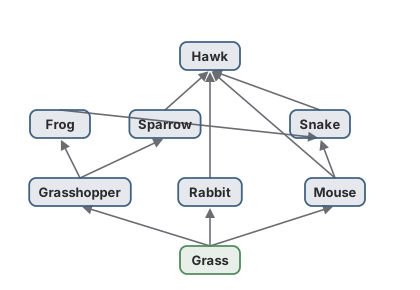
Count trophic levels from the producer: grass (1) → grasshopper (2) → frog (3) → snake (4). So the frog is a secondary consumer. A food web joins many chains, and an animal with a varied diet can feed at several levels.
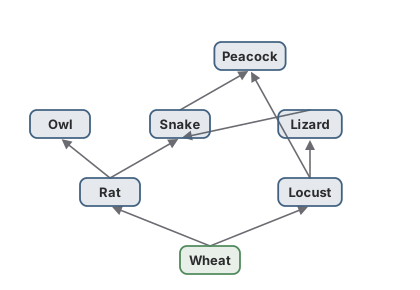
To count the chains in a web, start at each producer and follow every arrow path to an animal that nothing eats. Each complete path is one chain.
Example 1 · Counting chains
Plants are eaten by insects and mice; lizards eat insects; snakes eat mice and lizards; eagles eat snakes and mice. How many chains are there, and at how many levels does the eagle feed?
The paths are plants → insects → lizards → snakes → eagles, plants → mice → snakes → eagles, and plants → mice → eagles.
The eagle ends chains at levels 5, 4 and 3.
Answer
3 chains; the eagle feeds at 3 levels
Watch out
A tiger eating deer is a secondary consumer, at the third level, even though it is at the top of its chain. And if a predator is removed, its prey usually increases first.
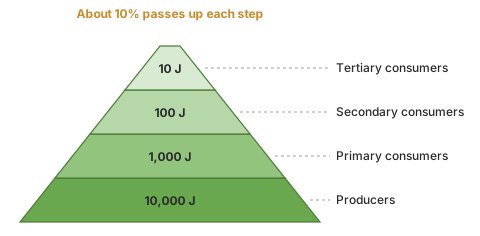
Only about 10% of the energy at one level passes to the next; the rest is used for living and lost as heat. That is why chains rarely have more than four or five links, and why energy flows one way while nutrients are recycled.
Each step up keeps about 10%. The pyramid of energy is always upright.
Example 2 · The 10 per cent law
Plants in a field trap 20,000 J. Grasshoppers eat the plants, frogs eat the grasshoppers and snakes eat the frogs. About how much energy reaches the snakes?
Grasshoppers: 20,000÷10=2,000 J. Frogs: 200 J.
Snakes, one more step: 200÷10=20 J.
Answer
About 20 J
The pyramid of energy can never be inverted. The pyramid of numbers can: one tree feeding thousands of insects and a few birds gives a spindle shape.
Poisons such as DDT and mercury are not broken down or excreted, so they build up in bodies, and each level eats many organisms from the level below. The concentration is highest at the top, in fish-eating birds.
Photosynthesis removes carbon dioxide and releases oxygen; respiration, decay and burning return carbon dioxide. Coal, oil and gas are carbon from ancient organisms, and burning them adds the most extra carbon dioxide. Cattle, termites and wetlands release methane. Oxygen is about 21% of air.
In the water cycle, evaporation and plant transpiration put vapour into the air, which condenses into clouds as it rises and cools. Only about 3% of Earth's water is fresh. The phosphorus cycle has no gaseous stage; it depends on the weathering of rocks.
It is the variety of life at three levels: genetic (thousands of rice varieties), species, and ecosystem. Tropical rainforests are the richest on land. India is megadiverse, one of the few countries that together hold most of the world's species, and it passed the Biological Diversity Act, 2002.
A region with a very large number of endemic plants that has already lost most of its original habitat. India has parts of 4: the Himalaya, Indo-Burma, the Western Ghats (famous for endemic frogs and amphibians) and Sundaland (the Nicobar Islands). The Thar Desert is not a hotspot.
In situ conservation protects species where they live: national parks, sanctuaries, biosphere reserves and sacred groves (as in Meghalaya's Khasi hills). Ex situ protects them elsewhere: zoos and seed banks.
A biosphere reserve has a strictly protected core, with only protection and limited research, and a buffer open to limited human activity. The first was the Nilgiri Biosphere Reserve (1986).
Year
Step
1972
Wildlife (Protection) Act
1973
Project Tiger; the Chipko movement, where villagers hugged trees
Approximately what proportion of energy is passed from one trophic level to the next in a food chain?
Show the explanationHide the explanation
AnswerB · 10%
Most of the energy at any level is spent on the organism's own respiration and movement, or lost as heat.
Only about a tenth is stored as body tissue and so becomes available to whatever eats it. This is usually called the ten per cent law.
Because the loss compounds at every step, food chains rarely run beyond four or five levels.
Worth noting
This is what an energy pyramid shows, and why the top of one is always narrow: after four levels only about one part in ten thousand of the original energy remains.
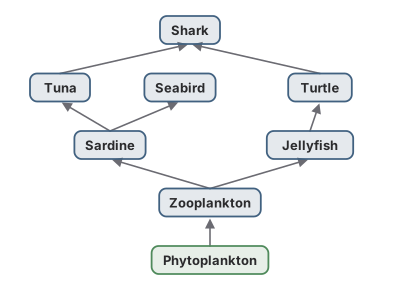
In the marine food web shown, at which trophic level does the shark feed?
Show the explanationHide the explanation
AnswerC · Fifth
Both chains to the shark have five links: phytoplankton → zooplankton → sardine → tuna → shark, and phytoplankton → zooplankton → jellyfish → turtle → shark.
Plants in a field trap 20,000 J of the Sun's energy. Grasshoppers eat the plants, frogs eat the grasshoppers and snakes eat the frogs. By the 10 per cent law, how much of this energy reaches the snakes?
Show the explanationHide the explanation
AnswerB · 20 J
Only about 10% of the energy at one level passes to the next.
Grasshoppers get 2,000 J, frogs 200 J and snakes 20 J.
Worth noting
200 J is what the frogs get; count one step for each arrow, three arrows from plants to snakes.
India passed a law to conserve biodiversity and share the benefits of its use fairly, following the Convention on Biological Diversity. Which law is it?
Show the explanationHide the explanation
AnswerB · The Biological Diversity Act, 2002
The Biological Diversity Act of 2002 set up the National Biodiversity Authority and local biodiversity management committees.
It controls access to biological resources and requires benefits to be shared with local communities.
Worth noting
The 1972 Act protects wild animals and plants and creates sanctuaries and national parks; it predates the Convention.
How does a biosphere reserve chiefly differ from a national park?
Show the explanationHide the explanation
AnswerB · It permits limited human activity in a buffer zone around a strictly protected core
A biosphere reserve is built in zones. The core is strictly protected, a buffer zone around it allows research and controlled use, and an outer transition zone supports settlements and livelihoods.
That design treats the people living in and around the reserve as part of the system rather than as intruders to be excluded.
A national park protects a single area uniformly, and biosphere reserves are usually larger, not smaller — several contain national parks within their cores.
Worth noting
The zoned design is the whole idea: conservation that depends on local people being able to continue living there tends to outlast conservation that does not.