EduFarming
Your list · 0हिं

Type at least two letters. Press Esc to close.

↑↓ navigate↵ openTAB cycle filter

Pollution, Climate and Conventions for CUET General Aptitude

About 10 min to learn · 67 questions

Environment questions lean on a few families of fact: which pollutant causes which disease, how the ozone layer differs from the greenhouse effect, and which treaty deals with what. The conventions are where most marks are lost, because the names sound alike: Stockholm the conference and Stockholm the convention, Kyoto and Kigali, Cartagena and Nagoya. This lesson covers air and water pollution, Indian laws, the ozone layer, the greenhouse effect, climate change and responses, and the conventions, with a diagram of the atmosphere's layers and the pairs swapped most often.

Syllabus area
General Science and Environment Literacy
On this page · 9 sections
  1. 01The core idea
  2. 02Pollution
  3. 03The ozone layer and the greenhouse effect
  4. 04Climate change
  5. 05Conventions
  6. 06Exam shortcuts
  7. 07Common mistakes
  8. 08Quick revision
  9. 09Check your understanding

The core idea

Keep two problems apart. The ozone hole lets in more ultraviolet light and is fought by the Montreal Protocol. The enhanced greenhouse effect traps more heat and is fought by the climate treaties: the UNFCCC, Kyoto and Paris. CFCs happen to worsen both, which is why the two get merged.

The rest is tables: a pollutant and its disease, a treaty and its subject. A treaty is named for a city, and the city tells you nothing, so the table has to be learnt.

Pollution

What are the main air pollutants?

PollutantMain sourceHarm
Carbon monoxideVehicles, stoves in closed roomsBinds to haemoglobin, so blood carries less oxygen
Sulphur dioxideBurning coalAcid rain
Nitrogen oxidesVehiclesAcid rain, smog
PM2.5Dust, smoke, stubble burningFine enough (2.5 micrometres or less) to reach deep into the lungs
Ground-level ozoneFormed in smogIrritates lungs, damages crops

Photochemical smog forms on sunny days when nitrogen oxides and hydrocarbons from vehicles react in sunlight, making ground-level ozone, a secondary pollutant, formed in the air rather than released. Acid rain damages marble monuments like the Taj Mahal because acids react with calcium carbonate.

ControlWhat it does
Catalytic converterTurns carbon monoxide, hydrocarbons and nitrogen oxides into less harmful gases
Electrostatic precipitatorRemoves ash from chimney smoke
Bharat Stage VINationwide from 1 April 2020, skipping Stage V
National Clean Air Programme (2019)Cuts PM10 and PM2.5 in cities

Key idea

Delhi's air worsens in October and November largely because paddy stubble is burnt in Punjab and Haryana while cool, still air traps smoke near the ground.

Which water pollutant causes which disease?

PollutantEffectWhere
MercuryMinamata diseaseJapan
CadmiumItai-itai diseaseJapan
NitrateBlue baby syndromeWells near fertilised fields
FluorideMottled teeth, stiff bonesRajasthan and other states
ArsenicSkin lesions, cancersWest Bengal, Ganga–Brahmaputra delta

Eutrophication: fertiliser in a lake feeds an algal bloom; when the algae die, decay uses up the oxygen and fish die. A high BOD means a lot of organic pollution. Hot water from power stations holds less dissolved oxygen.

Example 1 · Reading BOD

River A has a BOD of 2 mg/L and river B of 30 mg/L. Which is cleaner?

  1. BOD is the oxygen microbes need to break down organic matter in the water.

  2. More organic pollution means more oxygen demand, so the high figure is the dirty river.

Answer

River A

Which laws and events should you know?

YearLaw or event
1974Water (Prevention and Control of Pollution) Act
1981Air (Prevention and Control of Pollution) Act
1984Bhopal gas tragedy: methyl isocyanate leak
1986Environment (Protection) Act, after Bhopal
2010National Green Tribunal

Vegetable peels are biodegradable; a plastic bag will lie in a landfill largely unchanged for a century.

The ozone layer and the greenhouse effect

Where is the ozone layer, and what damaged it?

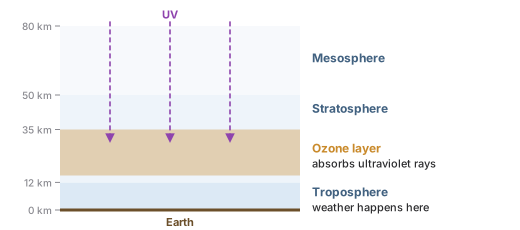
Ozone, O₃, forms a layer in the stratosphere and absorbs most of the Sun's ultraviolet radiation. The troposphere, below it, is where we live and where weather happens. The layer is measured in Dobson units.

Layers of the atmosphere from the ground up: the troposphere, where weather happens, up to about 12 km; the stratosphere above it, holding the ozone layer at about 15 to 35 km, which absorbs ultraviolet rays; then the mesosphere.
Weather and ground-level ozone are in the troposphere; the protective ozone layer is in the stratosphere.

CFCs from old refrigerators and sprays reach the stratosphere, where ultraviolet light frees chlorine. Each chlorine atom acts as a catalyst and can destroy thousands of ozone molecules. The ozone hole was first reported over Antarctica in 1985, where very cold polar clouds free the chlorine each spring. More UV means more skin cancer and cataracts.

Watch out

Ozone high up protects us; ozone at ground level is a pollutant. Same gas, different place.

What is the greenhouse effect?

Some gases trap heat given off by the Earth and keep the surface warm. Without this natural effect the average would be about −18 °C instead of about 15 °C.

GasMain sourceRemember
Water vapourEvaporationThe most abundant
Carbon dioxideBurning fossil fuelsThe main one added by people; above 400 ppm, up from 280
MethanePaddy fields, cattle, landfillsTraps much more heat per molecule, but lasts far shorter
Nitrous oxideNitrogen fertilisersAlso harms ozone

Nitrogen is not a greenhouse gas. The Keeling Curve, measured on Mauna Loa since 1958, tracks rising carbon dioxide.

Climate change

What does global warming do?

Global warming is the long-term rise in Earth's average temperature, driven mainly by burning fossil fuels.

EffectWhy
Sea-level riseLand ice melts into the sea, and warm water expands
Coral bleachingWarm water makes corals expel their algae
Ocean acidificationThe sea absorbs carbon dioxide
Faster Arctic warmingDark open water has a lower albedo than white ice, so it absorbs more sunlight

El Niño, a warming of the central and eastern Pacific, is often linked with a weaker Indian monsoon.

How do countries respond?

Mitigation cuts emissions (wind turbines, forests); adaptation copes with the effects (sea walls, mangroves). A growing forest is a carbon sink. A carbon footprint is the greenhouse gas a person's activities release, and one carbon credit is usually one tonne of carbon dioxide cut or removed.

Example 2 · Mitigation or adaptation?

A coastal city raises its sea walls and plants mangroves. Is this mitigation or adaptation?

  1. Mitigation reduces the cause, emissions.

  2. Sea walls and mangroves protect the city from rising seas, a consequence.

Answer

Adaptation

Net zero means remaining emissions are balanced by an equal amount removed; India's target, announced at COP26 in 2021, is 2070. India's National Action Plan on Climate Change (2008) has eight missions, including the National Solar Mission. The IPCC was set up in 1988 by the WMO and UNEP, and India and France launched the International Solar Alliance at Paris in 2015.

Conventions

Which convention deals with what?

AgreementYearDeals with
Ramsar (Iran)1971Wetlands
Stockholm Conference1972First UN environment meeting; World Environment Day
CITES1973Trade in endangered animals and plants
Bonn Convention1979Migratory species
Vienna Convention1985The ozone framework
Montreal Protocol1987Phasing out ozone-depleting substances
Basel Convention1989Hazardous waste across borders
Earth Summit, Rio1992UNFCCC and the Convention on Biological Diversity
Kyoto Protocol1997First binding cuts, for developed countries
Rotterdam Convention1998Prior consent before exporting hazardous chemicals
Cartagena Protocol2000Moving genetically modified organisms safely
Stockholm Convention2001Persistent organic pollutants such as DDT
Nagoya Protocol2010Sharing benefits from genetic resources
Minamata Convention2013Mercury
Paris Agreement2015Well below 2 °C, aiming for 1.5 °C
Kigali Amendment2016Phasing down HFCs under Montreal

"COP" means Conference of the Parties. The Brundtland Report (1987) defined sustainable development.

Watch out

The Stockholm Conference (1972) is not the Stockholm Convention (2001). Kigali amends Montreal to cut HFCs, which spare ozone but warm the climate. Cartagena is biosafety; Nagoya is benefit sharing.

Which environment days should you know?

DayDate
World Wetlands Day2 February
Earth Day22 April
World Environment Day5 June
World Ozone Day, marking Montreal16 September

Exam shortcuts

  • Ozone versus heat. Montreal for ozone; Kyoto and Paris for climate.
  • Stratosphere protects; troposphere ozone harms.
  • High BOD, dirty water.
  • Disease to metal. Minamata mercury; Itai-itai cadmium.
  • Sea walls adapt; wind farms mitigate.

Common mistakes

  • Montreal for climate.
  • Stockholm Conference for persistent pollutants.
  • Carbon dioxide as the most abundant greenhouse gas. Water vapour is.
  • Nitrogen as a greenhouse gas.
  • High BOD as clean water.
  • Net zero as zero emissions.
  • Ozone layer in the troposphere.
  • Cartagena for benefit sharing. That is Nagoya.

Quick revision

Pollution

  • CO blocks haemoglobin; SO₂ acid rain; PM2.5 lungs
  • Mercury Minamata; nitrate blue baby; fluoride fluorosis
  • BS-VI 1 Apr 2020; EPA 1986 after Bhopal

Ozone and heat

  • Ozone in the stratosphere; hole over Antarctica, 1985
  • Water vapour most abundant; CO₂ main human one
  • Natural effect: 15 °C instead of −18 °C

Treaties

  • Montreal ozone; Kigali HFCs; Kyoto, Paris climate
  • Ramsar wetlands; CITES trade; Basel waste
  • India net zero 2070; ISA with France

The science of cycles and food chains is in ecosystems and biodiversity, and India's environment laws in India's geography and environment.

Next · 08Quick revision

Check your understanding

67 questions, grouped by type, easy to hard. Pick an answer and check it. The worked solution opens when you ask for it.

Air, water, soil and noise pollutionQ1 of 67Q1

Air, water, soil and noise pollution

18 questions

The Bhopal gas tragedy of December 1984 was caused by a leak of which poisonous gas from a pesticide factory?

Options for question 1

Show the explanationHide the explanation

AnswerB · Methyl isocyanate

  1. Methyl isocyanate (MIC) leaked from the Union Carbide plant in Bhopal, killing thousands and injuring many more.

  2. It is among the worst industrial disasters in history, and it led to the Environment (Protection) Act of 1986.

Carbon monoxide from a car exhaust or a stove in a closed room is dangerous because it

Options for question 2

Show the explanationHide the explanation

AnswerD · binds to haemoglobin and stops the blood carrying oxygen

  1. Carbon monoxide combines with haemoglobin far more strongly than oxygen does, forming carboxyhaemoglobin.

  2. The blood then carries less oxygen, causing headache, drowsiness and even death.

Worth noting

Carbon monoxide has no colour or smell, which is exactly why it is so dangerous.

Which of these wastes is biodegradable?

Options for question 3

Show the explanationHide the explanation

AnswerA · Vegetable peels

  1. Biodegradable waste is broken down by bacteria and fungi into harmless substances.

  2. Vegetable peels rot within weeks and can be composted; plastic, glass and aluminium last for years.

Minamata disease, first seen in Japan among people who ate contaminated fish, is caused by poisoning with

Options for question 4

Show the explanationHide the explanation

AnswerC · mercury

  1. A factory released mercury compounds into Minamata Bay; they built up in fish and then in the people who ate them.

  2. Mercury damages the nervous system.

Worth noting

Itai-itai disease, also from Japan, was caused by cadmium.

A catalytic converter fitted in the exhaust of a car

Options for question 5

Show the explanationHide the explanation

AnswerA · changes carbon monoxide, unburnt hydrocarbons and nitrogen oxides into less harmful gases

  1. Metals such as platinum and rhodium in the converter speed up reactions in the hot exhaust.

  2. Carbon monoxide and hydrocarbons become carbon dioxide and water, and nitrogen oxides become nitrogen.

Worth noting

It still gives out carbon dioxide; it cannot turn it back into oxygen. Leaded petrol ruins the catalyst.

Air quality in Delhi often worsens sharply in October and November. One major seasonal cause is

Options for question 6

Show the explanationHide the explanation

AnswerA · the burning of paddy stubble in the fields of Punjab and Haryana

  1. After the rice harvest, farmers burn the leftover straw to clear fields quickly for wheat.

  2. The smoke drifts over the region just as cool, still air traps pollutants near the ground.

Worth noting

Rain cleans the air rather than polluting it; the monsoon has ended by October.

Burning coal that contains sulphur releases a gas that is a principal cause of acid rain. Which gas is it?

Options for question 7

Show the explanationHide the explanation

AnswerB · Sulphur dioxide

  1. Sulphur in coal burns to sulphur dioxide, which enters the atmosphere with the flue gases.

  2. There it reacts with water vapour to form sulphuric acid, which falls as acid rain.

  3. Carbon monoxide is a product of incomplete burning and is toxic but not a major cause of acid rain; nitrogen itself is unreactive in air.

Worth noting

Oxides of nitrogen from vehicle engines are the other main contributor, which is why acid rain is associated with both power stations and traffic.

Blue baby syndrome in infants is linked to drinking water that contains too much

Options for question 8

Show the explanationHide the explanation

AnswerB · nitrate

  1. Nitrate from fertilisers can seep into wells.

  2. In infants it reduces the blood's ability to carry oxygen, so the skin can look bluish.

People in parts of Rajasthan and other states suffer from mottled teeth and stiff bones because their groundwater contains excess

Options for question 9

Show the explanationHide the explanation

AnswerC · fluoride

  1. A little fluoride protects teeth, but too much causes fluorosis.

  2. Dental fluorosis mottles the teeth, and skeletal fluorosis stiffens the bones and joints.

Fertiliser washed from fields into a lake causes a thick growth of algae. When the algae die and decay, many fish die too. This process is called

Options for question 10

Show the explanationHide the explanation

AnswerA · eutrophication

  1. Nitrates and phosphates from fertilisers and sewage feed an algal bloom.

  2. Bacteria decomposing the dead algae use up the dissolved oxygen, so the fish suffocate.

Worth noting

Biomagnification is the build-up of a poison along a food chain, a different effect.

A river sample has a very high biochemical oxygen demand (BOD). What does this show?

Options for question 11

Show the explanationHide the explanation

AnswerD · The water holds a lot of organic pollution

  1. BOD is the oxygen that microbes need to break down the organic matter in a water sample.

  2. More sewage or organic waste means more oxygen demanded, so a high BOD means badly polluted water.

In air-quality reports, PM2.5 refers to

Options for question 12

Show the explanationHide the explanation

AnswerC · fine particles 2.5 micrometres or less across, which can reach deep into the lungs

  1. PM stands for particulate matter; the number is the largest particle size in micrometres.

  2. PM2.5 particles are about thirty times thinner than a human hair and pass deep into the lungs and even the blood.

Thermal power plants fit electrostatic precipitators in their chimneys in order to

Options for question 13

Show the explanationHide the explanation

AnswerB · remove fine ash particles from the smoke

  1. The smoke passes between charged plates or wires; the particles pick up a charge and stick to the oppositely charged plates.

  2. This removes most of the fly ash, but not gases such as carbon dioxide or sulphur dioxide.

High levels of arsenic in groundwater drawn from tube wells are a serious health problem in

Options for question 14

Show the explanationHide the explanation

AnswerB · West Bengal and the Ganga–Brahmaputra delta

  1. Arsenic occurs naturally in the delta's sediments and dissolves into the groundwater that tube wells tap.

  2. Long-term drinking of it causes skin lesions and cancers.

Worth noting

Rajasthan's major groundwater problem is excess fluoride, not arsenic.

A power station returns hot cooling water to a river. Why can this harm the fish downstream?

Options for question 15

Show the explanationHide the explanation

AnswerC · Warm water holds less dissolved oxygen

  1. Gases dissolve less well in warm water, so heated water carries less oxygen.

  2. At the same time, warmth speeds up the fish's own need for oxygen. This is thermal pollution.

Photochemical smog, the brown haze over busy cities on sunny days, forms when

Options for question 16

Show the explanationHide the explanation

AnswerD · nitrogen oxides and hydrocarbons from vehicles react in sunlight, making ground-level ozone

  1. Vehicle exhaust supplies nitrogen oxides and unburnt hydrocarbons.

  2. Sunlight drives reactions between them that produce ozone and other irritants such as PAN, which sting the eyes and harm the lungs.

Worth noting

Smoke mixed with fog from burning coal is the older, sulphurous 'London' smog, which forms in cold, damp weather.

India moved directly from Bharat Stage IV to Bharat Stage VI vehicle emission norms across the country, skipping Stage V, from

Options for question 17

Show the explanationHide the explanation

AnswerC · 1 April 2020

  1. Bharat Stage VI norms, roughly equal to Euro VI, came into force nationwide on 1 April 2020.

  2. They sharply cut the allowed particulate and nitrogen oxide emissions, especially from diesel vehicles.

Worth noting

1 April 2017 is when Bharat Stage IV became nationwide.

Which law, passed after the Bhopal gas tragedy, gives the central government wide powers to protect and improve the environment?

Options for question 18

Show the explanationHide the explanation

AnswerD · The Environment (Protection) Act, 1986

  1. The Environment (Protection) Act of 1986 is an umbrella law covering air, water and land.

  2. The Water Act (1974) and the Air Act (1981) came before Bhopal and deal with one medium each.

Ozone layer and greenhouse effect

17 questions

In which layer of the atmosphere is the ozone layer found?

Options for question 19

Show the explanationHide the explanation

AnswerC · Stratosphere

  1. Most of the atmosphere's ozone lies in the stratosphere, roughly 15 to 35 km above the ground.

Worth noting

The troposphere is the lowest layer, where weather happens; ozone there is a pollutant.

The ozone layer protects life on Earth by absorbing most of the Sun's

Options for question 20

Show the explanationHide the explanation

AnswerB · ultraviolet radiation

  1. Ozone absorbs harmful ultraviolet (UV) rays, especially UV-B, before they reach the ground.

Which of these gases is a greenhouse gas?

Options for question 21

Show the explanationHide the explanation

AnswerD · Methane

  1. Greenhouse gases absorb the heat (infrared) given off by the Earth.

  2. Methane does; nitrogen, oxygen and argon, which make up most of the air, do not.

The 'ozone hole', a severe thinning of the ozone layer each spring, was first reported in 1985 over

Options for question 22

Show the explanationHide the explanation

AnswerA · Antarctica

  1. British scientists at Halley station reported the Antarctic ozone hole in 1985.

  2. Very cold polar clouds there help chlorine from CFCs destroy ozone when the sunlight returns in spring.

Flooded paddy fields, cattle and rubbish dumps are major sources of which greenhouse gas?

Options for question 23

Show the explanationHide the explanation

AnswerB · Methane

  1. Bacteria that live without oxygen, in waterlogged soil, in cattle's stomachs and in buried rubbish, produce methane.

Which greenhouse gas added by human activities contributes most to global warming?

Options for question 24

Show the explanationHide the explanation

AnswerA · Carbon dioxide

  1. Burning coal, oil and gas and cutting forests release huge amounts of carbon dioxide.

  2. It stays in the air for centuries, so it causes the largest share of human-made warming.

Which group of compounds is chiefly responsible for depletion of the ozone layer?

Options for question 25

Show the explanationHide the explanation

AnswerC · Chlorofluorocarbons

  1. Chlorofluorocarbons drift up to the stratosphere, where ultraviolet light breaks them apart and releases chlorine atoms.

  2. Each chlorine atom then destroys many ozone molecules before it is removed, which is why small quantities did so much damage.

  3. Carbon dioxide and methane are greenhouse gases and drive warming; sulphur dioxide causes acid rain. Neither problem is the same as ozone depletion.

Worth noting

Ozone depletion and the greenhouse effect are separate problems with separate causes. Questions often rely on the two being run together.

The thickness of the ozone layer is measured in

Options for question 26

Show the explanationHide the explanation

AnswerD · Dobson units

  1. One Dobson unit would be a layer of pure ozone 0.01 mm thick at normal pressure and temperature.

  2. A healthy layer is about 300 Dobson units; the ozone hole is defined as less than 220.

Ozone high in the stratosphere is useful. What about ozone at ground level, in city air?

Options for question 27

Show the explanationHide the explanation

AnswerA · It is a harmful pollutant that irritates the lungs and damages crops

  1. Ground-level ozone forms in photochemical smog from vehicle exhaust and sunlight.

  2. It is a strong oxidising gas that harms breathing and plant leaves; it does not rise to refill the stratosphere.

What is meant by the greenhouse effect?

Options for question 28

Show the explanationHide the explanation

AnswerC · Some gases in the air trap heat given off by the Earth, keeping the surface warm

  1. Sunlight warms the ground, which gives off heat as infrared radiation.

  2. Greenhouse gases absorb much of it and send part back down, like the glass of a greenhouse.

Worth noting

The natural greenhouse effect is essential for life; the problem is the extra warming from added gases.

Molecule for molecule, how does methane compare with carbon dioxide as a greenhouse gas?

Options for question 29

Show the explanationHide the explanation

AnswerD · It traps much more heat, but stays in the air for a much shorter time

  1. Each methane molecule absorbs far more heat than a carbon dioxide molecule; over a century it has several tens of times the warming effect per kilogram.

  2. But methane breaks down in about a decade, while carbon dioxide lingers for centuries.

More ultraviolet radiation reaching the ground because of ozone depletion increases the risk of

Options for question 30

Show the explanationHide the explanation

AnswerD · skin cancer and cataracts

  1. UV-B damages the DNA in skin cells, which can lead to skin cancer.

  2. It also clouds the lens of the eye (cataract) and weakens the immune system.

Overuse of nitrogen fertilisers in farming releases which greenhouse gas, which also harms the ozone layer?

Options for question 31

Show the explanationHide the explanation

AnswerC · Nitrous oxide

  1. Soil bacteria turn part of the extra fertiliser nitrogen into nitrous oxide, N₂O.

  2. It is a powerful, long-lived greenhouse gas and, in the stratosphere, destroys ozone.

Without its natural greenhouse effect, the Earth's average surface temperature, now about 15 °C, would be roughly

Options for question 32

Show the explanationHide the explanation

AnswerA · −18 °C

  1. Calculations of the heat the Earth receives and gives off show it would average about −18 °C with no greenhouse gases.

  2. The natural greenhouse effect keeps it about 33 °C warmer, which allows liquid water and life.

Worth noting

Without greenhouse gases the Earth would be colder, not hotter; the gases trap heat.

Which gas is the most abundant greenhouse gas in the atmosphere?

Options for question 33

Show the explanationHide the explanation

AnswerB · Water vapour

  1. Water vapour is present in far larger amounts than any other greenhouse gas and causes most of the natural greenhouse effect.

  2. Its amount follows the temperature, so it amplifies warming caused by carbon dioxide rather than starting it.

Worth noting

Carbon dioxide is the main greenhouse gas added by human activity, which is a different question.

Why is even a small amount of CFCs reaching the stratosphere so damaging to the ozone layer?

Options for question 34

Show the explanationHide the explanation

AnswerC · Each chlorine atom released acts as a catalyst and can destroy thousands of ozone molecules

  1. Ultraviolet light breaks CFC molecules apart and frees chlorine atoms.

  2. A chlorine atom breaks an ozone molecule, is released again, and repeats the cycle many thousands of times before it is removed.

Before the Industrial Revolution the air held about 280 parts per million (ppm) of carbon dioxide. Its level today is

Options for question 35

Show the explanationHide the explanation

AnswerB · above 400 ppm

  1. Measurements at Mauna Loa in Hawaii and elsewhere show carbon dioxide passed 400 ppm in the 2010s and is still rising.

  2. That is roughly a 50% rise, mainly from burning fossil fuels.

Climate change

16 questions

Global warming refers to

Options for question 36

Show the explanationHide the explanation

AnswerA · the long-term rise in the Earth's average surface temperature

  1. Global warming is the rise in average temperature over decades, driven mainly by the extra greenhouse gases added since the Industrial Revolution.

  2. One hot season is weather; the long-term trend is climate.

What is the main cause of the global warming seen since about 1950?

Options for question 37

Show the explanationHide the explanation

AnswerB · Burning fossil fuels such as coal, oil and gas

  1. Burning fossil fuels releases carbon dioxide that had been locked underground for millions of years.

  2. Scientists' assessments (the IPCC) find human activity is the dominant cause of recent warming.

Worth noting

The ozone hole and global warming are separate problems, though some gases, such as CFCs, play a part in both.

Which of these acts as a carbon sink, taking in more carbon dioxide than it gives out?

Options for question 38

Show the explanationHide the explanation

AnswerD · A growing forest

  1. Growing trees take in carbon dioxide by photosynthesis and store the carbon in wood and soil.

  2. Forests and the oceans are the main natural carbon sinks.

A person's carbon footprint is

Options for question 39

Show the explanationHide the explanation

AnswerC · the total greenhouse gases released because of that person's activities

  1. It adds up the emissions from travel, electricity, food and goods used, usually in tonnes of carbon dioxide equivalent.

Which of these ways of generating electricity releases no carbon dioxide while it is running?

Options for question 40

Show the explanationHide the explanation

AnswerA · A wind turbine

  1. A wind turbine turns the energy of moving air into electricity without burning anything.

  2. Coal, diesel and gas all release carbon dioxide when burnt.

Worth noting

Gas emits less carbon dioxide than coal for the same electricity, but it still emits some.

Global warming raises the sea level mainly because

Options for question 41

Show the explanationHide the explanation

AnswerA · land ice melts into the sea and sea water expands as it warms

  1. Glaciers and the ice sheets of Greenland and Antarctica add water to the oceans as they melt.

  2. Warmer water also takes up more space (thermal expansion).

Worth noting

Melting floating sea ice barely changes sea level, just as melting ice cubes do not overflow a glass.

During marine heatwaves, large areas of coral reef turn white. This coral bleaching happens because

Options for question 42

Show the explanationHide the explanation

AnswerC · warm water makes corals expel the colourful algae that live in them and feed them

  1. Corals live in partnership with tiny algae that give them colour and most of their food.

  2. Under heat stress the corals expel the algae, showing the white skeleton; if the heat lasts, the corals starve and die.

The oceans absorb about a quarter of the carbon dioxide released by people. What harmful effect does this have on the sea?

Options for question 43

Show the explanationHide the explanation

AnswerB · The water becomes more acidic, making it harder for corals and shellfish to build shells

  1. Dissolved carbon dioxide forms carbonic acid, lowering the pH of sea water.

  2. More acidic water dissolves calcium carbonate, the material of shells and coral skeletons. This is ocean acidification.

A country that reaches net-zero emissions has

Options for question 44

Show the explanationHide the explanation

AnswerA · balanced the greenhouse gases it still releases with an equal amount removed from the air

  1. Net zero does not mean zero emissions.

  2. It means cutting emissions as far as possible and removing the rest, through forests or carbon capture, so the net addition is zero.

A coastal city builds higher sea walls and plants mangroves to protect itself from rising seas. This response to climate change is an example of

Options for question 45

Show the explanationHide the explanation

AnswerD · adaptation

  1. Mitigation tackles the cause by cutting emissions, as with solar power.

  2. Adaptation copes with the effects that are already happening, such as sea walls, drought-resistant crops and heat plans.

Worth noting

Mangroves also store carbon, so they help both ways, but the question's purpose, protection from the sea, is adaptation.

El Niño, an unusual warming of the surface waters of the central and eastern Pacific Ocean, is often linked in India with

Options for question 46

Show the explanationHide the explanation

AnswerA · a weaker monsoon with below-normal rainfall

  1. El Niño shifts the Pacific's warm water and rising air eastwards, changing wind patterns across the tropics.

  2. Many El Niño years have brought weak monsoons and droughts to India, though not every one.

Worth noting

La Niña, the opposite cooling phase, is often linked with good monsoon rains.

At the Glasgow climate summit (COP26) in 2021, India announced that it would reach net-zero emissions by

Options for question 47

Show the explanationHide the explanation

AnswerC · 2070

  1. India set 2070 as its net-zero year, as part of a five-point pledge often called the Panchamrit.

Worth noting

2050 is the target of many developed countries, which is why it tempts students.

One carbon credit generally represents

Options for question 48

Show the explanationHide the explanation

AnswerD · one tonne of carbon dioxide (or its equivalent) cut or removed

  1. A project that avoids or removes one tonne of CO₂-equivalent can earn one credit.

  2. Credits can be sold to others who need to offset their emissions. The Kyoto Protocol's Clean Development Mechanism started this trade.

As Arctic sea ice melts, the warming there speeds up. Why?

Options for question 49

Show the explanationHide the explanation

AnswerC · Dark open water absorbs much more sunlight than the white ice it replaces

  1. White ice reflects most sunlight back to space; it has a high albedo.

  2. Open ocean is dark and absorbs it, warming further and melting more ice: a positive feedback.

Worth noting

Melting actually absorbs heat; it does not release it.

India's National Action Plan on Climate Change, released in 2008, is organised around

Options for question 50

Show the explanationHide the explanation

AnswerB · eight national missions, such as the National Solar Mission

  1. The plan set up eight missions, including solar energy, enhanced energy efficiency, sustainable habitat, water, the Himalayan ecosystem, a Green India, sustainable agriculture and strategic knowledge.

The Intergovernmental Panel on Climate Change (IPCC), which assesses the science of climate change, was set up in 1988 by

Options for question 51

Show the explanationHide the explanation

AnswerD · the World Meteorological Organization and the UN Environment Programme

  1. The WMO and UNEP created the IPCC in 1988 to review climate research for governments.

  2. It shared the 2007 Nobel Peace Prize with Al Gore.

Conventions and protocols

16 questions

The Montreal Protocol of 1987 is an international agreement to

Options for question 52

Show the explanationHide the explanation

AnswerB · phase out substances that deplete the ozone layer

  1. The Montreal Protocol set dates for phasing out CFCs, halons and other ozone-depleting substances.

  2. It is signed by every UN member and is widely seen as the most successful environmental treaty.

The Paris Agreement of 2015 aims to

Options for question 53

Show the explanationHide the explanation

AnswerC · hold global warming well below 2 °C above pre-industrial levels and try to limit it to 1.5 °C

  1. Adopted at COP21 in Paris, the agreement asks every country to set its own emission targets, called nationally determined contributions (NDCs), and to raise them over time.

The Ramsar Convention of 1971, named after a city in Iran, is concerned with the conservation of

Options for question 54

Show the explanationHide the explanation

AnswerB · wetlands

  1. The Ramsar Convention protects wetlands of international importance, such as lakes, marshes, mangroves and coral reefs.

  2. India's Ramsar sites include Chilika Lake, Keoladeo and Loktak Lake. World Wetlands Day, 2 February, marks its signing.

CITES, an agreement signed in 1973, regulates

Options for question 55

Show the explanationHide the explanation

AnswerD · international trade in endangered wild animals and plants

  1. CITES (the Convention on International Trade in Endangered Species of Wild Fauna and Flora) lists species whose trade is banned or controlled.

  2. It covers products such as ivory, tiger skins and rhino horn.

World Environment Day, first observed after the 1972 Stockholm Conference, falls every year on

Options for question 56

Show the explanationHide the explanation

AnswerC · 5 June

  1. World Environment Day, led by UNEP, is observed on 5 June.

  2. 22 April is Earth Day, 16 September is World Ozone Day and 2 February is World Wetlands Day.

World Ozone Day, which marks the signing of the Montreal Protocol, is observed on

Options for question 57

Show the explanationHide the explanation

AnswerD · 16 September

  1. The Montreal Protocol was signed on 16 September 1987, and the UN made the date the International Day for the Preservation of the Ozone Layer.

The Kyoto Protocol, adopted in 1997, was the first treaty to

Options for question 58

Show the explanationHide the explanation

AnswerC · set binding greenhouse-gas cuts for developed countries

  1. Under the Kyoto Protocol, industrialised countries accepted legally binding targets to cut their emissions; it came into force in 2005.

  2. It also created carbon trading through the Clean Development Mechanism.

The Basel Convention of 1989 controls

Options for question 59

Show the explanationHide the explanation

AnswerA · the movement of hazardous wastes across national borders

  1. The Basel Convention stops rich countries from simply shipping toxic waste to poorer ones and requires consent before any such transfer.

The UN Framework Convention on Climate Change and the Convention on Biological Diversity were both opened for signature at

Options for question 60

Show the explanationHide the explanation

AnswerA · the Earth Summit in Rio de Janeiro, 1992

  1. The 1992 UN Conference on Environment and Development in Rio, the Earth Summit, produced the UNFCCC, the CBD and Agenda 21.

  2. The Kyoto Protocol and the Paris Agreement were later agreements under the UNFCCC.

The Kigali Amendment of 2016 to the Montreal Protocol aims to phase down

Options for question 61

Show the explanationHide the explanation

AnswerB · hydrofluorocarbons (HFCs), which do not harm ozone but are powerful greenhouse gases

  1. HFCs replaced CFCs in refrigerators and air conditioners because they spare the ozone layer.

  2. But they trap heat strongly, so the Kigali Amendment, agreed in Rwanda, set a timetable to cut them.

The Nagoya Protocol of 2010 is about

Options for question 62

Show the explanationHide the explanation

AnswerA · access to genetic resources and fair sharing of the benefits from their use

  1. If a company develops a medicine from a plant used by a community, the Nagoya Protocol says the community should share the benefits.

  2. India's Biological Diversity Act puts the same principle into Indian law.

The Brundtland Commission's 1987 report 'Our Common Future' is best known for defining

Options for question 63

Show the explanationHide the explanation

AnswerD · sustainable development

  1. It defined sustainable development as development that meets the needs of the present without compromising the ability of future generations to meet their own needs.
The International Solar Alliance, launched at the Paris climate conference in 2015 to promote solar energy, was started jointly by India and

Options for question 64

Show the explanationHide the explanation

AnswerC · France

  1. India and France launched the International Solar Alliance at COP21 in Paris in 2015.

  2. Its headquarters are in Gurugram, Haryana.

The Stockholm Convention of 2001 deals with

Options for question 65

Show the explanationHide the explanation

AnswerD · persistent organic pollutants such as DDT and dioxins

  1. Persistent organic pollutants last for years, travel far and build up in food chains.

  2. The 2001 Stockholm Convention aims to eliminate or restrict them.

Worth noting

Do not confuse it with the 1972 Stockholm Conference, the first UN meeting on the environment, which led to UNEP and World Environment Day.

The Cartagena Protocol under the Convention on Biological Diversity deals with

Options for question 66

Show the explanationHide the explanation

AnswerB · the safe handling and movement of genetically modified organisms

  1. The Cartagena Protocol on Biosafety (2000) sets rules for moving living modified organisms, such as GM seeds, between countries.

Worth noting

Benefit sharing is the subject of the Nagoya Protocol (2010), the other protocol under the same convention.

The Montreal Protocol was agreed under which earlier framework treaty for protecting the ozone layer?

Options for question 67

Show the explanationHide the explanation

AnswerB · The Vienna Convention of 1985

  1. The Vienna Convention for the Protection of the Ozone Layer (1985) set up the framework for cooperation.

  2. The Montreal Protocol of 1987 then added the binding phase-out schedules.

Worth noting

The Kyoto Protocol came later and belongs to the climate treaty, the UNFCCC.

The area names are NTA's. The chapters inside them are EduFarming's own division, not NTA's.