EduFarming
Your list · 0हिं

Type at least two letters. Press Esc to close.

↑↓ navigate↵ openTAB cycle filter

Biology, Human Body and Health for CUET General Aptitude

About 10 min to learn · 66 questions

Biology questions test the standard facts every Class 10 student meets: which organelle does what, which vitamin prevents which disease, which mosquito spreads which infection. They are quick marks when the facts are clear, and the distractors are usually the neighbouring fact, such as vein for artery or tendon for ligament. This lesson covers cells and tissues, the organ systems, hormones, nutrition and deficiency diseases, diseases and immunity, blood groups, and plant life, with a diagram of the heart's double circulation and the pairs most often confused.

Syllabus area
General Science and Environment Literacy
On this page · 10 sections
  1. 01The core idea
  2. 02Cells and tissues
  3. 03The human body
  4. 04Nutrition
  5. 05Diseases and immunity
  6. 06Plant life
  7. 07Exam shortcuts
  8. 08Common mistakes
  9. 09Quick revision
  10. 10Check your understanding

The core idea

Biology here is a set of matched pairs: organelle and job, vitamin and disease, germ and carrier, gland and hormone. The wrong options are nearly always the neighbouring pair, so learn each table as a whole and notice the few exceptions, such as the pulmonary vein carrying oxygen-rich blood.

Where a question describes symptoms or a situation, turn it back into the pair: bleeding gums means scurvy means vitamin C; a daytime-biting mosquito means Aedes means dengue.

Cells and tissues

What does each part of a cell do?

The cell is the basic unit of life; Robert Hooke named it in 1665 while looking at cork.

PartJob
NucleusHolds the chromosomes and controls the cell
MitochondrionReleases energy from food: the powerhouse
RibosomeMakes proteins
ChloroplastPhotosynthesis (plants only)
LysosomeDigestive enzymes that can destroy the cell: the suicide bag
Golgi apparatusPackages and dispatches materials
Cell membraneControls what enters and leaves
Cell wallA rigid layer in plant cells, absent in animals

Bacteria are prokaryotes: they lack a nucleus enclosed in a membrane. Plants, animals and fungi are eukaryotes.

What are the kinds of tissue?

TissueExamples
EpithelialSkin, the lining of the gut
ConnectiveBone, tendons (muscle to bone), ligaments (bone to bone), and blood
MuscularVoluntary, involuntary and heart muscle
NervousNeurons carry messages fast; the longest cells in the body

Mature red blood cells have no nucleus, which leaves more room for haemoglobin, so each carries more oxygen. White blood cells fight infection.

Watch out

Blood is a connective tissue, not a separate kind. And a tendon joins muscle to bone; a ligament joins bone to bone.

The human body

How do the organ systems work?

SystemKey facts
DigestiveStarch digestion starts in the mouth; pepsin begins protein digestion in the stomach; most food is absorbed in the small intestine; the liver makes bile, stored in the gall bladder
RespiratoryOxygen enters the blood through the alveoli
ExcretoryKidney nephrons filter blood into urine
NervousThe cerebrum is the largest part of the brain; the medulla oblongata controls heartbeat and breathing
EyeThe iris controls how much light enters
RecordAnswer
Largest organSkin
Largest glandLiver
Master glandPituitary
Longest boneFemur
Normal blood pressure120/80 mm Hg

How does blood flow through the heart?

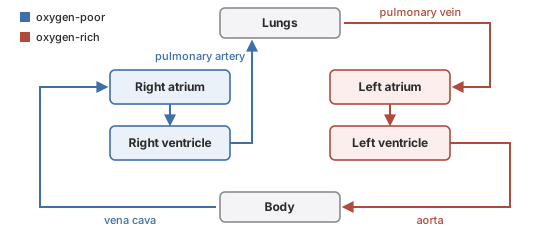
The heart has four chambers. Arteries carry blood away from the heart and veins bring it back, with one pair of exceptions: the pulmonary artery carries oxygen-poor blood to the lungs, and the pulmonary vein brings oxygen-rich blood back.

A loop diagram. Oxygen-poor blood from the body enters the right atrium, passes to the right ventricle, and goes through the pulmonary artery to the lungs. Oxygen-rich blood returns through the pulmonary vein to the left atrium, passes to the left ventricle, and goes out through the aorta to the body.
Two loops: right side to the lungs, left side to the body. The left ventricle pumps oxygen-rich blood to the whole body.

Example 1 · The exception

Which blood vessel breaks the rule that veins carry oxygen-poor blood?

  1. Veins return blood to the heart; normally that blood has given up its oxygen to the body.

  2. Blood coming back from the lungs has just picked up oxygen, and it returns through a vein.

Answer

The pulmonary vein

Which glands make which hormones?

GlandHormoneEffect
PituitaryGrowth hormone and othersThe master gland
ThyroidThyroxine, which needs iodineControls metabolism
PancreasInsulinLowers blood sugar
AdrenalAdrenalineEmergencies

Too little insulin causes diabetes; too little iodine causes goitre.

Nutrition

Which nutrient prevents which deficiency?

Fats give the most energy per gram. Proteins build the body, pulses being a rich source. Fibre moves food through the gut and prevents constipation.

Lack ofDisease or signGood source
Vitamin ANight blindnessCarrots, papaya
Vitamin B1Beri-beriWhole grains
Vitamin CScurvy: bleeding gumsAmla, citrus
Vitamin DRickets: soft, bent bonesSunlight, milk
Vitamin KPoor blood clottingGreen leafy vegetables
IodineGoitreIodised salt
IronAnaemiaLeafy greens, jaggery
CalciumWeak bones and teethMilk, ragi

Vitamins B and C dissolve in water and are not stored, so they are needed regularly. Iodine turns starch blue-black.

Example 2 · Kwashiorkor or marasmus?

A child eats enough calories, mostly starch, but little protein, and has thin limbs, a swollen belly and puffy feet. Which condition is it?

  1. Marasmus is a lack of both protein and energy, and shows as severe wasting without swelling.

  2. Enough calories but too little protein, with swelling, is the other condition.

Answer

Kwashiorkor

Diseases and immunity

What causes common diseases, and how do they spread?

DiseaseCauseSpread by
MalariaPlasmodium, a protozoanFemale Anopheles mosquito
Dengue, chikungunyaVirusAedes mosquito, biting by day
TuberculosisBacteriumAir
Cholera, typhoidBacteriaContaminated water and food
Polio, common coldVirusesContact, air, water
RabiesVirusBite of an infected animal, usually a dog
AIDSHIV, which destroys certain white blood cellsBlood, sex, mother to child

Diabetes is non-communicable. ORS replaces the water and salts lost in diarrhoea; it does not kill germs.

Watch out

Antibiotics kill bacteria, not viruses, so they do not cure a cold. Fleming discovered penicillin in 1928.

How do vaccines work?

White blood cells called lymphocytes make antibodies. A vaccine trains them with a harmless form of the germ, so the body can fight the real one quickly.

MilestoneFact
First vaccine, 1796Edward Jenner, smallpox, using cowpox
BCGProtects newborns against tuberculosis
2014India certified polio-free

Who can receive whose blood?

GroupMarkers on cellsCan receive from
AAA, O
BBB, O
ABA and BAny group
ONoneO only

O is the universal donor and AB the universal recipient.

Plant life

How do plants make and move food and water?

Photosynthesis uses sunlight absorbed by chlorophyll in the chloroplasts to turn carbon dioxide and water into glucose, giving out oxygen. Respiration goes on all the time, day and night.

Part or processJob
XylemCarries water and minerals up
PhloemCarries sugar to roots, fruits and other parts
StomataPores for gases, opened and closed by guard cells
TranspirationLoss of water vapour from leaves

Cuscuta (amarbel) is a parasite. The pitcher plant makes its own food but traps insects for nitrogen, which is scarce in its soil.

How do plants reproduce and respond?

Pollination moves pollen from anther to stigma; maize and other grasses use wind. After fertilisation the ovary becomes the fruit. Most seeds need water, air and warmth to germinate, but not light.

Response or hormoneEffect
PhototropismShoots bend towards light
EthyleneA gas that ripens fruit
Abscisic acidCloses stomata in drought

Exam shortcuts

  • Symptom to pair. Bleeding gums: vitamin C; night blindness: vitamin A.
  • Mosquito by time. Aedes by day (dengue); female Anopheles (malaria).
  • Pulmonary is the exception.
  • O gives, AB takes.
  • Xylem water, phloem food.

Common mistakes

  • Antibiotics for a cold.
  • Tendon and ligament swapped.
  • Pulmonary vein as oxygen-poor.
  • Liver as the largest organ. It is the largest gland; skin is the largest organ.
  • Plants respiring only at night.
  • Marasmus for kwashiorkor.
  • Male mosquitoes spreading malaria.
  • Light needed to germinate.

Quick revision

Cells and body

  • Mitochondrion powerhouse; lysosome suicide bag
  • Four chambers; left ventricle to the body
  • Skin largest organ; liver largest gland

Nutrition and disease

  • A night blindness; C scurvy; D rickets
  • Malaria protozoan, Anopheles; dengue virus, Aedes
  • Jenner 1796; polio-free 2014

Plants

  • Xylem water up; phloem sugar around
  • Respiration day and night
  • Ethylene ripens; abscisic acid closes stomata

The chemistry of food and the body is in everyday chemistry, and life beyond the body in ecosystems and biodiversity.

Next · 09Quick revision

Check your understanding

66 questions, grouped by type, easy to hard. Pick an answer and check it. The worked solution opens when you ask for it.

Cells and tissuesQ1 of 66Q1

Cells and tissues

13 questions

Which cell organelle is called the 'powerhouse of the cell' because it releases energy from food?

Options for question 1

Show the explanationHide the explanation

AnswerB · Mitochondrion

  1. Mitochondria carry out aerobic respiration, breaking down glucose to release energy stored as ATP.

The basic structural and functional unit of all living things is the

Options for question 2

Show the explanationHide the explanation

AnswerD · cell

  1. Every living thing is made of one or more cells, and every life process happens in cells.

  2. Cells group into tissues, tissues into organs and organs into systems.

Worth noting

An atom is a unit of matter, not of life; it is not alive.

In which organelle of a leaf cell does photosynthesis take place?

Options for question 3

Show the explanationHide the explanation

AnswerA · Chloroplast

  1. Chloroplasts contain the green pigment chlorophyll, which captures light energy to make food.

Which of these is present in plant cells but absent in animal cells?

Options for question 4

Show the explanationHide the explanation

AnswerC · Cell wall

  1. Plant cells have a rigid cell wall made of cellulose outside the cell membrane.

  2. Animal cells have a cell membrane, nucleus and mitochondria too, but no cell wall.

Worth noting

Plant cells also have chloroplasts and one large central vacuole, which animal cells lack.

Which part of the cell contains the chromosomes and controls the cell's activities?

Options for question 5

Show the explanationHide the explanation

AnswerB · Nucleus

  1. The nucleus holds the DNA, arranged in chromosomes, which carries the instructions for the cell.

  2. It directs growth, division and the making of proteins.

Proteins are made in the cell at the

Options for question 6

Show the explanationHide the explanation

AnswerC · ribosomes

  1. Ribosomes join amino acids together, following the instructions copied from DNA, to build proteins.

Lysosomes are called the 'suicide bags' of the cell because they

Options for question 7

Show the explanationHide the explanation

AnswerA · contain digestive enzymes that can break down the cell itself

  1. Lysosomes hold powerful digestive enzymes that break down worn-out parts and germs.

  2. If the cell is badly damaged, they burst and digest the cell itself, hence the name.

In 1665, who first observed and named 'cells' while looking at a thin slice of cork under a microscope?

Options for question 8

Show the explanationHide the explanation

AnswerD · Robert Hooke

  1. Robert Hooke saw tiny box-like compartments in cork and called them cells.

  2. Robert Brown later discovered the nucleus, in 1831.

Worth noting

Hooke and Brown share a first name, which is why they are paired as distractors.

The tough cord of tissue that joins a muscle to a bone is a

Options for question 9

Show the explanationHide the explanation

AnswerC · tendon

  1. Tendons are strong, inelastic connective tissue that pull on bones when muscles contract.

  2. Ligaments join bone to bone at joints.

Worth noting

Remember: Tendon joins muscle To bone; Ligament Links bone to bone.

Blood is classified as which type of tissue?

Options for question 10

Show the explanationHide the explanation

AnswerA · Connective tissue

  1. Connective tissues have cells spread in a matrix. Blood's matrix is the liquid plasma.

  2. Blood connects and carries materials between all parts of the body, so it is a fluid connective tissue.

Bacteria are prokaryotes. What do their cells lack that the cells of plants and animals have?

Options for question 11

Show the explanationHide the explanation

AnswerB · A nucleus enclosed in a membrane

  1. Prokaryotic cells have DNA, ribosomes and a cell membrane, but the DNA lies free in the cytoplasm.

  2. They have no membrane-bound nucleus (and no membrane-bound organelles such as mitochondria).

Worth noting

Every cell has DNA; the difference is whether a membrane encloses it.

Which is the longest cell in the human body?

Options for question 12

Show the explanationHide the explanation

AnswerD · Nerve cell (neuron)

  1. A neuron's long fibre, the axon, carries messages over long distances.

  2. Some neurons run from the base of the spine to the toes, about a metre long.

Worth noting

The ovum is the largest human cell by size, but the neuron is the longest.

Mature human red blood cells have no nucleus. What advantage does this give them?

Options for question 13

Show the explanationHide the explanation

AnswerA · More room for haemoglobin, so each cell carries more oxygen

  1. Losing the nucleus leaves more space inside for haemoglobin, the oxygen-carrying protein, and gives the cell its flexible biconcave shape.

  2. Without a nucleus they cannot divide and live only about 120 days.

Worth noting

Antibodies are made by white blood cells, not red ones.

Human organ systems

13 questions

What is the largest organ of the human body?

Options for question 14

Show the explanationHide the explanation

AnswerD · Skin

  1. The skin covers the whole body and is its largest organ by area and weight.

  2. The liver is the largest internal organ and the largest gland.

How many chambers does the human heart have?

Options for question 15

Show the explanationHide the explanation

AnswerC · 4

  1. Two upper chambers (atria) receive blood and two lower chambers (ventricles) pump it out.

Worth noting

Fish have two chambers and frogs three; birds and mammals have four.

In the lungs, oxygen passes into the blood through the walls of tiny air sacs called

Options for question 16

Show the explanationHide the explanation

AnswerB · alveoli

  1. The alveoli are millions of thin-walled sacs wrapped in blood capillaries.

  2. Oxygen diffuses into the blood there and carbon dioxide diffuses out.

Worth noting

Villi are finger-like folds in the small intestine that absorb food; nephrons are in the kidneys.

Blood vessels that carry blood away from the heart to the body are called

Options for question 17

Show the explanationHide the explanation

AnswerA · arteries

  1. Arteries carry blood away from the heart under high pressure, so they have thick, elastic walls.

  2. Veins bring blood back to the heart, and capillaries link the two.

Which is the largest gland in the human body?

Options for question 18

Show the explanationHide the explanation

AnswerC · Liver

  1. The liver weighs about 1.5 kg in an adult and is the largest gland.

  2. It makes bile, stores glycogen and removes toxins from the blood.

Worth noting

The pituitary is called the master gland because it controls other glands, not because it is large; it is pea-sized.

Bile, which helps digest fats, is stored in the gall bladder. Which organ makes it?

Options for question 19

Show the explanationHide the explanation

AnswerC · liver

  1. The liver makes bile continuously; the gall bladder stores and concentrates it.

  2. Bile breaks fat into small droplets (emulsification) so that enzymes can act on it.

Worth noting

Bile contains no enzymes; it prepares fat for the pancreatic enzyme lipase.

The filtering units of the kidney, which remove wastes from the blood to form urine, are called

Options for question 20

Show the explanationHide the explanation

AnswerB · nephrons

  1. Each kidney has about a million nephrons.

  2. Each nephron filters blood, takes back useful substances, and passes the waste (mainly urea) out as urine.

What is taken as the normal blood pressure of a healthy young adult?

Options for question 21

Show the explanationHide the explanation

AnswerD · 120/80 mm Hg

  1. Blood pressure is written as systolic over diastolic pressure.

  2. About 120 mm Hg when the heart contracts and 80 mm Hg when it relaxes is taken as normal.

Worth noting

The larger (systolic) number always comes first, so 80/120 is written the wrong way round.

The hormone insulin, which lowers the level of sugar in the blood, is made by the

Options for question 22

Show the explanationHide the explanation

AnswerD · pancreas

  1. Groups of cells in the pancreas, the islets of Langerhans, release insulin.

  2. Too little insulin causes diabetes, in which blood sugar stays high.

Which bone of the human skeleton is the longest?

Options for question 23

Show the explanationHide the explanation

AnswerA · Femur (thigh bone)

  1. The femur, in the thigh, is the longest and strongest bone.

  2. The stapes, in the middle ear, is the smallest. An adult has 206 bones.

Which gland is known as the 'master gland' because its hormones control several other glands?

Options for question 24

Show the explanationHide the explanation

AnswerB · Pituitary gland

  1. The pituitary, at the base of the brain, releases hormones that control the thyroid, adrenal glands and sex organs.

  2. It also makes growth hormone.

Which blood vessel is an exception to the rule that veins carry oxygen-poor blood?

Options for question 25

Show the explanationHide the explanation

AnswerC · The pulmonary vein, carrying oxygen-rich blood from the lungs to the heart

  1. Veins are defined by direction: they carry blood towards the heart.

  2. The pulmonary vein brings freshly oxygenated blood from the lungs to the heart, so it is a vein carrying oxygen-rich blood.

Worth noting

The pulmonary artery is the matching exception the other way: an artery carrying oxygen-poor blood to the lungs.

In which part of the digestive system is most digested food absorbed into the blood?

Options for question 26

Show the explanationHide the explanation

AnswerB · Small intestine

  1. Digestion is completed in the small intestine, which is about 6–7 m long.

  2. Its inner wall has millions of villi that give a huge surface for absorbing digested food into the blood.

Worth noting

The large intestine mainly absorbs water, not digested food.

Nutrition and deficiency diseases

13 questions

Bleeding gums and slow healing of wounds are signs of scurvy, caused by a lack of

Options for question 27

Show the explanationHide the explanation

AnswerA · vitamin C

  1. Vitamin C is needed to make collagen, which holds gums, skin and blood vessels together.

  2. Citrus fruits, amla and guava are rich sources.

Children whose bones become soft and bent, as in rickets, lack

Options for question 28

Show the explanationHide the explanation

AnswerD · vitamin D

  1. Vitamin D helps the body absorb calcium and phosphorus for bones.

  2. The skin makes vitamin D in sunlight; milk, eggs and fish also supply it.

A swelling in the neck called goitre is caused by a lack of which mineral in the diet?

Options for question 29

Show the explanationHide the explanation

AnswerC · Iodine

  1. The thyroid gland needs iodine to make the hormone thyroxine.

  2. Without enough iodine the gland enlarges. Iodised salt prevents this.

Anaemia, in which a person feels tired and looks pale, is most commonly caused by a lack of

Options for question 30

Show the explanationHide the explanation

AnswerD · iron

  1. Iron is part of haemoglobin, which carries oxygen in red blood cells.

  2. Too little iron means too little haemoglobin, so less oxygen reaches the tissues.

Worth noting

Green leafy vegetables, jaggery, pulses and meat are good sources of iron.

A person who cannot see well in dim light (night blindness) needs more

Options for question 31

Show the explanationHide the explanation

AnswerB · vitamin A

  1. Vitamin A is needed to make the light-sensitive pigment in the rods of the retina.

  2. Carrots, papaya, mango, green vegetables and milk are good sources.

Dietary fibre (roughage) from fruits, vegetables and whole grains mainly helps the body by

Options for question 32

Show the explanationHide the explanation

AnswerC · helping food move through the gut and preventing constipation

  1. Fibre is not digested, but it adds bulk and holds water.

  2. This helps the intestines push food along and helps prevent constipation.

Which vitamin is needed for blood to clot properly after a cut?

Options for question 33

Show the explanationHide the explanation

AnswerC · Vitamin K

  1. Vitamin K helps the liver make the proteins that form a blood clot.

  2. Green leafy vegetables are a rich source, and bacteria in the gut also make some.

Beri-beri, a disease affecting the nerves and heart, is caused by a lack of

Options for question 34

Show the explanationHide the explanation

AnswerA · vitamin B1 (thiamine)

  1. Thiamine (vitamin B1) helps cells release energy from carbohydrates.

  2. Beri-beri was common where people ate mostly polished white rice, which loses its thiamine-rich outer layer.

Marasmus, in which a child is extremely thin and wasted, results from a long-term lack of

Options for question 35

Show the explanationHide the explanation

AnswerB · both proteins and calories (energy)

  1. Marasmus is severe undernutrition: the diet lacks both energy and protein over months.

  2. The body uses up its own fat and muscle, leaving the child thin and weak.

A few drops of iodine solution are put on a slice of potato and it turns blue-black. This shows that the potato contains

Options for question 36

Show the explanationHide the explanation

AnswerB · starch

  1. Iodine turns blue-black in the presence of starch; this is the standard test for starch.

Worth noting

Fat is tested by a translucent spot on paper, and protein by the violet colour with copper sulphate and caustic soda.

A child eats enough calories, mostly as starchy food, but very little protein. The child has thin limbs, a swollen belly and puffy feet. The likely condition is

Options for question 37

Show the explanationHide the explanation

AnswerD · kwashiorkor

  1. Kwashiorkor is caused mainly by a lack of protein even when calories are enough.

  2. Fluid collects in the tissues, causing the swollen belly and puffy feet.

Worth noting

Marasmus is a lack of both protein and calories, and causes wasting without the swelling.
Gram for gram, which nutrient supplies the most energy?

Options for question 38

Show the explanationHide the explanation

AnswerA · Fats

  1. Fats give about 9 kcal per gram; carbohydrates and proteins about 4 kcal per gram each.

  2. Vitamins give no energy; they help the body use the energy-giving nutrients.

Worth noting

Carbohydrates are the body's main everyday source of energy, but fats give more energy per gram.

Which vitamins dissolve in water, so that any excess leaves the body in urine and they must be taken regularly?

Options for question 39

Show the explanationHide the explanation

AnswerC · Vitamins B and C

  1. Vitamins A, D, E and K are fat-soluble and can be stored in the body's fat and liver.

  2. The B group and vitamin C are water-soluble; they are not stored for long, so a regular supply is needed.

Diseases and immunity

14 questions

Malaria is spread from person to person by the bite of the

Options for question 40

Show the explanationHide the explanation

AnswerA · female Anopheles mosquito

  1. Malaria is caused by a protozoan, Plasmodium.

  2. Only the female Anopheles mosquito bites for blood and carries it between people.

Worth noting

Male mosquitoes feed on plant juices and do not bite.

Dengue and chikungunya are viral diseases spread by which mosquito, which usually bites in the daytime?

Options for question 41

Show the explanationHide the explanation

AnswerD · Aedes

  1. The Aedes mosquito, with black-and-white striped legs, breeds in clean stagnant water in coolers, pots and tyres.

  2. It spreads dengue, chikungunya and Zika.

Worth noting

Culex spreads filaria (elephantiasis) and Japanese encephalitis; the sand fly spreads kala-azar.

Tuberculosis (TB) is caused by a

Options for question 42

Show the explanationHide the explanation

AnswerC · bacterium

  1. TB is caused by the bacterium Mycobacterium tuberculosis and spreads through the air by coughing.

  2. It is treated with a long course of antibiotics; the BCG vaccine protects young children.

Cholera and typhoid usually spread through

Options for question 43

Show the explanationHide the explanation

AnswerB · contaminated water and food

  1. Both are bacterial diseases carried in water or food contaminated with sewage.

  2. Safe drinking water, handwashing and proper sanitation prevent them.

Antibiotics are of no use in treating the common cold because the cold is caused by

Options for question 44

Show the explanationHide the explanation

AnswerA · a virus

  1. Antibiotics act on bacteria by attacking structures such as the cell wall.

  2. Viruses lack these structures and multiply inside our own cells, so antibiotics do not affect them.

Worth noting

Using antibiotics when they are not needed helps bacteria become resistant to them.

How does a vaccine protect a person from a disease?

Options for question 45

Show the explanationHide the explanation

AnswerB · It trains the immune system with a harmless form of the germ, so the body can fight the real germ quickly

  1. A vaccine contains a dead or weakened germ, or a part of it, that cannot cause the disease.

  2. The body makes antibodies and memory cells against it, so a later infection is beaten before it causes illness.

Penicillin, the first widely used antibiotic, was discovered in 1928 by

Options for question 46

Show the explanationHide the explanation

AnswerD · Alexander Fleming

  1. Fleming noticed that a Penicillium mould had killed the bacteria growing around it on a culture plate.

Worth noting

Jenner made the first vaccine, Pasteur developed the rabies vaccine, and Koch identified the TB bacterium.

In 2014, India was certified free of which disease after a long vaccination campaign with oral drops?

Options for question 47

Show the explanationHide the explanation

AnswerA · Polio

  1. Under the Pulse Polio campaign, children under five were given oral polio vaccine drops.

  2. India's last wild polio case was in January 2011, and the WHO certified the South-East Asia region, including India, polio-free in March 2014.

HIV, the virus that causes AIDS, weakens the body's defences by destroying

Options for question 48

Show the explanationHide the explanation

AnswerD · certain white blood cells of the immune system

  1. HIV infects and kills helper T cells, a type of white blood cell that coordinates the immune response.

  2. As they fall, the body cannot fight ordinary infections, which become dangerous.

Which of these is a non-communicable disease, one that does not spread from person to person?

Options for question 49

Show the explanationHide the explanation

AnswerC · Diabetes

  1. Diabetes arises from a problem with insulin, linked to genes, diet and lifestyle, not from a germ.

  2. TB is bacterial, and measles and chickenpox are viral; all three are infectious.

Oral rehydration solution (ORS), a mixture of salt, sugar and clean water, is given mainly to

Options for question 50

Show the explanationHide the explanation

AnswerB · replace the water and salts lost in diarrhoea

  1. Diarrhoea drains water and salts quickly, and dehydration is what makes it dangerous, especially for young children.

  2. ORS replaces them; the sugar helps the gut absorb the salt and water.

Worth noting

ORS does not kill germs; it treats the dehydration while the body recovers.

Rabies is a deadly disease that spreads to humans mainly through

Options for question 51

Show the explanationHide the explanation

AnswerA · the bite of an infected animal, most often a dog

  1. Rabies is caused by a virus present in the saliva of infected animals.

  2. It enters through a bite or scratch. Once symptoms appear it is almost always fatal, so the vaccine must be taken promptly after a bite.

A patient with which blood group can safely receive red blood cells from a donor of any ABO blood group?

Options for question 52

Show the explanationHide the explanation

AnswerC · AB

  1. A person's plasma has antibodies against the A or B markers that their own cells lack.

  2. Group AB has both markers, so its plasma has neither antibody and does not attack any donor's cells. AB is the universal recipient.

Worth noting

Group O is the universal donor: its cells carry neither marker. The two are easily swapped.

The first vaccine, developed by Edward Jenner in 1796 using material from cowpox, protected people against

Options for question 53

Show the explanationHide the explanation

AnswerD · smallpox

  1. Jenner noticed that milkmaids who caught mild cowpox did not get smallpox.

  2. His cowpox vaccine protected against smallpox. The word vaccine comes from vacca, Latin for cow. Smallpox was declared eradicated worldwide in 1980.

Worth noting

Chickenpox is a different, milder disease; smallpox is the one that was eradicated.

Plant life

13 questions

Which gas do green plants give out during photosynthesis?

Options for question 54

Show the explanationHide the explanation

AnswerD · Oxygen

  1. Carbon dioxide + water → glucose + oxygen, in the presence of sunlight and chlorophyll.

  2. The oxygen comes from splitting water, and it is released into the air.

The green pigment in leaves that absorbs sunlight for photosynthesis is

Options for question 55

Show the explanationHide the explanation

AnswerA · chlorophyll

  1. Chlorophyll, in the chloroplasts, absorbs mainly red and blue light and reflects green, which is why leaves look green.

Worth noting

Carotene is an orange pigment also found in leaves and carrots; it helps, but it is not the main pigment.

Water and minerals travel up from the roots to the leaves through the

Options for question 56

Show the explanationHide the explanation

AnswerC · xylem

  1. Xylem vessels form continuous tubes from root to leaf and carry water and dissolved minerals upwards.

Tiny pores on the surface of leaves, each surrounded by two guard cells, through which gases enter and leave are called

Options for question 57

Show the explanationHide the explanation

AnswerA · stomata

  1. Stomata let carbon dioxide in for photosynthesis and let oxygen and water vapour out.

  2. The guard cells open and close them.

Worth noting

Lenticels are pores in woody stems and bark, not on leaves.

A potted plant kept near a window bends its shoot towards the light. This response is called

Options for question 58

Show the explanationHide the explanation

AnswerB · phototropism

  1. A tropism is growth in response to a direction-giving stimulus.

  2. Growth towards light is phototropism; shoots show it and roots grow away from light.

Worth noting

Geotropism is the response to gravity: roots grow down and shoots grow up.

Sugar made in the leaves is carried to the roots, fruits and other parts of the plant by the

Options for question 59

Show the explanationHide the explanation

AnswerB · phloem

  1. Phloem carries dissolved food (mainly sucrose) from where it is made to where it is used or stored. This is called translocation.

  2. Unlike xylem, phloem can carry material both up and down.

Worth noting

A way to remember: xylem for water, phloem for food.

The loss of water as vapour from the leaves of a plant is called

Options for question 60

Show the explanationHide the explanation

AnswerB · transpiration

  1. Water evaporates from leaf cells and escapes through the stomata.

  2. This transpiration pull helps draw water up the xylem from the roots and cools the plant.

Worth noting

Guttation is the loss of liquid water drops from leaf edges, seen early in the morning, not vapour.

The transfer of pollen grains from the anther to the stigma of a flower is called

Options for question 61

Show the explanationHide the explanation

AnswerD · pollination

  1. Pollen is carried by insects, birds, wind or water from the anther (male part) to the stigma (female part).

  2. Fertilisation comes later, when the male cell joins the egg inside the ovule.

Worth noting

Pollination and fertilisation are separate steps; pollination comes first.

The pitcher plant traps and digests insects even though it makes its own food by photosynthesis. It does this mainly to obtain

Options for question 62

Show the explanationHide the explanation

AnswerC · nitrogen, which is scarce in the soil where it grows

  1. Insectivorous plants grow in marshy, nitrogen-poor soils.

  2. Digesting insects gives them the nitrogen they need to make proteins; they still make sugar by photosynthesis.

Cuscuta (amarbel), a yellow, leafless plant that winds around other plants and draws food from them, is an example of a

Options for question 63

Show the explanationHide the explanation

AnswerD · parasite

  1. Cuscuta has no chlorophyll, so it cannot make its own food.

  2. It pushes special roots into its host and takes food from it, harming the host: that is parasitism.

Worth noting

A saprophyte, such as a mushroom, feeds on dead and decaying matter, not on a living host.

Fruit sellers keep a ripe banana with unripe fruit to make it ripen faster. Which plant hormone, a gas, is responsible?

Options for question 64

Show the explanationHide the explanation

AnswerC · Ethylene

  1. Ripe fruit gives off ethylene gas, which speeds up ripening in nearby fruit.

  2. Auxin controls growth towards light, gibberellin makes stems lengthen, and cytokinin promotes cell division.

Worth noting

Ethylene is the only common plant hormone that is a gas.

Most seeds need water, air and a suitable temperature to germinate. Which of these do most seeds NOT need to begin germinating?

Options for question 65

Show the explanationHide the explanation

AnswerA · Light

  1. Water softens the seed coat and activates enzymes; oxygen is needed for respiration; warmth lets enzymes work.

  2. The seed lives on its stored food at first, so most seeds germinate even in the dark. Light becomes necessary once the seedling starts photosynthesis.

Worth noting

A few seeds, such as lettuce, need light, which is why the question says most seeds.

When do green plants carry out respiration?

Options for question 66

Show the explanationHide the explanation

AnswerB · All the time, both day and night

  1. Every living cell needs energy all the time, so respiration never stops.

  2. Photosynthesis happens only in light. In the day it is faster than respiration, so plants give out oxygen overall; at night only respiration goes on.

Worth noting

'Plants respire only at night' is a common myth; at night respiration is simply the only process you can detect.

The area names are NTA's. The chapters inside them are EduFarming's own division, not NTA's.