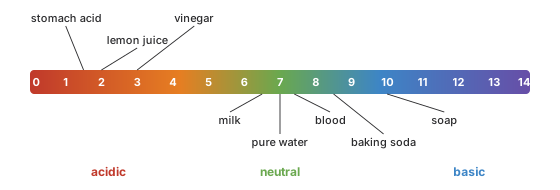
Chemistry questions in the General Aptitude Test are about the chemistry of ordinary life: why a matka cools water, what is in LPG, why a curry stain turns red with soap. They reward knowing a set of names and formulas and the reasons behind a few everyday effects. This lesson covers states of matter and separating mixtures, acids, bases and the pH scale, everyday compounds, metals and non-metals, corrosion and alloys, and the types of chemical reaction, with worked examples, a pH scale diagram and the traps set most often.
Everyday chemistry is a set of names joined to reasons. Baking soda is a mild base, so it soothes an ant sting; iron needs both air and water to rust, so paint stops it; ice is less dense than water, so lakes freeze from the top. Learn each fact with its reason and most questions answer themselves.
The traps are near-twins: brass and bronze, baking soda and washing soda, LPG and CNG, evaporation and boiling. Keep a table for each pair.
Sublimation is solid straight to gas (camphor, dry ice). Evaporation happens at any temperature, from the surface only, and cools what is left; boiling happens throughout, at one temperature. Pure ice melts at 0 °C, which is 273 K; −40 °C is 233 K.
Everyday effect
Why
Ice floats
Water expands on freezing, so ice is less dense
LPG is liquid in the cylinder
Compressed under high pressure
Hot food smells travel faster
Particles move faster when hot, so they diffuse faster
A pure substance, such as distilled water, has one kind of particle. A homogeneous mixture is the same throughout: salt water, air, brass. A colloid, such as milk, fog or smoke, has particles too small to settle but big enough to scatter light, so a beam through mist becomes visible: the Tyndall effect.
It runs from 0 to 14: 7 is neutral, below 7 acidic, above 7 basic. Acids turn blue litmus red; bases turn red litmus blue.
Lower pH means more acidic, and each step of 1 is ten times the hydrogen ion concentration.
Example 1 · How many times more acidic?
Solution P has pH 3 and solution Q has pH 5. How many times greater is the hydrogen ion concentration in P?
Each step of 1 on the pH scale is a factor of 10.
P is 2 steps lower: 10×10=100.
Answer
100 times
Natural acid
Found in
Citric
Lemons, oranges
Acetic
Vinegar
Lactic
Curd
Tartaric
Tamarind, grapes
Methanoic (formic)
Ant and bee stings
Hydrochloric
The stomach
Key idea
Turmeric is a natural indicator: yellow in acid or neutral, reddish-brown in a base. That is why a curry stain turns red with soap and yellow again when rinsed.
Acid + base → salt + water, so hydrochloric acid and sodium hydroxide give sodium chloride. Acid + carbonate also gives carbon dioxide, the fizz when baking soda meets vinegar.
From most to least reactive: potassium, sodium, calcium, magnesium, aluminium, zinc, iron, lead, (hydrogen), copper, mercury, silver, gold. Metals above hydrogen release hydrogen from dilute acid; copper does not.
Example 2 · The iron nail
An iron nail sits in blue copper sulphate solution. The solution turns pale green and the nail turns brown. What does this show?
Iron has pushed copper out of its salt, forming green iron sulphate.
A metal can only displace one below it in the reactivity series.
Iron rusts only with both air and water; rust is hydrated iron(III) oxide. Silver tarnishes black (silver sulphide) and copper turns green (basic copper carbonate). Aluminium resists because a thin, tough oxide layer protects it.
A chemical change forms a new substance with new properties: burning paper, rusting, cooking. Freezing water is a physical change.
Type
Pattern
Example
Combination
A + B → AB
Magnesium burns to magnesium oxide; quicklime + water
Decomposition
AB → A + B
Limestone heated to quicklime; silver chloride in light
Displacement
A + BC → AC + B
Zinc + copper sulphate
Double displacement
AB + CD → AD + CB
Sodium chloride + silver nitrate
Oxidation is gain of oxygen: copper turns black copper oxide in air. Rancidity is the oxidation of fats, which is why chips packets hold nitrogen. Exothermic reactions give out heat (respiration, quicklime with water); endothermic ones absorb it (photosynthesis).
Example 3 · Balancing an equation
Balance H₂ + O₂ → H₂O with the smallest whole numbers.
The right side has one oxygen, the left two, so write 2H₂O.
Now there are four hydrogens on the right, so write 2H₂: 2H₂ + O₂ → 2H₂O.
An iron nail is left in blue copper sulphate solution. After a while the solution turns pale green and a brown coating forms on the nail. What does this show?
Show the explanationHide the explanation
AnswerB · Iron is more reactive than copper and displaces it from the solution
Fe + CuSO₄ → FeSO₄ + Cu.
The brown coating is copper metal, and the pale green colour is iron sulphate. A more reactive metal displaces a less reactive one from its salt.
Worth noting
Rust is reddish-brown too, but rust would not change the solution from blue to green.
Baking soda is sodium hydrogen carbonate, written NaHCO₃.
NaCl is common salt and CaCO₃ is limestone or marble.
Na₂CO₃ is sodium carbonate, which is washing soda — a different substance with a similar name and a similar-looking formula.
Worth noting
Washing soda and baking soda are the pair most often swapped. The hydrogen in NaHCO₃ is the difference, and it is why baking soda releases carbon dioxide when heated.
Mixing solutions of sodium chloride and silver nitrate gives a white precipitate of silver chloride and a solution of sodium nitrate. What type of reaction is this?
Show the explanationHide the explanation
AnswerB · Double displacement
NaCl + AgNO₃ → AgCl + NaNO₃.
The two compounds swap partners, so it is a double displacement; because a solid forms, it is also a precipitation reaction.