Physics in the General Aptitude Test stays at the level of Class 9 and 10 science, asked about everyday things: a bus braking, a shaving mirror, a geyser's electricity bill. You need a handful of formulas, the standard cases of image formation, and a feel for why common things happen. This lesson covers units, motion and force, pressure, light and lenses, sound, electricity and magnetism, and heat, with worked examples, a ray diagram and the traps that cost the most marks.
Every physics question here is one of two kinds: a short calculation with one formula, or a "why does this happen" about something you have seen. For the first, write the formula, put the units right (metres, seconds, kilograms), and check that the answer's size makes sense. For the second, name the principle: inertia, pressure, refraction, latent heat.
Most wrong options come from a unit slip or from using the formula for the neighbouring quantity: weight for mass, power for energy, a speed for a distance.
The seven SI base units are the metre, kilogram, second, ampere, kelvin, mole and candela (luminous intensity). Everything else is derived.
Quantity
Unit
Built from
Force
newton (N)
kg m/s2
Work and energy
joule (J)
N m
Power
watt (W)
J/s
Pressure
pascal (Pa)
N/m2
A vector has size and direction (velocity, force, momentum); a scalar has size only (speed, mass, energy). A barometer measures air pressure. One nanometre is 10−9 m, and a kilometre is 106 mm.
Watch out
Some units sound like something else. A light year is a distance. The kilowatt-hour on a bill is energy, not power. From shortest to longest: astronomical unit, light year, parsec.
Mass is the amount of matter, in kilograms, and is the same everywhere. Weight is the pull of gravity, W=mg, in newtons. On the Moon, gravity is about one-sixth as strong, so a 60 kg astronaut still has a mass of 60 kg.
Pressure is force per area, P=AF. A sharp knife puts the same force on a smaller area, so the pressure is greater; wide tyres and camels' feet spread weight so they do not sink. A girl of weight 600 N on shoes of area 0.03 m² exerts 0.03600=20,000 Pa.
Watch out
Dividing the mass by six on the Moon is the commonest slip; only weight changes. And 21gt is not a height: the formula has t2.
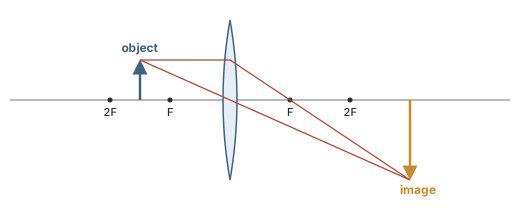
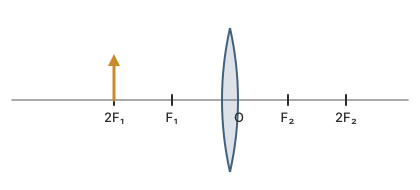
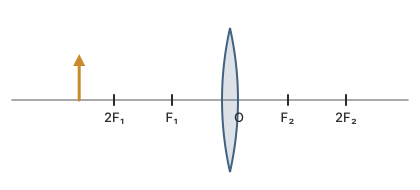
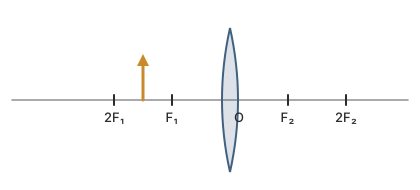
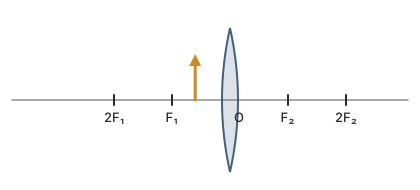
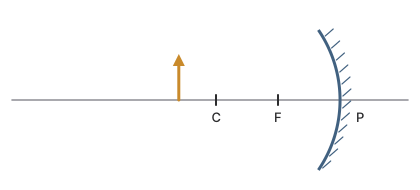
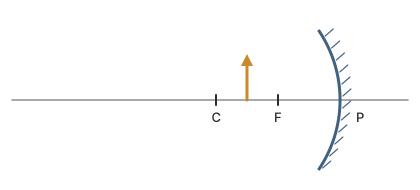
For a convex lens, the image depends on where the object stands relative to F and 2F. A concave mirror follows the same pattern, with C in place of 2F.
Object
Image
Nature
Use
Beyond 2F
Between F and 2F
Real, inverted, diminished
Camera
At 2F
At 2F
Real, inverted, same size
Between F and 2F
Beyond 2F
Real, inverted, magnified
Projector
Inside F
Same side as object
Virtual, erect, magnified
Magnifying glass, shaving mirror
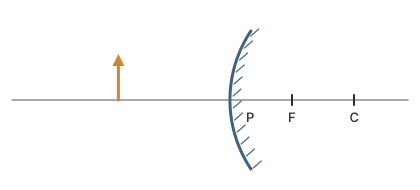
A convex mirror and a concave lens always give a virtual, erect, diminished image; that wide view is why a convex mirror is a rear-view mirror. A plane mirror gives a virtual, upright, same-size image.
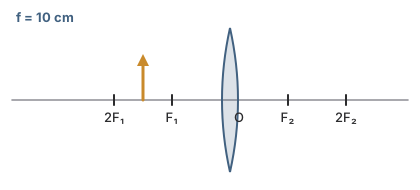
Object between F and 2F: the image is real, inverted and magnified, beyond 2F on the far side.
Lens, mirror and power
Lens: v1−u1=f1Mirror: v1+u1=f1P=f (in m)1
Example 3 · Where is the image?
An object is 15 cm in front of a convex lens of focal length 10 cm. Where is the image?
With u=−15 and f=+10: v1=101−151=301.
So v=+30 cm: real, on the far side, and twice as tall, as the table predicts for an object between F and 2F.
Answer
30 cm behind the lens
A convex lens has positive power, a concave lens negative: +2 D is a convex lens of focal length 50 cm, and −2 D a concave one. Short sight (myopia) is corrected with a concave lens.
Sound comes from vibration and needs a medium, so it cannot cross a vacuum. It is fastest in solids such as steel, slower in liquids, slowest in gases. Pitch depends on frequency; loudness on amplitude, measured in decibels. Humans hear 20 Hz to 20,000 Hz; below is infrasound (elephants, whales), above is ultrasound (bats).
Waves and echoes
v=fλdistance to reflector=2speed×time
Example 4 · Echo or lightning?
A clap's echo returns from a cliff after 2 s; thunder follows a flash by 3 s. With sound at 340 m/s, how far are the cliff and the lightning?
The echo goes there and back: 2340×2=340 m.
The light arrives almost at once, so the thunder travels one way: 340×3=1,020 m.
Answer
340 m and 1,020 m
Watch out
The decibel scale is logarithmic: every 10 dB is ten times the intensity, so 60 dB is 100 times 40 dB, not 1.5 times. For a clear echo, sound must return after at least 0.1 s, so the wall must be at least 17 m away.
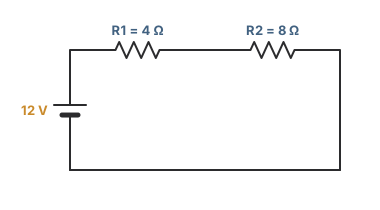
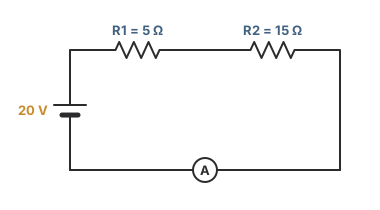
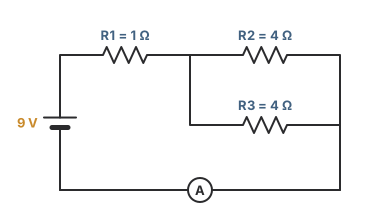
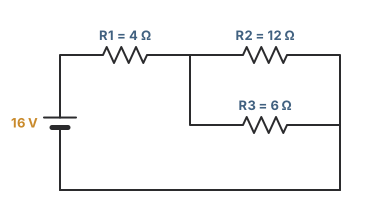
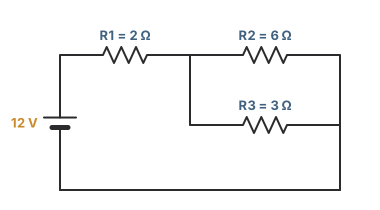
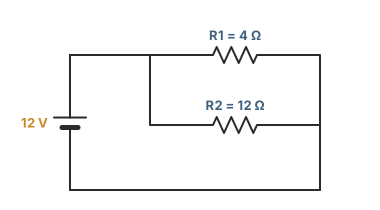
In series the current is the same and the voltage is shared; in parallel the voltage is the same and the currents add. A parallel pair is smaller than its smallest resistor. Resistance grows with length: doubling a 4 Ω wire gives 8 Ω.
Example 5 · A mixed circuit
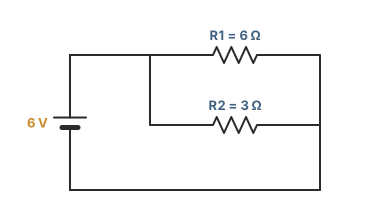
Two 6 Ω resistors are in parallel, and the pair is in series with a third 6 Ω resistor. What is the total resistance?
The parallel pair: 6+66×6=3 Ω.
In series with 6 Ω: 3+6=9 Ω.
Answer
9 Ω
Bills: energy in kWh = power in kW × hours. A 1,500 W geyser used 2 hours a day for 30 days uses 1.5×2×30=90 kWh. A fuse melts and breaks the circuit when too much current flows; rubber is a good insulator.
A current creates a magnetic field (Oersted), which is how electromagnets work. A changing magnetic field makes a current (Faraday's electromagnetic induction): a generator turns motion into electricity, and a motor turns electrical energy into mechanical energy.
Which of the following is a base quantity in the SI system?
Show the explanationHide the explanation
AnswerC · Luminous intensity
The SI system defines seven base quantities: length, mass, time, electric current, thermodynamic temperature, amount of substance and luminous intensity.
Luminous intensity is on that list, measured in candela.
Force, velocity and pressure are all derived: velocity is length over time, force is mass times acceleration, and pressure is force over area.
Worth noting
A quick test for a derived quantity is whether you can write its unit in terms of others — newtons, metres per second and pascals all decompose, candela does not.
A girl weighing 600 N stands on a floor. The soles of her shoes touch the floor over a total area of 0.03 m². What pressure does she exert on the floor?
Show the explanationHide the explanation
AnswerD · 20,000 Pa
Pressure = force ÷ area = 600 ÷ 0.03.
600 ÷ 0.03 = 60,000 ÷ 3 = 20,000 Pa.
Worth noting
18 multiplies force by area. 200 and 2,000 are decimal-place slips when dividing by 0.03.
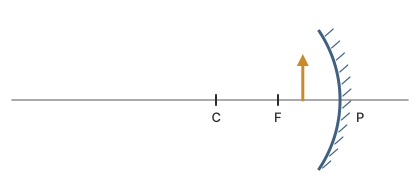
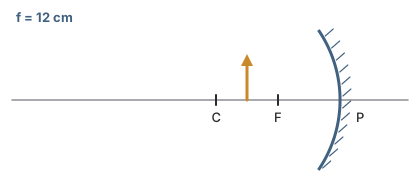
An object 18 cm in front of the concave mirror of focal length 12 cm in the figure forms a real image. How many times as tall as the object is the image?
Show the explanationHide the explanation
AnswerC · 2
Mirror formula: 1/v + 1/u = 1/f, with u = −18 cm and f = −12 cm.
1/v = −1/12 + 1/18 = −3/36 + 2/36 = −1/36, so v = −36 cm (36 cm in front of the mirror).
Magnification m = −v/u = −(−36)/(−18) = −2: the image is inverted and 2 times as tall.
Worth noting
1.5 is u ÷ f and 0.5 is the reciprocal of the right answer; magnification compares the image distance with the object distance.
During a storm, Irfan sees a flash of lightning and hears the thunder 3 s later. Taking the speed of sound as 340 m/s, about how far away was the lightning?
Show the explanationHide the explanation
AnswerD · 1,020 m
Light arrives almost instantly, so the 3 s is the time the sound took.
Distance = 340 × 3 = 1,020 m, about 1 km.
Worth noting
510 m halves the distance as if it were an echo; thunder travels only one way. 340 m forgets to multiply by the time, and 113 m divides by it.
Rice takes longer to cook in an open pot at a hill station like Leh than in Chennai because, at a high altitude,
Show the explanationHide the explanation
AnswerD · air pressure is lower, so water boils below 100 °C
The boiling point of water falls as the air pressure on it falls.
At high altitude water boils at, say, 88 °C, so the food cooks at a lower temperature and takes longer. A pressure cooker fixes this by raising the pressure.
Worth noting
Dissolved salts actually raise the boiling point slightly, which would speed cooking, not slow it.