On this page · 9 sections 01 The core idea 02 Five sources of human capital 03 Human and physical capital 04 Human capital and growth 05 Education in India 06 Exam shortcuts 07 Common mistakes 08 Quick revision 09 Check your understanding A country grows not only by adding machines but by adding skills . Human capital is the stock of skill and expertise in a nation's people at a point of time; human capital formation is the process, over time, of adding to it. Spending on education and health is therefore an investment : a cost now for higher output later.
Source How it adds to skills Example Education Knowledge and ability to learn School, college Health More and longer working life Vaccination, clean water On-the-job training Skills for a particular job, paid by the firm A bank's computer course for its clerks Migration Moving to where skills earn more A nurse moving from Kerala to the Gulf Information Knowing where jobs and courses are A job-search website
A firm that pays for training often asks the worker to stay for a set period, so the firm can recover its cost. Migration has costs too (travel, higher living costs, a new place), but higher earnings outweigh them.
Preventive medicine: vaccination.Curative medicine: treating illness.Social medicine: spreading health literacy.Clean water and good sanitation.
Physical capital Human capital Tangible; can be sold in the market Intangible; only its services are sold Separable from its owner Inseparable from the person Moves easily between countries Moves less freely: nationality and culture Depreciates with use and time Depreciates with age; slowed by more learning and health Benefits mainly its owner Benefits spill over to society
An educated mother keeps her family healthier, and a trained farmer's method is copied by neighbours: these spill-overs are why the state spends on education and health.
Human capital raises productivity , encourages innovation and helps a country absorb new technology . India's software and IT services industry is often cited as an example. The link runs both ways: higher income pays for more schooling and health care, and more schooling and health raise income.
Human capital treats education and health as means to more output.Human development treats them as ends in themselves : being educated and healthy is part of a good life, whether or not it raises income. The UNDP's Human Development Report measures it. Brain drain is the loss of human capital when highly skilled people, often trained at public cost, emigrate.
The Kothari Commission (1964–66) recommended public spending on education of at least 6% of GDP ; India has stayed below it.
A cess for education on Union taxes was introduced in 2004; today it is a health and education cess.
The Right to Education Act, 2009 , makes education free and compulsory for children aged 6 to 14 .
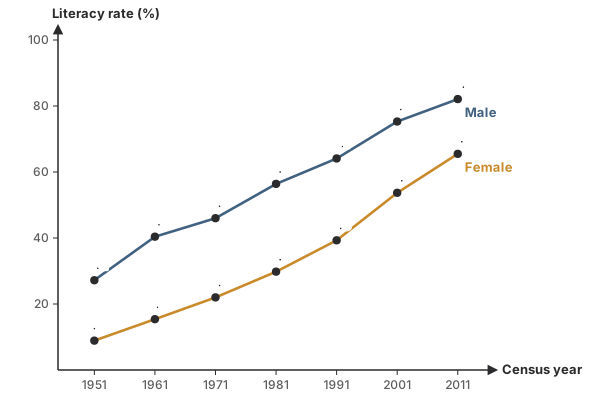
Census 2011 put literacy at 74.04 per cent, up from 64.83 per cent in 2001 .
The gap between men and women was widest in 1981 and has narrowed at every census since. Example 1 · Reading the literacy graph
Gap in 1981 = 56.4 − 29.8 = 26.6 points; in 2011 = 82.1 − 65.5 = 16.6.
Female literacy, 2001 to 2011: 65.5 − 53.7 = 11.8 points; male: 82.1 − 75.3 = 6.8.
Female literacy, 1951 to 2011: 65.5 ÷ 8.9 ≈ 7.4 times.
Answer Women's literacy has risen fastest, from a much lower base
Bodies in education and health include NCERT (school curricula), UGC (universities), AICTE (technical education) and ICMR (medical research).
Five sources: education, health, on-the-job training, migration, information.
Human capital is a stock; formation is a flow.
Kothari Commission: 6% of GDP. RTE 2009: ages 6–14.
Human capital = means; human development = ends.
Calling vaccination curative medicine.
Saying human capital can be sold apart from its owner.
Saying human capital never depreciates.
Crediting the Human Development Report to the World Bank (it is the UNDP's).
Human capital
Stock of skills; formation adds to it
Five sources
Spill-overs justify public spending
Compared
Physical: tangible, separable, mobile
Human: intangible, inseparable, less mobile
Education in India
Kothari 6% of GDP; RTE 6–14
Literacy 74% in 2011; gender gap narrowing
Development in the villages, where most Indians still live, is in rural development .
Next · 08 Quick revision → Check your understanding 51 questions, grouped by type, easy to hard. Pick an answer and check it. The worked solution opens when you ask for it.
Human capital 5 questions Options for question 1 A Option A the money a nation borrows from abroad B Option B the skill and expertise of a nation's people C Option C the machines and buildings a nation owns D Option D the total number of people living in a country
Skip Check Show the explanation Hide the explanation Next question Try again
Show the explanation Hide the explanation Answer B · the skill and expertise of a nation's people
Human capital is the skill and know-how embodied in people at a point in time, built by education, training and health.
Worth noting
Machines and buildings are physical capital.
Human capital formation is
Options for question 2 A Option A the process of building new factories B Option B a rise in the number of people living in a country C Option C the buying of shares by households D Option D adding to the skills and expertise of people
Skip Check Show the explanation Hide the explanation Next question Try again
Show the explanation Hide the explanation Answer D · adding to the skills and expertise of people
Human capital is a stock; human capital formation is the flow that adds to it over time.
Which of these turns people into a resource that adds to production?
Options for question 3 A Option A Investment in their education and health B Option B A rise in the price of food C Option C A fall in the rate of interest D Option D An increase in imports of machines
Skip Check Show the explanation Hide the explanation Next question Try again
Show the explanation Hide the explanation Answer A · Investment in their education and health
Educated and healthy people produce more; that is how a population becomes human capital.
Assertion (A): Spending on education is treated as an investment, not just consumption.
Reason (R): Education raises a person's future earnings and output.
Options for question 4 A Option A Both A and R are true, and R is the correct explanation of A. B Option B Both A and R are true, but R is not the correct explanation of A. C Option C A is true, but R is false. D Option D A is false, but R is true.
Skip Check Show the explanation Hide the explanation Next question Try again
Show the explanation Hide the explanation Answer A · Both A and R are true, and R is the correct explanation of A.
Like investment in a machine, spending now brings a stream of returns later.
R explains A.
Assertion (A): Human capital is a stock, while human capital formation is a flow.
Reason (R): Human capital formation adds to the stock of skills over a period of time.
Options for question 5 A Option A Both A and R are true, and R is the correct explanation of A. B Option B Both A and R are true, but R is not the correct explanation of A. C Option C A is true, but R is false. D Option D A is false, but R is true.
Skip Check Show the explanation Hide the explanation Next question Try again
Show the explanation Hide the explanation Answer A · Both A and R are true, and R is the correct explanation of A.
A stock is measured at a point of time; a flow over a period. Formation is the flow that adds to the stock.
R explains A.
Sources of human capital 11 questions Which of these is NOT a source of human capital formation?
Options for question 6 A Option A Spending on education B Option B On-the-job training C Option C Buying a new tractor D Option D Spending on health
Skip Check Show the explanation Hide the explanation Next question Try again
Show the explanation Hide the explanation Answer C · Buying a new tractor
The sources are education, health, on-the-job training, migration and information. A tractor is physical capital.
A firm pays for its new workers to learn a machine under an experienced operator. This is
Options for question 7 A Option A migration B Option B on-the-job training C Option C preventive medicine D Option D disinvestment
Skip Check Show the explanation Hide the explanation Next question Try again
Show the explanation Hide the explanation Answer B · on-the-job training
Firms train workers at the workplace, or send them for courses, so that the extra productivity repays the cost.
Firms that pay for on-the-job training often insist that the trained worker
Options for question 8 A Option A leaves the firm as soon as the training ends B Option B pays the firm the full cost in advance C Option C stays with the firm for a set period afterwards D Option D works without wages for the first year
Skip Check Show the explanation Hide the explanation Next question Try again
Show the explanation Hide the explanation Answer C · stays with the firm for a set period afterwards
The firm wants to recover what it spent through the worker's higher productivity, so it asks the worker to stay.
Migration counts as a source of human capital formation because
Options for question 9 A Option A people move to where their skills earn more B Option B migration always lowers the cost of living C Option C migrants never need any training D Option D it reduces the population of cities
Skip Check Show the explanation Hide the explanation Next question Try again
Show the explanation Hide the explanation Answer A · people move to where their skills earn more
Moving costs money (travel, higher living costs, the strain of a new place), but the higher earnings outweigh it.
Spending on migration is therefore an investment in using skills better.
Spending to find out about job openings, wages and courses is a source of human capital formation because
Options for question 10 A Option A it directly raises the prices of goods and services B Option B it adds to the stock of machines C Option C it reduces the need for education D Option D it helps people use their skills better
Skip Check Show the explanation Hide the explanation Next question Try again
Show the explanation Hide the explanation Answer D · it helps people use their skills better
Information about labour markets and education helps people choose the job or course that pays most for their abilities.
Match each example with the source of human capital it represents.
List I List II A. A child's polio vaccine I. Migration B. A clerk's computer course paid by her bank II. Health C. A nurse moving from Kerala to the Gulf III. Information D. A student paying for a job-search website IV. On-the-job training
Options for question 11 A Option A A-II, B-I, C-III, D-IV B Option B A-I, B-II, C-IV, D-III C Option C A-II, B-IV, C-I, D-III D Option D A-I, B-III, C-II, D-IV
Skip Check Show the explanation Hide the explanation Next question Try again
Show the explanation Hide the explanation Answer C · A-II, B-IV, C-I, D-III
A vaccine is health spending; a course paid by the employer is training; moving for work is migration; paying to learn about jobs is information.
Spending on health is a source of human capital because
Options for question 12 A Option A a healthy person can work more and for longer B Option B health care raises the price of medicines in shops C Option C sick people do not need any education D Option D hospitals are a kind of physical capital
Skip Check Show the explanation Hide the explanation Next question Try again
Show the explanation Hide the explanation Answer A · a healthy person can work more and for longer
Good health raises the hours, effort and working years a person can put in, so it raises output.
Read the two statements and choose the correct option.
I. Spending on migration includes the higher cost of living in the place one moves to.
II. Migration can add to human capital only within a country, never across borders.
Options for question 13 A Option A Only I B Option B Only II C Option C Both I and II D Option D Neither I nor II
Skip Check Show the explanation Hide the explanation Next question Try again
Show the explanation Hide the explanation Answer A · Only I
Travel, higher living costs and the strain of a new place are all costs of migration: I is true.
People also move abroad for better pay, so II is false.
Assertion (A): A vaccination programme is a form of human capital formation.
Reason (R): Vaccination is a kind of curative medicine.
Options for question 14 A Option A Both A and R are true, and R is the correct explanation of A. B Option B Both A and R are true, but R is not the correct explanation of A. C Option C A is true, but R is false. D Option D A is false, but R is true.
Skip Check Show the explanation Hide the explanation Next question Try again
Show the explanation Hide the explanation Answer C · A is true, but R is false.
Healthier people are more productive, so A is true.
Vaccination prevents illness: it is preventive, not curative. R is false.
Read the two statements and choose the correct option.
I. Spending on information about the labour market is a source of human capital formation.
II. On-the-job training is always paid for by the worker, not the firm.
Options for question 15 A Option A Only I B Option B Only II C Option C Both I and II D Option D Neither I nor II
Skip Check Show the explanation Hide the explanation Next question Try again
Show the explanation Hide the explanation Answer A · Only I
Information helps people use their skills where they are worth most: I is true.
Firms usually pay for it, so II is false.
Match each kind of health spending with an example.
List I List II A. Preventive medicine I. Treating an illness B. Curative medicine II. Clean water and sanitation C. Social medicine III. Vaccination D. Public health infrastructure IV. Spreading health literacy
Options for question 16 A Option A A-III, B-IV, C-II, D-I B Option B A-III, B-I, C-IV, D-II C Option C A-IV, B-III, C-I, D-II D Option D A-II, B-I, C-IV, D-III
Skip Check Show the explanation Hide the explanation Next question Try again
Show the explanation Hide the explanation Answer B · A-III, B-I, C-IV, D-II
Prevention stops illness before it starts; cure treats it; social medicine spreads knowledge; clean water and sanitation protect everyone.
Human and physical capital 9 questions Unlike physical capital, human capital
Options for question 17 A Option A can be sold outright in the market like a machine B Option B never depreciates, whatever happens C Option C can be seen and touched D Option D cannot be separated from the person who owns it
Skip Check Show the explanation Hide the explanation Next question Try again
Show the explanation Hide the explanation Answer D · cannot be separated from the person who owns it
A machine can be sold apart from its owner; a doctor's skill is inside the doctor. Only the services of human capital can be sold.
Which statement about the two kinds of capital is correct?
Options for question 18 A Option A Physical capital is tangible; human capital is intangible B Option B Human capital is tangible; physical capital is intangible C Option C Both are tangible and can be sold outright D Option D Neither ever loses value over time
Skip Check Show the explanation Hide the explanation Next question Try again
Show the explanation Hide the explanation Answer A · Physical capital is tangible; human capital is intangible
A building can be seen; skill and knowledge cannot. That is the difference between tangible and intangible.
Human capital depreciates with age, but this can be slowed by
Options for question 19 A Option A selling it in the market while it is new B Option B continued investment in education and health C Option C replacing it with a new machine D Option D moving it to another person
Skip Check Show the explanation Hide the explanation Next question Try again
Show the explanation Hide the explanation Answer B · continued investment in education and health
Machines wear out with use; people's skills fade with age and change. Further learning and good health slow the decline.
Human capital creates social benefits because
Options for question 20 A Option A only the owner gains from it B Option B it can be sold to the highest bidder in the market C Option C an educated person's knowledge also helps others D Option D it raises the price of machines
Skip Check Show the explanation Hide the explanation Next question Try again
Show the explanation Hide the explanation Answer C · an educated person's knowledge also helps others
An educated mother keeps the family healthier; a trained farmer's method is copied by neighbours. These spill-overs benefit society.
The benefits of physical capital go mainly to its owner.
Read the two statements and choose the correct option.
I. Both physical and human capital involve spending now for returns in the future.
II. Physical capital is formed partly by individuals' own choices, while human capital is formed only by the state.
Options for question 21 A Option A Only I B Option B Only II C Option C Both I and II D Option D Neither I nor II
Skip Check Show the explanation Hide the explanation Next question Try again
Show the explanation Hide the explanation Answer A · Only I
Both are investments: a cost now and a stream of returns later. I is true.
Families and firms invest heavily in education and training too, so II is false.
Assertion (A): A factory building is an example of physical capital.
Reason (R): Physical capital is tangible and can be sold in the market.
Options for question 22 A Option A Both A and R are true, and R is the correct explanation of A. B Option B Both A and R are true, but R is not the correct explanation of A. C Option C A is true, but R is false. D Option D A is false, but R is true.
Skip Check Show the explanation Hide the explanation Next question Try again
Show the explanation Hide the explanation Answer A · Both A and R are true, and R is the correct explanation of A.
A building is a tangible, saleable asset used in production.
R explains A.
How do the two kinds of capital differ in their mobility between countries?
Options for question 23 A Option A Human capital moves easily; physical capital can never cross borders at all B Option B Both move between countries with no restriction of any kind C Option C Neither can move between countries under any circumstances D Option D Physical capital moves easily; human capital is held back by nationality and culture
Skip Check Show the explanation Hide the explanation Next question Try again
Show the explanation Hide the explanation Answer D · Physical capital moves easily; human capital is held back by nationality and culture
Most physical capital (apart from fixed plant) can be moved or traded across borders.
People move too, but visas, nationality and culture limit how freely.
Assertion (A): The benefits of human capital spread beyond the person who owns it.
Reason (R): Human capital can be sold separately from its owner.
Options for question 24 A Option A Both A and R are true, and R is the correct explanation of A. B Option B Both A and R are true, but R is not the correct explanation of A. C Option C A is true, but R is false. D Option D A is false, but R is true.
Skip Check Show the explanation Hide the explanation Next question Try again
Show the explanation Hide the explanation Answer C · A is true, but R is false.
Spill-overs such as better health and shared know-how help others, so A is true.
Human capital is inseparable from its owner; only its services are sold. R is false.
Read the two statements and choose the correct option.
I. Physical capital depreciates with use and over time.
II. Human capital can never depreciate.
Options for question 25 A Option A Only I B Option B Only II C Option C Both I and II D Option D Neither I nor II
Skip Check Show the explanation Hide the explanation Next question Try again
Show the explanation Hide the explanation Answer A · Only I
Machines wear out: I is true.
Skills fade with age and change in technology, so II is false.
Growth and human development 10 questions Human capital raises economic growth mainly because it
Options for question 26 A Option A increases the number of people of working age in the country B Option B reduces the need for any physical capital C Option C raises productivity and the use of new technology D Option D raises the prices of all goods and services
Skip Check Show the explanation Hide the explanation Next question Try again
Show the explanation Hide the explanation Answer C · raises productivity and the use of new technology
Educated workers produce more, innovate, and can absorb new technologies.
The success of India's software and IT services industry is often cited as an example of
Options for question 27 A Option A land reforms B Option B the value of human capital C Option C the green revolution D Option D import substitution
Skip Check Show the explanation Hide the explanation Next question Try again
Show the explanation Hide the explanation Answer B · the value of human capital
The industry is built on skilled, educated workers: human capital.
Human development differs from human capital in that it treats education and health as
Options for question 28 A Option A useful only when they raise a worker's output and income B Option B a waste of resources better spent on machines C Option C goods that only the rich should buy D Option D valuable in themselves whatever they add to output
Skip Check Show the explanation Hide the explanation Next question Try again
Show the explanation Hide the explanation Answer D · valuable in themselves whatever they add to output
Human capital sees education and health as means to more output.
Human development sees them as ends: being educated and healthy is part of a good life, whether or not it raises output.
Options for question 29 A Option A skilled people leaving the country to work abroad B Option B students failing to finish school C Option C workers moving from industry back to agriculture in villages D Option D the ageing of a country's workforce
Skip Check Show the explanation Hide the explanation Next question Try again
Show the explanation Hide the explanation Answer A · skilled people leaving the country to work abroad
When doctors, engineers and scientists trained at public cost emigrate, the country loses the human capital it built.
The Human Development Report, which ranks countries by human development, is published by
Options for question 30 A Option A the World Bank B Option B the WTO C Option C NITI Aayog D Option D the UNDP
Skip Check Show the explanation Hide the explanation Next question Try again
Show the explanation Hide the explanation Answer D · the UNDP
The United Nations Development Programme publishes the Human Development Report and its Human Development Index (HDI).
Assertion (A): Brain drain can weaken human capital formation in a country.
Reason (R): Skilled people trained at the country's expense take their skills abroad.
Options for question 31 A Option A Both A and R are true, and R is the correct explanation of A. B Option B Both A and R are true, but R is not the correct explanation of A. C Option C A is true, but R is false. D Option D A is false, but R is true.
Skip Check Show the explanation Hide the explanation Next question Try again
Show the explanation Hide the explanation Answer A · Both A and R are true, and R is the correct explanation of A.
The country pays for the training but loses the output the skills would have produced at home.
R explains A.
Assertion (A): The gap between male and female literacy in India has always been zero.
Reason (R): Female literacy in India rose faster than male literacy between 2001 and 2011.
Options for question 32 A Option A Both A and R are true, and R is the correct explanation of A. B Option B Both A and R are true, but R is not the correct explanation of A. C Option C A is true, but R is false. D Option D A is false, but R is true.
Skip Check Show the explanation Hide the explanation Next question Try again
Show the explanation Hide the explanation Answer D · A is false, but R is true.
The gap has been large, over 16 points even in 2011, so A is false.
Female literacy rose about 11.8 points against about 7 for males, so R is true.
Assertion (A): In the human development view, basic education matters even if it does not raise a person's income.
Reason (R): Human development treats education as an end in itself.
Options for question 33 A Option A Both A and R are true, and R is the correct explanation of A. B Option B Both A and R are true, but R is not the correct explanation of A. C Option C A is true, but R is false. D Option D A is false, but R is true.
Skip Check Show the explanation Hide the explanation Next question Try again
Show the explanation Hide the explanation Answer A · Both A and R are true, and R is the correct explanation of A.
If education is valuable in itself, its worth does not depend on the income it brings.
R explains A.
Read the two statements and choose the correct option.
I. Higher income can lead to more spending on education and health.
II. More education and health can lead to higher income.
Options for question 34 A Option A Only I B Option B Only II C Option C Both I and II D Option D Neither I nor II
Skip Check Show the explanation Hide the explanation Next question Try again
Show the explanation Hide the explanation Answer C · Both I and II
Richer families and governments can spend more on schooling and care: I is true.
Better-educated, healthier people earn more: II is true. The link runs both ways.
Assertion (A): Human capital views education only as a means to raise productivity.
Reason (R): The Human Development Report is published by the World Bank.
Options for question 35 A Option A Both A and R are true, and R is the correct explanation of A. B Option B Both A and R are true, but R is not the correct explanation of A. C Option C A is true, but R is false. D Option D A is false, but R is true.
Skip Check Show the explanation Hide the explanation Next question Try again
Show the explanation Hide the explanation Answer C · A is true, but R is false.
In the human capital view, education matters for what it adds to output: A is true.
The UNDP publishes it, so R is false.
Education in India 16 questions The Right to Education Act, 2009, makes education free and compulsory for children aged
Options for question 36 A Option A 6 to 14 years B Option B 3 to 10 years C Option C 10 to 18 years D Option D 5 to 21 years
Skip Check Show the explanation Hide the explanation Next question Try again
Show the explanation Hide the explanation Answer A · 6 to 14 years
The RTE Act guarantees free and compulsory elementary education to every child from 6 to 14.
The Education Commission of 1964–66, the Kothari Commission, recommended that public spending on education should be at least
Options for question 37 A Option A 2% of GDP B Option B 6% of GDP C Option C 10% of GDP D Option D 20% of GDP
Skip Check Show the explanation Hide the explanation Next question Try again
Show the explanation Hide the explanation Answer B · 6% of GDP
The Kothari Commission set 6% of GDP as the goal for public spending on education; India has stayed below it.
To raise money for education, the Union government has levied
Options for question 38 A Option A a tax on every school fee paid B Option B a ban on private schools C Option C a cess for education on Union taxes D Option D a tariff on imported textbooks only
Skip Check Show the explanation Hide the explanation Next question Try again
Show the explanation Hide the explanation Answer C · a cess for education on Union taxes
A cess, a small extra levy on top of taxes, was introduced from 2004 to fund education; today it is a health and education cess.
Match each body with what it does in education or health.
List I List II A. NCERT I. Medical research B. UGC II. Technical education C. AICTE III. Higher education and universities D. ICMR IV. School curriculum and textbooks
Options for question 39 A Option A A-IV, B-II, C-I, D-III B Option B A-IV, B-III, C-II, D-I C Option C A-II, B-IV, C-III, D-I D Option D A-II, B-I, C-IV, D-III
Skip Check Show the explanation Hide the explanation Next question Try again
Show the explanation Hide the explanation Answer B · A-IV, B-III, C-II, D-I
NCERT shapes school curricula; UGC oversees universities; AICTE regulates technical education; ICMR runs medical research.
According to Census 2011, India's literacy rate was about
Options for question 40 A Option A 52% B Option B 65% C Option C 74% D Option D 90%
Skip Check Show the explanation Hide the explanation Next question Try again
Show the explanation Hide the explanation Answer C · 74%
Census 2011 put literacy at 74.04%, up from 64.83% in 2001.
The graph shows male and female literacy rates at each census from 1951 to 2011. In which census year was the gap between them widest?
Options for question 41 A Option A 1951 B Option B 1971 C Option C 1981 D Option D 2011
Skip Check Show the explanation Hide the explanation Next question Try again
Show the explanation Hide the explanation Answer C · 1981
Gaps: 1951 18.3, 1961 25.0, 1971 24.0, 1981 26.6, 1991 24.8, 2001 21.6, 2011 16.6 points.
The widest is 1981: 56.4 − 29.8 = 26.6.
Using the graph shown, by how many percentage points did female literacy rise between 2001 and 2011?
Options for question 42 A Option A 6.8 B Option B 11.8 C Option C 16.6 D Option D 21.6
Skip Check Show the explanation Hide the explanation Next question Try again
Show the explanation Hide the explanation Answer B · 11.8
Female: 65.5 − 53.7 = 11.8 points.
Male literacy rose by only 6.8, so the gap narrowed.
Worth noting
6.8 is the rise in male literacy; 16.6 and 21.6 are the gaps in 2011 and 2001.
What does the graph shown tell us about the gender gap in literacy since 1981?
Options for question 43 A Option A It has widened at every census B Option B It has narrowed at every census C Option C It has stayed exactly the same D Option D Women have overtaken men
Skip Check Show the explanation Hide the explanation Next question Try again
Show the explanation Hide the explanation Answer B · It has narrowed at every census
Gap: 26.6 (1981), 24.8 (1991), 21.6 (2001), 16.6 (2011): falling each time.
Read the two statements and choose the correct option.
I. India's literacy rate rose from about 18% in 1951 to about 74% in 2011.
II. In 2011, female literacy in India was higher than male literacy.
Options for question 44 A Option A Only I B Option B Only II C Option C Both I and II D Option D Neither I nor II
Skip Check Show the explanation Hide the explanation Next question Try again
Show the explanation Hide the explanation Answer A · Only I
Literacy rose from 18.33% to 74.04%: I is true.
Female literacy (65.5%) was well below male literacy (82.1%), so II is false.
A problem of human capital formation in India is that
Options for question 45 A Option A public spending on education is below the 6% target B Option B there are far too many teachers in villages C Option C literacy has fallen at every single census since 1951 D Option D all higher education is free of cost
Skip Check Show the explanation Hide the explanation Next question Try again
Show the explanation Hide the explanation Answer A · public spending on education is below the 6% target
Spending has not reached the Kothari Commission's 6% of GDP; other problems include brain drain and gaps by gender and region.
Assertion (A): The government spends on education and health as well as private households.
Reason (R): Education and health create benefits for society, not only for the person educated.
Options for question 46 A Option A Both A and R are true, and R is the correct explanation of A. B Option B Both A and R are true, but R is not the correct explanation of A. C Option C A is true, but R is false. D Option D A is false, but R is true.
Skip Check Show the explanation Hide the explanation Next question Try again
Show the explanation Hide the explanation Answer A · Both A and R are true, and R is the correct explanation of A.
Because the benefits spill over to others, private spending alone would be too low; the state steps in.
R explains A.
Arrange these in chronological order.
A. The Right to Education Act
B. The Kothari Commission reports
C. Census 2011 puts literacy at 74%
D. A cess for education is levied
Options for question 47 A Option A D, B, A, C B Option B B, A, D, C C Option C B, D, C, A D Option D B, D, A, C
Skip Check Show the explanation Hide the explanation Next question Try again
Show the explanation Hide the explanation Answer D · B, D, A, C
Kothari Commission 1964–66, education cess 2004, RTE Act 2009, Census 2011.
Using the graph shown, female literacy in 2011 was about how many times its level in 1951?
Options for question 48 A Option A 2.4 times B Option B 3.0 times C Option C 7.4 times D Option D 56.6 times
Skip Check Show the explanation Hide the explanation Next question Try again
Show the explanation Hide the explanation Answer C · 7.4 times
65.5 ÷ 8.9 ≈ 7.4.
Male literacy rose about 3 times (82.1 ÷ 27.2), so women gained much faster from a much lower base.
Worth noting
3.0 times is male literacy; 56.6 is the rise in points, not a ratio.
Assertion (A): Leaving education and health entirely to the market may leave many people out.
Reason (R): Private providers charge fees that poor households may not be able to pay.
Options for question 49 A Option A Both A and R are true, and R is the correct explanation of A. B Option B Both A and R are true, but R is not the correct explanation of A. C Option C A is true, but R is false. D Option D A is false, but R is true.
Skip Check Show the explanation Hide the explanation Next question Try again
Show the explanation Hide the explanation Answer A · Both A and R are true, and R is the correct explanation of A.
Where access depends on the ability to pay, the poor are priced out.
R explains A.
Read the two statements and choose the correct option.
I. Elementary education in India has grown faster than the education of teachers and the quality of schooling.
II. Spending on education per student is the same in every state of India.
Options for question 50 A Option A Only I B Option B Only II C Option C Both I and II D Option D Neither I nor II
Skip Check Show the explanation Hide the explanation Next question Try again
Show the explanation Hide the explanation Answer A · Only I
Enrolment rose quickly while quality lagged, a widely noted concern: I is true.
Spending per student varies widely between states, so II is false.
Assertion (A): The Right to Education Act covers children aged 6 to 14.
Reason (R): The Kothari Commission recommended spending 6% of GDP on education.
Options for question 51 A Option A Both A and R are true, and R is the correct explanation of A. B Option B Both A and R are true, but R is not the correct explanation of A. C Option C A is true, but R is false. D Option D A is false, but R is true.
Skip Check Show the explanation Hide the explanation Back to start Try again
Show the explanation Hide the explanation Answer B · Both A and R are true, but R is not the correct explanation of A.
Both statements are true.
A spending target set in the 1960s does not explain which ages a 2009 law covers, so R does not explain A.
Question types · easy to hard
NTA's Economics syllabus is three courses: Introductory Microeconomics, Introductory Macroeconomics and Indian Economic Development, each split into units with a list of topics. It prints no chapters and no split of the 50 questions across the courses. So the areas here are NTA's three courses, and the chapters inside them are ours: a unit that covers several ideas, such as consumer behaviour and demand, is split into a chapter for each, so that a chapter can be practised in one sitting. All three courses are here.