EduFarming
Your list · 0हिं

Type at least two letters. Press Esc to close.

↑↓ navigate↵ openTAB cycle filter

Rural Development for CUET Economics

About 5 min to learn · 53 questions

What rural development covers, rural credit from moneylenders to NABARD, regional rural banks and self-help groups, agricultural marketing and its alternative channels, diversification into dairy, fisheries and horticulture with an Operation Flood graph, cooperatives, and organic farming, with the traps CUET sets.

Syllabus area
Indian Economic Development
On this page · 10 sections
  1. 01The core idea
  2. 02Rural credit
  3. 03Agricultural marketing
  4. 04Diversification
  5. 05Cooperatives
  6. 06Organic farming
  7. 07Exam shortcuts
  8. 08Common mistakes
  9. 09Quick revision
  10. 10Check your understanding

The core idea

Rural development is action to develop the rural areas that lag behind. It covers people (literacy, health, sanitation), land reforms, infrastructure (roads, irrigation, electricity, credit and marketing), poverty alleviation and the productivity of each locality. Because so many Indians live in villages, the nation cannot progress if the villages do not.

Rural credit

Why do farmers borrow?

Income comes only after harvest, but seed, fertiliser and family expenses (weddings, illness, festivals) must be paid long before. This gestation lag creates the need to borrow.

Who lends?

Moneylenders and traders long dominated, charging high interest and manipulating accounts, which kept small farmers in debt. Formal credit was pushed into villages step by step:

StepYear
Nationalisation of fourteen major Indian scheduled commercial banks, in July 19691969
Regional Rural Banks1975
NABARD, the apex body coordinating rural finance1982
Kisan Credit Card1998

The institutional structure is a multi-agency system: commercial banks, regional rural banks, cooperatives and land development banks.

Self-help groups

A self-help group (SHG) is a small group whose members save small amounts regularly and lend the pooled money to members. Members know one another, so trust and group pressure replace collateral. Such lending is microcredit; most SHG members are women.

Example 1 · An SHG's savings

15 members each save ₹200 a month.

  1. Per month: 15 × 200 = ₹3,000.

  2. In 6 months: 3,000 × 6.

Answer

₹18,000

Problems remain: formal credit is still not enough, and loan recovery by rural banks has often been weak.

Agricultural marketing

Agricultural marketing is the whole chain from farm to buyer: assembling, storage, processing, transport, packaging, grading and distribution. Without storage and price information, farmers make distress sales right after harvest.

Government measurePurpose
Regulated marketsFair weights, honest accounts, transparent selling
InfrastructureRoads, warehouses, cold storage
Cooperative marketingBargaining power through selling together
Minimum support price, buffer stocks (FCI), PDSProtect farmers from price crashes and consumers from shortages

Alternative channels

Farmers selling straight to consumers keep the middleman's margin:

ChannelState
Apni MandiPunjab, Haryana, Rajasthan
Hadaspar MandiPune, Maharashtra
Rythu Bazars (fruit and vegetables)Andhra Pradesh, Telangana
Uzhavar Sandies (farmers' markets)Tamil Nadu

In contract farming, a buyer agrees before sowing to take the crop at a set price.

Diversification

Farming is risky and seasonal; in areas with poor irrigation there is little work in the rabi season. Diversification has two sides: a new crop mix, and moving workers into allied and non-farm work.

ActivityRevolution
Food grainsGreen
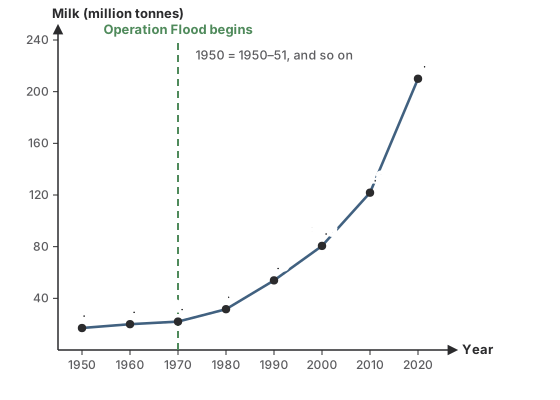
MilkWhite (Operation Flood, from 1970)
FishBlue
Horticulture (fruit, vegetables, flowers)Golden
A line graph of India's milk production in million tonnes: 17.0 in 1950-51, 20.0 in 1960-61, 22.0 in 1970-71, 31.6 in 1980-81, 53.9 in 1990-91, 80.6 in 2000-01, 121.8 in 2010-11 and 210.0 in 2020-21. A vertical line marks 1970, when Operation Flood began.
Milk output barely moved in the twenty years before Operation Flood and climbed fast after it.

Example 2 · Reading the milk graph

  1. Before Operation Flood, 1950-51 to 1970-71: 22.0 − 17.0 = 5.0 million tonnes.

  2. 1970-71 to 1990-91: 53.9 − 22.0 = 31.9 million tonnes.

  3. 2020-21 against 1970-71: 210.0 ÷ 22.0 ≈ 9.5 times.

Answer

Six times the rise in the same twenty years

Cooperatives

A cooperative is owned and run by its members for their benefit. Pooling lets small producers store, process and sell at a fair price. AMUL, at Anand in Gujarat, is the best-known dairy example; Kudumbashree in Kerala runs thrift and credit groups for poor women.

Organic farming

Organic farming uses no chemical fertilisers or pesticides; it relies on organic manure and natural pest control to keep the ecological balance.

  • Benefits: cheaper local inputs, export income, healthier food, more jobs (it is labour-intensive).
  • Limits: lower yields in the early years, a shorter shelf life, and the need for awareness and special marketing.

Exam shortcuts

  • NABARD 1982; RRBs 1975; bank nationalisation 1969; KCC 1998.
  • SHG lending = microcredit; no collateral.
  • Rythu Bazars AP/Telangana; Uzhavar Sandies TN; Apni Mandi Punjab-Haryana-Rajasthan; Hadaspar Pune.
  • Operation Flood 1970 = white revolution.

Common mistakes

  • Saying NABARD lends directly to every farmer.
  • Counting moneylenders as institutional credit.
  • Mixing up the blue (fish) and white (milk) revolutions.
  • Saying organic produce keeps longer.

Quick revision

Credit

  • Gestation lag; moneylenders' high interest
  • Banks, RRBs, cooperatives, NABARD
  • SHGs and microcredit

Marketing

  • Regulated markets, infrastructure, cooperatives
  • MSP, buffer stock, PDS
  • Direct channels cut out middlemen

Diversification

  • Dairy, fisheries, horticulture
  • Operation Flood from 1970
  • Organic farming: cheaper inputs, lower early yields

Who works, and in what kind of job, is in employment.

Next · 09Quick revision

Check your understanding

53 questions, grouped by type, easy to hard. Pick an answer and check it. The worked solution opens when you ask for it.

What rural development meansQ1 of 53Q1

What rural development means

3 questions

Rural development means

Options for question 1

Show the explanationHide the explanation

AnswerB · action to develop the rural areas that lag behind

  1. It focuses on the areas lagging behind in overall development: their people, land, infrastructure and incomes.

Which of these is NOT one of the key areas of rural development?

Options for question 2

Show the explanationHide the explanation

AnswerD · Raising tariffs on imported cars

  1. Rural development covers human resources, land reforms, infrastructure, poverty alleviation and productivity in each locality. Car tariffs are trade policy.

Assertion (A): Rural development is central to India's overall development.

Reason (R): A large share of India's people still live in villages and depend on agriculture.

Options for question 3

Show the explanationHide the explanation

AnswerA · Both A and R are true, and R is the correct explanation of A.

  1. When most people live in villages, the nation cannot progress if the villages do not.

  2. R explains A.

Rural credit

15 questions

The apex body that coordinates all institutions financing rural areas is

Options for question 4

Show the explanationHide the explanation

AnswerB · NABARD

  1. The National Bank for Agriculture and Rural Development (NABARD), set up in 1982, coordinates the rural financing system.

NABARD was set up in

Options for question 5

Show the explanationHide the explanation

AnswerC · 1982

  1. NABARD came in 1982. Bank nationalisation was in 1969 and Regional Rural Banks began in 1975.

A self-help group (SHG) is

Options for question 6

Show the explanationHide the explanation

AnswerD · a small group that pools savings to lend to members

  1. Members save small amounts regularly; the pooled money is lent to members, at reasonable rates and in small instalments.

Farmers need credit mainly because of

Options for question 7

Show the explanationHide the explanation

AnswerA · the long gap between sowing a crop and selling it

  1. Income comes only after harvest, but seed, fertiliser and family expenses must be met long before. This gestation lag creates the need to borrow.

Before institutional credit spread, moneylenders and traders often exploited small farmers by

Options for question 8

Show the explanationHide the explanation

AnswerC · charging high interest and manipulating accounts

  1. They charged very high rates and manipulated accounts, which kept small and marginal farmers in a debt trap.

The institutional structure of rural banking is a multi-agency system. Which of these is NOT part of it?

Options for question 9

Show the explanationHide the explanation

AnswerC · Village moneylenders

  1. The institutional structure is commercial banks, RRBs, cooperatives and land development banks. Moneylenders are non-institutional.

Arrange these steps in rural credit in chronological order.

A. NABARD is set up

B. Fourteen major banks are nationalised

C. The Kisan Credit Card scheme begins

D. Regional Rural Banks begin

Options for question 10

Show the explanationHide the explanation

AnswerA · B, D, A, C

  1. Bank nationalisation 1969, RRBs 1975, NABARD 1982, Kisan Credit Card 1998.

Lending to the poor through self-help groups is called

Options for question 11

Show the explanationHide the explanation

AnswerC · microcredit

  1. SHGs give small loans to people with no collateral, which is why such lending is called microcredit.

Self-help groups have been especially useful for

Options for question 12

Show the explanationHide the explanation

AnswerA · rural women and the poor with no collateral

  1. SHGs reach people formal banks find too risky, and most members are women; they have helped empower them.

Assertion (A): The government pushed banks to open branches in rural areas after 1969.

Reason (R): The aim was to free farmers from dependence on moneylenders.

Options for question 13

Show the explanationHide the explanation

AnswerA · Both A and R are true, and R is the correct explanation of A.

  1. Social banking after nationalisation took formal credit to villages to replace exploitative lenders.

  2. R explains A.

Assertion (A): Self-help groups can lend to members who have no collateral.

Reason (R): Members know one another, and group pressure helps ensure repayment.

Options for question 14

Show the explanationHide the explanation

AnswerA · Both A and R are true, and R is the correct explanation of A.

  1. Trust and peer pressure replace collateral as the guarantee of repayment.

  2. R explains A.

Read the two statements and choose the correct option.

I. Farmers borrow not only for seed and fertiliser but also for family needs such as weddings.

II. Regional Rural Banks were set up in 1982.

Options for question 15

Show the explanationHide the explanation

AnswerA · Only I

  1. Rural households borrow for both production and consumption: I is true.

  2. RRBs began in 1975; 1982 is NABARD. II is false.

Read the two statements and choose the correct option.

I. Commercial banks in rural areas have often failed to recover loans effectively.

II. Institutional credit has fully replaced moneylenders in rural India.

Options for question 16

Show the explanationHide the explanation

AnswerA · Only I

  1. High default rates on farm loans are a long-standing problem: I is true.

  2. Moneylenders still lend in many villages, so II is false.

A self-help group of 15 members saves ₹200 per member per month. How much does the group pool in 6 months?

Options for question 17

Show the explanationHide the explanation

AnswerC · ₹18,000

  1. Per month: 15 × 200 = ₹3,000.

  2. In 6 months: 3,000 × 6 = ₹18,000.

Worth noting

₹3,000 is one month's savings; ₹1,200 is one member's six months.

Assertion (A): NABARD lends directly to every farmer in India.

Reason (R): NABARD is the apex body that coordinates rural financing institutions.

Options for question 18

Show the explanationHide the explanation

AnswerD · A is false, but R is true.

  1. NABARD works through banks and cooperatives; it does not lend to every farmer directly. A is false.

  2. R is true.

Agricultural marketing

12 questions

Agricultural marketing covers

Options for question 19

Show the explanationHide the explanation

AnswerB · assembling, storing, grading and distributing produce

  1. Agricultural marketing is the whole chain from farm to buyer: assembling, storage, processing, transport, packaging, grading and distribution.

A farmer with no storage sells his crop right after harvest at a low price. This is called

Options for question 20

Show the explanationHide the explanation

AnswerD · distress sale

  1. Without storage or credit, the farmer cannot wait for prices to recover and must sell at once, cheaply.

Regulation of agricultural markets was meant mainly to

Options for question 21

Show the explanationHide the explanation

AnswerA · create fair and open conditions for selling

  1. Regulated markets check faulty weights and the manipulation of accounts, so that farmers get a fair price.

Which of these is a policy instrument the government uses in agricultural marketing?

Options for question 22

Show the explanationHide the explanation

AnswerD · Minimum support prices

  1. The instruments are minimum support prices, buffer stocks of wheat and rice held by the Food Corporation of India, and the public distribution system.

Match each policy instrument with its purpose.

List IList II
A. Minimum support priceI. Sells grain cheaply to poor households
B. Buffer stockII. Guards farmers against a price crash
C. Public distribution systemIII. Fair weights and honest accounts
D. Regulated marketIV. Grain held for times of shortage
Options for question 23

Show the explanationHide the explanation

AnswerB · A-II, B-IV, C-I, D-III

  1. MSP protects farmers' income; buffer stocks and the PDS protect consumers; regulation keeps the market fair.

Match each alternative marketing channel with its state.

List IList II
A. Apni MandiI. Pune, Maharashtra
B. Hadaspar MandiII. Tamil Nadu
C. Rythu BazarIII. Punjab, Haryana and Rajasthan
D. Uzhavar SandiesIV. Andhra Pradesh and Telangana
Options for question 24

Show the explanationHide the explanation

AnswerC · A-III, B-I, C-IV, D-II

  1. In each, farmers sell directly to consumers, cutting out middlemen.

Rythu Bazars are markets where farmers sell

Options for question 25

Show the explanationHide the explanation

AnswerC · fruit and vegetables directly to consumers

  1. Rythu Bazars in Andhra Pradesh and Telangana are fruit and vegetable markets where farmers meet buyers directly.

Assertion (A): Selling directly to consumers can raise a farmer's income.

Reason (R): Direct sale cuts out the margins of middlemen.

Options for question 26

Show the explanationHide the explanation

AnswerA · Both A and R are true, and R is the correct explanation of A.

  1. Without middlemen, more of the final price reaches the farmer.

  2. R explains A.

Read the two statements and choose the correct option.

I. Cold storage, warehouses and good roads help farmers avoid distress sales.

II. Farmers usually have full and timely information about prices in distant markets.

Options for question 27

Show the explanationHide the explanation

AnswerA · Only I

  1. Storage and transport let farmers hold produce and reach better markets: I is true.

  2. Lack of price information is a known problem of farm marketing, so II is false.

Under contract farming, a farmer

Options for question 28

Show the explanationHide the explanation

AnswerB · agrees before sowing to sell to a buyer at a set price

  1. Food-processing and fast-food firms contract with farmers for a crop of a given quality at a fixed price, which cuts the farmer's price risk.

Assertion (A): Distress sales lower farmers' incomes.

Reason (R): Farmers who cannot store or wait must sell when prices are lowest, just after harvest.

Options for question 29

Show the explanationHide the explanation

AnswerA · Both A and R are true, and R is the correct explanation of A.

  1. Selling at the seasonal low cuts the price received.

  2. R explains A.

Assertion (A): The Food Corporation of India holds buffer stocks of wheat and rice.

Reason (R): Uzhavar Sandies are farmers' markets in Tamil Nadu.

Options for question 30

Show the explanationHide the explanation

AnswerB · Both A and R are true, but R is not the correct explanation of A.

  1. Both statements are true.

  2. A farmers' market in Tamil Nadu does not explain why the FCI holds stocks, so R does not explain A.

Diversification

13 questions

Agricultural diversification includes

Options for question 31

Show the explanationHide the explanation

AnswerD · a new crop mix and more work outside farming

  1. Diversification has two sides: a shift in cropping pattern, and a shift of the workforce from farming to livestock, fisheries and non-farm work.

Diversification is needed mainly because farming alone

Options for question 32

Show the explanationHide the explanation

AnswerA · is risky and gives work only part of the year

  1. Farming depends on the weather and is seasonal; in areas with poor irrigation there is little work in the rabi season.

  2. Other activities reduce risk and give income all year.

Operation Flood, which began in 1970, is linked with

Options for question 33

Show the explanationHide the explanation

AnswerD · milk production through cooperatives

  1. Operation Flood pooled the milk of producers into cooperatives, linking them to urban markets; it began the white revolution.

Match each revolution with the product it raised.

List IList II
A. Green revolutionI. Horticulture
B. White revolutionII. Fish
C. Blue revolutionIII. Milk
D. Golden revolutionIV. Food grains
Options for question 34

Show the explanationHide the explanation

AnswerA · A-IV, B-III, C-II, D-I

  1. Green: grains; white: milk; blue: fish; golden: horticulture (fruit, vegetables, flowers).

Livestock is important to farm families mainly because it

Options for question 35

Show the explanationHide the explanation

AnswerC · steadies income and adds to food security

  1. Cattle, goats and poultry give milk, eggs, transport, fuel and income in seasons when crops give none.

Horticulture includes the growing of

Options for question 36

Show the explanationHide the explanation

AnswerB · fruit, vegetables, flowers and spices

  1. Horticulture covers fruit, vegetables, tuber crops, flowers, medicinal and aromatic plants, spices and plantation crops.

The graph shows India's milk production from 1950-51 to 2020-21. By how much did it rise between 1970-71 and 1990-91?

A line graph of India's milk production in million tonnes: 17.0 in 1950-51, 20.0 in 1960-61, 22.0 in 1970-71, 31.6 in 1980-81, 53.9 in 1990-91, 80.6 in 2000-01, 121.8 in 2010-11 and 210.0 in 2020-21. A vertical line marks 1970, when Operation Flood began.
Options for question 37

Show the explanationHide the explanation

AnswerC · 31.9 million tonnes

  1. 53.9 − 22.0 = 31.9 million tonnes.

  2. In the twenty years before 1970, it had risen by only 22.0 − 17.0 = 5.0.

Worth noting

53.9 is the 1990-91 level, not the rise; 22.3 is the rise over the 1980s alone.

Using the graph shown, milk production in 2020-21 was about how many times its level in 1970-71?

A line graph of India's milk production in million tonnes: 17.0 in 1950-51, 20.0 in 1960-61, 22.0 in 1970-71, 31.6 in 1980-81, 53.9 in 1990-91, 80.6 in 2000-01, 121.8 in 2010-11 and 210.0 in 2020-21. A vertical line marks 1970, when Operation Flood began.
Options for question 38

Show the explanationHide the explanation

AnswerB · 9.5 times

  1. 210.0 ÷ 22.0 ≈ 9.5.

Worth noting

12.4 times starts from 1950-51 (17.0); 188 is the rise in tonnes, not a ratio.

Assertion (A): Fisheries provide an important livelihood in coastal and riverine areas.

Reason (R): Fish come from both inland waters and the sea.

Options for question 39

Show the explanationHide the explanation

AnswerB · Both A and R are true, but R is not the correct explanation of A.

  1. Both statements are true.

  2. That fish come from two kinds of water does not explain why fishing matters as a livelihood, so R does not explain A.

What does the graph shown suggest about milk output before and after Operation Flood began?

A line graph of India's milk production in million tonnes: 17.0 in 1950-51, 20.0 in 1960-61, 22.0 in 1970-71, 31.6 in 1980-81, 53.9 in 1990-91, 80.6 in 2000-01, 121.8 in 2010-11 and 210.0 in 2020-21. A vertical line marks 1970, when Operation Flood began.
Options for question 40

Show the explanationHide the explanation

AnswerB · It grew slowly before 1970 and far faster after

  1. 1950-51 to 1970-71: +5.0 million tonnes in twenty years.

  2. 1970-71 to 1990-91: +31.9 in twenty years, and faster still after that.

Read the two statements and choose the correct option.

I. Diversification into non-farm work can reduce the risk faced by rural households.

II. Diversification means that every farmer must stop growing crops.

Options for question 41

Show the explanationHide the explanation

AnswerA · Only I

  1. Income from several sources is less exposed to a bad harvest: I is true.

  2. It adds other activities alongside farming; it does not end it. II is false.

Assertion (A): Operation Flood began in 1991.

Reason (R): Operation Flood is linked with the growth of milk cooperatives.

Options for question 42

Show the explanationHide the explanation

AnswerD · A is false, but R is true.

  1. It began in 1970, so A is false.

  2. R is true.

Read the two statements and choose the correct option.

I. India's golden revolution refers to the growth of horticulture.

II. The blue revolution refers to the growth of milk production.

Options for question 43

Show the explanationHide the explanation

AnswerA · Only I

  1. Golden revolution: fruit, vegetables and flowers. I is true.

  2. The blue revolution is fish; milk is the white revolution. II is false.

Cooperatives

5 questions

A cooperative society is

Options for question 44

Show the explanationHide the explanation

AnswerA · a body owned and run by its members

  1. Members pool resources, run the society together and share its gains, for example in selling milk or buying inputs.

Cooperative marketing helps farmers because

Options for question 45

Show the explanationHide the explanation

AnswerD · selling together gives them more bargaining power

  1. A single small farmer has little power; pooled produce can be stored, processed and sold at a fair price.

  2. Gujarat's milk cooperatives are the best-known example.

AMUL, a well-known example of rural cooperation, is a cooperative in

Options for question 46

Show the explanationHide the explanation

AnswerC · dairy, based in Gujarat

  1. AMUL, based in Anand, Gujarat, collects milk from village cooperatives and sells milk products across India.

Kudumbashree, a women-oriented, community-based poverty reduction programme, works in

Options for question 47

Show the explanationHide the explanation

AnswerD · Kerala

  1. Kudumbashree in Kerala runs thrift and credit societies for poor women, encouraging saving and small loans.

Assertion (A): Milk cooperatives raised the incomes of small dairy farmers.

Reason (R): Cooperatives collect, process and sell milk, so producers get a fair share of the final price.

Options for question 48

Show the explanationHide the explanation

AnswerA · Both A and R are true, and R is the correct explanation of A.

  1. Pooling and processing cut out middlemen and add value, which reaches the producers.

  2. R explains A.

Organic farming

5 questions

Organic farming is a system of farming that

Options for question 49

Show the explanationHide the explanation

AnswerB · uses no chemical fertilisers or pesticides

  1. Organic farming restores and keeps the ecological balance, using organic manure and natural pest control instead of chemicals.

A benefit of organic farming is that it

Options for question 50

Show the explanationHide the explanation

AnswerC · replaces costly inputs with cheaper local ones

  1. Local manure and natural pest control cost less than bought chemicals.

  2. It also earns from exports and gives healthier food, and it is labour-intensive, so it creates jobs.

Worth noting

Organic produce has a shorter shelf life, and yields are often lower in the first years.

A limitation of organic farming is that

Options for question 51

Show the explanationHide the explanation

AnswerA · yields are often lower in the early years

  1. Yields can fall when chemicals are first given up, which small farmers may find hard to bear.

  2. Organic produce also spoils faster and needs special marketing.

Read the two statements and choose the correct option.

I. Organic farming generates more employment because it is labour-intensive.

II. Organic produce usually has a longer shelf life than other produce.

Options for question 52

Show the explanationHide the explanation

AnswerA · Only I

  1. More work is done by hand in organic farming: I is true.

  2. Its shelf life is shorter, so II is false.

Assertion (A): Organic farming supports sustainable development.

Reason (R): It avoids chemicals that damage soil and water over time.

Options for question 53

Show the explanationHide the explanation

AnswerA · Both A and R are true, and R is the correct explanation of A.

  1. Keeping soil and water healthy keeps land productive for future generations.

  2. R explains A.

NTA's Economics syllabus is three courses: Introductory Microeconomics, Introductory Macroeconomics and Indian Economic Development, each split into units with a list of topics. It prints no chapters and no split of the 50 questions across the courses. So the areas here are NTA's three courses, and the chapters inside them are ours: a unit that covers several ideas, such as consumer behaviour and demand, is split into a chapter for each, so that a chapter can be practised in one sitting. All three courses are here.