On this page · 12 sections 01 The core idea 02 Counting workers 03 Status of employment 04 Jobs by sector 05 Jobless growth and casualisation 06 Formal and informal sectors 07 Kinds of unemployment 08 Government policies 09 Exam shortcuts 10 Common mistakes 11 Quick revision 12 Check your understanding A worker is anyone doing an activity that adds to the GDP, paid or not: a farmer, a shopkeeper, a clerk, or a daughter helping, unpaid, in the family shop. How many people work, in what kind of job, and how secure that job is, tells us more about living standards than GDP alone.
Workforce : everyone who is working.Labour force : the workforce plus the unemployed , those willing and able to work who are seeking it.Children, students and the retired who are not seeking work are outside both.
Example 1 · A village survey
Population 1,000; working 380; without work and seeking it 20.
Labour force = 380 + 20 = 400.
Worker-population ratio = 380 ÷ 1,000 × 100 = 38%.
Unemployment rate = 20 ÷ 400 × 100 = 5%.
Labour force participation = 400 ÷ 1,000 × 100 = 40%.
The unemployment rate is measured on the labour force, not the population: 20 ÷ 1,000 = 2% is wrong.
The worker-population ratio is higher in rural areas : poor families need every member to earn, while in towns more young people study or wait for jobs that match their qualifications. It is higher for men than for women , and much of women's work, such as unpaid help on the family farm, goes uncounted.
Status Meaning Self-employed Owns and runs an enterprise (including unpaid family helpers) Regular salaried Paid regularly by an employer, often with benefits Casual wage labourer Hired by the day, no social security
Self-employment is the largest category in India. Regular jobs are a larger share in towns; self-employment and casual work dominate villages.
Sector Activities Primary Agriculture, mining and quarrying Secondary Manufacturing, construction, electricity, gas and water Tertiary Trade, transport, storage and other services
Most rural workers are in the primary sector; in towns, services employ the most.
Jobless growth is a rise in output without a matching rise in jobs.
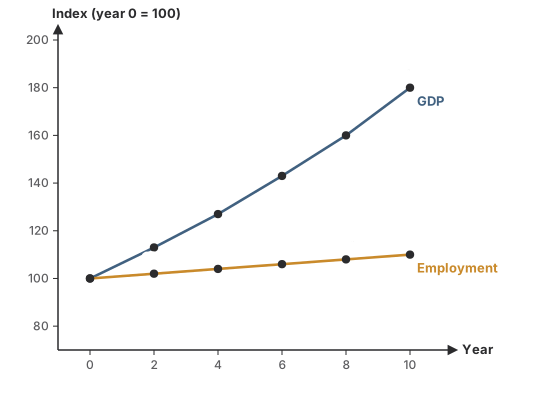
Output rises by 80% in ten years; employment by only 10%. Casualisation is a rising share of casual wage labour; informalisation is a rising share of informal work. Both leave workers more vulnerable.
The formal sector is all public sector establishments plus private establishments with 10 or more hired workers . Its workers earn more, get social security such as pensions and provident fund, and can form trade unions.
The informal sector is everyone else: farmers, farm labourers, small enterprises and the self-employed. They have no regular income or protection and can be dismissed without notice. The vast majority of India's workers are informal. The government has tried to modernise informal enterprises and extend social security to their workers.
Kind Example Disguised Six family members on a farm that needs four: removing two does not cut output Seasonal No farm work between harvest and sowing Open Willing and able to work, but no work at all Educated A graduate with no job matching the degree
Data come from the Census, national surveys (now the Periodic Labour Force Survey) and employment exchanges.
The government creates jobs directly (its own departments and firms) and indirectly (when public output raises private hiring). The Mahatma Gandhi National Rural Employment Guarantee Act, 2005 gives each rural household whose adults volunteer for unskilled manual work at least one hundred days of guaranteed wage employment in a financial year .
Labour force = employed + unemployed.
WPR = workers ÷ population × 100; UR = unemployed ÷ labour force × 100.
Formal: public sector + private with 10 or more hired workers.
Disguised unemployment: marginal product of the extra workers is zero.
Dividing the unemployed by the whole population.
Counting a private firm with 8 workers as formal.
Thinking disguised unemployment can be seen by counting the jobless.
Treating jobless growth as no growth at all.
Measures
Workforce vs labour force
WPR and unemployment rate
Rural WPR higher; men's higher
Kinds of work
Self-employed largest; casual least secure
Formal: 10 or more hired workers
Informal: the vast majority
Problems and policy
Jobless growth, casualisation, informalisation
Disguised, seasonal, open, educated unemployment
MGNREGA: 100 days a year
The environment that all this growth draws on is in environment and sustainable development .
Next · 11 Quick revision → Check your understanding 58 questions, grouped by type, easy to hard. Pick an answer and check it. The worked solution opens when you ask for it.
Who is a worker Q1 of 58 Q1
Who is a worker 6 questions In economics, a worker is anyone who
Options for question 1 A Option A works only in a factory or a mine B Option B does an activity that adds to the GDP C Option C is paid a fixed salary every month D Option D works for the central or state government
Skip Check Show the explanation Hide the explanation Next question Try again
Show the explanation Hide the explanation Answer B · does an activity that adds to the GDP
Anyone engaged in an economic activity that contributes to the GDP is a worker, paid or self-employed.
A girl helps her parents run the family shop without being paid. In employment statistics she is
Options for question 2 A Option A not a worker, since she is unpaid B Option B unemployed C Option C outside the population D Option D a worker
Skip Check Show the explanation Hide the explanation Next question Try again
Show the explanation Hide the explanation Answer D · a worker
She adds to the output of a business, so she counts as a worker (an unpaid family worker), even with no wage.
Worth noting
Being paid is not the test; contributing to production is.
The labour force is made up of
Options for question 3 A Option A people working and people seeking work B Option B only people who are working C Option C only people who are seeking work D Option D everyone in the country above the age of fifteen
Skip Check Show the explanation Hide the explanation Next question Try again
Show the explanation Hide the explanation Answer A · people working and people seeking work
Labour force = employed + unemployed (those willing and able to work who are looking for it).
The workforce is only those actually working.
Which of these people is counted as unemployed?
Options for question 4 A Option A A retired teacher who does not want to work any more B Option B A student in full-time study C Option C A graduate actively looking for a job who has none D Option D A farmer working on his own land
Skip Check Show the explanation Hide the explanation Next question Try again
Show the explanation Hide the explanation Answer C · A graduate actively looking for a job who has none
Unemployed means without work but willing and able to work and seeking it.
The retired teacher and the student are not seeking work; the farmer is working.
A survey of a village gives these figures:
Item Number Population 1,000 People working (the workforce) 380 People without work and seeking work 20 Workers who are self-employed 190 Workers in regular salaried jobs 76 Workers who are casual wage labourers 114
Using the survey, what is the size of the village's labour force?
Options for question 5 A Option A 20 B Option B 380 C Option C 400 D Option D 1,000
Skip Check Show the explanation Hide the explanation Next question Try again
Show the explanation Hide the explanation Answer C · 400
Labour force = working + seeking work = 380 + 20 = 400.
Worth noting
380 is the workforce, which leaves out those seeking work.
Assertion (A): A housewife cooking for her own family is counted as a worker in GDP terms.
Reason (R): Work done for one's own household is not sold in the market.
Options for question 6 A Option A Both A and R are true, and R is the correct explanation of A. B Option B Both A and R are true, but R is not the correct explanation of A. C Option C A is true, but R is false. D Option D A is false, but R is true.
Skip Check Show the explanation Hide the explanation Next question Try again
Show the explanation Hide the explanation Answer D · A is false, but R is true.
Unpaid household services are left out of GDP, so their providers are not counted as workers on that account. A is false.
R is true.
Participation rates 9 questions The worker-population ratio is
Options for question 7 A Option A the number of unemployed ÷ the labour force × 100 B Option B the number of workers ÷ the total population × 100 C Option C the total population ÷ the number of workers D Option D the number of workers ÷ the number of firms
Skip Check Show the explanation Hide the explanation Next question Try again
Show the explanation Hide the explanation Answer B · the number of workers ÷ the total population × 100
It shows what share of the population is engaged in producing goods and services.
Worth noting
Unemployed ÷ labour force × 100 is the unemployment rate.
A survey of a village gives these figures:
Item Number Population 1,000 People working (the workforce) 380 People without work and seeking work 20 Workers who are self-employed 190 Workers in regular salaried jobs 76 Workers who are casual wage labourers 114
Using the survey, what is the village's worker-population ratio?
Options for question 8 A Option A 5% B Option B 38% C Option C 40% D Option D 95%
Skip Check Show the explanation Hide the explanation Next question Try again
Show the explanation Hide the explanation Answer B · 38%
WPR = workers ÷ population × 100 = 380 ÷ 1000 × 100 = 38%.
Worth noting
40% counts those seeking work too: that is the labour force participation rate.
A survey of a village gives these figures:
Item Number Population 1,000 People working (the workforce) 380 People without work and seeking work 20 Workers who are self-employed 190 Workers in regular salaried jobs 76 Workers who are casual wage labourers 114
Using the survey, what is the village's unemployment rate?
Options for question 9 A Option A 2% B Option B 5% C Option C 20% D Option D 38%
Skip Check Show the explanation Hide the explanation Next question Try again
Show the explanation Hide the explanation Answer B · 5%
Unemployment rate = unemployed ÷ labour force × 100 = 20 ÷ 400 × 100 = 5%.
Worth noting
2% divides by the whole population; the rate is measured on the labour force.
In India, the worker-population ratio is higher in rural areas than in urban areas. A reason is that
Options for question 10 A Option A rural people all have regular salaried jobs B Option B there are no schools in rural areas at all C Option C poor rural families need every member to earn D Option D urban people are not allowed to work in factories
Skip Check Show the explanation Hide the explanation Next question Try again
Show the explanation Hide the explanation Answer C · poor rural families need every member to earn
Rural incomes are low, so more family members, including women and the young, must work.
In towns, more young people are in education and many wait for jobs that match their qualifications.
Read the two statements and choose the correct option.
I. In India, the worker-population ratio is higher for men than for women.
II. A higher worker-population ratio always means a richer economy.
Options for question 11 A Option A Only I B Option B Only II C Option C Both I and II D Option D Neither I nor II
Skip Check Show the explanation Hide the explanation Next question Try again
Show the explanation Hide the explanation Answer A · Only I
Men's participation is well above women's: I is true.
A high ratio can reflect poverty, as in villages where everyone must work. II is false.
Assertion (A): The unemployment rate is calculated on the labour force, not on the whole population.
Reason (R): Children and the retired are not seeking work.
Options for question 12 A Option A Both A and R are true, and R is the correct explanation of A. B Option B Both A and R are true, but R is not the correct explanation of A. C Option C A is true, but R is false. D Option D A is false, but R is true.
Skip Check Show the explanation Hide the explanation Next question Try again
Show the explanation Hide the explanation Answer B · Both A and R are true, but R is not the correct explanation of A.
Both statements are true.
R notes why some people are outside the labour force, but the reason the rate uses the labour force is that unemployment only means something for people who want work. R is not that explanation.
A survey of a village gives these figures:
Item Number Population 1,000 People working (the workforce) 380 People without work and seeking work 20 Workers who are self-employed 190 Workers in regular salaried jobs 76 Workers who are casual wage labourers 114
Using the survey, what is the village's labour force participation rate?
Options for question 13 A Option A 2% B Option B 38% C Option C 40% D Option D 60%
Skip Check Show the explanation Hide the explanation Next question Try again
Show the explanation Hide the explanation Answer C · 40%
Labour force = 380 + 20 = 400.
Participation rate = 400 ÷ 1000 × 100 = 40%.
Assertion (A): Women's work is often under-counted in employment statistics.
Reason (R): Much of women's work, such as unpaid help on the family farm, is not recognised as productive work.
Options for question 14 A Option A Both A and R are true, and R is the correct explanation of A. B Option B Both A and R are true, but R is not the correct explanation of A. C Option C A is true, but R is false. D Option D A is false, but R is true.
Skip Check Show the explanation Hide the explanation Next question Try again
Show the explanation Hide the explanation Answer A · Both A and R are true, and R is the correct explanation of A.
If such work is not reported as work, the women doing it are not counted as workers.
R explains A.
Assertion (A): The worker-population ratio measures the share of the labour force that is unemployed.
Reason (R): The labour force includes both the employed and the unemployed.
Options for question 15 A Option A Both A and R are true, and R is the correct explanation of A. B Option B Both A and R are true, but R is not the correct explanation of A. C Option C A is true, but R is false. D Option D A is false, but R is true.
Skip Check Show the explanation Hide the explanation Next question Try again
Show the explanation Hide the explanation Answer D · A is false, but R is true.
The WPR is workers as a share of the population; the share of the labour force without work is the unemployment rate. A is false.
R is true.
Self-employed, regular and casual 8 questions Match each worker with the status of employment.
List I List II A. A woman running her own tailoring shop I. Casual wage labourer B. A bank clerk paid every month II. Self-employed C. A labourer hired by the day at a building site III. Self-employed (unpaid family worker) D. A son helping, unpaid, on the family farm IV. Regular salaried
Options for question 16 A Option A A-II, B-IV, C-I, D-III B Option B A-II, B-I, C-III, D-IV C Option C A-I, B-III, C-II, D-IV D Option D A-III, B-II, C-I, D-IV
Skip Check Show the explanation Hide the explanation Next question Try again
Show the explanation Hide the explanation Answer A · A-II, B-IV, C-I, D-III
Owning and running an enterprise is self-employment; unpaid family helpers are counted with the self-employed.
A regular monthly wage is regular salaried work; hiring by the day is casual work.
A casual wage labourer is one who
Options for question 17 A Option A owns and runs a small business of his own B Option B receives a salary every month with paid leave C Option C works only for the government D Option D is hired by the day with no social security
Skip Check Show the explanation Hide the explanation Next question Try again
Show the explanation Hide the explanation Answer D · is hired by the day with no social security
Casual labourers are hired and dismissed as needed, are not paid regularly, and get no social security such as a pension.
In India, the largest share of workers is
Options for question 18 A Option A regular salaried B Option B casual wage labourers C Option C self-employed D Option D employed by foreign firms
Skip Check Show the explanation Hide the explanation Next question Try again
Show the explanation Hide the explanation Answer C · self-employed
Self-employment is the largest single source of work in India, for both men and women.
Regular salaried jobs are a larger share of work in
Options for question 19 A Option A urban areas than in rural areas B Option B rural areas than in urban areas C Option C rural and urban areas equally D Option D neither rural nor urban areas
Skip Check Show the explanation Hide the explanation Next question Try again
Show the explanation Hide the explanation Answer A · urban areas than in rural areas
Offices, factories and shops with regular jobs are concentrated in towns; villages have more self-employment and casual work.
A survey of a village gives these figures:
Item Number Population 1,000 People working (the workforce) 380 People without work and seeking work 20 Workers who are self-employed 190 Workers in regular salaried jobs 76 Workers who are casual wage labourers 114
Using the survey, what share of the village's workers are casual wage labourers?
Options for question 20 A Option A 11.4% B Option B 20% C Option C 30% D Option D 50%
Skip Check Show the explanation Hide the explanation Next question Try again
Show the explanation Hide the explanation Answer C · 30%
Casual share = 114 ÷ 380 × 100 = 30%.
Worth noting
11.4% divides by the whole population; the share of workers is measured on the workforce.
A survey of a village gives these figures:
Item Number Population 1,000 People working (the workforce) 380 People without work and seeking work 20 Workers who are self-employed 190 Workers in regular salaried jobs 76 Workers who are casual wage labourers 114
Using the survey, what share of the village's workers are hired workers (regular or casual)?
Options for question 21 A Option A 19% B Option B 20% C Option C 30% D Option D 50%
Skip Check Show the explanation Hide the explanation Next question Try again
Show the explanation Hide the explanation Answer D · 50%
Hired = regular + casual = 76 + 114 = 190.
Share = 190 ÷ 380 × 100 = 50%.
Assertion (A): Self-employment is the largest source of work in India.
Reason (R): Regular salaried jobs are more common in towns than in villages.
Options for question 22 A Option A Both A and R are true, and R is the correct explanation of A. B Option B Both A and R are true, but R is not the correct explanation of A. C Option C A is true, but R is false. D Option D A is false, but R is true.
Skip Check Show the explanation Hide the explanation Next question Try again
Show the explanation Hide the explanation Answer B · Both A and R are true, but R is not the correct explanation of A.
Both statements are true.
Where salaried jobs are found does not explain why self-employment is the largest category, so R does not explain A.
Read the two statements and choose the correct option.
I. Casual wage labourers usually have the least job security of the three groups.
II. Self-employed workers in India are mostly owners of large factories.
Options for question 23 A Option A Only I B Option B Only II C Option C Both I and II D Option D Neither I nor II
Skip Check Show the explanation Hide the explanation Next question Try again
Show the explanation Hide the explanation Answer A · Only I
Casual workers can be dropped at any time and get no social security: I is true.
Most self-employed are small farmers, vendors and artisans, so II is false.
Jobs by sector 5 questions Match each activity with its sector.
List I List II A. Growing wheat I. Secondary B. Making cars in a factory II. Primary (mining) C. Running a bus service III. Primary D. Mining coal IV. Tertiary (services)
Options for question 24 A Option A A-III, B-IV, C-II, D-I B Option B A-III, B-I, C-IV, D-II C Option C A-IV, B-II, C-III, D-I D Option D A-IV, B-III, C-I, D-II
Skip Check Show the explanation Hide the explanation Next question Try again
Show the explanation Hide the explanation Answer B · A-III, B-I, C-IV, D-II
Primary: agriculture and mining; secondary: manufacturing, construction, electricity, gas and water; tertiary: trade, transport and other services.
Construction and the supply of electricity, gas and water belong to the
Options for question 25 A Option A primary sector B Option B tertiary sector C Option C informal sector only D Option D secondary sector
Skip Check Show the explanation Hide the explanation Next question Try again
Show the explanation Hide the explanation Answer D · secondary sector
The secondary sector covers manufacturing, construction, and electricity, gas and water supply.
Most rural workers in India are employed in
Options for question 26 A Option A the primary sector B Option B the secondary sector C Option C the tertiary sector D Option D foreign firms
Skip Check Show the explanation Hide the explanation Next question Try again
Show the explanation Hide the explanation Answer A · the primary sector
Agriculture is still the main source of work in villages; in towns, services employ the most.
Assertion (A): The share of agriculture in India's employment has fallen more slowly than its share in GDP.
Reason (R): Industry and services have not created enough jobs to absorb workers leaving farming.
Options for question 27 A Option A Both A and R are true, and R is the correct explanation of A. B Option B Both A and R are true, but R is not the correct explanation of A. C Option C A is true, but R is false. D Option D A is false, but R is true.
Skip Check Show the explanation Hide the explanation Next question Try again
Show the explanation Hide the explanation Answer A · Both A and R are true, and R is the correct explanation of A.
Output moved to industry and services faster than jobs did, so many workers stayed on farms.
R explains A.
Read the two statements and choose the correct option.
I. Trade, transport and storage are part of the tertiary sector.
II. Mining and quarrying are part of the secondary sector.
Options for question 28 A Option A Only I B Option B Only II C Option C Both I and II D Option D Neither I nor II
Skip Check Show the explanation Hide the explanation Next question Try again
Show the explanation Hide the explanation Answer A · Only I
Services include trade, transport and storage: I is true.
Mining and quarrying are counted in the primary sector, so II is false.
Jobless growth and casualisation 7 questions Options for question 29 A Option A jobs rise while output falls B Option B both output and jobs fall C Option C jobs and output both rise at exactly the same rate D Option D output rises without a matching rise in jobs
Skip Check Show the explanation Hide the explanation Next question Try again
Show the explanation Hide the explanation Answer D · output rises without a matching rise in jobs
The economy produces more goods and services without a commensurate increase in employment.
The graph shows an economy's GDP and employment as indices over ten years. By what per cent did each grow?
Options for question 30 A Option A GDP by 10%, employment by 80% B Option B GDP by 80%, employment by 10% C Option C Both by 80% D Option D GDP by 180%, employment by 110%
Skip Check Show the explanation Hide the explanation Next question Try again
Show the explanation Hide the explanation Answer B · GDP by 80%, employment by 10%
GDP: 180 − 100 = 80, so 80%.
Employment: 110 − 100 = 10, so 10%.
Worth noting
An index of 180 means 180% of the starting level, a rise of 80%, not 180%.
What does the graph shown illustrate?
Options for question 31 A Option A Disguised unemployment B Option B Seasonal unemployment C Option C Jobless growth D Option D A fall in output
Skip Check Show the explanation Hide the explanation Next question Try again
Show the explanation Hide the explanation Answer C · Jobless growth
Output rises steeply while employment barely moves: that is jobless growth.
Casualisation of the workforce means that
Options for question 32 A Option A more workers get regular salaried jobs B Option B workers move from casual work to self-employment C Option C a growing share of workers are casual wage labourers D Option D all workers get social security benefits
Skip Check Show the explanation Hide the explanation Next question Try again
Show the explanation Hide the explanation Answer C · a growing share of workers are casual wage labourers
When the share of casual labour rises relative to self-employment and regular jobs, the workforce is becoming casualised.
Using the graph shown, by how many index points did GDP rise between year 4 and year 8?
Options for question 33 A Option A 4 B Option B 27 C Option C 33 D Option D 60
Skip Check Show the explanation Hide the explanation Next question Try again
Show the explanation Hide the explanation Answer C · 33
GDP: 160 − 127 = 33 points.
Over the same years, employment rose by 108 − 104 = 4.
Worth noting
4 is employment's rise; 27 is GDP's rise from year 0 to year 4.
Read the two statements and choose the correct option.
I. Casualisation tends to leave workers more vulnerable.
II. Jobless growth means the economy is not growing at all.
Options for question 34 A Option A Only I B Option B Only II C Option C Both I and II D Option D Neither I nor II
Skip Check Show the explanation Hide the explanation Next question Try again
Show the explanation Hide the explanation Answer A · Only I
Casual workers have no security of work or social security: I is true.
Under jobless growth output does grow; jobs do not keep up. II is false.
Assertion (A): India's growth after 1991 created jobs as fast as it raised output.
Reason (R): Much of the growth came from services such as IT that employ relatively few people.
Options for question 35 A Option A Both A and R are true, and R is the correct explanation of A. B Option B Both A and R are true, but R is not the correct explanation of A. C Option C A is true, but R is false. D Option D A is false, but R is true.
Skip Check Show the explanation Hide the explanation Next question Try again
Show the explanation Hide the explanation Answer D · A is false, but R is true.
Employment grew much more slowly than output, so A is false.
R is true, and it helps explain why jobs lagged.
9 questions
Which of these workers is in the informal sector?
Options for question 36 A Option A A clerk in a government office B Option B An engineer in a large public sector firm C Option C A teacher in a government school D Option D A street vendor selling fruit
Skip Check Show the explanation Hide the explanation Next question Try again
Show the explanation Hide the explanation Answer D · A street vendor selling fruit
The vendor has no regular income, no protection and no social security: informal work.
The formal sector consists of
Options for question 37 A Option A only the firms that are owned by the government B Option B public units and private units hiring 10 or more C Option C only the farms with more than 10 hectares of land D Option D all the firms that pay any tax to the government
Skip Check Show the explanation Hide the explanation Next question Try again
Show the explanation Hide the explanation Answer B · public units and private units hiring 10 or more
Public sector establishments plus private establishments that hire 10 or more workers make up the formal (organised) sector.
Workers in the formal sector, unlike those in the informal sector, usually
Options for question 38 A Option A get social security benefits and can form trade unions B Option B can be dismissed at any time without compensation C Option C work without any written contract or record D Option D earn less than workers in the informal sector
Skip Check Show the explanation Hide the explanation Next question Try again
Show the explanation Hide the explanation Answer A · get social security benefits and can form trade unions
Formal sector workers earn more, enjoy social security such as pensions and provident fund, and can bargain through unions.
The vast majority of India's workers are in
Options for question 39 A Option A the formal sector B Option B foreign companies C Option C the armed forces D Option D the informal sector
Skip Check Show the explanation Hide the explanation Next question Try again
Show the explanation Hide the explanation Answer D · the informal sector
Farmers, farm labourers, small enterprises and the self-employed make up most of the workforce, and almost all of them are informal.
Informalisation of the workforce means
Options for question 40 A Option A more and more workers moving into secure government jobs B Option B informal firms being banned by law C Option C a rising share of workers in unprotected informal work D Option D every worker getting a pension
Skip Check Show the explanation Hide the explanation Next question Try again
Show the explanation Hide the explanation Answer C · a rising share of workers in unprotected informal work
Since the 1990s, a larger share of the workforce has ended up in informal work, often without security.
Assertion (A): Informal sector workers are vulnerable to losing their livelihood.
Reason (R): They can be dismissed without notice or compensation and have no social security.
Options for question 41 A Option A Both A and R are true, and R is the correct explanation of A. B Option B Both A and R are true, but R is not the correct explanation of A. C Option C A is true, but R is false. D Option D A is false, but R is true.
Skip Check Show the explanation Hide the explanation Next question Try again
Show the explanation Hide the explanation Answer A · Both A and R are true, and R is the correct explanation of A.
No legal protection and no safety net mean a lost job is a lost income.
R explains A.
Read the two statements and choose the correct option.
I. Informal sector enterprises often use outdated technology and do not keep proper accounts.
II. The government has taken steps to modernise informal enterprises and extend social security to their workers.
Options for question 42 A Option A Only I B Option B Only II C Option C Both I and II D Option D Neither I nor II
Skip Check Show the explanation Hide the explanation Next question Try again
Show the explanation Hide the explanation Answer C · Both I and II
Both describe the informal sector and the policy response to it correctly.
A private garment unit employs 8 hired workers. Under the usual definition, it belongs to
Options for question 43 A Option A the informal sector B Option B the formal sector C Option C the public sector D Option D the primary sector
Skip Check Show the explanation Hide the explanation Next question Try again
Show the explanation Hide the explanation Answer A · the informal sector
A private unit is formal only if it hires 10 or more workers; with 8, it is informal.
Making garments is manufacturing, which is the secondary sector, not the primary.
Assertion (A): Every private firm is part of the formal sector.
Reason (R): A private firm is in the formal sector only if it hires 10 or more workers.
Options for question 44 A Option A Both A and R are true, and R is the correct explanation of A. B Option B Both A and R are true, but R is not the correct explanation of A. C Option C A is true, but R is false. D Option D A is false, but R is true.
Skip Check Show the explanation Hide the explanation Next question Try again
Show the explanation Hide the explanation Answer D · A is false, but R is true.
Small private firms are informal, so A is false.
R is true: it is the definition.
Kinds of unemployment 9 questions Farm workers who have no work in the months between harvest and the next sowing face
Options for question 45 A Option A disguised unemployment B Option B seasonal unemployment C Option C structural unemployment D Option D voluntary unemployment
Skip Check Show the explanation Hide the explanation Next question Try again
Show the explanation Hide the explanation Answer B · seasonal unemployment
Farm work comes in seasons; between them, many are out of work.
Five members of a family work on a small farm. If two of them left, output would not fall. This is
Options for question 46 A Option A seasonal unemployment B Option B disguised unemployment C Option C open unemployment D Option D educated unemployment
Skip Check Show the explanation Hide the explanation Next question Try again
Show the explanation Hide the explanation Answer B · disguised unemployment
More people appear to be working than the work needs; the marginal product of the extra two is zero.
Open unemployment refers to people who
Options for question 47 A Option A want work and can work but find none B Option B appear to work but add nothing to output C Option C are out of work only in some seasons D Option D choose not to work at the going wage
Skip Check Show the explanation Hide the explanation Next question Try again
Show the explanation Hide the explanation Answer A · want work and can work but find none
Open unemployment is visible: the person has no job and is looking for one, often in towns.
Match each kind of unemployment with an example.
List I List II A. Disguised I. A labourer seeking any work in a city B. Seasonal II. A graduate with no suitable job C. Educated III. No farm work after the harvest D. Open IV. Six people on a farm that needs four
Options for question 48 A Option A A-IV, B-II, C-I, D-III B Option B A-II, B-IV, C-III, D-I C Option C A-I, B-III, C-II, D-IV D Option D A-IV, B-III, C-II, D-I
Skip Check Show the explanation Hide the explanation Next question Try again
Show the explanation Hide the explanation Answer D · A-IV, B-III, C-II, D-I
Extra hands on a farm are disguised unemployment; idle months are seasonal; a jobless graduate is educated unemployment; a jobless labourer seeking work is open unemployment.
Which is NOT a source of data on employment in India?
Options for question 49 A Option A The Census of India B Option B Surveys of the National Statistics Office C Option C The Monetary Policy Committee D Option D Employment exchange records
Skip Check Show the explanation Hide the explanation Next question Try again
Show the explanation Hide the explanation Answer C · The Monetary Policy Committee
The Census, the national surveys (now the Periodic Labour Force Survey) and the registers of employment exchanges all report on work. The MPC sets interest rates.
Read the two statements and choose the correct option.
I. Seasonal unemployment is more common in agriculture than in office jobs.
II. A person with disguised unemployment is counted as having no work at all.
Options for question 50 A Option A Only I B Option B Only II C Option C Both I and II D Option D Neither I nor II
Skip Check Show the explanation Hide the explanation Next question Try again
Show the explanation Hide the explanation Answer A · Only I
Farm work rises and falls with the seasons: I is true.
Such a person appears to be working, which is why it is called disguised. II is false.
Assertion (A): Seasonal unemployment is found mainly in agriculture.
Reason (R): Farm work is needed mainly at sowing and harvest time.
Options for question 51 A Option A Both A and R are true, and R is the correct explanation of A. B Option B Both A and R are true, but R is not the correct explanation of A. C Option C A is true, but R is false. D Option D A is false, but R is true.
Skip Check Show the explanation Hide the explanation Next question Try again
Show the explanation Hide the explanation Answer A · Both A and R are true, and R is the correct explanation of A.
Work peaks at sowing and harvest and falls away in between, leaving workers idle for months.
R explains A.
Assertion (A): Disguised unemployment is common in Indian agriculture.
Reason (R): Family members with nowhere else to work share the work on the family farm.
Options for question 52 A Option A Both A and R are true, and R is the correct explanation of A. B Option B Both A and R are true, but R is not the correct explanation of A. C Option C A is true, but R is false. D Option D A is false, but R is true.
Skip Check Show the explanation Hide the explanation Next question Try again
Show the explanation Hide the explanation Answer A · Both A and R are true, and R is the correct explanation of A.
With few jobs outside farming, more family members stay on the farm than it needs.
R explains A.
Read the two statements and choose the correct option.
I. Educated unemployment is a problem mainly in towns and cities.
II. Disguised unemployment can be seen by counting the people who have no job.
Options for question 53 A Option A Only I B Option B Only II C Option C Both I and II D Option D Neither I nor II
Skip Check Show the explanation Hide the explanation Next question Try again
Show the explanation Hide the explanation Answer A · Only I
Graduates seeking jobs that match their degrees are mostly in towns: I is true.
Disguised unemployment is hidden: the people appear to be working. II is false.
Government policies 5 questions The Mahatma Gandhi National Rural Employment Guarantee Act (MGNREGA), 2005, guarantees each rural household
Options for question 54 A Option A a permanent job in a government office B Option B free land for farming of its own C Option C a monthly pension from the age of 60 D Option D at least 100 days of wage work in a year
Skip Check Show the explanation Hide the explanation Next question Try again
Show the explanation Hide the explanation Answer D · at least 100 days of wage work in a year
Adults in a rural household who volunteer for unskilled manual work are guaranteed at least 100 days of wage employment in a financial year.
When the government hires people in its own departments and public sector firms, it creates employment
Options for question 55 A Option A indirectly B Option B directly C Option C only in the private sector D Option D only abroad
Skip Check Show the explanation Hide the explanation Next question Try again
Show the explanation Hide the explanation Answer B · directly
Hiring in its own departments is direct employment.
When public firms raise output, private suppliers and traders hire too: that is indirect employment.
A public steel plant raises its output, and the private firms that supply it and sell its steel hire more workers. This is
Options for question 56 A Option A direct employment created by the government B Option B disguised unemployment in the steel industry C Option C indirect employment created by the government D Option D casualisation of the public sector workforce
Skip Check Show the explanation Hide the explanation Next question Try again
Show the explanation Hide the explanation Answer C · indirect employment created by the government
The jobs arise in private firms because of the public plant's extra output: indirect employment.
Assertion (A): MGNREGA provides a safety net for rural households.
Reason (R): Under MGNREGA, every rural adult is given a permanent job.
Options for question 57 A Option A Both A and R are true, and R is the correct explanation of A. B Option B Both A and R are true, but R is not the correct explanation of A. C Option C A is true, but R is false. D Option D A is false, but R is true.
Skip Check Show the explanation Hide the explanation Next question Try again
Show the explanation Hide the explanation Answer C · A is true, but R is false.
Guaranteed wage work in lean times supports incomes: A is true.
It guarantees at least 100 days of work a year per household, not a permanent job. R is false.
Read the two statements and choose the correct option.
I. MGNREGA was enacted in 2005.
II. MGNREGA guarantees work only to urban households.
Options for question 58 A Option A Only I B Option B Only II C Option C Both I and II D Option D Neither I nor II
Skip Check Show the explanation Hide the explanation Back to start Try again
Show the explanation Hide the explanation Answer A · Only I
I is true.
It is a rural employment guarantee, so II is false.
Question types · easy to hard
NTA's Economics syllabus is three courses: Introductory Microeconomics, Introductory Macroeconomics and Indian Economic Development, each split into units with a list of topics. It prints no chapters and no split of the 50 questions across the courses. So the areas here are NTA's three courses, and the chapters inside them are ours: a unit that covers several ideas, such as consumer behaviour and demand, is split into a chapter for each, so that a chapter can be practised in one sitting. All three courses are here.