On this page · 11 sections 01 The core idea 02 Four functions of the environment 03 Carrying and absorptive capacity 04 Global problems 05 India's environment 06 Sustainable development 07 Strategies 08 Exam shortcuts 09 Common mistakes 10 Quick revision 11 Check your understanding The environment is the total planetary inheritance: all its biotic (living) and abiotic (non-living) resources. Growth draws on it. As long as we take no more than it can regrow and dump no more waste than it can absorb, it keeps working; beyond that, there is an environmental crisis .
Function Example Supplies resources, renewable and non-renewable Timber, fish; coal, oil Assimilates waste A river breaking down sewage Sustains life Genetic diversity and biodiversity Provides aesthetic services A mountain view
A renewable resource can be used without running out if it is harvested no faster than it regrows; a non-renewable one, such as coal, took millions of years to form and is used up.
Carrying capacity : resource use stays within regrowth, and waste stays within the absorptive capacity , the environment's ability to absorb degradation.
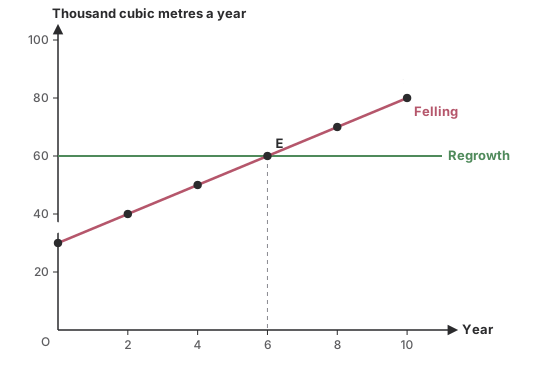
Up to E, felling stays within regrowth; after it, the forest is being used up, by 20 thousand cubic metres a year by year 10. Degradation has an opportunity cost : money spent treating illness from dirty air and water, or cleaning up, could have been used for other purposes.
Global warming is a slow rise in the earth's average temperature, as greenhouse gases such as carbon dioxide and methane trap heat. Burning fossil fuels and cutting down forests are the main human causes. Results include melting ice, a rising sea level and coastal flooding, disturbed ecosystems and the spread of tropical diseases.
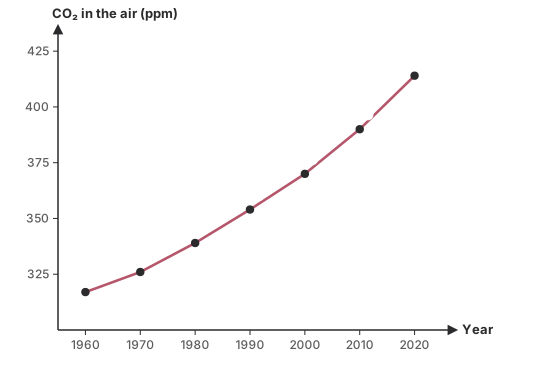
Carbon dioxide rose by 97 ppm (about 31%) in sixty years, and faster each decade: +9, +13, +15, +16, +20, +24. Ozone depletion is the thinning of the ozone layer in the stratosphere by CFCs (from refrigerators, air conditioners, aerosol sprays) and halons (fire extinguishers). Ozone screens out ultraviolet rays; more UV causes skin cancer and harms plankton and crops.
Agreement Subject Montreal Protocol, signed in 1987, in force from 1989 Phasing out ozone-depleting substances Kyoto Protocol, 1997 Cuts in rich countries' greenhouse gases Paris Agreement, 2015 Keeping warming well below 2 °C
Ozone depletion and global warming are different problems: one is a thinner shield against UV, the other is trapped heat.
India is rich in fertile soil, rivers, forests and minerals, but faces serious problems: land degradation (from deforestation, overgrazing, shifting cultivation, misuse of farm chemicals and over-use of groundwater), loss of biodiversity, air pollution (vehicle exhaust in cities, industry), fresh water and solid waste. The Central Pollution Control Board was set up in 1974 . Poverty can worsen degradation, since people with no alternatives may over-use the land and forests they depend on.
The Brundtland Commission's report, Our Common Future (1987), defined sustainable development as development that meets the needs of the present without compromising the ability of future generations to meet their own needs.
Herman Daly's conditions:
Keep population within the carrying capacity.
Make technology input-efficient, not input-consuming.
Harvest renewable resources no faster than they regenerate.
Use non-renewable resources no faster than renewable substitutes are created.
Correct the inefficiencies caused by pollution.
Strategy Example Non-conventional energy Wind power; solar photovoltaic cells Cleaner rural fuel LPG and gobar gas (biogas) in place of wood and dung cakes Cleaner urban fuel CNG in Delhi's public transport Mini-hydel plants Small turbines on hill streams serving nearby villages Traditional knowledge Ayurvedic and herbal remedies, traditional farming Biocomposting Earthworms turning farm waste into manure Biopest control Neem-based sprays, mixed cropping, birds that eat pests
People's movements such as Chipko (the Himalayas, now Uttarakhand, in the 1970s) and Appiko (Karnataka) protected forests.
Four functions: resources, waste, life, aesthetics.
Carrying capacity: extraction ≤ regeneration, waste ≤ absorptive capacity.
Montreal 1987 (ozone), Kyoto 1997, Paris 2015; Brundtland 1987; CPCB 1974.
Daly: five conditions.
Linking the Kyoto Protocol with the ozone layer.
Calling thermal power clean energy.
Saying sustainable development bans the use of non-renewables.
Saying mini-hydel plants need big dams.
Environment
Four functions
Carrying and absorptive capacity
Degradation has an opportunity cost
Global and Indian problems
Global warming: CO₂, methane
Ozone: CFCs, halons; Montreal 1987
India: land, air, water, waste
Sustainable development
Brundtland 1987 definition
Daly's five conditions
Wind, solar, biogas, CNG, biocompost, biopest control
How India's record compares with China's and Pakistan's is in India, China and Pakistan compared .
Next · 10 Quick revision → Check your understanding 52 questions, grouped by type, easy to hard. Pick an answer and check it. The worked solution opens when you ask for it.
The environment and its functions Q1 of 52 Q1
The environment and its functions 12 questions The environment is defined as
Options for question 1 A Option A only the forests, rivers and wildlife of a country B Option B the total planetary inheritance and all its resources C Option C only the air in our cities D Option D the buildings, roads and cities made by people over time
Skip Check Show the explanation Hide the explanation Next question Try again
Show the explanation Hide the explanation Answer B · the total planetary inheritance and all its resources
It covers all biotic (living) and abiotic (non-living) factors that influence one another.
Match each function of the environment with an example.
List I List II A. Supplies resources I. Genetic diversity and biodiversity B. Assimilates waste II. Coal and timber for production C. Sustains life III. A mountain view D. Provides aesthetic services IV. A river breaking down sewage
Options for question 2 A Option A A-II, B-I, C-III, D-IV B Option B A-I, B-II, C-IV, D-III C Option C A-IV, B-III, C-II, D-I D Option D A-II, B-IV, C-I, D-III
Skip Check Show the explanation Hide the explanation Next question Try again
Show the explanation Hide the explanation Answer D · A-II, B-IV, C-I, D-III
The environment does four jobs: it supplies resources, absorbs waste, sustains life and gives us scenery.
Which of these is a non-renewable resource?
Options for question 3 A Option A Coal B Option B Timber from a managed forest C Option C Fish in the sea D Option D Solar energy
Skip Check Show the explanation Hide the explanation Next question Try again
Show the explanation Hide the explanation Answer A · Coal
Coal took millions of years to form; once used, it is gone. Timber and fish regrow if harvested with care, and sunlight does not run out.
The environment can perform its functions without interruption as long as
Options for question 4 A Option A all resources are used up as quickly as possible B Option B population keeps growing faster than its resources every year C Option C resource use stays within regrowth and absorptive capacity D Option D waste is dumped into rivers without any treatment at all
Skip Check Show the explanation Hide the explanation Next question Try again
Show the explanation Hide the explanation Answer C · resource use stays within regrowth and absorptive capacity
This is the carrying capacity: use resources no faster than they regrow, and produce waste no faster than nature can absorb it.
Absorptive capacity is the ability of the environment to
Options for question 5 A Option A produce new minerals quickly B Option B absorb degradation and waste C Option C support a larger population D Option D generate more rainfall
Skip Check Show the explanation Hide the explanation Next question Try again
Show the explanation Hide the explanation Answer B · absorb degradation and waste
Rivers, soil and air can break down a certain amount of waste. Beyond that limit, pollution builds up.
An environmental crisis arises when
Options for question 6 A Option A people plant too many trees in their cities and towns B Option B the use of solar energy rises quickly C Option C demand on it exceeds its carrying capacity D Option D waste is fully treated before disposal
Skip Check Show the explanation Hide the explanation Next question Try again
Show the explanation Hide the explanation Answer C · demand on it exceeds its carrying capacity
When resources are drawn down faster than they regrow, or waste piles up faster than it is absorbed, the environment can no longer support life well.
Using the graph shown, by how much does felling exceed regrowth in year 10?
Options for question 7 A Option A 10 thousand cubic metres B Option B 20 thousand cubic metres C Option C 60 thousand cubic metres D Option D 80 thousand cubic metres
Skip Check Show the explanation Hide the explanation Next question Try again
Show the explanation Hide the explanation Answer B · 20 thousand cubic metres
Felling 80 − regrowth 60 = 20 thousand cubic metres a year.
Worth noting
80 is the felling itself; the forest shrinks by the gap between felling and regrowth.
What does point E on the graph shown mark?
Options for question 8 A Option A The year the forest is fully cut down B Option B The year regrowth stops altogether C Option C The year felling is at its lowest D Option D The year felling catches up with regrowth
Skip Check Show the explanation Hide the explanation Next question Try again
Show the explanation Hide the explanation Answer D · The year felling catches up with regrowth
At E, in year 6, felling = regrowth = 60. Beyond E, felling is more than the forest can replace.
Assertion (A): Environmental degradation has an opportunity cost.
Reason (R): Money spent treating illness from polluted air and water could have been used for other purposes.
Options for question 9 A Option A Both A and R are true, and R is the correct explanation of A. B Option B Both A and R are true, but R is not the correct explanation of A. C Option C A is true, but R is false. D Option D A is false, but R is true.
Skip Check Show the explanation Hide the explanation Next question Try again
Show the explanation Hide the explanation Answer A · Both A and R are true, and R is the correct explanation of A.
Cleaning up and treating the damage uses resources that could have gone elsewhere: that is an opportunity cost.
R explains A.
Read the two statements and choose the correct option.
I. Renewable resources can be used up if they are harvested faster than they regrow.
II. Non-renewable resources regenerate within a few years.
Options for question 10 A Option A Only I B Option B Only II C Option C Both I and II D Option D Neither I nor II
Skip Check Show the explanation Hide the explanation Next question Try again
Show the explanation Hide the explanation Answer A · Only I
Over-fishing or over-felling can exhaust even renewable resources: I is true.
Non-renewables such as coal and oil take millions of years to form, so II is false.
The graph shows a forest's yearly regrowth and yearly felling. In which years is the forest being used within its carrying capacity?
Options for question 11 A Option A Years 0 to 6 B Option B Years 6 to 10 C Option C Only year 10 D Option D In no year
Skip Check Show the explanation Hide the explanation Next question Try again
Show the explanation Hide the explanation Answer A · Years 0 to 6
Up to year 6, felling (30 rising to 60) is at or below regrowth (60), so the forest stock does not shrink.
After year 6, felling exceeds regrowth and the forest is being used up.
Assertion (A): A river can absorb any amount of untreated sewage without harm.
Reason (R): The environment has a limited absorptive capacity.
Options for question 12 A Option A Both A and R are true, and R is the correct explanation of A. B Option B Both A and R are true, but R is not the correct explanation of A. C Option C A is true, but R is false. D Option D A is false, but R is true.
Skip Check Show the explanation Hide the explanation Next question Try again
Show the explanation Hide the explanation Answer D · A is false, but R is true.
Beyond its limit, sewage pollutes the river, so A is false.
R is true.
Global warming and ozone depletion 13 questions Options for question 13 A Option A the thinning of the ozone layer over the poles B Option B a fall in the level of the sea around the world C Option C a slow rise in the earth's average temperature D Option D the cooling of the earth's oceans
Skip Check Show the explanation Hide the explanation Next question Try again
Show the explanation Hide the explanation Answer C · a slow rise in the earth's average temperature
Greenhouse gases such as carbon dioxide and methane trap heat, so the lower atmosphere warms.
Worth noting
The thinning of the ozone layer is ozone depletion, a different problem.
The depletion of the ozone layer is caused mainly by
Options for question 14 A Option A carbon dioxide from cars and power plants B Option B methane from rice fields and cattle C Option C dust from construction D Option D chlorofluorocarbons (CFCs) and halons
Skip Check Show the explanation Hide the explanation Next question Try again
Show the explanation Hide the explanation Answer D · chlorofluorocarbons (CFCs) and halons
CFCs from refrigerators, air conditioners and aerosol sprays, and halons from fire extinguishers, break down ozone in the stratosphere.
The main human causes of global warming are
Options for question 15 A Option A burning fossil fuels and cutting down forests B Option B planting trees and using solar power in homes C Option C organic farming and biocomposting D Option D using CNG in public transport
Skip Check Show the explanation Hide the explanation Next question Try again
Show the explanation Hide the explanation Answer A · burning fossil fuels and cutting down forests
Burning coal, oil and gas releases carbon dioxide, and felling forests removes the trees that absorb it.
Which of these is a likely result of global warming?
Options for question 16 A Option A A thicker ozone layer over the poles B Option B A rise in sea level from melting ice C Option C Colder summers in every part of the world D Option D More polar ice each year
Skip Check Show the explanation Hide the explanation Next question Try again
Show the explanation Hide the explanation Answer B · A rise in sea level from melting ice
Warming melts polar ice and glaciers, so sea levels rise and coasts flood; ecosystems are disturbed and tropical diseases spread.
A thinner ozone layer is harmful because it
Options for question 17 A Option A lets more ultraviolet rays reach the earth B Option B traps more of the sun's heat near the ground C Option C makes rain more acidic D Option D blocks sunlight from plants
Skip Check Show the explanation Hide the explanation Next question Try again
Show the explanation Hide the explanation Answer A · lets more ultraviolet rays reach the earth
Ozone screens out ultraviolet rays; more UV causes skin cancer and harms plankton and crops.
Worth noting
Trapping heat is what greenhouse gases do; that is global warming.
Match each international agreement with its subject.
List I List II A. Montreal Protocol, 1987 I. Binding cuts in rich countries' greenhouse gases B. Kyoto Protocol, 1997 II. Defining sustainable development C. Paris Agreement, 2015 III. Phasing out ozone-depleting substances D. Brundtland Report, 1987 IV. Keeping warming well below 2 °C
Options for question 18 A Option A A-III, B-IV, C-II, D-I B Option B A-IV, B-III, C-I, D-II C Option C A-IV, B-II, C-III, D-I D Option D A-III, B-I, C-IV, D-II
Skip Check Show the explanation Hide the explanation Next question Try again
Show the explanation Hide the explanation Answer D · A-III, B-I, C-IV, D-II
Montreal deals with the ozone layer; Kyoto and Paris with greenhouse gases; the Brundtland Report gave the definition of sustainable development.
The graph shows the amount of carbon dioxide in the air from 1960 to 2020. By how much did it rise over the whole period?
Options for question 19 A Option A 24 ppm B Option B 31 ppm C Option C 97 ppm D Option D 414 ppm
Skip Check Show the explanation Hide the explanation Next question Try again
Show the explanation Hide the explanation Answer C · 97 ppm
414 − 317 = 97 parts per million.
Worth noting
24 is the rise in the last decade alone; 31 is the percentage rise, not ppm.
Using the graph shown, by about what per cent did carbon dioxide rise between 1960 and 2020?
Options for question 20 A Option A 23% B Option B 31% C Option C 97% D Option D 131%
Skip Check Show the explanation Hide the explanation Next question Try again
Show the explanation Hide the explanation Answer B · 31%
Rise = 414 − 317 = 97 ppm.
97 ÷ 317 × 100 ≈ 31%.
Worth noting
23% divides by the 2020 level; growth is measured on the starting level.
Assertion (A): CFCs were phased out under the Montreal Protocol.
Reason (R): CFCs break down ozone in the stratosphere.
Options for question 21 A Option A Both A and R are true, and R is the correct explanation of A. B Option B Both A and R are true, but R is not the correct explanation of A. C Option C A is true, but R is false. D Option D A is false, but R is true.
Skip Check Show the explanation Hide the explanation Next question Try again
Show the explanation Hide the explanation Answer A · Both A and R are true, and R is the correct explanation of A.
The Protocol targeted CFCs precisely because they destroy the ozone layer.
R explains A.
Read the two statements and choose the correct option.
I. The Montreal Protocol was signed in 1987.
II. The Paris Agreement was signed in 1997.
Options for question 22 A Option A Only I B Option B Only II C Option C Both I and II D Option D Neither I nor II
Skip Check Show the explanation Hide the explanation Next question Try again
Show the explanation Hide the explanation Answer A · Only I
I is true.
Paris is 2015; 1997 is Kyoto. II is false.
What does the graph shown suggest about the pace at which carbon dioxide is building up?
Options for question 23 A Option A It is rising more slowly each decade B Option B It is rising faster each decade C Option C It rose and then fell back D Option D It has stayed steady since 1960
Skip Check Show the explanation Hide the explanation Next question Try again
Show the explanation Hide the explanation Answer B · It is rising faster each decade
Rise per decade: 9, 13, 15, 16, 20, 24 ppm, getting larger each time.
Read the two statements and choose the correct option.
I. Carbon dioxide in the air has risen steadily since the industrial revolution.
II. Ozone depletion and global warming are the same problem.
Options for question 24 A Option A Only I B Option B Only II C Option C Both I and II D Option D Neither I nor II
Skip Check Show the explanation Hide the explanation Next question Try again
Show the explanation Hide the explanation Answer A · Only I
Burning fossil fuels has raised carbon dioxide steadily: I is true.
Ozone depletion is the thinning of the ozone layer by CFCs; global warming is heat trapped by greenhouse gases. II is false.
Assertion (A): The Kyoto Protocol dealt with the ozone layer.
Reason (R): The Kyoto Protocol set cuts in greenhouse gas emissions for industrialised countries.
Options for question 25 A Option A Both A and R are true, and R is the correct explanation of A. B Option B Both A and R are true, but R is not the correct explanation of A. C Option C A is true, but R is false. D Option D A is false, but R is true.
Skip Check Show the explanation Hide the explanation Next question Try again
Show the explanation Hide the explanation Answer D · A is false, but R is true.
The ozone layer was the Montreal Protocol's subject, so A is false.
R is true.
India's environment 7 questions Which of these is one of the priority environmental issues for India?
Options for question 26 A Option A A shortage of rainfall everywhere B Option B Too much forest cover C Option C Land degradation D Option D Falling population
Skip Check Show the explanation Hide the explanation Next question Try again
Show the explanation Hide the explanation Answer C · Land degradation
The priority issues include land degradation, loss of biodiversity, air pollution, management of fresh water and solid waste.
Which of these is a cause of land degradation in India?
Options for question 27 A Option A Planting trees on wasteland B Option B Using biocompost C Option C Overgrazing and deforestation D Option D Rotating crops properly
Skip Check Show the explanation Hide the explanation Next question Try again
Show the explanation Hide the explanation Answer C · Overgrazing and deforestation
Loss of vegetation, overgrazing, shifting cultivation, misuse of farm chemicals, poor irrigation practice and over-use of groundwater all degrade land.
In India's cities, a major source of air pollution is
Options for question 28 A Option A organic farming B Option B vehicle exhaust C Option C solar panels D Option D mini-hydel plants
Skip Check Show the explanation Hide the explanation Next question Try again
Show the explanation Hide the explanation Answer B · vehicle exhaust
The rapid rise in the number of vehicles has made exhaust a leading source of urban air pollution, along with industry.
The Central Pollution Control Board (CPCB) was set up in
Options for question 29 A Option A 1952 B Option B 1974 C Option C 1987 D Option D 1997
Skip Check Show the explanation Hide the explanation Next question Try again
Show the explanation Hide the explanation Answer B · 1974
The CPCB was set up in 1974 to check pollution of water, and later of air, and to set standards for industry.
Read the two statements and choose the correct option.
I. India is rich in natural resources such as fertile soil, rivers, forests and minerals.
II. India faces no threat of air or water pollution.
Options for question 30 A Option A Only I B Option B Only II C Option C Both I and II D Option D Neither I nor II
Skip Check Show the explanation Hide the explanation Next question Try again
Show the explanation Hide the explanation Answer A · Only I
I is true: India's natural endowment is large.
Air and water pollution are serious problems in India, so II is false.
Assertion (A): Vehicle exhaust is a major source of air pollution in Indian cities.
Reason (R): The CPCB was set up in 1974.
Options for question 31 A Option A Both A and R are true, and R is the correct explanation of A. B Option B Both A and R are true, but R is not the correct explanation of A. C Option C A is true, but R is false. D Option D A is false, but R is true.
Skip Check Show the explanation Hide the explanation Next question Try again
Show the explanation Hide the explanation Answer B · Both A and R are true, but R is not the correct explanation of A.
Both statements are true.
The date a regulator was set up does not explain why vehicles pollute, so R does not explain A.
Assertion (A): Poverty can worsen environmental degradation.
Reason (R): Poor households that depend on land and forests may have to over-use them to survive.
Options for question 32 A Option A Both A and R are true, and R is the correct explanation of A. B Option B Both A and R are true, but R is not the correct explanation of A. C Option C A is true, but R is false. D Option D A is false, but R is true.
Skip Check Show the explanation Hide the explanation Next question Try again
Show the explanation Hide the explanation Answer A · Both A and R are true, and R is the correct explanation of A.
With few alternatives, people may over-graze, over-fell and over-farm, degrading the very resources they depend on.
R explains A.
Sustainable development 7 questions Sustainable development, as defined by the Brundtland Commission, is development that
Options for question 33 A Option A uses up resources quickly to maximise the growth of GDP this year B Option B stops all use of natural resources so that nothing is ever used up C Option C raises the income of rich countries before that of poor countries D Option D meets present needs without harming future generations' ability to meet theirs
Skip Check Show the explanation Hide the explanation Next question Try again
Show the explanation Hide the explanation Answer D · meets present needs without harming future generations' ability to meet theirs
The World Commission on Environment and Development (the Brundtland Commission) gave this definition in its 1987 report, Our Common Future.
The Brundtland Commission's report, which defined sustainable development, was titled
Options for question 34 A Option A Our Common Future B Option B The Limits to Growth C Option C Silent Spring D Option D Small Is Beautiful
Skip Check Show the explanation Hide the explanation Next question Try again
Show the explanation Hide the explanation Answer A · Our Common Future
Our Common Future, 1987.
According to Herman Daly, for a renewable resource to be used sustainably,
Options for question 35 A Option A it must not be used at all until it is fully grown B Option B the rate of harvest must rise every year without limit C Option C it must be replaced by a non-renewable resource D Option D the rate of harvest must not exceed the rate of regeneration
Skip Check Show the explanation Hide the explanation Next question Try again
Show the explanation Hide the explanation Answer D · the rate of harvest must not exceed the rate of regeneration
If harvest equals regrowth, the stock stays the same and can be used forever.
Which of these is NOT one of Herman Daly's conditions for sustainable development?
Options for question 36 A Option A Keeping population within the carrying capacity B Option B Making technology input-efficient C Option C Raising GDP as fast as possible whatever the cost D Option D Correcting the inefficiencies caused by pollution
Skip Check Show the explanation Hide the explanation Next question Try again
Show the explanation Hide the explanation Answer C · Raising GDP as fast as possible whatever the cost
Daly's conditions: limit population to the carrying capacity; input-efficient technology; harvest renewables no faster than they regrow; deplete non-renewables no faster than substitutes appear; correct pollution.
Assertion (A): Sustainable development is concerned with the welfare of future generations.
Reason (R): Resources used up today will not be available to people in the future.
Options for question 37 A Option A Both A and R are true, and R is the correct explanation of A. B Option B Both A and R are true, but R is not the correct explanation of A. C Option C A is true, but R is false. D Option D A is false, but R is true.
Skip Check Show the explanation Hide the explanation Next question Try again
Show the explanation Hide the explanation Answer A · Both A and R are true, and R is the correct explanation of A.
Because today's use limits tomorrow's options, development must leave enough for the future.
R explains A.
Herman Daly's condition for non-renewable resources is that
Options for question 38 A Option A they are used no faster than renewable substitutes are created B Option B they are used as fast as possible before prices rise C Option C they are never used under any circumstances D Option D they are sold only to developed countries
Skip Check Show the explanation Hide the explanation Next question Try again
Show the explanation Hide the explanation Answer A · they are used no faster than renewable substitutes are created
Since non-renewables cannot regrow, their depletion should be matched by building renewable substitutes, such as solar power for coal.
Assertion (A): Sustainable development forbids all use of non-renewable resources.
Reason (R): Non-renewable resources should be depleted no faster than renewable substitutes are created.
Options for question 39 A Option A Both A and R are true, and R is the correct explanation of A. B Option B Both A and R are true, but R is not the correct explanation of A. C Option C A is true, but R is false. D Option D A is false, but R is true.
Skip Check Show the explanation Hide the explanation Next question Try again
Show the explanation Hide the explanation Answer D · A is false, but R is true.
It allows their use at a controlled pace, so A is false.
R is Daly's condition, and it is true.
Strategies for sustainable development 13 questions Which of these is a non-conventional source of energy?
Options for question 40 A Option A Coal-fired thermal power B Option B Wind power C Option C Diesel generators D Option D Firewood
Skip Check Show the explanation Hide the explanation Next question Try again
Show the explanation Hide the explanation Answer B · Wind power
Wind and solar are non-conventional and clean; thermal power from coal pollutes the air.
Gobar gas (biogas) plants in villages help the environment because they
Options for question 41 A Option A burn coal far more efficiently than big power stations B Option B replace firewood and dung cakes with a cleaner fuel C Option C need large dams on rivers D Option D produce petrol for tractors
Skip Check Show the explanation Hide the explanation Next question Try again
Show the explanation Hide the explanation Answer B · replace firewood and dung cakes with a cleaner fuel
Cattle dung is turned into gas for cooking and light, cutting smoke indoors and the felling of trees for fuel; the slurry left over is a good manure.
Switching Delhi's public transport to CNG
Options for question 42 A Option A lowered air pollution in the city B Option B raised the use of diesel in buses C Option C increased the smoke from city buses D Option D stopped all private cars
Skip Check Show the explanation Hide the explanation Next question Try again
Show the explanation Hide the explanation Answer A · lowered air pollution in the city
Compressed natural gas burns cleaner than diesel, so the switch reduced air pollution.
Mini-hydel plants are suited to
Options for question 43 A Option A deserts with no rivers or water B Option B large cities on the northern plains C Option C coal mines and steel plants D Option D hill streams that serve nearby villages
Skip Check Show the explanation Hide the explanation Next question Try again
Show the explanation Hide the explanation Answer D · hill streams that serve nearby villages
Small turbines on hill streams generate enough power for local needs without large dams or displacement.
Options for question 44 A Option A burning crop waste in the fields B Option B using chemical fertiliser on every crop in the field C Option C turning organic waste into manure with earthworms D Option D storing grain in cold storage
Skip Check Show the explanation Hide the explanation Next question Try again
Show the explanation Hide the explanation Answer C · turning organic waste into manure with earthworms
Earthworms and microbes break down organic waste into compost, which replaces chemical fertiliser.
Which of these is an example of biopest control?
Options for question 45 A Option A Spraying DDT on fields B Option B Burning crop stubble C Option C Using more chemical fertiliser D Option D Using neem-based pesticides
Skip Check Show the explanation Hide the explanation Next question Try again
Show the explanation Hide the explanation Answer D · Using neem-based pesticides
Neem-based sprays, mixed cropping, and birds and animals that eat pests control them without poisoning the soil.
Match each strategy for sustainable development with an example.
List I List II A. Non-conventional energy I. Vermicompost from farm waste B. Cleaner urban fuel II. Ayurvedic and herbal remedies C. Traditional knowledge III. CNG buses D. Biocomposting IV. Solar panels on rooftops
Options for question 46 A Option A A-IV, B-II, C-I, D-III B Option B A-IV, B-III, C-II, D-I C Option C A-II, B-I, C-IV, D-III D Option D A-II, B-IV, C-III, D-I
Skip Check Show the explanation Hide the explanation Next question Try again
Show the explanation Hide the explanation Answer B · A-IV, B-III, C-II, D-I
Each example shows one strategy: clean power, cleaner fuel, traditional practice and organic manure.
The Chipko movement, in which villagers hugged trees to stop them being felled, began in
Options for question 47 A Option A the Western Ghats of Karnataka B Option B the Thar desert of Rajasthan C Option C the Himalayan region of Uttarakhand D Option D the Sundarbans of West Bengal
Skip Check Show the explanation Hide the explanation Next question Try again
Show the explanation Hide the explanation Answer C · the Himalayan region of Uttarakhand
Chipko began in the 1970s in the Himalayan hills now in Uttarakhand; a similar movement in Karnataka was called Appiko.
Worth noting
Karnataka's Western Ghats saw the Appiko movement.
Read the two statements and choose the correct option.
I. Solar photovoltaic cells turn sunlight directly into electricity.
II. Thermal power plants are a source of clean energy.
Options for question 48 A Option A Only I B Option B Only II C Option C Both I and II D Option D Neither I nor II
Skip Check Show the explanation Hide the explanation Next question Try again
Show the explanation Hide the explanation Answer A · Only I
I is true: that is how solar panels work.
Thermal plants burn coal and release carbon dioxide and ash, so II is false.
Assertion (A): Traditional knowledge can support sustainable development.
Reason (R): Traditional farming, medicine and building practices were often in harmony with nature.
Options for question 49 A Option A Both A and R are true, and R is the correct explanation of A. B Option B Both A and R are true, but R is not the correct explanation of A. C Option C A is true, but R is false. D Option D A is false, but R is true.
Skip Check Show the explanation Hide the explanation Next question Try again
Show the explanation Hide the explanation Answer A · Both A and R are true, and R is the correct explanation of A.
Practices that used local, renewable materials and did not harm the land are a guide to sustainable ways.
R explains A.
Arrange these in chronological order.
A. The Kyoto Protocol
B. The CPCB is set up
C. The Paris Agreement
D. The Brundtland Report
Options for question 50 A Option A B, D, A, C B Option B D, B, A, C C Option C B, A, D, C D Option D B, D, C, A
Skip Check Show the explanation Hide the explanation Next question Try again
Show the explanation Hide the explanation Answer A · B, D, A, C
CPCB 1974, Brundtland Report 1987, Kyoto 1997, Paris 2015.
Assertion (A): Wind power is a clean source of energy.
Reason (R): The Chipko movement began in Uttarakhand.
Options for question 51 A Option A Both A and R are true, and R is the correct explanation of A. B Option B Both A and R are true, but R is not the correct explanation of A. C Option C A is true, but R is false. D Option D A is false, but R is true.
Skip Check Show the explanation Hide the explanation Next question Try again
Show the explanation Hide the explanation Answer B · Both A and R are true, but R is not the correct explanation of A.
Both statements are true.
Where Chipko began has nothing to do with whether wind power is clean, so R does not explain A.
Read the two statements and choose the correct option.
I. LPG and biogas in villages reduce indoor smoke from burning wood and dung.
II. Mini-hydel plants need very large dams that displace thousands of people.
Options for question 52 A Option A Only I B Option B Only II C Option C Both I and II D Option D Neither I nor II
Skip Check Show the explanation Hide the explanation Back to start Try again
Show the explanation Hide the explanation Answer A · Only I
Cleaner fuels cut indoor air pollution: I is true.
Mini-hydel plants use small streams and need no large dams, so II is false.
Question types · easy to hard
NTA's Economics syllabus is three courses: Introductory Microeconomics, Introductory Macroeconomics and Indian Economic Development, each split into units with a list of topics. It prints no chapters and no split of the 50 questions across the courses. So the areas here are NTA's three courses, and the chapters inside them are ours: a unit that covers several ideas, such as consumer behaviour and demand, is split into a chapter for each, so that a chapter can be practised in one sitting. All three courses are here.