On this page · 9 sections 01 The core idea 02 Land reforms 03 The green revolution 04 The subsidy debate 05 Farming's share by 1990 06 Exam shortcuts 07 Common mistakes 08 Quick revision 09 Check your understanding In 1950 most Indians farmed, yields were low and the crop depended on the monsoon. Planners attacked the problem from two sides: land reforms changed who owns the land (the institutions ), and the green revolution changed how it is farmed (the technology ).
A tenant who pays a heavy rent keeps little of any extra output, so has little reason to invest. An owner keeps all the gain. So land to the tiller promised both equity and higher productivity .
Measure What it did Abolition of intermediaries Removed the zamindars between tiller and state; about 200 lakh tenants came into direct contact with the government Land ceiling Fixed the most land one person may own; land above it went to the landless Tenancy reform Gave tenants security and limited rents Consolidation of holdings Joined scattered plots into one
Only partly. Big landowners challenged the laws in court, transferred land to relatives' names, or kept land by claiming it was under their own cultivation. The poorest, such as sharecroppers and landless labourers, often gained nothing. Land reforms succeeded best in Kerala and West Bengal , whose governments were committed to land to the tiller.
High-yielding variety (HYV) seeds , used with fertiliser, pesticides and a regular supply of water , raised grain output sharply. Without those inputs, HYV seeds yield no more than old ones, so they went first to irrigated areas.
Phase Years Reach First Mid-1960s to mid-1970s Better-off states (Punjab, Andhra Pradesh, Tamil Nadu); mainly wheat Second Mid-1970s to mid-1980s More states and more crops
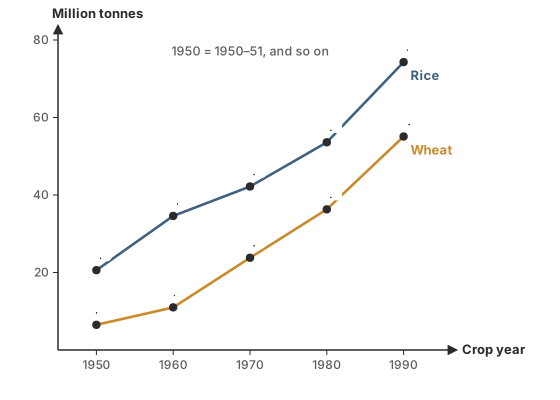
Wheat more than doubled in the 1960s, when HYV seeds arrived; rice grew more slowly at first. Example 1 · Reading the output graph
Wheat, 1960-61 to 1970-71: 23.8 − 11.0 = 12.8 million tonnes, a rise of 12.8 ÷ 11.0 ≈ 116%.
Rice over the same decade: 42.2 − 34.6 = 7.6, about 22%.
Wheat over forty years: 55.1 ÷ 6.5 ≈ 8.5 times.
Answer The green revolution shows first in wheat
Self-sufficiency in food grains : India no longer had to import grain to feed its people.A large marketed surplus , the part of output farmers sell. Food prices fell relative to other goods, which helped the poor, who spend much of their income on food.
The government could build a buffer stock of grain for shortages.
Example 2 · Marketed surplus
A farmer grows 40 quintals of wheat and keeps 12 for the family.
Marketed surplus = output − own use = 40 − 12.
HYV crops were more open to pests , and a small farmer who lost a crop could be ruined. At first it was feared only big farmers would gain. Low-interest loans and fertiliser subsidies let small farmers adopt the seeds too, and research institutes advised them.
A subsidy means the government pays part of the price of an input, such as fertiliser.
For : a new technology is risky; subsidies get farmers, especially small ones, to try it. Farming is risky and most farmers are poor.Against : once the technology has spread, much of the gain goes to the fertiliser industry and better-off farmers, at a large cost to the budget. Some argue subsidies should be phased out. Agriculture's share of GDP fell sharply between 1950 and 1990, but the share of people depending on it barely moved (from about 67.5% to 64.9%), because industry and services did not create enough jobs.
Land reforms = institutions; green revolution = technology.
Kerala and West Bengal: land reform success; Punjab, AP, TN: first phase of HYV.
HYV needs fertiliser, pesticides and assured water.
Marketed surplus = output − own consumption.
Linking Punjab and Haryana with land reform success.
Saying the green revolution first raised pulses or rice output most.
Giving the subsidy critics' argument (it helps big farmers) as the supporters'.
Calling milk's rise the green revolution (it is the white revolution).
Land reforms
Abolition of intermediaries; ceilings
200 lakh tenants freed from zamindars
Best in Kerala and West Bengal
Green revolution
HYV + fertiliser + pesticides + water
First phase: wheat, a few states
Self-sufficiency, marketed surplus, buffer stock
Subsidies
For: spread new technology
Against: help industry and big farmers
Industry and trade in the same years are in industry and trade, 1950–90 .
Next · 08 Quick revision → Check your understanding 54 questions, grouped by type, easy to hard. Pick an answer and check it. The worked solution opens when you ask for it.
Agriculture in 1950 Q1 of 54 Q1
Agriculture in 1950 5 questions At the start of planning in 1950, Indian agriculture was marked by
Options for question 1 A Option A high yields and the wide use of tractors and machines B Option B low productivity and dependence on the monsoon C Option C large exports of food grains to Europe and Asia D Option D very few people working on farms
Skip Check Show the explanation Hide the explanation Next question Try again
Show the explanation Hide the explanation Answer B · low productivity and dependence on the monsoon
Colonial rule left farming stagnant: yields were low, irrigation was scarce and most farms depended on the rains.
The institutional reform of Indian agriculture after independence is known as
Options for question 2 A Option A the green revolution B Option B disinvestment C Option C import substitution D Option D land reforms
Skip Check Show the explanation Hide the explanation Next question Try again
Show the explanation Hide the explanation Answer D · land reforms
Land reforms changed who owned the land (institutions); the green revolution changed how it was farmed (technology).
Worth noting
The green revolution is the technological side, sometimes called the new agricultural strategy.
Assertion (A): Agriculture in 1950 depended heavily on the monsoon.
Reason (R): Irrigation reached only a small part of the cropped area.
Options for question 3 A Option A Both A and R are true, and R is the correct explanation of A. B Option B Both A and R are true, but R is not the correct explanation of A. C Option C A is true, but R is false. D Option D A is false, but R is true.
Skip Check Show the explanation Hide the explanation Next question Try again
Show the explanation Hide the explanation Answer A · Both A and R are true, and R is the correct explanation of A.
Where there is no irrigation, the crop depends on the rains.
R explains A.
Read the two statements and choose the correct option.
I. Between 1950 and 1990, the share of agriculture in India's GDP fell sharply.
II. Between 1950 and 1990, the share of India's population depending on agriculture fell just as sharply.
Options for question 4 A Option A Only I B Option B Only II C Option C Both I and II D Option D Neither I nor II
Skip Check Show the explanation Hide the explanation Next question Try again
Show the explanation Hide the explanation Answer A · Only I
Industry and services grew faster, so agriculture's share of output fell sharply: I is true.
The share of people depending on it barely moved, from about 67.5% to 64.9%: II is false.
Assertion (A): By 1990, about two-thirds of India's people still depended on agriculture.
Reason (R): Industry and services did not create enough jobs to absorb the people leaving agriculture.
Options for question 5 A Option A Both A and R are true, and R is the correct explanation of A. B Option B Both A and R are true, but R is not the correct explanation of A. C Option C A is true, but R is false. D Option D A is false, but R is true.
Skip Check Show the explanation Hide the explanation Next question Try again
Show the explanation Hide the explanation Answer A · Both A and R are true, and R is the correct explanation of A.
Output shifted to industry and services, but jobs did not follow, so people stayed on the land.
R explains A.
16 questions
The main aim of land reforms after independence was
Options for question 6 A Option A to give ownership of land to the tiller B Option B to give more land to the zamindars C Option C to sell farmland to foreign companies D Option D to turn farmland into industrial estates
Skip Check Show the explanation Hide the explanation Next question Try again
Show the explanation Hide the explanation Answer A · to give ownership of land to the tiller
'Land to the tiller': the person who works the land should own it.
Abolition of intermediaries meant
Options for question 7 A Option A ending the role of traders in all food grain markets B Option B removing the zamindars between tiller and state C Option C removing banks from rural lending D Option D banning the sale of land altogether
Skip Check Show the explanation Hide the explanation Next question Try again
Show the explanation Hide the explanation Answer B · removing the zamindars between tiller and state
Zamindars stood between the cultivator and the government; abolishing zamindari brought tenants into direct contact with the state.
Options for question 8 A Option A the minimum area needed to grow wheat B Option B the highest price at which land may be sold C Option C the maximum area of land one person may own D Option D the tax rate on agricultural land
Skip Check Show the explanation Hide the explanation Next question Try again
Show the explanation Hide the explanation Answer C · the maximum area of land one person may own
A ceiling fixes the most land an individual can hold; land above it is taken and given to the landless.
Why was ownership of land by the tiller expected to raise output?
Options for question 9 A Option A Owners are always given free fertiliser by the government B Option B Owners do not have to pay any taxes on their land C Option C Owners keep all the gains and so invest more in the land D Option D Owners can sell their crops only to the government
Skip Check Show the explanation Hide the explanation Next question Try again
Show the explanation Hide the explanation Answer C · Owners keep all the gains and so invest more in the land
A tenant who pays a large rent keeps little of any extra output; an owner keeps all of it.
So ownership gives an incentive to invest in irrigation, seeds and care.
About how many tenants came into direct contact with the government after intermediaries were abolished?
Options for question 10 A Option A 2 lakh B Option B 20 lakh C Option C 200 lakh D Option D 2,000 lakh
Skip Check Show the explanation Hide the explanation Next question Try again
Show the explanation Hide the explanation Answer C · 200 lakh
The abolition of intermediaries brought about 200 lakh tenants into direct contact with the government, freeing them from the zamindars' exploitation.
The purpose of a land ceiling was
Options for question 11 A Option A to cut the concentration of land in a few hands B Option B to raise the market price of farmland across India C Option C to encourage large mechanised farms run by companies D Option D to collect more land revenue
Skip Check Show the explanation Hide the explanation Next question Try again
Show the explanation Hide the explanation Answer A · to cut the concentration of land in a few hands
Ceilings were meant to promote equity: surplus land from big owners would go to the landless.
Land ceiling laws had limited success because big landowners
Options for question 12 A Option A gave away their land to the landless B Option B moved away to the cities to work in new factories C Option C formed cooperatives with the tenants D Option D went to court and put land in relatives' names
Skip Check Show the explanation Hide the explanation Next question Try again
Show the explanation Hide the explanation Answer D · went to court and put land in relatives' names
Landowners delayed the laws through the courts, and registered land in the names of relatives to keep it within the family.
Land reforms were most successful in
Options for question 13 A Option A Punjab and Haryana B Option B Bihar and Uttar Pradesh C Option C Kerala and West Bengal D Option D Rajasthan and Gujarat
Skip Check Show the explanation Hide the explanation Next question Try again
Show the explanation Hide the explanation Answer C · Kerala and West Bengal
Their governments were committed to the policy of land to the tiller.
Worth noting
Punjab and Haryana are linked with the green revolution, not with land reform.
Assertion (A): Land reforms succeeded in Kerala and West Bengal.
Reason (R): The governments of these states were committed to giving land to the tiller.
Options for question 14 A Option A Both A and R are true, and R is the correct explanation of A. B Option B Both A and R are true, but R is not the correct explanation of A. C Option C A is true, but R is false. D Option D A is false, but R is true.
Skip Check Show the explanation Hide the explanation Next question Try again
Show the explanation Hide the explanation Answer A · Both A and R are true, and R is the correct explanation of A.
Where governments were committed, the laws were carried out.
R explains A.
Read the two statements and choose the correct option.
I. In some areas, former zamindars kept large areas of land by claiming it was under their own cultivation.
II. The abolition of intermediaries ended all inequality in land ownership.
Options for question 15 A Option A Only I B Option B Only II C Option C Both I and II D Option D Neither I nor II
Skip Check Show the explanation Hide the explanation Next question Try again
Show the explanation Hide the explanation Answer A · Only I
Loopholes such as 'self-cultivation' let some zamindars keep land: I is true.
Inequality fell but did not end, so II is false.
Match each land reform measure with what it did.
List I List II A. Abolition of intermediaries I. Secured tenants and limited their rents B. Land ceiling II. Removed zamindars between tiller and state C. Regulation of tenancy III. Joined scattered plots into one D. Consolidation of holdings IV. Fixed the most land one person may own
Options for question 16 A Option A A-II, B-IV, C-I, D-III B Option B A-II, B-I, C-III, D-IV C Option C A-I, B-II, C-IV, D-III D Option D A-III, B-IV, C-I, D-II
Skip Check Show the explanation Hide the explanation Next question Try again
Show the explanation Hide the explanation Answer A · A-II, B-IV, C-I, D-III
Each measure attacked one weakness of the old land system.
Read the two statements and choose the correct option.
I. Land reforms changed the institutions of agriculture, such as who owns the land.
II. The green revolution changed the technology of agriculture, such as the seeds used.
Options for question 17 A Option A Only I B Option B Only II C Option C Both I and II D Option D Neither I nor II
Skip Check Show the explanation Hide the explanation Next question Try again
Show the explanation Hide the explanation Answer C · Both I and II
Both are true: land reforms are the institutional side and the green revolution the technological side of farm policy.
Assertion (A): The zamindari system was abolished after independence.
Reason (R): Zamindars invested heavily in improving the land.
Options for question 18 A Option A Both A and R are true, and R is the correct explanation of A. B Option B Both A and R are true, but R is not the correct explanation of A. C Option C A is true, but R is false. D Option D A is false, but R is true.
Skip Check Show the explanation Hide the explanation Next question Try again
Show the explanation Hide the explanation Answer C · A is true, but R is false.
A is true.
Zamindars took rent and invested little, which is why zamindari was abolished. R is false.
Assertion (A): Land reforms aimed at equity as well as at higher productivity.
Reason (R): Land reforms were carried out equally well in every state.
Options for question 19 A Option A Both A and R are true, and R is the correct explanation of A. B Option B Both A and R are true, but R is not the correct explanation of A. C Option C A is true, but R is false. D Option D A is false, but R is true.
Skip Check Show the explanation Hide the explanation Next question Try again
Show the explanation Hide the explanation Answer C · A is true, but R is false.
Spreading land promotes equity; ownership raises incentives: A is true.
They succeeded in a few states and lagged in many, so R is false.
Assertion (A): A land ceiling helps equity.
Reason (R): Land above the ceiling is taken from big owners and given to the landless.
Options for question 20 A Option A Both A and R are true, and R is the correct explanation of A. B Option B Both A and R are true, but R is not the correct explanation of A. C Option C A is true, but R is false. D Option D A is false, but R is true.
Skip Check Show the explanation Hide the explanation Next question Try again
Show the explanation Hide the explanation Answer A · Both A and R are true, and R is the correct explanation of A.
Moving land from the few to the many spreads ownership more evenly.
R explains A.
Assertion (A): Land reforms raised output in some areas after independence.
Reason (R): Land ceiling laws were carried out fully in every state.
Options for question 21 A Option A Both A and R are true, and R is the correct explanation of A. B Option B Both A and R are true, but R is not the correct explanation of A. C Option C A is true, but R is false. D Option D A is false, but R is true.
Skip Check Show the explanation Hide the explanation Next question Try again
Show the explanation Hide the explanation Answer C · A is true, but R is false.
Where tenants became owners, they invested and output rose: A is true.
Ceiling laws were evaded in many states, so R is false.
The green revolution 26 questions The green revolution refers to
Options for question 22 A Option A the planting of new forests on village wasteland B Option B a big rise in grain output from new seeds and inputs C Option C the growth of the dairy industry after Operation Flood D Option D a movement to protect rivers and lakes
Skip Check Show the explanation Hide the explanation Next question Try again
Show the explanation Hide the explanation Answer B · a big rise in grain output from new seeds and inputs
High-yielding varieties (HYV) of seed, used with fertiliser, pesticides and regular water, raised the output of food grains sharply.
Worth noting
The rise in milk output is the white revolution.
Options for question 23 A Option A the output a farmer keeps for his family B Option B the stock of grain held by the government C Option C the part of output that farmers sell D Option D the output lost to pests every year
Skip Check Show the explanation Hide the explanation Next question Try again
Show the explanation Hide the explanation Answer C · the part of output that farmers sell
Marketed surplus = output sold in the market, after what the farm household keeps for itself.
HYV in 'HYV seeds' stands for
Options for question 24 A Option A high-yielding variety B Option B hybrid yearly variety C Option C high-yield vegetable D Option D home-grown yield value
Skip Check Show the explanation Hide the explanation Next question Try again
Show the explanation Hide the explanation Answer A · high-yielding variety
High-yielding varieties produce much more grain per hectare when given the right inputs.
HYV seeds give high yields only when they are used with
Options for question 25 A Option A only traditional manure, rain and wooden ploughs B Option B hand tools, bullocks and no irrigation at all C Option C a fallow period of a year after each crop D Option D fertiliser, pesticides and regular water
Skip Check Show the explanation Hide the explanation Next question Try again
Show the explanation Hide the explanation Answer D · fertiliser, pesticides and regular water
HYV seeds respond to inputs: without fertiliser and assured water, their yield is no better than old seeds.
In the first phase of the green revolution, HYV seeds were used mainly in
Options for question 26 A Option A Punjab, Andhra Pradesh and Tamil Nadu B Option B Kerala, Assam and Bihar C Option C Rajasthan, Gujarat and Madhya Pradesh D Option D Every state equally
Skip Check Show the explanation Hide the explanation Next question Try again
Show the explanation Hide the explanation Answer A · Punjab, Andhra Pradesh and Tamil Nadu
From the mid-1960s to the mid-1970s, HYV seeds were limited to the better-off states such as Punjab, Andhra Pradesh and Tamil Nadu.
In its first phase, the green revolution mainly benefited which crop?
Options for question 27 A Option A Pulses B Option B Cotton C Option C Jute D Option D Wheat
Skip Check Show the explanation Hide the explanation Next question Try again
Show the explanation Hide the explanation Answer D · Wheat
The HYV seeds first transformed the wheat-growing regions.
The second phase of the green revolution, from the mid-1970s to the mid-1980s, saw
Options for question 28 A Option A HYV seeds banned in most of the states B Option B HYV seeds spread to more states and crops C Option C food grain output fall in every single year D Option D land reforms replace new seeds
Skip Check Show the explanation Hide the explanation Next question Try again
Show the explanation Hide the explanation Answer B · HYV seeds spread to more states and crops
In the second phase the new technology spread to a larger number of states and benefited more crops.
The green revolution helped poor households in towns and villages because
Options for question 29 A Option A every poor household received free land B Option B wages in factories doubled C Option C food grain prices fell relative to other goods D Option D food was exported at high prices
Skip Check Show the explanation Hide the explanation Next question Try again
Show the explanation Hide the explanation Answer C · food grain prices fell relative to other goods
A large marketed surplus pushed food prices down relative to other goods.
Poor households spend a large share of their income on food, so they gained most.
The green revolution allowed the government to
Options for question 30 A Option A stop all food imports in 1951 B Option B build up a buffer stock of food grains C Option C abolish the zamindari system D Option D fix a ceiling on land holdings
Skip Check Show the explanation Hide the explanation Next question Try again
Show the explanation Hide the explanation Answer B · build up a buffer stock of food grains
With more grain sold in the market, the government could procure enough to hold a buffer stock for times of shortage.
A risk of the green revolution was that
Options for question 31 A Option A HYV seeds needed no water at all B Option B output of wheat fell sharply C Option C farmers were barred from selling grain D Option D HYV crops were more prone to attack by pests
Skip Check Show the explanation Hide the explanation Next question Try again
Show the explanation Hide the explanation Answer D · HYV crops were more prone to attack by pests
HYV crops were more open to pests, and a small farmer who lost a crop could be ruined.
Research institutes advised farmers and the government gave loans and subsidies to cut this risk.
Assertion (A): The green revolution made India self-sufficient in food grains.
Reason (R): HYV seeds raised yields sharply, above all of wheat.
Options for question 32 A Option A Both A and R are true, and R is the correct explanation of A. B Option B Both A and R are true, but R is not the correct explanation of A. C Option C A is true, but R is false. D Option D A is false, but R is true.
Skip Check Show the explanation Hide the explanation Next question Try again
Show the explanation Hide the explanation Answer A · Both A and R are true, and R is the correct explanation of A.
Higher yields meant India no longer had to import food grains to feed its people.
R explains A.
Which of these was NOT an input of the green revolution?
Options for question 33 A Option A Chemical fertilisers in large amounts B Option B Assured irrigation from canals and wells C Option C Pesticides to protect the crop D Option D Abolition of the zamindari system
Skip Check Show the explanation Hide the explanation Next question Try again
Show the explanation Hide the explanation Answer D · Abolition of the zamindari system
Fertilisers, irrigation and pesticides went with HYV seeds. Abolishing zamindari was a land reform, an institutional change.
The graph shows India's wheat and rice output from 1950-51 to 1990-91. By how much did wheat output rise between 1960-61 and 1970-71?
Options for question 34 A Option A 4.5 million tonnes B Option B 7.6 million tonnes C Option C 12.5 million tonnes D Option D 12.8 million tonnes
Skip Check Show the explanation Hide the explanation Next question Try again
Show the explanation Hide the explanation Answer D · 12.8 million tonnes
Wheat: 23.8 − 11.0 = 12.8 million tonnes.
Worth noting
7.6 is rice over the same decade; 12.5 is wheat over the next one.
Using the graph shown, wheat output in 1990-91 was about how many times its level in 1950-51?
Options for question 35 A Option A 2.2 times B Option B 3.6 times C Option C 8.5 times D Option D 48.6 times
Skip Check Show the explanation Hide the explanation Next question Try again
Show the explanation Hide the explanation Answer C · 8.5 times
55.1 ÷ 6.5 ≈ 8.5.
Worth noting
3.6 times is rice over the same forty years; 48.6 is the rise in tonnes, not a ratio.
What does the graph shown suggest about the green revolution's early years?
Options for question 36 A Option A Rice gained far more than wheat in the 1960s B Option B Both crops fell in the 1960s C Option C Wheat gained far more than rice in the 1960s D Option D Neither crop changed in the 1960s
Skip Check Show the explanation Hide the explanation Next question Try again
Show the explanation Hide the explanation Answer C · Wheat gained far more than rice in the 1960s
Wheat rose from 11.0 to 23.8 (more than double); rice from 34.6 to 42.2 (about 22%).
The early HYV seeds were mainly wheat.
Match each term with its meaning.
List I List II A. HYV seeds I. Output a farmer sells in the market B. Marketed surplus II. The most land one person may own C. Buffer stock III. Seeds giving high yields with the right inputs D. Land ceiling IV. Grain the government holds for shortages
Options for question 37 A Option A A-III, B-IV, C-II, D-I B Option B A-IV, B-III, C-I, D-II C Option C A-I, B-II, C-III, D-IV D Option D A-III, B-I, C-IV, D-II
Skip Check Show the explanation Hide the explanation Next question Try again
Show the explanation Hide the explanation Answer D · A-III, B-I, C-IV, D-II
Each term names one part of the farm policy of 1950–90.
Read the two statements and choose the correct option.
I. The green revolution was first introduced in rain-fed areas with no irrigation.
II. The green revolution raised the output of pulses most of all.
Options for question 38 A Option A Only I B Option B Only II C Option C Both I and II D Option D Neither I nor II
Skip Check Show the explanation Hide the explanation Next question Try again
Show the explanation Hide the explanation Answer D · Neither I nor II
HYV seeds need assured water, so they went first to irrigated areas. I is false.
Wheat gained most, then rice; pulses gained little. II is false.
Assertion (A): After the green revolution, India did not need to import food grains to meet its needs.
Reason (R): HYV seeds were used only on small farms.
Options for question 39 A Option A Both A and R are true, and R is the correct explanation of A. B Option B Both A and R are true, but R is not the correct explanation of A. C Option C A is true, but R is false. D Option D A is false, but R is true.
Skip Check Show the explanation Hide the explanation Next question Try again
Show the explanation Hide the explanation Answer C · A is true, but R is false.
Self-sufficiency in food grains was the green revolution's main achievement: A is true.
Big and small farms alike used them, so R is false.
Assertion (A): Wheat output rose faster than rice output in the early green revolution.
Reason (R): The first HYV seeds to spread were mainly wheat varieties.
Options for question 40 A Option A Both A and R are true, and R is the correct explanation of A. B Option B Both A and R are true, but R is not the correct explanation of A. C Option C A is true, but R is false. D Option D A is false, but R is true.
Skip Check Show the explanation Hide the explanation Next question Try again
Show the explanation Hide the explanation Answer A · Both A and R are true, and R is the correct explanation of A.
The new technology reached wheat first, so wheat output jumped first.
R explains A.
A farmer grows 40 quintals of wheat, keeps 12 for the family, and sells the rest. What is the marketed surplus?
Options for question 41 A Option A 12 quintals B Option B 28 quintals C Option C 40 quintals D Option D 52 quintals
Skip Check Show the explanation Hide the explanation Next question Try again
Show the explanation Hide the explanation Answer B · 28 quintals
Marketed surplus = output − own use = 40 − 12 = 28 quintals.
Read the two statements and choose the correct option.
I. At first, it was feared that the green revolution would help only the big farmers.
II. Low-interest loans and subsidies on fertiliser let small farmers adopt HYV seeds too.
Options for question 42 A Option A Only I B Option B Only II C Option C Both I and II D Option D Neither I nor II
Skip Check Show the explanation Hide the explanation Next question Try again
Show the explanation Hide the explanation Answer C · Both I and II
The inputs cost money, which small farmers lacked, so the fear was real: I is true.
Government loans and subsidies spread the gains to small farmers: II is true.
Assertion (A): In the first phase, the green revolution widened the gap between regions.
Reason (R): HYV seeds were at first used mainly in a few states with irrigation.
Options for question 43 A Option A Both A and R are true, and R is the correct explanation of A. B Option B Both A and R are true, but R is not the correct explanation of A. C Option C A is true, but R is false. D Option D A is false, but R is true.
Skip Check Show the explanation Hide the explanation Next question Try again
Show the explanation Hide the explanation Answer A · Both A and R are true, and R is the correct explanation of A.
States such as Punjab gained first and fastest; rain-fed regions were left behind.
R explains A.
In which decade shown did wheat output grow fastest in percentage terms?
Options for question 44 A Option A 1960-61 to 1970-71 B Option B 1950-51 to 1960-61 C Option C 1970-71 to 1980-81 D Option D 1980-81 to 1990-91
Skip Check Show the explanation Hide the explanation Next question Try again
Show the explanation Hide the explanation Answer A · 1960-61 to 1970-71
1950s: 4.5 ÷ 6.5 ≈ 69%. 1960s: 12.8 ÷ 11.0 ≈ 116%.
1970s: 12.5 ÷ 23.8 ≈ 53%. 1980s: 18.8 ÷ 36.3 ≈ 52%.
The 1960s, when HYV wheat arrived, more than doubled output.
Worth noting
The 1980s added the most tonnes (18.8), but from a much larger base, so the percentage rise was smaller.
Arrange these in the order in which they happened.
A. The first phase of the green revolution
B. The Permanent Settlement in Bengal
C. The second phase of the green revolution
D. Zamindari abolition laws after independence
Options for question 45 A Option A D, B, A, C B Option B B, A, D, C C Option C B, D, A, C D Option D B, D, C, A
Skip Check Show the explanation Hide the explanation Next question Try again
Show the explanation Hide the explanation Answer C · B, D, A, C
Permanent Settlement 1793; zamindari abolished in the early 1950s; first phase mid-1960s to mid-1970s; second phase mid-1970s to mid-1980s.
Assertion (A): Food grain prices fell relative to other goods after the green revolution.
Reason (R): Farmers sold a much larger share of their output in the market.
Options for question 46 A Option A Both A and R are true, and R is the correct explanation of A. B Option B Both A and R are true, but R is not the correct explanation of A. C Option C A is true, but R is false. D Option D A is false, but R is true.
Skip Check Show the explanation Hide the explanation Next question Try again
Show the explanation Hide the explanation Answer A · Both A and R are true, and R is the correct explanation of A.
A bigger marketed surplus means more grain on sale, which lowers its relative price.
R explains A.
Assertion (A): Small farmers feared the green revolution at first.
Reason (R): HYV crops faced a greater risk from pests, and a lost crop could ruin a small farmer.
Options for question 47 A Option A Both A and R are true, and R is the correct explanation of A. B Option B Both A and R are true, but R is not the correct explanation of A. C Option C A is true, but R is false. D Option D A is false, but R is true.
Skip Check Show the explanation Hide the explanation Next question Try again
Show the explanation Hide the explanation Answer A · Both A and R are true, and R is the correct explanation of A.
The new seeds needed costly inputs and carried more risk; small farmers had the least to fall back on.
R explains A.
The subsidy debate 7 questions A farm subsidy on fertiliser means
Options for question 48 A Option A the farmer pays a tax on every bag of fertiliser B Option B the government pays part of the price C Option C the government bans the sale of fertiliser D Option D fertiliser can be bought only from abroad
Skip Check Show the explanation Hide the explanation Next question Try again
Show the explanation Hide the explanation Answer B · the government pays part of the price
A subsidy lowers the price the user pays; the government meets the difference.
Supporters of farm subsidies in the green revolution years argued that
Options for question 49 A Option A they mainly helped the fertiliser industry and big farmers B Option B they were needed to get farmers to try the new technology C Option C they should be removed once the technology spread D Option D they made farmers depend less on the monsoon
Skip Check Show the explanation Hide the explanation Next question Try again
Show the explanation Hide the explanation Answer B · they were needed to get farmers to try the new technology
A new technology is risky; a subsidy lowers its cost, so farmers are willing to adopt it.
Worth noting
Helping the fertiliser industry and big farmers is the critics' argument, not the supporters'.
Critics of fertiliser subsidies argue that
Options for question 50 A Option A most of the gain goes to fertiliser makers and richer farmers B Option B subsidies always lower the output of food grains in India C Option C small farmers never use any fertiliser at all D Option D subsidies raise the price of fertiliser for farmers
Skip Check Show the explanation Hide the explanation Next question Try again
Show the explanation Hide the explanation Answer A · most of the gain goes to fertiliser makers and richer farmers
Once a technology has spread, the subsidy no longer changes behaviour; it is a large burden on the budget that mostly helps those who are already better off.
Read the two statements and choose the correct option.
I. Some economists argue that farm subsidies should be phased out once a new technology has been widely adopted.
II. Others argue that subsidies should stay, because farming is risky and most farmers are poor.
Options for question 51 A Option A Only I B Option B Only II C Option C Both I and II D Option D Neither I nor II
Skip Check Show the explanation Hide the explanation Next question Try again
Show the explanation Hide the explanation Answer C · Both I and II
Both views are part of the subsidy debate, so both statements are true.
Assertion (A): Fertiliser subsidies benefit only small farmers.
Reason (R): A subsidy lowers the price of fertiliser for every buyer.
Options for question 52 A Option A Both A and R are true, and R is the correct explanation of A. B Option B Both A and R are true, but R is not the correct explanation of A. C Option C A is true, but R is false. D Option D A is false, but R is true.
Skip Check Show the explanation Hide the explanation Next question Try again
Show the explanation Hide the explanation Answer D · A is false, but R is true.
Every buyer gets the lower price, so big farmers, who buy more, gain more. A is false.
R is true.
Assertion (A): Farm subsidies are a burden on the government's budget.
Reason (R): The green revolution raised the output of wheat.
Options for question 53 A Option A Both A and R are true, and R is the correct explanation of A. B Option B Both A and R are true, but R is not the correct explanation of A. C Option C A is true, but R is false. D Option D A is false, but R is true.
Skip Check Show the explanation Hide the explanation Next question Try again
Show the explanation Hide the explanation Answer B · Both A and R are true, but R is not the correct explanation of A.
Subsidies cost the government money: A is true.
R is true, but more wheat does not explain the cost of subsidies.
Assertion (A): Removing fertiliser subsidies at once could hurt poor farmers.
Reason (R): Poor farmers may not be able to afford fertiliser at the full market price.
Options for question 54 A Option A Both A and R are true, and R is the correct explanation of A. B Option B Both A and R are true, but R is not the correct explanation of A. C Option C A is true, but R is false. D Option D A is false, but R is true.
Skip Check Show the explanation Hide the explanation Back to start Try again
Show the explanation Hide the explanation Answer A · Both A and R are true, and R is the correct explanation of A.
Without the subsidy, fertiliser costs more; farmers who cannot pay use less and lose output.
R explains A.
Question types · easy to hard
NTA's Economics syllabus is three courses: Introductory Microeconomics, Introductory Macroeconomics and Indian Economic Development, each split into units with a list of topics. It prints no chapters and no split of the 50 questions across the courses. So the areas here are NTA's three courses, and the chapters inside them are ours: a unit that covers several ideas, such as consumer behaviour and demand, is split into a chapter for each, so that a chapter can be practised in one sitting. All three courses are here.