On this page · 9 sections 01 The core idea 02 Full employment 03 Excess demand and the inflationary gap 04 Deficient demand and the deflationary gap 05 Measures to correct the gaps 06 Exam shortcuts 07 Common mistakes 08 Quick revision 09 Check your understanding Equilibrium income is set by AD, but nothing guarantees it is the income that employs everyone willing to work. The yardstick is full-employment output : compare AD there with what the economy can produce.
Full employment means everyone able and willing to work at the going wage has work. It still allows frictional unemployment (people between jobs) and voluntary unemployment (people who will not work at the going wage). Involuntary unemployment, people who want work at the going wage and cannot find it, is what demand policy targets.
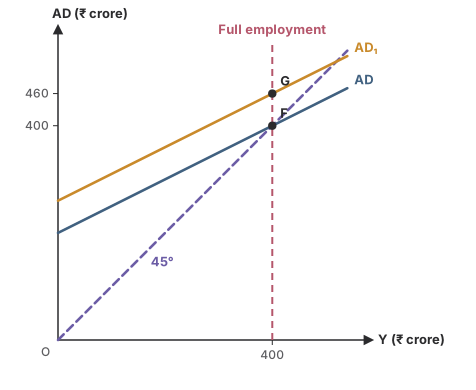
Excess demand : AD is greater than output at full employment. The inflationary gap is the size of that excess, measured vertically at full-employment income.
The inflationary gap is GF = 460 − 400 = ₹60 crore. Output cannot rise beyond full employment in the short run, so the extra demand pushes up prices : shortages, waiting lists and inflation, with no gain in real output.
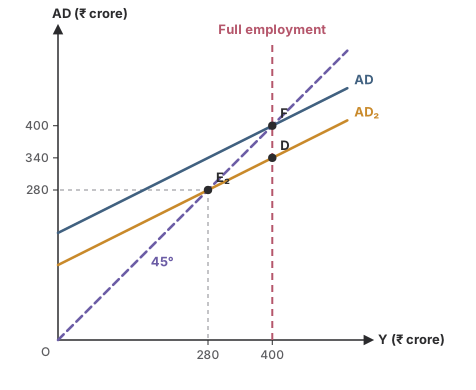
Deficient demand : AD is less than output at full employment. The deflationary gap is the shortfall at full-employment income.
The deflationary gap is FD = ₹60 crore; with AD₂ the economy settles at E₂, ₹280 crore. Unsold goods pile up, firms cut output and jobs, and the economy settles at an underemployment equilibrium , here ₹280 crore, with involuntary unemployment.
The gap is measured in AD at full employment (₹60 crore here), not in income. The shortfall in income (400 − 280 = 120) is the gap times the multiplier, 2 here.
Example 1 · Sizing the gap
C = 40 + 0.75Y, planned investment ₹80 crore, full-employment income ₹400 crore.
AD at full employment = 40 + 0.75 × 400 + 80 = 420.
Inflationary gap = 420 − 400 = ₹20 crore.
A ₹20 crore cut in government spending closes it.
Answer Inflationary gap ₹20 crore
Excess demand Deficient demand Government spending Cut it Raise it (public works) Taxes Raise them Cut them Repo and bank rate Raise them Cut them CRR and SLR Raise them Cut them Open market operations Sell securities Buy securities Margin requirements Raise them Lower them
The first two are fiscal policy, decided by the government in its budget; the rest are monetary policy, run by the RBI.
Example 2 · Spending needed for full employment
Equilibrium income is ₹400 crore, full-employment income ₹500 crore, MPC 0.8.
Income must rise by 100; the multiplier is 1 ÷ 0.2 = 5.
Government spending must rise by 100 ÷ 5 = ₹20 crore.
Inflationary gap = AD at full employment − full-employment output.
Deflationary gap = full-employment output − AD at full employment.
Close a gap by shifting AD by the gap; income moves by gap × multiplier.
Excess demand → tight policy; deficient demand → easy policy.
Measuring the gap in income instead of in AD.
Saying excess demand raises real output beyond full employment.
Raising taxes to cure deficient demand.
Counting frictional unemployment as involuntary.
Gaps
Excess demand: AD > full-employment output → inflation
Deficient demand: AD < full-employment output → unemployment
Gaps measured vertically at full employment
Remedies
Fiscal: G and taxes
Monetary: repo, bank rate, CRR, SLR, OMO, margins
Tight for excess, easy for deficient
The government's own spending and taxes are laid out in the government budget .
Next · 08 Quick revision → Check your understanding 53 questions, grouped by type, easy to hard. Pick an answer and check it. The worked solution opens when you ask for it.
Full employment and involuntary unemployment Q1 of 53 Q1
Full employment and involuntary unemployment 8 questions Full employment is a situation in which
Options for question 1 A Option A every person in the country has a job, including children and the old B Option B everyone who is able and willing to work at the going wage has work C Option C there is no unemployment of any kind at all D Option D all workers are employed by the government
Skip Check Show the explanation Hide the explanation Next question Try again
Show the explanation Hide the explanation Answer B · everyone who is able and willing to work at the going wage has work
Full employment means no involuntary unemployment.
Some frictional unemployment (people between jobs) and voluntary unemployment can still exist.
Worth noting
'No unemployment of any kind' is too strong; full employment allows people who are changing jobs or do not want to work at the going wage.
Involuntary unemployment means
Options for question 2 A Option A people do not want to work at the going wage B Option B people are between two jobs C Option C students are not working D Option D people willing to work at the going wage cannot find work
Skip Check Show the explanation Hide the explanation Next question Try again
Show the explanation Hide the explanation Answer D · people willing to work at the going wage cannot find work
Involuntary unemployment exists when there are more people willing to work than jobs at the current wage.
Disguised unemployment is most common in
Options for question 3 A Option A large factories with machines B Option B software companies C Option C government offices only D Option D small family farms
Skip Check Show the explanation Hide the explanation Next question Try again
Show the explanation Hide the explanation Answer D · small family farms
Removing some workers from a small family farm would not reduce its output: their marginal product is zero.
Match each case with the kind of unemployment.
List I List II A. A graduate refuses jobs below ₹50,000 a month though such jobs exist I. Frictional B. A factory worker looks for work at the going wage but finds none in a slump II. Voluntary C. A software engineer is between leaving one job and joining the next III. Disguised D. A family of five does work that three could do on its small farm IV. Involuntary
Options for question 4 A Option A A-II, B-IV, C-I, D-III B Option B A-II, B-I, C-III, D-IV C Option C A-I, B-II, C-IV, D-III D Option D A-III, B-IV, C-I, D-II
Skip Check Show the explanation Hide the explanation Next question Try again
Show the explanation Hide the explanation Answer A · A-II, B-IV, C-I, D-III
Refusing available jobs is voluntary; failing to find work at the going wage is involuntary.
Between jobs is frictional; extra hands adding nothing on a farm is disguised unemployment.
Assertion (A): Equilibrium income can be below the full-employment level.
Reason (R): Equilibrium depends on aggregate demand, which may be too low to employ everyone willing to work.
Options for question 5 A Option A Both A and R are true, and R is the correct explanation of A. B Option B Both A and R are true, but R is not the correct explanation of A. C Option C A is true, but R is false. D Option D A is false, but R is true.
Skip Check Show the explanation Hide the explanation Next question Try again
Show the explanation Hide the explanation Answer A · Both A and R are true, and R is the correct explanation of A.
Keynes's key point: AD = AS can occur with involuntary unemployment. R explains A.
Read the two statements and choose the correct option.
I. At full employment, there are no frictional unemployed people.
II. At full employment, output cannot rise further in the short run.
Options for question 6 A Option A Only I B Option B Only II C Option C Both I and II D Option D Neither I nor II
Skip Check Show the explanation Hide the explanation Next question Try again
Show the explanation Hide the explanation Answer B · Only II
People changing jobs are always present. I is false.
With all willing workers employed, output is at its short-run limit. II is true.
Which kind of unemployment does Keynesian policy to raise aggregate demand aim to remove?
Options for question 7 A Option A Voluntary unemployment B Option B Frictional unemployment C Option C Unemployment of students D Option D Involuntary unemployment
Skip Check Show the explanation Hide the explanation Next question Try again
Show the explanation Hide the explanation Answer D · Involuntary unemployment
More demand creates jobs for people who want work at the going wage but cannot find it.
In Keynes's theory, an economy can be in equilibrium
Options for question 8 A Option A at full employment or below it B Option B only at full employment C Option C only above full employment D Option D never
Skip Check Show the explanation Hide the explanation Next question Try again
Show the explanation Hide the explanation Answer A · at full employment or below it
Equilibrium needs AD = output, which can happen at any level of output up to full employment.
Excess demand and the inflationary gap 13 questions Excess demand is a situation in which
Options for question 9 A Option A aggregate demand is less than aggregate supply at full employment B Option B demand for one good exceeds its supply C Option C aggregate demand is greater than aggregate supply at the full-employment level of output D Option D aggregate demand equals aggregate supply
Skip Check Show the explanation Hide the explanation Next question Try again
Show the explanation Hide the explanation Answer C · aggregate demand is greater than aggregate supply at the full-employment level of output
Spending planned is more than the economy can produce with full employment.
Worth noting
Demand exceeding supply for one good is a micro idea; excess demand here is for the whole economy.
Options for question 10 A Option A the amount by which aggregate supply exceeds aggregate demand at full employment B Option B the amount by which aggregate demand exceeds aggregate supply at full employment C Option C the rise in the price level in a year D Option D the gap between exports and imports
Skip Check Show the explanation Hide the explanation Next question Try again
Show the explanation Hide the explanation Answer B · the amount by which aggregate demand exceeds aggregate supply at full employment
It measures the excess demand at the full-employment level of output.
Which of these is NOT a measure to correct excess demand?
Options for question 11 A Option A Raising government spending B Option B Raising taxes C Option C Raising the repo rate D Option D Selling government securities
Skip Check Show the explanation Hide the explanation Next question Try again
Show the explanation Hide the explanation Answer A · Raising government spending
More government spending adds to AD and makes excess demand worse.
The graph shows AD₁ above AD at the full-employment income. The inflationary gap is
Options for question 12 A Option A ₹60 crore B Option B ₹120 crore C Option C ₹400 crore D Option D ₹460 crore
Skip Check Show the explanation Hide the explanation Next question Try again
Show the explanation Hide the explanation Answer A · ₹60 crore
At the full-employment income of 400, AD₁ = 460 (point G) while full-employment output is 400 (point F).
Gap = 460 − 400 = ₹60 crore.
Worth noting
₹120 crore would be the multiplied effect on money income; the gap itself is the vertical distance at full employment.
The graph shows AD₁ above AD at full employment. Since output cannot rise beyond full employment in the short run, the excess demand mainly causes
Options for question 13 A Option A a rise in real output and employment B Option B a fall in prices C Option C a rise in the general price level D Option D involuntary unemployment
Skip Check Show the explanation Hide the explanation Next question Try again
Show the explanation Hide the explanation Answer C · a rise in the general price level
With all resources already in use, extra spending bids up prices instead of output.
Match each effect with excess demand or deficient demand.
List I List II A. Prices rise with no rise in output I. Deficient demand: excess stock B. Unsold stocks pile up II. Deficient demand: job losses C. Firms' order books are full and stocks run down III. Excess demand: inflation D. Involuntary unemployment rises IV. Excess demand: shortages
Options for question 14 A Option A A-III, B-I, C-IV, D-II B Option B A-III, B-IV, C-II, D-I C Option C A-IV, B-III, C-I, D-II D Option D A-II, B-I, C-IV, D-III
Skip Check Show the explanation Hide the explanation Next question Try again
Show the explanation Hide the explanation Answer A · A-III, B-I, C-IV, D-II
Too much spending shows up as rising prices and running-down stocks.
Too little spending shows up as piling stocks and lost jobs.
Assertion (A): Excess demand at full employment leads to inflation.
Reason (R): At full employment, output cannot rise to meet the extra demand.
Options for question 15 A Option A Both A and R are true, and R is the correct explanation of A. B Option B Both A and R are true, but R is not the correct explanation of A. C Option C A is true, but R is false. D Option D A is false, but R is true.
Skip Check Show the explanation Hide the explanation Next question Try again
Show the explanation Hide the explanation Answer A · Both A and R are true, and R is the correct explanation of A.
Only prices can adjust when output is at its limit. R explains A.
Which of these could cause excess demand?
Options for question 16 A Option A A rise in the CRR when prices are already rising B Option B A rise in income tax rates for every slab C Option C A fall in exports to the rest of the world D Option D A big rise in government spending at full employment
Skip Check Show the explanation Hide the explanation Next question Try again
Show the explanation Hide the explanation Answer D · A big rise in government spending at full employment
Extra spending at full employment pushes AD above full-employment output.
The other three lower AD.
The graph shows AD₁ above AD at full employment. To close the gap with fiscal policy, aggregate demand must be brought down from
Options for question 17 A Option A AD₁ to AD, by ₹60 crore, through spending cuts or higher taxes B Option B AD to AD₁, by raising spending C Option C AD₁ to AD, by ₹120 crore D Option D AD₁ to the horizontal axis
Skip Check Show the explanation Hide the explanation Next question Try again
Show the explanation Hide the explanation Answer A · AD₁ to AD, by ₹60 crore, through spending cuts or higher taxes
Cutting G or raising taxes by the size of the gap, ₹60 crore, shifts AD₁ down until it passes through F.
Read the two statements and choose the correct option.
I. Excess demand raises real output beyond the full-employment level.
II. Excess demand creates an inflationary gap.
Options for question 18 A Option A Only I B Option B Only II C Option C Both I and II D Option D Neither I nor II
Skip Check Show the explanation Hide the explanation Next question Try again
Show the explanation Hide the explanation Answer B · Only II
Output cannot go beyond full employment in the short run; prices rise instead. I is false.
The excess of AD over full-employment output is the inflationary gap. II is true.
Full-employment output is ₹1,000 crore and aggregate demand at that output is ₹1,050 crore. There is
Options for question 19 A Option A a deflationary gap of ₹50 crore B Option B an inflationary gap of ₹1,050 crore C Option C an inflationary gap of ₹50 crore D Option D no gap
Skip Check Show the explanation Hide the explanation Next question Try again
Show the explanation Hide the explanation Answer C · an inflationary gap of ₹50 crore
AD exceeds full-employment output by 1,050 − 1,000 = ₹50 crore: an inflationary gap.
Which of these is most likely to be seen when there is excess demand?
Options for question 20 A Option A Unsold goods in warehouses B Option B Shortages and rising prices C Option C Factories cutting shifts D Option D Falling prices
Skip Check Show the explanation Hide the explanation Next question Try again
Show the explanation Hide the explanation Answer B · Shortages and rising prices
Buyers want more than can be produced, so goods run short and prices are bid up.
C = 40 + 0.75Y, planned investment is ₹80 crore and full-employment income is ₹400 crore. The inflationary gap is
Options for question 21 A Option A ₹20 crore B Option B ₹40 crore C Option C ₹80 crore D Option D ₹420 crore
Skip Check Show the explanation Hide the explanation Next question Try again
Show the explanation Hide the explanation Answer A · ₹20 crore
AD at an income of 400 = 40 + 0.75 × 400 + 80 = 420.
Gap = AD − full-employment output = 420 − 400 = ₹20 crore.
Deficient demand and the deflationary gap 12 questions Deficient demand is a situation in which
Options for question 22 A Option A aggregate demand is greater than aggregate supply at full employment B Option B there is no demand at all C Option C aggregate demand is less than aggregate supply at the full-employment level of output D Option D prices are rising fast
Skip Check Show the explanation Hide the explanation Next question Try again
Show the explanation Hide the explanation Answer C · aggregate demand is less than aggregate supply at the full-employment level of output
Planned spending is too low to buy all that full employment would produce.
Options for question 23 A Option A the amount by which aggregate demand falls short of aggregate supply at full employment B Option B the fall in prices in a year C Option C the amount by which AD exceeds AS at full employment D Option D the gap between saving and consumption
Skip Check Show the explanation Hide the explanation Next question Try again
Show the explanation Hide the explanation Answer A · the amount by which aggregate demand falls short of aggregate supply at full employment
It measures the shortfall of demand at the full-employment level of output.
The graph shows AD₂ below AD at the full-employment income. The deflationary gap is
Options for question 24 A Option A ₹60 crore B Option B ₹120 crore C Option C ₹280 crore D Option D ₹340 crore
Skip Check Show the explanation Hide the explanation Next question Try again
Show the explanation Hide the explanation Answer A · ₹60 crore
At the full-employment income of 400, AD₂ = 340 (point D) while full-employment output is 400 (point F).
Gap = 400 − 340 = ₹60 crore.
Worth noting
₹120 crore is the shortfall of equilibrium income (400 − 280), not the gap in demand.
The graph shows AD₂ below AD. With AD₂, the economy settles at E₂. What does this mean?
Options for question 25 A Option A The economy is at full employment B Option B Equilibrium income is ₹280 crore, with involuntary unemployment C Option C Prices rise because demand is too high D Option D Equilibrium income is ₹340 crore
Skip Check Show the explanation Hide the explanation Next question Try again
Show the explanation Hide the explanation Answer B · Equilibrium income is ₹280 crore, with involuntary unemployment
AD₂ meets the 45° line at E₂, at Y = 280, short of the full-employment income of 400.
Output and jobs are below full employment: an underemployment equilibrium.
Which of these is an effect of deficient demand?
Options for question 26 A Option A Prices rise sharply B Option B Firms' stocks run down C Option C Output rises beyond full employment D Option D Output and employment fall
Skip Check Show the explanation Hide the explanation Next question Try again
Show the explanation Hide the explanation Answer D · Output and employment fall
Unsold goods pile up, so firms cut production and lay off workers.
Assertion (A): Deficient demand can cause long-lasting involuntary unemployment.
Reason (R): With demand too low, the economy can settle at an equilibrium below full employment, with no force pushing output up.
Options for question 27 A Option A Both A and R are true, and R is the correct explanation of A. B Option B Both A and R are true, but R is not the correct explanation of A. C Option C A is true, but R is false. D Option D A is false, but R is true.
Skip Check Show the explanation Hide the explanation Next question Try again
Show the explanation Hide the explanation Answer A · Both A and R are true, and R is the correct explanation of A.
At that equilibrium, firms sell all they produce, so they have no reason to hire more. R explains A.
Read the two statements and choose the correct option.
I. A deflationary gap means that prices must be falling.
II. A deflationary gap means that output is above the full-employment level.
Options for question 28 A Option A Only I B Option B Only II C Option C Both I and II D Option D Neither I nor II
Skip Check Show the explanation Hide the explanation Next question Try again
Show the explanation Hide the explanation Answer D · Neither I nor II
The main effect is lower output and employment; prices may stay sticky. I is false.
With too little demand, output settles below full employment, not above it. II is false.
Full-employment output is ₹1,000 crore and aggregate demand at that output is ₹900 crore. The deflationary gap is
Options for question 29 A Option A ₹10 crore B Option B ₹100 crore C Option C ₹900 crore D Option D ₹1,900 crore
Skip Check Show the explanation Hide the explanation Next question Try again
Show the explanation Hide the explanation Answer B · ₹100 crore
Gap = full-employment output − AD = 1,000 − 900 = ₹100 crore.
Which of these could cause deficient demand?
Options for question 30 A Option A A rise in government spending B Option B A sharp fall in private investment as firms become pessimistic C Option C A cut in the repo rate D Option D A rise in exports
Skip Check Show the explanation Hide the explanation Next question Try again
Show the explanation Hide the explanation Answer B · A sharp fall in private investment as firms become pessimistic
Lower investment cuts AD directly and, through the multiplier, income.
The other three raise AD.
Assertion (A): Deficient demand pushes prices up sharply.
Reason (R): Deficient demand means AD is less than output at full employment.
Options for question 31 A Option A Both A and R are true, and R is the correct explanation of A. B Option B Both A and R are true, but R is not the correct explanation of A. C Option C A is true, but R is false. D Option D A is false, but R is true.
Skip Check Show the explanation Hide the explanation Next question Try again
Show the explanation Hide the explanation Answer D · A is false, but R is true.
R is the definition of deficient demand, so it is true.
With too little demand, goods go unsold; prices do not rise sharply. A is false.
C = 40 + 0.75Y, planned investment is ₹40 crore and full-employment income is ₹400 crore. The deflationary gap is
Options for question 32 A Option A ₹20 crore B Option B ₹40 crore C Option C ₹60 crore D Option D ₹80 crore
Skip Check Show the explanation Hide the explanation Next question Try again
Show the explanation Hide the explanation Answer A · ₹20 crore
AD at an income of 400 = 40 + 0.75 × 400 + 40 = 380.
Gap = 400 − 380 = ₹20 crore.
Worth noting
₹80 crore is how far equilibrium income (320) falls short of 400, which is the gap times the multiplier 4.
The graph shows AD₂ below AD. If AD₂ is raised by ₹60 crore at every income, equilibrium income rises by
Options for question 33 A Option A ₹60 crore B Option B ₹120 crore C Option C ₹340 crore D Option D ₹400 crore
Skip Check Show the explanation Hide the explanation Next question Try again
Show the explanation Hide the explanation Answer B · ₹120 crore
Raising AD₂ by 60 makes it AD, which meets the 45° line at F (₹400 crore).
Income rises from E₂ (280) to F (400), by ₹120 crore: the multiplier, 2 here, at work.
Fiscal measures 10 questions Fiscal policy is the use of
Options for question 34 A Option A government spending and taxes B Option B the repo rate and the CRR C Option C the exchange rate D Option D open market operations
Skip Check Show the explanation Hide the explanation Next question Try again
Show the explanation Hide the explanation Answer A · government spending and taxes
Fiscal policy is set by the government through its budget.
To correct excess demand, the government should
Options for question 35 A Option A raise its spending and cut taxes B Option B cut the repo rate C Option C raise its borrowing to spend more D Option D cut its spending and raise taxes
Skip Check Show the explanation Hide the explanation Next question Try again
Show the explanation Hide the explanation Answer D · cut its spending and raise taxes
Less government spending lowers G directly; higher taxes lower disposable income and consumption.
Both bring AD down towards full-employment output.
To correct deficient demand, the government should
Options for question 36 A Option A cut its spending and raise taxes B Option B raise its spending on public works and cut taxes C Option C raise the CRR D Option D run a budget surplus
Skip Check Show the explanation Hide the explanation Next question Try again
Show the explanation Hide the explanation Answer B · raise its spending on public works and cut taxes
More spending and lower taxes raise AD, which raises output and jobs through the multiplier.
Assertion (A): A rise in income tax helps to reduce deficient demand.
Reason (R): Higher taxes leave households with less disposable income to spend.
Options for question 37 A Option A Both A and R are true, and R is the correct explanation of A. B Option B Both A and R are true, but R is not the correct explanation of A. C Option C A is true, but R is false. D Option D A is false, but R is true.
Skip Check Show the explanation Hide the explanation Next question Try again
Show the explanation Hide the explanation Answer D · A is false, but R is true.
R is true: taxes reduce disposable income and consumption.
So a tax rise makes deficient demand worse, not better. A is false.
Read the two statements and choose the correct option.
I. Cutting taxes during a boom helps to control inflation.
II. Raising public spending on roads during a slump can raise income by more than the amount spent.
Options for question 38 A Option A Only I B Option B Only II C Option C Both I and II D Option D Neither I nor II
Skip Check Show the explanation Hide the explanation Next question Try again
Show the explanation Hide the explanation Answer B · Only II
Tax cuts raise spending, which adds to inflation in a boom. I is false.
Government spending works through the multiplier. II is true.
The MPC is 0.75 and the government raises its spending by ₹30 crore. Income rises by
Options for question 39 A Option A ₹22.5 crore B Option B ₹30 crore C Option C ₹40 crore D Option D ₹120 crore
Skip Check Show the explanation Hide the explanation Next question Try again
Show the explanation Hide the explanation Answer D · ₹120 crore
Government spending is multiplied like investment: k = 1 ÷ 0.25 = 4.
ΔY = 4 × 30 = ₹120 crore.
Read the two statements and choose the correct option.
I. A budget surplus is a suitable remedy for deficient demand.
II. Borrowing to spend more on public works is a remedy for deficient demand.
Options for question 40 A Option A Only I B Option B Only II C Option C Both I and II D Option D Neither I nor II
Skip Check Show the explanation Hide the explanation Next question Try again
Show the explanation Hide the explanation Answer B · Only II
A surplus takes more in taxes than it spends, which lowers AD. I is false.
Deficit-financed spending adds to AD. II is true.
There is an inflationary gap of ₹20 crore. By how much should the government cut its spending to close it?
Options for question 41 A Option A ₹5 crore B Option B ₹20 crore C Option C ₹80 crore D Option D ₹400 crore
Skip Check Show the explanation Hide the explanation Next question Try again
Show the explanation Hide the explanation Answer B · ₹20 crore
The gap is measured in AD at full employment. A cut of ₹20 crore in G lowers AD by ₹20 crore at every income.
That brings AD at full employment down to full-employment output, closing the gap.
Worth noting
₹80 crore is the change in income the cut brings about, not the cut itself.
Equilibrium income is ₹400 crore, full-employment income is ₹500 crore and the MPC is 0.8. By how much must government spending rise to reach full employment?
Options for question 42 A Option A ₹20 crore B Option B ₹80 crore C Option C ₹100 crore D Option D ₹500 crore
Skip Check Show the explanation Hide the explanation Next question Try again
Show the explanation Hide the explanation Answer A · ₹20 crore
Income must rise by 500 − 400 = 100; the multiplier is 1 ÷ 0.2 = 5.
Required ΔG = 100 ÷ 5 = ₹20 crore.
Worth noting
₹100 crore is the rise in income needed; the multiplier means spending need rise only a fifth of that.
There is a deflationary gap of ₹50 crore and the MPC is 0.8. To reach full employment, government spending should rise by
Options for question 43 A Option A ₹10 crore B Option B ₹40 crore C Option C ₹50 crore D Option D ₹250 crore
Skip Check Show the explanation Hide the explanation Next question Try again
Show the explanation Hide the explanation Answer C · ₹50 crore
The gap is the shortfall of AD at full employment, so AD must rise by ₹50 crore.
A ₹50 crore rise in G does that; income then rises by 5 × 50 = 250 to full employment.
Worth noting
₹250 crore is the rise in income, not the rise in spending needed.
Monetary measures 10 questions Raising the bank rate is a measure to correct
Options for question 44 A Option A deficient demand B Option B unemployment caused by low demand C Option C excess demand D Option D a deflationary gap
Skip Check Show the explanation Hide the explanation Next question Try again
Show the explanation Hide the explanation Answer C · excess demand
A higher bank rate makes borrowing costlier and reduces spending.
Read the two statements and choose the correct option.
I. Fiscal policy is decided by the Reserve Bank of India.
II. Monetary policy is decided by the Reserve Bank of India.
Options for question 45 A Option A Only I B Option B Only II C Option C Both I and II D Option D Neither I nor II
Skip Check Show the explanation Hide the explanation Next question Try again
Show the explanation Hide the explanation Answer B · Only II
Fiscal policy is the government's budget. I is false.
The RBI, through its Monetary Policy Committee, runs monetary policy. II is true.
Which monetary measure helps to correct excess demand?
Options for question 46 A Option A Cutting the CRR B Option B Buying government securities C Option C Raising the repo rate D Option D Lowering margin requirements
Skip Check Show the explanation Hide the explanation Next question Try again
Show the explanation Hide the explanation Answer C · Raising the repo rate
A higher repo rate makes credit costlier, so borrowing and spending fall.
The other three make credit cheaper or more plentiful.
Which monetary measure helps to correct deficient demand?
Options for question 47 A Option A Raising the bank rate B Option B Raising the SLR C Option C Buying government securities in the open market D Option D Raising margin requirements
Skip Check Show the explanation Hide the explanation Next question Try again
Show the explanation Hide the explanation Answer C · Buying government securities in the open market
Purchases add to banks' reserves, so they can lend more and spending rises.
Assertion (A): Selling government securities in the open market helps to control excess demand.
Reason (R): Selling securities adds to banks' reserves and their ability to lend.
Options for question 48 A Option A Both A and R are true, and R is the correct explanation of A. B Option B Both A and R are true, but R is not the correct explanation of A. C Option C A is true, but R is false. D Option D A is false, but R is true.
Skip Check Show the explanation Hide the explanation Next question Try again
Show the explanation Hide the explanation Answer C · A is true, but R is false.
A is true: sales take money out of the banking system.
R is false: buyers pay the RBI, so banks' reserves and lending fall, not rise.
Read the two statements and choose the correct option.
I. Lowering margin requirements helps to fight deficient demand.
II. Raising the SLR helps to fight deficient demand.
Options for question 49 A Option A Only I B Option B Only II C Option C Both I and II D Option D Neither I nor II
Skip Check Show the explanation Hide the explanation Next question Try again
Show the explanation Hide the explanation Answer A · Only I
Lower margins let borrowers get larger loans, raising spending. I is true.
A higher SLR locks up more bank funds and cuts lending. II is false.
During a period of deficient demand, which combination of policies is most suitable?
Options for question 50 A Option A Lower government spending, higher taxes and a higher repo rate B Option B Higher taxes and a lower CRR C Option C A budget surplus and sales of securities D Option D Higher government spending, lower taxes and a lower repo rate
Skip Check Show the explanation Hide the explanation Next question Try again
Show the explanation Hide the explanation Answer D · Higher government spending, lower taxes and a lower repo rate
All three raise AD: more public spending, more disposable income and cheaper credit.
During deficient demand, a cut in the CRR works mainly by
Options for question 51 A Option A raising taxes B Option B cutting government spending C Option C raising the exchange rate D Option D freeing funds for banks to lend
Skip Check Show the explanation Hide the explanation Next question Try again
Show the explanation Hide the explanation Answer D · freeing funds for banks to lend
Banks keep less with the RBI, so they can lend more, and more credit supports spending.
Assertion (A): In a slump, the RBI buys government securities.
Reason (R): Purchases add reserves to banks, which can then lend more.
Options for question 52 A Option A Both A and R are true, and R is the correct explanation of A. B Option B Both A and R are true, but R is not the correct explanation of A. C Option C A is true, but R is false. D Option D A is false, but R is true.
Skip Check Show the explanation Hide the explanation Next question Try again
Show the explanation Hide the explanation Answer A · Both A and R are true, and R is the correct explanation of A.
More lending raises spending and helps close a deflationary gap. R explains A.
Match each measure with the problem it is used to correct.
List I List II A. Raising the CRR I. Deficient demand (monetary) B. Cutting taxes II. Excess demand (open market) C. Selling government securities III. Deficient demand (fiscal) D. Cutting the repo rate IV. Excess demand (monetary)
Options for question 53 A Option A A-IV, B-II, C-I, D-III B Option B A-IV, B-III, C-II, D-I C Option C A-II, B-IV, C-III, D-I D Option D A-I, B-III, C-II, D-IV
Skip Check Show the explanation Hide the explanation Back to start Try again
Show the explanation Hide the explanation Answer B · A-IV, B-III, C-II, D-I
A higher CRR and sales of securities shrink credit; tax cuts and repo cuts expand spending.
Question types · easy to hard
NTA's Economics syllabus is three courses: Introductory Microeconomics, Introductory Macroeconomics and Indian Economic Development, each split into units with a list of topics. It prints no chapters and no split of the 50 questions across the courses. So the areas here are NTA's three courses, and the chapters inside them are ours: a unit that covers several ideas, such as consumer behaviour and demand, is split into a chapter for each, so that a chapter can be practised in one sitting. All three courses are here.