EduFarming
Your list · 0हिं

Type at least two letters. Press Esc to close.

↑↓ navigate↵ openTAB cycle filter

Indian History and the Freedom Movement for CUET General Aptitude

About 10 min to learn · 75 questions

History is where a confident wrong answer is easiest to give: the options are four things you have genuinely heard of. What wins the mark is keeping nearby facts apart, such as the march and the law it broke, or the battle that won influence and the one that won revenue. This lesson runs from the Indus cities to the Constitution, organised around the pairs that get confused, with every key date cited to its source and a timeline of the freedom movement.

Syllabus area
General Knowledge
On this page · 9 sections
  1. 01The core idea
  2. 02Ancient India
  3. 03Medieval India
  4. 04Company rule and 1857
  5. 05The freedom movement
  6. 06Exam shortcuts
  7. 07Common mistakes
  8. 08Quick revision
  9. 09Check your understanding

The core idea

History questions are built from pairs that sit close together: two battles seven years apart, two Chandraguptas six hundred years apart, a march that began on one date and a law broken on another. Learning more facts helps less than keeping each pair apart, so this lesson is organised around them.

Every key date below carries its source; hover it to see where it comes from. Where the record itself is contested, as it is on one famous event, the lesson says so instead of picking a number.

Ancient India

How old and how large was the Indus Valley Civilisation?

Also called the Harappan Civilisation, it is old enough that everything else here is recent. The earliest evidence at Dholavira goes back to 3000 BCE, and the city there spans the 3rd to the mid-2nd millennium BCE. The sites found so far number more than 1,000, not the famous handful.

SitePresent stateKnown for
Mohenjo-daroSindh, PakistanThe Great Bath
LothalGujaratA brick basin read as a dockyard
KalibanganRajasthanA ploughed field, fire altars
DholaviraGujaratStone-cut reservoirs, no river

What makes Dholavira the site every question uses?

It broke the pattern. Harappan towns sat on rivers; Dholavira sits on the island of Khadir, in the Rann of Kutch, Gujarat, with no perennial water, and stored seasonal streams in stone-cut reservoirs. It was inscribed as a World Heritage Site in 2021, as India's 40th World Heritage property.

Watch out

"Second millennium" is the usual near-miss for the civilisation's age, and "about 50" for the number of sites. For prehistory before cities, the site is the Rock Shelters of Bhimbetka, in Madhya Pradesh, inscribed in 2003: paintings, not a monument.

What should you know about the Vedas, the Buddha and Mahavira?

The Rigveda is the oldest of the four Vedas, and the Sama Veda is hymns set to melody. "Satyameva Jayate", the national motto, comes from the Mundaka Upanishad.

The Buddha and Mahavira lived in the same centuries and the same region, which is exactly why options swap them. Mahavira is the twenty-fourth and last Tirthankara of Jainism, born at Kundagrama near Vaishali. The Tripitaka and the Eightfold Path are Buddhist.

Event in the Buddha's lifePlaceWhere it is
BirthLumbiniNepal
EnlightenmentBodh Gaya (Mahabodhi Temple)Bihar
First sermonSarnathUttar Pradesh
DeathKushinagarUttar Pradesh

What are the Mauryan facts that get asked?

Chandragupta Maurya founded the empire, with its capital at Pataliputra; he is said to have become a Jain monk and died at Shravanabelagola. Kautilya's Arthashastra and Megasthenes' Indica, written as Seleucus Nicator's ambassador, belong to his reign.

Ashoka, his grandson, turned to Buddhism after the Kalinga war and held the Third Buddhist Council at Pataliputra. His edicts are mostly in Brahmi, first read by James Prinsep in 1837. The Sanchi stupas are in Madhya Pradesh, inscribed in 1989, and his Lion Capital at Sarnath became the State Emblem: four lions, three visible.

Watch out

Chandragupta Maurya is not Chandragupta I or II, who are Guptas about six hundred years later. And Ashoka did not found the empire.

Who were the great Guptas and southern dynasties?

NameRemembered for
SamudraguptaConquests; the "Napoleon of India"
Chandragupta II (Vikramaditya)Kalidasa at his court; the pilgrim Fa-Hien visited
AryabhataThe Aryabhatiya
Gupta periodThe rust-free Iron Pillar at Mehrauli
Rajendra I, CholaA naval expedition against Srivijaya

Nalanda Mahavihara, the great monastic university, is in Bihar, inscribed in 2016.

Which dynasty built which monument?

This table answers more questions than any other, because the exam asks from either end: name the dynasty, or name the state.

MonumentDynastyState and inscription
MahabalipuramPallavaTamil Nadu, inscribed in 1984
Great Living Chola TemplesCholaTamil Nadu, 1987 and 2004
PattadakalChalukyaKarnataka, 1987
HampiVijayanagaraKarnataka, inscribed in 1986
KhajurahoChandelaMadhya Pradesh, 1986

Exam shortcut

Pallava and Chola are the pair that gets swapped, because both are in Tamil Nadu. Hampi answers Vijayanagara, never its rival the Bahmani sultanate.

Medieval India

How do you keep the Delhi Sultanate straight?

Five dynasties, in order: Slave (Mamluk), Khalji, Tughlaq, Sayyid, Lodi. The Lodis' defeat at Panipat in 1526 ends the Sultanate.

SultanRemembered for
Qutb-ud-din AibakBegan the Qutb Minar
RaziaThe only woman to rule as Sultan
Alauddin KhaljiMarket price control; the Alai Darwaza
Muhammad bin TughlaqCapital to Daulatabad; token currency

Qutb Minar and its Monuments are in Delhi, inscribed in 1993.

Which Mughal did what?

EmperorAssociated with
BaburFirst Battle of Panipat, 1526; the Baburnama, in Chagatai Turkish
AkbarFatehpur Sikri, in Uttar Pradesh, inscribed in 1986; Din-i-Ilahi; Haldighati, 1576, against Maharana Pratap
Shah JahanThe Taj Mahal; the Red Fort, in Delhi, inscribed in 2007
AurangzebThe title "Alamgir"

Abul Fazl wrote the Akbarnama and the Ain-i-Akbari. Akbar built Fatehpur Sikri as his capital and left it within about fifteen years.

Example 1 · Which Panipat?

A question asks who won the Battle of Panipat that ended the Delhi Sultanate. How do you choose?

  1. Panipat is three battles: 1526 Babur, 1556 Akbar, 1761 the Marathas against Ahmad Shah Abdali.

  2. The Sultanate ended with the Lodis, whom Babur defeated in 1526.

Answer

Babur, in the First Battle of Panipat, 1526

Company rule and 1857

How did a trading company become a government?

Vasco da Gama reached Calicut in 1498 and opened the sea route. The East India Company then won power in two battles, and the second matters more.

Plassey, 1757 won influence over Bengal. Buxar, 1764 won the Diwani, the right to collect the revenue of Bengal, Bihar and Odisha, and collecting revenue is what a government does.

Governor-GeneralRemembered for
CornwallisThe Permanent Settlement, 1793
WellesleyThe Subsidiary Alliance
William BentinckSati banned, 1829; first Governor-General of India, 1833
DalhousieThe Doctrine of Lapse
LyttonThe Vernacular Press Act, 1878
CurzonThe Partition of Bengal, 1905

Watch out

The capital moved from Calcutta to Delhi in 1911, announced at the Durbar; New Delhi was inaugurated in 1931. A question about the shift wants 1911.

What happened in 1857, and what came after?

The revolt began at Meerut in May 1857; Mangal Pandey's act at Barrackpore weeks earlier was the prelude. The rebels proclaimed Bahadur Shah Zafar their symbolic head, while Nana Saheb, Rani Lakshmibai at Jhansi and Tatya Tope led in the field. The Government of India Act, 1858 then moved the government from the Company to the Crown.

YearEvent
1875Arya Samaj, founded by Dayananda Saraswati
1883Ilbert Bill: Indian judges to try Europeans
1885Indian National Congress; first session under W. C. Bonnerjee
1905Partition of Bengal, which set off the Swadeshi movement
1911Partition annulled

Dadabhai Naoroji, the "Grand Old Man of India", set out the drain theory of British rule.

The freedom movement

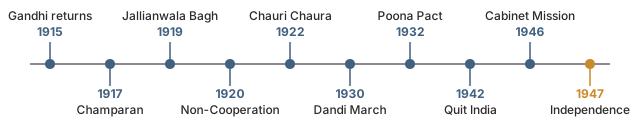
A timeline from 1915 to 1947: Gandhi returns 1915, Champaran 1917, Jallianwala Bagh 1919, Non-Cooperation 1920, Chauri Chaura 1922, Dandi March 1930, Poona Pact 1932, Quit India 1942, Cabinet Mission 1946, Independence 1947.
The Gandhian era in order. Most questions are a pair of neighbours on this line.

How did Gandhi's movements unfold?

Gandhi returned from South Africa in 1915, and his first Indian satyagraha was for the indigo farmers of Champaran in 1917. The Non-Cooperation Movement began in 1920 and was called off in 1922 after the violence at Chauri Chaura. Khan Abdul Ghaffar Khan's Khudai Khidmatgar carried non-violence to the North-West Frontier.

What happened at Jallianwala Bagh, and what does the record say?

The massacre was on 13 April 1919 at Amritsar, where people had gathered for Baisakhi and to protest the arrest of two leaders. Behind it was the Rowlatt Act, the "Black Act", which gave the police power of arrest without any reason whatsoever. The Hunter Committee reported in March 1920: it condemned Dyer unanimously and punished him not at all.

Key idea

This lesson gives no death toll. The official count and the Congress inquiry were far apart, and the count was taken three months later. If a mock marks a number, treat it as that book's opinion; the date, the occasion and the Act are settled.

What are the two dates of the Dandi March?

The march set out on 12 March 1930 from Sabarmati Ashram, with 79 followers, covering 241 miles, covered in 24 days. Gandhi broke the salt law at Dandi on 6 April 1930. It began Civil Disobedience, not Non-Cooperation.

Example 2 · Began or broke?

One question asks when the Dandi March began; another asks when the salt law was broken. What are the answers?

  1. The march left Sabarmati on 12 March 1930.

  2. After 24 days on the road, the salt was raised at Dandi on 6 April 1930.

Answer

12 March 1930 and 6 April 1930

Why did Quit India come when it did?

Because of the offer refused a few months earlier. The Cripps Mission of 1942 offered dominion status in return for India's support in the war, but the demand was now complete independence. Quit India was launched on 8 August 1942 in Bombay, with the call Do or Die — 'Karo ya Maro', and the leaders were arrested within a day.

SloganWhose
Do or DieGandhi, 1942
Dilli ChaloSubhas Chandra Bose, Indian National Army
Jai Jawan Jai KisanLal Bahadur Shastri, 1965

The Poona Pact of 1932, between Gandhi and B. R. Ambedkar, replaced separate electorates for the Depressed Classes with reserved seats.

How does the story end, and where does the Constitution begin?

The Cabinet Mission came in 1946 with a plan, and Mountbatten's plan of 3 June 1947 proposed partition. India became independent on 15 August 1947 under the Indian Independence Act, 1947; C. Rajagopalachari was the only Indian Governor-General.

The Constituent Assembly, presided over by Rajendra Prasad, with B. R. Ambedkar chairing the Drafting Committee, adopted the Constitution on 26 November 1949; it came into force on 26 January 1950.

Watch out

The Cabinet Mission was a plan, not an Act, and the Government of India Act, 1935 was the working constitution until 1950, not the Act of independence.

Exam shortcuts

  • Pairs. Plassey and Buxar; Meerut and Barrackpore; 12 March and 6 April; 1911 and 1931.
  • Dynasty to state. Pallava and Chola: Tamil Nadu; Vijayanagara: Karnataka.
  • Order of five. Slave, Khalji, Tughlaq, Sayyid, Lodi.
  • Panipat by year. 1526, 1556, 1761.
  • One policy per Governor-General.

Common mistakes

  • Ashoka as founder of the Mauryan empire.
  • Chandragupta Maurya for a Gupta.
  • Plassey for the Diwani. It was Buxar.
  • Barrackpore for where 1857 began.
  • Non-Cooperation for the Dandi March.
  • Sevagram for Sabarmati.
  • 1931 for the capital's move.
  • The Cabinet Mission as an Act.

Quick revision

Ancient

  • Harappan: over 1,000 sites; Dholavira without a river
  • Buddha: Lumbini, Bodh Gaya, Sarnath, Kushinagar
  • Mauryas: Chandragupta founds, Ashoka after Kalinga

Medieval and colonial

  • Slave, Khalji, Tughlaq, Sayyid, Lodi
  • Panipat 1526, 1556, 1761
  • Plassey 1757 influence, Buxar 1764 revenue

Freedom movement

  • Jallianwala 13 Apr 1919, Baisakhi, Rowlatt Act
  • Dandi 12 Mar to 6 Apr 1930
  • Quit India 8 Aug 1942, Do or Die

The story continues in Indian polity and the Constitution, and the monuments reappear in art, culture and heritage.

Next · 08Quick revision

Check your understanding

75 questions, grouped by type, easy to hard. Pick an answer and check it. The worked solution opens when you ask for it.

The Indus Valley CivilisationQ1 of 75Q1

The Indus Valley Civilisation

7 questions

Dholavira, the Harappan city inscribed on UNESCO's World Heritage List, lies in which state?

Options for question 1

Show the explanationHide the explanation

AnswerD · Gujarat

  1. Dholavira stands on the island of Khadir, in the Rann of Kutch.

  2. Kalibangan is the Harappan site in Rajasthan and Rakhigarhi is the one in Haryana.

  3. All three are genuinely Harappan, so the question is asking you to place the site rather than recognise the name.

Worth noting

Rakhigarhi is the tempting answer because it is the largest Harappan site in India. Largest is not the same as this one.

The Great Bath, a large brick-lined tank of the Harappan civilisation, was found at

Options for question 2

Show the explanationHide the explanation

AnswerC · Mohenjo-daro

  1. The Great Bath stands in the citadel of Mohenjo-daro, in Sindh, now in Pakistan.

  2. Its bricks were sealed with bitumen to hold water, and it is usually read as a place for ritual bathing.

The urban settlement at Dholavira dates from which period?

Options for question 3

Show the explanationHide the explanation

AnswerA · The 3rd to the mid-2nd millennium BCE

  1. The settlement belongs to the third and second millennia BCE, with the earliest evidence around 3000 BCE.

  2. That is the span usually given for the Harappan civilisation as a whole, so the date doubles as the date of the civilisation.

  3. Anything in the first millennium BCE is already the Vedic and post-Vedic world, which is a later chapter of the same story.

Worth noting

A question that asks 'how old is the Indus Valley Civilisation' wants the third millennium BCE. Answering 'the second' is the common slip.

Roughly how many Harappan sites have been discovered so far?

Options for question 4

Show the explanationHide the explanation

AnswerC · More than 1,000

  1. More than a thousand Harappan sites are known.

  2. The famous names — Harappa, Mohenjo-daro, Dholavira, Lothal, Kalibangan, Rakhigarhi — are a handful out of that number.

  3. The point of the question is scale: this was a settlement network across a large region, not a few cities.

Worth noting

Every wrong option here is the number of sites a reader could name, which is exactly the mistake being tested.

When Dholavira was inscribed on the World Heritage List in 2021, it became India's

Options for question 5

Show the explanationHide the explanation

AnswerC · 40th World Heritage property

  1. Dholavira was inscribed on 27 July 2021 as India's 40th property.

  2. The Ramappa Temple in Telangana had become the 39th a few days earlier, in the same session.

  3. India's total has risen since, so this is a fact about 2021 and not about today's count.

Worth noting

Two Indian sites were inscribed days apart in 2021. A question naming one of them is usually testing whether you have them in the right order.

What distinguishes Dholavira from most other Harappan towns?

Options for question 6

Show the explanationHide the explanation

AnswerC · It was not sited near a river, and stored water in large stone-cut reservoirs

  1. Harappan towns were normally placed on rivers or other perennial water.

  2. Dholavira sits on an arid island, so water was diverted from seasonal streams and held in rock-cut reservoirs along the fortifications.

  3. That water system, not the brickwork, is why the site is the standard example of Harappan water management.

Worth noting

Dholavira is in fact heavily fortified and used dressed stone rather than brick as its main building material, so the claims about baked brick and a missing fortification wall are both the reverse of the truth.

Which Harappan site in Gujarat has a large brick basin that is widely identified as a dockyard?

Options for question 7

Show the explanationHide the explanation

AnswerA · Lothal

  1. Lothal, near the Gulf of Khambhat, has a brick basin connected by a channel to an old course of the Sabarmati, read as a dock for boats.

  2. Beads and seals found there point to trade by sea, including with Mesopotamia.

  3. Dholavira, Surkotada and Rangpur are also Harappan sites in Gujarat, which is what makes the options hard.

The Vedic age, Buddhism and Jainism

8 questions

Which is the oldest of the four Vedas?

Options for question 8

Show the explanationHide the explanation

AnswerD · Rigveda

  1. The Rigveda is the earliest of the four and the oldest text in the tradition.

  2. The Samaveda sets Rigvedic verses to melody, the Yajurveda supplies sacrificial formulae, and the Atharvaveda is the latest of the four.

  3. The usual order to remember is Rig, Sama, Yajur, Atharva.

Worth noting

The Samaveda draws most of its verses from the Rigveda, which is why it can feel like the older of the two. It is not.

In which state is the Mahabodhi Temple Complex, which marks the place where the Buddha attained enlightenment?

Options for question 9

Show the explanationHide the explanation

AnswerB · Bihar

  1. Bodh Gaya, where the enlightenment took place, is in Bihar.

  2. Lumbini, the birthplace, is in Nepal; Sarnath, where he first taught, and Kushinagar, where he died, are both in Uttar Pradesh.

  3. Four places, three of them in the options — the question is asking you to separate them.

Worth noting

Nepal is offered because Lumbini genuinely is there. It is the birthplace, not the place of enlightenment.

Who was the twenty-fourth and last Tirthankara of Jainism?

Options for question 10

Show the explanationHide the explanation

AnswerD · Mahavira

  1. Mahavira is the twenty-fourth and last Tirthankara.

  2. Rishabhanatha is counted as the first and Parshvanatha as the twenty-third.

  3. Gautama is the Buddha's name, and belongs to the other tradition entirely.

Worth noting

Mahavira and the Buddha were near-contemporaries, which is why their names are so often swapped between the two traditions in an option set.

The Eightfold Path, which begins with right understanding, is a teaching of

Options for question 11

Show the explanationHide the explanation

AnswerB · Buddhism

  1. The Buddha taught the Four Noble Truths, and the fourth is the Eightfold Path that ends suffering.

  2. Jainism's equivalent teaching is the three jewels (triratna): right faith, right knowledge and right conduct.

The Buddha delivered his first sermon at

Options for question 12

Show the explanationHide the explanation

AnswerB · Sarnath

  1. The first sermon was given at Sarnath, near Varanasi.

  2. It is remembered as the turning of the wheel of law, and it is the reason Sarnath carries the Lion Capital.

  3. Bodh Gaya is the enlightenment, Lumbini the birth, Kushinagar the death.

Worth noting

This is the same four-place set as the Bodh Gaya question, asked from the other end. Learn the four together and both are free.

The Tripitaka is the canonical collection of

Options for question 13

Show the explanationHide the explanation

AnswerB · Buddhism

  1. Tripitaka means 'three baskets' and is the Buddhist canon in Pali.

  2. The three are the Vinaya Pitaka on monastic discipline, the Sutta Pitaka of discourses, and the Abhidhamma Pitaka of doctrine.

  3. The Jain canon is the Agamas, which is the option this question is really distinguishing it from.

Worth noting

'Three baskets' is the giveaway: the name itself tells you the collection has three parts.

India's national motto 'Satyameva Jayate' is taken from

Options for question 14

Show the explanationHide the explanation

AnswerB · the Mundaka Upanishad

  1. 'Satyameva Jayate', truth alone triumphs, is a line from the Mundaka Upanishad.

  2. It is written in Devanagari below the State Emblem.

Mahavira, the twenty-fourth Tirthankara, was born at

Options for question 15

Show the explanationHide the explanation

AnswerD · Kundagrama, near Vaishali

  1. Jain tradition places Mahavira's birth at Kundagrama, near Vaishali in present-day Bihar.

  2. He attained nirvana at Pavapuri, also in Bihar, which is why that is the tempting wrong answer.

  3. Lumbini is the Buddha's birthplace, and Shravasti was a city where the Buddha often stayed.

The Mauryan empire and Ashoka

8 questions

Who founded the Mauryan empire?

Options for question 16

Show the explanationHide the explanation

AnswerB · Chandragupta Maurya

  1. Chandragupta Maurya founded the empire in the late fourth century BCE.

  2. Bindusara was his son and Ashoka his grandson, so both ruled an empire they inherited.

  3. Chandragupta I is a different person altogether — a Gupta ruler, some six hundred years later.

Worth noting

Chandragupta Maurya and Chandragupta I are the trap. One founds the Mauryas, the other belongs to the Guptas.

Which war is said to have turned Ashoka towards Buddhism?

Options for question 17

Show the explanationHide the explanation

AnswerC · The Kalinga war

  1. The conquest of Kalinga, in what is now Odisha, was followed by Ashoka's turn to Buddhism and to his policy of dhamma.

  2. Hydaspes was fought between Alexander and Porus, before the Mauryas.

  3. Kurukshetra belongs to the Mahabharata, and Talikota to the sixteenth century and the fall of Vijayanagara.

Worth noting

Three of the four options are real battles from three different eras. Only Kalinga is Mauryan.

The Buddhist Monuments at Sanchi, the stupa complex associated with Ashoka's patronage, stand in

Options for question 18

Show the explanationHide the explanation

AnswerD · Madhya Pradesh

  1. Sanchi is in Madhya Pradesh, and its monuments were inscribed on the World Heritage List in 1989.

  2. Bihar holds Bodh Gaya and Nalanda; Maharashtra holds Ajanta and Ellora.

  3. Odisha is offered because Kalinga was there, which makes it the most reasonable wrong answer on the list.

Worth noting

Every option is a state with major Buddhist remains. Only one of them has Sanchi.

The Arthashastra, the treatise on statecraft and economy, is attributed to

Options for question 19

Show the explanationHide the explanation

AnswerD · Kautilya

  1. Kautilya, also called Chanakya, is traditionally named as its author and as Chandragupta Maurya's minister.

  2. Kalidasa is a poet and dramatist of the Gupta era.

  3. Panini wrote on grammar and Patanjali on yoga and on grammar — neither on statecraft.

Worth noting

All four names are genuine and famous. The question is whether you know which field each belongs to.

India's State Emblem is adapted from which Mauryan work?

Options for question 20

Show the explanationHide the explanation

AnswerA · The Lion Capital of Ashoka at Sarnath

  1. The emblem is adapted from the Lion Capital that once crowned an Ashokan pillar at Sarnath.

  2. In the original, four lions stand back to back; the emblem shows three, with the fourth hidden behind.

  3. The wheel below it is the Ashoka Chakra, the same wheel that sits at the centre of the national flag.

Worth noting

The hidden fourth lion is the detail a question likes: the sculpture has four, the emblem shows three.

Megasthenes, who wrote the Indica, came to the court of Chandragupta Maurya as the ambassador of

Options for question 21

Show the explanationHide the explanation

AnswerD · Seleucus Nicator

  1. After his conflict with Chandragupta, Seleucus Nicator made peace and sent Megasthenes to the Mauryan capital, Pataliputra.

  2. His Indica survives only in quotations by later Greek writers, but it is a major outside source on Mauryan India.

Most of Ashoka's edicts inside India were written in which script?

Options for question 22

Show the explanationHide the explanation

AnswerC · Brahmi

  1. Most of the edicts are in Prakrit written in the Brahmi script.

  2. In the north-west, some are in Kharosthi, and in Afghanistan there are versions in Greek and Aramaic.

  3. James Prinsep deciphered Brahmi in 1837, which made the edicts readable again.

Worth noting

Devanagari developed many centuries later, from Brahmi.

The Third Buddhist Council, held under Ashoka's patronage, met at

Options for question 23

Show the explanationHide the explanation

AnswerA · Pataliputra

  1. The Third Council met at Pataliputra, the Mauryan capital, in the third century BCE, presided over by Moggaliputta Tissa.

  2. The First Council met at Rajagriha soon after the Buddha's death, the Second at Vaishali, and the Fourth in Kashmir under Kanishka.

Worth noting

Learn the four councils as a list of places: Rajagriha, Vaishali, Pataliputra, Kashmir.

The Guptas and the southern kingdoms

8 questions

Hampi was the capital of which empire?

Options for question 24

Show the explanationHide the explanation

AnswerA · The Vijayanagara empire

  1. Hampi was the capital of Vijayanagara, and the ruins carry the empire's name in the World Heritage listing.

  2. The Bahmani sultanate was Vijayanagara's northern rival, not the same state.

  3. The Hoysalas ruled earlier and from a different capital, and have their own inscription for the Sacred Ensembles of the Hoysalas.

Worth noting

Bahmani is offered because the two powers are always taught together as rivals. Rivals, not the same kingdom.

Hampi, the ruined capital of Vijayanagara, lies in

Options for question 25

Show the explanationHide the explanation

AnswerC · Karnataka

  1. Hampi is in Karnataka, and its monuments were inscribed in 1986.

  2. The empire's territory covered much of the southern peninsula, which is why neighbouring states are plausible options.

  3. The capital itself, on the Tungabhadra, is Karnataka's.

Worth noting

The empire spanned several modern states. The question asks where the capital is, not where the empire was.

The ancient university of Nalanda, whose ruins are a World Heritage Site, was in present-day

Options for question 26

Show the explanationHide the explanation

AnswerB · Bihar

  1. Nalanda Mahavihara, in Bihar, grew under Gupta patronage from the fifth century CE and drew students from across Asia.

  2. Its ruins were inscribed on the World Heritage List in 2016.

The Group of Monuments at Mahabalipuram was built under which dynasty?

Options for question 27

Show the explanationHide the explanation

AnswerB · The Pallavas

  1. Mahabalipuram, on the Tamil Nadu coast, is Pallava work, inscribed on the World Heritage List in 1984.

  2. The Great Living Chola Temples are the Chola entry on the same list, and Pattadakal is the Chalukya one.

  3. The Rashtrakutas are associated with Ellora, in Maharashtra.

Worth noting

All four dynasties have their own World Heritage site. Confusing Pallava with Chola is the standard slip because both are in Tamil Nadu.

The Great Living Chola Temples are concentrated in

Options for question 28

Show the explanationHide the explanation

AnswerD · Tamil Nadu

  1. The Chola temples are in Tamil Nadu, inscribed in 1987 and extended in 2004.

  2. 'Living' in the name means they are still in worship, which is what separates them from a ruin.

  3. The Chola heartland was the Kaveri delta, in what is now Tamil Nadu.

Worth noting

The word 'Living' is doing real work in the name and is worth remembering — it is the part a question sometimes asks about.

Which astronomer and mathematician of the Gupta period wrote the Aryabhatiya?

Options for question 29

Show the explanationHide the explanation

AnswerC · Aryabhata

  1. The Aryabhatiya is named for its author, Aryabhata, who wrote it in the fifth century CE.

  2. Varahamihira and Brahmagupta came after him, and Bhaskara II several centuries later still.

  3. India's first satellite was named Aryabhata after him, which is the link a general-knowledge paper often uses.

Worth noting

The title contains the answer. Questions that name a text after its author are usually free marks.

Kalidasa, author of Abhijnanashakuntalam, is traditionally placed at the court of

Options for question 30

Show the explanationHide the explanation

AnswerA · Chandragupta II (Vikramaditya)

  1. Tradition counts Kalidasa among the 'nine gems' at the court of Vikramaditya, usually identified with the Gupta king Chandragupta II.

  2. His other works include Meghaduta and Raghuvamsha.

Which Chinese Buddhist pilgrim travelled in India during the reign of Chandragupta II?

Options for question 31

Show the explanationHide the explanation

AnswerD · Fa-Hien (Faxian)

  1. Fa-Hien came to India at the start of the fifth century CE, in Chandragupta II's time, to collect Buddhist texts.

  2. Hiuen Tsang came about two centuries later, in the reign of Harshavardhana, and studied at Nalanda.

Worth noting

Fa-Hien goes with the Guptas; Hiuen Tsang goes with Harsha.

The Delhi Sultanate

7 questions

Qutb Minar and its Monuments stand in which city?

Options for question 32

Show the explanationHide the explanation

AnswerD · Delhi

  1. The Qutb complex is in Delhi and was inscribed on the World Heritage List in 1993.

  2. Agra holds the Taj Mahal, Agra Fort and Fatehpur Sikri nearby.

  3. Jaipur has the Jantar Mantar and the walled city, both separately inscribed.

Worth noting

Delhi has three inscribed properties — the Qutb complex, Humayun's Tomb and the Red Fort. Agra has its own set, and the two cities are easy to swap.

Construction of the Qutb Minar was begun by

Options for question 33

Show the explanationHide the explanation

AnswerB · Qutb-ud-din Aibak

  1. Qutb-ud-din Aibak, founder of the Mamluk dynasty, began the minar at the end of the twelfth century.

  2. His successor Iltutmish added the upper storeys, and Firoz Shah Tughlaq later repaired it.

Worth noting

Aibak began it and Iltutmish completed it; a question asking who finished it wants Iltutmish.

Which was the first of the five dynasties of the Delhi Sultanate?

Options for question 34

Show the explanationHide the explanation

AnswerA · The Mamluk or Slave dynasty

  1. The Mamluk or Slave dynasty came first, founded by Qutb-ud-din Aibak at the start of the thirteenth century.

  2. The order that follows is Khalji, Tughlaq, Sayyid, Lodi.

  3. The Lodis were the last, and their defeat at Panipat in 1526 ended the Sultanate.

Worth noting

Five dynasties in order — Slave, Khalji, Tughlaq, Sayyid, Lodi — answers most Sultanate sequence questions on their own.

Who was the only woman to rule as Sultan of Delhi?

Options for question 35

Show the explanationHide the explanation

AnswerA · Razia

  1. Razia, daughter of Iltutmish, sat on the throne of Delhi in the thirteenth century.

  2. Chand Bibi ruled in the Deccan and Rani Durgavati in Gondwana — neither at Delhi.

  3. Nur Jahan was a Mughal empress with great influence, but she was not a sultan.

Worth noting

All four were women who wielded real power. Only one of them held the throne of Delhi in her own name.

Which Sultan moved his capital from Delhi to Daulatabad?

Options for question 36

Show the explanationHide the explanation

AnswerC · Muhammad bin Tughlaq

  1. Muhammad bin Tughlaq shifted the capital to Daulatabad in the Deccan, and later reversed the decision.

  2. The move, and the token currency he also tried, are the two experiments his reign is remembered for.

  3. Firoz Shah Tughlaq, his successor, is remembered instead for canals and for founding towns.

Worth noting

The two Tughlaqs are the trap. The capital shift and the token currency both belong to Muhammad, not Firoz.

Fixing the prices of grain and cloth in the markets of Delhi is associated with which Sultan?

Options for question 37

Show the explanationHide the explanation

AnswerC · Alauddin Khalji

  1. Alauddin Khalji controlled market prices so that he could pay and keep a large standing army against Mongol raids.

  2. Market officers enforced the fixed prices, and traders who cheated were punished.

In which year were Qutb Minar and its Monuments inscribed on the World Heritage List?

Options for question 38

Show the explanationHide the explanation

AnswerC · 1993

  1. The Qutb complex was inscribed in 1993, in the same year as Humayun's Tomb.

  2. 1983 is the Taj Mahal, Agra Fort, Ajanta and Ellora; 1986 is Khajuraho, Hampi and Fatehpur Sikri.

  3. 2007 is the Red Fort Complex, the third of Delhi's three.

Worth noting

Delhi's three properties were inscribed in two goes: the Qutb complex and Humayun's Tomb in 1993, the Red Fort in 2007.

The Mughal empire

8 questions

Fatehpur Sikri was built as a capital by

Options for question 39

Show the explanationHide the explanation

AnswerA · Akbar

  1. Akbar built Fatehpur Sikri and made it his capital, then abandoned it within about fifteen years.

  2. Babur, his grandfather, founded the empire but built no such city.

  3. Shah Jahan is the emperor of the great building projects that followed — the Taj Mahal and the Red Fort.

Worth noting

The city being abandoned so quickly is the detail questions like: built, used briefly, left.

Akbar's capital at Fatehpur Sikri was built in what is today

Options for question 40

Show the explanationHide the explanation

AnswerC · Uttar Pradesh

  1. Fatehpur Sikri is in Uttar Pradesh, near Agra, and was inscribed on the World Heritage List in 1986.

  2. Rajasthan is plausible because the site is close to the state boundary and to Mughal Rajput alliances.

  3. Uttar Pradesh also holds the Taj Mahal and Agra Fort, both inscribed in 1983.

Worth noting

Three of India's inscribed Mughal-era properties are in Uttar Pradesh and two are in Delhi. Knowing that split answers several questions at once.

The Red Fort Complex in Delhi was built by

Options for question 41

Show the explanationHide the explanation

AnswerD · Shah Jahan

  1. Shah Jahan built the Red Fort when he moved the Mughal capital from Agra to his new city of Shahjahanabad.

  2. It was inscribed on the World Heritage List in 2007.

  3. Sher Shah Suri built the Purana Qila in Delhi, which is a different fort and a different century.

Worth noting

Delhi has more than one historic fort. Purana Qila is Sher Shah's; the Red Fort is Shah Jahan's.

The Din-i-Ilahi, a path drawing on several faiths, was started by

Options for question 42

Show the explanationHide the explanation

AnswerA · Akbar

  1. Akbar started the Din-i-Ilahi in 1582, after years of debates between scholars of many faiths at his Ibadat Khana in Fatehpur Sikri.

  2. It had very few followers and ended with Akbar, but it reflects his policy of sulh-i-kul, peace with all.

The First Battle of Panipat, fought in 1526, was won by

Options for question 43

Show the explanationHide the explanation

AnswerB · Babur

  1. Babur defeated Ibrahim Lodi at Panipat in 1526, which ended the Delhi Sultanate and began Mughal rule.

  2. The Second Battle of Panipat, in 1556, was won for Akbar.

  3. The Third, in 1761, was fought between the Marathas and Ahmad Shah Abdali.

Worth noting

Three battles at the same place: 1526 Babur, 1556 Akbar, 1761 Marathas and Abdali. The year tells you which one is meant.

The Battle of Haldighati in 1576 was fought between Akbar's army and

Options for question 44

Show the explanationHide the explanation

AnswerD · Maharana Pratap of Mewar

  1. At Haldighati in Rajasthan, a Mughal army led by Raja Man Singh fought Maharana Pratap of Mewar.

  2. Hemu was defeated at the Second Battle of Panipat in 1556; Rani Durgavati fought the Mughals in Gondwana in 1564, and Chand Bibi defended Ahmednagar.

The Ain-i-Akbari, the detailed account of Akbar's administration, was written by

Options for question 45

Show the explanationHide the explanation

AnswerA · Abul Fazl

  1. Abul Fazl wrote the Akbarnama, of which the Ain-i-Akbari is the third and final volume.

  2. Faizi was his brother and the court poet; Badauni was a contemporary historian who wrote a far more critical account.

  3. Birbal belongs to the court but not to its literature.

Worth noting

Abul Fazl and Faizi were brothers at the same court, which is why the pair is used as a distractor.

Babur wrote his memoirs, the Baburnama, in

Options for question 46

Show the explanationHide the explanation

AnswerC · Chagatai Turkish

  1. Babur wrote the Baburnama in Chagatai, the Turkish language of his homeland in Central Asia.

  2. It was translated into Persian in Akbar's reign, which is why Persian is the tempting wrong answer.

Company rule and the colonial state

8 questions

The Battle of Plassey was fought in

Options for question 47

Show the explanationHide the explanation

AnswerA · 1757

  1. Plassey was fought in 1757, between the East India Company under Clive and Siraj-ud-Daulah of Bengal.

  2. It is treated as the beginning of Company political power in India.

  3. 1764 is Buxar, which is the battle that consolidated what Plassey began.

Worth noting

Plassey then Buxar, 1757 then 1764. Getting the order right matters more than the dates, because questions often ask which came first.

The practice of sati was declared illegal in 1829 during the governor-generalship of

Options for question 48

Show the explanationHide the explanation

AnswerB · Lord William Bentinck

  1. Bentinck's regulation of 1829 made sati a crime in the Bengal Presidency.

  2. Raja Ram Mohan Roy had campaigned against the practice for years before the law was passed.

Which battle won the East India Company the Diwani of Bengal, Bihar and Odisha, and in which year?

Options for question 49

Show the explanationHide the explanation

AnswerA · Buxar, 1764

  1. Buxar was fought in 1764, and the Company’s victory led to the grant of the Diwani — the right to collect revenue.

  2. That grant is what turned a trading company into a government, which is why Buxar matters more constitutionally than Plassey.

  3. Plassey in 1757 won influence over Bengal; Panipat in 1761 was fought between the Marathas and Ahmad Shah Abdali, with no Company involvement.

Worth noting

Plassey is the famous battle and Buxar the consequential one. A question about the Diwani always wants Buxar.

The Permanent Settlement of Bengal, introduced in 1793, is associated with

Options for question 50

Show the explanationHide the explanation

AnswerD · Lord Cornwallis

  1. Cornwallis introduced the Permanent Settlement, fixing the land revenue demand on zamindars in perpetuity.

  2. Wellesley is remembered for the Subsidiary Alliance and Dalhousie for the Doctrine of Lapse.

  3. Warren Hastings preceded Cornwallis and is associated with the earliest revenue experiments, not the settlement itself.

Worth noting

Each of these Governors-General is remembered for one policy. Pairing the four names with the four policies is the whole question.

After the revolt of 1857, the government of India passed from the East India Company to the British Crown under

Options for question 51

Show the explanationHide the explanation

AnswerC · The Government of India Act, 1858

  1. The Government of India Act, 1858 abolished the Company's rule and vested the government in the Crown.

  2. It created the office of Secretary of State for India, answerable to Parliament.

  3. The Regulating Act and the Charter Acts came earlier and reformed the Company rather than replacing it.

Worth noting

The date is the giveaway: 1858 is the year after the revolt, and the Act is the direct response to it.

The Subsidiary Alliance, under which Indian rulers kept British troops at their own cost, was introduced by

Options for question 52

Show the explanationHide the explanation

AnswerC · Lord Wellesley

  1. Lord Wellesley, Governor-General from 1798, used the Subsidiary Alliance to bring Indian states under Company control without war.

  2. A ruler who signed kept a British force, paid for it, and could not make treaties with others without the Company's consent. Hyderabad was the first to accept, in 1798.

  3. Dalhousie's instrument was the Doctrine of Lapse, a different policy fifty years later.

The capital of British India was moved from Calcutta to Delhi in

Options for question 53

Show the explanationHide the explanation

AnswerB · 1911

  1. The move was announced at the Delhi Durbar in 1911.

  2. The new capital took two decades to build, and New Delhi was formally inaugurated in 1931.

  3. 1905 is the Partition of Bengal, which was annulled in the same announcement that moved the capital.

Worth noting

1911 and 1931 are both real and both about Delhi — one is the decision, the other the opening. A question asking when the capital 'shifted' wants 1911.

The Vernacular Press Act of 1878, which curbed newspapers in Indian languages, was passed under

Options for question 54

Show the explanationHide the explanation

AnswerD · Lord Lytton

  1. Lord Lytton's government passed the Act in 1878 to silence criticism in the Indian-language press; English newspapers were not covered.

  2. Lord Ripon repealed it in 1882, which is why his name is the tempting wrong answer.

1857 and the rise of nationalism

7 questions

The Revolt of 1857 began at

Options for question 55

Show the explanationHide the explanation

AnswerA · Meerut

  1. The revolt broke out at Meerut in May 1857, and the soldiers marched from there to Delhi.

  2. Barrackpore is where Mangal Pandey's individual act took place some weeks earlier, which is why it is the strongest wrong option.

  3. Kanpur and Jhansi became major centres of the revolt, but it did not start there.

Worth noting

Barrackpore is the trap. Mangal Pandey's protest is the prelude; the uprising itself begins at Meerut.

The Indian National Congress was founded in

Options for question 56

Show the explanationHide the explanation

AnswerB · 1885

  1. The Congress was founded in 1885 and held its first session in Bombay.

  2. 1905 is the Partition of Bengal and 1916 the Lucknow Pact — both later milestones of the same movement.

  3. The founding date anchors the whole chronology of organised nationalism.

Worth noting

Every other option is a real date in the same story, which is why the year itself has to be known rather than reasoned out.

During the revolt of 1857, the rebels proclaimed as their symbolic head

Options for question 57

Show the explanationHide the explanation

AnswerB · Bahadur Shah Zafar

  1. The soldiers who reached Delhi proclaimed the last Mughal emperor, Bahadur Shah Zafar, as their leader.

  2. Nana Saheb led at Kanpur, Rani Lakshmibai at Jhansi and Tatya Tope in the field.

  3. Those three were commanders of the revolt; the emperor was its symbol.

Worth noting

The question separates leadership in the field from the figurehead. All four names are correct answers to some question about 1857, but only one to this one.

The first Partition of Bengal, in 1905, was carried out by

Options for question 58

Show the explanationHide the explanation

AnswerA · Lord Curzon

  1. Curzon partitioned Bengal in 1905, and the decision was annulled in 1911.

  2. Ripon is remembered for local self-government, Minto for the reforms of 1909 that carry his name with Morley's.

  3. Hardinge was the Viceroy at the 1911 Durbar that reversed the partition and moved the capital.

Worth noting

Four viceroys, four separate decisions. The partition and its annulment fall to different men six years apart.

The Swadeshi Movement began as a response to

Options for question 59

Show the explanationHide the explanation

AnswerB · The Partition of Bengal

  1. Swadeshi grew out of the protest against the 1905 Partition of Bengal, and turned on boycotting British goods.

  2. The Rowlatt Act and Jallianwala Bagh belong to 1919, more than a decade later.

  3. The Simon Commission protests came in 1927 and 1928.

Worth noting

The options are four separate provocations, each of which produced its own movement. Matching provocation to movement is the skill being tested.

Who is known as the 'Grand Old Man of India' and set out the drain theory of British rule?

Options for question 60

Show the explanationHide the explanation

AnswerA · Dadabhai Naoroji

  1. Dadabhai Naoroji argued that Britain was draining India's wealth, most fully in 'Poverty and Un-British Rule in India' (1901).

  2. He was three times President of the Congress and the first Indian elected to the British House of Commons, in 1892.

Who presided over the first session of the Indian National Congress in Bombay in 1885?

Options for question 61

Show the explanationHide the explanation

AnswerD · W. C. Bonnerjee

  1. Womesh Chunder Bonnerjee presided over the first session, attended by 72 delegates.

  2. A. O. Hume, a retired British official, helped found the Congress but did not preside.

  3. Dadabhai Naoroji presided over the second session in 1886, and Badruddin Tyabji was the first Muslim president, in 1887.

Worth noting

Hume is the founder the textbooks name, which makes him the trap; founding and presiding are different roles.

The Gandhian mass movements

7 questions

The Jallianwala Bagh massacre took place on

Options for question 62

Show the explanationHide the explanation

AnswerC · 13 April 1919

  1. The firing took place on Sunday, 13 April 1919, at Amritsar.

  2. On the same day, most of Punjab was placed under martial law.

  3. 9 April is the date of Gandhi's arrest, which is part of what brought crowds onto the streets of Amritsar in the first place.

Worth noting

Three of the four options are dates in the same fortnight. Only one is the massacre itself.

In which year did Gandhi return to India from South Africa for good?

Options for question 63

Show the explanationHide the explanation

AnswerB · 1915

  1. Gandhi landed in Bombay on 9 January 1915, after about twenty years in South Africa.

  2. The date is now observed as Pravasi Bharatiya Divas.

  3. 1917 is Champaran, his first satyagraha in India, and 1920 the Non-Cooperation Movement.

Many of those in Jallianwala Bagh that day had gathered to celebrate

Options for question 64

Show the explanationHide the explanation

AnswerD · Baisakhi

  1. Villagers had come into Amritsar for Baisakhi, which falls in mid-April.

  2. They had also gathered to protest peacefully at the arrest of Satyapal and Saifuddin Kitchlew.

  3. The ban on meetings had been issued that morning and had not reached most of the crowd.

Worth noting

Lohri is the tempting wrong answer because it is also a Punjabi festival — but it falls in January, not April.

The Rowlatt Act, which Gandhi called on the country to resist, gave the police power to

Options for question 65

Show the explanationHide the explanation

AnswerB · Arrest any person without any reason whatsoever

  1. The Act, known as the Black Act, allowed arrest without stated reason, and its purpose was to check the growing nationalist movement.

  2. Gandhi's response was a call for satyagraha against it.

  3. It was the protest against this Act, and the arrest of two of its leaders at Amritsar, that filled Jallianwala Bagh.

Worth noting

The Act's nickname carries its meaning: a law that took away the ordinary protection of having to be told why you are being held.

The Dandi March set out on 12 March 1930 from

Options for question 66

Show the explanationHide the explanation

AnswerC · Sabarmati Ashram

  1. Gandhi left Sabarmati Ashram, near Ahmedabad, at half past six in the morning with 79 followers.

  2. They covered 241 miles to Dandi in 24 days.

  3. Sevagram, near Wardha, became his base later; Porbandar is his birthplace, not the starting point.

Worth noting

Sevagram is the strongest wrong option because it is also an ashram of Gandhi's. The march began from the earlier one, at Sabarmati.

Gandhi broke the salt law at the Dandi coast on

Options for question 67

Show the explanationHide the explanation

AnswerC · 6 April 1930

  1. The march reached Dandi in early April and Gandhi raised a fistful of salt on the morning of 6 April 1930.

  2. 12 March is the date the march began, which is the answer to a different question about the same event.

  3. 26 January 1930 is the date the Congress observed as Purna Swaraj day, earlier the same year.

Worth noting

One event, two dates: the march starts on 12 March and the law is broken on 6 April. Read which one the question is asking for.

Gandhi called off the Non-Cooperation Movement in 1922 after the violence at

Options for question 68

Show the explanationHide the explanation

AnswerA · Chauri Chaura

  1. In February 1922 a crowd at Chauri Chaura, in the Gorakhpur district of Uttar Pradesh, set fire to a police station, and 22 policemen died.

  2. Gandhi judged that the movement had turned violent and suspended it.

  3. Bardoli was where he had planned mass civil disobedience; Kheda was a peasant satyagraha of 1918.

Towards independence and the Constitution

7 questions

The Quit India Movement was launched on

Options for question 69

Show the explanationHide the explanation

AnswerB · 8 August 1942

  1. The call was given on 8 August 1942, at the All India Congress Committee session in Bombay.

  2. Every senior leader was arrested within twenty-four hours, which is why 9 August is also remembered — as the day of the arrests.

  3. The movement then ran without its recognised leadership, which is a large part of what makes it distinctive.

Worth noting

8 and 9 August are a day apart and both real: the call, then the arrests.

Which call did Gandhi give the country on the eve of the Quit India Movement?

Options for question 70

Show the explanationHide the explanation

AnswerB · Do or Die

  1. Gandhi gave the country a single mantra: 'Karo ya Maro' — Do or Die.

  2. 'Dilli Chalo' was Subhas Chandra Bose's call to the Indian National Army.

  3. 'Jai Jawan Jai Kisan' is much later still — Lal Bahadur Shastri, in 1965.

Worth noting

Four slogans from four different moments. The exam relies on them blurring together.

The Cripps Mission of 1942 offered India

Options for question 71

Show the explanationHide the explanation

AnswerB · Dominion status in return for India's support in the war

  1. Sir Stafford Cripps came with an offer of dominion status after the war, in return for India's support during it.

  2. By 1942 the Congress demand was Purna Swaraj, complete independence, so the offer was refused.

  3. The failure of the mission is the immediate background to the Quit India call a few months later.

Worth noting

Gandhi's description of the offer — a post-dated cheque — is the line most often quoted about it, and it captures why it was rejected.

The slogan 'Dilli Chalo' is associated with

Options for question 72

Show the explanationHide the explanation

AnswerD · Subhas Chandra Bose

  1. 'Dilli Chalo' was Subhas Chandra Bose's call as he marched with the Indian National Army.

  2. Tilak's line is 'Swaraj is my birthright and I shall have it'.

  3. Bhagat Singh is associated with 'Inquilab Zindabad', which he did not coin but made famous.

Worth noting

Bose leads an army towards Delhi while Gandhi leads a non-violent movement in the same years. The two strands of 1942 are worth keeping apart.

India became independent on 15 August 1947 under which Act of the British Parliament?

Options for question 73

Show the explanationHide the explanation

AnswerA · The Indian Independence Act, 1947

  1. The Indian Independence Act, 1947 created the two independent dominions of India and Pakistan.

  2. The Cabinet Mission was a plan and a set of proposals, not an Act of Parliament, which is what the question asks for.

  3. The Government of India Act, 1935 remained the working constitutional document until 26 January 1950.

Worth noting

The 1935 Act is the tempting answer because so much of it survived into independent India's government. Surviving is not the same as granting independence.
Who was the first and only Indian to serve as Governor-General of independent India?

Options for question 74

Show the explanationHide the explanation

AnswerB · C. Rajagopalachari

  1. Lord Mountbatten stayed on as Governor-General after independence, until June 1948.

  2. C. Rajagopalachari succeeded him and held the office until 26 January 1950, when it was abolished and Rajendra Prasad became the first President.

Worth noting

Mountbatten was the first Governor-General of independent India, but not an Indian; read the question's two conditions together.

The Poona Pact of 1932, which replaced separate electorates for the Depressed Classes with reserved seats, was signed between Gandhi and

Options for question 75

Show the explanationHide the explanation

AnswerC · B. R. Ambedkar

  1. Ramsay MacDonald's Communal Award of 1932 gave the Depressed Classes separate electorates, and Gandhi began a fast against it in Yerawada jail.

  2. Ambedkar and Gandhi agreed on joint electorates with more reserved seats instead, and the fast ended.

  3. The pact with Lord Irwin was the Gandhi–Irwin Pact of 1931, a different agreement.

The area names are NTA's. The chapters inside them are EduFarming's own division, not NTA's.