Art, Culture and Heritage for CUET General Aptitude
About 10 min to learn · 75 questions
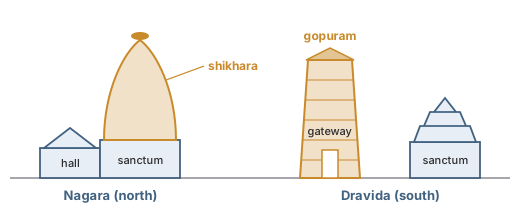
Culture is the chapter with thousands of traditions and no syllabus saying which, so this lesson keeps to what can be reasoned to: a state, a patron, a technique, a classification, a fixed date. It covers classical dance and music, theatre and folk forms, temple styles and monuments, painting traditions, crafts and GI tags, festivals, languages, the World Heritage and intangible heritage lists, and the academies and honours, with a diagram of the two temple styles and the traps the wrong options use.
Most culture questions are a pairing: a form and its state, a monument and its builder, an instrument and its category. Learn the pairs as tables, and learn the few tests that turn a guess into a deduction, such as which tower is taller or which list a tradition sits on.
Skip anything that turns on a count. How many World Heritage Sites or GI tags India has changes every year, and even the number of classical dances is disputed between two official bodies.
The number of classical forms is not settled: the Sangeet Natak Akademi's list and the Ministry of Culture's differ over Chhau. What is settled, and asked, is the state.
Form
State
Signature
Bharatanatyam
Tamil Nadu
Temple dance tradition
Kathakali
Kerala
Ramayana and Mahabharata; green "pacha" make-up for heroes and gods
Mohiniyattam
Kerala
Kuchipudi
Andhra Pradesh
Named after a village
Odissi
Odisha
The tribhanga, bending at neck, waist and knee
Manipuri
Manipur
The Ras Lila of Radha and Krishna
Sattriya
Assam
Named for the sattra, a Vaishnava monastery
Kathak
North India
Court dance; gharanas at Lucknow, Jaipur, Banaras
Watch out
Kerala has two forms, Kathakali and Mohiniyattam. Kathak is the only northern one. And Garba, Bhangra and Bihu are folk dances, never classical.
Carnatic is the southern system, Hindustani the northern. Raga is the melodic framework; tala is the rhythmic cycle. Carnatic ragas come from 72 parent scales, the Melakarta, and a Carnatic concert's drum is the mridangam. Dhrupad, linked to Tansen, is the oldest surviving Hindustani vocal form.
The Carnatic Trinity is Tyagaraja, Muthuswami Dikshitar and Syama Sastri. Hindustani music has no trinity.
Category
Covers
Examples
Tata
Strings
Sitar (Ravi Shankar), veena
Sushira
Wind
Flute, shehnai (Bismillah Khan)
Avanaddha
Stretched membrane
Tabla (Zakir Hussain), mridangam
Ghana
Solid
Ghatam, manjira
Watch out
The tabla and the ghatam are both "percussion" in ordinary speech, but the tabla has a membrane (avanaddha) and the ghatam, a clay pot, does not (ghana).
Koodiyattam was originally proclaimed in 2001 and inscribed on the Representative List in 2008, one of India's first entries on UNESCO's intangible heritage list; Kalbelia followed in 2010 and Kolkata's Durga Puja in 2021.
Key idea
The intangible heritage list records practices; the World Heritage list records places. A question offering both is testing whether you know they are separate.
Look at which tower is tallest. If it is the tower over the sanctum, a curving shikhara, the temple is Nagara, the northern style. If it is the tower over the gateway, a gopuram, it is Dravida, the southern style. Vesara is the Deccan blend.
The test at the site: the tallest tower over the sanctum means Nagara; over the gateway means Dravida.
Sites are inscribed by the World Heritage Committee, on the country's nomination. India's first were Ajanta Caves, Ellora Caves, Agra Fort and the Taj Mahal, all in 1983. Every site is cultural, natural or mixed, and the category is often the question.
Cultural: Ajanta (Maharashtra), Hampi, Humayun's Tomb, Rani ki Vav (Gujarat), Santiniketan (2023), and Ahmedabad, the first World Heritage City (2017).
Natural: Kaziranga, Sundarbans, Western Ghats.
Mixed:Khangchendzonga National Park, inscribed in 2016 — India's only one.
Example 1 · Cultural or natural?
Which of these is a natural World Heritage Site: Hampi, Kaziranga National Park, Rani ki Vav, Humayun's Tomb?
Hampi, Rani ki Vav and Humayun's Tomb are built by people, so they are cultural.
Kaziranga is protected for its rhinos and grassland, so it is natural.
A geographical indication ties a name to a place, so no producer elsewhere may use it. The law is the Geographical Indications of Goods (Registration and Protection) Act, 1999, the registry sits under the Ministry of Commerce and Industry, and the first tag went to Darjeeling tea, from West Bengal.
The Eighth Schedule is constitutional and carries twenty-two languages. Classical status is a government decision; the first was Tamil, notified on 12 October 2004, and the list now has eleven: Tamil, Sanskrit, Telugu, Kannada, Malayalam, Odia, and from 2024 Marathi, Pali, Prakrit, Assamese and Bengali. A language can be on one list and not the other.
The official language of the Union is Hindi in the Devanagari script, under Article 343: official, not national, since the Constitution names no national language.
The civilian honours run Padma Vibhushan, then Padma Bhushan, then Padma Shri, with the Bharat Ratna above them. The Jnanpith is for literature in an Indian language, and the Dadasaheb Phalke Award for a lifetime in cinema.
Museum
City
Indian Museum, the oldest
the Indian Museum, Kolkata, founded in 1814
Victoria Memorial
Kolkata
Salar Jung Museum
Hyderabad
Example 2 · Which academy?
A sculptor and a playwright are each honoured by a national academy. Which academies?
Sculpture is a visual art: the Lalit Kala Akademi.
Drama belongs with music and dance: the Sangeet Natak Akademi, not the Sahitya Akademi.
Which classical dance form developed in the courts of north India and has gharanas at Lucknow, Jaipur and Banaras?
Show the explanationHide the explanation
AnswerB · Kathak
Kathak is the one classical form that belongs to north India.
It moved from temple storytelling into Mughal and Rajput courts, which is where its spins, its footwork and its Persian-influenced costume come from.
Its three main gharanas are named for Lucknow, Jaipur and Banaras.
Worth noting
Because it was a court form rather than a temple form, Kathak is the only one of the eight performed from the start by both Hindu and Muslim practitioners.
Which of the two systems of Indian classical music is the southern one?
Show the explanationHide the explanation
AnswerD · Carnatic
Carnatic is the classical music of southern India; Hindustani is that of the north.
Both share the concepts of raga and tala and diverged from a common root, largely after the arrival of Persian influence in the north.
Dhrupad and thumri are not systems but forms within Hindustani music.
Worth noting
A practical difference: a Carnatic concert is built mostly on composed pieces, while a Hindustani one gives far more time to improvisation around the raga.
In Indian classical music, what does 'tala' refer to?
Show the explanationHide the explanation
AnswerD · The rhythmic cycle of a piece
Tala is the rhythmic cycle — the pattern of beats the piece is set in.
Raga is the melodic framework, the set of notes and the rules for moving between them.
The two are independent: the same raga may be sung in several talas.
Worth noting
The drone is supplied by the tanpura, and the unmetred opening is the alap. Four different words for four different things, and the question is which is which.
In the classical fourfold classification of instruments, the tabla and the mridangam belong to which category?
Show the explanationHide the explanation
AnswerB · Avanaddha
Avanaddha covers instruments sounded by striking a stretched membrane, which is what a drum is.
Tata covers stringed instruments such as the sitar and the veena, and sushira the wind instruments such as the flute and the shehnai.
Ghana covers solid instruments that sound without a membrane or string, such as the ghatam and the manjira.
Worth noting
The ghatam is a clay pot and the tabla a drum, so both are percussion in ordinary speech — but the classification splits them, and that split is the question.
Chhau, a masked dance drawing on martial movement, is shared by which group of states?
Show the explanationHide the explanation
AnswerD · Odisha, Jharkhand and West Bengal
Chhau is performed in Odisha, Jharkhand and West Bengal, with a distinct style in each.
The Seraikella and Purulia styles use masks; the Mayurbhanj style does not, which is a standard point of difference.
Its vocabulary borrows openly from martial training, which is what sets it apart from the classical forms.
Worth noting
Chhau is on UNESCO's intangible heritage list and the Sangeet Natak Akademi runs a Chhau Kendra for it, but it is usually grouped with the folk and martial traditions rather than with the classical dance forms. Lists differ on that point, so a question asking how many classical dances there are does not have one settled answer.
Which group of sites was among India's first to be inscribed on the World Heritage list, in 1983?
Show the explanationHide the explanation
AnswerC · Ajanta Caves, Ellora Caves, Agra Fort and the Taj Mahal
Ajanta, Ellora, Agra Fort and the Taj Mahal were all inscribed in 1983, the first year India had sites on the list.
India had ratified the World Heritage Convention shortly before, in 1977.
The other groups are all real World Heritage Sites, inscribed in later years.
Worth noting
Two of the four are cave complexes in Maharashtra and two are Mughal monuments in Agra, so the set is not thematic — it is simply what was nominated first.
Geographical indications in India are registered by an office under which ministry?
Show the explanationHide the explanation
AnswerA · The Ministry of Commerce and Industry
The Geographical Indications Registry works under the Controller General of Patents, Designs and Trade Marks.
That office sits in the Department for Promotion of Industry and Internal Trade, in the Ministry of Commerce and Industry.
The governing law is the Geographical Indications of Goods (Registration and Protection) Act, 1999.
Worth noting
A GI is a form of intellectual property, which is why it is administered alongside patents and trade marks rather than by a culture or textiles ministry.
Bidriware, dark metal work inlaid with silver, takes its name from a town in
Show the explanationHide the explanation
AnswerD · Karnataka
Bidriware is named after Bidar, in northern Karnataka, where it grew under the Bahmani sultans.
An alloy of zinc and copper is cast, inlaid with silver, and blackened with a paste of soil from the area, which leaves the silver shining against a dark ground.
Chhath, in which offerings are made standing in water to the setting and rising sun, is most associated with which region?
Show the explanationHide the explanation
AnswerD · Bihar and eastern Uttar Pradesh
Chhath belongs to Bihar, eastern Uttar Pradesh and the neighbouring parts of Jharkhand and Nepal.
It is one of very few Indian festivals addressed directly to the sun, and the only major one where the setting sun is worshipped before the rising sun.
The rituals are performed on a riverbank or the edge of a tank, standing in the water.
Worth noting
It has travelled with migration and is now kept in cities far from that region, which is why it is often described by where it began rather than where it is observed.
Which was the first Indian language to be given classical status, in 2004?
Show the explanationHide the explanation
AnswerB · Tamil
Tamil was declared a classical language in 2004, and was the first.
Sanskrit followed in 2005, and Telugu and Kannada together in 2008.
The status carries recognition and funding for study of the language rather than any constitutional consequence.
Worth noting
Classical status and the Eighth Schedule are separate things: a language can be on the Schedule without being classical, and the two lists are decided by different processes.
In 2024 five more languages were granted classical status. Which set was it?
Show the explanationHide the explanation
AnswerA · Marathi, Pali, Prakrit, Assamese and Bengali
Marathi, Pali, Prakrit, Assamese and Bengali were approved together in October 2024.
That took the number of classical languages from six to eleven.
Malayalam and Odia had already been granted the status earlier, in 2013 and 2014.
Worth noting
Pali and Prakrit are the unusual entries, because neither is a language of everyday speech today — the status recognises a literary corpus, not a speaking population.