EduFarming
Your list · 0हिं

Type at least two letters. Press Esc to close.

↑↓ navigate↵ openTAB cycle filter

World GK and International Bodies for CUET General Aptitude

About 10 min to learn · 75 questions

World GK has the largest surface and the smallest core. There are hundreds of organisations, but what gets asked is a stable set: when the UN began, which bodies are organs and which are agencies, which city holds which headquarters, which line separates which countries. This lesson covers the UN and its organs, the specialised agencies, Bretton Woods and the WTO, groupings, treaties, headquarters, capitals and currencies, boundary lines and space agencies, learnt as pairs, with a chart of the UN system.

Syllabus area
General Knowledge
On this page · 10 sections
  1. 01The core idea
  2. 02The United Nations
  3. 03Agencies, money and trade
  4. 04Treaties and headquarters
  5. 05Countries, capitals and borders
  6. 06Space and defence
  7. 07Exam shortcuts
  8. 08Common mistakes
  9. 09Quick revision
  10. 10Check your understanding

The core idea

Almost everything here is a pair: a body and its city, a line and its two countries, a treaty and its subject. Learn it as pairs and the chapter shrinks to something you can hold.

Four distinctions carry most of the marks: organ against agency, ICJ against ICC, Fund against Bank, agreement against organisation. And ignore current counts, with one exception: the UN's 193 members, unchanged since 2011.

The United Nations

When did the United Nations begin?

Two dates, and the question turns on which one it wants. The Charter was signed on 26 June 1945 at San Francisco and in force from 24 October 1945. United Nations Day, 24 October, marks entry into force, not signing.

There were 51 original members in 1945, India among them, and membership is 193 members since South Sudan joined in 2011. The UN replaced the League of Nations and has its headquarters in New York.

FactAnswer
First Secretary-GeneralTrygve Lie
First woman President of the General AssemblyVijaya Lakshmi Pandit, of India
Official languagesSix
Universal Declaration of Human Rights1948

What are the six principal organs?

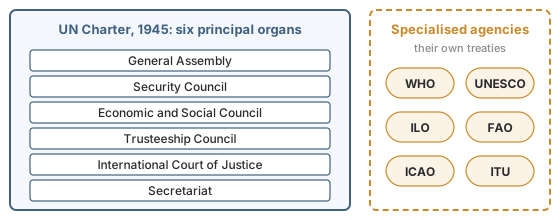
The six are the General Assembly, the Security Council, the Economic and Social Council, the Trusteeship Council, the International Court of Justice and the Secretariat, all set up by the Charter in 1945.

A chart. Inside a box labelled UN Charter 1945 are the six principal organs: General Assembly, Security Council, Economic and Social Council, Trusteeship Council, International Court of Justice and Secretariat. Outside, in a dashed box labelled specialised agencies with their own treaties, are WHO, UNESCO, ILO, FAO, ICAO and ITU.
Six organs inside the Charter; the agencies outside have their own treaties. 'Which is not an organ?' is always an agency.
OrganKey fact
General AssemblyEvery member has one vote
Security Council15 members; its decisions bind all members
Economic and Social Council54 members
Trusteeship Councilsuspended operation on 1 November 1994, but is still an organ
International Court of Justice15 judges; sits at the Peace Palace in The Hague — the only principal organ not in New York
SecretariatHeaded by the Secretary-General

Watch out

The ICJ settles disputes between states and is a UN organ. The International Criminal Court, also at The Hague, tries individuals under a separate treaty.

How does the Security Council work?

Fifteen members: five permanent with the veto (China, France, Russia, the United Kingdom, the United States) and ten elected for two-year terms. The Secretary-General is appointed by the General Assembly on the recommendation of the Security Council.

Example 1 · Who appoints?

An option says the Security Council appoints the Secretary-General on the General Assembly's recommendation. Is it right?

  1. The order is the other way round: the Council recommends, the Assembly appoints.

  2. It matters because the recommendation is subject to the veto and the appointment is not.

Answer

No. The General Assembly appoints, on the Security Council's recommendation.

Agencies, money and trade

Which specialised agency does what?

AgencyForRemember
ITUTelecommunicationsThe oldest, 1865
ILOLabourcreated in 1919, as part of the Treaty of Versailles; the only tripartite United Nations agency, bringing together governments, employers and workers
UNICEFChildrenfounded in 1946, in the aftermath of the Second World War; New York
WHOHealthfounded in 1948; World Health Day 7 April
UNESCOEducation, science, cultureParis; keeps the World Heritage List
ICAOCivil aviationSets its standards
UNHCRRefugees
World Food ProgrammeHungerNobel Peace Prize 2020

Watch out

UNESCO and UNICEF sit next to each other in every list: UNESCO is Paris and culture, UNICEF is New York and children. And the ILO is older than the UN, having started under the League in 1919.

What did Bretton Woods create, and how did the WTO come about?

The 1944 conference created the International Monetary Fund and the World Bank. The Fund handles balance of payments and monetary stability, and publishes the World Economic Outlook; the Bank finances development. Within the Bank, the IDA lends on concessional terms to the poorest countries.

The WTO was established on 1 January 1995, out of the Uruguay Round of 1986–94. The GATT before it was an agreement, not an organisation with permanent legal standing. The WTO's highest body is the Ministerial Conference.

Which groupings should you know?

GroupingFact
SAARC8 members; founded at Dhaka 1985; secretariat Kathmandu
ASEANFounded at Bangkok 1967; Vietnam is a member, India is not
BRICSSouth Africa joined in 2010
NAMFirst summit at Belgrade, 1961
G20The African Union joined at the 2023 New Delhi summit
G7China is not a member
QuadIndia, Japan, Australia, the United States

Exam shortcut

The founding city is not the secretariat's city: Dhaka and Kathmandu for SAARC, Bangkok and Jakarta for ASEAN.

Treaties and headquarters

Which treaty is about what?

A treaty is named for its city, and the city tells you nothing about the subject.

TreatySubject
Ramsar, 1971Wetlands
CITES, 1973Trade in endangered animals and plants
Montreal Protocol, 1987Ozone-depleting substances
Basel ConventionHazardous waste across borders
Kyoto Protocol, 1997Binding greenhouse targets, developed countries only
Paris Agreement, 2015Every party sets its own contribution, under the UNFCCC
Geneva ConventionsHumane treatment in war
Versailles, 1919Ended the First World War
Tordesillas, 1494Split new lands between Spain and Portugal

India has not signed the Nuclear Non-Proliferation Treaty.

Watch out

Ozone is not climate: ozone is Montreal; climate is Kyoto and Paris under the UNFCCC.

Which body sits in which city?

Learn by city, not by body.

CityBodies
New YorkUN, UNICEF
GenevaWHO, ILO, WTO
ViennaIAEA
ParisUNESCO
RomeFAO, World Food Programme
NairobiUN Environment Programme
The HagueInternational Court of Justice
BrusselsNATO, European Commission
LondonCommonwealth Secretariat
LyonInterpol, which is not a UN body

Countries, capitals and borders

Which capitals are not the famous city?

CountryCapitalNot
AustraliaCanberraSydney
TurkeyAnkaraIstanbul
MyanmarNay Pyi TawYangon
BrazilBrasília, a planned cityRio de Janeiro
CanadaOttawaToronto
New ZealandWellingtonAuckland
South AfricaPretoria (administrative)Johannesburg
CurrencyCountry
NgultrumBhutan
TakaBangladesh
RandSouth Africa
YenJapan
EuroMost of the European Union

Which line separates which countries?

LineSeparates
RadcliffeIndia and Pakistan
DurandPakistan and Afghanistan
McMahonIndia and China, eastern sector
Line of Actual ControlIndia and China
38th parallelNorth and South Korea
17th parallelNorth and South Vietnam, 1954–76
49th parallelThe United States and Canada

Sir Creek, in the Rann of Kutch, is disputed with Pakistan.

Example 2 · The longest border

With which country does India share its longest land border: China, Pakistan, Bangladesh or Nepal?

  1. Length follows the shape of the border, not the size of the neighbour.

  2. Bangladesh is surrounded by India on three sides.

Answer

Bangladesh

Space and defence

What should you know about space missions and agencies?

Chandrayaan-3's lander landed on 23 August 2023, at about 1745 hrs IST. The Mars Orbiter Mission reached Mars orbit in 2014 at the first attempt, and Aditya-L1, the first solar observatory, orbits the first Lagrange point between the Sun and the Earth. Launches go from Sriharikota; ISRO's headquarters is in Bengaluru.

AgencyCountry
NASAUnited States (leads the Artemis Accords, which India signed in 2023)
RoscosmosRussia
JAXAJapan
ISROIndia, under the Department of Space
DRDOIndia, under the Ministry of Defence

Exam shortcuts

  • Organ or agency? Six organs; everything else is an agency.
  • Signed or in force? 26 June or 24 October 1945.
  • By city. Geneva, Vienna, Paris, Rome, Nairobi, The Hague.
  • Founding city is not the seat. SAARC, ASEAN.
  • Capital is not the famous city.

Common mistakes

  • WHO as a principal organ.
  • ICJ for ICC.
  • The Council appointing the Secretary-General.
  • UNICEF in Paris.
  • Montreal for climate.
  • Sydney, Istanbul or Rio as a capital.
  • China for India's longest border.
  • Interpol as a UN body.

Quick revision

The UN

  • Charter signed 26 Jun 1945, in force 24 Oct 1945
  • 51 founders; 193 since 2011 (South Sudan)
  • Security Council 15: 5 veto, 10 for two years

Bodies and treaties

  • ILO 1919 tripartite; WHO 1948; ITU oldest
  • IMF and World Bank 1944; WTO 1 Jan 1995
  • Ramsar wetlands; Montreal ozone; Paris climate

Places

  • Geneva WHO, ILO, WTO; Paris UNESCO; Rome FAO
  • Radcliffe, Durand, McMahon, 38th parallel
  • Longest border: Bangladesh

The economic side of these bodies is in Indian economy and institutions, and the climate treaties in pollution, climate and conventions.

Next · 09Quick revision

Check your understanding

75 questions, grouped by type, easy to hard. Pick an answer and check it. The worked solution opens when you ask for it.

The United Nations: how it was foundedQ1 of 75Q1

The United Nations: how it was founded

8 questions

How many states were original members of the United Nations in 1945?

Options for question 1

Show the explanationHide the explanation

AnswerB · 51

  1. Fifty-one states were original members, having taken part at San Francisco or signed the earlier Declaration by United Nations.

  2. India was among them, and signed while still under British rule, which is why it counts as a founder rather than as a later entrant.

  3. Membership then grew in waves, most sharply through the decolonisation of the 1960s.

Worth noting

The founding figure and the present one are both asked, and they are nearly four times apart. Fifty-one in 1945; the count today is in the one hundred and nineties.

The United Nations was created to succeed which earlier organisation?

Options for question 2

Show the explanationHide the explanation

AnswerD · The League of Nations

  1. The League of Nations was set up after the First World War and had failed to prevent the second.

  2. The United Nations was designed to replace it, with a Security Council able to take binding decisions — the power the League most obviously lacked.

  3. The League was formally wound up in 1946, after the United Nations was already in operation.

Worth noting

The International Labour Organization is the trap worth knowing: it began under the League in 1919 and survived the League's collapse, so it is older than the United Nations rather than a creation of it.

The headquarters of the United Nations is in

Options for question 3

Show the explanationHide the explanation

AnswerC · New York

  1. The UN headquarters stands in Manhattan, New York, on land beside the East River.

  2. Geneva hosts the UN's second-largest office, and many agencies are based there.

The Charter of the United Nations was signed in June 1945 at

Options for question 4

Show the explanationHide the explanation

AnswerA · San Francisco

  1. Delegates of 50 countries signed the Charter on 26 June 1945 at the end of the San Francisco conference; Poland signed later as the 51st original member.

  2. The Charter came into force on 24 October 1945, now kept as United Nations Day.

United Nations Day is observed on 24 October because that is the date on which

Options for question 5

Show the explanationHide the explanation

AnswerD · the Charter came into force

  1. The Charter was signed on 26 June 1945, at the close of the United Nations Conference on International Organization at San Francisco.

  2. It came into force four months later, on 24 October 1945, once enough states had ratified it.

  3. The anniversary that is kept is the second one, because an organisation begins when its founding treaty takes effect rather than when it is drafted.

Worth noting

Both dates are 1945 and both are about the Charter, which is what makes the pair worth learning together. Signing is agreement to a text; entry into force is the point at which it binds.

The United Nations has had 193 member states since 2011, when its most recent member joined. Which state was it?

Options for question 6

Show the explanationHide the explanation

AnswerD · South Sudan

  1. South Sudan became independent in July 2011 and was admitted to the United Nations the same month, taking the membership to 193.

  2. No state has been admitted since, which is why the figure has held for well over a decade.

  3. The others named all joined earlier: Switzerland and Timor-Leste in 2002, Montenegro in 2006.

Worth noting

A membership figure is usually a bad thing to memorise because it moves. This one is an exception precisely because nothing has moved it since 2011.

How many official languages does the United Nations have?

Options for question 7

Show the explanationHide the explanation

AnswerC · Six

  1. The official languages are Arabic, Chinese, English, French, Russian and Spanish — six in all.

  2. Five were official from the start; Arabic was added later.

  3. Of the six, English and French are the working languages of the Secretariat, which is a narrower category than official.

Worth noting

Official and working are not the same status, and a question can ask for either. Hindi is not among the six, although it is among the most widely spoken languages in the world.

Who was the first Secretary-General of the United Nations?

Options for question 8

Show the explanationHide the explanation

AnswerB · Trygve Lie

  1. Trygve Lie of Norway served as the first Secretary-General from 1946 to 1952.

  2. Dag Hammarskjöld of Sweden was the second, and U Thant of Burma the third.

Worth noting

Hammarskjöld is the best-known early name, which makes him the trap.

The six principal organs

8 questions

In which organ of the United Nations does every member state have one vote?

Options for question 9

Show the explanationHide the explanation

AnswerD · The General Assembly

  1. All member states sit in the General Assembly, and each has one vote regardless of size.

  2. Important questions need a two-thirds majority there; the Security Council has only fifteen members.

How many judges sit on the International Court of Justice?

Options for question 10

Show the explanationHide the explanation

AnswerC · 15

  1. The Court has fifteen judges, each elected for nine years by the General Assembly and the Security Council voting separately.

  2. No two judges may be of the same nationality.

Which of the following is NOT one of the six principal organs of the United Nations?

Options for question 11

Show the explanationHide the explanation

AnswerD · The World Health Organization

  1. The six principal organs are the General Assembly, the Security Council, the Economic and Social Council, the Trusteeship Council, the International Court of Justice and the Secretariat.

  2. All six were established by the Charter itself in 1945.

  3. The World Health Organization is a specialised agency: a separate organisation with its own membership and constitution that works with the United Nations rather than forming part of it.

Worth noting

The distinction is the whole question. Agencies such as WHO, UNESCO and the ILO have their own founding treaties and their own budgets; the principal organs do not exist apart from the Charter.

The International Court of Justice sits at

Options for question 12

Show the explanationHide the explanation

AnswerC · The Hague

  1. The Court sits at the Peace Palace in The Hague, in the Netherlands.

  2. It is the only one of the six principal organs not located in New York.

  3. That single exception is why the seat is asked about at all: the rest of the answer is simply New York.

Worth noting

Do not confuse it with the International Criminal Court, which also sits at The Hague but is not a United Nations organ. The ICJ settles disputes between states; the ICC tries individuals.

The Security Council has fifteen members. How are they made up?

Options for question 13

Show the explanationHide the explanation

AnswerB · Five permanent and ten elected for two-year terms

  1. Five members — China, France, Russia, the United Kingdom and the United States — hold permanent seats and the veto.

  2. The other ten are elected by the General Assembly for two-year terms, with seats distributed by region.

  3. A retiring non-permanent member is not immediately re-eligible, which is what keeps the seats circulating.

Worth noting

Two facts travel together here and are easy to swap: fifteen members in total, five of them permanent. The veto belongs to the five, not to the fifteen.

Which United Nations organ can take decisions that all member states are obliged to carry out?

Options for question 14

Show the explanationHide the explanation

AnswerB · The Security Council

  1. Under Article 25 of the Charter, members agree to accept and carry out the decisions of the Security Council.

  2. Under Chapter VII it can order sanctions or the use of force to deal with threats to peace.

  3. General Assembly resolutions on most matters are recommendations, not binding orders.

What is the present position of the Trusteeship Council?

Options for question 15

Show the explanationHide the explanation

AnswerD · It suspended operation in 1994 but remains a principal organ

  1. The Council supervised eleven Trust Territories as they moved towards self-government.

  2. The last of them, Palau, became self-governing, and the Council suspended operation on 1 November 1994.

  3. Suspending is not abolishing: it still exists under the Charter and can meet if the need arises, so it is still counted among the six.

Worth noting

This is why lists of the principal organs still say six rather than five. A body with nothing to do has not thereby ceased to be a body.

The Secretary-General of the United Nations is appointed by

Options for question 16

Show the explanationHide the explanation

AnswerD · the General Assembly, on the recommendation of the Security Council

  1. The Charter gives the appointment to the General Assembly.

  2. But the Assembly acts on a recommendation from the Security Council, and that recommendation is subject to the veto.

  3. So the Council decides in practice who is available to be appointed, while the formal appointment is the Assembly's.

Worth noting

The order of the two bodies is the question. Reversing it — Council appointing on the Assembly's recommendation — is the distractor, and it inverts where the veto bites.

The specialised agencies

8 questions

The World Health Organization was founded in

Options for question 17

Show the explanationHide the explanation

AnswerC · 1948

  1. The WHO was founded in 1948, three years after the United Nations itself.

  2. Its constitution, of the same year, opens by defining health as more than the absence of disease.

  3. World Health Day is kept on the day that constitution came into force.

Worth noting

1946 belongs to UNICEF and 1948 to the WHO — two years apart, both just after the war, and routinely swapped.

The World Food Programme, awarded the Nobel Peace Prize in 2020, works mainly to

Options for question 18

Show the explanationHide the explanation

AnswerD · fight hunger by providing food assistance

  1. The WFP is the UN's food-assistance agency, delivering food in emergencies and to people facing hunger.

  2. It is based in Rome, alongside the FAO and IFAD, and won the 2020 Nobel Peace Prize.

The UNHCR is the United Nations agency that protects

Options for question 19

Show the explanationHide the explanation

AnswerA · refugees

  1. UNHCR, the Office of the UN High Commissioner for Refugees, was set up in 1950 and is based in Geneva.

  2. It protects and assists refugees and other people forced from their homes, and has twice won the Nobel Peace Prize.

World Health Day, marking the founding of the World Health Organization, is observed on

Options for question 20

Show the explanationHide the explanation

AnswerA · 7 April

  1. The WHO's constitution came into force on 7 April 1948, and the day is kept each year with a health theme.

  2. 1 December is World AIDS Day and 24 October is United Nations Day.

Which body was created in 1919 as part of the Treaty of Versailles?

Options for question 21

Show the explanationHide the explanation

AnswerB · The International Labour Organization

  1. The International Labour Organization was created in 1919, written into the Treaty of Versailles that ended the First World War.

  2. Its founding idea was that lasting peace has to rest on social justice, which is why labour standards were treated as a peace question.

  3. It began under the League of Nations and became a United Nations specialised agency after 1945, making it older than the United Nations itself.

Worth noting

A question that asks which agency is oldest is asking about this. The others named here are all creations of the 1940s.

UNICEF was established in 1946 in order to

Options for question 22

Show the explanationHide the explanation

AnswerB · help children at risk after the Second World War, regardless of which side their country fought on

  1. UNICEF was set up in the aftermath of the Second World War, when children across Europe and beyond were in immediate danger.

  2. Its brief deliberately made no distinction between the children of victors and of the defeated.

  3. The mandate has been children's welfare ever since, and today it runs the largest humanitarian warehouse in the world.

Worth noting

The neutrality in the original mandate is the point worth remembering, and it is what the question is testing rather than the date.

The World Heritage List is maintained under the authority of

Options for question 23

Show the explanationHide the explanation

AnswerA · UNESCO

  1. The World Heritage Convention of 1972 is a UNESCO instrument, and the World Heritage Committee operates under it.

  2. UNESCO's remit is education, science and culture, which is what puts heritage inside it.

  3. The IUCN and ICOMOS advise the Committee on natural and cultural nominations respectively, but neither keeps the list.

Worth noting

Advising and deciding are different roles, and the question turns on that. UNESCO also keeps the intangible heritage list, which records practices rather than places.

The International Labour Organization is unique in the United Nations system because

Options for question 24

Show the explanationHide the explanation

AnswerD · employers and workers sit alongside governments

  1. It is the only tripartite agency in the system: governments, employers and workers are all represented.

  2. Each has a voice in setting labour standards, rather than the standards being negotiated between governments alone.

  3. Everywhere else in the United Nations, only governments vote.

Worth noting

Tripartite is the word to attach to the ILO, and it means three kinds of participant rather than three organs or three committees.

Bretton Woods and world trade

7 questions

The Bretton Woods conference, which created the IMF and the World Bank, was held in

Options for question 25

Show the explanationHide the explanation

AnswerB · 1944

  1. Delegates of 44 Allied nations met at Bretton Woods in New Hampshire, United States, in July 1944.

  2. The conference met while the Second World War was still going on, to plan the post-war economic order.

The Bretton Woods conference of 1944 led directly to the creation of

Options for question 26

Show the explanationHide the explanation

AnswerD · the International Monetary Fund and the World Bank

  1. The conference at Bretton Woods in 1944 was called to design the post-war monetary and financial order.

  2. It produced two institutions: the International Monetary Fund, and the International Bank for Reconstruction and Development, which became the core of the World Bank.

  3. India took part and is an original member of both.

Worth noting

The pairing is the thing to hold. The GATT came out of separate negotiations three years later, and the WTO is later still.

The World Trade Organization came into existence on

Options for question 27

Show the explanationHide the explanation

AnswerC · 1 January 1995

  1. The WTO was established on 1 January 1995.

  2. It came out of the Uruguay Round of negotiations, which ran from 1986 to 1994.

  3. The agreement establishing it was signed at Marrakesh in April 1994, but the organisation itself began the following January.

Worth noting

Signature and establishment are months apart here, as they are for the UN Charter, and a question can ask for either. 1948 belongs to the GATT.

The highest decision-making body of the World Trade Organization is the

Options for question 28

Show the explanationHide the explanation

AnswerC · Ministerial Conference

  1. The Ministerial Conference, made up of trade ministers of all members, is the WTO's top body and usually meets every two years.

  2. Between conferences the General Council runs the organisation; it also meets as the Dispute Settlement Body.

  3. A Board of Governors is the top body of the IMF and the World Bank.

Which statement best distinguishes the International Monetary Fund from the World Bank?

Options for question 29

Show the explanationHide the explanation

AnswerC · The Fund addresses balance-of-payments and monetary stability; the Bank finances development projects

  1. The Fund's business is monetary: exchange stability, and support for countries in balance-of-payments difficulty.

  2. The Bank's business is development: long-term finance for projects and reform programmes.

  3. Both lend to governments, and both are specialised agencies rather than principal organs, so the difference is one of purpose rather than of legal status.

Worth noting

A short version worth carrying: the Fund is about a country's ability to pay its way from month to month; the Bank is about what it builds over decades.

What was the principal difference between the GATT and the WTO that replaced it?

Options for question 30

Show the explanationHide the explanation

AnswerB · The GATT was an agreement, not an organisation with a permanent legal standing

  1. The General Agreement on Tariffs and Trade was exactly that: an agreement, applied provisionally from 1948 and administered by a small secretariat.

  2. The WTO is an organisation, with a permanent structure, a wider remit covering services and intellectual property, and a binding dispute settlement system.

  3. The GATT itself was not abolished; it survives as one of the agreements the WTO administers.

Worth noting

The last step is the part most often got wrong. The WTO did not repeal the GATT — it absorbed it, which is why the name still appears in trade law.

Within the World Bank Group, the arm that lends on concessional terms to the poorest countries is

Options for question 31

Show the explanationHide the explanation

AnswerA · the IDA

  1. The International Development Association lends to the poorest countries on concessional terms — very long maturities and little or no interest.

  2. The IBRD, the original Bretton Woods institution, lends to middle-income countries on terms closer to the market.

  3. The IFC lends to the private sector and MIGA provides guarantees against political risk, so neither is a concessional lender to governments.

Worth noting

"World Bank" in ordinary use means the IBRD and the IDA together. The other three members of the Group are separate institutions with separate purposes.

Groupings India belongs to, and their summits

8 questions

Which of these countries is NOT a member of the G7?

Options for question 32

Show the explanationHide the explanation

AnswerA · China

  1. The G7 is made up of Canada, France, Germany, Italy, Japan, the United Kingdom and the United States, with the European Union also taking part.

  2. China belongs to the larger G20, as does India.

The Quad, a grouping of four democracies in the Indo-Pacific, is made up of India, Japan, Australia and

Options for question 33

Show the explanationHide the explanation

AnswerD · the United States

  1. The Quadrilateral Security Dialogue brings together India, Japan, Australia and the United States.

  2. Its leaders began meeting at summit level in 2021.

The euro is the currency used by most members of

Options for question 34

Show the explanationHide the explanation

AnswerB · the European Union

  1. The euro was introduced in 1999 and its notes and coins in 2002; it is used by most, but not all, EU member states.

  2. The European Central Bank in Frankfurt sets monetary policy for the euro area.

BRIC became BRICS when which country joined the grouping in 2010?

Options for question 35

Show the explanationHide the explanation

AnswerA · South Africa

  1. The original four were Brazil, Russia, India and China.

  2. South Africa was invited to join in 2010 and attended its first summit as a member the following year.

  3. The added S is the whole of the change in the name, which is why the year is worth attaching to the letter.

Worth noting

The label began as an economist's shorthand for four fast-growing economies before it became an actual grouping with summits, which is why the membership and the acronym did not start out the same.

SAARC was founded in 1985 at Dhaka. Where is its secretariat?

Options for question 36

Show the explanationHide the explanation

AnswerA · Kathmandu

  1. The founding summit was held at Dhaka in 1985, which is why Bangladesh is associated with the beginning of SAARC.

  2. The secretariat, established two years later, is at Kathmandu.

  3. Founding place and seat are different cities, and the question is usually built on the assumption that they are the same.

Worth noting

The same trap runs through this whole topic. A grouping is often named for the city of its founding declaration and then administered from somewhere else entirely.

ASEAN was established in 1967 by a declaration signed at

Options for question 37

Show the explanationHide the explanation

AnswerC · Bangkok

  1. ASEAN was founded in August 1967 by the Bangkok Declaration, signed by five states.

  2. Its secretariat is at Jakarta, which is a different city from the one in the declaration's name.

  3. India is not a member; it is a dialogue partner, which is a different relationship.

Worth noting

Bangkok for the founding, Jakarta for the secretariat — the same split as SAARC's Dhaka and Kathmandu, and worth learning as a pattern rather than as four separate facts.

The first summit of the Non-Aligned Movement was held in 1961 at

Options for question 38

Show the explanationHide the explanation

AnswerB · Belgrade

  1. The first summit met at Belgrade in 1961.

  2. Bandung, in 1955, was the Asian-African Conference that prepared the ground, but it was not itself a Non-Aligned summit.

  3. Cairo and Havana hosted later summits, which is why they are offered here.

Worth noting

Bandung is the distractor that catches most people, because it comes earlier and is genuinely part of the story. The distinction is between the conference that led to the movement and the movement's own first summit.

At the G20 summit hosted by India in 2023, which body was admitted as a permanent member of the group?

Options for question 39

Show the explanationHide the explanation

AnswerC · The African Union

  1. The summit was held at New Delhi in September 2023, under India's presidency.

  2. The African Union was admitted as a permanent member at that summit.

  3. It is the second regional grouping in the G20, alongside the European Union, which has been a member from the start.

Worth noting

The G20's name has not changed, which is a small trap: it now has more than twenty participants, because two of them are unions of states rather than single countries.

Treaties and conventions

8 questions

The Kyoto Protocol of 1997 set targets for cutting

Options for question 40

Show the explanationHide the explanation

AnswerC · greenhouse gas emissions

  1. The Kyoto Protocol, under the UN climate convention, set binding targets for developed countries to cut greenhouse gas emissions.

  2. It came into force in 2005; the Paris Agreement of 2015 later took a different approach.

CITES, signed in 1973, regulates

Options for question 41

Show the explanationHide the explanation

AnswerB · international trade in endangered wild animals and plants

  1. CITES, the Convention on International Trade in Endangered Species of Wild Fauna and Flora, was signed at Washington in 1973.

  2. It lists species in appendices according to how strictly their trade must be controlled.

  3. Wetlands come under the Ramsar Convention.

The Paris Agreement of 2015 was adopted under which parent convention?

Options for question 42

Show the explanationHide the explanation

AnswerB · The UN Framework Convention on Climate Change

  1. The Paris Agreement was adopted at the twenty-first Conference of the Parties to the UN Framework Convention on Climate Change.

  2. The Framework Convention, agreed at the Rio summit of 1992, sets the structure; the agreements under it set the commitments.

  3. That is why the meetings are numbered as COPs of the Convention rather than of the Agreement.

Worth noting

Three of the four options are real conventions, and all came out of the same period. The climate one is the Framework Convention; the ozone one is Vienna, which is a separate treaty entirely.

The Montreal Protocol of 1987 deals with

Options for question 43

Show the explanationHide the explanation

AnswerA · substances that deplete the ozone layer

  1. The Montreal Protocol controls the production and consumption of ozone-depleting substances, chiefly chlorofluorocarbons.

  2. It sits under the Vienna Convention of 1985, which established the framework two years earlier.

  3. The three other subjects listed belong to the Kyoto Protocol, the Basel Convention and CITES respectively.

Worth noting

Ozone depletion and climate change are different problems with different treaties, and conflating them is the single commonest error in this topic. Ozone is Vienna and Montreal; climate is the Framework Convention, Kyoto and Paris.

The Ramsar Convention of 1971 concerns the conservation of

Options for question 44

Show the explanationHide the explanation

AnswerC · wetlands

  1. The Ramsar Convention is the treaty on wetlands of international importance, named for the Iranian city where it was signed.

  2. Sites designated under it are called Ramsar sites, and India has a large and growing number of them.

  3. Waterfowl habitat was the original motivation, but the convention covers wetlands as ecosystems, not birds alone.

Worth noting

The last step is the distinction being tested. Waterbirds explain why the convention exists; they are not the limit of what it protects.

One important difference between the Kyoto Protocol and the Paris Agreement is that

Options for question 45

Show the explanationHide the explanation

AnswerD · Kyoto set binding targets for developed countries only; Paris asks every party to set its own contribution

  1. Kyoto, adopted in 1997, placed binding emission targets on developed countries listed in an annex, and none on the rest.

  2. Paris, adopted in 2015, asks every party to put forward its own nationally determined contribution instead.

  3. The shift is from targets imposed by category to commitments declared by each country, which is why participation under Paris is far wider.

Worth noting

Both sit under the same Framework Convention; neither replaced it. What changed between them is how obligations are allocated, not which treaty is in charge.

The Basel Convention governs

Options for question 46

Show the explanationHide the explanation

AnswerC · the movement of hazardous wastes across borders

  1. The Basel Convention controls the transboundary movement of hazardous wastes and their disposal.

  2. It was a response to hazardous waste being shipped from richer countries to poorer ones for cheap disposal.

  3. Its central requirement is prior informed consent: a state must agree before waste can be sent to it.

Worth noting

Treaties are often named for the city where they were concluded, which carries no clue at all about the subject. Basel, Rotterdam and Stockholm are three separate chemicals and waste conventions, and their names have to be learnt against their subjects.

Which of these international agreements has India NOT signed?

Options for question 47

Show the explanationHide the explanation

AnswerA · The Treaty on the Non-Proliferation of Nuclear Weapons

  1. India has never signed the NPT, arguing that it divides the world into five recognised nuclear-weapon states and everyone else.

  2. India is a party to the Paris Agreement, the Ramsar Convention and the Convention on Biological Diversity.

Worth noting

India has also not signed the Comprehensive Nuclear-Test-Ban Treaty, for similar reasons.

Which body sits where

7 questions

UNESCO is headquartered at

Options for question 48

Show the explanationHide the explanation

AnswerA · Paris

  1. UNESCO's headquarters is at Paris.

  2. It is the agency for education, science and culture, and it administers the World Heritage Convention.

  3. The Hague belongs to the International Court of Justice, and Geneva to the health and labour bodies.

Worth noting

UNESCO and UNICEF are adjacent in most lists and are constantly swapped. UNESCO is Paris and deals with education, science and culture; UNICEF is New York and deals with children.

NATO, the North Atlantic Treaty Organization, has its headquarters in

Options for question 49

Show the explanationHide the explanation

AnswerC · Brussels

  1. NATO's headquarters is in Brussels, Belgium, which also hosts the main institutions of the European Union.

  2. The alliance was founded by the North Atlantic Treaty, signed in Washington in 1949.

The Commonwealth Secretariat is located in

Options for question 50

Show the explanationHide the explanation

AnswerD · London

  1. The Commonwealth Secretariat was set up in 1965 and is based at Marlborough House in London.

  2. The Commonwealth is a voluntary association of countries, most of them once part of the British Empire.

The International Atomic Energy Agency has its headquarters at

Options for question 51

Show the explanationHide the explanation

AnswerC · Vienna

  1. The IAEA is headquartered at Vienna.

  2. Vienna is one of the four cities that host a United Nations office, alongside New York, Geneva and Nairobi.

  3. Geneva is the crowded answer in this topic and is worth reserving for the health, labour and trade bodies.

Worth noting

Grouping the seats by city is faster than learning them one by one: Geneva for WHO, ILO and WTO; Vienna for the IAEA; Paris for UNESCO; Rome for the food bodies.

The Food and Agriculture Organization has its headquarters at

Options for question 52

Show the explanationHide the explanation

AnswerC · Rome

  1. The FAO is at Rome.

  2. So are the World Food Programme and the International Fund for Agricultural Development, which makes Rome the food and agriculture city of the system.

  3. Nairobi is the seat of the UN Environment Programme, which is the answer this option is placed here to catch.

Worth noting

Three food bodies in one city is the pattern to hold, and it means a question naming any of the three has the same answer.

Which of these organisations is NOT headquartered at Geneva?

Options for question 53

Show the explanationHide the explanation

AnswerA · The United Nations Environment Programme

  1. The WHO, the ILO and the WTO are all at Geneva, which is the second-largest United Nations centre after New York.

  2. The UN Environment Programme is at Nairobi.

  3. Nairobi is the only headquarters of a major United Nations programme in the global South, which is the reason it is worth remembering separately.

Worth noting

A question asking which one is the odd one out is easier than one asking for each seat in turn, provided Geneva's cluster is held as a cluster.

Interpol, the international police organisation, has its headquarters at

Options for question 54

Show the explanationHide the explanation

AnswerA · Lyon

  1. Interpol is headquartered at Lyon, in France.

  2. It is not a United Nations body: it is an organisation of national police forces, and it has no power to arrest anyone itself.

  3. The Hague is offered because Europol and the international courts are there, which is a different set of institutions altogether.

Worth noting

The useful fact here is the second one. Interpol circulates notices and runs databases; arrests are made by national police under national law.

Capitals, currencies and neighbours

8 questions

The capital of Australia is

Options for question 55

Show the explanationHide the explanation

AnswerD · Canberra

  1. The capital is Canberra.

  2. It was built for the purpose, as a compromise between Sydney and Melbourne, which were both candidates.

  3. Sydney is the largest city, which is exactly why it is the expected wrong answer.

Worth noting

A country's largest city and its capital are different questions. Australia, Brazil, Turkey, Switzerland and the United States all separate the two, and that group is worth knowing as a group.

The capital of Canada is

Options for question 56

Show the explanationHide the explanation

AnswerC · Ottawa

  1. Ottawa, in the province of Ontario, is Canada's capital.

  2. Toronto is the largest city, which is why it is the usual wrong answer.

The currency of Japan is the

Options for question 57

Show the explanationHide the explanation

AnswerB · yen

  1. Japan's currency is the yen.

  2. The won is South Korea's, the yuan (renminbi) China's and the ringgit Malaysia's.

Which city, built in the 1950s as a planned capital, is the capital of Brazil?

Options for question 58

Show the explanationHide the explanation

AnswerD · Brasília

  1. Brasília was built inland and became the capital in 1960, taking over from Rio de Janeiro.

  2. São Paulo is Brazil's largest city.

The capital of Myanmar is

Options for question 59

Show the explanationHide the explanation

AnswerA · Nay Pyi Taw

  1. The capital was moved to Nay Pyi Taw, a purpose-built city, in 2005.

  2. Yangon, formerly Rangoon, remains the largest city and the commercial centre.

  3. Questions on this topic are often written from older material, so the former capital is the standard distractor.

Worth noting

Capitals that have been moved within living memory are favourite question material: Myanmar to Nay Pyi Taw, Nigeria to Abuja, Kazakhstan's repeated renamings of Astana.

The currency of Bhutan is the

Options for question 60

Show the explanationHide the explanation

AnswerB · ngultrum

  1. Bhutan's currency is the ngultrum, pegged at par with the Indian rupee.

  2. The taka is Bangladesh's and the kyat is Myanmar's.

  3. Nepal's currency is also called the rupee, which is why the rupee is a trap in any question about the neighbours rather than about Bhutan in particular.

Worth noting

Four of India's neighbours have four different currencies with names that get mixed up. Ngultrum for Bhutan, taka for Bangladesh, kyat for Myanmar, rufiyaa for the Maldives.

The capital of Turkey is

Options for question 61

Show the explanationHide the explanation

AnswerA · Ankara

  1. Ankara has been the capital since the founding of the republic in the 1920s.

  2. Istanbul is the largest city and was the seat of the Ottoman Empire, which is the reason for the confusion.

  3. The move inland was deliberate, marking a break from the imperial capital on the straits.

Worth noting

Where a capital was moved for political reasons, the reason is usually worth a sentence, because it is what makes the fact stay put.

South Africa is unusual in having three capitals. Which is its administrative capital?

Options for question 62

Show the explanationHide the explanation

AnswerB · Pretoria

  1. Pretoria is the administrative capital and the seat of the executive.

  2. Cape Town is the legislative capital, where Parliament sits, and Bloemfontein the judicial one.

  3. Johannesburg is the largest city and is not a capital at all, which is what puts it on the list.

Worth noting

The question is never simply "the capital of South Africa"; it always names which of the three functions it wants, and the answer changes with it.

The boundary lines and who they separate

7 questions

The Radcliffe Line is the boundary between

Options for question 63

Show the explanationHide the explanation

AnswerC · India and Pakistan

  1. The Radcliffe Line was drawn in 1947 to divide British India, and is the boundary between India and Pakistan — and, in the east, between India and what is now Bangladesh.

  2. It is named for Cyril Radcliffe, who chaired the boundary commissions.

  3. He had never visited India before the task and was given about five weeks to complete it.

Worth noting

Learn the four named lines against their pairs of countries: Radcliffe for India and Pakistan, Durand for Pakistan and Afghanistan, McMahon for India and China, and the 38th parallel for the two Koreas.

The Line of Actual Control is the working boundary between India and

Options for question 64

Show the explanationHide the explanation

AnswerA · China

  1. The Line of Actual Control separates areas held by India and China along their disputed boundary.

  2. The Line of Control, a different line, divides the parts of Jammu and Kashmir held by India and Pakistan.

Worth noting

LAC with China, LoC with Pakistan: the one-word difference is the whole question.

The Durand Line separates

Options for question 65

Show the explanationHide the explanation

AnswerD · Pakistan and Afghanistan

  1. The Durand Line was agreed in 1893 between British India and the Amir of Afghanistan.

  2. It now forms the boundary between Pakistan and Afghanistan.

  3. Afghanistan has never fully accepted it, which is why it remains a live dispute rather than a settled border.

Worth noting

The line was drawn before Pakistan existed, which is the point that makes the dispute intelligible: one party to the original agreement is not either of the present neighbours.

The McMahon Line is associated with the boundary between

Options for question 66

Show the explanationHide the explanation

AnswerB · India and China

  1. The McMahon Line was drawn at the Simla Convention of 1914 as the boundary between Tibet and British India.

  2. It runs along the eastern sector, in what is now Arunachal Pradesh.

  3. China does not accept it, which is why the eastern sector of the India-China boundary remains disputed.

Worth noting

The line's name attaches to the eastern sector specifically. The western sector dispute, over Aksai Chin, is a separate question with a separate history.

The 38th parallel is best known as the line dividing

Options for question 67

Show the explanationHide the explanation

AnswerC · North and South Korea

  1. The Korean peninsula was divided at the 38th parallel in 1945 for the purposes of accepting the Japanese surrender.

  2. The division hardened into two states, and the Korean War was fought across it.

  3. The armistice line of 1953 is close to the parallel but is not identical to it.

Worth noting

Vietnam is the distractor with a real basis: it was divided at the 17th parallel, which is a different line and a different war.

Sir Creek, a strip of tidal marsh in the Rann of Kutch, is the subject of a boundary dispute between India and

Options for question 68

Show the explanationHide the explanation

AnswerD · Pakistan

  1. Sir Creek lies between Gujarat and Pakistan's Sindh province, where the Rann of Kutch meets the Arabian Sea.

  2. The two countries disagree over where the boundary runs in the creek, which also affects their sea boundary and fishing rights.

India shares its longest land boundary with

Options for question 69

Show the explanationHide the explanation

AnswerA · Bangladesh

  1. The boundary with Bangladesh is the longest India has, running for over four thousand kilometres.

  2. It is longer than the boundary with China, which is the answer most people expect because China is the larger country.

  3. Length of boundary follows the shape of the border, not the size of the neighbour.

Worth noting

The last step is the reasoning worth keeping. Bangladesh is small but is almost surrounded by India on three sides, which is what makes the shared boundary so long.

Space and defence organisations

6 questions

Chandrayaan-3's lander touched down on the Moon in

Options for question 70

Show the explanationHide the explanation

AnswerA · August 2023

  1. The landing took place on 23 August 2023.

  2. The date is now observed as National Space Day.

  3. September 2019 belongs to Chandrayaan-2, whose lander did not achieve a soft landing, which is why the two are offered together.

Worth noting

Two missions, four years apart, one successful landing. Attaching the outcome to the year is what separates them.

Indian orbital launches are conducted from the Satish Dhawan Space Centre, which is at

Options for question 71

Show the explanationHide the explanation

AnswerB · Sriharikota

  1. The Satish Dhawan Space Centre is at Sriharikota, an island on the coast of Andhra Pradesh.

  2. A coastal site on the east lets a rocket drop its spent stages over the sea while flying east, which is the direction that gains most from the Earth's rotation.

  3. The other cities named are all ISRO centres, but they build and control rather than launch.

Worth noting

The geography is the reason, not an accident: launch sites are coastal and as near the equator as the country allows.

Roscosmos is the space agency of

Options for question 72

Show the explanationHide the explanation

AnswerB · Russia

  1. Roscosmos is the Russian state corporation for space activities.

  2. China's agency is the CNSA and Japan's is JAXA.

  3. The European Space Agency is not a national agency at all but an organisation of member states, which is the fourth kind of answer this topic offers.

Worth noting

Agency acronyms are a small closed set worth learning together: NASA, ESA, Roscosmos, CNSA, JAXA and ISRO.

The Defence Research and Development Organisation functions under which ministry?

Options for question 73

Show the explanationHide the explanation

AnswerD · The Ministry of Defence

  1. DRDO is the research and development wing of the Ministry of Defence.

  2. Its work covers missiles, armaments, radar and related systems for the armed forces.

  3. ISRO, by contrast, works under the Department of Space, which reports to the Prime Minister — a genuinely different arrangement, and the reason this question is worth asking.

Worth noting

The contrast in the last step is the substance here. Two large technical organisations, two quite different places in the machinery of government.

The Mars Orbiter Mission entered Martian orbit in 2014. What was notable about it?

Options for question 74

Show the explanationHide the explanation

AnswerA · India succeeded in reaching Mars orbit at the first attempt

  1. The orbiter reached Mars in September 2014, at India's first attempt.

  2. Most space programmes have failed at least once before reaching Mars, which is what makes a first-attempt success unusual.

  3. It was an orbiter, so it neither landed nor returned anything — it observed from orbit.

Worth noting

Orbiter, lander, rover and sample-return are four different kinds of mission, and a question will often offer the wrong kind as its distractor. Mangalyaan orbited.

Aditya-L1, India's first solar observatory in space, was placed in orbit around

Options for question 75

Show the explanationHide the explanation

AnswerA · the first Lagrange point between the Sun and the Earth

  1. Aditya-L1 was launched in September 2023 and reached a halo orbit around Lagrange point L1 in January 2024.

  2. L1 lies about 1.5 million km from the Earth towards the Sun; from there the spacecraft can watch the Sun without being blocked by the Earth or the Moon.

Worth noting

The 'L1' in the mission's name is the answer: it names the point the craft circles.

The area names are NTA's. The chapters inside them are EduFarming's own division, not NTA's.