Awards, Books, Firsts and Symbols for CUET General Aptitude
About 10 min to learn · 75 questions
Awards look like pure memorisation and mostly are not. Almost every award has a scheme saying who may receive it, who recommends it, how many may be given and what the recipient gets, and most questions come from that scheme rather than from lists of winners. This lesson covers the civilian and gallantry awards, the Nobel Prizes, literary, science and film awards, which body confers what, national symbols and the flag code, important days, famous books and India's firsts, with every rule cited and a diagram of the gallantry order.
Past winners change every year; the schemes do not. Who recommends an award, how many are given, who is barred and who confers it are all written in a short government document, and those rules are what a good question tests. Every rule below is cited; hover it to see the source.
Then learn the few pairs that do need memory: a book and its author, a day and whose birthday it marks, a first and its year.
The government instituted Bharat Ratna and Padma Vibhushan, both in 1954; the Padma Vibhushan's three classes became today's three Padma awards. The order is Bharat Ratna, then Padma Vibhushan, Padma Bhushan and Padma Shri. C. V. Raman was among the first three Bharat Ratna recipients.
Rule
Bharat Ratna
Padma awards
Recommended by
the Prime Minister, recommending directly to the President — no formal recommendation is necessary
A committee, from public nominations
How many
At most three a year
not more than 120 in a year, counting neither posthumous awards nor awards to foreigners
Announced
announced on 26 January every year, and presented at Rashtrapati Bhavan usually in March or April
Money
None
Before a higher Padma can be given, at least five years must have elapsed since the earlier Padma award. Government servants, including staff of public sector undertakings, are barred, except doctors and scientists. The Ministry of Home Affairs administers the awards.
Watch out
An award does not amount to a title and cannot be used as a suffix or prefix to the awardee's name, because Article 18(1) abolishes titles. "Padma Shri Dr X" is not allowed.
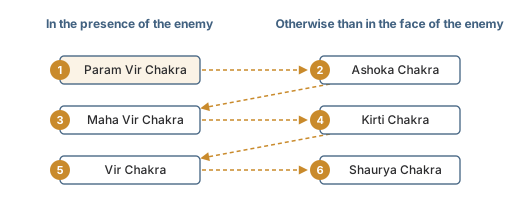
Six awards in two families, split by one phrase: "in the presence of the enemy" for the Vir Chakra series and "otherwise than in the face of the enemy" for the Chakra series. The first three were the Param Vir Chakra, Maha Vir Chakra and Vir Chakra, instituted on 26 January 1950 with effect from 15 August 1947; the peacetime three began as Ashoka Chakra Classes I, II and III. They are announced twice a year, on Republic Day and Independence Day, by the Ministry of Defence, and civilians may receive the peacetime three.
The order of precedence zigzags between the two families, so the Ashoka Chakra ranks second.
The full order is the Param Vir Chakra, the Ashoka Chakra, the Maha Vir Chakra, the Kirti Chakra, the Vir Chakra and the Shaurya Chakra.
Example 1 · What comes second?
Which gallantry award ranks immediately after the Param Vir Chakra?
The two families interleave rather than running one after the other.
So the top peacetime award comes next, before the Maha Vir Chakra.
Answer
The Ashoka Chakra
The Param Vir Chakra's design shows four replicas of Indra's vajra, and its first recipient was Major Somnath Sharma.
The will created prizes in physics, chemistry, physiology or medicine, literature and peace. There is no Nobel Prize in mathematics. The sixth prize at the ceremonies, in economic sciences, was established by Sveriges Riksbank, Sweden's central bank, in 1968, so it is not in the will.
On sharing, the statutes say: "In no case may a prize amount be divided between more than three persons". The ceremonies are held on 10 December, in Stockholm for all of them except the Peace Prize, which is presented in Oslo. The first Peace Prize, in 1901, went to Henry Dunant, founder of the Red Cross.
Indian or India-linked laureate
Prize
Rabindranath Tagore
Rabindranath Tagore, awarded the Nobel Prize in Literature in 1913
instituted in 1954, with the first awards given in 1955
1965; first to G. Sankara Kurup
Given for
An original book (never a translation), in 24 languages
the first seventeen awards went to a book; from the eighteenth, to the writer
Book window
Published within five years before the year preceding the award
The Jnanpith's languages now include English, added to the language list from the 49th award. Geetanjali Shree won the 2022 International Booker Prize for Tomb of Sand (Ret Samadhi), and the Pulitzer Prizes are American.
Watch out
A play is honoured by the Sangeet Natak Akademi, not the Sahitya Akademi. And the Jnanpith is the one major literary award not given by the government.
The Rashtriya Vigyan Puraskar has four categories: Vigyan Ratna, Vigyan Shri, Vigyan Yuva–Shanti Swarup Bhatnagar and Vigyan Team. The Bhatnagar name marks the young-scientist category, and it is announced on National Technology Day, 11 May.
The National Film Awards were established in 1954 as the State Awards, the first edition honouring the films of 1953. They are conferred by the Ministry of Information and Broadcasting and presented by the President. Feature films are judged by five regional panels and a national panel, and books on film win "Best Writing on Cinema".
For the Dadasaheb Phalke Award, for lifetime contribution to cinema, no entries are invited for it — a specially constituted committee of eminent film personalities recommends the name. Phalke made Raja Harishchandra (1913), the first full-length Indian feature film.
Film first
Who or what
First Indian Oscar winner
Bhanu Athaiya, costume design for Gandhi
First Indian film nominated for Best Foreign Language Film
The flag may be any size, but the ratio of length to height is 3:2 — the length to the height. Displayed vertically, the saffron band shall be to the right in reference to the flag, that is, to the left of a person facing it. At half-mast it is first hoisted to the peak, then lowered. Only a listed set of dignitaries, including the President, Vice-President, Prime Minister and Governors, may fly it on a car.
Misuse of the State Emblem is barred by the State Emblem of India (Prohibition of Improper Use) Act, 2005, with rules made under it in 2007.
AnswerC · two civilian awards: Bharat Ratna and Padma Vibhushan
Two awards were created in 1954 — the Bharat Ratna and the Padma Vibhushan.
The Padma Vibhushan then had three classes, called Pahela Varg, Dusra Varg and Tisra Varg.
A Presidential Notification of 8 January 1955 renamed those three classes Padma Vibhushan, Padma Bhushan and Padma Shri.
Worth noting
The three Padmas are one award split into classes, not three awards founded together. That is why they share a scheme, a committee and an announcement date.
A Padma award may not be used as a prefix or suffix to the recipient's name because
Show the explanationHide the explanation
AnswerC · Article 18(1) of the Constitution abolishes titles, so the award does not amount to one
The scheme says in terms that the award does not amount to a title and cannot be used as a suffix or prefix.
It ties that to Article 18(1) of the Constitution, which abolishes titles conferred by the State.
The bar reaches letterheads, invitation cards, posters and books, and misuse costs the recipient the award.
Worth noting
This is a constitutional rule wearing an administrative coat. Knowing where it comes from also tells you why the same restriction attaches to the Bharat Ratna.
A recommendation for the Bharat Ratna is made to the President by
Show the explanationHide the explanation
AnswerD · the Prime Minister, with no formal recommendation being necessary
The scheme of the award places the recommendation with the Prime Minister, who makes it directly to the President.
It adds that no formal recommendation is necessary, so there is no nomination portal and no window for the public.
The Padma Awards Committee, which the Prime Minister constitutes every year, handles the Padma awards and not this one.
Worth noting
The absence of a process is the point. The Bharat Ratna is deliberately outside the machinery that the Padma awards run on, and a question about nominations for it has no correct answer of that kind.
Which of these persons is ineligible for a Padma award under the scheme?
Show the explanationHide the explanation
AnswerA · A serving officer of a public sector undertaking
Government servants, including those working with public sector undertakings, are not eligible.
The scheme carves out an exception for doctors and scientists, so both of those government employees remain eligible.
Foreigners are eligible and are simply counted outside the annual ceiling.
Worth noting
The exception is what the question is really about. A blanket rule about government servants gets this wrong in exactly two places, and those two are the ones worth holding.
Before a person who already holds a Padma award can be given a higher one, the scheme requires that
Show the explanationHide the explanation
AnswerD · at least five years have elapsed since the earlier award
The scheme sets a minimum gap of five years between an earlier Padma award and a higher one.
The Awards Committee may relax the gap in a highly deserving case, so it is a rule with a stated exception rather than a bar.
Nothing in the scheme asks for the earlier award to be given up.
Worth noting
The five-year gap is why the same name rarely climbs the three Padmas quickly, and it is the sort of detail a paper likes because it is a number attached to a rule rather than to an event.
The Param Vir Chakra and the Ashoka Chakra differ in that
Show the explanationHide the explanation
AnswerB · one is for bravery in the presence of the enemy and the other for bravery otherwise than in the face of the enemy
The Param Vir Chakra is awarded for valour in the presence of the enemy.
The Ashoka Chakra is awarded for valour otherwise than in the face of the enemy.
All of these awards may be conferred posthumously, and all are conferred by the President, so neither of those separates the two.
Worth noting
That one phrase is the whole division, and it explains the eligibility rules too: civilians and police personnel can receive the Chakra series, because bravery away from a battlefield is not the soldier's monopoly.
AnswerC · twice a year, on Republic Day and Independence Day
The awards are announced twice a year.
The two occasions are Republic Day and Independence Day.
The Padma awards, by contrast, are announced once a year and only on Republic Day, which is where the single-occasion answer comes from.
Worth noting
Two announcements a year is a small fact that separates the gallantry awards from the civilian honours cleanly, and questions that mix the two families lean on it.
In the official order of precedence of the gallantry awards, the award immediately after the Param Vir Chakra is
Show the explanationHide the explanation
AnswerD · the Ashoka Chakra
The order runs Param Vir Chakra, Ashoka Chakra, Maha Vir Chakra, Kirti Chakra, Vir Chakra, Shaurya Chakra.
It interleaves the two families rather than exhausting one and then starting the other.
So the Ashoka Chakra stands above the Maha Vir Chakra, which is the step most often missed.
Worth noting
Read the wartime three straight down and then the peacetime three and you get a plausible order that is wrong at every position but the first. The interleaving is the fact.
The awards originally instituted as Ashoka Chakra Class I, Class II and Class III are now known as
Show the explanationHide the explanation
AnswerD · Ashoka Chakra, Kirti Chakra and Shaurya Chakra
The three classes were renamed in January 1967.
Class I became the Ashoka Chakra, Class II the Kirti Chakra and Class III the Shaurya Chakra.
The Vir Chakra series was never a class structure and was never renamed.
Worth noting
The renaming is why one family has three unrelated names while the other three all end in Chakra with a rank word in front. The shape of the names records their history.
The first Nobel Prize awarded to an Indian went to
Show the explanationHide the explanation
AnswerD · Rabindranath Tagore, in Literature, in 1913
Rabindranath Tagore received the Nobel Prize in Literature in 1913, and took the whole prize rather than a share of it.
It was the first Nobel Prize to an Indian and the first to anyone from Asia.
C. V. Raman's Physics prize of 1930 came seventeen years later.
Worth noting
The prize motivation is worth reading once: it praises the verse Tagore recast in his own English words. The citation is about the English, which surprises most people who expect it to name a Bengali book.
The Prize in Economic Sciences in Memory of Alfred Nobel was established by
Show the explanationHide the explanation
AnswerC · Sveriges Riksbank, Sweden's central bank, in 1968
Sweden's central bank established the prize in 1968.
It is awarded in memory of Alfred Nobel but is not in his will and is not paid from his bequest.
That is why its full name is the Sveriges Riksbank Prize in Economic Sciences in Memory of Alfred Nobel.
Worth noting
Calling it the Nobel Prize in economics is the error the full name exists to prevent. A question that offers the full name is usually testing whether you know why it is that long.
AnswerD · the most outstanding original book published in a recognised language
The rules make it an award for a book: the most outstanding original book by an Indian author in a recognised language.
A work of translation is expressly excluded, and the Akademi runs a separate Prize for Translation for that.
Lifetime contribution is what the Akademi’s Fellowship recognises, and the Akademi runs separate honours for young writers and for writing for children.
Worth noting
The Akademi runs several honours and they divide the ground carefully. Knowing that this one attaches to a book rather than a career is what separates it from the Jnanpith.
Which of these is a category of the Rashtriya Vigyan Puraskar?
Show the explanationHide the explanation
AnswerB · Vigyan Team
The four categories are Vigyan Ratna, Vigyan Shri, Vigyan Yuva-Shanti Swarup Bhatnagar and Vigyan Team.
The team category is the distinctive one: it recognises three or more scientists working together, which no other national science honour does.
The names that echo the Padma series are not categories of this award.
Worth noting
The award borrows Ratna and Shri from the civilian honours, which is exactly why a distractor built on Bhushan or Vibhushan reads so plausibly. The team category is the one that could not be anything else.
The Jnanpith Award changed the object of its selection so that
Show the explanationHide the explanation
AnswerD · the first seventeen awards went to a book and the awards from the eighteenth go to the writer
For the first seventeen awards the Jnanpith selected the most outstanding work.
From the eighteenth award the rule was revised and the entire contribution of the author is taken into account.
That is why a citation from the 1960s names a title and a recent one does not.
Worth noting
This one change is what makes the Jnanpith a lifetime honour today. It is also what makes the Jnanpith and the Sahitya Akademi Award answer different questions, although both are literary and both are annual.
The award is given by the Bharatiya Jnanpith, which is a trust and not a government body.
It is open only to Indian citizens, and English joined its language list from the forty-ninth award.
The Sahitya Akademi is the government's literary body and gives its own, separate award.
Worth noting
A writer can hold both, because they come from different places for different reasons. The Jnanpith's language list is its own too — English is on it although English is not in the Eighth Schedule.
Within the Rashtriya Vigyan Puraskar, the name Shanti Swarup Bhatnagar is attached to the category for
Show the explanationHide the explanation
AnswerA · young scientists making an exceptional contribution
The category is Vigyan Yuva-Shanti Swarup Bhatnagar, and it recognises and encourages young scientists.
Lifetime achievement is Vigyan Ratna and distinguished contribution is Vigyan Shri.
The team award carries no personal name at all.
Worth noting
The name survived a restructure of the national science awards and landed on the young-scientist category, which is where the older Shanti Swarup Bhatnagar Prize had always pointed.
The National Film Awards were established in 1954 under the name
Show the explanationHide the explanation
AnswerC · the State Awards
They were established in 1954 and were initially called the State Awards.
The first edition honoured the films of 1953, so the year of the award and the year of the films differ by one.
The early prizes were two President's Gold Medals, two certificates of merit and twelve silver medals for regional films.
Worth noting
The one-year offset between the films and the award has never gone away, which is why the seventieth awards, conferred in 2024, were for the films of 2022.
AnswerC · lifetime contribution to the growth and development of Indian cinema
The award recognises lifetime contribution to Indian cinema.
Best Writing on Cinema is a separate section of the National Film Awards, covering books and criticism rather than films.
Feature films and debut work are decided by the feature film juries.
Worth noting
It is named for the maker of Raja Harishchandra, the first indigenous Indian film, in 1913 — a lifetime award named after the man whose lifetime started the industry.
AnswerC · no entries are invited; a specially constituted committee of eminent film personalities recommends the name
No entries are invited for this award.
The selection rests on the recommendations of a committee of eminent film personalities constituted specially for the purpose.
The two-tier process of regional panels and a national panel is how the feature film section is decided, not this award.
Worth noting
It is the one National Film Award nobody can apply for, and that is the cleanest way to tell it apart from the rest of the ceremony it is presented at.
AnswerB · the Ministry of Information and Broadcasting and presented by the President
The Ministry of Information and Broadcasting confers the awards and the President presents them.
The National Film Development Corporation took over the organisation of film festivals in March 2022, which is a different job from conferring these awards.
The Sangeet Natak Akademi covers music, dance and drama, not cinema.
Worth noting
Cinema sits under Information and Broadcasting while the other arts sit under Culture, and that single split answers a whole family of questions about which body does what.
Since the 57th National Film Awards, the winners in the feature film section have been decided by
Show the explanationHide the explanation
AnswerA · five regional panels shortlisting entries and a national panel deciding
The feature film section runs a two-tier selection: five regional panels shortlist the entries and a national panel picks the winners.
The non-feature film section and Best Writing on Cinema have juries specific to those awards.
The Dadasaheb Phalke committee is separate again and invites no entries.
Worth noting
Three sections, three different selection routes. A question about the film awards that offers one process for the whole ceremony is offering a simplification that does not exist.
Under the Flag Code of India, the National Flag shall be rectangular and
Show the explanationHide the explanation
AnswerA · of any size, with the ratio of length to height fixed at 3:2
The Flag Code fixes the proportion but not the size.
The Flag may be of any size so long as it is rectangular and the ratio of its length to its height is 3:2.
A ratio of 2:1 belongs to other countries' flags and is the usual distractor here.
Worth noting
Proportion is regulated, dimension is not. That distinction is the whole answer, and it is why a flag on a desk and one over a fort obey the same rule.
Under the Flag Code, the National Flag may be flown on a motor car by
Show the explanationHide the explanation
AnswerA · a specified list of dignitaries including the President, the Vice-President, the Prime Minister and Governors
The privilege of flying the National Flag on a motor car is limited to the dignitaries the Flag Code names.
That list includes the President, the Vice-President, the Prime Minister and Governors.
A member of the public may hoist or display the Flag on all days, but that permission is about display and not about vehicles.
Worth noting
Two different rules were relaxed at different times and are easy to merge. Displaying the Flag at home was opened to everyone; flying it on a car was not.
When the National Flag is displayed vertically, the saffron band shall be
Show the explanationHide the explanation
AnswerC · to the right in reference to the flag, that is, to the left of a person facing it
The rule is written from the flag's point of view, not the viewer's.
The saffron band is to the right in reference to the flag, which puts it on the left of a person standing in front of it.
Uppermost is the rule for a flag displayed flat and horizontal on a wall, which is the other case the FAQ covers.
Worth noting
The two halves of the sentence look contradictory until you notice whose right is meant. Reading it as a statement about the flag and then translating for the viewer is the only way it comes out right.
When the National Flag is to be flown at half-mast, it is
Show the explanationHide the explanation
AnswerA · hoisted to the peak of the staff first, then lowered to the half-mast position
The Flag is hoisted to the peak or top of the staff first and only then lowered to the half-mast position.
Before it is lowered for the day it is raised to the peak again.
The Flag is not flown at half-mast at all except on occasions instructed by the Government of India, so there is no personal discretion in it.
Worth noting
The full hoist at each end is the part of the practice most people have never noticed, and a question about half-mast is usually asking about that rather than about the occasion.
The improper use of the State Emblem of India is prohibited by
Show the explanationHide the explanation
AnswerD · the State Emblem of India (Prohibition of Improper Use) Act, 2005
The State Emblem has a statute of its own, passed in 2005, with rules made under it in 2007.
The Flag Code governs the hoisting and display of the National Flag and is not a statute at all.
The Prevention of Insults to National Honour Act, 1971 is the law that covers insults to the Flag and the Anthem.
Worth noting
Three symbols, three different instruments. Sorting them by which document governs which is more reliable than sorting them by date, because the dates are easy to swap and the subjects are not.
The United Nations observes the International Day of Yoga on 21 June.
It was created by General Assembly resolution A/RES/69/131.
11 May is National Technology Day, which is an Indian observance with no UN resolution behind it.
Worth noting
Every UN international day is created by a resolution, and the resolution number is the proof that a day is a UN observance rather than a national one. That is a useful test when an option set mixes the two.
World Environment Day falls on 5 June, under General Assembly resolution A/RES/2994 (XXVII).
16 September is the International Day for the Preservation of the Ozone Layer, which is a different environmental observance.
22 April is not the date the United Nations assigns to World Environment Day.
Worth noting
The environment carries several UN days and they are easily swapped. Attaching each to its own resolution is the only way to keep them apart, because the themes overlap and the dates do not.
Human Rights Day is observed on 10 December because that is the date on which
Show the explanationHide the explanation
AnswerA · the Universal Declaration of Human Rights was adopted
The day marks the adoption of the Universal Declaration of Human Rights, and rests on General Assembly resolution A/RES/423 (V).
The United Nations came into existence on 24 October, which is United Nations Day.
The Nobel Peace Prize is indeed presented on 10 December, but that is Alfred Nobel's death anniversary and is a coincidence of dates rather than the reason for the observance.
Worth noting
Two things happen on 10 December for two unrelated reasons, and a question can use one to make the other look wrong. The Declaration is the reason for the day.
Which of these is an observance of the United Nations rather than an Indian national observance?
Show the explanationHide the explanation
AnswerA · World Refugee Day
World Refugee Day, on 20 June, is on the United Nations list of international days and rests on General Assembly resolution A/RES/55/76.
National Space Day and National Technology Day are Indian observances, marked by the Government of India.
National Science Day is likewise Indian and has no General Assembly resolution behind it.
Worth noting
The word National in the name of a day is a reliable signal that no international body created it, and the presence of a resolution number is the positive test in the other direction.
Books about cinema are recognised within the National Film Awards under the section called
Show the explanationHide the explanation
AnswerD · Best Writing on Cinema
Best Writing on Cinema is a section of the National Film Awards in its own right, honouring books and critics.
It has a jury specific to it, separate from the feature and non-feature juries.
The Dadasaheb Phalke Award is for lifetime contribution to cinema and is not about writing at all.
Worth noting
A film award that honours a book sounds like a contradiction until you see the section name. It is the reason a literary prize can turn up in a question about cinema.
Of the Sahitya Akademi Award and the Jnanpith Award as they stand today, the one given for a single book is
Show the explanationHide the explanation
AnswerB · the Sahitya Akademi Award
The Sahitya Akademi Award goes to the most outstanding original book by an Indian author in a recognised language.
The Jnanpith selected a work for its first seventeen awards but has taken the author's entire contribution into account since the eighteenth.
So only one of the two is still an award for a book.
Worth noting
A writer can hold both, and the citations will read quite differently: one names a title, the other a life's work. That is the practical consequence of the rule change.
A book is ineligible for the Sahitya Akademi Award if it is
Show the explanationHide the explanation
AnswerD · a work of translation
The rules require an original book and expressly exclude a work of translation.
A critical work is allowed: the rules admit creative and critical work alike.
The Akademi runs a separate Prize for Translation, which is where a translator's work is recognised.
Worth noting
Translation is not excluded because it is thought lesser; it is excluded because it has its own prize. The Akademi's honours divide the ground rather than compete for it.
For the Sahitya Akademi Award of a given year, the book must have been published
Show the explanationHide the explanation
AnswerB · within the five years before the year immediately preceding the award
The rules set a five-year window, ending with the year before the year preceding the award.
The Akademi's own illustration makes this concrete: for the award of 2004, books published between 1998 and 2002 would be considered.
A one-year window would leave no time for a book to be read and judged, which is why the rule allows the gap it does.
Worth noting
The window exists because literary reputation takes a few years to settle. Working through the Akademi's illustration once is faster than memorising the rule as a sentence.
English was added to the list of languages considered for the Jnanpith Award
Show the explanationHide the explanation
AnswerC · from the 49th award
English joined the Jnanpith's language list from the forty-ninth award.
English is not in the Eighth Schedule and never has been, so that cannot be the trigger.
The award is open only to Indian citizens, wherever they write from.
Worth noting
Two lists of Indian languages exist for two different purposes, and they do not match. The Eighth Schedule is constitutional; the Jnanpith's list is the trust's own, and this is the clearest place the difference shows.
The Sahitya Akademi was established in 1954 and gave its first Awards in
Show the explanationHide the explanation
AnswerB · 1955
The Akademi was set up in 1954 and the first Awards were given in 1955.
A one-year gap between founding and first award is common, because the first cycle of reading and judging has to run before anything can be given.
The Jnanpith, founded on the same pattern, gave its first award in 1965.
Worth noting
Founding year and first award year are separate facts about the same institution, and an option set that offers both is testing whether you have kept them apart.
K. R. Narayanan was the tenth and Pratibha Devisingh Patil the twelfth.
Pranab Mukherjee, the thirteenth, followed her.
Worth noting
The ordinals are worth learning as a short run rather than one at a time, because a question about any one of them is usually really a question about the order.
The scheme of the Padma awards is a Ministry of Home Affairs document and the nominations run through it.
The President confers the awards, but conferring and administering are different jobs.
The Ministry of Information and Broadcasting handles the film awards, not these.
Worth noting
Four bodies touch a Padma award — a ministry, a committee, the Prime Minister and the President — and a question usually asks about exactly one of them. Reading which verb the question uses is half the answer.
The Arjuna Award for outstanding performance in sport is given by
Show the explanationHide the explanation
AnswerB · the Ministry of Youth Affairs and Sports
The national sports awards, including the Arjuna Award, the Dronacharya Award for coaches and the Major Dhyan Chand Khel Ratna, are conferred by the Ministry of Youth Affairs and Sports.
The President presents them at Rashtrapati Bhavan. The Indian Olympic Association is a sports body, not an awarding ministry.
Which of these honours is conferred by a body that is not part of the Government of India?
Show the explanationHide the explanation
AnswerB · The Jnanpith Award
The Jnanpith Award is given by the Bharatiya Jnanpith, which is a trust.
The Sahitya Akademi is the national academy of letters and the Rashtriya Vigyan Puraskar is a government award in science.
The Dadasaheb Phalke Award is part of the National Film Awards, conferred by a ministry.
Worth noting
Prestige and government are not the same thing. The Jnanpith carries as much standing as any of the others and belongs to none of the machinery they share.
AnswerB · the Ministry of Defence, with civilians eligible for the Ashoka, Kirti and Shaurya Chakras
The gallantry awards are a Ministry of Defence subject.
Civilians and members of the police forces are eligible for the Ashoka Chakra, the Kirti Chakra and the Shaurya Chakra.
Only the Param Vir, Maha Vir and Vir Chakras are confined to the armed forces and the services attached to them, because those require an act in the presence of the enemy.
Worth noting
The eligibility follows the definition rather than the ministry. Bravery away from a battlefield is open to anyone, so the awards for it are too.
Among the prizes presented at the Nobel ceremonies, the one established by a body other than those named in Alfred Nobel's will is
Show the explanationHide the explanation
AnswerA · the Prize in Economic Sciences, established by Sweden's central bank
Sveriges Riksbank, Sweden's central bank, established the Prize in Economic Sciences in 1968.
The other four prizes named here come from Nobel's will of 1895, which assigned each to an awarding institution.
The Norwegian Nobel Committee awards the Peace Prize under the will rather than having created the prize.
Worth noting
Awarding a prize and establishing one are different acts, and this question turns on that difference. Only one of these prizes has a founder outside the will.
The area names are NTA's. The chapters inside them are EduFarming's own division, not NTA's.