On this page · 9 sections 01 The core idea 02 Demand for and supply of foreign exchange 03 The flexible exchange rate 04 The fixed exchange rate 05 Managed floating 06 Exam shortcuts 07 Common mistakes 08 Quick revision 09 Check your understanding The exchange rate is the price of one currency in terms of another, written here as rupees per dollar. When it rises (₹80 → ₹85 per $), each dollar costs more rupees: the rupee has depreciated . When it falls, the rupee has appreciated .
Demand for dollars (payments abroad) Supply of dollars (receipts from abroad) Imports of goods and services Exports of goods and services Indians travelling or studying abroad Foreign tourists in India Indians investing abroad Foreign investment in India Repaying foreign loans, sending gifts abroad Remittances to India, borrowing from abroad Speculators expecting the dollar to rise
The demand curve slopes down : a cheaper dollar makes imports cheaper, so more dollars are wanted. The supply curve slopes up : a dearer dollar makes Indian goods cheaper for foreigners, so exports and dollar earnings rise.
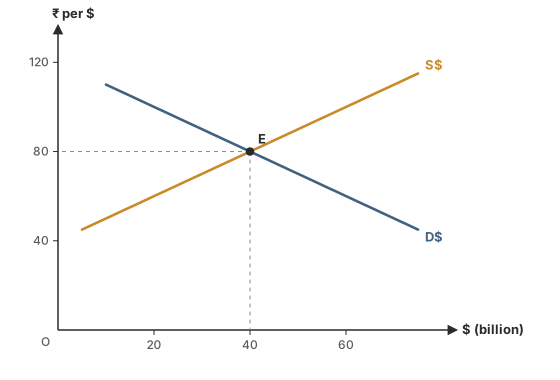
Under a flexible (floating) rate, the market sets the rate where the dollars demanded equal the dollars supplied.
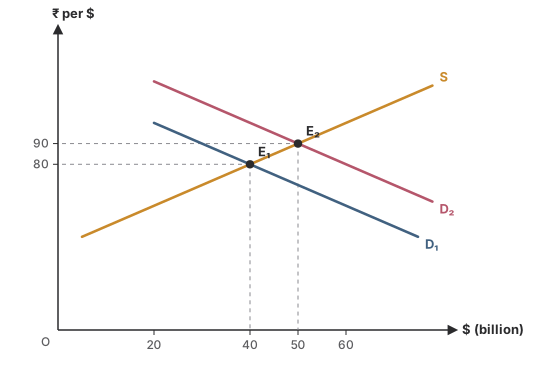
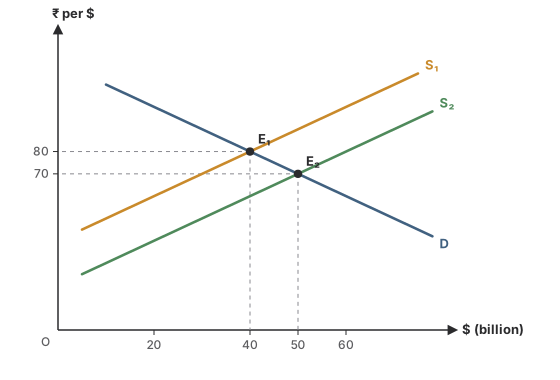
A rise in the demand for dollars, such as a costlier oil import bill, depreciates the rupee from ₹80 to ₹90. A rise in the supply of dollars, such as a surge of foreign investment, appreciates the rupee from ₹80 to ₹70. Depreciation makes exports cheaper abroad and imports dearer at home, which helps close a BoP deficit on its own. A floating rate needs no reserves to defend a level, but it can swing and make trade uncertain.
Example 1 · Who gains from depreciation
An exporter sells software worth 10 lakh dollars. Before payment, the rupee moves from ₹80 to ₹84 per dollar.
At ₹80: 10 lakh × 80 = ₹8 crore. At ₹84: 10 lakh × 84 = ₹8.4 crore.
The dollar's price rose by 4 ÷ 80 = 5%.
Answer The exporter earns ₹40 lakh more
Under a fixed rate, the government or central bank sets the rate and holds it by buying or selling foreign currency. Lowering the fixed value is devaluation ; raising it is revaluation . Under the gold standard each currency had a gold value; under Bretton Woods (1944–1971) currencies were pegged to the dollar, which was convertible into gold.
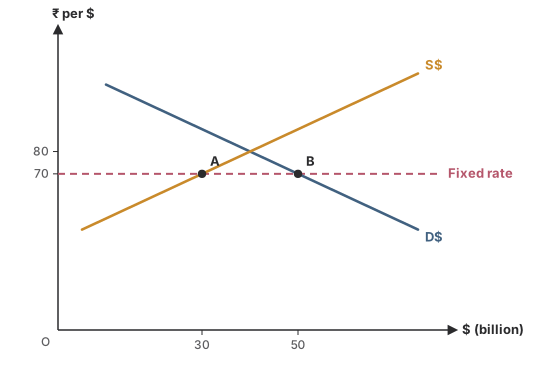
At the fixed ₹70, the central bank must sell $20 billion from reserves to meet the shortage AB. A fixed rate gives traders certainty but needs large reserves; if they run out, the country must devalue towards the market rate.
Floating rate Fixed rate Depreciation, appreciation Devaluation, revaluation Set by the market Set by the authority
The market sets the rate, but the central bank buys or sells dollars to stop sharp swings: sell dollars to support a falling rupee, buy them when inflows push the rupee up too fast. India moved to a market-determined rate in March 1993 and follows managed floating, with the RBI intervening to curb excessive volatility.
Higher ₹ per $ = rupee depreciation.
Payments abroad = demand for forex; receipts = supply.
Market moves: depreciation/appreciation. Government moves: devaluation/revaluation.
Rupee falling too fast: the RBI sells dollars.
Reading a higher number as a stronger rupee.
Calling foreign investment into India a demand for dollars.
Using "devaluation" for a market fall.
Thinking managed floating needs no reserves.
The market
Demand for $: imports, travel, investment abroad
Supply of $: exports, tourists, investment into India
Equilibrium where they meet
Systems
Flexible: market sets it
Fixed: authority sets it; devalue or revalue
Managed floating: market with intervention (India since 1993)
All of Macroeconomics on one page is in the Macro formulas and graphs sheet.
Next · 08 Quick revision → Check your understanding 50 questions, grouped by type, easy to hard. Pick an answer and check it. The worked solution opens when you ask for it.
The exchange rate Q1 of 50 Q1
The exchange rate 10 questions The foreign exchange rate is
Options for question 1 A Option A the rate of interest on foreign loans B Option B the price of one currency in terms of another C Option C the growth rate of exports D Option D the share of trade in GDP
Skip Check Show the explanation Hide the explanation Next question Try again
Show the explanation Hide the explanation Answer B · the price of one currency in terms of another
₹84 per dollar means one dollar costs ₹84.
The rupee-dollar rate moves from ₹80 to ₹85 per dollar. The rupee has
Options for question 2 A Option A appreciated B Option B been revalued C Option C not changed in value D Option D depreciated
Skip Check Show the explanation Hide the explanation Next question Try again
Show the explanation Hide the explanation Answer D · depreciated
More rupees are now needed to buy one dollar, so each rupee is worth less in dollars.
Worth noting
The number went up, but a higher ₹ per $ means a weaker rupee.
Read the two statements and choose the correct option.
I. A rise in the rupee price of a dollar means the rupee has appreciated.
II. When the rupee depreciates, foreign holidays become costlier for Indians.
Options for question 3 A Option A Only I B Option B Only II C Option C Both I and II D Option D Neither I nor II
Skip Check Show the explanation Hide the explanation Next question Try again
Show the explanation Hide the explanation Answer B · Only II
More rupees per dollar is a depreciation of the rupee. I is false.
Each dollar spent abroad now costs more rupees. II is true.
If $1 = ₹80, then ₹1 is worth
Options for question 4 A Option A $0.0125 B Option B $0.8 C Option C $1.25 D Option D $80
Skip Check Show the explanation Hide the explanation Next question Try again
Show the explanation Hide the explanation Answer A · $0.0125
₹1 = $1 ÷ 80 = $0.0125.
A laptop costs $500 in the USA. If $1 = ₹84, its price in rupees (ignoring taxes and transport) is
Options for question 5 A Option A ₹4,200 B Option B ₹5,952 C Option C ₹42,000 D Option D ₹58,400
Skip Check Show the explanation Hide the explanation Next question Try again
Show the explanation Hide the explanation Answer C · ₹42,000
Price in rupees = 500 × 84 = ₹42,000.
Assertion (A): A depreciation of the rupee makes Indian goods cheaper for foreign buyers.
Reason (R): After depreciation, each dollar buys more rupees' worth of Indian goods.
Options for question 6 A Option A Both A and R are true, and R is the correct explanation of A. B Option B Both A and R are true, but R is not the correct explanation of A. C Option C A is true, but R is false. D Option D A is false, but R is true.
Skip Check Show the explanation Hide the explanation Next question Try again
Show the explanation Hide the explanation Answer A · Both A and R are true, and R is the correct explanation of A.
A ₹840 shirt costs $10.5 at ₹80 per dollar but $10 at ₹84 per dollar. R explains A.
Read the two statements and choose the correct option.
I. A fall in the rupee price of a dollar is an appreciation of the rupee.
II. An appreciation of the rupee makes imports more expensive in rupees.
Options for question 7 A Option A Only I B Option B Only II C Option C Both I and II D Option D Neither I nor II
Skip Check Show the explanation Hide the explanation Next question Try again
Show the explanation Hide the explanation Answer A · Only I
Fewer rupees per dollar means a stronger rupee. I is true.
With a stronger rupee, a dollar-priced import costs fewer rupees, so imports become cheaper. II is false.
If £1 = ₹105 and $1 = ₹84, then £1 is worth about
Options for question 8 A Option A $0.80 B Option B $1.25 C Option C $21 D Option D $189
Skip Check Show the explanation Hide the explanation Next question Try again
Show the explanation Hide the explanation Answer B · $1.25
£1 buys ₹105, and ₹105 buys 105 ÷ 84 dollars.
105 ÷ 84 = 1.25, so £1 ≈ $1.25.
Assertion (A): An appreciation of the rupee helps Indian exporters.
Reason (R): After an appreciation, each dollar earned from exports converts into fewer rupees.
Options for question 9 A Option A Both A and R are true, and R is the correct explanation of A. B Option B Both A and R are true, but R is not the correct explanation of A. C Option C A is true, but R is false. D Option D A is false, but R is true.
Skip Check Show the explanation Hide the explanation Next question Try again
Show the explanation Hide the explanation Answer D · A is false, but R is true.
R is true: fewer rupees per dollar is what appreciation means.
So exporters earn fewer rupees and their goods cost more abroad: appreciation hurts them. A is false.
The exchange rate moves from ₹80 to ₹84 per dollar. By what percentage has the dollar appreciated against the rupee?
Options for question 10 A Option A 4% B Option B 4.76% C Option C 5% D Option D 84%
Skip Check Show the explanation Hide the explanation Next question Try again
Show the explanation Hide the explanation Answer C · 5%
The dollar's price in rupees rose by 4 on a base of 80.
4 ÷ 80 × 100 = 5%.
Worth noting
4.76% is how much the rupee fell in dollar terms (1/80 to 1/84), a different measure.
Demand for and supply of foreign exchange 10 questions Which of these creates a demand for foreign exchange in India?
Options for question 11 A Option A Indians importing goods from abroad B Option B Foreign tourists visiting India C Option C Foreign firms investing in India D Option D Indians abroad sending money home
Skip Check Show the explanation Hide the explanation Next question Try again
Show the explanation Hide the explanation Answer A · Indians importing goods from abroad
Importers must pay in foreign currency, so they buy it with rupees.
The other three bring foreign currency in: they add to supply.
Match each transaction with its effect in India's forex market.
List I List II A. An Indian student pays fees to a university in Canada I. Supply of foreign exchange (investment inflow) B. An Indian IT firm is paid by a US client II. Demand for foreign exchange (services import) C. A Japanese company builds a factory in Gujarat III. Demand for foreign exchange (loan repayment) D. An Indian firm repays a loan taken from a German bank IV. Supply of foreign exchange (services export)
Options for question 12 A Option A A-II, B-I, C-III, D-IV B Option B A-I, B-II, C-IV, D-III C Option C A-II, B-IV, C-I, D-III D Option D A-III, B-IV, C-I, D-II
Skip Check Show the explanation Hide the explanation Next question Try again
Show the explanation Hide the explanation Answer C · A-II, B-IV, C-I, D-III
Payments abroad create demand for foreign currency; receipts from abroad create supply.
The demand curve for dollars in India slopes downward because, as the rupee price of a dollar falls,
Options for question 13 A Option A Indian goods become cheaper for foreigners B Option B foreign goods become cheaper in rupees, so imports rise C Option C the RBI sells more dollars D Option D exports rise
Skip Check Show the explanation Hide the explanation Next question Try again
Show the explanation Hide the explanation Answer B · foreign goods become cheaper in rupees, so imports rise
A cheaper dollar makes imports, foreign travel and study abroad cheaper, so more dollars are demanded.
The supply curve of dollars in India slopes upward because, as the rupee price of a dollar rises,
Options for question 14 A Option A imports become cheaper B Option B Indians travel abroad more C Option C exports become cheaper for foreigners and rise D Option D foreign investors leave India
Skip Check Show the explanation Hide the explanation Next question Try again
Show the explanation Hide the explanation Answer C · exports become cheaper for foreigners and rise
Each dollar now buys more Indian goods, so foreigners buy more from India and bring in more dollars.
The graph shows the demand for and supply of dollars. What is the equilibrium exchange rate?
Options for question 15 A Option A ₹40 per dollar B Option B ₹60 per dollar C Option C ₹80 per dollar D Option D ₹120 per dollar
Skip Check Show the explanation Hide the explanation Next question Try again
Show the explanation Hide the explanation Answer C · ₹80 per dollar
Equilibrium is where D$ meets S$, at E.
E is at ₹80 per dollar, with $40 billion traded.
Worth noting
40 is the quantity of dollars traded, in billions, not the rate.
Read the two statements and choose the correct option.
I. Foreign tourists spending in India add to the supply of foreign exchange.
II. Indians buying shares of foreign companies add to the supply of foreign exchange.
Options for question 16 A Option A Only I B Option B Only II C Option C Both I and II D Option D Neither I nor II
Skip Check Show the explanation Hide the explanation Next question Try again
Show the explanation Hide the explanation Answer A · Only I
Tourists exchange their currency for rupees. I is true.
Buying foreign shares needs foreign currency: that is demand, not supply. II is false.
Assertion (A): Speculators who expect the dollar to rise buy dollars now.
Reason (R): They hope to sell the dollars later for more rupees.
Options for question 17 A Option A Both A and R are true, and R is the correct explanation of A. B Option B Both A and R are true, but R is not the correct explanation of A. C Option C A is true, but R is false. D Option D A is false, but R is true.
Skip Check Show the explanation Hide the explanation Next question Try again
Show the explanation Hide the explanation Answer A · Both A and R are true, and R is the correct explanation of A.
Speculative demand rises when a currency is expected to gain. R explains A.
The graph shows the demand for and supply of dollars. At ₹90 per dollar, the market has
Options for question 18 A Option A an excess demand for dollars, so the rate rises B Option B equilibrium C Option C an excess supply of dollars, so the rate falls D Option D no supply of dollars
Skip Check Show the explanation Hide the explanation Next question Try again
Show the explanation Hide the explanation Answer C · an excess supply of dollars, so the rate falls
Above the equilibrium rate of ₹80, S$ lies to the right of D$: more dollars are offered than wanted.
Sellers cut the price of dollars until the rate returns to ₹80.
Read the two statements and choose the correct option.
I. Indian students going to study abroad add to the supply of foreign exchange in India.
II. Exports of Indian pharmaceuticals add to the supply of foreign exchange in India.
Options for question 19 A Option A Only I B Option B Only II C Option C Both I and II D Option D Neither I nor II
Skip Check Show the explanation Hide the explanation Next question Try again
Show the explanation Hide the explanation Answer B · Only II
Fees paid abroad need foreign currency: demand, not supply. I is false.
Export earnings bring foreign currency in. II is true.
Which of these would shift the supply curve of dollars in India to the left?
Options for question 20 A Option A A rise in foreign tourists visiting India B Option B Foreign investors pulling money out of Indian shares C Option C A rise in India's exports D Option D A rise in remittances from abroad
Skip Check Show the explanation Hide the explanation Next question Try again
Show the explanation Hide the explanation Answer B · Foreign investors pulling money out of Indian shares
Fewer dollars come in at every exchange rate, so supply falls.
The flexible rate: depreciation and appreciation 10 questions Under a flexible (floating) exchange rate system, the exchange rate is set by
Options for question 21 A Option A demand and supply in the forex market B Option B the government by law C Option C the IMF D Option D the price of gold
Skip Check Show the explanation Hide the explanation Next question Try again
Show the explanation Hide the explanation Answer A · demand and supply in the forex market
The rate moves freely to the level where the quantity demanded equals the quantity supplied.
The graph shows the demand for dollars rising from D₁ to D₂. What happens to the rupee?
Options for question 22 A Option A It appreciates from ₹80 to ₹70 per dollar B Option B It stays at ₹80 per dollar C Option C It depreciates from ₹40 to ₹50 per dollar D Option D It depreciates from ₹80 to ₹90 per dollar
Skip Check Show the explanation Hide the explanation Next question Try again
Show the explanation Hide the explanation Answer D · It depreciates from ₹80 to ₹90 per dollar
Equilibrium moves from E₁ (₹80) to E₂ (₹90).
More rupees per dollar means the rupee has depreciated.
Worth noting
40 and 50 are quantities of dollars, in billions, read off the horizontal axis, not exchange rates.
The graph shows the demand for dollars rising from D₁ to D₂. Which event could cause this shift?
Options for question 23 A Option A A rise in foreign investment into India B Option B A rise in India's software exports C Option C A rise in the world price of crude oil, which India imports D Option D A rise in remittances from abroad
Skip Check Show the explanation Hide the explanation Next question Try again
Show the explanation Hide the explanation Answer C · A rise in the world price of crude oil, which India imports
A costlier oil bill means importers need more dollars at every exchange rate: demand shifts right.
The other three add to the supply of dollars.
The graph shows the supply of dollars rising from S₁ to S₂. What happens to the rupee?
Options for question 24 A Option A It appreciates from ₹80 to ₹70 per dollar B Option B It depreciates from ₹80 to ₹90 per dollar C Option C It stays at ₹80 per dollar D Option D It is devalued by the RBI
Skip Check Show the explanation Hide the explanation Next question Try again
Show the explanation Hide the explanation Answer A · It appreciates from ₹80 to ₹70 per dollar
Equilibrium moves from E₁ (₹80) to E₂ (₹70).
Fewer rupees per dollar: the rupee has appreciated.
Worth noting
Devaluation is a decision under a fixed rate; here the market moved the rate.
The graph shows the supply of dollars rising from S₁ to S₂. Which event could cause this?
Options for question 25 A Option A A rise in Indians travelling abroad B Option B A surge in foreign portfolio investment into Indian shares C Option C A rise in India's gold imports D Option D Indian firms repaying foreign loans
Skip Check Show the explanation Hide the explanation Next question Try again
Show the explanation Hide the explanation Answer B · A surge in foreign portfolio investment into Indian shares
Foreign investors bring in dollars to buy rupee assets, adding to supply at every rate.
The other three raise the demand for dollars.
Read the two statements and choose the correct option.
I. Under a flexible rate, the central bank does not need to hold large foreign exchange reserves to defend a rate.
II. A flexible rate gives traders certainty about future exchange rates.
Options for question 26 A Option A Only I B Option B Only II C Option C Both I and II D Option D Neither I nor II
Skip Check Show the explanation Hide the explanation Next question Try again
Show the explanation Hide the explanation Answer A · Only I
The market clears itself, so reserves are not needed to hold any level. I is true.
A floating rate can swing, which creates uncertainty for traders. II is false.
An Indian exporter sells software worth 10 lakh dollars. If the rupee depreciates from ₹80 to ₹84 per dollar before payment, the exporter's rupee earnings
Options for question 27 A Option A fall by ₹40 lakh B Option B do not change C Option C rise by ₹4 lakh D Option D rise by ₹40 lakh
Skip Check Show the explanation Hide the explanation Next question Try again
Show the explanation Hide the explanation Answer D · rise by ₹40 lakh
At ₹80: 10 lakh × 80 = ₹8 crore. At ₹84: 10 lakh × 84 = ₹8.4 crore.
Rise = ₹40 lakh: depreciation helps exporters.
Assertion (A): A depreciation of the rupee makes imports cheaper for Indians.
Reason (R): After depreciation, more rupees are needed to buy each dollar.
Options for question 28 A Option A Both A and R are true, and R is the correct explanation of A. B Option B Both A and R are true, but R is not the correct explanation of A. C Option C A is true, but R is false. D Option D A is false, but R is true.
Skip Check Show the explanation Hide the explanation Next question Try again
Show the explanation Hide the explanation Answer D · A is false, but R is true.
R is true: that is what depreciation means.
So dollar-priced imports cost more rupees, not fewer. A is false.
The graph shows the demand for and supply of dollars. If India's exports fall sharply, the rupee is likely to
Options for question 29 A Option A appreciate, as the supply of dollars shifts right B Option B stay at ₹80, as demand is unchanged C Option C appreciate, as the demand for dollars shifts right D Option D depreciate, as the supply of dollars shifts left
Skip Check Show the explanation Hide the explanation Next question Try again
Show the explanation Hide the explanation Answer D · depreciate, as the supply of dollars shifts left
Fewer exports mean fewer dollars coming in at every rate: S$ shifts left.
With demand unchanged, the rupee price of a dollar rises above ₹80: the rupee depreciates.
Assertion (A): Under a flexible exchange rate, a BoP deficit tends to correct itself.
Reason (R): Excess demand for foreign currency makes the home currency depreciate, which raises exports and cuts imports.
Options for question 30 A Option A Both A and R are true, and R is the correct explanation of A. B Option B Both A and R are true, but R is not the correct explanation of A. C Option C A is true, but R is false. D Option D A is false, but R is true.
Skip Check Show the explanation Hide the explanation Next question Try again
Show the explanation Hide the explanation Answer A · Both A and R are true, and R is the correct explanation of A.
Depreciation makes exports cheaper abroad and imports dearer at home, closing the gap. R explains A.
The fixed rate: devaluation and revaluation 11 questions Under a fixed exchange rate system, the exchange rate is
Options for question 31 A Option A set by the government or central bank and kept there B Option B set freely by demand and supply C Option C changed every day by banks D Option D set by exporters
Skip Check Show the explanation Hide the explanation Next question Try again
Show the explanation Hide the explanation Answer A · set by the government or central bank and kept there
The authority announces a rate and buys or sells foreign currency to hold it.
Match each term with its meaning.
List I List II A. Depreciation I. Market-driven rise in a currency's value B. Appreciation II. Government raises the fixed value of its currency C. Devaluation III. Market-driven fall in a currency's value D. Revaluation IV. Government lowers the fixed value of its currency
Options for question 32 A Option A A-III, B-IV, C-II, D-I B Option B A-IV, B-III, C-I, D-II C Option C A-II, B-I, C-IV, D-III D Option D A-III, B-I, C-IV, D-II
Skip Check Show the explanation Hide the explanation Next question Try again
Show the explanation Hide the explanation Answer D · A-III, B-I, C-IV, D-II
Depreciation and appreciation happen under floating rates; devaluation and revaluation are decisions under a fixed rate.
The graph shows the rate fixed at ₹70 per dollar, below the market rate. How many dollars must the central bank sell from its reserves to hold the rate?
Options for question 33 A Option A $10 billion B Option B $20 billion C Option C $30 billion D Option D $50 billion
Skip Check Show the explanation Hide the explanation Next question Try again
Show the explanation Hide the explanation Answer B · $20 billion
At ₹70, $50 billion is demanded (B) but only $30 billion is supplied (A).
The shortage of 50 − 30 = $20 billion must be met from reserves.
Worth noting
$10 billion confuses the gap in rupees per dollar (80 − 70) with the gap in dollars.
The graph shows the rate fixed at ₹70 per dollar, below the market rate. If the central bank runs short of reserves, it is likely to
Options for question 34 A Option A revalue the rupee to ₹60 per dollar B Option B devalue the rupee towards ₹80 per dollar C Option C buy more dollars D Option D leave everything as it is for ever
Skip Check Show the explanation Hide the explanation Next question Try again
Show the explanation Hide the explanation Answer B · devalue the rupee towards ₹80 per dollar
The rupee is overvalued at ₹70, so there is a lasting shortage of dollars.
Devaluing towards the market rate of ₹80 removes the shortage.
Assertion (A): A fixed exchange rate reduces uncertainty for exporters and importers.
Reason (R): Traders know in advance how many rupees a dollar will cost.
Options for question 35 A Option A Both A and R are true, and R is the correct explanation of A. B Option B Both A and R are true, but R is not the correct explanation of A. C Option C A is true, but R is false. D Option D A is false, but R is true.
Skip Check Show the explanation Hide the explanation Next question Try again
Show the explanation Hide the explanation Answer A · Both A and R are true, and R is the correct explanation of A.
Stable rates make planning and pricing easier. R explains A.
Read the two statements and choose the correct option.
I. A fixed rate needs the central bank to hold large foreign exchange reserves.
II. Under a fixed rate, the currency's value never changes.
Options for question 36 A Option A Only I B Option B Only II C Option C Both I and II D Option D Neither I nor II
Skip Check Show the explanation Hide the explanation Next question Try again
Show the explanation Hide the explanation Answer A · Only I
Reserves are needed to buy or sell currency at the fixed rate. I is true.
The authority can devalue or revalue. II is false.
Under the Bretton Woods system (1944–1971), most currencies were
Options for question 37 A Option A free to float every day B Option B replaced by a single world currency C Option C pegged to the US dollar, which was convertible into gold D Option D fixed to the price of oil
Skip Check Show the explanation Hide the explanation Next question Try again
Show the explanation Hide the explanation Answer C · pegged to the US dollar, which was convertible into gold
It was a system of fixed but adjustable rates against the dollar; it ended in 1971.
Read the two statements and choose the correct option.
I. Revaluation makes a country's exports cheaper abroad.
II. Devaluation is a deliberate cut in a currency's fixed value by the government.
Options for question 38 A Option A Only I B Option B Only II C Option C Both I and II D Option D Neither I nor II
Skip Check Show the explanation Hide the explanation Next question Try again
Show the explanation Hide the explanation Answer B · Only II
Revaluation raises the currency's value, making exports dearer abroad. I is false.
II is the definition of devaluation.
Under the gold standard, exchange rates between currencies were
Options for question 39 A Option A set by daily demand and supply B Option B fixed by the amount of gold each currency could be exchanged for C Option C set by the IMF D Option D changed by central banks every week
Skip Check Show the explanation Hide the explanation Next question Try again
Show the explanation Hide the explanation Answer B · fixed by the amount of gold each currency could be exchanged for
Each currency had a fixed gold value, so the rate between two currencies was the ratio of their gold values.
Under a fixed rate, the government changes the official rate from ₹70 to ₹77 per dollar. This is a
Options for question 40 A Option A revaluation of the rupee by 10% B Option B depreciation of the rupee by 10% C Option C devaluation of the rupee by about 9% D Option D appreciation of the rupee by about 9%
Skip Check Show the explanation Hide the explanation Next question Try again
Show the explanation Hide the explanation Answer C · devaluation of the rupee by about 9%
An official cut in the rupee's value is a devaluation.
₹1 was worth 1/70 dollar and is now 1/77: a fall of (77 − 70) ÷ 77 ≈ 9% (the dollar's price rose 10%).
Worth noting
'Depreciation' is the market word; when the government moves a fixed rate, it is devaluation.
Assertion (A): A country with a fixed exchange rate and a large BoP deficit may have to devalue.
Reason (R): Under a fixed rate, the central bank can create unlimited foreign exchange reserves.
Options for question 41 A Option A Both A and R are true, and R is the correct explanation of A. B Option B Both A and R are true, but R is not the correct explanation of A. C Option C A is true, but R is false. D Option D A is false, but R is true.
Skip Check Show the explanation Hide the explanation Next question Try again
Show the explanation Hide the explanation Answer C · A is true, but R is false.
A is true: a lasting shortage of foreign exchange drains reserves until the rate must change.
R is false: a central bank can print its own currency, not foreign currency.
Managed floating 9 questions Managed floating is a system in which
Options for question 42 A Option A the rate is fixed by law and never changes B Option B the market sets the rate, with central bank intervention C Option C the rate is set by the IMF D Option D there is no market for foreign exchange
Skip Check Show the explanation Hide the explanation Next question Try again
Show the explanation Hide the explanation Answer B · the market sets the rate, with central bank intervention
It mixes a floating rate with intervention, sometimes called a 'dirty float'.
India's exchange rate system today is best described as
Options for question 43 A Option A a fixed rate pegged to gold B Option B a fixed rate set every year by Parliament C Option C barter D Option D managed floating
Skip Check Show the explanation Hide the explanation Next question Try again
Show the explanation Hide the explanation Answer D · managed floating
Since 1993 the rupee's value has been set in the market, with the RBI stepping in to curb excessive volatility.
To stop the rupee from falling too fast, the RBI is most likely to
Options for question 44 A Option A sell dollars from its reserves B Option B buy dollars C Option C print more rupees D Option D cut the repo rate sharply
Skip Check Show the explanation Hide the explanation Next question Try again
Show the explanation Hide the explanation Answer A · sell dollars from its reserves
Selling dollars adds to their supply in the market, which supports the rupee.
When large foreign inflows push the rupee up too fast, the RBI may
Options for question 45 A Option A sell dollars from reserves B Option B ban exports C Option C fix the rate by law D Option D buy dollars in the market and add them to reserves
Skip Check Show the explanation Hide the explanation Next question Try again
Show the explanation Hide the explanation Answer D · buy dollars in the market and add them to reserves
Buying dollars raises demand for them, which slows the rupee's rise.
Assertion (A): Managed floating tries to combine the merits of fixed and flexible rates.
Reason (R): The market sets the rate, while the central bank smooths out sharp movements.
Options for question 46 A Option A Both A and R are true, and R is the correct explanation of A. B Option B Both A and R are true, but R is not the correct explanation of A. C Option C A is true, but R is false. D Option D A is false, but R is true.
Skip Check Show the explanation Hide the explanation Next question Try again
Show the explanation Hide the explanation Answer A · Both A and R are true, and R is the correct explanation of A.
Market setting gives flexibility; intervention gives some stability. R explains A.
Read the two statements and choose the correct option.
I. Under managed floating, the central bank intervenes only to smooth sharp swings, not to fix a rate.
II. Managed floating needs no foreign exchange reserves at all.
Options for question 47 A Option A Only I B Option B Only II C Option C Both I and II D Option D Neither I nor II
Skip Check Show the explanation Hide the explanation Next question Try again
Show the explanation Hide the explanation Answer A · Only I
The aim is to limit volatility, not to defend a fixed level. I is true.
Intervening means buying and selling dollars, which needs reserves. II is false.
Match each system with its description.
List I List II A. Flexible exchange rate I. Each currency's value tied to a fixed amount of gold B. Fixed exchange rate II. Market-set with central bank intervention C. Managed floating III. Set and held by the government D. Gold standard IV. Set only by market demand and supply
Options for question 48 A Option A A-IV, B-III, C-II, D-I B Option B A-IV, B-II, C-I, D-III C Option C A-II, B-IV, C-III, D-I D Option D A-I, B-III, C-II, D-IV
Skip Check Show the explanation Hide the explanation Next question Try again
Show the explanation Hide the explanation Answer A · A-IV, B-III, C-II, D-I
Floating is market only; fixed is government only; managed floating mixes the two; the gold standard tied currencies to gold.
In March 1993, India moved to
Options for question 49 A Option A a market-determined exchange rate for the rupee B Option B a fixed rate pegged to the US dollar C Option C the gold standard D Option D a ban on buying foreign currency
Skip Check Show the explanation Hide the explanation Next question Try again
Show the explanation Hide the explanation Answer A · a market-determined exchange rate for the rupee
After a brief dual-rate system in 1992, the rupee's rate was unified and left to the market in March 1993, with RBI intervention.
Read the two statements and choose the correct option.
I. Under managed floating, the RBI fixes the rupee's value at a set number every day.
II. Under managed floating, the RBI's interventions change the supply of or demand for dollars in the market.
Options for question 50 A Option A Only I B Option B Only II C Option C Both I and II D Option D Neither I nor II
Skip Check Show the explanation Hide the explanation Back to start Try again
Show the explanation Hide the explanation Answer B · Only II
The RBI does not fix a rate; the market sets it. I is false.
Selling dollars adds to supply; buying them adds to demand. II is true.
Question types · easy to hard
NTA's Economics syllabus is three courses: Introductory Microeconomics, Introductory Macroeconomics and Indian Economic Development, each split into units with a list of topics. It prints no chapters and no split of the 50 questions across the courses. So the areas here are NTA's three courses, and the chapters inside them are ours: a unit that covers several ideas, such as consumer behaviour and demand, is split into a chapter for each, so that a chapter can be practised in one sitting. All three courses are here.