The Indian Economy on the Eve of Independence for CUET Economics
About 5 min to learn · 69 questions
What two centuries of colonial rule left behind in 1947: stagnant agriculture under zamindari, the decline of handicrafts and a thin industrial base, an export surplus drained to Britain, high mortality and low literacy, a lopsided occupational structure, and infrastructure built for colonial ends, with a census graph and the traps CUET sets.
Before British rule, India was known for its handicrafts and had an independent, if mainly agrarian, economy. Colonial policy turned it into a supplier of raw materials for Britain's factories and a market for their finished goods. By 1947 output per person had barely grown: real output rose by less than 2% a year in the first half of the twentieth century, and output per person by only about 0.5% a year.
Independent India's planners started from this legacy, which is why the next chapters begin with planning.
The colonial government never made a serious attempt to measure national or per capita income. Individuals did: Dadabhai Naoroji, William Digby, Findlay Shirras, V.K.R.V. Rao and R.C. Desai. Rao's estimates are rated the most significant. The estimates do not always agree, but all show very slow growth.
About 85% of the people lived in villages and depended, directly or indirectly, on agriculture. Yet farming stagnated.
Land settlement systems, above all the zamindari system in the Bengal Presidency (the Permanent Settlement of 1793): the zamindars collected rent, kept the gain and invested little; the revenue had to be paid on fixed dates whatever the harvest, or the zamindar lost his rights.
Low technology, little irrigation and negligible fertiliser, so yields were low.
Commercialisation: farmers were pushed into cash crops such as indigo, cotton and jute for British industry. Yields of these crops rose in places, but the gains went to traders and Britain, not to the farmers.
Partition gave much of the jute-growing land to East Pakistan, while the jute mills stayed in India.
Colonial policy had a twin motive: reduce India to an exporter of raw materials for Britain's new industries, and turn it into a market for their output. Cheap machine-made goods replaced the crafts, artisans lost their work and crowded into agriculture, and imports met the demand the crafts once served. Losing the crafts without gaining modern industry in their place is deindustrialisation.
Western India (Maharashtra, Gujarat), mostly Indian-owned
Jute mills
Bengal, mostly foreign-owned
Iron and steel
TISCO incorporated in 1907
Sugar, cement, paper
After the Second World War
There was hardly any capital goods industry (machine tools that make other goods), and modern industry's share of GDP stayed very small. The public sector was confined to railways, power, communications, ports and a few departmental undertakings.
India exported primary products (raw silk, cotton, wool, sugar, indigo, jute) and imported finished consumer goods and light machinery. Britain kept a monopoly hold: more than half of India's trade was with it, the rest mostly with China, Ceylon and Persia. The Suez Canal, opened in 1869, tightened that control by shortening the route.
India ran a large export surplus, but it brought in no gold or silver. It paid for the colonial government's office in Britain, its wars and invisible imports: the drain of India's wealth. Meanwhile essentials such as food grains and kerosene were short at home.
Watch out
An export surplus usually means a country earns more than it spends abroad. Here it was not a gain: the surplus was used up paying Britain's costs.
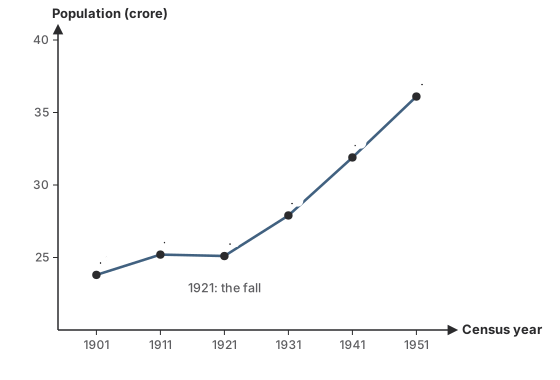
Details of British India's population were first collected through a census in 1881. Before 1921, India was in the first stage of the demographic transition: high births and high deaths, so slow growth. After 1921 deaths began to fall while births stayed high, so population grew steadily. That is why 1921 is the year of the great divide.
The only fall comes between 1911 and 1921; after 1921 the population rises by more each decade.
Example 1 · Reading the census graph
Growth from 1921 to 1951 = 36.1 − 25.1 = 11 crore.
The occupational structure is how the workforce is spread across sectors. It barely changed: agriculture kept 70–75% of the workforce, manufacturing about 10% and services 15–20%. Regional differences grew: parts of the Madras Presidency, Bombay and Bengal moved workers out of agriculture, while Orissa, Rajasthan and Punjab moved more into it.
Railways, ports, water transport, posts and the telegraph were built, but to serve colonial interests, not to give people basic amenities. Roads moved troops and carried raw materials to ports; villages lacked all-weather roads. The telegraph mainly helped keep law and order. Some waterways, such as the Coast Canal on the Orissa coast, cost a great deal and proved uneconomical.
The railways had two big effects: people could travel long distances, breaking geographical and cultural barriers, and agriculture was commercialised, which weakened the self-sufficiency of villages. Exports grew, but the gains rarely reached Indians.
Whose estimates of India's national income during the colonial period are considered the most significant?
Show the explanationHide the explanation
AnswerC · V.K.R.V. Rao
Dadabhai Naoroji, William Digby, Findlay Shirras, V.K.R.V. Rao and R.C. Desai all estimated national income; Rao's estimates are rated the most significant.
Worth noting
Mahalanobis is the architect of planning after independence, not an estimator of colonial income.
Inland waterways in colonial India, such as the Coast Canal on the Orissa coast, were
Show the explanationHide the explanation
AnswerC · built at great cost but proved uneconomical
The Coast Canal cost a great deal but could not compete with the railway running alongside it, and was uneconomical.
NTA's Economics syllabus is three courses: Introductory Microeconomics, Introductory Macroeconomics and Indian Economic Development, each split into units with a list of topics. It prints no chapters and no split of the 50 questions across the courses. So the areas here are NTA's three courses, and the chapters inside them are ours: a unit that covers several ideas, such as consumer behaviour and demand, is split into a chapter for each, so that a chapter can be practised in one sitting. All three courses are here.