On this page · 10 sections 01 Total cost from marginal cost 02 Revenue and demand from marginal revenue 03 Market equilibrium 04 Consumer surplus 05 Producer surplus 06 How CUET asks this chapter 07 Exam shortcuts 08 Common mistakes 09 Quick revision 10 Check your understanding In a town's mango market, some buyers would happily pay ₹50 a kg, yet they pay only the market price of ₹30. Some growers would sell at ₹20, yet they receive ₹30. Those gains are the consumer and producer surplus, and integration measures them. Integration also undoes the marginal functions of the last chapter, so we start there.
Integrate the marginal cost: C ( x ) = ∫ M C d x + k C(x) = \int MC\,dx + k C ( x ) = ∫ M C d x + k k k k C ( 0 ) C(0) C ( 0 )
Example 1 · A cost function
The marginal cost is M C = 12 + 6 x MC = 12 + 6x M C = 12 + 6 x
∫ ( 12 + 6 x ) d x = 12 x + 3 x 2 \int (12 + 6x)\,dx = 12x + 3x^{2} ∫ ( 12 + 6 x ) d x = 12 x + 3 x 2
Add the fixed cost: C ( x ) = 500 + 12 x + 3 x 2 C(x) = 500 + 12x + 3x^{2} C ( x ) = 500 + 12 x + 3 x 2
Answer C ( x ) = 3 x 2 + 12 x + 500 C(x) = 3x^{2} + 12x + 500 C ( x ) = 3 x 2 + 12 x + 500 The increase in cost when output rises from a a a b b b ∫ a b M C d x \int_{a}^{b} MC\,dx ∫ a b M C d x
Integrate the marginal revenue, taking the constant so that no sales bring no revenue: R ( 0 ) = 0 R(0) = 0 R ( 0 ) = 0 x x x p = R ( x ) x p = \frac{R(x)}{x} p = x R ( x )
If M R = 40 − 6 x MR = 40 - 6x M R = 40 − 6 x R ( x ) = 40 x − 3 x 2 R(x) = 40x - 3x^{2} R ( x ) = 40 x − 3 x 2 p = 40 − 3 x p = 40 - 3x p = 40 − 3 x
It is the price and quantity at which the quantity buyers want equals the quantity sellers offer: the point where the demand curve and the supply curve meet. Set the demand price equal to the supply price and solve for x 0 x_0 x 0 p 0 p_0 p 0
In the mango market, demand is p = 60 − 2 x p = 60 - 2x p = 60 − 2 x p = 15 + x p = 15 + x p = 15 + x x x x 60 − 2 x = 15 + x 60 - 2x = 15 + x 60 − 2 x = 15 + x x 0 = 15 x_0 = 15 x 0 = 15 p 0 = 30 p_0 = 30 p 0 = 30
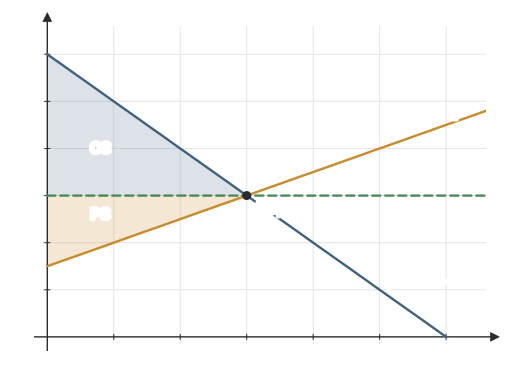
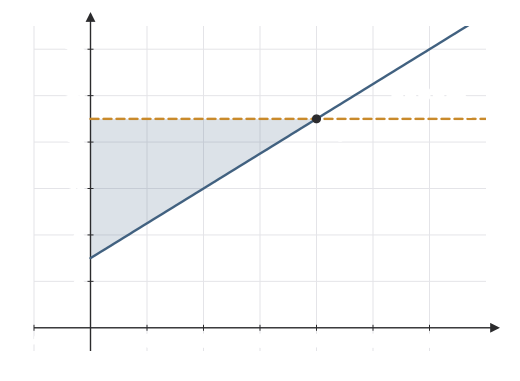
Consumer surplus is what buyers would have been willing to pay beyond what they actually pay. It is the area between the demand curve and the price line p = p 0 p = p_0 p = p 0 x 0 x_0 x 0 C S = ∫ 0 x 0 D ( x ) d x − p 0 x 0 CS = \int_{0}^{x_0} D(x)\,dx - p_0x_0 C S = ∫ 0 x 0 D ( x ) d x − p 0 x 0
The mango market: consumer surplus above the price line, producer surplus below it. Example 2 · The mangoes' consumer surplus
Find the consumer surplus in the mango market.
∫ 0 15 ( 60 − 2 x ) d x = [ 60 x − x 2 ] 0 15 = 900 − 225 = 675 \int_{0}^{15} (60 - 2x)\,dx = \left[60x - x^{2}\right]_{0}^{15} = 900 - 225 = 675 ∫ 0 15 ( 60 − 2 x ) d x = [ 60 x − x 2 ] 0 15 = 900 − 225 = 675
C S = 675 − 30 × 15 = 675 − 450 = 225 CS = 675 - 30 \times 15 = 675 - 450 = 225 C S = 675 − 30 × 15 = 675 − 450 = 225
Answer 225, in units of hundreds of kg times rupees: ₹22,500.
Producer surplus is what sellers receive beyond the least they would have accepted. It is the area between the price line and the supply curve, from 0 to x 0 x_0 x 0 P S = p 0 x 0 − ∫ 0 x 0 S ( x ) d x PS = p_0x_0 - \int_{0}^{x_0} S(x)\,dx P S = p 0 x 0 − ∫ 0 x 0 S ( x ) d x
For the mangoes: ∫ 0 15 ( 15 + x ) d x = 225 + 112.5 = 337.5 \int_{0}^{15} (15 + x)\,dx = 225 + 112.5 = 337.5 ∫ 0 15 ( 15 + x ) d x = 225 + 112.5 = 337.5 P S = 450 − 337.5 = 112.5 PS = 450 - 337.5 = 112.5 P S = 450 − 337.5 = 112.5
The order of subtraction differs: the demand curve lies above the price line, so CS is integral minus rectangle; the supply curve lies below it, so PS is rectangle minus integral. Either way a surplus is never negative.
Cost: the total cost function from MC and a fixed cost, a cost at some output, the rise in cost, the fixed cost from one known cost.Revenue: the revenue function or the demand function from MR, the revenue from some output.Equilibrium: the equilibrium quantity or price.Surpluses: CS or PS from given curves, often with the region drawn, or the formulas themselves.
C ( x ) = ∫ M C d x + fixed cost C(x) = \int MC\,dx + \text{fixed cost} C ( x ) = ∫ M C d x + fixed cost R ( x ) = ∫ M R d x R(x) = \int MR\,dx R ( x ) = ∫ M R d x R ( 0 ) = 0 R(0) = 0 R ( 0 ) = 0 p = R x p = \frac{R}{x} p = x R C S = ∫ 0 x 0 D d x − p 0 x 0 CS = \int_{0}^{x_0} D\,dx - p_0x_0 C S = ∫ 0 x 0 D d x − p 0 x 0 P S = p 0 x 0 − ∫ 0 x 0 S d x PS = p_0x_0 - \int_{0}^{x_0} S\,dx P S = p 0 x 0 − ∫ 0 x 0 S d x Straight lines: each surplus is a triangle, 1 2 × x 0 × \frac{1}{2} \times x_0 \times 2 1 × x 0 ×
Leaving out the fixed cost, or setting it to zero.
Taking MR as the price.
Giving the area under the curve, or the rectangle p 0 x 0 p_0x_0 p 0 x 0
Using a negative root as the equilibrium quantity.
From marginals
C = ∫ M C + C ( 0 ) C = \int MC + C(0) C = ∫ M C + C ( 0 )
R = ∫ M R R = \int MR R = ∫ M R p = R x p = \frac{R}{x} p = x R Surpluses
Equilibrium: demand = supply
CS above the price line, PS below it
Next in Section B2: chance put into numbers, with random variables, expectation and variance .
Next · 09 Quick revision → Check your understanding 70 questions, grouped by type, easy to hard. Pick an answer and check it. The worked solution opens when you ask for it.
Total cost from marginal cost Q1 of 70 Q1
Total cost from marginal cost 15 questions The marginal cost of making x x x 3 x 2 − 10 x + 15 3x^{2} - 10x + 15 3 x 2 − 10 x + 15
Options for question 1 A Option A x 3 − 5 x 2 + 15 x x^{3} - 5 x^{2} + 15 x x 3 − 5 x 2 + 15 x B Option B x 3 − 5 x 2 + 15 x + 400 x^{3} - 5 x^{2} + 15 x + 400 x 3 − 5 x 2 + 15 x + 400 C Option C 6 x + 390 6 x + 390 6 x + 390 D Option D x 3 − 10 x 2 + 15 x + 400 x^{3} - 10 x^{2} + 15 x + 400 x 3 − 10 x 2 + 15 x + 400
Skip Check Show the explanation Hide the explanation Next question Try again
Show the explanation Hide the explanation Answer B · x 3 − 5 x 2 + 15 x + 400 x^{3} - 5 x^{2} + 15 x + 400 x 3 − 5 x 2 + 15 x + 400
Total cost is the integral of marginal cost: C ( x ) = x 3 − 5 x 2 + 15 x + k C(x) = x^{3} - 5x^{2} + 15x + k C ( x ) = x 3 − 5 x 2 + 15 x + k
The constant is the fixed cost, C ( 0 ) = 400 C(0) = 400 C ( 0 ) = 400 C ( x ) = x 3 − 5 x 2 + 15 x + 400 C(x) = x^{3} - 5x^{2} + 15x + 400 C ( x ) = x 3 − 5 x 2 + 15 x + 400
Worth noting
Without the 400 the cost of making nothing would be zero, but the fixed cost is paid anyway.
The marginal cost of making x x x 4 x + 9 4x + 9 4 x + 9
Options for question 2 A Option A 4 x 2 + 9 x + 250 4 x^{2} + 9 x + 250 4 x 2 + 9 x + 250 B Option B 2 x 2 + 9 x 2 x^{2} + 9 x 2 x 2 + 9 x C Option C 2 x 2 + 9 x + 250 2 x^{2} + 9 x + 250 2 x 2 + 9 x + 250 D Option D 2 x 2 + 9 x − 250 2 x^{2} + 9 x - 250 2 x 2 + 9 x − 250
Skip Check Show the explanation Hide the explanation Next question Try again
Show the explanation Hide the explanation Answer C · 2 x 2 + 9 x + 250 2 x^{2} + 9 x + 250 2 x 2 + 9 x + 250
C ( x ) = ∫ ( 4 x + 9 ) d x = 2 x 2 + 9 x + K C(x) = \int (4x + 9)\,dx = 2x^{2} + 9x + K C ( x ) = ∫ ( 4 x + 9 ) d x = 2 x 2 + 9 x + K
The constant is the fixed cost, C ( 0 ) = 250 C(0) = 250 C ( 0 ) = 250 C ( x ) = 2 x 2 + 9 x + 250 C(x) = 2x^{2} + 9x + 250 C ( x ) = 2 x 2 + 9 x + 250
Worth noting
4 x 2 + 9 x + 250 4x^{2} + 9x + 250 4 x 2 + 9 x + 250 4 x 4x 4 x
A workshop's marginal cost is M C = 6 + 2 x MC = 6 + 2x M C = 6 + 2 x M R = 30 − 4 x MR = 30 - 4x M R = 30 − 4 x x x x
What is the workshop's daily cost function?
Options for question 3 A Option A C ( x ) = x 2 + 6 x C(x) = x^{2} + 6x C ( x ) = x 2 + 6 x B Option B C ( x ) = 2 x 2 + 6 x + 20 C(x) = 2x^{2} + 6x + 20 C ( x ) = 2 x 2 + 6 x + 20 C Option C C ( x ) = 2 + 20 C(x) = 2 + 20 C ( x ) = 2 + 20 D Option D C ( x ) = x 2 + 6 x + 20 C(x) = x^{2} + 6x + 20 C ( x ) = x 2 + 6 x + 20
Skip Check Show the explanation Hide the explanation Next question Try again
Show the explanation Hide the explanation Answer D · C ( x ) = x 2 + 6 x + 20 C(x) = x^{2} + 6x + 20 C ( x ) = x 2 + 6 x + 20
C ( x ) = ∫ ( 6 + 2 x ) d x = 6 x + x 2 + k C(x) = \int (6 + 2x)\,dx = 6x + x^{2} + k C ( x ) = ∫ ( 6 + 2 x ) d x = 6 x + x 2 + k
At x = 0 x = 0 x = 0 k = 20 k = 20 k = 20
Worth noting
x 2 + 6 x x^{2} + 6x x 2 + 6 x
A workshop's marginal cost is M C = 6 + 2 x MC = 6 + 2x M C = 6 + 2 x M R = 30 − 4 x MR = 30 - 4x M R = 30 − 4 x x x x
What is the workshop's daily revenue function?
Options for question 4 A Option A R ( x ) = 30 x − 4 x 2 R(x) = 30x - 4x^{2} R ( x ) = 30 x − 4 x 2 B Option B R ( x ) = 30 x − 2 x 2 + 20 R(x) = 30x - 2x^{2} + 20 R ( x ) = 30 x − 2 x 2 + 20 C Option C R ( x ) = 30 − 2 x R(x) = 30 - 2x R ( x ) = 30 − 2 x D Option D R ( x ) = 30 x − 2 x 2 R(x) = 30x - 2x^{2} R ( x ) = 30 x − 2 x 2
Skip Check Show the explanation Hide the explanation Next question Try again
Show the explanation Hide the explanation Answer D · R ( x ) = 30 x − 2 x 2 R(x) = 30x - 2x^{2} R ( x ) = 30 x − 2 x 2
R ( x ) = ∫ ( 30 − 4 x ) d x = 30 x − 2 x 2 + k R(x) = \int (30 - 4x)\,dx = 30x - 2x^{2} + k R ( x ) = ∫ ( 30 − 4 x ) d x = 30 x − 2 x 2 + k
Selling nothing earns nothing, so R ( 0 ) = 0 R(0) = 0 R ( 0 ) = 0 k = 0 k = 0 k = 0
Worth noting
Adding 20 borrows the fixed cost; revenue starts at zero.
The marginal cost is M C = 20 + 4 x MC = 20 + 4x M C = 20 + 4 x
Options for question 5 A Option A ₹60 B Option B ₹400 C Option C ₹500 D Option D ₹700
Skip Check Show the explanation Hide the explanation Next question Try again
Show the explanation Hide the explanation Answer C · ₹500
C ( x ) = 100 + 20 x + 2 x 2 C(x) = 100 + 20x + 2x^{2} C ( x ) = 100 + 20 x + 2 x 2
C ( 10 ) = 100 + 200 + 200 = 500 C(10) = 100 + 200 + 200 = 500 C ( 10 ) = 100 + 200 + 200 = 500
Worth noting
₹60 is the marginal cost at x = 10 x = 10 x = 10
The marginal cost is M C = 6 x + 8 MC = 6x + 8 M C = 6 x + 8
Options for question 6 A Option A ₹60 B Option B ₹980 C Option C ₹1,020 D Option D ₹1,360
Skip Check Show the explanation Hide the explanation Next question Try again
Show the explanation Hide the explanation Answer B · ₹980
The rise in cost is ∫ 10 20 ( 6 x + 8 ) d x = [ 3 x 2 + 8 x ] 10 20 \int_{10}^{20} (6x + 8)\,dx = \left[3x^{2} + 8x\right]_{10}^{20} ∫ 10 20 ( 6 x + 8 ) d x = [ 3 x 2 + 8 x ] 10 20
= ( 1,200 + 160 ) − ( 300 + 80 ) = 980 = (1{,}200 + 160) - (300 + 80) = 980 = ( 1 , 200 + 160 ) − ( 300 + 80 ) = 980
Worth noting
₹1,360 is the cost of the first 20 units from nothing, not the rise from 10.
Read the two statements and choose the correct option.
I. Integrating the marginal cost gives the total cost up to a constant, and that constant is the fixed cost.
II. The fixed cost can be found from the marginal cost function alone.
Options for question 7 A Option A Only I B Option B Only II C Option C Both I and II D Option D Neither I nor II
Skip Check Show the explanation Hide the explanation Next question Try again
Show the explanation Hide the explanation Answer A · Only I
I: C ( x ) = ∫ M C d x + k C(x) = \int MC\,dx + k C ( x ) = ∫ M C d x + k C ( 0 ) = k C(0) = k C ( 0 ) = k
II: differentiating removes the fixed cost, so MC alone cannot bring it back; one more fact, such as C ( 0 ) C(0) C ( 0 )
The marginal cost is M C = 3 x 2 + 4 x MC = 3x^{2} + 4x M C = 3 x 2 + 4 x
Options for question 8 A Option A x 3 + 2 x 2 + 100 x^{3} + 2 x^{2} + 100 x 3 + 2 x 2 + 100 B Option B x 2 + 2 x + 100 x^{2} + 2 x + 100 x 2 + 2 x + 100 C Option C 3 x + 4 + 100 x 3 x + 4 + \frac{100}{x} 3 x + 4 + x 100 D Option D x 2 + 2 x + 100 x x^{2} + 2 x + \frac{100}{x} x 2 + 2 x + x 100
Skip Check Show the explanation Hide the explanation Next question Try again
Show the explanation Hide the explanation Answer D · x 2 + 2 x + 100 x x^{2} + 2 x + \frac{100}{x} x 2 + 2 x + x 100
C ( x ) = x 3 + 2 x 2 + 100 C(x) = x^{3} + 2x^{2} + 100 C ( x ) = x 3 + 2 x 2 + 100
Average cost = C ( x ) x = x 2 + 2 x + 100 x = \frac{C(x)}{x} = x^{2} + 2x + \frac{100}{x} = x C ( x ) = x 2 + 2 x + x 100
Worth noting
x 2 + 2 x + 100 x^{2} + 2x + 100 x 2 + 2 x + 100 x x x
The marginal cost is M C = 0.6 x 2 − 4 x + 10 MC = 0.6x^{2} - 4x + 10 M C = 0.6 x 2 − 4 x + 10
Options for question 9 A Option A 6 x 5 + 116 \frac{6 x}{5} + 116 5 6 x + 116 B Option B 3 x 3 5 − 4 x 2 + 10 x + 120 \frac{3 x^{3}}{5} - 4 x^{2} + 10 x + 120 5 3 x 3 − 4 x 2 + 10 x + 120 C Option C x 3 5 − 2 x 2 + 10 x \frac{x^{3}}{5} - 2 x^{2} + 10 x 5 x 3 − 2 x 2 + 10 x D Option D x 3 5 − 2 x 2 + 10 x + 120 \frac{x^{3}}{5} - 2 x^{2} + 10 x + 120 5 x 3 − 2 x 2 + 10 x + 120
Skip Check Show the explanation Hide the explanation Next question Try again
Show the explanation Hide the explanation Answer D · x 3 5 − 2 x 2 + 10 x + 120 \frac{x^{3}}{5} - 2 x^{2} + 10 x + 120 5 x 3 − 2 x 2 + 10 x + 120
∫ ( 0.6 x 2 − 4 x + 10 ) d x = 0.2 x 3 − 2 x 2 + 10 x + K \int (0.6x^{2} - 4x + 10)\,dx = 0.2x^{3} - 2x^{2} + 10x + K ∫ ( 0.6 x 2 − 4 x + 10 ) d x = 0.2 x 3 − 2 x 2 + 10 x + K
With K = 120 K = 120 K = 120 C ( x ) = 0.2 x 3 − 2 x 2 + 10 x + 120 C(x) = 0.2x^{3} - 2x^{2} + 10x + 120 C ( x ) = 0.2 x 3 − 2 x 2 + 10 x + 120
Worth noting
Leaving out + 120 +120 + 120
The marginal cost is M C = 15 + 2 x MC = 15 + 2x M C = 15 + 2 x
Options for question 10 A Option A ₹55 B Option B ₹700 C Option C ₹1,000 D Option D ₹1,100
Skip Check Show the explanation Hide the explanation Next question Try again
Show the explanation Hide the explanation Answer C · ₹1,000
C ( x ) = 15 x + x 2 + 300 C(x) = 15x + x^{2} + 300 C ( x ) = 15 x + x 2 + 300
C ( 20 ) = 300 + 400 + 300 = 1,000 C(20) = 300 + 400 + 300 = 1{,}000 C ( 20 ) = 300 + 400 + 300 = 1 , 000
Worth noting
₹700 leaves out the fixed cost; ₹55 is the marginal cost at 20.
The marginal cost is M C = 4 x + 5 MC = 4x + 5 M C = 4 x + 5
Options for question 11 A Option A ₹40 B Option B ₹125 C Option C ₹1,050 D Option D ₹1,950
Skip Check Show the explanation Hide the explanation Next question Try again
Show the explanation Hide the explanation Answer C · ₹1,050
The rise is ∫ 20 30 ( 4 x + 5 ) d x = [ 2 x 2 + 5 x ] 20 30 \int_{20}^{30} (4x + 5)\,dx = \left[2x^{2} + 5x\right]_{20}^{30} ∫ 20 30 ( 4 x + 5 ) d x = [ 2 x 2 + 5 x ] 20 30
= ( 1,800 + 150 ) − ( 800 + 100 ) = 1,050 = (1{,}800 + 150) - (800 + 100) = 1{,}050 = ( 1 , 800 + 150 ) − ( 800 + 100 ) = 1 , 050
Worth noting
₹1,950 is the variable cost of all 30 units, not the rise from 20.
A workshop's marginal cost is M C = 6 + 2 x MC = 6 + 2x M C = 6 + 2 x M R = 30 − 4 x MR = 30 - 4x M R = 30 − 4 x x x x
How many items a day give the workshop the greatest profit?
Options for question 12 A Option A 4 units B Option B 5 units C Option C 6 units D Option D 7.5 units
Skip Check Show the explanation Hide the explanation Next question Try again
Show the explanation Hide the explanation Answer A · 4 units
Profit is greatest where M R = M C MR = MC M R = M C 30 − 4 x = 6 + 2 x 30 - 4x = 6 + 2x 30 − 4 x = 6 + 2 x
6 x = 24 6x = 24 6 x = 24 x = 4 x = 4 x = 4
Worth noting
7.5 items is where MR alone is zero, the revenue maximum, ignoring cost.
A workshop's marginal cost is M C = 6 + 2 x MC = 6 + 2x M C = 6 + 2 x M R = 30 − 4 x MR = 30 - 4x M R = 30 − 4 x x x x
What is the workshop's greatest daily profit?
Options for question 13 A Option A ₹28 B Option B ₹48 C Option C ₹60 D Option D ₹88
Skip Check Show the explanation Hide the explanation Next question Try again
Show the explanation Hide the explanation Answer A · ₹28
At x = 4 x = 4 x = 4 R = 120 − 32 = 88 R = 120 - 32 = 88 R = 120 − 32 = 88 C = 16 + 24 + 20 = 60 C = 16 + 24 + 20 = 60 C = 16 + 24 + 20 = 60
Profit = 88 − 60 = 28 = 88 - 60 = 28 = 88 − 60 = 28
Worth noting
₹48 leaves out the fixed ₹20.
The marginal cost is M C = 10 + 2 x MC = 10 + 2x M C = 10 + 2 x
Options for question 14 A Option A ₹125 B Option B ₹150 C Option C ₹180 D Option D ₹200
Skip Check Show the explanation Hide the explanation Next question Try again
Show the explanation Hide the explanation Answer A · ₹125
C ( x ) = 10 x + x 2 + k C(x) = 10x + x^{2} + k C ( x ) = 10 x + x 2 + k k k k
C ( 5 ) = 50 + 25 + k = 200 C(5) = 50 + 25 + k = 200 C ( 5 ) = 50 + 25 + k = 200 k = 125 k = 125 k = 125
Worth noting
₹180 subtracts only the marginal cost at 5, M C ( 5 ) = 20 MC(5) = 20 M C ( 5 ) = 20
The marginal cost is M C = 8 + 6 x MC = 8 + 6x M C = 8 + 6 x
Options for question 15 A Option A ₹380 B Option B ₹520 C Option C ₹832 D Option D ₹900
Skip Check Show the explanation Hide the explanation Next question Try again
Show the explanation Hide the explanation Answer B · ₹520
C ( x ) = 8 x + 3 x 2 + F C(x) = 8x + 3x^{2} + F C ( x ) = 8 x + 3 x 2 + F C ( 10 ) = 80 + 300 + F C(10) = 80 + 300 + F C ( 10 ) = 80 + 300 + F
380 + F = 900 380 + F = 900 380 + F = 900 F = 520 F = 520 F = 520
Worth noting
₹380 is the variable cost of 10 units, not the fixed cost.
Revenue and demand from marginal revenue 10 questions The marginal revenue from selling x x x M R = 30 − 2 x MR = 30 - 2x M R = 30 − 2 x
Options for question 16 A Option A 30 − x 30 - x 30 − x B Option B − 2 x 2 + 30 x - 2 x^{2} + 30 x − 2 x 2 + 30 x C Option C − 2 -2 − 2 D Option D − x 2 + 30 x - x^{2} + 30 x − x 2 + 30 x
Skip Check Show the explanation Hide the explanation Next question Try again
Show the explanation Hide the explanation Answer D · − x 2 + 30 x - x^{2} + 30 x − x 2 + 30 x
R ( x ) = ∫ ( 30 − 2 x ) d x = 30 x − x 2 + k R(x) = \int (30 - 2x)\,dx = 30x - x^{2} + k R ( x ) = ∫ ( 30 − 2 x ) d x = 30 x − x 2 + k
No sales bring no revenue, so k = 0 k = 0 k = 0 R ( x ) = 30 x − x 2 R(x) = 30x - x^{2} R ( x ) = 30 x − x 2
Worth noting
30 x − 2 x 2 30x - 2x^{2} 30 x − 2 x 2 2 x 2x 2 x
The marginal revenue from selling x x x M R = 40 − 6 x MR = 40 - 6x M R = 40 − 6 x
Options for question 17 A Option A − 6 x 2 + 40 x - 6 x^{2} + 40 x − 6 x 2 + 40 x B Option B − 3 x 2 + 40 x - 3 x^{2} + 40 x − 3 x 2 + 40 x C Option C 40 − 3 x 40 - 3 x 40 − 3 x D Option D − 3 x 2 + 40 x + 40 - 3 x^{2} + 40 x + 40 − 3 x 2 + 40 x + 40
Skip Check Show the explanation Hide the explanation Next question Try again
Show the explanation Hide the explanation Answer B · − 3 x 2 + 40 x - 3 x^{2} + 40 x − 3 x 2 + 40 x
R ( x ) = ∫ ( 40 − 6 x ) d x = 40 x − 3 x 2 + K R(x) = \int (40 - 6x)\,dx = 40x - 3x^{2} + K R ( x ) = ∫ ( 40 − 6 x ) d x = 40 x − 3 x 2 + K
Selling nothing earns nothing, R ( 0 ) = 0 R(0) = 0 R ( 0 ) = 0 K = 0 K = 0 K = 0
Worth noting
40 x − 6 x 2 40x - 6x^{2} 40 x − 6 x 2 6 x 6x 6 x
The marginal revenue is M R = 30 − 2 x MR = 30 - 2x M R = 30 − 2 x p p p x x x
Options for question 18 A Option A 30 − 2 x 30 - 2 x 30 − 2 x B Option B − x 2 + 30 x - x^{2} + 30 x − x 2 + 30 x C Option C 15 − x 15 - x 15 − x D Option D 30 − x 30 - x 30 − x
Skip Check Show the explanation Hide the explanation Next question Try again
Show the explanation Hide the explanation Answer D · 30 − x 30 - x 30 − x
R ( x ) = 30 x − x 2 R(x) = 30x - x^{2} R ( x ) = 30 x − x 2
So p = R ( x ) x = 30 − x p = \frac{R(x)}{x} = 30 - x p = x R ( x ) = 30 − x
Worth noting
30 − 2 x 30 - 2x 30 − 2 x
The marginal revenue is M R = 100 − 6 x MR = 100 - 6x M R = 100 − 6 x
Options for question 19 A Option A ₹40 B Option B ₹400 C Option C ₹700 D Option D ₹1,000
Skip Check Show the explanation Hide the explanation Next question Try again
Show the explanation Hide the explanation Answer C · ₹700
R ( 10 ) = ∫ 0 10 ( 100 − 6 x ) d x = [ 100 x − 3 x 2 ] 0 10 R(10) = \int_{0}^{10} (100 - 6x)\,dx = \left[100x - 3x^{2}\right]_{0}^{10} R ( 10 ) = ∫ 0 10 ( 100 − 6 x ) d x = [ 100 x − 3 x 2 ] 0 10
= 1,000 − 300 = 700 = 1{,}000 - 300 = 700 = 1 , 000 − 300 = 700
Worth noting
₹40 is the marginal revenue at x = 10 x = 10 x = 10
Assertion (A): If M R = 50 − 4 x MR = 50 - 4x M R = 50 − 4 x p = 50 − 2 x p = 50 - 2x p = 50 − 2 x
Reason (R): Revenue is price times quantity, so p = R ( x ) x p = \frac{R(x)}{x} p = x R ( x )
Options for question 20 A Option A Both A and R are true, and R is the correct explanation of A. B Option B Both A and R are true, but R is not the correct explanation of A. C Option C A is true, but R is false. D Option D A is false, but R is true.
Skip Check Show the explanation Hide the explanation Next question Try again
Show the explanation Hide the explanation Answer A · Both A and R are true, and R is the correct explanation of A.
R ( x ) = 50 x − 2 x 2 R(x) = 50x - 2x^{2} R ( x ) = 50 x − 2 x 2 p = R ( x ) x = 50 − 2 x p = \frac{R(x)}{x} = 50 - 2x p = x R ( x ) = 50 − 2 x
R is the step that turns revenue into price, so it explains A.
The marginal revenue is M R = 100 − 2 x MR = 100 - 2x M R = 100 − 2 x
Options for question 21 A Option A ₹700 B Option B ₹701 C Option C ₹900 D Option D ₹1,600
Skip Check Show the explanation Hide the explanation Next question Try again
Show the explanation Hide the explanation Answer A · ₹700
∫ 10 20 ( 100 − 2 x ) d x = [ 100 x − x 2 ] 10 20 \int_{10}^{20} (100 - 2x)\,dx = \left[100x - x^{2}\right]_{10}^{20} ∫ 10 20 ( 100 − 2 x ) d x = [ 100 x − x 2 ] 10 20
= ( 2,000 − 400 ) − ( 1,000 − 100 ) = 700 = (2{,}000 - 400) - (1{,}000 - 100) = 700 = ( 2 , 000 − 400 ) − ( 1 , 000 − 100 ) = 700
Worth noting
₹1,600 is the revenue from all 20 units; ₹900 is from the first 10.
The marginal revenue is M R = 60 − 4 x MR = 60 - 4x M R = 60 − 4 x p p p x x x
Options for question 22 A Option A p = 60 − 4 x p = 60 - 4x p = 60 − 4 x B Option B p = 60 x − 2 x 2 p = 60x - 2x^{2} p = 60 x − 2 x 2 C Option C p = 30 − 2 x p = 30 - 2x p = 30 − 2 x D Option D p = 60 − 2 x p = 60 - 2x p = 60 − 2 x
Skip Check Show the explanation Hide the explanation Next question Try again
Show the explanation Hide the explanation Answer D · p = 60 − 2 x p = 60 - 2x p = 60 − 2 x
R ( x ) = 60 x − 2 x 2 R(x) = 60x - 2x^{2} R ( x ) = 60 x − 2 x 2 R ( 0 ) = 0 R(0) = 0 R ( 0 ) = 0
p = R ( x ) x = 60 − 2 x p = \frac{R(x)}{x} = 60 - 2x p = x R ( x ) = 60 − 2 x
Worth noting
p = 60 − 4 x p = 60 - 4x p = 60 − 4 x
The marginal revenue is M R = 80 − 4 x MR = 80 - 4x M R = 80 − 4 x
Options for question 23 A Option A ₹40 B Option B ₹400 C Option C ₹600 D Option D ₹800
Skip Check Show the explanation Hide the explanation Next question Try again
Show the explanation Hide the explanation Answer C · ₹600
R ( 10 ) = ∫ 0 10 ( 80 − 4 x ) d x = [ 80 x − 2 x 2 ] 0 10 R(10) = \int_0^{10} (80 - 4x)\,dx = \left[80x - 2x^{2}\right]_0^{10} R ( 10 ) = ∫ 0 10 ( 80 − 4 x ) d x = [ 80 x − 2 x 2 ] 0 10
= 800 − 200 = 600 = 800 - 200 = 600 = 800 − 200 = 600
Worth noting
₹40 is the marginal revenue at 10 units, not the total.
Read the two statements and choose the correct option.
I. When the total revenue is found by integrating the marginal revenue, the constant is 0, because selling nothing earns nothing.
II. The demand function is the total revenue divided by the number of units.
Options for question 24 A Option A Only I B Option B Only II C Option C Both I and II D Option D Neither I nor II
Skip Check Show the explanation Hide the explanation Next question Try again
Show the explanation Hide the explanation Answer C · Both I and II
I: R ( 0 ) = 0 R(0) = 0 R ( 0 ) = 0
II: R = p x R = px R = p x p = R x p = \frac{R}{x} p = x R x x x
The marginal revenue is M R = 50 − 3 x MR = 50 - 3x M R = 50 − 3 x
Options for question 25 A Option A ₹20 B Option B ₹35 C Option C ₹40.50 D Option D ₹350
Skip Check Show the explanation Hide the explanation Next question Try again
Show the explanation Hide the explanation Answer B · ₹35
R ( x ) = 50 x − 1.5 x 2 R(x) = 50x - 1.5x^{2} R ( x ) = 50 x − 1.5 x 2 p = 50 − 1.5 x p = 50 - 1.5x p = 50 − 1.5 x
At x = 10 x = 10 x = 10 50 − 15 = 35 50 - 15 = 35 50 − 15 = 35
Worth noting
₹20 is the marginal revenue at 10 units, not the price.
Market equilibrium 12 questions The demand function is p = 50 − 2 x p = 50 - 2x p = 50 − 2 x p = 10 + 3 x p = 10 + 3x p = 10 + 3 x
Options for question 26 A Option A 7 units B Option B 8 units C Option C 34 units D Option D 40 units
Skip Check Show the explanation Hide the explanation Next question Try again
Show the explanation Hide the explanation Answer B · 8 units
At equilibrium the demand price equals the supply price: 50 − 2 x = 10 + 3 x 50 - 2x = 10 + 3x 50 − 2 x = 10 + 3 x
5 x = 40 5x = 40 5 x = 40 x = 8 x = 8 x = 8
Worth noting
34 is the equilibrium price, not the quantity.
Read the two statements and choose the correct option.
I. At equilibrium, the quantity consumers want to buy equals the quantity producers want to sell.
II. A demand curve usually slopes upwards: the higher the price, the more is bought.
Options for question 27 A Option A Only I B Option B Only II C Option C Both I and II D Option D Neither I nor II
Skip Check Show the explanation Hide the explanation Next question Try again
Show the explanation Hide the explanation Answer A · Only I
I is the meaning of equilibrium: demand and supply meet. True.
II: demand usually slopes downwards, as people buy less at a higher price; it is supply that slopes upwards. False.
The demand function is p = 45 − x p = 45 - x p = 45 − x p = 3 x + 5 p = 3 x + 5 p = 3 x + 5
Options for question 28 A Option A ₹10 B Option B ₹25 C Option C ₹34 D Option D ₹35
Skip Check Show the explanation Hide the explanation Next question Try again
Show the explanation Hide the explanation Answer D · ₹35
At equilibrium demand price equals supply price: 45 − x = 3 x + 5 45 - x = 3 x + 5 45 − x = 3 x + 5 x 0 = 10 x_0 = 10 x 0 = 10
The price there is p 0 = 35 p_0 = 35 p 0 = 35
Worth noting
10 is the equilibrium quantity.
The demand function is p = 80 − 3 x p = 80 - 3 x p = 80 − 3 x p = 2 x + 20 p = 2 x + 20 p = 2 x + 20
Options for question 29 A Option A 12 units B Option B 16 units C Option C 20 units D Option D 44 units
Skip Check Show the explanation Hide the explanation Next question Try again
Show the explanation Hide the explanation Answer A · 12 units
At equilibrium demand price equals supply price: 80 − 3 x = 2 x + 20 80 - 3 x = 2 x + 20 80 − 3 x = 2 x + 20 x 0 = 12 x_0 = 12 x 0 = 12
The price there is p 0 = 44 p_0 = 44 p 0 = 44
Worth noting
44 is the equilibrium price, not the quantity.
In a weekly vegetable market, the demand for a crate of tomatoes is p = 90 − 3 x p = 90 - 3x p = 90 − 3 x p = 10 + x p = 10 + x p = 10 + x x x x p p p
How many crates of tomatoes change hands at the market's equilibrium?
Options for question 30 A Option A 20 20 20 B Option B 25 25 25 C Option C 30 30 30 D Option D 40 40 40
Skip Check Show the explanation Hide the explanation Next question Try again
Show the explanation Hide the explanation Answer A · 20 20 20
At equilibrium demand price = supply price: 90 − 3 x = 10 + x 90 - 3x = 10 + x 90 − 3 x = 10 + x
4 x = 80 4x = 80 4 x = 80 x = 20 x = 20 x = 20
Worth noting
40 divides 80 by 2, adding the slopes as 3 − 1 3 - 1 3 − 1
In a weekly vegetable market, the demand for a crate of tomatoes is p = 90 − 3 x p = 90 - 3x p = 90 − 3 x p = 10 + x p = 10 + x p = 10 + x x x x p p p
What is the market's equilibrium price for a crate of tomatoes?
Options for question 31 A Option A ₹20 B Option B ₹30 C Option C ₹50 D Option D ₹60
Skip Check Show the explanation Hide the explanation Next question Try again
Show the explanation Hide the explanation Answer B · ₹30
At x = 20 x = 20 x = 20 p = 10 + 20 p = 10 + 20 p = 10 + 20
₹30 a crate (and 90 − 60 = 30 90 - 60 = 30 90 − 60 = 30
Worth noting
₹20 is the equilibrium quantity read as a price.
The demand function is p = 40 − x 2 p = 40 - x^{2} p = 40 − x 2 p = 3 x 2 + 4 p = 3x^{2} + 4 p = 3 x 2 + 4
Options for question 32 A Option A ₹3 B Option B ₹9 C Option C ₹31 D Option D ₹36
Skip Check Show the explanation Hide the explanation Next question Try again
Show the explanation Hide the explanation Answer C · ₹31
40 − x 2 = 3 x 2 + 4 40 - x^{2} = 3x^{2} + 4 40 − x 2 = 3 x 2 + 4 4 x 2 = 36 4x^{2} = 36 4 x 2 = 36 x = 3 x = 3 x = 3
The price is 40 − 9 = 31 40 - 9 = 31 40 − 9 = 31
Worth noting
3 is the equilibrium quantity; the price is found by putting it back into either function.
The demand is x = 100 − 2 p x = 100 - 2p x = 100 − 2 p x = 3 p − 20 x = 3p - 20 x = 3 p − 20 p p p
Options for question 33 A Option A ₹16 B Option B ₹24 C Option C ₹40 D Option D ₹52
Skip Check Show the explanation Hide the explanation Next question Try again
Show the explanation Hide the explanation Answer B · ₹24
At equilibrium the quantities are equal: 100 − 2 p = 3 p − 20 100 - 2p = 3p - 20 100 − 2 p = 3 p − 20
5 p = 120 5p = 120 5 p = 120 p = 24 p = 24 p = 24
Worth noting
52 is the equilibrium quantity.
The demand function is p = 80 − 2 x p = 80 - 2x p = 80 − 2 x p = 10 + 2 x p = 10 + 2x p = 10 + 2 x
Options for question 34 A Option A 7.5 units B Option B 10 units C Option C 15 units D Option D 25 units
Skip Check Show the explanation Hide the explanation Next question Try again
Show the explanation Hide the explanation Answer C · 15 units
At ₹30, buyers want 80 − 2 x = 30 80 - 2x = 30 80 − 2 x = 30 10 + 2 x = 30 10 + 2x = 30 10 + 2 x = 30
The shortfall, the excess demand, is 25 − 10 = 15 25 - 10 = 15 25 − 10 = 15
Worth noting
25 units is the demand alone at ₹30.
The demand function is p = 52 − x 2 p = 52 - x^{2} p = 52 − x 2 p = 2 x 2 + 4 p = 2 x^{2} + 4 p = 2 x 2 + 4
Options for question 35 A Option A ₹4 B Option B ₹16 C Option C ₹36 D Option D ₹48
Skip Check Show the explanation Hide the explanation Next question Try again
Show the explanation Hide the explanation Answer C · ₹36
At equilibrium demand price equals supply price: 52 − x 2 = 2 x 2 + 4 52 - x^{2} = 2 x^{2} + 4 52 − x 2 = 2 x 2 + 4 x 0 = 4 x_0 = 4 x 0 = 4
The price there is p 0 = 36 p_0 = 36 p 0 = 36
Worth noting
4 is the equilibrium quantity; put it back into either function for the price.
In a weekly vegetable market, the demand for a crate of tomatoes is p = 90 − 3 x p = 90 - 3x p = 90 − 3 x p = 10 + x p = 10 + x p = 10 + x x x x p p p
What is the consumers' surplus at the market's equilibrium?
Options for question 36 A Option A ₹200 B Option B ₹300 C Option C ₹600 D Option D ₹1,200
Skip Check Show the explanation Hide the explanation Next question Try again
Show the explanation Hide the explanation Answer C · ₹600
C S = ∫ 0 20 ( 90 − 3 x ) d x − 30 × 20 = ( 1,800 − 600 ) − 600 CS = \int_0^{20}(90 - 3x)\,dx - 30 \times 20 = (1{,}800 - 600) - 600 C S = ∫ 0 20 ( 90 − 3 x ) d x − 30 × 20 = ( 1 , 800 − 600 ) − 600
₹600, the triangle 1 2 × 20 × ( 90 − 30 ) \frac{1}{2} \times 20 \times (90 - 30) 2 1 × 20 × ( 90 − 30 )
Worth noting
₹1,200 is what buyers would be willing to pay in all; the surplus subtracts the ₹600 they do pay.
In a weekly vegetable market, the demand for a crate of tomatoes is p = 90 − 3 x p = 90 - 3x p = 90 − 3 x p = 10 + x p = 10 + x p = 10 + x x x x p p p
What is the producers' surplus at the market's equilibrium?
Options for question 37 A Option A ₹100 B Option B ₹200 C Option C ₹400 D Option D ₹600
Skip Check Show the explanation Hide the explanation Next question Try again
Show the explanation Hide the explanation Answer B · ₹200
P S = 30 × 20 − ∫ 0 20 ( 10 + x ) d x = 600 − ( 200 + 200 ) PS = 30 \times 20 - \int_0^{20}(10 + x)\,dx = 600 - (200 + 200) P S = 30 × 20 − ∫ 0 20 ( 10 + x ) d x = 600 − ( 200 + 200 )
₹200, the triangle 1 2 × 20 × ( 30 − 10 ) \frac{1}{2} \times 20 \times (30 - 10) 2 1 × 20 × ( 30 − 10 )
Worth noting
₹400 is the area under the supply curve, the least sellers would accept, not their surplus.
Consumer surplus 17 questions Read the two statements and choose the correct option.
I. Consumer surplus is the area between the demand curve and the price line, up to the quantity sold.
II. Consumer surplus is the amount consumers actually spend.
Options for question 38 A Option A Only I B Option B Only II C Option C Both I and II D Option D Neither I nor II
Skip Check Show the explanation Hide the explanation Next question Try again
Show the explanation Hide the explanation Answer A · Only I
I: the area under the demand curve is what buyers would pay; taking off what they do pay leaves the region above the price line. True.
II: what they spend is p 0 x 0 p_0x_0 p 0 x 0
The demand function is p = 40 − 2 x p = 40 - 2 x p = 40 − 2 x
Options for question 39 A Option A ₹100 B Option B ₹101 C Option C ₹200 D Option D ₹300
Skip Check Show the explanation Hide the explanation Next question Try again
Show the explanation Hide the explanation Answer A · ₹100
The market clears at x 0 = 10 x_0 = 10 x 0 = 10 p 0 = 20 p_0 = 20 p 0 = 20
C S = ∫ 0 10 ( 40 − 2 x ) d x − 20 × 10 = 300 − 200 = 100 CS = \int_0^{10} (40 - 2 x)\,dx - 20 \times 10 = 300 - 200 = 100 C S = ∫ 0 10 ( 40 − 2 x ) d x − 20 × 10 = 300 − 200 = 100
Worth noting
₹300 is the area under the whole demand curve; what consumers pay, ₹200, must come off.
Read the two statements and choose the correct option.
I. When the market price falls, the consumer surplus rises.
II. Consumer surplus can be negative.
Options for question 40 A Option A Only I B Option B Only II C Option C Both I and II D Option D Neither I nor II
Skip Check Show the explanation Hide the explanation Next question Try again
Show the explanation Hide the explanation Answer A · Only I
I: a lower price line leaves more area between it and the demand curve. True.
II: on every unit sold, the demand price is at least the market price, so the area is never negative. False.
The demand function is p = 30 − x p = 30 - x p = 30 − x
Options for question 41 A Option A ₹72 B Option B ₹73 C Option C ₹144 D Option D ₹216
Skip Check Show the explanation Hide the explanation Next question Try again
Show the explanation Hide the explanation Answer A · ₹72
The market clears at x 0 = 12 x_0 = 12 x 0 = 12 p 0 = 18 p_0 = 18 p 0 = 18
C S = ∫ 0 12 ( 30 − x ) d x − 18 × 12 = 288 − 216 = 72 CS = \int_0^{12} (30 - x)\,dx - 18 \times 12 = 288 - 216 = 72 C S = ∫ 0 12 ( 30 − x ) d x − 18 × 12 = 288 − 216 = 72
Worth noting
₹144 is 12 × 12 12 \times 12 12 × 12
The demand function for a brand of earphones is p = 50 − x 2 p = 50 - x^{2} p = 50 − x 2 p p p x x x
What quantity of earphones is demanded at the market price of ₹14?
Options for question 42 A Option A 4 4 4 B Option B 5 5 5 C Option C 6 6 6 D Option D 36 36 36
Skip Check Show the explanation Hide the explanation Next question Try again
Show the explanation Hide the explanation Answer C · 6 6 6
50 − x 2 = 14 50 - x^{2} = 14 50 − x 2 = 14 x 2 = 36 x^{2} = 36 x 2 = 36
x = 6 x = 6 x = 6
Worth noting
36 is x 2 x^{2} x 2
The demand function is p = 25 − x p = 25 - x p = 25 − x p = 5 + x p = 5 + x p = 5 + x
Options for question 43 A Option A ₹49 B Option B ₹50 C Option C ₹150 D Option D ₹200
Skip Check Show the explanation Hide the explanation Next question Try again
Show the explanation Hide the explanation Answer B · ₹50
Equilibrium: 25 − x = 5 + x 25 - x = 5 + x 25 − x = 5 + x x 0 = 10 x_0 = 10 x 0 = 10 p 0 = 15 p_0 = 15 p 0 = 15
C S = ∫ 0 10 ( 25 − x ) d x − p 0 x 0 = 200 − 150 = 50 CS = \int_{0}^{10} (25 - x)\,dx - p_0x_0 = 200 - 150 = 50 C S = ∫ 0 10 ( 25 − x ) d x − p 0 x 0 = 200 − 150 = 50
Worth noting
₹200 is what consumers would be willing to pay in all; they actually pay ₹150, and the surplus is the difference.
The demand function is p = D ( x ) p = D(x) p = D ( x ) x 0 x_0 x 0 p 0 p_0 p 0
Options for question 44 A Option A p 0 x 0 − ∫ 0 x 0 D ( x ) d x p_0x_0 - \int_{0}^{x_0} D(x)\,dx p 0 x 0 − ∫ 0 x 0 D ( x ) d x B Option B ∫ 0 x 0 D ( x ) d x \int_{0}^{x_0} D(x)\,dx ∫ 0 x 0 D ( x ) d x C Option C ∫ 0 p 0 D ( x ) d x − p 0 x 0 \int_{0}^{p_0} D(x)\,dx - p_0x_0 ∫ 0 p 0 D ( x ) d x − p 0 x 0 D Option D ∫ 0 x 0 D ( x ) d x − p 0 x 0 \int_{0}^{x_0} D(x)\,dx - p_0x_0 ∫ 0 x 0 D ( x ) d x − p 0 x 0
Skip Check Show the explanation Hide the explanation Next question Try again
Show the explanation Hide the explanation Answer D · ∫ 0 x 0 D ( x ) d x − p 0 x 0 \int_{0}^{x_0} D(x)\,dx - p_0x_0 ∫ 0 x 0 D ( x ) d x − p 0 x 0
∫ 0 x 0 D ( x ) d x \int_{0}^{x_0} D(x)\,dx ∫ 0 x 0 D ( x ) d x x 0 x_0 x 0 p 0 x 0 p_0x_0 p 0 x 0
The surplus is the difference: the area between the demand curve and the price line.
Worth noting
p 0 x 0 − ∫ 0 x 0 D ( x ) d x p_0x_0 - \int_{0}^{x_0} D(x)\,dx p 0 x 0 − ∫ 0 x 0 D ( x ) d x
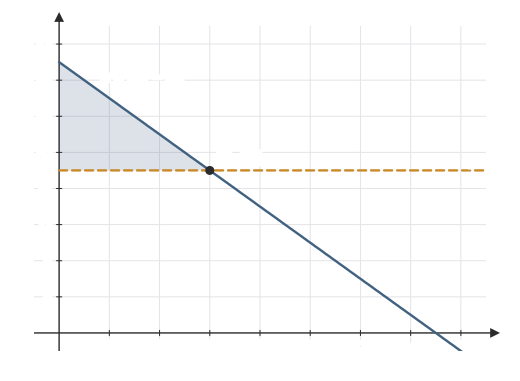
The figure shows the demand curve p = 30 − 2 x p = 30 - 2x p = 30 − 2 x
Options for question 45 A Option A ₹35 B Option B ₹36 C Option C ₹108 D Option D ₹144
Skip Check Show the explanation Hide the explanation Next question Try again
Show the explanation Hide the explanation Answer B · ₹36
The price line meets the demand curve where 30 − 2 x = 18 30 - 2x = 18 30 − 2 x = 18 x 0 = 6 x_0 = 6 x 0 = 6
The shaded triangle has base 6 and height 30 − 18 = 12 30 - 18 = 12 30 − 18 = 12 1 2 × 6 × 12 = 36 \frac{1}{2} \times 6 \times 12 = 36 2 1 × 6 × 12 = 36
Worth noting
₹108 is the rectangle under the price line, what consumers pay, not the surplus above it.
The demand function is p = 50 − 3 x p = 50 - 3 x p = 50 − 3 x p = x + 10 p = x + 10 p = x + 10
Options for question 46 A Option A ₹50 B Option B ₹150 C Option C ₹200 D Option D ₹350
Skip Check Show the explanation Hide the explanation Next question Try again
Show the explanation Hide the explanation Answer B · ₹150
The market clears at x 0 = 10 x_0 = 10 x 0 = 10 p 0 = 20 p_0 = 20 p 0 = 20
C S = ∫ 0 10 ( 50 − 3 x ) d x − 20 × 10 = 350 − 200 = 150 CS = \int_0^{10} (50 - 3 x)\,dx - 20 \times 10 = 350 - 200 = 150 C S = ∫ 0 10 ( 50 − 3 x ) d x − 20 × 10 = 350 − 200 = 150
Worth noting
₹350 forgets to take off what consumers pay at the equilibrium price.
The demand function is p = 100 − 5 x p = 100 - 5 x p = 100 − 5 x
Options for question 47 A Option A ₹80 B Option B ₹160 C Option C ₹320 D Option D ₹480
Skip Check Show the explanation Hide the explanation Next question Try again
Show the explanation Hide the explanation Answer B · ₹160
The market clears at x 0 = 8 x_0 = 8 x 0 = 8 p 0 = 60 p_0 = 60 p 0 = 60
C S = ∫ 0 8 ( 100 − 5 x ) d x − 60 × 8 = 640 − 480 = 160 CS = \int_0^{8} (100 - 5 x)\,dx - 60 \times 8 = 640 - 480 = 160 C S = ∫ 0 8 ( 100 − 5 x ) d x − 60 × 8 = 640 − 480 = 160
Worth noting
₹320 forgets the 1 2 \frac{1}{2} 2 1
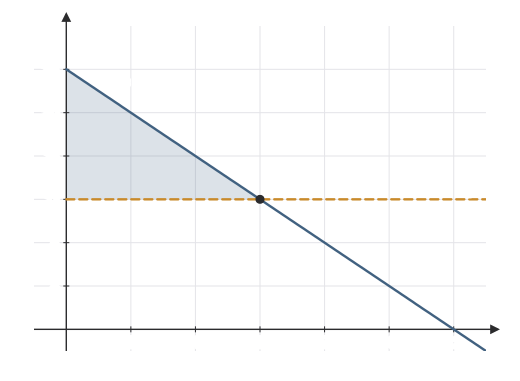
The figure shows the demand curve p = 24 − 2 x p = 24 - 2x p = 24 − 2 x
Options for question 48 A Option A ₹18 B Option B ₹35 C Option C ₹36 D Option D ₹72
Skip Check Show the explanation Hide the explanation Next question Try again
Show the explanation Hide the explanation Answer C · ₹36
The market clears at x 0 = 6 x_0 = 6 x 0 = 6 p 0 = 12 p_0 = 12 p 0 = 12
C S = ∫ 0 6 ( 24 − 2 x ) d x − 12 × 6 = 108 − 72 = 36 CS = \int_0^{6} (24 - 2 x)\,dx - 12 \times 6 = 108 - 72 = 36 C S = ∫ 0 6 ( 24 − 2 x ) d x − 12 × 6 = 108 − 72 = 36
Worth noting
₹72 is the rectangle under the price line, what consumers pay.
The demand function for a brand of earphones is p = 50 − x 2 p = 50 - x^{2} p = 50 − x 2 p p p x x x
What is the most buyers of the earphones would have been willing to pay in all for that quantity?
Options for question 49 A Option A ₹84 B Option B ₹144 C Option C ₹227 D Option D ₹228
Skip Check Show the explanation Hide the explanation Next question Try again
Show the explanation Hide the explanation Answer D · ₹228
It is the area under the demand curve: ∫ 0 6 ( 50 − x 2 ) d x = [ 50 x − x 3 3 ] 0 6 \int_0^{6}(50 - x^{2})\,dx = \left[50x - \frac{x^{3}}{3}\right]_0^{6} ∫ 0 6 ( 50 − x 2 ) d x = [ 50 x − 3 x 3 ] 0 6
300 − 72 = 228 300 - 72 = 228 300 − 72 = 228
Worth noting
₹300 forgets to subtract x 3 3 \frac{x^{3}}{3} 3 x 3
The demand function for a brand of earphones is p = 50 − x 2 p = 50 - x^{2} p = 50 − x 2 p p p x x x
What is the consumers' surplus in the earphone market?
Options for question 50 A Option A ₹84 B Option B ₹144 C Option C ₹216 D Option D ₹228
Skip Check Show the explanation Hide the explanation Next question Try again
Show the explanation Hide the explanation Answer B · ₹144
Buyers pay 14 × 6 = 84 14 \times 6 = 84 14 × 6 = 84
C S = 228 − 84 = 144 CS = 228 - 84 = 144 C S = 228 − 84 = 144
Worth noting
₹84 is what buyers pay, not what they save.
The demand function is p = 50 − x 2 p = 50 - x^{2} p = 50 − x 2
Options for question 51 A Option A ₹250 3 \frac{250}{3} 3 250 B Option B ₹125 C Option C ₹500 3 \frac{500}{3} 3 500 D Option D ₹625 3 \frac{625}{3} 3 625
Skip Check Show the explanation Hide the explanation Next question Try again
Show the explanation Hide the explanation Answer A · ₹250 3 \frac{250}{3} 3 250
At x 0 = 5 x_0 = 5 x 0 = 5 p 0 = 50 − 25 = 25 p_0 = 50 - 25 = 25 p 0 = 50 − 25 = 25 25 × 5 = 125 25 \times 5 = 125 25 × 5 = 125
C S = ∫ 0 5 ( 50 − x 2 ) d x − 125 = ( 250 − 125 3 ) − 125 = 250 3 CS = \int_{0}^{5} (50 - x^{2})\,dx - 125 = \left(250 - \frac{125}{3}\right) - 125 = \frac{250}{3} C S = ∫ 0 5 ( 50 − x 2 ) d x − 125 = ( 250 − 3 125 ) − 125 = 3 250
Worth noting
₹125 treats the demand curve as a straight line from ( 0 , 50 ) (0, 50) ( 0 , 50 ) ( 5 , 25 ) (5, 25) ( 5 , 25 )
The demand function is p = 45 − x 2 p = 45 - x^{2} p = 45 − x 2
Options for question 52 A Option A ₹18 B Option B ₹19 C Option C ₹27 D Option D ₹126
Skip Check Show the explanation Hide the explanation Next question Try again
Show the explanation Hide the explanation Answer A · ₹18
The market clears at x 0 = 3 x_0 = 3 x 0 = 3 p 0 = 36 p_0 = 36 p 0 = 36
C S = ∫ 0 3 ( 45 − x 2 ) d x − 36 × 3 = 126 − 108 = 18 CS = \int_0^{3} (45 - x^{2})\,dx - 36 \times 3 = 126 - 108 = 18 C S = ∫ 0 3 ( 45 − x 2 ) d x − 36 × 3 = 126 − 108 = 18
Worth noting
₹27 treats the demand curve as a straight line from (0, 45) to (3, 36); the curve bends.
The demand function is p = 18 x + 1 p = \frac{18}{x + 1} p = x + 1 18
Options for question 53 A Option A ₹− 12 + 18 log 2 -12 + 18 \log 2 − 12 + 18 log 2 B Option B ₹− 12 + 18 log 3 -12 + 18 \log 3 − 12 + 18 log 3 C Option C ₹12 D Option D ₹18 log 3 18 \log 3 18 log 3
Skip Check Show the explanation Hide the explanation Next question Try again
Show the explanation Hide the explanation Answer B · ₹− 12 + 18 log 3 -12 + 18 \log 3 − 12 + 18 log 3
At x 0 = 2 x_0 = 2 x 0 = 2 p 0 = 18 3 = 6 p_0 = \frac{18}{3} = 6 p 0 = 3 18 = 6 6 × 2 = 12 6 \times 2 = 12 6 × 2 = 12
C S = ∫ 0 2 18 x + 1 d x − 12 = 18 log 3 − 12 ≈ 7.78 CS = \int_0^{2} \frac{18}{x + 1}\,dx - 12 = 18\log 3 - 12 \approx 7.78 C S = ∫ 0 2 x + 1 18 d x − 12 = 18 log 3 − 12 ≈ 7.78
Worth noting
18 log 3 18\log 3 18 log 3
The demand function for a brand of earphones is p = 50 − x 2 p = 50 - x^{2} p = 50 − x 2 p p p x x x
The earphone price rises to ₹41. What is the consumers' surplus now?
Options for question 54 A Option A ₹18 B Option B ₹27 C Option C ₹36 D Option D ₹144
Skip Check Show the explanation Hide the explanation Next question Try again
Show the explanation Hide the explanation Answer A · ₹18
50 − x 2 = 41 50 - x^{2} = 41 50 − x 2 = 41 x = 3 x = 3 x = 3
C S = ∫ 0 3 ( 50 − x 2 ) d x − 41 × 3 = ( 150 − 9 ) − 123 = 18 CS = \int_0^{3}(50 - x^{2})\,dx - 41 \times 3 = (150 - 9) - 123 = 18 C S = ∫ 0 3 ( 50 − x 2 ) d x − 41 × 3 = ( 150 − 9 ) − 123 = 18
Worth noting
₹27 forgets that x 3 3 \frac{x^{3}}{3} 3 x 3 x = 3 x = 3 x = 3 x 2 x^{2} x 2
Producer surplus 16 questions The supply function is p = 2 x + 5 p = 2 x + 5 p = 2 x + 5
Options for question 55 A Option A ₹50 B Option B ₹99 C Option C ₹100 D Option D ₹150
Skip Check Show the explanation Hide the explanation Next question Try again
Show the explanation Hide the explanation Answer C · ₹100
The market clears at x 0 = 10 x_0 = 10 x 0 = 10 p 0 = 25 p_0 = 25 p 0 = 25
P S = 25 × 10 − ∫ 0 10 ( 2 x + 5 ) d x = 250 − 150 = 100 PS = 25 \times 10 - \int_0^{10} (2 x + 5)\,dx = 250 - 150 = 100 P S = 25 × 10 − ∫ 0 10 ( 2 x + 5 ) d x = 250 − 150 = 100
Worth noting
₹150 is the area under the supply line, the least the producers would accept, not the surplus above it.
The supply function for a kind of handmade chair is p = 4 + 3 x 2 p = 4 + 3x^{2} p = 4 + 3 x 2 p p p x x x
What quantity of chairs is supplied at the market price of ₹31?
Options for question 56 A Option A 2 2 2 B Option B 3 3 3 C Option C 5 5 5 D Option D 9 9 9
Skip Check Show the explanation Hide the explanation Next question Try again
Show the explanation Hide the explanation Answer B · 3 3 3
4 + 3 x 2 = 31 4 + 3x^{2} = 31 4 + 3 x 2 = 31 x 2 = 9 x^{2} = 9 x 2 = 9
x = 3 x = 3 x = 3
The supply function is p = 3 + x p = 3 + x p = 3 + x
Options for question 57 A Option A ₹31 B Option B ₹32 C Option C ₹56 D Option D ₹88
Skip Check Show the explanation Hide the explanation Next question Try again
Show the explanation Hide the explanation Answer B · ₹32
At p 0 = 11 p_0 = 11 p 0 = 11 x 0 = 8 x_0 = 8 x 0 = 8 11 × 8 = 88 11 \times 8 = 88 11 × 8 = 88
P S = 88 − ∫ 0 8 ( 3 + x ) d x = 88 − ( 24 + 32 ) = 32 PS = 88 - \int_{0}^{8} (3 + x)\,dx = 88 - (24 + 32) = 32 P S = 88 − ∫ 0 8 ( 3 + x ) d x = 88 − ( 24 + 32 ) = 32
Worth noting
₹56 is the area under the supply curve, the least producers would accept, not the surplus above it.
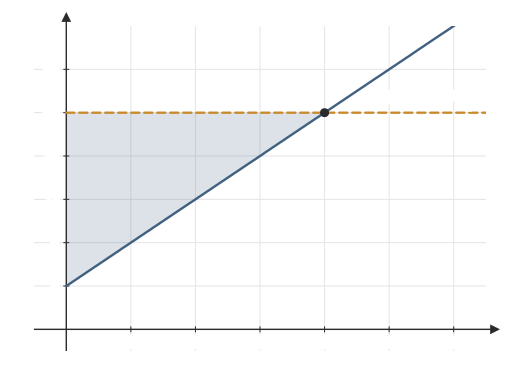
The figure shows the supply curve p = 4 + 2 x p = 4 + 2x p = 4 + 2 x
Options for question 58 A Option A ₹64 B Option B ₹96 C Option C ₹128 D Option D ₹160
Skip Check Show the explanation Hide the explanation Next question Try again
Show the explanation Hide the explanation Answer A · ₹64
The price line meets the supply curve where 4 + 2 x = 20 4 + 2x = 20 4 + 2 x = 20 x 0 = 8 x_0 = 8 x 0 = 8
The shaded triangle has base 8 and height 20 − 4 = 16 20 - 4 = 16 20 − 4 = 16 1 2 × 8 × 16 = 64 \frac{1}{2} \times 8 \times 16 = 64 2 1 × 8 × 16 = 64
Worth noting
₹96 is the area under the supply curve, ∫ 0 8 ( 4 + 2 x ) d x \int_{0}^{8} (4 + 2x)\,dx ∫ 0 8 ( 4 + 2 x ) d x
The demand function is p = 60 − 3 x p = 60 - 3 x p = 60 − 3 x p = x + 12 p = x + 12 p = x + 12
Options for question 59 A Option A ₹72 B Option B ₹144 C Option C ₹216 D Option D ₹288
Skip Check Show the explanation Hide the explanation Next question Try again
Show the explanation Hide the explanation Answer A · ₹72
The market clears at x 0 = 12 x_0 = 12 x 0 = 12 p 0 = 24 p_0 = 24 p 0 = 24
P S = 24 × 12 − ∫ 0 12 ( x + 12 ) d x = 288 − 216 = 72 PS = 24 \times 12 - \int_0^{12} (x + 12)\,dx = 288 - 216 = 72 P S = 24 × 12 − ∫ 0 12 ( x + 12 ) d x = 288 − 216 = 72
Worth noting
₹216 is the area under the supply line up to 12 units, not the surplus.
The supply function is p = S ( x ) p = S(x) p = S ( x ) x 0 x_0 x 0 p 0 p_0 p 0
Options for question 60 A Option A ∫ 0 x 0 S ( x ) d x − p 0 x 0 \int_{0}^{x_0} S(x)\,dx - p_0x_0 ∫ 0 x 0 S ( x ) d x − p 0 x 0 B Option B ∫ 0 x 0 S ( x ) d x \int_{0}^{x_0} S(x)\,dx ∫ 0 x 0 S ( x ) d x C Option C p 0 x 0 p_0x_0 p 0 x 0 D Option D p 0 x 0 − ∫ 0 x 0 S ( x ) d x p_0x_0 - \int_{0}^{x_0} S(x)\,dx p 0 x 0 − ∫ 0 x 0 S ( x ) d x
Skip Check Show the explanation Hide the explanation Next question Try again
Show the explanation Hide the explanation Answer D · p 0 x 0 − ∫ 0 x 0 S ( x ) d x p_0x_0 - \int_{0}^{x_0} S(x)\,dx p 0 x 0 − ∫ 0 x 0 S ( x ) d x
Producers receive p 0 x 0 p_0x_0 p 0 x 0
The least they would accept is the area under the supply curve; the surplus is the difference.
Worth noting
The reversed difference is negative: the supply curve lies below the price line up to x 0 x_0 x 0
The figure shows the supply curve p = 6 + 3 x p = 6 + 3x p = 6 + 3 x
Options for question 61 A Option A ₹12 B Option B ₹23 C Option C ₹24 D Option D ₹48
Skip Check Show the explanation Hide the explanation Next question Try again
Show the explanation Hide the explanation Answer C · ₹24
The market clears at x 0 = 4 x_0 = 4 x 0 = 4 p 0 = 18 p_0 = 18 p 0 = 18
P S = 18 × 4 − ∫ 0 4 ( 3 x + 6 ) d x = 72 − 48 = 24 PS = 18 \times 4 - \int_0^{4} (3 x + 6)\,dx = 72 - 48 = 24 P S = 18 × 4 − ∫ 0 4 ( 3 x + 6 ) d x = 72 − 48 = 24
Worth noting
₹48 forgets the 1 2 \frac{1}{2} 2 1
The supply function for a kind of handmade chair is p = 4 + 3 x 2 p = 4 + 3x^{2} p = 4 + 3 x 2 p p p x x x
What is the least the chair makers would have accepted in all for that quantity?
Options for question 62 A Option A ₹12 B Option B ₹38 C Option C ₹39 D Option D ₹93
Skip Check Show the explanation Hide the explanation Next question Try again
Show the explanation Hide the explanation Answer C · ₹39
It is the area under the supply curve: ∫ 0 3 ( 4 + 3 x 2 ) d x = [ 4 x + x 3 ] 0 3 \int_0^{3}(4 + 3x^{2})\,dx = \left[4x + x^{3}\right]_0^{3} ∫ 0 3 ( 4 + 3 x 2 ) d x = [ 4 x + x 3 ] 0 3
12 + 27 = 39 12 + 27 = 39 12 + 27 = 39
Worth noting
₹93 is what they actually receive, 31 × 3 31 \times 3 31 × 3
The supply function for a kind of handmade chair is p = 4 + 3 x 2 p = 4 + 3x^{2} p = 4 + 3 x 2 p p p x x x
What is the producers' surplus in the chair market?
Options for question 63 A Option A ₹39 B Option B ₹53 C Option C ₹54 D Option D ₹93
Skip Check Show the explanation Hide the explanation Next question Try again
Show the explanation Hide the explanation Answer C · ₹54
Makers receive 31 × 3 = 93 31 \times 3 = 93 31 × 3 = 93
P S = 93 − 39 = 54 PS = 93 - 39 = 54 P S = 93 − 39 = 54
Worth noting
₹81 subtracts only the 12 of the constant part, leaving out the x 3 x^{3} x 3
The supply function is p = 2 + x 2 p = 2 + x^{2} p = 2 + x 2
Options for question 64 A Option A ₹88 3 \frac{88}{3} 3 88 B Option B ₹32 C Option C ₹40 D Option D ₹128 3 \frac{128}{3} 3 128
Skip Check Show the explanation Hide the explanation Next question Try again
Show the explanation Hide the explanation Answer D · ₹128 3 \frac{128}{3} 3 128
At x 0 = 4 x_0 = 4 x 0 = 4 p 0 = 2 + 16 = 18 p_0 = 2 + 16 = 18 p 0 = 2 + 16 = 18 18 × 4 = 72 18 \times 4 = 72 18 × 4 = 72
P S = 72 − ∫ 0 4 ( 2 + x 2 ) d x = 72 − ( 8 + 64 3 ) = 128 3 PS = 72 - \int_{0}^{4} (2 + x^{2})\,dx = 72 - \left(8 + \frac{64}{3}\right) = \frac{128}{3} P S = 72 − ∫ 0 4 ( 2 + x 2 ) d x = 72 − ( 8 + 3 64 ) = 3 128
Worth noting
₹32 takes the triangle under a straight line from ( 0 , 2 ) (0, 2) ( 0 , 2 ) ( 4 , 18 ) (4, 18) ( 4 , 18 )
The demand function is p = 40 − x 2 p = 40 - x^{2} p = 40 − x 2 p = 3 x 2 + 4 p = 3x^{2} + 4 p = 3 x 2 + 4
Options for question 65 A Option A ₹18 B Option B ₹39 C Option C ₹54 D Option D ₹93
Skip Check Show the explanation Hide the explanation Next question Try again
Show the explanation Hide the explanation Answer C · ₹54
Equilibrium: x 0 = 3 x_0 = 3 x 0 = 3 p 0 = 31 p_0 = 31 p 0 = 31 31 × 3 = 93 31 \times 3 = 93 31 × 3 = 93
P S = 93 − ∫ 0 3 ( 3 x 2 + 4 ) d x = 93 − ( 27 + 12 ) = 54 PS = 93 - \int_{0}^{3} (3x^{2} + 4)\,dx = 93 - (27 + 12) = 54 P S = 93 − ∫ 0 3 ( 3 x 2 + 4 ) d x = 93 − ( 27 + 12 ) = 54
Worth noting
₹18 is the consumer surplus in the same market, worked from the demand curve.
In a market, demand is p = 20 − x p = 20 - x p = 20 − x p = 2 + 2 x p = 2 + 2x p = 2 + 2 x
List I List II A. Consumer surplus I. ₹84 B. Producer surplus II. ₹18 C. Amount spent, p 0 x 0 p_0x_0 p 0 x 0 III. ₹54 D. Total surplus IV. ₹36
Options for question 66 A Option A A-IV, B-II, C-I, D-III B Option B A-II, B-IV, C-III, D-I C Option C A-IV, B-II, C-III, D-I D Option D A-II, B-IV, C-I, D-III
Skip Check Show the explanation Hide the explanation Next question Try again
Show the explanation Hide the explanation Answer D · A-II, B-IV, C-I, D-III
Equilibrium: 20 − x = 2 + 2 x 20 - x = 2 + 2x 20 − x = 2 + 2 x x 0 = 6 x_0 = 6 x 0 = 6 p 0 = 14 p_0 = 14 p 0 = 14 p 0 x 0 = 84 p_0x_0 = 84 p 0 x 0 = 84
C S = 1 2 × 6 × ( 20 − 14 ) = 18 CS = \frac{1}{2} \times 6 \times (20 - 14) = 18 C S = 2 1 × 6 × ( 20 − 14 ) = 18 P S = 1 2 × 6 × ( 14 − 2 ) = 36 PS = \frac{1}{2} \times 6 \times (14 - 2) = 36 P S = 2 1 × 6 × ( 14 − 2 ) = 36 18 + 36 = 54 18 + 36 = 54 18 + 36 = 54
The supply function is p = x 2 + 3 p = x^{2} + 3 p = x 2 + 3
Options for question 67 A Option A ₹9 B Option B ₹18 C Option C ₹27 D Option D ₹36
Skip Check Show the explanation Hide the explanation Next question Try again
Show the explanation Hide the explanation Answer B · ₹18
The market clears at x 0 = 3 x_0 = 3 x 0 = 3 p 0 = 12 p_0 = 12 p 0 = 12
P S = 12 × 3 − ∫ 0 3 ( x 2 + 3 ) d x = 36 − 18 = 18 PS = 12 \times 3 - \int_0^{3} (x^{2} + 3)\,dx = 36 - 18 = 18 P S = 12 × 3 − ∫ 0 3 ( x 2 + 3 ) d x = 36 − 18 = 18
Worth noting
₹27 treats the supply curve as a straight line from (0, 3) to (3, 12); the curve bends below it.
In a market, demand is p = 28 − 2 x p = 28 - 2x p = 28 − 2 x p = 4 + x p = 4 + x p = 4 + x
Options for question 68 A Option A ₹32 B Option B ₹64 C Option C ₹95 D Option D ₹96
Skip Check Show the explanation Hide the explanation Next question Try again
Show the explanation Hide the explanation Answer D · ₹96
Equilibrium: 28 − 2 x = 4 + x 28 - 2x = 4 + x 28 − 2 x = 4 + x x 0 = 8 x_0 = 8 x 0 = 8 p 0 = 12 p_0 = 12 p 0 = 12
CS = 1 2 × 8 × 16 = 64 = \frac{1}{2} \times 8 \times 16 = 64 = 2 1 × 8 × 16 = 64 = 1 2 × 8 × 8 = 32 = \frac{1}{2} \times 8 \times 8 = 32 = 2 1 × 8 × 8 = 32 96 96 96
Worth noting
₹64 is the consumer surplus alone.
The demand function is p = 30 − x 2 p = 30 - x^{2} p = 30 − x 2 p = 2 x 2 + 3 p = 2 x^{2} + 3 p = 2 x 2 + 3
Options for question 69 A Option A ₹18 B Option B ₹27 C Option C ₹35 D Option D ₹36
Skip Check Show the explanation Hide the explanation Next question Try again
Show the explanation Hide the explanation Answer D · ₹36
The market clears at x 0 = 3 x_0 = 3 x 0 = 3 p 0 = 21 p_0 = 21 p 0 = 21
P S = 21 × 3 − ∫ 0 3 ( 2 x 2 + 3 ) d x = 63 − 27 = 36 PS = 21 \times 3 - \int_0^{3} (2 x^{2} + 3)\,dx = 63 - 27 = 36 P S = 21 × 3 − ∫ 0 3 ( 2 x 2 + 3 ) d x = 63 − 27 = 36
Worth noting
₹27 is the area under the supply curve up to 3 units, what producers would accept at the least.
The supply function for a kind of handmade chair is p = 4 + 3 x 2 p = 4 + 3x^{2} p = 4 + 3 x 2 p p p x x x
The chair price rises to ₹52. What is the producers' surplus now?
Options for question 70 A Option A ₹80 B Option B ₹128 C Option C ₹192 D Option D ₹208
Skip Check Show the explanation Hide the explanation Back to start Try again
Show the explanation Hide the explanation Answer B · ₹128
4 + 3 x 2 = 52 4 + 3x^{2} = 52 4 + 3 x 2 = 52 x = 4 x = 4 x = 4 52 × 4 = 208 52 \times 4 = 208 52 × 4 = 208
P S = 208 − ( 16 + 64 ) = 128 PS = 208 - (16 + 64) = 128 P S = 208 − ( 16 + 64 ) = 128
Worth noting
₹80 is the area under the supply curve, not the surplus above it.
Question types · easy to hard
NTA's Mathematics / Applied Mathematics syllabus has three sections: Section A1, which every candidate answers, then Section B1 (Mathematics) or Section B2 (Applied Mathematics), of which a candidate answers one. Each section lists units and topics but no chapters, so the chapters here are ours. Where both B sections list a topic that Section A also lists, its questions sit once, in Section A.