EduFarming
Your list · 0हिं

Type at least two letters. Press Esc to close.

↑↓ navigate↵ openTAB cycle filter

Calendars and Clocks for CUET General Aptitude

About 10 min to learn · 65 questions

Calendar and clock questions look like general knowledge but are pure arithmetic. Every calendar question comes down to one number, the remainder when a count of days is divided by 7. Every clock question comes down to two speeds: the minute hand turns 6° a minute and the hour hand 0.5°. This lesson covers odd days, the day of the week for any date, leap years, repeating calendars, angles between the hands, when they meet, mirror images and clocks that gain or lose.

Syllabus area
Logical and Analytical Reasoning
On this page · 7 sections
  1. 01The core idea
  2. 02Calendars
  3. 03Clocks
  4. 04Exam shortcuts
  5. 05Common mistakes
  6. 06Quick revision
  7. 07Check your understanding

The core idea

Calendars run on remainders: whole weeks change nothing, so only the days left over after dividing by 7 move the weekday. Clocks run on two speeds: the minute hand turns 6° a minute and the hour hand 0.5° a minute, so the minute hand gains 5.5° a minute.

Learn those two ideas and the chapter becomes routine: count days and take the remainder, or turn a clock question into a gap closed at 5.5° a minute.

Calendars

What are odd days?

Odd days are the days left after removing complete weeks from a stretch of time. Divide the number of days by 7; the remainder is how far the weekday moves. 38 days is 5 weeks and 3 days, so a Tuesday moves on to a Friday.

PeriodDaysOdd days
Ordinary year365 = 52 weeks + 11
Leap year366 = 52 weeks + 22
100 years, 24 leap and 76 ordinary124 odd days in total5
200 years103
300 years151
400 years, the 400th year leap210

Key idea

The last row is why the calendar repeats exactly every 400 years. It also means the last day of a century is always a Friday, Wednesday, Monday or Sunday, never a Tuesday, Thursday or Saturday.

How do you find the day of the week after a given number of days?

Divide the number of days by 7 and move the weekday forward or back by the remainder. The starting day is day 0. Going back rr days is the same as going forward 7−r7 - r.

Example 1 · Days between two dates

5 September 2033 is a Monday. What day is 14 November 2033?

  1. Days left in September after the 5th: 30−5=2530 - 5 = 25.

  2. October: 31. November to the 14th: 14.

  3. Total: 25+31+14=7025 + 31 + 14 = 70, exactly 10 weeks.

Answer

Monday

Exam shortcut

90 days before a Sunday: 90=12×7+690 = 12 \times 7 + 6, so go back 6 days, to Monday. Back 4 from Saturday is forward 3, Tuesday.

How do you find the day of the week for any date using odd days?

Count the odd days from the start of the calendar to the date, then read the weekday from the code. Break the count into complete centuries, the remaining complete years, the complete months of the final year, and the days of the final month.

Odd days0123456
DaySunMonTueWedThuFriSat
JanFebMarAprMayJunJulAugSepOctNovDec
303232332323

Example 2 · The Moon landing

Find the day of the week of 20 July 1969.

  1. Complete years: 1968. The first 1,600 give 0 odd days and the next 300 give 1.

  2. 1901 to 1968: 17 leap and 51 ordinary years, 17×2+51=8517 \times 2 + 51 = 85, which leaves 1.

  3. January to June 1969: 3+0+3+2+3+2=133 + 0 + 3 + 2 + 3 + 2 = 13, which leaves 6. July's 20 days leave 6.

  4. Total: 1+1+6+6=141 + 1 + 6 + 6 = 14, which leaves 0.

Answer

Sunday

Exam shortcut

A 31-day month gives 3 odd days and a 30-day month 2; add 1 for February in a leap year.

What is the rule for a leap year?

A year divisible by 4 is a leap year, except that a century year is leap only if divisible by 400. So 2024 and 2000 are leap years, while 1900 and 2100 are not.

  • 1801 to 1900 has 25 multiples of 4, but 1900 is not leap, so 24 leap years.
  • Jumping one year ahead, ask whether a 29 February lies between the two dates, not merely whether a leap year is involved.
  • 1 March 2035 is a Thursday. The year to 1 March 2036 includes 29 February 2036, so it has 366 days, and 1 March 2036 is a Saturday.

How do you tell how many times a weekday occurs in a month or a year?

Every weekday occurs 4 times in 28 days, and the days beyond 28 occur a fifth time, starting from the 1st. A 30-day month has 2 such days and a 31-day month 3. In a year only the weekday of 1 January occurs 53 times; in a leap year, those of 1 and 2 January.

Key idea

In an ordinary year, January and October start on the same weekday; so do February, March and November; April and July; and September and December.

Which year will have the same calendar as a given year?

Two years share a calendar when they start on the same weekday and are both leap or both ordinary. Add up odd days year by year until the total is a multiple of 7, then check the leap status. When no non-leap century year lies between, a shortcut works.

The given year isCalendar repeats after
A leap year28 years
One year after a leap year6 years
Two or three years after a leap year11 years

Example 3 · A repeating calendar

Which year has the same calendar as 2041?

  1. 2040 is leap, so 2041 is one year after a leap year: try 2047.

  2. Check: 2041 to 2046 includes one leap year, 2044, so the odd days are 6+1=76 + 1 = 7.

  3. 2047 is ordinary, like 2041.

Answer

2047

Watch out

Near a century year the shortcut breaks: 1900 was ordinary, so its calendar repeated in 1906, not 1928. And starting on the same weekday is not enough: 2032 begins on a Thursday like 2026, but it is leap, so from March its dates are a day out. The next year to reuse 2026's calendar is 2037.

Clocks

How do you find the angle between the hands of a clock?

At hh hours and mm minutes, the angle is ∣30h−5.5m∣|30h - 5.5m| degrees. If that is more than 180°, subtract it from 360° for the smaller angle. The formula comes from the hour hand at 30h+0.5m30h + 0.5m degrees past 12 and the minute hand at 6m6m.

Angle between the hands

θ=∣30h−5.5m∣\theta = |30h - 5.5m|

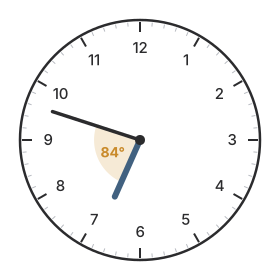
Example 4 · The angle at 6:48

Find the angle between the hands at 6:48.

  1. ∣30×6−5.5×48∣=∣180−264∣=84∘|30 \times 6 - 5.5 \times 48| = |180 - 264| = 84^\circ.

  2. 84° is less than 180°, so that is the angle.

Answer

84°

The reflex angle is 276°.

A clock face showing 6:48. The minute hand points to the 48-minute mark, and the hour hand is between 6 and 7. The angle between them is shaded and marked 84 degrees.
At 6:48 the hour hand has moved 24° past the 6. Treating it as fixed on the 6 is the commonest clock error.

Watch out

The hour hand keeps moving. At 8:10 the formula gives ∣240−55∣=185∘|240 - 55| = 185^\circ, more than 180°, so the smaller angle is 360∘−185∘=175∘360^\circ - 185^\circ = 175^\circ.

When do the hands of a clock coincide, point opposite or form a right angle?

Use relative speed. The minute hand gains 5.5° a minute, so the time needed is the gap to be closed divided by 5.5. At hh o'clock the minute hand is 30h30h degrees behind the hour hand. Keep only answers between 0 and 60.

Between hh and h+1h + 1Gap to gainMinutes past hh
Hands together30h30h60h11\tfrac{60h}{11}
Hands opposite30h±18030h \pm 18030h±1805.5\tfrac{30h \pm 180}{5.5}
Right angle30h±9030h \pm 9030h±905.5\tfrac{30h \pm 90}{5.5}

Example 5 · Together and opposite

When are the hands together between 9 and 10, and when are they opposite between 2 and 3?

  1. Together: gap 270°, so 270÷5.5=54011=49111270 \div 5.5 = \tfrac{540}{11} = 49\tfrac{1}{11} minutes past 9.

  2. Opposite: the minute hand must catch the hour hand, 60°, and go 180° beyond, 240° in all. 240÷5.5=48011=43711240 \div 5.5 = \tfrac{480}{11} = 43\tfrac{7}{11} minutes past 2.

Answer

4911149\tfrac{1}{11} minutes past 9; 4371143\tfrac{7}{11} minutes past 2

Counts to remember

  • The hands coincide 11 times in 12 hours, once every 6551165\tfrac{5}{11} minutes, and 22 times a day.
  • They are opposite 11 times in 12 hours and 22 times a day.
  • They are at right angles 22 times in 12 hours and 44 times a day, not 48, because 3:00 and 9:00 are each shared by two hours.

How do you read the time from a clock's mirror image?

Subtract the mirror time from 11:60, which is 12:00 written for easy borrowing. A mirror showing 10:17 means the real time is 11:60−10:17=1:4311{:}60 - 10{:}17 = 1{:}43. For an hour of 12, use 23:60: 12:20 reflects to 11:40.

Watch out

A mirror clock runs backwards: as real time passes, the reflected reading goes down.

How do you handle a clock that gains or loses time?

The gain or loss builds up with true time, so first find the true hours passed. A clock that gains gg minutes an hour shows 60+g60 + g minutes for every 60 true ones, so true time is the time shown times 6060+g\tfrac{60}{60 + g}; for a clock that loses, use 60−g60 - g.

Example 6 · A slow clock

A clock loses 6 minutes an hour and is set right at 9 a.m. It now shows 3:18 p.m. What is the true time?

  1. Time shown since 9 a.m.: 6 hours 18 minutes, which is 378 minutes.

  2. The clock shows 54 minutes for every 60 true ones: 378×6054=420378 \times \tfrac{60}{54} = 420 minutes.

  3. 420 minutes is 7 hours after 9 a.m.

Answer

4:00 p.m.

Exam shortcut

A faulty clock shows the right time again when its total gain or loss reaches 12 hours, 720 minutes: gaining 4 minutes a day, that takes 180 days. Two clocks agree again when the gap between them reaches 720 minutes, so add their rates if one gains and the other loses.

Exam shortcuts

  • Remainder by 7. Only odd days move the weekday.
  • Century odd days. 100, 200, 300, 400 years give 5, 3, 1, 0.
  • Repeat after. Leap: 28. One after leap: 6. Two or three after: 11.
  • Clock angle. ∣30h−5.5m∣|30h - 5.5m|, then take the smaller angle.
  • Mirror. Subtract from 11:60.

Common mistakes

  • Counting the start day. "38 days from Tuesday" starts counting on Wednesday.
  • Forgetting the century rule.
  • A leap year taken for 29 February. One year later gives 2 odd days only if 29 February falls between.
  • Same first day taken for the same calendar.
  • The 28-year rule across 2100.
  • Reflex or smaller angle.
  • A still hour hand.
  • Gain per dial hour. Convert to true time before multiplying.
  • Forgetting that mirror clocks run backwards.

Quick revision

Calendars

  • Odd days = days mod 7
  • Ordinary year 1, leap year 2
  • Leap: divisible by 4; centuries only by 400
  • Month odd days: 31 days → 3, 30 → 2, February 0 or 1

Clocks

  • Minute hand 6°, hour hand 0.5° a minute
  • θ=∣30h−5.5m∣\theta = |30h - 5.5m|
  • Meeting time = gap ÷ 5.5
  • Together 11 times in 12 hours

Mirrors and faulty clocks

  • Mirror time = 11:60 − shown
  • True time = shown × 6060±g\tfrac{60}{60 \pm g}
  • Right again after a 720-minute drift

Patterns in numbers and days continue in number and letter series and puzzles.

Next · 06Quick revision

Check your understanding

65 questions, grouped by type, easy to hard. Pick an answer and check it. The worked solution opens when you ask for it.

Day of the weekQ1 of 65Q1

Day of the week

17 questions

Today is a Wednesday. Which day of the week will it be 45 days from today?

Options for question 1

Show the explanationHide the explanation

AnswerB · Saturday

  1. Only the remainder after removing whole weeks matters: 45=6×7+345 = 6 \times 7 + 3.

  2. 6 whole weeks bring you back to Wednesday; 3 more days: Thursday, Friday, Saturday.

Worth noting

Friday comes from counting today as the first of the 45 days. Today is day 0; the count starts tomorrow.

Nandini's birthday this year falls on a Friday. On which day of the week was the date exactly 100 days before her birthday?

Options for question 2

Show the explanationHide the explanation

AnswerA · Wednesday

  1. 100=14×7+2100 = 14 \times 7 + 2, so 100 days back is the same as 2 days back.

  2. Two days before Friday: Thursday, then Wednesday.

Worth noting

Sunday is what you get by moving 2 days FORWARD. The question goes back in time.

If the day after tomorrow is a Sunday, which day of the week was the day before yesterday?

Options for question 3

Show the explanationHide the explanation

AnswerD · Wednesday

  1. The day after tomorrow is today + 2, so today = Sunday − 2 days = Friday.

  2. The day before yesterday is today − 2 = Wednesday.

Worth noting

Friday is TODAY, not the day asked for. Fix today first, then move.

How many odd days are there in a leap year?

Options for question 4

Show the explanationHide the explanation

AnswerC · 2

  1. A leap year has 366 days.

  2. 366=52×7+2366 = 52 \times 7 + 2: 52 complete weeks and 2 days left over, so 2 odd days.

Worth noting

1 is the odd-day count of an ORDINARY year (365 = 52 weeks + 1 day). The extra 29 February adds the second odd day.

1 April 2029 is a Sunday. How many days of the week occur five times in April 2029?

Options for question 5

Show the explanationHide the explanation

AnswerB · 2

  1. April has 30 days =4= 4 weeks +2+ 2 days.

  2. Every weekday occurs 4 times in the 28 days; the 2 extra days (29 and 30 April) are Sunday and Monday.

  3. So Sunday and Monday occur five times: 2 days of the week.

Worth noting

3 is the answer for a 31-day month. April has only 30 days.

The 3rd of a month is a Tuesday. On which day of the week does the 24th of the same month fall?

Options for question 6

Show the explanationHide the explanation

AnswerA · Tuesday

  1. From the 3rd to the 24th is 24−3=2124 - 3 = 21 days.

  2. 21 is exactly 3 weeks, so the 24th is also a Tuesday.

Worth noting

Wednesday comes from counting 22 days (both ends). Subtract the dates; do not count both.

15 August 2031 is a Friday. On which day of the week will Gandhi Jayanti, 2 October 2031, fall?

Options for question 7

Show the explanationHide the explanation

AnswerC · Thursday

  1. Days left in August after the 15th: 31−15=1631 - 15 = 16.

  2. Add all 30 days of September and 2 days of October: 16+30+2=4816 + 30 + 2 = 48 days.

  3. 48=6×7+648 = 6 \times 7 + 6, so move 6 days on from Friday: Thursday.

Worth noting

Wednesday comes from giving August 30 days or counting 47 days. August has 31 days.

India's Constitution came into force on 26 January 1950. Using odd days, find the day of the week of that date.

Options for question 8

Show the explanationHide the explanation

AnswerB · Thursday

  1. Complete years before 1950=19491950 = 1949. The first 1600 years give 0 odd days; the next 300 years give 1.

  2. The remaining 49 years (1901–1949) have 12 leap years and 37 ordinary years: 12×2+37=6112 \times 2 + 37 = 61 odd days, and 61=8×7+561 = 8 \times 7 + 5 gives 5.

  3. 26 days of January 1950 give 26=3×7+526 = 3 \times 7 + 5, that is 5 odd days.

  4. Total 1+5+5=111 + 5 + 5 = 11, and 11−7=411 - 7 = 4. With 0 = Sunday, 4 = Thursday.

Worth noting

Counting 1900 as a leap year adds one odd day and gives Friday. Century years are leap only when divisible by 400.

Independence Day, 15 August 2031, is a Friday. On which day of the week will 15 August 2032 fall?

Options for question 9

Show the explanationHide the explanation

AnswerD · Sunday

  1. Between the two dates lies 29 February 2032, because 2032 is a leap year.

  2. So the gap is 366 days, which is 52 weeks and 2 days.

  3. Friday moved on by 2 days is Sunday.

Worth noting

Saturday assumes a 365-day gap. Check whether a 29 February lies BETWEEN the two dates, not just whether either year is leap.

Today is a Monday. Which day of the week will it be 61 days after the day before yesterday?

Options for question 10

Show the explanationHide the explanation

AnswerC · Thursday

  1. The day before yesterday was Monday − 2 = Saturday.

  2. 61=8×7+561 = 8 \times 7 + 5, so move 5 days on from Saturday.

  3. Sunday, Monday, Tuesday, Wednesday, Thursday: the answer is Thursday.

Worth noting

Saturday is 61 days after TODAY (Monday + 5), which ignores the 2-day shift back. Friday takes the day before yesterday to be Sunday.

In a certain month the first Monday falls on the 4th. On which date of that month does the third Thursday fall?

Options for question 11

Show the explanationHide the explanation

AnswerC · 21

  1. The first Thursday comes 3 days after the first Monday: the 7th.

  2. The second Thursday is the 14th and the third is 7+14=217 + 14 = 21st.

Worth noting

18 is the third MONDAY (4th + 14). 14 is only the second Thursday and 28 the fourth.

How many odd days are there in the 53 years from 1 January 1901 to 31 December 1953?

Options for question 12

Show the explanationHide the explanation

AnswerB · 3

  1. Leap years in 1901–1953: 1904, 1908, …, 1952, which is 13 years. The other 40 are ordinary.

  2. Odd days =13×2+40×1=66= 13 \times 2 + 40 \times 1 = 66.

  3. 66=9×7+366 = 9 \times 7 + 3, so 3 odd days.

Worth noting

2 comes from counting only 12 leap years (stopping at 1948); 1952 is inside the range.

Anwar's board exam is on Thursday, 21 November 2030. He wants to start revising exactly 75 days earlier. On which day of the week will he start?

Options for question 13

Show the explanationHide the explanation

AnswerA · Saturday

  1. 75=10×7+575 = 10 \times 7 + 5, so 75 days back is the same weekday as 5 days back.

  2. 5 days before Thursday: Wednesday, Tuesday, Monday, Sunday, Saturday.

Worth noting

Tuesday moves 5 days FORWARD from Thursday. Going back 5 is the same as going forward 2, which lands on Saturday.

1 January 2001 was a Monday. On which day of the week will 1 January 2101 fall?

Options for question 14

Show the explanationHide the explanation

AnswerB · Saturday

  1. The years 2001 to 2100 must be counted. Leap years among them: 2004, 2008, …, 2096, which is 24 years. 2100 is NOT leap (a century year not divisible by 400).

  2. Odd days =24×2+76×1=124= 24 \times 2 + 76 \times 1 = 124.

  3. 124=17×7+5124 = 17 \times 7 + 5, so 5 odd days.

  4. Monday moved on by 5 days is Saturday.

Worth noting

Sunday comes from treating 2100 as a leap year (25 leap years, 6 odd days). Monday assumes 100 years always give 0 odd days; in fact 100 years give 5.

Using odd days, find the day of the week on which India became independent, 15 August 1947.

Options for question 15

Show the explanationHide the explanation

AnswerC · Friday

  1. Complete years = 1946: 1600 years give 0 odd days and 300 years give 1.

  2. 46 years (1901–1946) have 11 leap years and 35 ordinary ones: 22+35=5722 + 35 = 57, and 57=8×7+157 = 8 \times 7 + 1 gives 1.

  3. January to July 1947: 3+0+3+2+3+2+3=163 + 0 + 3 + 2 + 3 + 2 + 3 = 16 odd days, which is 2. Then 15 days of August give 1.

  4. Total 1+1+2+1=51 + 1 + 2 + 1 = 5. With 0 = Sunday, 5 = Friday.

Worth noting

Saturday comes from giving February 29 days in 1947; 1947 is not a leap year. Thursday comes from forgetting the 300 years' 1 odd day.

A leap year begins on a Friday. Which day or days of the week occur 53 times in that year?

Options for question 16

Show the explanationHide the explanation

AnswerB · Friday and Saturday

  1. 366 days = 52 weeks + 2 days, so every weekday occurs 52 times, and the 2 extra days occur once more.

  2. The extra days are the first two days of the year: 1 January (Friday) and 2 January (Saturday).

  3. So Friday and Saturday occur 53 times each.

Worth noting

Friday only is the answer for an ORDINARY year that begins on Friday (1 extra day). A leap year has 2 extra days.

2031 is not a leap year. Which of these months of 2031 begins on the same day of the week as September 2031?

Options for question 17

Show the explanationHide the explanation

AnswerD · December

  1. Two months begin on the same weekday when the days between their first days form whole weeks.

  2. From 1 September to 1 December: 30+31+30=9130 + 31 + 30 = 91 days =13= 13 weeks exactly.

  3. Check the others: to 1 October is 30 days (2 odd days), to 1 November 61 days (5 odd days); June begins 92 days before September (1 odd day).

Worth noting

October feels close because both follow 30-day gaps, but 30 days leave 2 odd days. Only 91-day gaps (or other multiples of 7) keep the weekday.

Leap years and repeating calendars

16 questions

Which of the following years is a leap year?

Options for question 18

Show the explanationHide the explanation

AnswerD · 2400

  1. A century year is a leap year only if it is divisible by 400.

  2. 1900÷4001900 \div 400, 2100÷4002100 \div 400 and 2200÷4002200 \div 400 are not whole numbers; 2400=6×4002400 = 6 \times 400, so 2400 is a leap year.

Worth noting

All four years are divisible by 4. For century years, divisibility by 4 is not enough.

Which one of these years is NOT a leap year?

Options for question 19

Show the explanationHide the explanation

AnswerB · 1800

  1. 2012 is divisible by 4 and is not a century year, so it is a leap year.

  2. 1600 and 2000 are divisible by 400, so they are leap years.

  3. 1800 is a century year not divisible by 400, so it is not a leap year.

Worth noting

2000 is the year students most often strike out, but 2000 is divisible by 400 and was a leap year.

How many leap years are there from 2001 to 2100, both years included?

Options for question 20

Show the explanationHide the explanation

AnswerB · 24

  1. Multiples of 4 from 2004 to 2100: (2100−2004)÷4+1=25(2100 - 2004) \div 4 + 1 = 25 years.

  2. 2100 is a century year not divisible by 400, so it is not leap: 25−1=2425 - 1 = 24.

Worth noting

25 counts 2100. Century years must be divisible by 400.

2032 is a leap year. In which year will the calendar of 2032 be repeated for the first time?

Options for question 21

Show the explanationHide the explanation

AnswerD · 2060

  1. A leap year's calendar returns after 28 years, as long as no non-leap century year (like 2100) falls in between.

  2. 2032+28=20602032 + 28 = 2060, which is also a leap year starting on the same day (Thursday).

Worth noting

2037 begins on the same weekday as 2032 but is not a leap year, so its dates drift by one day after February. 2043 uses the 11-year gap meant for ordinary years.

How many of the century years from 1601 to 2400 (both included) are leap years?

Options for question 22

Show the explanationHide the explanation

AnswerA · 2

  1. The century years in the range are 1700, 1800, 1900, 2000, 2100, 2200, 2300 and 2400.

  2. Only those divisible by 400 are leap: 2000 and 2400. That is 2.

Worth noting

8 counts every century year as leap because each is divisible by 4.

How many odd days are there in 400 consecutive years of the Gregorian calendar?

Options for question 23

Show the explanationHide the explanation

AnswerA · 0

  1. Each block of 100 years has 5 odd days, but the 400th year is a leap year, adding 1 odd day.

  2. Total =4×5+1=21= 4 \times 5 + 1 = 21, and 21 is a multiple of 7, so 0 odd days.

Worth noting

5 is the figure for 100 years. It is also why 400 years exactly bring the weekday back.

Priya bought a 2023 wall calendar with photographs she loved. In which year will she first be able to hang it up again with every date on the correct day?

Options for question 24

Show the explanationHide the explanation

AnswerC · 2034

  1. The later year must start on the same day as 2023 (a Sunday) and must also be an ordinary year.

  2. Add odd days year by year: 2023 gives 1, 2024 gives 2, 2025–2027 give 1 each, 2028 gives 2, 2029–2031 give 1 each, 2032 gives 2, 2033 gives 1. Running total after 2033: 1+2+1+1+1+2+1+1+1+2+1=141+2+1+1+1+2+1+1+1+2+1 = 14, a multiple of 7.

  3. So 1 January 2034 is a Sunday, and 2034 is ordinary: the calendar repeats in 2034.

Worth noting

2040 also begins on a Sunday, but it is a leap year, so from March onwards every date is a day out. 2030 treats every year as 1 odd day.

A school printed its 2019 timetable on a full-year calendar. What is the next year in which exactly the same calendar can be used?

Options for question 25

Show the explanationHide the explanation

AnswerC · 2030

  1. 2019 is ordinary and 2019 is 3 more than a multiple of 4 (2016). For such a year the calendar repeats after 11 years.

  2. Check by odd days: 2019–2029 contain 3 leap years (2020, 2024, 2028), so odd days =11+3=14= 11 + 3 = 14, a multiple of 7.

  3. 2030 is ordinary and starts on a Tuesday like 2019, so the answer is 2030.

Worth noting

2025 uses the 6-year gap, which works only for a year just after a leap year. 2036 starts on Tuesday too, but it is a leap year.

Tenzin keeps a 2029 desk diary in which every page has its date and weekday printed. In which year will the diary next match the calendar exactly?

Options for question 26

Show the explanationHide the explanation

AnswerA · 2035

  1. 2029 is the year just after a leap year (2028). Such a calendar repeats after 6 years.

  2. Check: 2029–2034 contain one leap year (2032), so odd days =6+1=7= 6 + 1 = 7, a multiple of 7.

  3. 2035 is ordinary and starts on Monday, like 2029.

Worth noting

2040 uses the 11-year gap, which is for the second or third year after a leap year. 2052 begins on a Monday but is a leap year.

1 January 2027 is a Friday. On which day of the week will 31 December 2027 fall?

Options for question 27

Show the explanationHide the explanation

AnswerC · Friday

  1. From 1 January to 31 December of an ordinary year is 364 days after the first day.

  2. 364 is exactly 52 weeks, so 31 December falls on the same weekday as 1 January: Friday.

Worth noting

Saturday comes from adding the year's 1 odd day; that odd day moves 1 January of the NEXT year, not 31 December of this one.

1 January 2024 was a Monday. What is the first year after 2024 in which 1 January is again a Monday?

Options for question 28

Show the explanationHide the explanation

AnswerB · 2029

  1. Odd days carried from each year: 2024 is leap (2), 2025 (1), 2026 (1), 2027 (1), 2028 is leap (2).

  2. Running total: 2, 3, 4, 5, 7. It reaches 7 after 2028.

  3. So 1 January 2029 is a Monday.

Worth noting

2052 is when the whole 2024 CALENDAR repeats (28 years). The question asks only about 1 January. 2031 treats every year as 1 odd day.

2000 was a leap year that began on a Saturday. Which is the first later year with exactly the same calendar as 2000?

Options for question 29

Show the explanationHide the explanation

AnswerD · 2028

  1. The later year must be a leap year and must begin on a Saturday.

  2. From 2000 to 2027 there are 28 years with 7 leap years (2000, 2004, …, 2024): odd days =28+7=35=5×7= 28 + 7 = 35 = 5 \times 7.

  3. 2028 is leap and begins on Saturday. No non-leap century year lies in between, so the 28-year rule holds.

Worth noting

2005 and 2011 also start on a Saturday, but they are ordinary years, so their dates from March onwards do not match 2000.

The last day of a century is 31 December of a year such as 1900 or 2000. On which of these days of the week can the last day of a century NEVER fall?

Options for question 30

Show the explanationHide the explanation

AnswerC · Tuesday

  1. 100 years have 5 odd days, 200 years have 3, 300 years have 1 and 400 years have 0.

  2. So the last day of each century, counted from day 0 = Sunday, is day 5, 3, 1 or 0: Friday, Wednesday, Monday or Sunday.

  3. Tuesday, Thursday and Saturday can never be the last day of a century.

Worth noting

Monday, Friday and Sunday all happen (1 odd day after 300 years is Monday, for example 31 December 1900).

In which year will the calendar of 2100 be repeated for the first time?

Options for question 31

Show the explanationHide the explanation

AnswerA · 2106

  1. 2100 is a century year not divisible by 400, so it is an ORDINARY year, beginning on a Friday.

  2. Look for the next ordinary year beginning on Friday. Odd days: 2100 (1), 2101 (1), 2102 (1), 2103 (1), 2104 leap (2), 2105 (1). Total =7= 7.

  3. So 1 January 2106 is a Friday, and 2106 is ordinary: the calendar repeats in 2106.

Worth noting

2128 comes from treating 2100 as a leap year and using the 28-year rule. 2112 begins on a Friday but is a leap year.

2096 is a leap year beginning on a Sunday. In which year will its calendar be repeated for the first time?

Options for question 32

Show the explanationHide the explanation

AnswerB · 2108

  1. The 28-year rule fails here because 2100, which lies in between, is NOT a leap year.

  2. Odd days from 2096: 2096 (2), 2097 (1), 2098 (1), 2099 (1), 2100 (1), 2101–2103 (1 each), 2104 (2), 2105–2107 (1 each). Total =2+1+1+1+1+3+2+3=14= 2+1+1+1+1+3+2+3 = 14.

  3. 14 is a multiple of 7, and 2108 is a leap year, so 2108 repeats the calendar of 2096.

Worth noting

2124 is 2096+282096 + 28, which assumes 2100 is leap. 2102 and 2113 begin on Sunday but are ordinary years.

Lalremsiami was born on Saturday, 29 February 2020. In which later year will 29 February next fall on a Saturday?

Options for question 33

Show the explanationHide the explanation

AnswerD · 2048

  1. Her birthday exists only in leap years: 2024, 2028, 2032, …

  2. From one 29 February to the next is 4×365+1=14614 \times 365 + 1 = 1461 days =208= 208 weeks +5+ 5 days, so each birthday moves 5 days on.

  3. Saturday + 5 = Thursday (2024), then Tuesday (2028), Sunday (2032), Friday (2036), Wednesday (2040), Monday (2044), Saturday (2048).

  4. After 7 steps of 5 days (35=535 = 5 weeks) it is Saturday again: 2048.

Worth noting

2024 is merely the next leap year, when the birthday is a Thursday. 2044 stops one step early: that 29 February is a Monday.

Angles between the hands

16 questions

What is the smaller angle between the hour hand and the minute hand of a clock at 3:40?

Options for question 34

Show the explanationHide the explanation

AnswerA · 130°

  1. Angle =∣30h−5.5m∣=∣30×3−5.5×40∣= |30h - 5.5m| = |30 \times 3 - 5.5 \times 40|.

  2. =∣90−220∣=130∘= |90 - 220| = 130^\circ. This is less than 180∘180^\circ, so it is the angle asked for.

Worth noting

150° assumes the hour hand is still exactly on 3. By 3:40 it has moved 40×0.5=20∘40 \times 0.5 = 20^\circ towards 4. 230° is the reflex angle.

Find the smaller of the two angles between the hands of a clock when it shows 7:20.

Options for question 35

Show the explanationHide the explanation

AnswerB · 100°

  1. Angle =∣30×7−5.5×20∣=∣210−110∣=100∘= |30 \times 7 - 5.5 \times 20| = |210 - 110| = 100^\circ.

Worth noting

90° counts 3 hour-gaps from the 4 to the 7 but forgets the hour hand has moved 10∘10^\circ past 7. 260° is the reflex angle.

A classroom clock shows 9:15. What is the smaller angle between its two hands?

Options for question 36

Show the explanationHide the explanation

AnswerB · 172.5°

  1. ∣30×9−5.5×15∣=∣270−82.5∣=187.5∘|30 \times 9 - 5.5 \times 15| = |270 - 82.5| = 187.5^\circ.

  2. That is more than 180∘180^\circ, so the smaller angle is 360−187.5=172.5∘360 - 187.5 = 172.5^\circ.

Worth noting

180° pictures the hands as a straight line from 9 to 3, but at 9:15 the hour hand has moved 7.5° towards 10. 187.5° is the reflex angle, not the smaller one.

At half past two, what is the smaller angle formed between the hands of a clock?

Options for question 37

Show the explanationHide the explanation

AnswerA · 105°

  1. Half past two is 2:30.

  2. Angle =∣30×2−5.5×30∣=∣60−165∣=105∘= |30 \times 2 - 5.5 \times 30| = |60 - 165| = 105^\circ.

Worth noting

120° keeps the hour hand on 2 (4 gaps of 30°); at 2:30 it is halfway to 3. 165° is 5.5×305.5 \times 30 alone, forgetting the 30h30h term.

Through how many degrees does the hour hand of a clock turn between 11 a.m. and 2:20 p.m. on the same day?

Options for question 38

Show the explanationHide the explanation

AnswerC · 100°

  1. 11 a.m. to 2:20 p.m. is 3 hours 20 minutes =200= 200 minutes.

  2. The hour hand turns 30∘30^\circ per hour, that is 0.5∘0.5^\circ per minute: 200×0.5=100∘200 \times 0.5 = 100^\circ.

Worth noting

90° counts only the 3 whole hours. 200° gives the hour hand 1∘1^\circ a minute. 70° counts 11 to 2 as 2 hours.

How many times in a full day of 24 hours are the hands of a clock at right angles to each other?

Options for question 39

Show the explanationHide the explanation

AnswerC · 44

  1. In every 12 hours the minute hand gains 11 full turns on the hour hand, and in each gain the hands are at right angles twice.

  2. So 22 times in 12 hours, and 2×22=442 \times 22 = 44 times in 24 hours.

Worth noting

48 assumes twice every hour. Near 3 o'clock and 9 o'clock, one right angle is shared between two hours, so it is 44, not 48. 22 is the count for 12 hours.

A railway-station clock shows 10:25. Find the smaller angle between its hour hand and minute hand.

Options for question 40

Show the explanationHide the explanation

AnswerC · 162.5°

  1. Angle =∣30×10−5.5×25∣=∣300−137.5∣=162.5∘= |30 \times 10 - 5.5 \times 25| = |300 - 137.5| = 162.5^\circ.

  2. 162.5∘162.5^\circ is less than 180∘180^\circ, so it is the angle between the hands.

Worth noting

150° counts 5 gaps from the 5 to the 10 and ignores the 12.5∘12.5^\circ the hour hand has moved. 137.5° uses only 5.5m5.5m. 197.5° is the reflex angle.

What is the reflex angle between the hour hand and the minute hand at 4:36?

Options for question 41

Show the explanationHide the explanation

AnswerD · 282°

  1. Smaller angle =∣30×4−5.5×36∣=∣120−198∣=78∘= |30 \times 4 - 5.5 \times 36| = |120 - 198| = 78^\circ.

  2. The reflex angle is the other side of the dial: 360−78=282∘360 - 78 = 282^\circ.

Worth noting

78° is the smaller angle, not the reflex one. 96° and 264° leave the hour hand on 4 (minute hand at 216∘216^\circ, hour hand at 120∘120^\circ).

At what time between 4 o'clock and 5 o'clock are the hands of a clock together?

Options for question 42

Show the explanationHide the explanation

AnswerC · 2191121\frac{9}{11} minutes past 4

  1. At 4:00 the minute hand is 120∘120^\circ behind the hour hand.

  2. The minute hand gains 6−0.5=5.5∘6 - 0.5 = 5.5^\circ per minute on the hour hand.

  3. Time to close the gap =120÷5.5=24011=21911= 120 \div 5.5 = \frac{240}{11} = 21\frac{9}{11} minutes, so 2191121\frac{9}{11} minutes past 4.

Worth noting

20 minutes pretends the hour hand stands still (120÷6)(120 \div 6). 1861318\frac{6}{13} adds the speeds (6+0.5)(6 + 0.5) instead of subtracting them, and 24 divides by 5.

At what time between 7 and 8 o'clock do the hands of a clock point in exactly opposite directions?

Options for question 43

Show the explanationHide the explanation

AnswerB · 55115\frac{5}{11} minutes past 7

  1. At 7:00 the hour hand is 210∘210^\circ ahead of the minute hand. For the hands to be opposite, the gap must shrink to 180∘180^\circ.

  2. Gap to close =210−180=30∘= 210 - 180 = 30^\circ, at 5.5∘5.5^\circ per minute: 30÷5.5=6011=551130 \div 5.5 = \frac{60}{11} = 5\frac{5}{11} minutes.

  3. So the hands are opposite at 55115\frac{5}{11} minutes past 7.

Worth noting

5 minutes ignores the hour hand's motion (30÷6)(30 \div 6); 6 divides by 5. 3821138\frac{2}{11} minutes past 7 is when the hands COINCIDE, not when they are opposite.

Between 5 and 6 o'clock the hands of a clock are at right angles twice. At what time does this happen the SECOND time?

Options for question 44

Show the explanationHide the explanation

AnswerD · 4371143\frac{7}{11} minutes past 5

  1. At 5:00 the minute hand is 150∘150^\circ behind the hour hand. The second right angle comes after the minute hand has passed the hour hand and is 90∘90^\circ ahead of it.

  2. So the minute hand must gain 150+90=240∘150 + 90 = 240^\circ.

  3. Time =240÷5.5=48011=43711= 240 \div 5.5 = \frac{480}{11} = 43\frac{7}{11} minutes past 5.

Worth noting

10101110\frac{10}{11} is the FIRST right angle (gain of 60∘60^\circ). 2731127\frac{3}{11} is when the hands coincide. 40 ignores the hour hand's movement.

After the hands of a correct clock coincide, how many minutes pass before they coincide again?

Options for question 45

Show the explanationHide the explanation

AnswerC · 6551165\frac{5}{11} minutes

  1. The minute hand has to gain a full 360∘360^\circ on the hour hand.

  2. It gains 5.5∘5.5^\circ per minute, so time =360÷5.5=72011=65511= 360 \div 5.5 = \frac{720}{11} = 65\frac{5}{11} minutes.

Worth noting

60 minutes ignores the hour hand's movement. Check: 11 meetings in 12 hours means 720÷11720 \div 11 minutes apart.

Irfan looks at a wall clock (without numbers) in a mirror, and the reflection appears to show 4:25. What is the actual time?

Options for question 46

Show the explanationHide the explanation

AnswerD · 7:35

  1. For a mirror image, actual time =11:60−= 11{:}60 - the time seen.

  2. 11:60−4:25=7:3511{:}60 - 4{:}25 = 7{:}35.

Worth noting

4:35 flips only the minutes. 7:25 and 6:35 are borrowing slips in the subtraction; write 12:00 as 11:60 first.

The reflection of a clock in a mirror shows 3:48. What will the reflection show 20 minutes later?

Options for question 47

Show the explanationHide the explanation

AnswerA · 3:28

  1. First find the actual time: 11:60−3:48=8:1211{:}60 - 3{:}48 = 8{:}12.

  2. 20 minutes later the actual time is 8:32.

  3. Reflection of 8:32 =11:60−8:32=3:28= 11{:}60 - 8{:}32 = 3{:}28.

Worth noting

4:08 adds the 20 minutes to the REFLECTION; a mirror clock runs backwards, so its reading goes down as time passes. 8:32 is the actual time, not the reflection.

Between 8 and 9 o'clock the angle between the hands is 50° twice. At what time is it 50° for the second time?

Options for question 48

Show the explanationHide the explanation

AnswerD · 5281152\frac{8}{11} minutes past 8

  1. At 8:00 the minute hand is 240∘240^\circ behind the hour hand.

  2. The second time, the minute hand has passed the hour hand and is 50∘50^\circ ahead: it has gained 240+50=290∘240 + 50 = 290^\circ.

  3. Time =290÷5.5=58011=52811= 290 \div 5.5 = \frac{580}{11} = 52\frac{8}{11} minutes past 8.

Worth noting

3461134\frac{6}{11} is the first time (gain of 190∘190^\circ). 4371143\frac{7}{11} is when the hands coincide. 481348\frac{1}{3} divides by 6 and ignores the hour hand.

How many times are the hands of a clock at right angles between 1 p.m. and 5 p.m.?

Options for question 49

Show the explanationHide the explanation

AnswerB · 7

  1. Normally the hands are at right angles twice in each hour, which would suggest 4×2=84 \times 2 = 8.

  2. But 3:00 is itself a right angle, and it is shared by the hour 2–3 and the hour 3–4. The two right angles of 2 to 3 o'clock are at 2731127\frac{3}{11} minutes past 2 and at 3:00.

  3. List: 2191121\frac{9}{11} and 5461154\frac{6}{11} past 1; 2731127\frac{3}{11} past 2; 3:00; 3281132\frac{8}{11} past 3; 55115\frac{5}{11} and 3821138\frac{2}{11} past 4. That is 7.

Worth noting

8 double-counts 3:00. This is exactly why there are 22 right angles in 12 hours, not 24.

Clocks that gain or lose

16 questions

A clock gains 5 minutes every hour. It is set right at 8 a.m. What time will it show when the correct time is 2 p.m. the same day?

Options for question 50

Show the explanationHide the explanation

AnswerD · 2:30 p.m.

  1. From 8 a.m. to 2 p.m. is 6 hours.

  2. Gain =6×5=30= 6 \times 5 = 30 minutes, so the clock shows 2:30 p.m.

Worth noting

1:30 p.m. subtracts the gain. A clock that GAINS runs ahead, so its reading is later than the true time.

Dhruv's watch loses 3 minutes every hour. He sets it right at 12 noon. What will it show at 8 p.m. the same day?

Options for question 51

Show the explanationHide the explanation

AnswerA · 7:36 p.m.

  1. From noon to 8 p.m. is 8 hours.

  2. Loss =8×3=24= 8 \times 3 = 24 minutes, so the watch shows 8:00−248{:}00 - 24 min == 7:36 p.m.

Worth noting

8:24 p.m. adds the loss. 7:57 p.m. takes off only one hour's loss.

A table clock gains 2 minutes every day. It is set right at 10 a.m. on 1 March. By how many minutes will it be fast at 10 a.m. on 15 March?

Options for question 52

Show the explanationHide the explanation

AnswerC · 28

  1. From 10 a.m. on 1 March to 10 a.m. on 15 March is 15−1=1415 - 1 = 14 days.

  2. Gain =14×2=28= 14 \times 2 = 28 minutes.

Worth noting

30 counts 15 days by including 1 March as a full day of gaining. The clock was correct at the start of 1 March's count.

A clock loses 20 seconds every hour. How many minutes does it lose in one full day?

Options for question 53

Show the explanationHide the explanation

AnswerB · 8

  1. One day has 24 hours, so the loss =24×20=480= 24 \times 20 = 480 seconds.

  2. 480÷60=8480 \div 60 = 8 minutes.

Worth noting

480 is the loss in SECONDS; the question asks for minutes. 4.8 divides by 100 instead of 60.

A clock gains 15 seconds every hour. It is set right at 6 a.m. on Monday. What will it show at 6 a.m. on Wednesday?

Options for question 54

Show the explanationHide the explanation

AnswerD · 6:12 a.m.

  1. From 6 a.m. Monday to 6 a.m. Wednesday is 48 hours.

  2. Gain =48×15=720= 48 \times 15 = 720 seconds =12= 12 minutes, so it shows 6:12 a.m.

Worth noting

6:06 a.m. counts only one day (24 hours). 5:48 a.m. subtracts a gain.

A clock that gains 5 minutes every hour is set right at 8 a.m. Later the same day it shows 4:40 p.m. What is the correct time then?

Options for question 55

Show the explanationHide the explanation

AnswerB · 4:00 p.m.

  1. In every 60 true minutes this clock shows 65 minutes.

  2. Since 8 a.m. it has shown 8 h 40 min =520= 520 minutes.

  3. True time passed =520×6065=480= 520 \times \frac{60}{65} = 480 minutes =8= 8 hours, so the correct time is 4:00 p.m.

Worth noting

3:55 p.m. treats 8 a.m. to 4:40 p.m. as 9 hours of gain. 5:20 p.m. adds the gain instead of removing it. The gain builds per TRUE hour, so convert with the ratio 60:6560 : 65.

A clock loses 4 minutes every hour. It is set right at 6 a.m. What is the correct time when this clock shows 5:12 p.m. the same day?

Options for question 56

Show the explanationHide the explanation

AnswerD · 6:00 p.m.

  1. For every 60 true minutes the clock shows only 56 minutes.

  2. Time shown since 6 a.m. =11= 11 h 12 min =672= 672 minutes.

  3. True time passed =672×6056=720= 672 \times \frac{60}{56} = 720 minutes =12= 12 hours, so the correct time is 6:00 p.m.

Worth noting

5:56 p.m. adds 4 minutes for each of the 11 hours on the dial. The loss is 4 minutes per TRUE hour, and 12 true hours have passed. 4:28 p.m. subtracts instead of adding.

Two clocks are set right at 9 a.m. The first gains 2 minutes every hour and the second loses 3 minutes every hour. When the first clock shows 3:12 p.m., what does the second clock show?

Options for question 57

Show the explanationHide the explanation

AnswerA · 2:42 p.m.

  1. First find the true time. The first clock shows 62 minutes for every 60 true minutes.

  2. It has shown 6 h 12 min =372= 372 minutes, so true time passed =372×6062=360= 372 \times \frac{60}{62} = 360 minutes: it is 3:00 p.m.

  3. The second clock has lost 6×3=186 \times 3 = 18 minutes, so it shows 2:42 p.m.

Worth noting

2:54 p.m. subtracts 18 minutes from the first clock's reading instead of from the true time.

A clock gains 3 minutes every hour. How many minutes will it gain between 9 a.m. and 2:20 p.m. (correct time) on the same day?

Options for question 58

Show the explanationHide the explanation

AnswerB · 16

  1. 9 a.m. to 2:20 p.m. is 5 hours 20 minutes =513= 5\frac{1}{3} hours.

  2. Gain =513×3=16= 5\frac{1}{3} \times 3 = 16 minutes.

Worth noting

15 ignores the last 20 minutes (a third of an hour, worth 1 more minute). 18 counts 9 to 2 as 6 hours.

A wall clock gains 20 seconds every hour. It is set right at 7 a.m. on Sunday. What will it show at 7 p.m. on Tuesday?

Options for question 59

Show the explanationHide the explanation

AnswerC · 7:20 p.m.

  1. 7 a.m. Sunday to 7 a.m. Tuesday is 48 hours; to 7 p.m. Tuesday is 60 hours.

  2. Gain =60×20=1200= 60 \times 20 = 1200 seconds =20= 20 minutes.

  3. The clock shows 7:20 p.m.

Worth noting

7:16 p.m. counts only 48 hours (Sunday to Tuesday morning). 7:24 p.m. counts 72 hours.

A clock is 5 minutes slow at 12 noon on Monday and 3 minutes fast at 8 p.m. on Tuesday. It gains at a steady rate. When did it show the correct time?

Options for question 60

Show the explanationHide the explanation

AnswerC · 8 a.m. on Tuesday

  1. From noon Monday to 8 p.m. Tuesday is 32 hours, and the clock went from 5 minutes slow to 3 minutes fast: a gain of 5+3=85 + 3 = 8 minutes.

  2. Rate =8÷32=14= 8 \div 32 = \frac{1}{4} minute per hour, that is 1 minute every 4 hours.

  3. It was correct once it had gained 5 minutes: 5×4=205 \times 4 = 20 hours after noon Monday, which is 8 a.m. on Tuesday.

Worth noting

12 midnight uses the 3 minutes instead of the 5 (the clock must first make up the 5 minutes it was slow). 4 p.m. Tuesday takes the halfway point of the 32 hours.

A clock loses 2 minutes every hour. It is set right at 10 a.m. Later that day it shows 3:48 p.m. What is the correct time?

Options for question 61

Show the explanationHide the explanation

AnswerD · 4:00 p.m.

  1. The clock shows 58 minutes for every 60 true minutes.

  2. Shown since 10 a.m.: 5 h 48 min =348= 348 minutes.

  3. True time passed =348×6058=360= 348 \times \frac{60}{58} = 360 minutes =6= 6 hours: the correct time is 4:00 p.m.

Worth noting

3:58 p.m. adds 2 minutes for each of the 5 whole hours on the dial. 3:36 p.m. subtracts the loss from a slow clock, which makes it worse.

A clock loses 9 minutes every day. It is set right at 12 noon on 1 June. What will it show at 12 noon on 21 June?

Options for question 62

Show the explanationHide the explanation

AnswerA · 9:00 a.m.

  1. From noon on 1 June to noon on 21 June is 20 days.

  2. Loss =20×9=180= 20 \times 9 = 180 minutes =3= 3 hours, so the clock shows 9:00 a.m.

Worth noting

3:00 p.m. adds the 3 hours; a slow clock is behind. 9:09 a.m. counts only 19 days.

Fatima's alarm clock gains 6 minutes every hour. She set it right at 7 a.m. When it shows 12:30 p.m., what is the correct time?

Options for question 63

Show the explanationHide the explanation

AnswerD · 12:00 noon

  1. The clock shows 66 minutes for every 60 true minutes.

  2. It has shown 5 h 30 min =330= 330 minutes since 7 a.m.

  3. True time passed =330×6066=300= 330 \times \frac{60}{66} = 300 minutes =5= 5 hours, so it is 12:00 noon.

Worth noting

11:57 a.m. multiplies 6 minutes by the 5.5 hours on the DIAL (33 minutes). The gain is 6 minutes per TRUE hour, and only 5 true hours have passed, so the clock is 30 minutes ahead.

Two clocks with ordinary 12-hour dials (no a.m./p.m. shown) are set right at 12 noon. One gains 1 minute every hour and the other loses 1 minute every hour. After how many days will the two dials next show the same time?

Options for question 64

Show the explanationHide the explanation

AnswerA · 15 days

  1. The clocks drift apart by 1+1=21 + 1 = 2 minutes every hour.

  2. On a 12-hour dial they show the same time again when the gap is 12 hours =720= 720 minutes.

  3. Time =720÷2=360= 720 \div 2 = 360 hours =360÷24=15= 360 \div 24 = 15 days.

Worth noting

30 days uses a drift of 1 minute per hour instead of 2. 360 is the answer in HOURS, not days.

A clock with an ordinary 12-hour dial (no a.m./p.m. shown) gains 5 minutes every hour. It is set right at 6 a.m. on a Monday. When will its dial next show the correct time?

Options for question 65

Show the explanationHide the explanation

AnswerA · 6 a.m. on Sunday

  1. A 12-hour dial shows the correct time again when the clock is exactly 12 hours =720= 720 minutes ahead.

  2. At 5 minutes per hour this takes 720÷5=144720 \div 5 = 144 hours =6= 6 days.

  3. 6 days after 6 a.m. on Monday is 6 a.m. on Sunday.

Worth noting

Saturday of the following week waits for a 24-hour gain (12 days), but a 12-hour dial is right again after only 12 hours. The following Monday treats 144 hours as a full week; 144 hours is 6 days.

The area names are NTA's. The chapters inside them are EduFarming's own division, not NTA's.