EduFarming
Your list · 0हिं

Type at least two letters. Press Esc to close.

↑↓ navigate↵ openTAB cycle filter

Venn Diagrams for CUET General Aptitude

About 10 min to learn · 65 questions

Venn diagram questions in CUET's General Aptitude Test come in three kinds: choosing the picture that shows how three groups are related, reading numbers off a labelled diagram, and word problems about people in one, two or three groups. All three rest on one idea: every member sits in exactly one region. This lesson covers pair relations, the standard three-circle shapes, reading regions, inclusion–exclusion for two and three sets, and the greatest and least overlap.

Syllabus area
Logical and Analytical Reasoning
On this page · 7 sections
  1. 01The core idea
  2. 02Relations between classes
  3. 03Reading and counting regions
  4. 04Exam shortcuts
  5. 05Common mistakes
  6. 06Quick revision
  7. 07Check your understanding

The core idea

Every member of the universe sits in exactly one region of a Venn diagram. Think in regions and every question becomes careful bookkeeping: which regions does this phrase describe, and what do they add up to?

For relation questions, the regions become a test: can something be in both groups, and can something be in one without the other? For counting questions, fill the diagram from the centre outwards and add regions to answer.

Relations between classes

How do you decide whether two classes are inside, apart or overlapping?

Ask whether something can belong to both, and whether something can belong to one without the other. The answers give one of three relations, each with its own picture.

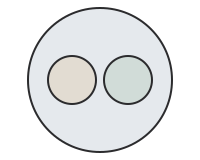
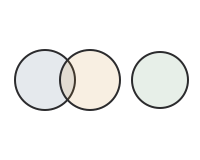
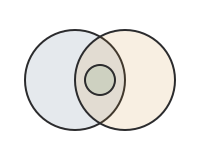
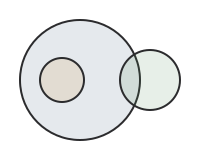
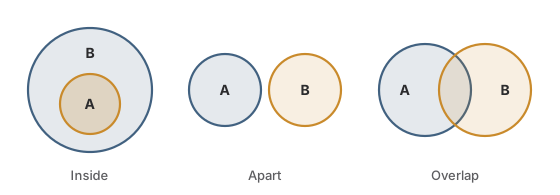
Three pairs of circles: A inside B; A and B apart, not touching; and A and B overlapping.
Inside: every A is a B. Apart: nothing is both. Overlap: some are both, and each has members outside the other.
RelationTestExample
InsideEvery A is a B, but not every B is an ACows, Animals
ApartNothing is bothCows, Chairs
OverlapSome are both, and each has members outside the otherCows, Pets

Exam shortcut

To prove an overlap, find three witnesses: one member of both, one of A only and one of B only. For Teachers and Parents: a teacher who is a parent, a teacher with no children, and a parent who does not teach.

What do the standard three-circle diagrams look like?

There are about a dozen shapes, and each is just a list of three pair relations. Read a shape as "which pairs are inside, apart or crossing"; the class names are never printed, so any class may sit in any circle.

ShapeA–BB–CA–C
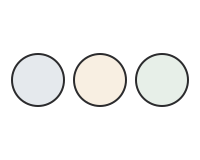
Three separate circlesApartApartApart
Each circle inside the nextB inside AC inside BC inside A
Two separate circles inside a larger oneB inside AApartC inside A
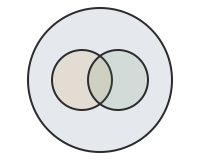
Two crossing circles inside a larger oneB inside AOverlapC inside A
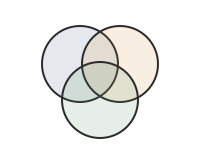
Three circles, each crossing the other twoOverlapOverlapOverlap
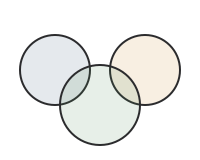
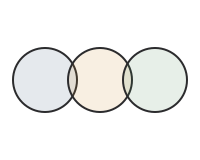
Chain: the middle crosses both, the outer two apartOverlapOverlapApart
Small inside large, third apart from bothB inside AApartApart
Small inside large, third crossing the large onlyB inside AApartOverlap
Small inside large, third crossing bothB inside AOverlapOverlap
Two crossing, third apart from bothOverlapApartApart
Two crossing, a small circle inside their common partOverlapC inside BC inside A

How do you choose the right diagram for three classes?

List the three pair relations, then find the one shape with the same list. The order in the question does not matter, so sort the classes from largest to smallest first.

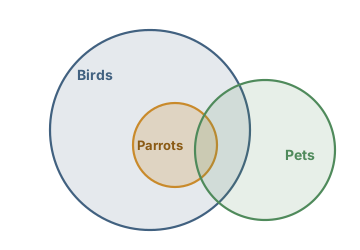
Example 1 · Birds, Parrots, Pets

Which diagram shows Birds, Parrots and Pets?

  1. Every parrot is a bird, but not every bird a parrot: Parrots is inside Birds.

  2. Some pets are birds, some birds are not pets, and some pets are not birds: Pets overlaps Birds.

  3. Some parrots are pets and some are wild: Pets overlaps Parrots too.

Answer

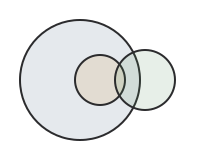
A small circle inside a larger one, with a third circle crossing both

A large circle labelled Birds with a smaller circle labelled Parrots inside it. A third circle labelled Pets crosses both the Birds circle and the Parrots circle.
Birds, Parrots, Pets: Parrots inside Birds, and Pets crossing both.

Example 2 · Number classes

Which diagram shows multiples of 4, multiples of 8 and odd numbers?

  1. Every multiple of 8 is a multiple of 4, so multiples of 8 are inside multiples of 4.

  2. No odd number is a multiple of 4, so odd numbers are apart from both.

Answer

A small circle inside a larger one, and a third circle apart from both

Watch out

Choose the relation that is always true, not usually true. Test the common multiple: multiples of 4 and of 6 look unrelated until you try 12. And 2 is prime and even, so primes cross even numbers.

Which classes should you be careful with?

One counter-example turns a claimed "inside" into an overlap.

  • Men and Women are apart, and so are Boys and Girls; each crosses Students, Doctors, Teachers and Singers.
  • Mothers is inside Women, Fathers inside Men, and both inside Parents.
  • Square is inside both Rectangle and Rhombus, and Rectangle crosses Rhombus. Equilateral and right-angled triangles are apart.
  • A city is inside its state, inside its country, inside its continent.

Reading and counting regions

How do you read a labelled three-circle diagram?

Name the seven regions inside the circles, plus the region outside, and add only the regions the question describes. Each number in a region counts members in exactly those circles and no others.

PhraseRegions to add
A, or "in A"Only A + A&B only + A&C only + all three
Only A, A but neither B nor COnly A
A and B, bothA&B only + all three
A and B but not CA&B only
A but not BOnly A + A&C only
Exactly oneThe three "only" regions
Exactly twoThe three "two only" regions
At least twoExactly two + all three
NoneThe region outside the circles
Not AEverything outside circle A, including "none"

Example 3 · 90 families

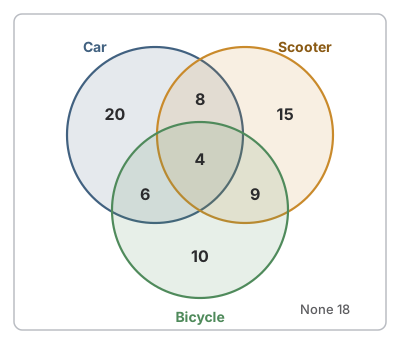
A diagram of 90 families shows: only Car 20, only Scooter 15, only Bicycle 10, Car and Scooter only 8, Car and Bicycle only 6, Scooter and Bicycle only 9, all three 4, none 18. How many have a car, both a scooter and a bicycle, exactly two, and no car?

  1. A car: 20+8+6+4=3820 + 8 + 6 + 4 = 38.

  2. A scooter and a bicycle: 9+4=139 + 4 = 13. Exactly two: 8+6+9=238 + 6 + 9 = 23.

  3. No car: 90−38=5290 - 38 = 52. Check: 15+10+9+18=5215 + 10 + 9 + 18 = 52.

Answer

38, 13, 23 and 52

Three overlapping circles labelled Car, Scooter and Bicycle inside a box. Regions: only Car 20, only Scooter 15, only Bicycle 10, Car and Scooter only 8, Car and Bicycle only 6, Scooter and Bicycle only 9, all three 4. Outside the circles: none 18.
Example 3. Each number counts families in exactly those circles.

Exam shortcut

Whenever you subtract, add the regions the other way too. The two routes agree only if you remembered the region outside the circles.

What is inclusion–exclusion for two sets?

The number in at least one of two sets is their totals added, minus the overlap, because adding the totals counts the overlap twice.

Two sets

n(A∪B)=n(A)+n(B)−n(A∩B)n(A \cup B) = n(A) + n(B) - n(A \cap B)

Neither = total − n(A∪B)n(A \cup B). Only A = n(A)−n(A∩B)n(A) - n(A \cap B). Exactly one = n(A)+n(B)−2n(A∩B)n(A) + n(B) - 2n(A \cap B).

Example 4 · Two cards

In a class of 55, 31 students have a library card, 27 a bus pass, and 9 neither. How many have both?

  1. At least one: 55−9=4655 - 9 = 46.

  2. Both: 31+27−46=1231 + 27 - 46 = 12.

  3. Check: only a library card 19, only a bus pass 15, and 19+15+12+9=5519 + 15 + 12 + 9 = 55.

Answer

12

Exam shortcut

Percentages work the same way with a total of 100%: 62% tennis, 45% squash and 18% neither give both =62+45−82=25%= 62 + 45 - 82 = 25\%.

What is inclusion–exclusion for three sets?

Add the three totals, subtract the three pair counts, then add back the number in all three. Someone in all three is counted three times, then removed three times, so they must be added once more.

Three sets

n(A∪B∪C)=n(A)+n(B)+n(C)−n(A∩B)−n(A∩C)−n(B∩C)+n(A∩B∩C)n(A \cup B \cup C) = n(A) + n(B) + n(C) - n(A \cap B) - n(A \cap C) - n(B \cap C) + n(A \cap B \cap C)

With the pair sum including the centre: exactly two = pair sum − 3 × all three; at least two = pair sum − 2 × all three.

Example 5 · Three games

Of 100 students, 48 play chess, 40 carrom and 32 badminton. 16 play chess and carrom, 12 chess and badminton, 10 carrom and badminton, and 5 all three. How many play none, and how many exactly one?

  1. At least one: 48+40+32−16−12−10+5=8748 + 40 + 32 - 16 - 12 - 10 + 5 = 87, so none is 13.

  2. Exactly two: 38−3×5=2338 - 3 \times 5 = 23.

  3. Exactly one: 87−23−5=5987 - 23 - 5 = 59.

Answer

13 play none; 59 play exactly one

Filling from the centre: only chess 25, only carrom 19, only badminton 15, and 25+19+15=5925 + 19 + 15 = 59.

How do you find the greatest or least possible overlap?

The overlap is greatest when the smaller set sits inside the larger, so the maximum is the smaller total. It is least when the union is as big as the total allows: n(A)+n(B)−totaln(A) + n(B) - \text{total}, or 0 if that is negative.

Example 6 · Chargers and bottles

Of 70 passengers, 52 carry a phone charger and 41 a water bottle. Find the least and greatest number carrying both, and the greatest number carrying neither.

  1. Least: 52+41−70=2352 + 41 - 70 = 23.

  2. Greatest: 41, all the bottles among the chargers.

  3. Then only 52 carry anything, so at most 70−52=1870 - 52 = 18 carry neither.

Answer

Least 23, greatest 41; at most 18 carry neither

Key idea

If lists of sizes pp, qq and rr contain NN different people, then exactly one + 2 × exactly two + 3 × all three = p+q+rp + q + r, because each person is counted once for every list they are on.

Exam shortcuts

  • Three pair relations. Write them before looking at the options.
  • Centre first. Then "two only", then "only", then outside.
  • Check the total. The regions must add up to it, and none may be negative.
  • Two sets. Both = A + B − at least one.
  • Overlap bounds. Maximum = smaller set; minimum = A + B − total.

Common mistakes

  • "A" read as "only A".
  • Forgetting that "both" includes the centre in a three-set problem.
  • Forgetting the outside in "not A" or a percentage base.
  • Exactly two taken for at least two.
  • Subtracting the centre the wrong number of times.
  • Subtracting from a "but not" number, which is already a region.
  • Matching the order of words instead of the pattern of relations.
  • Usually true taken for always true.

Quick revision

Relations

  • Inside, apart, overlap
  • Overlap needs three witnesses
  • Shapes are lists of three pair relations

Regions

  • "A" = the whole circle; "only A" = one region
  • "Both" includes the centre
  • At least two = exactly two + all three

Formulas

  • n(A∪B)=n(A)+n(B)−n(A∩B)n(A \cup B) = n(A) + n(B) - n(A \cap B)
  • Three sets: add, subtract pairs, add the centre
  • Overlap between A + B − total and the smaller set

The same circles decide conclusions in syllogisms, and related counting is in counting and probability.

Next · 06Quick revision

Check your understanding

65 questions, grouped by type, easy to hard. Pick an answer and check it. The worked solution opens when you ask for it.

Which diagram fitsQ1 of 65Q1

Which diagram fits

22 questions

Which diagram best represents the relationship among Mothers, Women and Men?

Options for question 1

Show the explanationHide the explanation

AnswerC · A small circle inside a larger circle, and a third circle apart from bothA small circle inside a larger circle, and a third circle apart from both
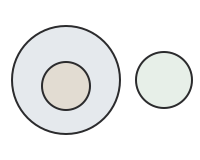
  1. Every mother is a woman, but not every woman is a mother: the Mothers circle lies inside the Women circle.

  2. No man is a woman (and so no man is a mother): the Men circle is separate from both.

  3. The picture needed is a small circle inside a larger one, with a third circle apart from both.

Worth noting

Two separate circles inside a larger circle would put Men inside Women, which is false.
Which diagram best shows how Cities in Kerala, Cities in Asia and Cities in India are related?

Options for question 2

Show the explanationHide the explanation

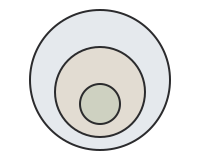
AnswerD · Three circles, each inside the nextThree circles, each inside the next

  1. Every city in Kerala is a city in India, and every city in India is a city in Asia.

  2. Each class is wholly inside the next: Kerala inside India inside Asia.

  3. The picture is three circles, each inside the next.

Worth noting

The order in the question does not matter. Sort the classes by size first: Kerala, then India, then Asia.

Which diagram best represents the relationship among Buses, Vehicles and Bicycles?

Options for question 3

Show the explanationHide the explanation

AnswerB · Two separate circles inside a larger circleTwo separate circles inside a larger circle

  1. Every bus is a vehicle and every bicycle is a vehicle: both circles go inside Vehicles.

  2. Nothing is both a bus and a bicycle: those two circles do not meet.

  3. So two separate circles sit inside a larger circle.

Worth noting

Two overlapping circles inside a larger one would claim that some buses are bicycles.

Select the figure whose circles correctly relate Teachers, Parents and Graduates to one another.

Options for question 4

Show the explanationHide the explanation

AnswerA · Three circles, each overlapping the other twoThree circles, each overlapping the other two

  1. Some teachers are parents and some are not, so Teachers and Parents overlap.

  2. Some teachers are graduates and some parents are graduates, and neither class is wholly inside Graduates: each pair overlaps.

  3. Some people are all three (a teacher who is a parent and a graduate).

  4. So the picture is three circles, each overlapping the other two.

Worth noting

Two circles inside a larger one would need every teacher to be a graduate, which the classes do not guarantee.

Which diagram best represents the relationship among Boys, Students and Girls?

Options for question 5

Show the explanationHide the explanation

AnswerD · Two separate circles, each overlapping a third circleTwo separate circles, each overlapping a third circle

  1. No boy is a girl: Boys and Girls are separate circles.

  2. Some boys are students and some are not (a boy who has left school): Boys overlaps Students. The same is true of Girls.

  3. So the picture is two separate circles, each overlapping a third circle.

Worth noting

Two separate circles inside a larger circle is wrong for two reasons: not every boy or girl is a student, and some students are neither boys nor girls (adult students at a college, for example). Either fact is enough to rule it out.

Which diagram best represents the relationship among Iron, Wood and Metals?

Options for question 6

Show the explanationHide the explanation

AnswerA · A small circle inside a larger circle, and a third circle apart from bothA small circle inside a larger circle, and a third circle apart from both

  1. Iron is a metal (and not every metal is iron): the Iron circle lies inside Metals.

  2. Wood is not a metal and is not iron: the Wood circle is separate from both.

  3. So a small circle sits inside a larger one, with a third circle apart.

Which diagram best represents the relationship among Tigers, Sparrows and Snakes?

Options for question 7

Show the explanationHide the explanation

AnswerB · Three separate circlesThree separate circles

  1. No tiger is a sparrow, no tiger is a snake and no sparrow is a snake.

  2. No two classes share a member, so the picture is three separate circles.

Which diagram best represents the relationship among Teachers, Mountains and Writers?

Options for question 8

Show the explanationHide the explanation

AnswerA · Two overlapping circles, and a third circle apart from bothTwo overlapping circles, and a third circle apart from both

  1. Some teachers write books and some writers teach, but neither class is inside the other: Teachers and Writers overlap.

  2. A mountain is neither a teacher nor a writer: Mountains is apart from both.

  3. So two overlapping circles, with a third circle apart from both.

Worth noting

Three separate circles would deny that any teacher is a writer.

Which diagram best represents the relationship among Dogs, Animals and Mammals?

Options for question 9

Show the explanationHide the explanation

AnswerD · Three circles, each inside the nextThree circles, each inside the next

  1. Every dog is a mammal, and every mammal is an animal.

  2. So Dogs sits inside Mammals, which sits inside Animals: three circles, each inside the next.

Pick the picture that shows how these three classes are related: Doctors, Women, Mothers.

Options for question 10

Show the explanationHide the explanation

AnswerA · A small circle inside a larger circle, and a third circle overlapping both of themA small circle inside a larger circle, and a third circle overlapping both of them

  1. Every mother is a woman: Mothers sits inside Women.

  2. Some doctors are women and some are men: Doctors overlaps Women.

  3. Some mothers are doctors and some are not, and many doctors are not mothers: Doctors also overlaps Mothers.

  4. So a small circle sits inside a larger one, and a third circle cuts across both.

Worth noting

The diagram where the third circle meets only the larger circle would mean no mother is a doctor. Women doctors who are mothers exist, so Doctors must cut the small circle too.

Which diagram best represents the relationship among Teachers, Parents and Human beings?

Options for question 11

Show the explanationHide the explanation

AnswerB · Two overlapping circles inside a larger circleTwo overlapping circles inside a larger circle

  1. Every teacher and every parent is a human being: both circles lie inside Human beings.

  2. Many teachers are parents, some teachers are not parents and some parents are not teachers: Teachers and Parents overlap.

  3. So two overlapping circles sit inside a larger circle.

Worth noting

Three mutually overlapping circles would allow teachers who are not human beings. Two separate circles inside a larger one forgets that a teacher can also be a parent.

Which diagram best shows how Rectangles, Quadrilaterals and Rhombuses are related?

Options for question 12

Show the explanationHide the explanation

AnswerD · Two overlapping circles inside a larger circleTwo overlapping circles inside a larger circle

  1. Every rectangle and every rhombus has four sides: both circles lie inside Quadrilaterals.

  2. A square is both a rectangle and a rhombus, but most rectangles are not rhombuses and most rhombuses are not rectangles: the two circles overlap.

  3. So two overlapping circles sit inside a larger circle.

Worth noting

Two separate circles inside a larger one forgets the square, which belongs to both classes.

Which diagram best represents the relationship among Multiples of 2, Multiples of 3 and Multiples of 5?

Options for question 13

Show the explanationHide the explanation

AnswerD · Three circles, each overlapping the other twoThree circles, each overlapping the other two

  1. 6 is a multiple of 2 and of 3; 10 is a multiple of 2 and of 5; 15 is a multiple of 3 and of 5: every pair meets.

  2. No class is inside another (4 is not a multiple of 3, 9 is not a multiple of 2, and so on).

  3. 30 is a multiple of all three, so the three circles share a common part.

  4. So the picture is three circles, each overlapping the other two.

Worth noting

Three separate circles is the tempting answer if you think of 2, 3 and 5 as 'different numbers'. The classes are multiples, and common multiples exist.

Which of these diagrams correctly shows the relationship among Two-digit numbers, Multiples of 7 and Three-digit numbers?

Options for question 14

Show the explanationHide the explanation

AnswerB · Three circles in a chain: the middle one overlaps both, the outer two do not meetThree circles in a chain: the middle one overlaps both, the outer two do not meet

  1. 14 is a two-digit multiple of 7, while 10 is two-digit but not a multiple of 7 and 7 is a multiple of 7 with one digit: Two-digit numbers overlaps Multiples of 7.

  2. 105 is a three-digit multiple of 7, while 100 is not a multiple of 7 and 1001 has four digits: Three-digit numbers overlaps Multiples of 7.

  3. No number has both two digits and three digits: those two circles do not meet.

  4. So the picture is a chain: the middle circle (Multiples of 7) overlaps both, and the outer two do not meet.

Worth noting

Three mutually overlapping circles would show a number with both two and three digits. Two overlapping circles with a third apart forgets that multiples of 7 also have three digits, such as 105.

Choose the correct Venn diagram for these three classes of numbers: Multiples of 3, Even numbers, Multiples of 4.

Options for question 15

Show the explanationHide the explanation

AnswerA · A small circle inside a larger circle, and a third circle overlapping both of themA small circle inside a larger circle, and a third circle overlapping both of them

  1. Every multiple of 4 is even: Multiples of 4 sits inside Even numbers.

  2. 6 is even and a multiple of 3, while 3 is not even and 2 is not a multiple of 3: Multiples of 3 overlaps Even numbers.

  3. 12 is a multiple of both 3 and 4, and 8 and 9 each belong to only one: Multiples of 3 overlaps Multiples of 4 as well.

  4. So a small circle inside a larger one, with a third circle overlapping both.

Worth noting

Missing 12 leads to the picture where the third circle touches only the larger circle. Always test a common multiple (here 12, the LCM).

Choose the diagram that best represents Women, Scientists and Physicists.

Options for question 16

Show the explanationHide the explanation

AnswerD · A small circle inside a larger circle, and a third circle overlapping both of themA small circle inside a larger circle, and a third circle overlapping both of them

  1. Every physicist is a scientist: Physicists lies inside Scientists.

  2. Some scientists are women and some are not: Women overlaps Scientists.

  3. Some physicists are women and some are not: Women overlaps Physicists too.

  4. So a small circle inside a larger one, with a third circle overlapping both.

Worth noting

Two overlapping circles inside a larger one would put every woman inside Scientists.

Which diagram best represents the relationship among Squares, Rectangles and Rhombuses?

Options for question 17

Show the explanationHide the explanation

AnswerC · Two overlapping circles with a small circle inside their common partTwo overlapping circles with a small circle inside their common part

  1. A square has four right angles, so it is a rectangle; it has four equal sides, so it is a rhombus. Squares lies inside both.

  2. Some rectangles are not rhombuses and some rhombuses are not rectangles: Rectangles and Rhombuses overlap.

  3. Their common part is exactly the squares.

  4. So two overlapping circles with a small circle inside their common part.

Worth noting

Three circles, each inside the next, would need every rectangle to be a rhombus (or the reverse). A long thin rectangle is not a rhombus.

Which diagram best represents the relationship among Equilateral triangles, Triangles and Right-angled triangles?

Options for question 18

Show the explanationHide the explanation

AnswerA · Two separate circles inside a larger circleTwo separate circles inside a larger circle

  1. Both equilateral triangles and right-angled triangles are triangles: both circles go inside Triangles.

  2. Every angle of an equilateral triangle is 60°, so none is right-angled: the two inner circles do not meet.

  3. So two separate circles inside a larger circle.

Worth noting

Two overlapping circles inside a larger one would claim a triangle that is both equilateral and right-angled, which cannot exist.

Which diagram best represents the relationship among Odd numbers, Prime numbers and Even numbers?

Options for question 19

Show the explanationHide the explanation

AnswerC · Three circles in a chain: the middle one overlaps both, the outer two do not meetThree circles in a chain: the middle one overlaps both, the outer two do not meet

  1. 3 is odd and prime, while 9 is odd but not prime and 2 is prime but not odd: Odd numbers and Prime numbers overlap.

  2. 2 is even and prime, and 4 is even but not prime: Prime numbers and Even numbers also overlap.

  3. No number is both odd and even: those two circles do not meet.

  4. So the picture is a chain with Prime numbers in the middle, overlapping both of the others.

Worth noting

The trap is to forget 2, the only even prime. Without it you would put Prime numbers inside Odd numbers and choose the small-circle-inside-a-larger-one picture.

In India a person must be at least 18 years old to vote. Which diagram best represents the relationship among Teenagers, Voters and 15-year-olds?

Options for question 20

Show the explanationHide the explanation

AnswerC · A small circle inside a larger circle, and a third circle overlapping the larger circle onlyA small circle inside a larger circle, and a third circle overlapping the larger circle only

  1. Every 15-year-old is a teenager: 15-year-olds sits inside Teenagers.

  2. 18- and 19-year-olds are teenagers who can vote, and voters over 19 are not teenagers: Voters overlaps Teenagers.

  3. No 15-year-old can vote: Voters does not meet the 15-year-olds circle.

  4. So a small circle sits inside a larger one, with a third circle overlapping the larger circle only.

Worth noting

The third circle cuts the large circle but must miss the small one. The picture where it cuts both would make some 15-year-olds voters.

Which diagram best represents the relationship among Odd numbers, Multiples of 6 and Multiples of 3?

Options for question 21

Show the explanationHide the explanation

AnswerD · A small circle inside a larger circle, and a third circle overlapping the larger circle onlyA small circle inside a larger circle, and a third circle overlapping the larger circle only

  1. Every multiple of 6 is a multiple of 3: Multiples of 6 sits inside Multiples of 3.

  2. 9 is odd and a multiple of 3; 5 is odd but not a multiple of 3; 6 is a multiple of 3 but not odd: Odd numbers overlaps Multiples of 3.

  3. Every multiple of 6 is even, so no odd number is a multiple of 6: Odd numbers misses the small circle.

  4. So a small circle inside a larger one, with a third circle overlapping the larger circle only.

Worth noting

Two separate circles inside Multiples of 3 would put every odd number inside Multiples of 3, but 5 and 7 are odd and not multiples of 3.

Of the four figures, which one matches the way Multiples of 12, Multiples of 2 and Multiples of 3 are related?

Options for question 22

Show the explanationHide the explanation

AnswerB · Two overlapping circles with a small circle inside their common partTwo overlapping circles with a small circle inside their common part

  1. Every multiple of 12 is a multiple of 2 and of 3: Multiples of 12 lies inside both.

  2. 6 is a multiple of 2 and 3, 4 is a multiple of 2 only, 9 of 3 only: Multiples of 2 and Multiples of 3 overlap.

  3. So two overlapping circles with a small circle inside their common part.

Worth noting

The small circle does not fill the common part (6 and 18 are in it but are not multiples of 12), yet it lies wholly inside it, which is all the diagram claims.

Reading a labelled diagram

19 questions

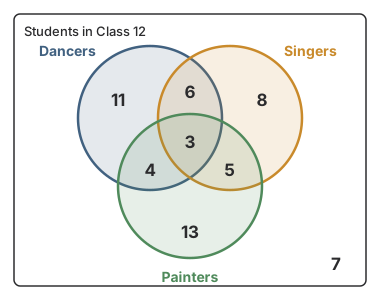
The diagram shows which students of Class 12 dance, sing or paint. How many students sing but neither dance nor paint?

Venn diagram of three overlapping circles labelled Dancers, Singers and Painters inside a box labelled Students in Class 12. Only Dancers: 11. Only Singers: 8. Only Painters: 13. Dancers and Singers only: 6. Dancers and Painters only: 4. Singers and Painters only: 5. All three: 3. Outside all three: 7.
Options for question 23

Show the explanationHide the explanation

AnswerA · 8

  1. 'Sing but neither dance nor paint' is the part of Singers outside both other circles: the Only Singers region.

  2. That region shows 8.

Worth noting

22 is the whole Singers circle (8+6+5+3)(8 + 6 + 5 + 3); 13 and 14 keep one shared region by mistake. The word 'neither' leaves only the unshared part.

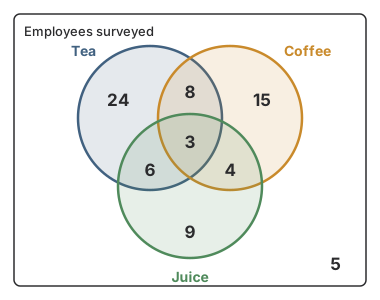
The diagram shows the drinks chosen by the employees of an office in a survey. How many employees drink both Tea and Coffee?

Venn diagram of three overlapping circles labelled Tea, Coffee and Juice inside a box labelled Employees surveyed. Only Tea: 24. Only Coffee: 15. Only Juice: 9. Tea and Coffee only: 8. Tea and Juice only: 6. Coffee and Juice only: 4. All three: 3. Outside all three: 5.
Options for question 24

Show the explanationHide the explanation

AnswerB · 11

  1. 'Both Tea and Coffee' is every region inside both circles, whether or not the person also drinks Juice.

  2. Tea and Coffee only 8, all three 3.

  3. Both Tea and Coffee =8+3=11= 8 + 3 = 11.

Worth noting

8 is 'Tea and Coffee only'. The stem does not say 'only', so the centre counts too. 30 and 41 are the whole Coffee and Tea circles.

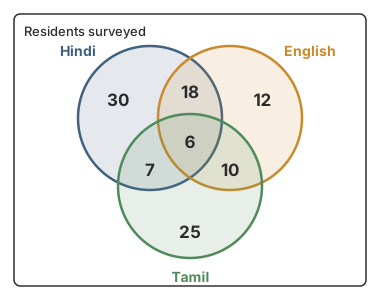
The diagram shows the languages spoken by the residents of a housing society who were surveyed. How many of them speak English?

Venn diagram of three overlapping circles labelled Hindi, English and Tamil inside a box labelled Residents surveyed. Only Hindi: 30. Only English: 12. Only Tamil: 25. Hindi and English only: 18. Hindi and Tamil only: 7. English and Tamil only: 10. All three: 6.
Options for question 25

Show the explanationHide the explanation

AnswerD · 46

  1. Speakers of English are everyone inside the English circle.

  2. 12+18+10+6=4612 + 18 + 10 + 6 = 46.

Worth noting

12 is 'Only English'. 40 leaves out the 6 residents who speak all three.

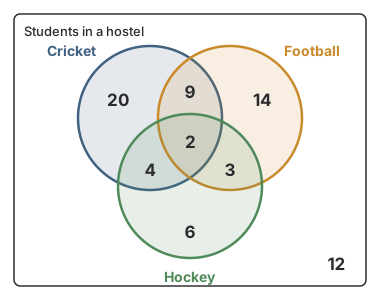
The diagram shows the games played by students in a hostel. How many students in the hostel play none of the three games?

Venn diagram of three overlapping circles labelled Cricket, Football and Hockey inside a box labelled Students in a hostel. Only Cricket: 20. Only Football: 14. Only Hockey: 6. Cricket and Football only: 9. Cricket and Hockey only: 4. Football and Hockey only: 3. All three: 2. Outside all three: 12.
Options for question 26

Show the explanationHide the explanation

AnswerB · 12

  1. Students who play none of the games are inside the box but outside every circle.

  2. That number is 12.

Worth noting

58 counts the students who play at least one game and 70 is the whole hostel. 0 ignores the number written outside the circles.

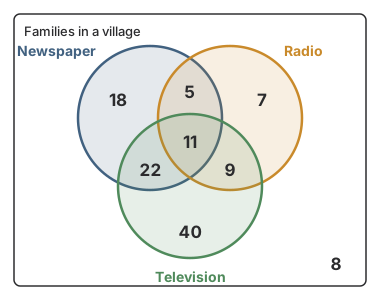
The diagram shows how families in a village get their news. How many families use all three sources?

Venn diagram of three overlapping circles labelled Newspaper, Radio and Television inside a box labelled Families in a village. Only Newspaper: 18. Only Radio: 7. Only Television: 40. Newspaper and Radio only: 5. Newspaper and Television only: 22. Radio and Television only: 9. All three: 11. Outside all three: 8.
Options for question 27

Show the explanationHide the explanation

AnswerA · 11

  1. All three is the centre region, common to every circle.

  2. It shows 11.

Worth noting

47 is at least two sources; 22 is Newspaper and Television only, which leaves out Radio.

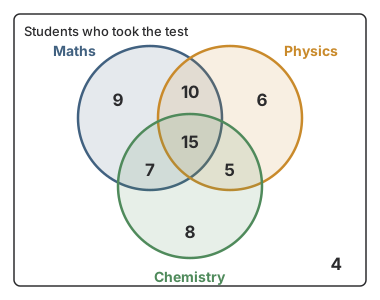
The diagram shows the subjects in which students passed a test. How many students passed in Maths only?

Venn diagram of three overlapping circles labelled Maths, Physics and Chemistry inside a box labelled Students who took the test. Only Maths: 9. Only Physics: 6. Only Chemistry: 8. Maths and Physics only: 10. Maths and Chemistry only: 7. Physics and Chemistry only: 5. All three: 15. Outside all three: 4.
Options for question 28

Show the explanationHide the explanation

AnswerA · 9

  1. 'Maths only' is the part of the Maths circle outside both other circles.

  2. It shows 9.

Worth noting

41 is everyone who passed Maths, including those who also passed other subjects.

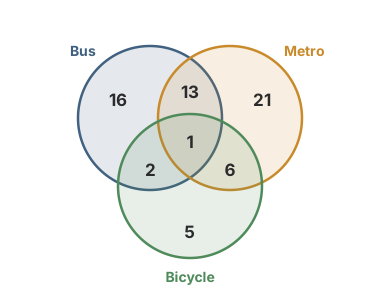
In the diagram of office-goers' travel, how many people use the Metro and a Bicycle but not the Bus?

Venn diagram of three overlapping circles labelled Bus, Metro and Bicycle. Only Bus: 16. Only Metro: 21. Only Bicycle: 5. Bus and Metro only: 13. Bus and Bicycle only: 2. Metro and Bicycle only: 6. All three: 1.
Options for question 29

Show the explanationHide the explanation

AnswerA · 6

  1. Metro and Bicycle but not Bus is the 'Metro and Bicycle only' region.

  2. It shows 6.

Worth noting

7 adds the centre, but the person in the centre also uses the Bus. 13 is the Bus and Metro only region, and 11 is every Bicycle user who does not take the Bus.

According to the diagram of Class 12 activities, how many students take part in exactly two of the three activities?

Venn diagram of three overlapping circles labelled Dancers, Singers and Painters inside a box labelled Students in Class 12. Only Dancers: 11. Only Singers: 8. Only Painters: 13. Dancers and Singers only: 6. Dancers and Painters only: 4. Singers and Painters only: 5. All three: 3. Outside all three: 7.
Options for question 30

Show the explanationHide the explanation

AnswerD · 15

  1. Exactly two means the three 'two only' regions, not the centre.

  2. Dancers and Singers only 6, Dancers and Painters only 4, Singers and Painters only 5.

  3. Exactly two =6+4+5=15= 6 + 4 + 5 = 15.

Worth noting

10 and 11 each miss one of the three 'two only' regions. Do not add the centre (3): those students take part in all three, not exactly two.

According to the survey diagram of office drinks, how many employees drink at least one of the three drinks?

Venn diagram of three overlapping circles labelled Tea, Coffee and Juice inside a box labelled Employees surveyed. Only Tea: 24. Only Coffee: 15. Only Juice: 9. Tea and Coffee only: 8. Tea and Juice only: 6. Coffee and Juice only: 4. All three: 3. Outside all three: 5.
Options for question 31

Show the explanationHide the explanation

AnswerC · 69

  1. At least one means every region inside the circles.

  2. 24+15+9+8+6+4+3=6924 + 15 + 9 + 8 + 6 + 4 + 3 = 69.

Worth noting

74 also counts the 5 employees outside the circles, who drink none of the three. 48 counts only the 'only' regions.

From the survey diagram of office drinks, how many employees drink Coffee but not Tea?

Venn diagram of three overlapping circles labelled Tea, Coffee and Juice inside a box labelled Employees surveyed. Only Tea: 24. Only Coffee: 15. Only Juice: 9. Tea and Coffee only: 8. Tea and Juice only: 6. Coffee and Juice only: 4. All three: 3. Outside all three: 5.
Options for question 32

Show the explanationHide the explanation

AnswerC · 19

  1. Coffee but not Tea: the part of the Coffee circle outside the Tea circle.

  2. That is Only Coffee (15) and Coffee and Juice only (4).

  3. Total =15+4=19= 15 + 4 = 19.

Worth noting

15 forgets the Coffee-and-Juice drinkers, who also drink Coffee without Tea.

According to the languages diagram, how many surveyed residents speak exactly one of the three languages?

Venn diagram of three overlapping circles labelled Hindi, English and Tamil inside a box labelled Residents surveyed. Only Hindi: 30. Only English: 12. Only Tamil: 25. Hindi and English only: 18. Hindi and Tamil only: 7. English and Tamil only: 10. All three: 6.
Options for question 33

Show the explanationHide the explanation

AnswerD · 67

  1. Exactly one: the three 'only' regions.

  2. 30+12+25=6730 + 12 + 25 = 67.

Worth noting

41 is the residents who speak more than one language (35 speak exactly two and 6 speak all three), the opposite group.

According to the hostel sports diagram, how many students play Football or Hockey but not Cricket?

Venn diagram of three overlapping circles labelled Cricket, Football and Hockey inside a box labelled Students in a hostel. Only Cricket: 20. Only Football: 14. Only Hockey: 6. Cricket and Football only: 9. Cricket and Hockey only: 4. Football and Hockey only: 3. All three: 2. Outside all three: 12.
Options for question 34

Show the explanationHide the explanation

AnswerA · 23

  1. Keep regions in Football or Hockey that lie outside Cricket.

  2. Only Football 14, Only Hockey 6, Football and Hockey only 3.

  3. Total =14+6+3=23= 14 + 6 + 3 = 23.

Worth noting

35 also counts the 12 students who play nothing; they are not Cricket players, but they do not play Football or Hockey either. 29 and 38 include regions shared with Cricket.

Using the diagram of news sources in the village, find the number of families that use Television but not Newspaper.

Venn diagram of three overlapping circles labelled Newspaper, Radio and Television inside a box labelled Families in a village. Only Newspaper: 18. Only Radio: 7. Only Television: 40. Newspaper and Radio only: 5. Newspaper and Television only: 22. Radio and Television only: 9. All three: 11. Outside all three: 8.
Options for question 35

Show the explanationHide the explanation

AnswerB · 49

  1. Keep the parts of Television outside Newspaper.

  2. Only Television 40, Radio and Television only 9.

  3. Total =40+9=49= 40 + 9 = 49.

Worth noting

40 is Only Television and misses the families who also use Radio. 82 is the whole Television circle.

According to the village news diagram, how many families use at least two of the three sources?

Venn diagram of three overlapping circles labelled Newspaper, Radio and Television inside a box labelled Families in a village. Only Newspaper: 18. Only Radio: 7. Only Television: 40. Newspaper and Radio only: 5. Newspaper and Television only: 22. Radio and Television only: 9. All three: 11. Outside all three: 8.
Options for question 36

Show the explanationHide the explanation

AnswerD · 47

  1. At least two means exactly two or all three.

  2. Exactly two =5+22+9=36= 5 + 22 + 9 = 36; all three =11= 11.

  3. At least two =36+11=47= 36 + 11 = 47.

Worth noting

36 stops at exactly two and forgets the centre; 11 is the centre alone; 25 subtracts the centre instead of adding it.

According to the test results diagram, how many students failed in Maths?

Venn diagram of three overlapping circles labelled Maths, Physics and Chemistry inside a box labelled Students who took the test. Only Maths: 9. Only Physics: 6. Only Chemistry: 8. Maths and Physics only: 10. Maths and Chemistry only: 7. Physics and Chemistry only: 5. All three: 15. Outside all three: 4.
Options for question 37

Show the explanationHide the explanation

AnswerB · 23

  1. Total students =9+6+8+10+7+5+15+4=64= 9 + 6 + 8 + 10 + 7 + 5 + 15 + 4 = 64.

  2. Passed Maths =9+10+7+15=41= 9 + 10 + 7 + 15 = 41.

  3. Failed Maths =64−41=23= 64 - 41 = 23. (Check: 6+8+5+4=236 + 8 + 5 + 4 = 23.)

Worth noting

19 forgets the 4 students outside every circle, who failed all three subjects, Maths included. 41 is the number who PASSED Maths.

The diagram shows how a group of office-goers travel to work in a week. How many more people use the Metro than use the Bus?

Venn diagram of three overlapping circles labelled Bus, Metro and Bicycle. Only Bus: 16. Only Metro: 21. Only Bicycle: 5. Bus and Metro only: 13. Bus and Bicycle only: 2. Metro and Bicycle only: 6. All three: 1.
Options for question 38

Show the explanationHide the explanation

AnswerA · 9

  1. Metro users =21+13+6+1=41= 21 + 13 + 6 + 1 = 41.

  2. Bus users =16+13+2+1=32= 16 + 13 + 2 + 1 = 32.

  3. Difference =41−32=9= 41 - 32 = 9.

Worth noting

41 and 32 are the two totals, not their difference; 73 adds them. Compare whole circles, not just the 'only' regions.

Using the diagram of Class 12 activities, find how many students of Class 12 do not paint.

Venn diagram of three overlapping circles labelled Dancers, Singers and Painters inside a box labelled Students in Class 12. Only Dancers: 11. Only Singers: 8. Only Painters: 13. Dancers and Singers only: 6. Dancers and Painters only: 4. Singers and Painters only: 5. All three: 3. Outside all three: 7.
Options for question 39

Show the explanationHide the explanation

AnswerB · 32

  1. Class 12 has 11+8+13+6+4+5+3+7=5711 + 8 + 13 + 6 + 4 + 5 + 3 + 7 = 57 students.

  2. Painters =13+4+5+3=25= 13 + 4 + 5 + 3 = 25.

  3. Students who do not paint =57−25=32= 57 - 25 = 32. (Check: 11+8+6+7=3211 + 8 + 6 + 7 = 32.)

Worth noting

25 is the number of painters, and also what you get if you forget the 7 students outside every circle (11+8+6)(11 + 8 + 6). 44 subtracts only the Only Painters region (57−13)(57 - 13). 57 is the whole class.

In the languages diagram, how many residents speak Tamil and at least one other of the three languages?

Venn diagram of three overlapping circles labelled Hindi, English and Tamil inside a box labelled Residents surveyed. Only Hindi: 30. Only English: 12. Only Tamil: 25. Hindi and English only: 18. Hindi and Tamil only: 7. English and Tamil only: 10. All three: 6.
Options for question 40

Show the explanationHide the explanation

AnswerB · 23

  1. The residents must be inside Tamil and inside at least one more circle.

  2. Hindi and Tamil only 7, English and Tamil only 10, all three 6.

  3. Total =7+10+6=23= 7 + 10 + 6 = 23.

Worth noting

17 forgets the centre: a person who speaks all three still speaks Tamil and another language. 25 is 'Only Tamil', the opposite group.

In the hostel sports diagram, what percentage of all the students in the hostel play Cricket?

Venn diagram of three overlapping circles labelled Cricket, Football and Hockey inside a box labelled Students in a hostel. Only Cricket: 20. Only Football: 14. Only Hockey: 6. Cricket and Football only: 9. Cricket and Hockey only: 4. Football and Hockey only: 3. All three: 2. Outside all three: 12.
Options for question 41

Show the explanationHide the explanation

AnswerC · 50%

  1. All students =20+14+6+9+4+3+2+12=70= 20 + 14 + 6 + 9 + 4 + 3 + 2 + 12 = 70.

  2. Cricket players =20+9+4+2=35= 20 + 9 + 4 + 2 = 35.

  3. Percentage =3570×100=50%= \frac{35}{70} \times 100 = 50\%.

Worth noting

The base is the whole hostel, 70, including the 12 who play nothing. Using 58 (only those who play something) gives about 60%. 35 is the count, not the percentage.

Counting with overlapping sets

24 questions

In Meenakshi's class, 25 students like cricket, 18 like chess and 7 like both. Every student likes at least one of the two games. How many students are in the class?

Options for question 42

Show the explanationHide the explanation

AnswerC · 36

  1. Adding 25+1825 + 18 counts the 7 students who like both twice.

  2. Students =25+18−7=36= 25 + 18 - 7 = 36.

Worth noting

43 forgets to remove the double count; 29 removes it twice. 11 is the number who like only chess.

A survey of 60 households in Pune found that 35 buy a Hindi newspaper, 30 buy an English newspaper and 12 buy both. How many households buy neither?

Options for question 43

Show the explanationHide the explanation

AnswerA · 7

  1. Households buying at least one =35+30−12=53= 35 + 30 - 12 = 53.

  2. Neither =60−53=7= 60 - 53 = 7.

Worth noting

53 is the number buying at least one, not neither. 19 comes from subtracting the 12 twice.

At a language institute, 40 learners take French, 26 take German and 9 take both. How many learners take French only?

Options for question 44

Show the explanationHide the explanation

AnswerD · 31

  1. French only = French learners who do not also take German.

  2. French only =40−9=31= 40 - 9 = 31.

Worth noting

17 is German only and 26 is all German learners. 'Only' removes the shared part from the circle named.

Each of the 50 members of a music club plays the tabla, the harmonium or both. If 32 play the tabla and 27 play the harmonium, how many play both?

Options for question 45

Show the explanationHide the explanation

AnswerA · 9

  1. Tabla + harmonium =32+27=59= 32 + 27 = 59, but there are only 50 members.

  2. The extra 9 have been counted twice, so 9 play both.

Worth noting

23 and 18 are the numbers who play only the tabla and only the harmonium. 59 is the sum before removing the double count.

In a survey, 70% of the people like mangoes, 50% like litchis and 10% like neither fruit. What percentage like both?

Options for question 46

Show the explanationHide the explanation

AnswerC · 30%

  1. People who like at least one fruit =100%−10%=90%= 100\% - 10\% = 90\%.

  2. Both =70%+50%−90%=30%= 70\% + 50\% - 90\% = 30\%.

Worth noting

20% uses 100% as the union and ignores the 10% who like neither. 90% is the union itself.

In a residential colony, 45 people own a bicycle, 30 own a scooter and 12 own both. How many people own exactly one of the two?

Options for question 47

Show the explanationHide the explanation

AnswerD · 51

  1. Bicycle only =45−12=33= 45 - 12 = 33; scooter only =30−12=18= 30 - 12 = 18.

  2. Exactly one =33+18=51= 33 + 18 = 51.

Worth noting

39 takes the 12 away twice (63−12−12)(63 - 12 - 12); the owners of both are removed only once from the 63 who own at least one. 33 counts bicycle-only owners alone, and 12 is the number who own both.

Of the 32 members of a society who play carrom, 8 also play chess but not ludo, 5 also play ludo but not chess, and 3 play all three games. How many members play only carrom?

Options for question 48

Show the explanationHide the explanation

AnswerB · 16

  1. Split the 32 carrom players: 8 (with chess only), 5 (with ludo only), 3 (all three) and the rest.

  2. Only carrom =32−8−5−3=16= 32 - 8 - 5 - 3 = 16.

Worth noting

19 forgets the 3 who play all three; they also play carrom. 13 subtracts the 3 twice.

Of 80 students surveyed, 35 like kabaddi, 30 like kho-kho and 25 like badminton. 12 like both kabaddi and kho-kho, 10 like both kabaddi and badminton, 8 like both kho-kho and badminton (each of these counts includes those who like all three), and 5 like all three. How many like none of the three games?

Options for question 49

Show the explanationHide the explanation

AnswerB · 15

  1. At least one =35+30+25−12−10−8+5= 35 + 30 + 25 - 12 - 10 - 8 + 5.

  2. =90−30+5=65= 90 - 30 + 5 = 65.

  3. None =80−65=15= 80 - 65 = 15.

Worth noting

20 forgets to add back the 5 who like all three; subtracting the three pair counts removed them once too often. 65 is the number who like at least one.

In a housing society, 14 families own both a car and a scooter, 11 own both a car and a bicycle, and 9 own both a scooter and a bicycle. These counts include the 4 families that own all three. How many families own exactly two of the three?

Options for question 50

Show the explanationHide the explanation

AnswerA · 22

  1. Each pair count contains the 4 all-three families, so remove them from each: 10,7,510, 7, 5.

  2. Exactly two =10+7+5=22= 10 + 7 + 5 = 22, which is 34−3×434 - 3 \times 4.

Worth noting

30 removes the 4 only once and 26 removes it twice. The all-three families sit inside all three pair counts, so they must go three times.

Every one of the 62 members of a reading circle reads at least one of three magazines: a science magazine, a sports magazine and a travel magazine. 9 read both the science and the sports magazine, 7 read both the science and the travel magazine, 8 read both the sports and the travel magazine (each count includes those who read all three), and 3 read all three. How many members read exactly one magazine?

Options for question 51

Show the explanationHide the explanation

AnswerC · 44

  1. Exactly two =9+7+8−3×3=15= 9 + 7 + 8 - 3 \times 3 = 15.

  2. All three =3= 3.

  3. Exactly one =62−15−3=44= 62 - 15 - 3 = 44.

Worth noting

38 subtracts the raw pair counts (24) instead of exactly two; 35 subtracts them and the 3 as well. Both over-remove the centre.

In a group of 80 people, 20 speak both Bengali and Odia and 12 speak neither. The number who speak only Bengali is twice the number who speak only Odia. How many people speak Bengali?

Options for question 52

Show the explanationHide the explanation

AnswerD · 52

  1. Only Bengali + only Odia =80−20−12=48= 80 - 20 - 12 = 48.

  2. If only Odia =x= x, then 2x+x=482x + x = 48, so x=16x = 16 and only Bengali =32= 32.

  3. Bengali speakers =32+20=52= 32 + 20 = 52.

Worth noting

32 is only Bengali; the question asks for everyone who speaks Bengali, which includes the 20 who speak both. 36 is the Odia total.

In a class of 46, 18 students take Art but not Music, 12 take Music but not Art, and 10 take both. How many take neither subject?

Options for question 53

Show the explanationHide the explanation

AnswerA · 6

  1. The three numbers given are separate regions (Art only, Music only, both), so simply add them: 18+12+10=4018 + 12 + 10 = 40.

  2. Neither =46−40=6= 46 - 40 = 6.

Worth noting

16 forgets the 10 who take both. 26 subtracts the 10 as if the first two numbers already contained it; 'but not' tells you they do not.

Of the 30 students in a school's Science club, 9 are also in the Maths club, 11 are also in the Quiz club (each count includes those in all three), and 4 are in all three clubs. How many are in the Science club only?

Options for question 54

Show the explanationHide the explanation

AnswerC · 14

  1. The 9 and the 11 both contain the 4 who are in all three clubs, so those 4 were subtracted twice.

  2. Science only =30−9−11+4=14= 30 - 9 - 11 + 4 = 14.

Worth noting

10 subtracts 9 and 11 and stops, removing the 4 twice. 6 subtracts the 4 a third time.

In a town, 65% of households have a piped gas connection, 48% have a solar water heater and 25% have both. What percentage of households have neither?

Options for question 55

Show the explanationHide the explanation

AnswerA · 12%

  1. At least one =65%+48%−25%=88%= 65\% + 48\% - 25\% = 88\%.

  2. Neither =100%−88%=12%= 100\% - 88\% = 12\%.

Worth noting

37% subtracts only the gas-only (40%) and solar-only (23%) households and forgets the 25% who have both. 88% is at least one.

At a sports camp, 15 children swim and cycle, 12 swim and skate, and 10 cycle and skate; these counts include the 6 children who do all three. How many children do at least two of the three activities?

Options for question 56

Show the explanationHide the explanation

AnswerB · 25

  1. Exactly two =15+12+10−3×6=19= 15 + 12 + 10 - 3 \times 6 = 19.

  2. At least two =19+6=25= 19 + 6 = 25, which is 37−2×637 - 2 \times 6.

Worth noting

19 is exactly two and leaves out the 6 who do all three. 37 counts those 6 three times.

In a library survey, 42 members borrowed fiction, 36 borrowed biographies and 28 borrowed poetry. 14 borrowed fiction and biographies, 10 fiction and poetry, 12 biographies and poetry (each count includes those who borrowed all three), and 5 borrowed all three. How many members borrowed at least one of these?

Options for question 57

Show the explanationHide the explanation

AnswerC · 75

  1. Add the three totals: 42+36+28=10642 + 36 + 28 = 106.

  2. Subtract the pair counts: 106−36=70106 - 36 = 70.

  3. Add back all three: 70+5=7570 + 5 = 75.

Worth noting

70 stops before adding back the 5; 65 subtracts the 5 instead. 106 counts everyone who borrowed two or three kinds more than once.

In a batch of 40 students, 28 like Mathematics and 25 like Science. What is the greatest possible number of students who like both?

Options for question 58

Show the explanationHide the explanation

AnswerC · 25

  1. The overlap cannot be bigger than the smaller group, 25.

  2. 25 is possible: if every Science-lover also likes Mathematics, the Science circle sits inside the Mathematics circle, and 28 students like at least one, which is within 40.

  3. Greatest overlap =25= 25.

Worth noting

13 is the LEAST possible overlap (28+25−40)(28 + 25 - 40). 28 cannot be right, because only 25 students like Science.

Of 200 students in a college, 120 play a sport, 90 play a musical instrument and 30 do neither. How many play an instrument but not a sport?

Options for question 59

Show the explanationHide the explanation

AnswerB · 50

  1. At least one =200−30=170= 200 - 30 = 170.

  2. Those who play an instrument but not a sport are the part of the 170 outside the sport circle: 170−120=50170 - 120 = 50.

  3. (Check: both =120+90−170=40= 120 + 90 - 170 = 40, and 90−40=5090 - 40 = 50.)

Worth noting

40 is the number who do both. 60 subtracts the 30 who do neither from the 90, but those 30 were never among the instrument players.

In a hostel of 50 students, 36 have a laptop and 29 have a tablet. What is the least number of students who must have both?

Options for question 60

Show the explanationHide the explanation

AnswerB · 15

  1. The overlap is smallest when as many students as possible have at least one device, that is, all 50.

  2. Then both =36+29−50=15= 36 + 29 - 50 = 15.

  3. A smaller overlap would need more than 50 students, so at least 15 have both.

Worth noting

14 and 21 are the students without a laptop and without a tablet. 29 is the greatest possible overlap, not the least.

At a café, 60 customers were asked about their drinks: 35 like tea and 28 like coffee. What is the greatest possible number of customers who like neither?

Options for question 61

Show the explanationHide the explanation

AnswerC · 25

  1. 'Neither' is largest when the two groups overlap as much as possible.

  2. The largest overlap puts all 28 coffee-lovers inside the 35 tea-lovers; then only 35 like at least one.

  3. Neither =60−35=25= 60 - 35 = 25.

Worth noting

0 is the SMALLEST possible 'neither'. 7 is just 35−2835 - 28, a difference with no meaning here. 32 (60−28)(60 - 28) would need the 35 tea-lovers inside the 28 coffee-lovers, which is impossible.

Three volunteer lists for a school fair have 60, 50 and 45 names. Altogether 100 different students are on the lists, and 10 of them are on all three. How many students are on exactly two lists?

Options for question 62

Show the explanationHide the explanation

AnswerB · 35

  1. Adding the lists gives 155 names: a student on one list is counted once, on two lists twice, on three lists three times.

  2. So (exactly one) + 2 × (exactly two) + 3×10=1553 \times 10 = 155, and (exactly one) + (exactly two) + 10=10010 = 100.

  3. Subtract: (exactly two) + 20=5520 = 55, so exactly two = 35.

Worth noting

45 subtracts the 10 only once (155−100−10)(155 - 100 - 10). 55 is the number on exactly one list.

In an examination, 75% of the candidates passed in English, 65% passed in Mathematics and 8% failed in both. If 96 candidates passed in both subjects, how many candidates took the examination?

Options for question 63

Show the explanationHide the explanation

AnswerB · 200

  1. Passed in at least one =100%−8%=92%= 100\% - 8\% = 92\%.

  2. Passed in both =75%+65%−92%=48%= 75\% + 65\% - 92\% = 48\%.

  3. 48% of the total is 96, so total =96×10048=200= \frac{96 \times 100}{48} = 200.

Worth noting

240 takes 'both' as 75%+65%−100%=40%75\% + 65\% - 100\% = 40\%, ignoring the 8% who failed both; 300 subtracts the 8% instead of allowing for it (32%). 128 divides 96 by 75%, as if 96 were the English passes.

Each of the 104 employees of a company attends at least one of the yoga, Zumba and aerobics classes. 50 attend yoga, 45 Zumba and 40 aerobics; 15 attend both yoga and Zumba, 12 both yoga and aerobics, and 10 both Zumba and aerobics (each of these counts includes those who attend all three). How many employees attend exactly one class?

Options for question 64

Show the explanationHide the explanation

AnswerC · 79

  1. All three: 104=50+45+40−15−12−10+x104 = 50 + 45 + 40 - 15 - 12 - 10 + x, so 104=98+x104 = 98 + x and x=6x = 6.

  2. Exactly two =15+12+10−3×6=19= 15 + 12 + 10 - 3 \times 6 = 19.

  3. Exactly one =104−19−6=79= 104 - 19 - 6 = 79.

Worth noting

67 subtracts the raw pair counts (37). 85 forgets to remove the 6 who attend all three. 73 removes the centre only twice from the pair counts.

In a group of 72 friends, 12 like neither tea nor coffee. The number who like only tea is three times the number who like both, and the number who like only coffee is twice the number who like both. How many like tea?

Options for question 65

Show the explanationHide the explanation

AnswerD · 40

  1. Let xx like both. Then only tea =3x= 3x and only coffee =2x= 2x.

  2. 3x+2x+x=72−12=603x + 2x + x = 72 - 12 = 60, so x=10x = 10.

  3. Tea drinkers =3x+x=40= 3x + x = 40.

Worth noting

30 is only tea; everyone who likes both also likes tea. 20 is only coffee and 10 is both.

The area names are NTA's. The chapters inside them are EduFarming's own division, not NTA's.