Counting and Probability for CUET General Aptitude
About 15 min to learn · 65 questions
CUET's counting and probability questions cover the addition and multiplication rules, numbers formed from digits, permutations and combinations, repeated letters and seating, classical probability, at least one, independent events, drawing with and without replacement, and coins, dice and cards. The questions are short but punish a misread word: with or without replacement, order or group, repeats allowed or not. This lesson works through each with examples and the traps beside them.
Every counting question asks how many outcomes there are, and every probability question divides one count by another. So the first job is always the same: decide what one outcome looks like.
Then read the stem twice. "With replacement" or "without", "order matters" or "a group", "digits may repeat" or "no digit repeated": each word changes the answer, and the answer the other reading gives is usually among the options.
Add when you make one choice from several separate groups, an "either … or". Multiply when you make several choices one after another and every choice goes with every other, an "and then".
Situation
Rule
Example
One item from group A or group B
a+b
One sweet from 7 kinds of barfi or 4 of ladoo: 11
One from A and one from B
a×b
One barfi and one ladoo: 28
The same choice made k times, n options each
nk
3 letters, each any of 26: 263
Example 1 · Add or multiply
A café sells 6 kinds of sandwich and 7 kinds of juice. In how many ways can a customer buy one item only, and in how many ways one sandwich with one juice?
One item, from either list: 6+7=13.
A sandwich and a juice: 6×7=42.
Answer
13 and 42
Exam shortcut
Many questions mix the two. Split the situation into cases that cannot happen together, multiply inside each case, then add the cases.
Draw one box for each place, fill the most restricted box first, and multiply the number of choices for each box. The usual restrictions are that the first digit cannot be 0, that the number must be even or odd, and that no digit may repeat.
A leading digit can never be 0.
"Even" or "odd" fixes the units digit. "Divisible by 5" means the units digit is 0 or 5.
With no repetition, each box has one choice fewer than the box filled before it.
If 0 is among the digits and the units digit is restricted, split into cases, units digit 0 and units digit not 0, because the leading-digit rule works differently in each.
Example 2 · Four-digit numbers
How many four-digit numbers can be formed from 0, 1, 3, 5, 7, 9 if no digit is repeated?
Thousands place: any digit except 0, so 5 choices.
Hundreds place: the remaining 5 digits, since 0 is now allowed.
Tens: 4. Units: 3.
Total: 5×5×4×3=300.
Answer
300
With repetition allowed it would be 5×6×6×6=1,080. One word in the stem moves the answer that far.
Watch out
Letting 0 lead is the commonest slip. A three-digit number cannot start with 0, so the first box never has all 10 digits.
Use a permutation when order matters: ranks, posts, positions, codes, arrangements in a row. Use a combination when only the group matters: teams, committees, handshakes, choosing items.
Arrangements and selections
nPr=(n−r)!n!nCr=r!(n−r)!n!nPr=nCr×r!
Also 0!=1, nC0=nCn=1, nC1=n, nC2=2n(n−1), and nCr=nCn−r.
Example 3 · Posts or a team
From 11 students, in how many ways can we choose a captain and a vice-captain, and in how many ways a two-member team?
Posts, so order matters: 11P2=11×10=110.
A team, so order does not: 11C2=110÷2=55.
Answer
110 and 55
The ÷2 is exactly the 2! ways of ordering the same pair.
Exam shortcut
Swap two of the people chosen. If that gives a different outcome, as when a captain and a vice-captain swap jobs, order matters. If nothing changes, as with two members of a committee, it does not.
Several standard counts follow from nC2 and nC3.
Question
Count
Handshakes among n people
nC2
Straight lines through n points, no three in a line
List the cases that satisfy the condition, count each as a product of combinations, and add. Or count every selection and subtract the ones you do not want. Doing both is a good check.
Example 4 · At least 2 women
A committee of 3 is chosen from 5 men and 4 women. In how many ways can it have at least 2 women?
Exactly 2 women and 1 man: 4C2×5C1=6×5=30.
Exactly 3 women: 4C3=4.
Total: 30+4=34.
Check by subtraction: all committees 9C3=84, with no woman 5C3=10, with one woman 4×5C2=40. So 84−10−40=34.
Divide the number of arrangements by the factorial of each repeated letter's count. Swapping two identical letters gives the same word, so every arrangement was counted that many times.
Arrangements with repeats
p!q!⋯n!
Here n is the number of letters, and one letter appears p times, another q times, and so on.
Example 5 · Repeated letters
How many arrangements of all the letters of COMMITTEE are there?
9 letters: M twice, T twice, E twice, and C, O and I once each.
Arrangements: 9!÷(2!×2!×2!)=3,62,880÷8=45,360.
Answer
45,360
Watch out
Dividing by only one of the repeated letters. Write down every letter's count before you start.
For "together", tie the group into one block, arrange the blocks, then multiply by the arrangements inside the block. For "never together", subtract the "together" count from the total. For a round table, fix one person and arrange the rest, so n people give (n−1)! seatings.
Example 6 · Together, apart and round
Seven people sit in a row, and 4 of them are friends who must sit together. Then, separately: in how many ways can 5 people sit in a row if A and B must not sit together? And in how many ways can 6 people sit at a round table?
Together: the 4 friends form one block, so there are 1+3=4 units. That gives 4!×4!=24×24=576, the second 4! arranging the friends inside the block.
Never together: all rows 5!=120, with A and B together 4!×2=48. So 120−48=72.
Round table: (6−1)!=5!=120.
Answer
576, 72 and 120
Watch out
Forgetting the arrangements inside a block. Two people who sit together can do so in 2 orders.
Necklaces and garlands
A necklace or garland can be flipped over, so clockwise and anticlockwise orders are the same: n beads give 2(n−1)! arrangements. Use this only when the stem says the two directions count as one. It is never true of people at a table.
When all outcomes are equally likely, the probability of an event is the number of favourable outcomes divided by the total number of outcomes. It always lies between 0, impossible, and 1, certain.
Probability rules
P(A)=total outcomesfavourable outcomes
Complement: P(not A)=1−P(A). Either: P(A or B)=P(A)+P(B)−P(A and B), and the last term is 0 when A and B cannot happen together.
Example 7 · A bag of beads
A bag has 8 yellow and 5 black beads. One bead is picked at random. Find the probability that it is black.
There are 13 beads, each equally likely.
P(black)=135.
Answer
135
Watch out
The method needs equally likely outcomes. The 11 possible totals of two dice are not equally likely, and neither are the letters of a word in which one letter appears four times. Count the underlying outcomes, the ordered pairs or the individual cards, not the labels.
Use the complement: the probability of at least one is 1 minus the probability of none. "None" is one case and "at least one" is many, so the complement is almost always faster.
Example 8 · At least one head
A fair coin is tossed 5 times. Find the probability of at least one head.
P(no head)=P(all tails)=(21)5=321.
P(at least one head)=1−321=3231.
Answer
3231
Watch out
Adding the separate probabilities for "at least one" is a classic error. It can even give an answer above 1.
Two events are independent when one happening does not change the chance of the other, such as two different people shooting, or a coin and a die. For independent events, the probability that both happen is the product of their probabilities.
Event, A and B independent
Probability
Both happen
P(A)×P(B)
Neither happens
(1−P(A))×(1−P(B))
At least one happens
1−(1−P(A))(1−P(B))
Exactly one happens
P(A)(1−P(B))+(1−P(A))P(B)
Example 9 · Exactly one passes
Rohan passes a driving test with probability 0.7 and Sneha with probability 0.9, independently. Find the probability that exactly one of them passes.
Rohan passes and Sneha fails: 0.7×0.1=0.07.
Rohan fails and Sneha passes: 0.3×0.9=0.27.
Exactly one: 0.07+0.27=0.34.
Answer
0.34
Both pass with 0.63 and neither with 0.03, and 0.63+0.34+0.03=1, as it must.
Without replacement, each draw leaves one item fewer, so the second probability comes from a smaller total and the draws are no longer independent. With replacement, every draw is a fresh start.
Example 10 · Two balls without replacement
A bag holds 5 red and 3 green balls. Two are drawn without replacement. Find the probability that both are green.
First green: 83. Second green, with 2 green left among 7: 72.
Both green: 83×72=566=283.
Check with combinations: 3C2÷8C2=283.
Answer
283
With replacement it would be (83)2=649.
Key idea
"Drawn together" and "drawn at once" both mean without replacement.
They are equally likely sample spaces of known size: 2 outcomes per coin, 6 per die, and 52 cards in a deck. Count the outcomes, and keep ordered outcomes separate.
Coins.n coins, or n tosses of one coin, give 2n outcomes, and the number with exactly k heads is nCk.
Coins
Outcomes
Exactly 0, 1, 2, 3, … heads
2
4
1, 2, 1
3
8
1, 3, 3, 1
4
16
1, 4, 6, 4, 1
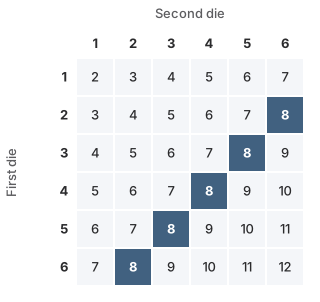
Dice. Two dice give 36 ordered outcomes, so (2, 5) and (5, 2) are different. Each total's count reads off the grid: 1 way for 2, rising by one to 6 ways for 7, then falling back to 1 way for 12. There are 6 doubles, and 15 outcomes each with the first die higher or with the second die higher.
The 36 outcomes of two dice. A total of 8 comes up in 5 of them.
Example 11 · A dice total
Two dice are rolled. Find the probability that the total is 8.
A total of 8 comes in 5 ways: (2, 6), (3, 5), (4, 4), (5, 3) and (6, 2).
P=365.
Answer
365
Cards. A deck has 52 cards in 4 suits of 13: ace, 2 to 10, jack, queen and king. Hearts and diamonds are red, clubs and spades black. The jack, queen and king are face cards, so there are 12 face cards, 4 of each rank, and 26 of each colour.
Example 12 · A card
One card is drawn. Find the probability that it is a black face card.
Black face cards: the jack, queen and king of clubs and of spades, so 6.
P=526=263.
Answer
263
Watch out
For "A or B" with cards, ask what is counted twice: the red kings in "red or king", the face hearts in "heart or face card". Subtract them once.
Together: block, then inside the block. Round table: (n−1)!
Diagonals 2n(n−3), triangles nC3
Probability
Favourable ÷ total, for equally likely outcomes
P(not A)=1−P(A)
At least one =1−P(none)
Independent: multiply. Without replacement: the total shrinks
Coins, dice, cards
n coins: 2n outcomes
Two dice: 36 ordered outcomes, 7 the commonest total
Cards: 52, 13 per suit, 12 face cards, 26 of each colour
A probability is a fraction of a whole, so ratio and proportion and percentages carry straight over, and counting factors by multiplying one more than each prime's power links this chapter to the number system.
Tenzin packs 4 shirts, 3 pairs of trousers and 2 pairs of shoes for a trip. An outfit is one shirt, one pair of trousers and one pair of shoes. How many different outfits can he make?
Show the explanationHide the explanation
AnswerD · 24
Each choice is made independently, so multiply: 4×3×2.
4×3=12, and 12×2=24 outfits.
Worth noting
9 comes from adding 4+3+2; addition is for choosing ONE item from several groups. 12 forgets the shoes.
A college canteen has 5 different vegetarian thalis and 3 different non-vegetarian thalis on its menu. Gurpreet will order exactly one thali. In how many ways can she choose?
Show the explanationHide the explanation
AnswerC · 8
She picks one thali from the veg list OR one from the non-veg list, never both.
For 'either … or' choices, add: 5+3=8.
Worth noting
15 multiplies 5×3, which would count a veg thali AND a non-veg thali together. She orders only one.
Three different roads connect Kochi to Thrissur, and four different roads connect Thrissur to Palakkad. In how many ways can Joseph drive from Kochi to Palakkad through Thrissur?
Show the explanationHide the explanation
AnswerA · 12
The first leg can be done in 3 ways, and each of these can be followed by any of the 4 roads on the second leg.
Routes =3×4=12.
Worth noting
24 doubles the answer as if the trip were a round trip. 64 and 81 are 43 and 34: powers are for repeating the SAME choice, not for two different legs.
A ship signals by hoisting 3 flags one above another, chosen from 5 flags of different colours. No flag is used twice in a signal, and a different order gives a different signal. How many signals are possible?
Show the explanationHide the explanation
AnswerC · 60
Top flag: 5 choices; middle: 4; bottom: 3.
Signals =5×4×3=60.
Worth noting
10 is the number of ways to CHOOSE 3 flags, ignoring order; here order changes the signal. 125 lets a flag repeat.
A teacher asks her class to list every two-digit number whose tens digit and units digit are both even. How many numbers are on a complete list?
Show the explanationHide the explanation
AnswerA · 20
Tens digit: 2, 4, 6 or 8 (0 would not give a two-digit number), so 4 choices.
Units digit: 0, 2, 4, 6 or 8, so 5 choices.
Numbers =4×5=20.
Worth noting
25 is 5×5, which lets the tens digit be 0. 40 checks only the tens digit, and 45 counts every even two-digit number, where only the units digit need be even.
Four roads join Jaipur to Ajmer and three roads join Ajmer to Udaipur. Farhan drives from Jaipur to Udaipur through Ajmer and back again through Ajmer, and he does not use any road a second time. How many different round trips are possible?
Show the explanationHide the explanation
AnswerC · 72
Going: 4×3=12 ways.
Returning: one Udaipur–Ajmer road and one Ajmer–Jaipur road are already used, so 2×3=6 ways.
Round trips =12×6=72.
Worth noting
144 is 12×12, which allows a road to be reused. 12 counts only the outward journey.
How many three-digit numbers can be made from the digits 0, 2, 4, 6 and 8 if no digit is used more than once in a number?
Show the explanationHide the explanation
AnswerA · 48
The hundreds digit cannot be 0, so it has 4 choices.
The tens digit can be any of the remaining 4 digits (0 is now allowed).
The units digit has the remaining 3 choices, so the count is 4×4×3=48.
Worth noting
60 is 5×4×3, which lets 0 lead (giving two-digit 'numbers' like 024). 80 is 4×5×4, which forgets that the hundreds digit is already used when filling the tens place. 100 allows repetition.
A restaurant's lunch offer is one main course from 4 choices together with EITHER one starter from 3 choices OR one dessert from 2 choices (not both). How many different lunches are possible?
Show the explanationHide the explanation
AnswerC · 20
Main with a starter: 4×3=12 lunches.
Main with a dessert: 4×2=8 lunches.
The two cases cannot overlap, so add: 12+8=20.
Worth noting
24 is 4×3×2, which gives every lunch both a starter and a dessert. 12 counts only the starter case.
A quiz has 5 questions, and each question has 4 answer choices. A student marks exactly one choice for every question. In how many different ways can the answer sheet be filled?
Show the explanationHide the explanation
AnswerD · 1,024
Each question is answered in 4 ways, independently of the others.
Ways =4×4×4×4×4=45=1024.
Worth noting
625 is 54: the base must be the number of choices per question (4), raised to the number of questions (5). 20 multiplies 5 by 4 once.
In the numbers from 1 to 500, both included, how many contain the digit 7 at least once?
Show the explanationHide the explanation
AnswerB · 95
Count the numbers with NO 7. Write 0 to 499 as three digits (000 to 499): hundreds digit 0 to 4 (5 ways), tens and units each 9 ways (any digit except 7).
That gives 5×9×9=405 strings. Drop 000 and add 500 (which has no 7): still 405 numbers from 1 to 500 without a 7.
Numbers with at least one 7 =500−405=95.
Worth noting
Adding 50 numbers with 7 in the units place and 50 with 7 in the tens place gives 100, but 77, 177, 277, 377 and 477 are counted twice. 405 is the count WITHOUT a 7.
How many three-digit numbers that are divisible by 5 have all three digits different?
Show the explanationHide the explanation
AnswerC · 136
Split by the units digit, since the rule for 0 changes with it.
Units digit 0: hundreds digit has 9 choices, tens 8, so 9×8=72.
Units digit 5: hundreds digit cannot be 0 or 5, so 8 choices; tens then has 8 choices (0 is allowed), so 8×8=64.
Total =72+64=136.
Worth noting
128 treats both cases like the units-5 case; 180 counts every three-digit multiple of 5, with repeats allowed. The two cases must be counted separately because 0 is barred from the front only in one of them.
A college issues parking stickers made of 2 letters from A to Z followed by 3 digits. The two letters must be different, the digits may repeat, and the first digit cannot be 0. How many stickers can be issued?
Show the explanationHide the explanation
AnswerA · 5,85,000
Letters: 26×25=650 ordered pairs of different letters.
Digits: first digit 9 ways, then 10 and 10, so 900.
Stickers =650×900=5,85,000.
Worth noting
6,08,400 is 26×26×900, letting the letters repeat. 6,50,000 lets the digits start with 0, and 6,76,000 makes both mistakes.
Eight volunteers offer to help at a blood-donation camp, and the organiser needs a group of 3 of them. The 3 have identical duties. How many different groups can be chosen?
Show the explanationHide the explanation
AnswerC · 56
Order does not matter, so this is a combination.
8C3=3×2×18×7×6=6336=56.
Worth noting
336 is 8P3, which counts the same three people 6 times over, once for each order. 24 is 8×3.
A residents' welfare committee of 3 men and 2 women is to be formed from 6 men and 5 women who have volunteered. In how many ways can the committee be formed?
Show the explanationHide the explanation
AnswerB · 200
Men: 6C3=20 ways. Women: 5C2=10 ways.
Both choices are needed together, so multiply: 20×10=200.
Worth noting
30 adds 20+10; the committee needs the men AND the women. 462 is 11C5, which ignores the 3-and-2 split. 2400 uses permutations, but committee members have no order.
Six speakers, including Ritu and Sandeep, will speak one after another at a seminar. The organisers do not want Ritu and Sandeep to speak one immediately after the other (in either order). How many speaking orders are possible?
Show the explanationHide the explanation
AnswerD · 480
All orders: 6!=720.
Orders with the two together: treat them as a block, 5!×2=240.
Orders with them apart =720−240=480.
Worth noting
240 is the number of orders where they ARE together. 360 simply halves 720, and 120 is 5! without the factor 2.
The letters of the word EQUATION are arranged in a row. In how many arrangements do all five vowels appear together?
Show the explanationHide the explanation
AnswerC · 2,880
EQUATION has 8 different letters: vowels E, U, A, I, O and consonants Q, T, N.
Treat the 5 vowels as one block. With Q, T and N that makes 4 units: 4!=24 orders.
The vowels can be arranged inside the block in 5!=120 ways.
Arrangements =24×120=2880.
Worth noting
120 counts only the order inside the block, and 720 multiplies 5! by 3!, forgetting that the block itself moves among the consonants. 40,320 is 8!, with no condition.
Seven members of a book club sit around a round table. Two seatings count as the same if one can be turned into the other by everyone moving the same number of places around the table. How many different seatings are possible?
Show the explanationHide the explanation
AnswerC · 720
In a row, 7 people can sit in 7!=5040 ways.
Around a table, each seating appears 7 times in that count (once for each rotation).
Seatings =75040=6!=720.
Worth noting
5040 treats the table as a row. 360 also divides by 2 for mirror images, which applies to a necklace, not to people who can tell left from right.
Streets in a town form a grid. To get from home to school, Lalremsiami must walk 4 blocks east and 3 blocks north, in any order, never going west or south. How many different shortest routes can she take?
Show the explanationHide the explanation
AnswerB · 35
Every shortest route is a string of 7 moves: 4 E's and 3 N's.
A route is fixed once you choose which 3 of the 7 moves are N.
Routes =7C3=67×6×5=35.
Worth noting
12 multiplies 4×3, which is not how routes combine. 128 is 27, which allows any number of E's and N's.
A bag contains 5 red, 3 blue and 2 green marbles. Kavya takes out one marble without looking. What is the probability that it is blue?
Show the explanationHide the explanation
AnswerD · 103
Total marbles =5+3+2=10, all equally likely to be picked.
Favourable outcomes: 3 blue marbles.
Probability =103.
Worth noting
73 divides by the number of NON-blue marbles instead of the total. 31 treats the three colours as equally likely, and 107 is the chance of NOT blue.
The probability that a student picked at random from a college wears spectacles is 0.28. What is the probability that a student picked at random does not wear spectacles?
Show the explanationHide the explanation
AnswerC · 0.72
'Wears spectacles' and 'does not' are complementary: their probabilities add to 1.
Probability =1−0.28=0.72.
Worth noting
0.28 is the chance of wearing spectacles, the event itself. 0.62 and 0.82 are subtraction slips; check by adding back: 0.72+0.28=1.
Each letter of the word MAHARASHTRA is written on its own card, and the 11 cards are shuffled. One card is drawn at random. What is the probability that it shows the letter A?
Show the explanationHide the explanation
AnswerB · 114
There are 11 cards, and A appears 4 times: M-A-H-A-R-A-S-H-T-R-A.
Probability =114.
Worth noting
61 treats the 6 different letters as equally likely, but A is on more cards than any other letter. 112 is the chance for H or for R.
A jar holds 24 sweets, each either mango or lemon flavoured. The probability of picking a mango sweet at random is 83. How many lemon sweets are in the jar?
Show the explanationHide the explanation
AnswerD · 15
Mango sweets =83×24=9.
Lemon sweets =24−9=15.
Worth noting
9 is the number of MANGO sweets. 8 and 3 come from dividing 24 by 3 or by 8 instead of multiplying by the fraction.
A two-digit number is chosen at random. What is the probability that it is a perfect square?
Show the explanationHide the explanation
AnswerD · 151
There are 90 two-digit numbers (10 to 99).
The perfect squares among them are 16, 25, 36, 49, 64 and 81, which is 6.
Probability =906=151.
Worth noting
There are 90 two-digit numbers, not 99 or 100: using 99 gives 332 and using 100 gives 503. Wrongly including 100 (or 09) as a seventh square gives 907.
Arjun hits a target with probability 32 and Nandini hits it with probability 53. Each fires one shot, independently of the other. What is the probability that both of them hit the target?
Show the explanationHide the explanation
AnswerD · 52
For independent events, P(both) = product of the probabilities.
P(both hit) =32×53=156=52.
Worth noting
152 is the chance that both MISS (31×52), and 1513 is the chance that at least one hits. 154 is P(Arjun hits and Nandini misses).
Meera can solve a puzzle with probability 43 and Joseph with probability 52. They try it independently. What is the probability that the puzzle gets solved, that is, at least one of them solves it?
Show the explanationHide the explanation
AnswerB · 2017
The puzzle stays unsolved only if BOTH fail: 41×53=203.
P(solved) =1−203=2017.
Worth noting
203 is the chance it is NOT solved. 103 is P(both solve) and 2011 is P(exactly one solves); 'at least one' includes both of those cases.
Two machines in a factory work independently. On a given day, machine X breaks down with probability 51 and machine Y with probability 41. What is the probability that exactly one of the two machines breaks down that day?
Show the explanationHide the explanation
AnswerC · 207
Exactly one = (X fails and Y works) or (X works and Y fails).
51×43=203 and 54×41=204.
These cases cannot both happen, so add: 207.
Worth noting
52 is P(at least one fails), which also includes both failing (201). 53 is P(neither fails).
March 2027 has 31 days, and 1 March 2027 is a Monday. A date in March 2027 is chosen at random. What is the probability that it is a Sunday?
Show the explanationHide the explanation
AnswerA · 314
The first Sunday is 7 March; the Sundays are 7, 14, 21 and 28 March.
29, 30 and 31 March are Monday, Tuesday and Wednesday, so there is no fifth Sunday.
Probability =314.
Worth noting
71 assumes each weekday is equally common, but a 31-day month has 5 of three weekdays and 4 of the rest. 315 is right for a Monday, Tuesday or Wednesday.
Five cards numbered 1, 2, 3, 4 and 5 are in a hat. Two cards are drawn together (without replacement). What is the probability that the sum of the two numbers is even?
Show the explanationHide the explanation
AnswerD · 52
Pairs possible: 5C2=10.
An even sum needs two odd cards (from 1, 3, 5: 3 pairs) or two even cards (2 and 4: 1 pair).
Probability =103+1=52.
Worth noting
2513 is the answer if the first card is put back, since then a card can pair with itself. 21 assumes odd and even sums are equally likely; with three odd cards and two even, they are not.
A carton of 12 bulbs contains 3 defective ones. An electrician picks 2 bulbs at random, without replacement. What is the probability that at least one of the two is defective?
Show the explanationHide the explanation
AnswerB · 115
Ways to pick 2 of 12: 12C2=66.
Ways to pick 2 good bulbs (none defective): 9C2=36.
P(at least one defective) =1−6636=6630=115.
Worth noting
167=1−(43)2 treats the draws as WITH replacement. 41 is the chance for a single bulb, and 221 is the chance that both are defective.
Three archers aim at the same target, each shooting once and independently. Their chances of hitting are 21, 31 and 41. What is the probability that the target is hit at least once?
Show the explanationHide the explanation
AnswerB · 43
The target escapes only if all three miss: 21×32×43=246=41.
P(hit at least once) =1−41=43.
Worth noting
Adding the three chances gives 1213, more than 1, which is impossible. 241 is P(all hit), 41 is P(all miss) and 2411 is P(exactly one hits).
Five friends, including Nikhil and Farah, sit in a row of 5 seats in random order. What is the probability that Nikhil and Farah get the two end seats?
Show the explanationHide the explanation
AnswerD · 101
All seatings: 5!=120.
Nikhil and Farah at the ends: 2 ways (either can take the left end); the other three fill the middle in 3!=6 ways, giving 12.
Probability =12012=101.
Worth noting
201 forgets that Nikhil and Farah can swap ends. 52 is the chance that they sit NEXT to each other, a different event.
A class committee of 3 is chosen at random from 5 boys and 4 girls. What is the probability that the committee has exactly 2 girls?
Show the explanationHide the explanation
AnswerA · 145
All committees: 9C3=84.
Exactly 2 girls: 4C2×5C1=6×5=30.
Probability =8430=145.
Worth noting
4217 adds the all-girl committees (4 of them), which answers 'at least 2 girls'. 211 is the chance of 3 girls, and 94 is only the chance that one chosen person is a girl.
Two fair dice are rolled together. What is the probability that the numbers shown add up to 9?
Show the explanationHide the explanation
AnswerD · 91
There are 6×6=36 equally likely ordered outcomes.
Sum 9: (3, 6), (6, 3), (4, 5), (5, 4), which is 4 outcomes.
Probability =364=91.
Worth noting
111 treats the 11 possible sums (2 to 12) as equally likely. 212 counts unordered pairs, but (3, 6) and (6, 3) are different outcomes. 121 misses one of the four.
A standard deck has 52 cards in 4 suits of 13 (ace, 2 to 10, jack, queen, king); hearts and diamonds are red, clubs and spades are black, and the jack, queen and king are the face cards. One card is drawn at random. What is the probability that it is a face card or an ace?
Show the explanationHide the explanation
AnswerA · 134
Face cards: 3 in each suit, so 12. Aces: 4. No card is both.
Favourable =12+4=16, so probability =5216=134.
Worth noting
133 counts only the face cards and 131 only the aces. 41 is the chance of any one suit.
Rukhsana tosses a fair coin and rolls a fair die at the same time. What is the probability that she gets a head on the coin and an even number on the die?
Show the explanationHide the explanation
AnswerA · 41
The coin and the die are independent: P(head) =21, P(even) =63=21.
P(head and even) =21×21=41.
Worth noting
43 is P(head OR even). 121 is the chance of one particular pair, such as a head with a 4.
A standard deck has 52 cards in 4 suits of 13 (ace, 2 to 10, jack, queen, king); hearts and diamonds are red, clubs and spades are black, and the jack, queen and king are the face cards. A card is drawn at random. What is the probability that it is red or a king (or both)?
Show the explanationHide the explanation
AnswerB · 137
Red cards: 26. Kings: 4, of which 2 are red and already counted.
Favourable =26+4−2=28.
Probability =5228=137.
Worth noting
2615=5230 counts the king of hearts and king of diamonds twice. 21 counts only the red cards.
A standard deck has 52 cards in 4 suits of 13 (ace, 2 to 10, jack, queen, king); hearts and diamonds are red, clubs and spades are black, and the jack, queen and king are the face cards. Two cards are drawn one after the other without replacement. What is the probability that both are aces?
Show the explanationHide the explanation
AnswerB · 2211
First card an ace: 524. Second card an ace, with 3 aces left in 51 cards: 513.
P(both aces) =524×513=265212=2211.
Worth noting
1691=(524)2 is WITH replacement. 4421 divides 4C2=6 by the ordered count 52×51, mixing combinations with ordered draws.
At a board-game club, two fair dice are rolled together. What is the probability that the total is a prime number?
Show the explanationHide the explanation
AnswerC · 125
Possible prime totals: 2, 3, 5, 7, 11.
Ways: 2 in 1 way, 3 in 2, 5 in 4, 7 in 6, 11 in 2, so 1+2+4+6+2=15.
Probability =3615=125.
Worth noting
115 counts 5 prime totals out of 11 possible totals, but the totals are not equally likely. 21 is P(odd total), which includes 9 and leaves out 2. 127 is P(not prime).
In a board game you may start only after rolling at least one six with two fair dice. What is the probability of getting at least one six on a single roll of the two dice?
Show the explanationHide the explanation
AnswerD · 3611
No six on either die: 5×5=25 of the 36 outcomes.
P(at least one six) =1−3625=3611.
Worth noting
185=3610 is P(exactly one six), which leaves out the double six. 61 is for one die only, and 361 is P(two sixes).
A standard deck has 52 cards in 4 suits of 13 (ace, 2 to 10, jack, queen, king); hearts and diamonds are red, clubs and spades are black, and the jack, queen and king are the face cards. One card is drawn at random. What is the probability that it is neither a heart nor a face card?
Show the explanationHide the explanation
AnswerB · 2615
Cards that are a heart or a face card: 13 hearts + 12 face cards − 3 face cards that are hearts = 22.
Neither: 52−22=30.
Probability =5230=2615.
Worth noting
5227 removes all 12 face cards from the 39 non-hearts, but only 9 face cards are not hearts. 43 ignores the face-card condition, and 1310 ignores the heart condition.
A standard deck has 52 cards in 4 suits of 13 (ace, 2 to 10, jack, queen, king); hearts and diamonds are red, clubs and spades are black, and the jack, queen and king are the face cards. Two cards are drawn together at random (without replacement). What is the probability that one is red and the other is black?
Show the explanationHide the explanation
AnswerA · 5126
Ways to draw 2 cards: 52C2=1326.
One red and one black: 26×26=676.
Probability =1326676=5126.
Worth noting
21 is the answer WITH replacement (2×21×21). 5125 is P(same colour), and 5113 counts only the order red-then-black.
The area names are NTA's. The chapters inside them are EduFarming's own division, not NTA's.