EduFarming
Your list · 0हिं

Type at least two letters. Press Esc to close.

↑↓ navigate↵ openTAB cycle filter

Syllogisms for CUET General Aptitude

About 10 min to learn · 68 questions

A syllogism question gives two or three short statements built from All, Some and No and asks which conclusions follow. The statements may sound silly on purpose: you must assume they are true and judge only what the words force. This lesson covers the four statement types, Venn diagrams that test every case, the conclusion each pair of statements gives, three-statement chains, possibility conclusions and when 'either I or II' is right.

Syllabus area
Logical and Analytical Reasoning
On this page · 8 sections
  1. 01The core idea
  2. 02Statements and pictures
  3. 03Combining statements
  4. 04Possibility and either-or
  5. 05Exam shortcuts
  6. 06Common mistakes
  7. 07Quick revision
  8. 08Check your understanding

The core idea

Assume every statement is true, however odd it sounds, and judge only what the words force. Real-world knowledge is the enemy here: if the statements say all rivers are chairs, then all rivers are chairs.

A conclusion follows only if it holds in every picture that obeys the statements. So draw one picture, then try to draw a second that obeys the statements but breaks the conclusion. If you can, it does not follow.

Statements and pictures

What are the four types of statement in a syllogism?

There are exactly four: All X are Y, Some X are Y, No X is Y, and Some X are not Y. Every statement and conclusion in this chapter is one of them, or a possibility built from one.

StatementWhat it saysReverses to
All X are YEvery X is inside YOnly "Some Y are X"
Some X are YAt least one X is a Y, and "all" is not ruled out"Some Y are X"
No X is YX and Y share nothing"No Y is X"
Some X are not YAt least one X is outside YNothing

Two conventions

  • "Some" means at least one, and it allows all. So "Some pens are books" never tells you that some pens are not books.
  • Every group mentioned has at least one member. That is why "All pens are books" gives "Some books are pens".

How do you use Venn diagrams to solve a syllogism?

Draw one circle per group, place them to obey every statement, then try to build a second picture that also obeys them but breaks the conclusion. The overlap in "Some X are Y" might be tiny or might swallow all of X; in "All X are Y", Y might be far bigger than X or exactly the same size.

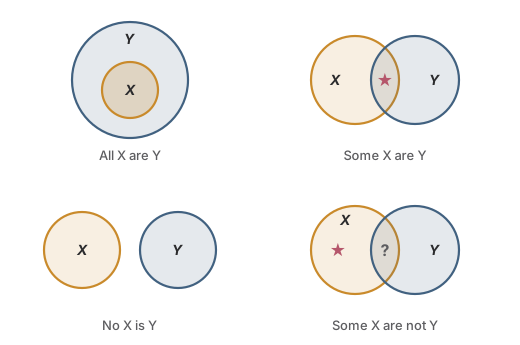
Four diagrams. All X are Y: X inside Y. Some X are Y: overlapping circles with a star in the overlap. No X is Y: two separate circles. Some X are not Y: overlapping circles with a star in the part of X outside Y and a question mark in the overlap.
A star marks a region that must have a member. A question mark marks one that may or may not.

Example 1 · A nested chain

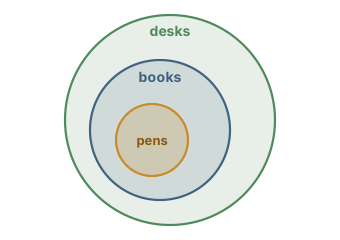
All pens are books. All books are desks. Conclusions: I. All pens are desks. II. All desks are pens. Which follow?

  1. The circles nest, pens inside books inside desks, so every pen is a desk: I follows.

  2. The desk circle may be far bigger than the pen circle, so II does not follow. What does follow is "Some desks are pens".

Answer

Only I follows

Three nested circles: pens inside books, and books inside desks.
Every pen is a desk, but the desks circle has room for desks that are not pens.

Combining statements

What conclusion follows from each pair of statements?

When two statements share a middle group B, the pair gives a fixed result. Learn the table and most two-statement questions take seconds.

FirstSecondDefinite conclusion about X and Y
All X are BAll B are YAll X are Y, and Some Y are X
All X are BNo B is YNo X is Y
Some X are BAll B are YSome X are Y
Some X are BNo B is YSome X are not Y, this direction only
No X is BAll B are YSome Y are not X, this direction only
No X is BSome B are YSome Y are not X, this direction only
All B are XAll B are YSome X are Y
All B are XNo B is YSome X are not Y
All X are BSome B are YNothing
Some X are BSome B are YNothing
No X is BNo B is YNothing
All X are BAll Y are BNothing

Exam shortcut

A definite conclusion needs the middle group fully covered at least once, by an "All B" or a "No". Two Somes, or an All that only points into B, leave the middle loose. With "Some … not", the useful case is All B are X plus Some B are not Y, which gives Some X are not Y.

Example 2 · Some and No

Some clocks are keys. No key is a card. Conclusions: I. Some clocks are not cards. II. Some cards are not clocks. Which follow?

  1. The clocks that are keys cannot be cards, so I follows.

  2. For II, draw every card inside the clock circle, away from the keys. Every statement still holds, and every card is a clock, so II does not follow.

Answer

Only I follows

The "some … not" runs from the group in the "Some" statement, clocks, never the other way.

How do you solve three-statement syllogisms?

Combine two statements at a time: join the first two with the table, then join the result with the third. If a link is loose, the chain breaks there, and nothing is certain beyond it.

Example 3 · A chain of three

Some chalks are crayons. All crayons are paints. No paint is a brush. What follows about chalks and brushes?

  1. All crayons are paints, and no paint is a brush: no crayon is a brush.

  2. Some chalks are crayons, and no crayon is a brush: some chalks are not brushes.

  3. "No chalk is a brush" does not follow, since chalks that are not crayons may be brushes. Nor does the reversed "Some brushes are not chalks".

Answer

Some chalks are not brushes

Possibility and either-or

What does "is a possibility" mean in a conclusion?

A possibility follows if at least one picture that obeys every statement makes it true. It fails only when it clashes with something definite. And whatever must be true can be true, so a certain fact is also a possibility.

  • If "No X is Y" is definite, "Some X being Y" and "All X being Y" are impossible.
  • If "Some X are not Y" is definite, "All X being Y" is impossible.
  • If "Some X are Y" is definite, "No X being Y" is impossible.
  • If "All X are Y" is definite, "Some X not being Y" is impossible.
  • Otherwise the possibility follows.

Example 4 · Possibilities

No shoe is a sock. Some socks are gloves. Conclusions: I. All gloves being shoes is a possibility. II. Some shoes being gloves is a possibility. Which follow?

  1. The gloves that are socks can never be shoes, so "Some gloves are not shoes" is definite, which rules out I.

  2. Gloves that are not socks are free, so a picture where some of them are shoes obeys everything. II follows.

Answer

Only II follows

Exam shortcut

"All X are Y" always allows "All Y being X", since the circles may be the same size. And groups linked only by a loose chain can have any relation.

When is "Either I or II follows" the right answer?

Only when neither conclusion follows alone, both are about the same two groups, and they form a complementary pair, so exactly one of them is true in every picture.

PairWhy exactly one is true
Some X are Y / No X is YThe circles either meet or do not
All X are Y / Some X are not YEvery X is inside Y, or at least one is outside

Example 5 · Either-or

All bats are rackets. Some rackets are balls. Conclusions: I. Some bats are balls. II. No bat is a ball. Which follow?

  1. All plus Some gives nothing, so neither conclusion is definite.

  2. Both are about bats and balls, and Some / No is a complementary pair.

Answer

Either I or II follows

Watch out

All / No looks opposite but is not complementary: both are false when X partly overlaps Y. Some / Some-not can both be true. Neither pair ever gives "either". And if one of a complementary pair does follow, the answer is "only I", not "either".

Exam shortcuts

  1. Mark each statement's type and link the groups into a chain.
  2. Use the pair table to write every definite conclusion.
  3. Check each given conclusion; allowed reverses are Some to Some, No to No, All to Some.
  4. For a possibility, ask only whether it clashes with a definite fact.
  5. If neither follows, check for a complementary pair before choosing "neither".

Common mistakes

  • Some taken for all. A chain led by Some never ends in All.
  • Some taken for "some are not".
  • Reversing All. "All pens are books" gives only "Some books are pens".
  • Rejecting a reversed No. "No key is a card" is the same as "No card is a key".
  • Reversing a some-not.
  • Passing an exclusion upward. "No shoe is a sock" and "All socks are garments" do not give "No shoe is a garment".
  • Chaining two Nos. They give nothing.
  • Using real-world knowledge.
  • Misusing either-or. All / No is not a complementary pair.

Quick revision

Statements

  • All X are Y → Some Y are X
  • Some ↔ Some, No ↔ No
  • Some X are not Y: no reverse
  • Some allows all; groups are non-empty

Pairs

  • All + All → All; All + No → No
  • Some + All → Some; Some + No → Some not
  • Two Somes, All + Some, two Nos → nothing

Possibility and either-or

  • Possible unless it clashes with a definite fact
  • Either: neither alone, same groups, complementary pair
  • Pairs: Some/No and All/Some-not

The same circles run through Venn diagrams, and reading only what a statement says carries over to statements, conclusions and assumptions.

Next · 07Quick revision

Check your understanding

68 questions, grouped by type, easy to hard. Pick an answer and check it. The worked solution opens when you ask for it.

Two statementsQ1 of 68Q1

Two statements

28 questions

Assume the statements are true.

Statements: All spoons are plates. All plates are cups.

Conclusions:

I. All spoons are cups.

II. All cups are spoons.

Options for question 1

Show the explanationHide the explanation

AnswerA · Only I follows

  1. Every spoon is a plate and every plate is a cup, so every spoon is a cup. Conclusion I follows.

  2. Conclusion II turns 'All spoons are cups' around. The cup circle may be much bigger than the spoon circle, so there can be cups that are not spoons. II does not follow.

  3. Only I follows.

Worth noting

'All' is not reversible. From 'All X are Y' you may say 'Some Y are X', never 'All Y are X'.

Assume the statements are true.

Statements: All candles are lamps. No lamp is a chair.

Conclusions:

I. No candle is a chair.

II. No chair is a candle.

Options for question 2

Show the explanationHide the explanation

AnswerD · Both I and II follow

  1. The candle circle sits inside the lamp circle, and the lamp circle is separate from the chair circle. So no candle can be a chair: conclusion I follows.

  2. 'No' is reversible: 'No candle is a chair' says exactly the same as 'No chair is a candle'. Conclusion II follows too.

  3. Both I and II follow.

Assume the statements are true.

Statements: Some pencils are erasers. All erasers are stones.

Conclusions:

I. Some pencils are stones.

II. Some stones are pencils.

Options for question 3

Show the explanationHide the explanation

AnswerD · Both I and II follow

  1. Take the pencils that are erasers. Every eraser is a stone, so those pencils are stones. Some pencils are stones: I follows.

  2. 'Some' is reversible: if some pencils are stones, then some stones are pencils. II follows.

  3. Both I and II follow.

Assume the statements are true.

Statements: Some kettles are jars. Some jars are baskets.

Conclusions:

I. Some kettles are baskets.

II. Some baskets are jars.

Options for question 4

Show the explanationHide the explanation

AnswerB · Only II follows

  1. The jars that are kettles and the jars that are baskets may be quite different jars, so conclusion I is not definite.

  2. Conclusion II just reverses the second statement. 'Some' reverses safely, so II follows.

  3. Only II follows.

Assume the statements are true.

Statements: Some shells are pebbles. All pebbles are marbles.

Conclusions:

I. All shells are marbles.

II. Some marbles are shells.

Options for question 5

Show the explanationHide the explanation

AnswerB · Only II follows

  1. The shells that are pebbles are marbles. So some shells are marbles, and reversing, some marbles are shells: II follows.

  2. Only some shells are known to be pebbles; the other shells need not be marbles. I is not definite.

  3. Only II follows.

Worth noting

Some + All gives only a Some conclusion. Upgrading it to All is the commonest slip.

Assume the statements are true.

Statements: All carts are wheels. No wheel is a tyre.

Conclusions:

I. Some tyres are carts.

II. No cart is a tyre.

Options for question 6

Show the explanationHide the explanation

AnswerB · Only II follows

  1. Every cart is a wheel and no wheel is a tyre, so no cart is a tyre: II follows.

  2. Conclusion I says some tyres are carts, which contradicts II. It is definitely false.

  3. Only II follows.

Assume the statements are true.

Statements: All umbrellas are bags. Some bags are boxes.

Conclusions:

I. Some bags are umbrellas.

II. Some boxes are umbrellas.

Options for question 7

Show the explanationHide the explanation

AnswerA · Only I follows

  1. Every umbrella is a bag, and umbrellas exist, so some bags are umbrellas: I follows.

  2. The bags that are boxes may be bags that are not umbrellas. II is not definite.

  3. Only I follows.

Assume the statements are true.

Statements: No brick is a tile. All tiles are slabs.

Conclusions:

I. Some bricks are slabs.

II. Some slabs are not bricks.

Options for question 8

Show the explanationHide the explanation

AnswerA · Only II follows

  1. Every tile is a slab and no tile is a brick, so those slabs (the tiles) are not bricks. Some slabs are not bricks: II follows.

  2. Bricks may or may not be slabs; the statements do not decide. I is not definite.

  3. Only II follows.

Assume the statements are true.

Statements: Some combs are brushes. No brush is a jar.

Conclusions:

I. Some combs are jars.

II. Some brushes are combs.

Options for question 9

Show the explanationHide the explanation

AnswerB · Only II follows

  1. Conclusion II reverses 'Some combs are brushes'; 'Some' is reversible, so II follows.

  2. The combs that are brushes are not jars, but other combs may or may not be jars. I is not definite.

  3. Only II follows.

Read the statements as true, even if they conflict with commonly known facts, and decide which of the conclusions follows.

Statements: All roses are flowers. Some flowers fade quickly.

Conclusions: I. Some roses fade quickly. II. All flowers are roses.

Options for question 10

Show the explanationHide the explanation

AnswerD · Neither conclusion follows

  1. The flowers that fade quickly are only some of the flowers. Nothing says roses are among them, so conclusion I is possible but not certain.

  2. Conclusion II reverses the first statement. 'All roses are flowers' allows plenty of flowers that are not roses, so it does not follow either.

  3. Neither conclusion is forced by the statements.

Worth noting

A conclusion 'follows' only if it must be true whenever the statements are. Something that merely could be true is not enough, and that is what makes conclusion I fail.

Assume the statements are true.

Statements: All drums are bells. Some bells are whistles.

Conclusions:

I. Some drums are whistles.

II. No drum is a whistle.

Options for question 11

Show the explanationHide the explanation

AnswerC · Either I or II follows

  1. The drum circle is inside the bell circle; the whistle circle overlaps the bell circle somewhere.

  2. The overlap may pass through the drum circle (then some drums are whistles) or miss it entirely (then no drum is a whistle). Neither conclusion is definite on its own.

  3. The two conclusions are about the same pair, drums and whistles, and 'Some … are' and 'No … is' are opposites: exactly one of them must be true.

  4. So either I or II follows.

Worth noting

'All + Some' gives no definite conclusion. When neither follows, check whether the pair is a complementary Some/No pair before choosing 'Neither'.

Assume the statements are true.

Statements: All buttons are coins. No coin is a ring.

Conclusions:

I. No button is a ring.

II. Some rings are buttons.

Options for question 12

Show the explanationHide the explanation

AnswerA · Only I follows

  1. Every button is a coin, and no coin is a ring, so no button can be a ring. Conclusion I follows.

  2. Conclusion II says the opposite of I. Since I is definite, II is definitely false.

  3. Only I follows.

Worth noting

The pair 'No button is a ring / Some rings are buttons' looks like an either-or pair, but either-or needs NEITHER to follow alone. Here I follows, so the answer is 'Only I'.

Assume the statements are true.

Statements: Some ladders are ropes. No rope is a bucket.

Conclusions:

I. Some ladders are not buckets.

II. No ladder is a bucket.

Options for question 13

Show the explanationHide the explanation

AnswerA · Only I follows

  1. Look at the ladders that are ropes. No rope is a bucket, so these ladders are not buckets. Some ladders are not buckets: I follows.

  2. The other ladders, the ones that are not ropes, are free to be buckets. So 'No ladder is a bucket' is possible but not certain; II does not follow.

  3. Only I follows.

Worth noting

Some + No gives 'Some … are not', never a full 'No'. The statements only control the ladders that are ropes.

Assume the statements are true.

Statements: No tent is a pillow. Some pillows are blankets.

Conclusions:

I. Some tents are not blankets.

II. Some blankets are not tents.

Options for question 14

Show the explanationHide the explanation

AnswerB · Only II follows

  1. The blankets that are pillows cannot be tents, because no pillow is a tent. So some blankets are not tents: II follows.

  2. For conclusion I, draw all the tents inside the blanket circle but away from the pillows. Every statement still holds, yet every tent is a blanket. So I is not definite.

  3. Only II follows.

Worth noting

In 'No + Some' the definite conclusion runs from the SECOND group: Some blankets are not tents. Reading it the other way round is the classic trap.

Assume the statements are true.

Statements: Some mirrors are frames. Some frames are windows.

Conclusions:

I. Some mirrors are windows.

II. No mirror is a window.

Options for question 15

Show the explanationHide the explanation

AnswerB · Either I or II follows

  1. Two 'Some' statements give no definite link between mirrors and windows: the mirror-frames and the frame-windows may or may not share members.

  2. So I is not definite, and II is not definite either.

  3. I and II are about the same pair and are exact opposites (Some … are / No … is); in every possible picture exactly one of them is true.

  4. Either I or II follows.

Assume the statements are true.

Statements: No bridge is a tower. No tower is a gate.

Conclusions:

I. No bridge is a gate.

II. Some bridges are gates.

Options for question 16

Show the explanationHide the explanation

AnswerC · Either I or II follows

  1. Both statements only keep towers away from the other two groups. They say nothing about bridges and gates.

  2. Bridges and gates may overlap, or may not: neither I nor II is definite.

  3. The pair 'No bridge is a gate / Some bridges are gates' is complementary, so exactly one of them is true.

  4. Either I or II follows.

Worth noting

Two 'No' statements never give a definite conclusion. It is tempting to 'chain' them into a third No, but that is not valid.

Assume the statements are true.

Statements: All oars are sails. All anchors are sails.

Conclusions:

I. Some oars are anchors.

II. No oar is an anchor.

Options for question 17

Show the explanationHide the explanation

AnswerB · Either I or II follows

  1. Oars and anchors both sit inside the sail circle. Two circles inside a bigger one may overlap or may be apart.

  2. So neither 'Some oars are anchors' nor 'No oar is an anchor' is definite.

  3. They form a complementary Some/No pair on oars and anchors, so exactly one must be true: either I or II follows.

Worth noting

Sharing a bigger group does not link two groups. 'All X are Y, all Z are Y' says nothing definite about X and Z.

Assume the statements are true.

Statements: All violins are flutes. All violins are sitars.

Conclusions:

I. Some flutes are sitars.

II. Some sitars are violins.

Options for question 18

Show the explanationHide the explanation

AnswerD · Both I and II follow

  1. Violins exist (every category is non-empty), and each violin is both a flute and a sitar. So some flutes are sitars: I follows.

  2. Every violin is a sitar, so at least some sitars are violins: II follows.

  3. Both I and II follow.

Worth noting

When the SUBJECT is shared ('All V are F, all V are S'), the Vs themselves sit in both groups, so 'Some F are S' is certain. Compare with a shared predicate, which gives nothing.

Assume the statements are true.

Statements: No onion is a mango. All mangoes are apples.

Conclusions:

I. No apple is an onion.

II. Some apples are not onions.

Options for question 19

Show the explanationHide the explanation

AnswerB · Only II follows

  1. The mangoes are apples, and none of them is an onion. So some apples (the mangoes) are not onions: II follows.

  2. Apples that are not mangoes may well be onions, so 'No apple is an onion' is not definite. I does not follow.

  3. Only II follows.

Worth noting

Being kept out of a small group (mangoes) does not keep you out of the bigger group that contains it (apples).

Assume the statements are true.

Statements: All scarves are shawls. Some shawls are not caps.

Which one of the following conclusions definitely follows?

Options for question 20

Show the explanationHide the explanation

AnswerC · Some shawls are scarves

  1. 'All scarves are shawls' gives 'Some shawls are scarves' in reverse, because scarves exist. That one is certain.

  2. The shawls that are not caps may be scarves or not, so 'Some scarves are not caps' and 'No scarf is a cap' are only possible.

  3. 'All shawls are scarves' reverses an All statement, which is never allowed.

  4. So the conclusion that definitely follows is: Some shawls are scarves.

Assume the statements are true.

Statements: No lake is a pond. Some ponds are wells.

Which one of the following conclusions definitely follows?

Options for question 21

Show the explanationHide the explanation

AnswerC · Some wells are not lakes

  1. The wells that are ponds cannot be lakes, since no pond is a lake. So some wells are not lakes: this follows.

  2. Wells that are not ponds are unrestricted, so they may or may not be lakes. 'No well is a lake' and 'Some lakes are wells' are only possible.

  3. Every lake could lie inside the part of the well circle that is not a pond, so 'Some lakes are not wells' is not certain either.

  4. Only 'Some wells are not lakes' definitely follows.

Worth noting

In No + Some, the Some-not conclusion always starts from the group in the Some statement that is not in the No statement.

Assume the statements are true.

Statements: Some blankets are quilts. Some blankets are not quilts.

Conclusions:

I. Some quilts are not blankets.

II. All quilts are blankets.

Options for question 22

Show the explanationHide the explanation

AnswerC · Either I or II follows

  1. The statements only say the blanket circle is partly inside and partly outside the quilt circle. The quilt circle may lie wholly inside the blankets or may stick out.

  2. So neither 'Some quilts are not blankets' nor 'All quilts are blankets' is definite.

  3. They share the same subject and predicate (quilts, blankets) and form the complementary All / Some-not pair: one of them must be true.

  4. Either I or II follows.

Worth noting

The complementary pairs are Some/No and All/Some-not, on the same two groups. All/Some-not is the one students forget.

Read the statements as true, even if they conflict with commonly known facts, and decide which of the conclusions follows.

Statements: All doctors are graduates. All graduates are literate.

Conclusions: I. All doctors are literate. II. Some literate people are doctors.

Options for question 23

Show the explanationHide the explanation

AnswerC · Both conclusions follow

  1. The two statements chain together: every doctor is a graduate, and every graduate is literate, so every doctor is literate. Conclusion I follows.

  2. Conclusion II is the converse in its weaker 'some' form. Since all doctors are literate and doctors exist, at least some literate people are doctors.

  3. Both conclusions follow.

Worth noting

'All A are B' does not give 'All B are A', but it does give 'Some B are A'. That asymmetry is the single most useful rule in this topic.

Read the statements as true, even if they conflict with commonly known facts, and decide which of the conclusions follows.

Statements: No cat is a dog. All dogs are animals.

Conclusions: I. No cat is an animal. II. Some animals are not cats.

Options for question 24

Show the explanationHide the explanation

AnswerB · Only conclusion II follows

  1. Conclusion I overreaches. Cats are excluded from dogs, not from animals; nothing stops cats from being animals by some other route.

  2. Conclusion II does follow. Dogs are animals, and no dog is a cat, so those dogs are animals that are not cats.

  3. Only conclusion II follows.

Worth noting

Conclusion I is the common trap: an exclusion from a smaller group is read as an exclusion from the larger one that contains it.

Assume the statements are true.

Statements: All feathers are balloons. Some feathers are not lanterns.

Conclusions:

I. Some balloons are not lanterns.

II. Some lanterns are not balloons.

Options for question 25

Show the explanationHide the explanation

AnswerA · Only I follows

  1. Pick a feather that is not a lantern. It is a feather, so it is also a balloon. That balloon is not a lantern, so some balloons are not lanterns: I follows.

  2. For II, draw the lantern circle entirely inside the balloon circle (away from that feather). All statements hold and every lantern is a balloon, so II is not definite.

  3. Only I follows.

Worth noting

'Some X are not Y' cannot be reversed into 'Some Y are not X'. Conclusion II is exactly that reversed form.

Assume the statements are true.

Statements: Some benches are not tables. All tables are stools.

Conclusions:

I. Some benches are not stools.

II. Some stools are not benches.

Options for question 26

Show the explanationHide the explanation

AnswerC · Neither I nor II follows

  1. The benches that are not tables may still be stools (the stool circle is bigger than the table circle). Draw every bench inside the stool circle: the statements hold, so I is not definite.

  2. Now draw the stool circle (with the table circle inside it) entirely inside the bench circle, leaving some benches outside the tables. The statements hold and every stool is a bench, so II is not definite either.

  3. The two conclusions are about different subjects (benches in I, stools in II), so they cannot be an either-or pair.

  4. Neither I nor II follows.

Worth noting

A 'Some … not' statement gives nothing when it meets an All that runs away from it. Also, Some-not / Some-not is never an either-or pair.

Assume the statements are true.

Statements: Some owls are eagles. No eagle is a parrot.

Conclusions:

I. Some parrots are not owls.

II. Some owls are not parrots.

Options for question 27

Show the explanationHide the explanation

AnswerB · Only II follows

  1. The owls that are eagles are not parrots, because no eagle is a parrot. So some owls are not parrots: II follows.

  2. For I, put every parrot inside the owl circle, away from the eagles. The statements still hold and every parrot is an owl, so I is not definite.

  3. Only II follows.

Worth noting

Some + No gives 'Some (first group) are not (third group)'. Conclusion I is the reversed Some-not, which is invalid.

Assume the statements are true.

Statements: All gates are walls. No gate is a roof.

Conclusions:

I. Some walls are not roofs.

II. Some roofs are not walls.

Options for question 28

Show the explanationHide the explanation

AnswerA · Only I follows

  1. Gates exist, every gate is a wall, and no gate is a roof. So those walls (the gates) are not roofs: I follows.

  2. Roofs could all sit inside the wall circle, in the part that holds no gates. The statements still hold, so II is not definite.

  3. Only I follows.

Worth noting

With a shared subject ('All G are W', 'No G is R'), the definite conclusion is 'Some W are not R'. Reversing it gives II, which is the trap.

Three statements

22 questions

Assume the statements are true.

Statements: All jugs are mugs. All mugs are bowls. All bowls are trays.

Conclusions:

I. All jugs are trays.

II. Some trays are mugs.

Options for question 29

Show the explanationHide the explanation

AnswerD · Both I and II follow

  1. The circles nest: jugs inside mugs, mugs inside bowls, bowls inside trays. So every jug is a tray: I follows.

  2. Mugs exist and every mug is a tray, so some trays are mugs: II follows.

  3. Both I and II follow.

Assume the statements are true.

Statements: Some carpets are rugs. All rugs are mats. All mats are sheets.

Conclusions:

I. Some carpets are mats.

II. All carpets are sheets.

Options for question 30

Show the explanationHide the explanation

AnswerA · Only I follows

  1. The carpets that are rugs are mats (every rug is a mat). So some carpets are mats: I follows.

  2. Nothing is said about the carpets that are not rugs, so they need not be sheets. II is not definite.

  3. Only I follows.

Worth noting

A chain that starts with 'Some' can only ever give 'Some'. It never becomes 'All'.

Assume the statements are true.

Statements: Some rivers are canals. All canals are streams. No stream is a pond.

Conclusions:

I. Some rivers are not ponds.

II. No canal is a pond.

Options for question 31

Show the explanationHide the explanation

AnswerD · Both I and II follow

  1. Every canal is a stream and no stream is a pond, so no canal is a pond: II follows.

  2. The rivers that are canals are therefore not ponds, so some rivers are not ponds: I follows.

  3. Both I and II follow.

Assume the statements are true.

Statements: All kites are gliders. All gliders are planes. No plane is a jet.

Conclusions:

I. No kite is a jet.

II. No glider is a jet.

Options for question 32

Show the explanationHide the explanation

AnswerD · Both I and II follow

  1. Every glider is a plane and no plane is a jet, so no glider is a jet: II follows.

  2. Every kite is a glider, so no kite is a jet either: I follows.

  3. Both I and II follow.

Assume the statements are true.

Statements: Some notebooks are diaries. All diaries are files. All files are folders.

Conclusions:

I. Some folders are notebooks.

II. All diaries are folders.

Options for question 33

Show the explanationHide the explanation

AnswerD · Both I and II follow

  1. Every diary is a file and every file is a folder, so all diaries are folders: II follows.

  2. The notebooks that are diaries are therefore folders, so some notebooks are folders, and reversing, some folders are notebooks: I follows.

  3. Both I and II follow.

Assume the statements are true.

Statements: All maps are charts. All charts are graphs. No graph is a table.

Conclusions:

I. No map is a table.

II. Some graphs are maps.

Options for question 34

Show the explanationHide the explanation

AnswerD · Both I and II follow

  1. Maps are charts, charts are graphs, and no graph is a table, so no map is a table: I follows.

  2. Every map is a graph and maps exist, so some graphs are maps: II follows.

  3. Both I and II follow.

Assume the statements are true.

Statements: All buses are vans. Some vans are trucks. No truck is a car.

Conclusions:

I. No bus is a car.

II. Some vans are not cars.

Options for question 35

Show the explanationHide the explanation

AnswerB · Only II follows

  1. The vans that are trucks cannot be cars, since no truck is a car. So some vans are not cars: II follows.

  2. Buses are vans, but nothing ties buses to the trucks. A bus that is not a truck may be a car, so I is not definite.

  3. Only II follows.

Worth noting

The 'No' statement only protects trucks. Buses are linked to vans by All, and vans to trucks only by Some, so the chain breaks at buses.

Assume the statements are true.

Statements: No doll is a toy. All toys are games. Some games are puzzles.

Conclusions:

I. Some puzzles are not dolls.

II. Some games are not dolls.

Options for question 36

Show the explanationHide the explanation

AnswerA · Only II follows

  1. Toys exist, every toy is a game, and no toy is a doll. So those games (the toys) are not dolls: II follows.

  2. The games that are puzzles may be games that are not toys, and those can be dolls. So every puzzle could be a doll, and I is not definite.

  3. Only II follows.

Worth noting

'No doll is a toy' says nothing about games outside the toy circle. Check which part of the bigger circle the third statement actually touches.

Assume the statements are true.

Statements: Some lemons are limes. Some limes are oranges. Some oranges are melons.

Conclusions:

I. Some lemons are oranges.

II. Some limes are melons.

Options for question 37

Show the explanationHide the explanation

AnswerD · Neither I nor II follows

  1. Each 'Some' only says two circles touch somewhere. Two 'Some' statements in a row never give a definite link.

  2. Lemons and oranges are joined only through two Some statements, so I is not definite. Limes and melons likewise, so II is not definite.

  3. I and II are about different pairs, so they cannot be an either-or pair.

  4. Neither I nor II follows.

Assume the statements are true.

Statements: All pearls are gems. All gems are stones. Some stones are rocks.

Conclusions:

I. Some rocks are pearls.

II. Some stones are pearls.

Options for question 38

Show the explanationHide the explanation

AnswerB · Only II follows

  1. Pearls are gems and gems are stones, so every pearl is a stone. Since pearls exist, some stones are pearls: II follows.

  2. The stones that are rocks may all lie outside the pearl circle. I is not definite.

  3. Only II follows.

Assume the statements are true.

Statements: No sparrow is a crow. All crows are ravens. All ravens are finches.

Conclusions:

I. No sparrow is a finch.

II. Some finches are not sparrows.

Options for question 39

Show the explanationHide the explanation

AnswerB · Only II follows

  1. Every crow is a raven and every raven is a finch, so every crow is a finch.

  2. Those finches (the crows) are not sparrows, because no sparrow is a crow. Some finches are not sparrows: II follows.

  3. Sparrows are kept out of the crow circle only. They may still be finches, so I is not definite.

  4. Only II follows.

Worth noting

An exclusion from the small group (crows) never passes up to the bigger group (finches).

Assume the statements are true.

Statements: All rings are bangles. Some bangles are chains. Some chains are not anklets.

Conclusions:

I. Some rings are chains.

II. Some bangles are not anklets.

Options for question 40

Show the explanationHide the explanation

AnswerC · Neither I nor II follows

  1. Rings are inside bangles, but the chain overlap may lie outside the rings. I is not definite.

  2. The chains that are not anklets may all be chains outside the bangle circle. Then every bangle could be an anklet, so II is not definite.

  3. I and II are about different pairs, so there is no either-or.

  4. Neither I nor II follows.

Assume the statements are true.

Statements: All violets are lilies. All lilies are tulips. Some tulips are daisies.

Which one of the following conclusions definitely follows?

Options for question 41

Show the explanationHide the explanation

AnswerD · Some tulips are violets

  1. Violets are lilies and lilies are tulips, so all violets are tulips. Since violets exist, some tulips are violets: this follows.

  2. The tulips that are daisies may or may not include violets or lilies, so 'Some violets are daisies' and 'No lily is a daisy' are only possible.

  3. 'All tulips are lilies' reverses an All statement, which is invalid.

  4. So 'Some tulips are violets' is the one that definitely follows.

Assume the statements are true.

Statements: No apple is a berry. No berry is a cherry. No cherry is a plum.

Conclusions:

I. No apple is a cherry.

II. No berry is a plum.

Options for question 42

Show the explanationHide the explanation

AnswerC · Neither I nor II follows

  1. Each statement keeps one pair apart and nothing more. Apples and cherries are never compared directly, so they may overlap: I is not definite.

  2. Berries and plums are also never compared directly, so II is not definite either.

  3. I and II are about different pairs; there is no either-or.

  4. Neither I nor II follows.

Worth noting

Two 'No' statements in a row never produce a third 'No'. It feels like a chain, but it is not one.

Assume the statements are true.

Statements: All camels are yaks. Some yaks are llamas. No llama is a mule.

Conclusions:

I. Some yaks are not mules.

II. Some camels are not mules.

Options for question 43

Show the explanationHide the explanation

AnswerA · Only I follows

  1. The yaks that are llamas cannot be mules. So some yaks are not mules: I follows.

  2. Camels are only known to be yaks; the llama overlap may lie outside the camels. Every camel could be a mule, so II is not definite.

  3. Only I follows.

Assume the statements are true.

Statements: All rafts are boats. Some boats are ships. All ships are yachts.

Conclusions:

I. Some rafts are ships.

II. Some boats are yachts.

Options for question 44

Show the explanationHide the explanation

AnswerB · Only II follows

  1. The boats that are ships are yachts, since every ship is a yacht. So some boats are yachts: II follows.

  2. Rafts are inside boats, but the ship overlap may lie outside the rafts. I is not definite.

  3. Only II follows.

Assume the statements are true.

Statements: All shirts are jackets. No jacket is a coat. Some coats are sweaters.

Conclusions:

I. Some sweaters are not shirts.

II. No shirt is a sweater.

Options for question 45

Show the explanationHide the explanation

AnswerA · Only I follows

  1. Every shirt is a jacket and no jacket is a coat, so no shirt is a coat.

  2. The sweaters that are coats are therefore not shirts. Some sweaters are not shirts: I follows.

  3. Sweaters that are not coats are unrestricted and may be shirts, so 'No shirt is a sweater' is not definite. II does not follow.

  4. Only I follows.

Worth noting

First combine the first two statements (No shirt is a coat), then join that with the third. Joining 'No + Some' gives a Some-not starting from the Some group.

Assume the statements are true.

Statements: All ferns are shrubs. Some shrubs are vines. All vines are creepers.

Conclusions:

I. Some ferns are creepers.

II. Some creepers are shrubs.

Options for question 46

Show the explanationHide the explanation

AnswerB · Only II follows

  1. The shrubs that are vines are creepers, so some shrubs are creepers, and reversing, some creepers are shrubs: II follows.

  2. Ferns are only some of the shrubs, and the vine overlap may lie outside the ferns. So I is not definite.

  3. Only II follows.

Worth noting

Four groups, but only two links are strong. 'All + Some' at the start already breaks the chain for ferns.

Assume the statements are true.

Statements: Some lamps are torches. No torch is a candle. All candles are lanterns.

Conclusions:

I. Some lanterns are not torches.

II. Some lamps are not candles.

Options for question 47

Show the explanationHide the explanation

AnswerD · Both I and II follow

  1. Candles exist, every candle is a lantern, and no candle is a torch. So those lanterns are not torches: I follows.

  2. The lamps that are torches cannot be candles. So some lamps are not candles: II follows.

  3. Both I and II follow.

Worth noting

The 'No' in the middle pays off twice: through the candles (an All link) it gives 'Some lanterns are not torches', and through the lamps (a Some link) it gives 'Some lamps are not candles'.

Assume the statements are true.

Statements: All pots are pans. No pan is a lid. Some lids are handles.

Conclusions:

I. Some pots are handles.

II. Some handles are not pots.

Options for question 48

Show the explanationHide the explanation

AnswerB · Only II follows

  1. Every pot is a pan and no pan is a lid, so no pot is a lid.

  2. The handles that are lids cannot be pots. So some handles are not pots: II follows.

  3. Handles that are not lids may or may not be pots, so I is not definite.

  4. Only II follows.

Assume the statements are true.

Statements: Some hammers are not spanners. All spanners are wrenches. All wrenches are levers.

Conclusions:

I. Some levers are spanners.

II. Some hammers are not levers.

Options for question 49

Show the explanationHide the explanation

AnswerA · Only I follows

  1. Every spanner is a wrench and every wrench is a lever, so all spanners are levers. Spanners exist, so some levers are spanners: I follows.

  2. The hammers that are not spanners may still be levers (the lever circle is bigger). All hammers could be levers, so II is not definite.

  3. Only I follows.

Worth noting

'Some … not' does not carry forward through an All. Being outside the small circle says nothing about the big circle around it.

Assume the statements are true.

Statements: Some trunks are chests. All chests are crates. No crate is a barrel.

Which one of the following conclusions definitely follows?

Options for question 50

Show the explanationHide the explanation

AnswerC · Some trunks are not barrels

  1. Every chest is a crate and no crate is a barrel, so no chest is a barrel.

  2. The trunks that are chests are therefore not barrels: some trunks are not barrels. This follows.

  3. Trunks that are not chests may be barrels, so 'No trunk is a barrel' is not certain. 'Some barrels are chests' contradicts 'No chest is a barrel'. 'All crates are chests' reverses an All.

  4. The conclusion that definitely follows is: Some trunks are not barrels.

Worth noting

Upgrading the Some-not to a full 'No trunk is a barrel' is the tempting mistake.

Possibility and either-or

18 questions

Assume the statements are true.

Statements: All buckets are tubs. Some tubs are basins.

Conclusions:

I. All tubs being buckets is a possibility.

II. Some buckets being basins is a possibility.

Options for question 51

Show the explanationHide the explanation

AnswerD · Both I and II follow

  1. A possibility follows if at least one picture that obeys the statements makes it true.

  2. Draw the bucket circle and the tub circle as the same circle, with the basins overlapping it. Every statement holds and all tubs are buckets, so I follows.

  3. Draw the basin overlap passing through the buckets. The statements still hold and some buckets are basins, so II follows.

  4. Both I and II follow.

Worth noting

Nothing in the statements forbids either picture. For a possibility, you only need ONE valid picture, not every picture.

Assume the statements are true.

Statements: Some pigeons are hawks. All hawks are falcons.

Conclusions:

I. All pigeons being falcons is a possibility.

II. No pigeon is a falcon.

Options for question 52

Show the explanationHide the explanation

AnswerA · Only I follows

  1. The pigeons that are hawks are falcons, so 'Some pigeons are falcons' is definite. That makes 'No pigeon is a falcon' false: II does not follow.

  2. Nothing stops the rest of the pigeons from being falcons as well. Draw all pigeons inside the falcon circle: the statements hold, so I follows.

  3. Only I follows.

Assume the statements are true.

Statements: Some forks are knives. Some knives are spoons.

Conclusions:

I. No fork is a spoon.

II. Some forks being spoons is a possibility.

Options for question 53

Show the explanationHide the explanation

AnswerB · Only II follows

  1. Two 'Some' statements give no definite link between forks and spoons. 'No fork is a spoon' is only one possible picture, so I does not follow.

  2. Draw the fork-knives and the knife-spoons as the same objects. The statements hold and some forks are spoons, so II follows.

  3. Only II follows.

Worth noting

A possible picture is not a definite conclusion. I is possible but not certain, while II only claims a possibility.

Assume the statements are true.

Statements: All poles are posts. All posts are pillars.

Conclusions:

I. All pillars being poles is a possibility.

II. Some poles not being pillars is a possibility.

Options for question 54

Show the explanationHide the explanation

AnswerA · Only I follows

  1. All three circles may coincide: every pillar a post, every post a pole. That picture obeys both statements, so I follows.

  2. Every pole is a post and every post is a pillar, so every pole is a pillar in every picture. 'Some poles not being pillars' is impossible: II does not follow.

  3. Only I follows.

Worth noting

'All A are B' allows A and B to be exactly the same group, so 'All B being A' is always a possibility.

Assume the statements are true.

Statements: Some caps are hats. No hat is a helmet.

Conclusions:

I. Some caps are not helmets.

II. All helmets being caps is a possibility.

Options for question 55

Show the explanationHide the explanation

AnswerD · Both I and II follow

  1. The caps that are hats are not helmets, so some caps are not helmets: I follows.

  2. Draw every helmet inside the cap circle, away from the hats. Every statement holds, so all helmets being caps is a possibility: II follows.

  3. Both I and II follow.

Assume the statements are true.

Statements: Some sails are flags. No flag is a banner.

Conclusions:

I. All sails being flags is a possibility.

II. Some banners being sails is a possibility.

Options for question 56

Show the explanationHide the explanation

AnswerD · Both I and II follow

  1. Draw the sail circle entirely inside the flag circle. It still overlaps flags and no flag is a banner, so every statement holds: I follows.

  2. Or let some sails lie outside the flags and overlap the banners. The statements still hold, so II follows.

  3. Both I and II follow.

Assume the statements are true.

Statements: Some jars are lids. Some lids are caps.

Conclusions:

I. Some jars are caps.

II. No jar is a cap.

Options for question 57

Show the explanationHide the explanation

AnswerC · Either I or II follows

  1. Two 'Some' statements give no definite link between jars and caps, so neither I nor II follows on its own.

  2. Both conclusions are about jars and caps, and 'Some … are' and 'No … is' are exact opposites: in every picture exactly one is true.

  3. Either I or II follows.

Assume the statements are true.

Statements: No shelf is a rack. All racks are stands.

Conclusions:

I. Some shelves are stands.

II. No shelf is a stand.

Options for question 58

Show the explanationHide the explanation

AnswerC · Either I or II follows

  1. Shelves are kept out of the rack circle only; the stand circle is bigger, so shelves may or may not overlap it. Neither I nor II is definite.

  2. The pair is a complementary Some/No pair on shelves and stands, so one of them must be true.

  3. Either I or II follows.

Assume the statements are true.

Statements: No lock is a latch. Some latches are bolts.

Conclusions:

I. All bolts being locks is a possibility.

II. Some locks being bolts is a possibility.

Options for question 59

Show the explanationHide the explanation

AnswerB · Only II follows

  1. Some bolts are latches, and no latch is a lock. So those bolts can never be locks, and 'all bolts are locks' is impossible. I does not follow.

  2. Bolts that are not latches are unrestricted, so a picture where some of them are locks obeys every statement. II follows.

  3. Only II follows.

Worth noting

A possibility fails only when it clashes with a definite fact. Here 'Some bolts are not locks' is definite, and it kills conclusion I.

Assume the statements are true.

Statements: All carrots are radishes. No radish is a beet.

Conclusions:

I. Some carrots being beets is a possibility.

II. All beets being radishes is a possibility.

Options for question 60

Show the explanationHide the explanation

AnswerC · Neither I nor II follows

  1. Every carrot is a radish and no radish is a beet, so no carrot is a beet is definite. 'Some carrots being beets' clashes with it, so I does not follow.

  2. No radish is a beet, so the beets can never be radishes. 'All beets being radishes' is impossible, so II does not follow.

  3. Neither I nor II follows.

Worth noting

A possibility needs just one valid picture, but when a 'No' statement separates two groups there is no picture where they meet.

Assume the statements are true.

Statements: No cloud is a star. Some stars are moons. All moons are planets.

Conclusions:

I. All moons being clouds is a possibility.

II. Some planets being clouds is a possibility.

Options for question 61

Show the explanationHide the explanation

AnswerB · Only II follows

  1. Some moons are stars, and no star is a cloud, so those moons can never be clouds. 'All moons being clouds' is impossible: I does not follow.

  2. Planets that are not moons (or moons that are not stars) are unrestricted, so a picture where some planets are clouds obeys every statement. II follows.

  3. Only II follows.

Assume the statements are true.

Statements: All saws are drills. Some drills are not planes.

Conclusions:

I. All saws are planes.

II. Some saws are not planes.

Options for question 62

Show the explanationHide the explanation

AnswerC · Either I or II follows

  1. The drills that are not planes may be outside the saws, so every saw could be a plane: II is not definite.

  2. They may also include saws, so some saws could be not planes: I is not definite.

  3. I and II have the same subject (saws) and predicate (planes), and All / Some-not are opposites, so exactly one is true in every picture.

  4. Either I or II follows.

Worth noting

The All / Some-not pair is as complementary as Some / No, but only with the same subject and the same predicate.

Assume the statements are true.

Statements: Some guavas are figs. All figs are dates.

Conclusions:

I. Some guavas are dates.

II. No guava is a date.

Options for question 63

Show the explanationHide the explanation

AnswerA · Only I follows

  1. The guavas that are figs are dates, so some guavas are dates: I follows.

  2. Conclusion II contradicts I, so it is definitely false.

  3. Either-or needs neither conclusion to follow alone. Here I follows, so the answer is only I.

Worth noting

A complementary pair is not automatically 'Either I or II'. Check first whether one of them follows by itself.

Assume the statements are true.

Statements: All seeds are grains. Some grains are nuts. No nut is a bean.

Conclusions:

I. Some seeds are beans.

II. No seed is a bean.

Options for question 64

Show the explanationHide the explanation

AnswerC · Either I or II follows

  1. The statements give 'Some grains are not beans' (the nut-grains), but nothing about seeds and beans.

  2. Seeds may overlap beans or may not, so neither I nor II is definite.

  3. I and II are the complementary Some/No pair on seeds and beans, so one of them must be true.

  4. Either I or II follows.

Assume the statements are true.

Statements: Some pipes are tubes. No tube is a hose.

Conclusions:

I. Some pipes are hoses.

II. Some pipes are not hoses.

Options for question 65

Show the explanationHide the explanation

AnswerB · Only II follows

  1. The pipes that are tubes cannot be hoses, so some pipes are not hoses: II follows.

  2. Pipes that are not tubes may or may not be hoses, so I is not definite.

  3. Only II follows.

Worth noting

'Some … are' and 'Some … are not' are not opposites; both can be true together. So they are never an either-or pair.

Assume the statements are true.

Statements: Some sofas are not beds. All beds are cots.

Conclusions:

I. All sofas being cots is a possibility.

II. All cots being sofas is a possibility.

Options for question 66

Show the explanationHide the explanation

AnswerD · Both I and II follow

  1. For I, draw every sofa inside the cot circle, with some sofas in the part that is not beds. Every statement holds, so I follows.

  2. For II, draw the cot circle (with the bed circle inside it) inside a bigger sofa circle, leaving some sofas outside the beds. Every statement holds, so II follows.

  3. Both pictures are valid, so both possibilities follow.

  4. Both I and II follow.

Worth noting

The only fixed fact is that at least one sofa is not a bed. Both pictures keep such a sofa, so neither breaks the statements.

Assume the statements are true.

Statements: Some sheds are huts. All huts are cabins. No cabin is a villa.

Conclusions:

I. Some sheds being villas is a possibility.

II. All sheds being villas is a possibility.

Options for question 67

Show the explanationHide the explanation

AnswerA · Only I follows

  1. Every hut is a cabin and no cabin is a villa, so no hut is a villa. The sheds that are huts are therefore not villas, so 'Some sheds are not villas' is definite.

  2. That makes 'All sheds being villas' impossible: II does not follow.

  3. Sheds that are not huts are unrestricted, so a picture where some of them are villas obeys every statement. I follows.

  4. Only I follows.

Worth noting

Find the definite Some-not first. Any possibility that contradicts it is out.

Assume the statements are true.

Statements: Some tulips are orchids. Some orchids are irises.

Conclusions:

I. All tulips are irises.

II. No tulip is an iris.

Options for question 68

Show the explanationHide the explanation

AnswerC · Neither I nor II follows

  1. Two 'Some' statements give no definite link between tulips and irises, so neither I nor II follows alone.

  2. 'All' and 'No' are not a complementary pair: the picture where some tulips are irises and some are not makes both I and II false.

  3. Since it is possible for both to be false, 'either I or II' is not guaranteed.

  4. Neither I nor II follows.

Worth noting

All/No is not an either-or pair because both can be false at once: if some tulips are irises and some are not, neither 'All tulips are irises' nor 'No tulip is an iris' is true. The complementary pairs are Some/No and All/Some-not.

The area names are NTA's. The chapters inside them are EduFarming's own division, not NTA's.