EduFarming
Your list · 0हिं

Type at least two letters. Press Esc to close.

↑↓ navigate↵ openTAB cycle filter

Linear Programming for CUET Maths

About 5 min to learn · 59 questions

Linear programming is part of Section A of CUET Maths, the section every candidate answers, whether you take Mathematics or Applied Mathematics. Its questions follow one method, often with the feasible region drawn for you, which makes them some of the most reliable marks in the paper. Learn each step here, from writing the constraints and the objective to the feasible region, the corner-point method and the traps of unbounded and infeasible regions, with worked examples, time-saving shortcuts and the traps CUET sets, then practise on free questions in CUET's own formats, each fully solved.

Syllabus area
Section A1
On this page · 9 sections
  1. 01A linear programming problem
  2. 02The feasible region
  3. 03The corner-point method
  4. 04Unbounded regions and infeasible problems
  5. 05How CUET asks this chapter
  6. 06Exam shortcuts
  7. 07Common mistakes
  8. 08Quick revision
  9. 09Check your understanding

A linear programming problem

A potter makes bowls and vases. A bowl takes 1 hour on the wheel and a vase 2 hours, and the wheel is free for 10 hours a day. A bowl uses 3 kg of clay and a vase 1 kg, and there are 15 kg of clay. A bowl earns ₹60 and a vase ₹40. How many of each should she make? This chapter answers questions like that one, where limited resources have to be shared out for the best result.

What is a linear programming problem?

It is a problem of making a linear expression, the objective function, as large or as small as possible, while the decision variables obey a set of linear inequalities, the constraints. The variables count real things, so they also obey the non-negative constraints x≥0x \ge 0 and y≥0y \ge 0.

Example 1 · Writing the problem down

Formulate the potter's problem.

  1. Let xx be the number of bowls and yy the number of vases.

  2. Wheel time: x+2y≤10x + 2y \le 10. Clay: 3x+y≤153x + y \le 15. And x≥0x \ge 0, y≥0y \ge 0.

  3. Profit: Z=60x+40yZ = 60x + 40y, to be maximised.

Answer

Maximise Z=60x+40yZ = 60x + 40y subject to x+2y≤10x + 2y \le 10, 3x+y≤153x + y \le 15, x≥0x \ge 0, y≥0y \ge 0.

Watch out

Read the words for the direction: "at most" and "available" give ≤\le; "at least" and "must provide" give ≥\ge. And keep each product's number on its own variable: a bowl's 3 kg goes with xx, not yy.

The feasible region

What is a feasible region?

The feasible region is the set of points that satisfy every constraint at once, the non-negative ones included. Each linear inequality is a half-plane: the boundary line and everything on one side. To find the side, test a point not on the line, usually the origin: 0+2(0)≤100 + 2(0) \le 10 is true, so x+2y≤10x + 2y \le 10 is the side containing the origin.

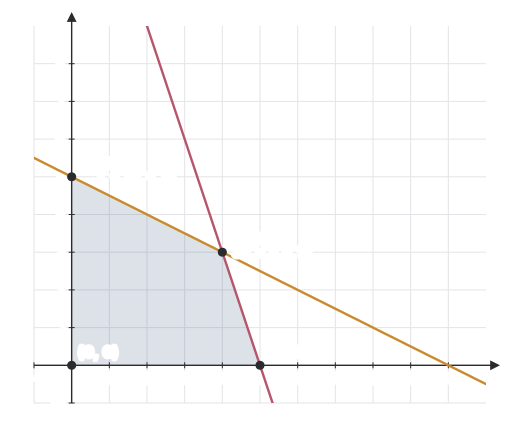
The feasible region of x + 2y ≤ 10, 3x + y ≤ 15, x ≥ 0, y ≥ 0, shaded, with corners (0, 0), (5, 0), (4, 3) and (0, 5).
The potter's feasible region, with its four corners.

Every point of the shaded region is a feasible solution; points outside break at least one constraint. The corners, where boundary lines meet, are found by solving the lines' equations in pairs: x+2y=10x + 2y = 10 and 3x+y=153x + y = 15 meet at (4,3)(4, 3).

The corner-point method

How does the corner-point method work?

If the feasible region is bounded, the objective function has a maximum and a minimum on it, and each occurs at a corner point. So list the corners, work out ZZ at each, and pick the largest or smallest value.

Example 2 · The potter's best plan

Maximise Z=60x+40yZ = 60x + 40y over the potter's region.

  1. Corners: (0,0)(0, 0), (5,0)(5, 0), (4,3)(4, 3) and (0,5)(0, 5).

  2. ZZ there: 0, 300, 240+120=360240 + 120 = 360 and 200.

Answer

The maximum profit is ₹360, from 4 bowls and 3 vases.

Key idea

If two corners give the same best value, every point on the edge between them does too, so there are infinitely many optimal solutions. This happens when the objective's line is parallel to that edge.

Unbounded regions and infeasible problems

What happens when the feasible region is unbounded?

On an unbounded region the corner values are still the candidates, but they need a check. For a minimum mm, see whether the open half-plane Z<mZ < m has any point in common with the region: if it has none, mm is the minimum; if it has some, there is no minimum. The same test with Z>MZ > M settles a maximum, and a region that runs off to infinity often has no maximum at all.

Example 3 · A minimum over an unbounded region

Minimise Z=3x+2yZ = 3x + 2y subject to x+y≥5x + y \ge 5, x+3y≥9x + 3y \ge 9, x≥0x \ge 0, y≥0y \ge 0.

  1. The region lies above both lines and is unbounded. Its corners are (0,5)(0, 5), (3,2)(3, 2) and (9,0)(9, 0), where Z=10Z = 10, 13 and 27.

  2. Check 3x+2y<103x + 2y < 10: every feasible point has 3x+2y=2(x+y)+x≥10+x≥103x + 2y = 2(x + y) + x \ge 10 + x \ge 10, so the half-plane misses the region.

Answer

The minimum is 10, at (0,5)(0, 5). There is no maximum.

If the constraints contradict each other, such as x+y≤2x + y \le 2 and x+y≥5x + y \ge 5, the feasible region is empty and the problem has no feasible solution at all.

Watch out

On an unbounded region, the largest corner value is not the maximum. Points far out in the region make ZZ as large as you like.

How CUET asks this chapter

  • Formulation: the constraint or objective that a situation describes.
  • Feasible region: which point is feasible, which half-plane an inequality gives, or how many corners a region has.
  • Corner-point method: the maximum or minimum, often with the region drawn, the point where it occurs, or a word problem.
  • Special cases: an unbounded region, no maximum, an infeasible problem, or two optimal corners.

Exam shortcuts

  • Test the origin to shade a half-plane.
  • Bounded region: compare ZZ at the corners, nothing more.
  • Unbounded region: check the half-plane Z<mZ < m (or Z>MZ > M).
  • Same best value at two corners: the whole edge is optimal.
  • Z=px+qyZ = px + qy optimal at (x1,y1)(x_1, y_1) and (x2,y2)(x_2, y_2): px1+qy1=px2+qy2px_1 + qy_1 = px_2 + qy_2.

Common mistakes

  • Reversing an inequality, or putting a product's number on the wrong variable.
  • Forgetting x≥0x \ge 0 and y≥0y \ge 0, and so including corners on negative axes.
  • Taking the largest corner value as a maximum on an unbounded region.
  • Stopping at the corner where the two lines cross, without checking the others.

Quick revision

Formulation

  • Variables, objective ZZ, constraints, x,y≥0x, y \ge 0
  • "At most" ≤\le; "at least" ≥\ge

Graphical method

  • Feasible region: all constraints at once
  • Bounded: optimum at a corner
  • Unbounded: half-plane test; empty: no solution

The formulas of all ten chapters are on one page: the Section A formula sheet.

Next · 08Quick revision

Check your understanding

59 questions, grouped by type, easy to hard. Pick an answer and check it. The worked solution opens when you ask for it.

Formulating a problemQ1 of 59Q1

Formulating a problem

16 questions

A carpenter makes chairs (xx) and tables (yy). A chair takes 2 hours and a table 3 hours, and he has 12 hours a day. Which constraint describes his time?

Options for question 1

Show the explanationHide the explanation

AnswerB · 2x+3y≤122x + 3y \le 12

  1. Write each resource as (amount used per unit) × (number of units), added over the products.

  2. 'At most' or 'available' gives ≤, 'at least' or 'must give' gives ≥; a profit is maximised and a cost minimised.
A diet must give at least 40 units of vitamin A. Food P (xx kg) gives 5 units per kg and food Q (yy kg) gives 2 units per kg. Which constraint expresses this?

Options for question 2

Show the explanationHide the explanation

AnswerD · 5x+2y≥405x + 2y \ge 40

  1. Write each resource as (amount used per unit) × (number of units), added over the products.

  2. 'At most' or 'available' gives ≤, 'at least' or 'must give' gives ≥; a profit is maximised and a cost minimised.
A dealer sells fans (xx) at a profit of ₹50 each and lamps (yy) at a profit of ₹30 each. Which is his objective function?

Options for question 3

Show the explanationHide the explanation

AnswerA · maximise Z=50x+30y\text{maximise } Z = 50x + 30y

  1. Write each resource as (amount used per unit) × (number of units), added over the products.

  2. 'At most' or 'available' gives ≤, 'at least' or 'must give' gives ≥; a profit is maximised and a cost minimised.
A bakery makes cakes (xx) and pastries (yy). It must make at least as many cakes as pastries. Which constraint is this?

Options for question 4

Show the explanationHide the explanation

AnswerA · x≥yx \ge y

  1. Write each resource as (amount used per unit) × (number of units), added over the products.

  2. 'At most' or 'available' gives ≤, 'at least' or 'must give' gives ≥; a profit is maximised and a cost minimised.
In a linear programming problem, what are the unknowns xx and yy, whose values are to be decided, called?

Options for question 5

Show the explanationHide the explanation

AnswerB · Decision variables

  1. xx and yy stand for the quantities to be decided, such as how many units to make.

  2. They are the decision variables; ZZ is the objective function and the inequalities are the constraints.

Assertion (A): A production problem includes the constraints x≥0x \ge 0 and y≥0y \ge 0.

Reason (R): A firm cannot make a negative number of units.

Options for question 6

Show the explanationHide the explanation

AnswerA · Both A and R are true, and R is the correct explanation of A.

  1. xx and yy count units, which cannot be negative, so R is true.

  2. That is exactly why the non-negative constraints are written: A is true and R explains it.

A student plans to study Mathematics for xx hours and Physics for yy hours a day, and has at most 10 hours. Which constraint describes this?

Options for question 7

Show the explanationHide the explanation

AnswerD · x+y≤10x + y \le 10

  1. Write each resource as (amount used per unit) × (number of units), added over the products.

  2. 'At most' or 'available' gives ≤, 'at least' or 'must give' gives ≥; a profit is maximised and a cost minimised.
A firm makes xx units of product M and yy of product N. Machine time is 3 h for M and 1 h for N, with 15 h available; labour is 1 h for M and 2 h for N, with 10 h available. Which constraints are right?

Options for question 8

Show the explanationHide the explanation

AnswerB · 3x+y≤15, x+2y≤103x + y \le 15,\ x + 2y \le 10

  1. Write each resource as (amount used per unit) × (number of units), added over the products.

  2. 'At most' or 'available' gives ≤, 'at least' or 'must give' gives ≥; a profit is maximised and a cost minimised.
A transporter uses xx small trucks costing ₹400 a trip and yy large trucks costing ₹700 a trip, and wants the cheapest plan. Which is the objective?

Options for question 9

Show the explanationHide the explanation

AnswerD · minimise Z=400x+700y\text{minimise } Z = 400x + 700y

  1. Write each resource as (amount used per unit) × (number of units), added over the products.

  2. 'At most' or 'available' gives ≤, 'at least' or 'must give' gives ≥; a profit is maximised and a cost minimised.

Which of the following statements are true?

I. The objective function of a linear programming problem is linear in the decision variables.

II. x≥0x \ge 0, y≥0y \ge 0 are called the non-negative constraints.

III. The feasible region is the common region of all the constraints, the non-negative ones included.

IV. Every point of the feasible region is an optimal solution.

Options for question 10

Show the explanationHide the explanation

AnswerC · I, II and III only

  1. I, II and III are the definitions: a linear objective, non-negative variables, and a feasible region where every constraint holds.

  2. IV is false: a point of the feasible region is a feasible solution; an optimal solution is one that gives the best value of ZZ.

A shop can store at most 60 units of goods, and must keep at least twice as many units of type A (xx) as of type B (yy). Which pair of constraints is right?

Options for question 11

Show the explanationHide the explanation

AnswerC · x+y≤60, x≥2yx + y \le 60,\ x \ge 2y

  1. Write each resource as (amount used per unit) × (number of units), added over the products.

  2. 'At most' or 'available' gives ≤, 'at least' or 'must give' gives ≥; a profit is maximised and a cost minimised.

Food A (xx kg) gives 2 units of protein and 3 units of iron per kg; food B (yy kg) gives 4 units of protein and 1 unit of iron per kg. A meal needs at least 20 units of protein and 12 of iron. Which constraints are right?

Options for question 12

Show the explanationHide the explanation

AnswerA · 2x+4y≥20, 3x+y≥122x + 4y \ge 20,\ 3x + y \ge 12

  1. Write each resource as (amount used per unit) × (number of units), added over the products.

  2. 'At most' or 'available' gives ≤, 'at least' or 'must give' gives ≥; a profit is maximised and a cost minimised.

Read the two statements and choose the correct option.

I. Z=3x+2y−xyZ = 3x + 2y - xy can be the objective function of a linear programming problem.

II. x+2y≤4x + 2y \le 4 can be a constraint of a linear programming problem.

Options for question 13

Show the explanationHide the explanation

AnswerB · Only II

  1. I is false: the term xyxy makes ZZ non-linear; the objective must be linear.

  2. II is true: it is a linear inequality in xx and yy.

A workshop sells a table (xx) for ₹900 that costs ₹600 to make, and a chair (yy) for ₹300 that costs ₹200 to make. Which objective maximises its profit?

Options for question 14

Show the explanationHide the explanation

AnswerD · maximise Z=300x+100y\text{maximise } Z = 300x + 100y

  1. Write each resource as (amount used per unit) × (number of units), added over the products.

  2. 'At most' or 'available' gives ≤, 'at least' or 'must give' gives ≥; a profit is maximised and a cost minimised.

Worth noting

Revenue is not profit: subtract each item's cost from its price first.

A farmer sows wheat on xx acres and rice on yy acres of his 50 acres. Wheat needs 4 kg of fertiliser an acre and rice 6 kg, and he has 240 kg. Which constraints are right?

Options for question 15

Show the explanationHide the explanation

AnswerB · x+y≤50, 4x+6y≤240x + y \le 50,\ 4x + 6y \le 240

  1. Write each resource as (amount used per unit) × (number of units), added over the products.

  2. 'At most' or 'available' gives ≤, 'at least' or 'must give' gives ≥; a profit is maximised and a cost minimised.

A factory makes xx units of type A and yy units of type B. At most one-third of all the units it makes can be of type B. Which constraint is this?

Options for question 16

Show the explanationHide the explanation

AnswerC · x≥2yx \ge 2y

  1. Write each resource as (amount used per unit) × (number of units), added over the products.

  2. 'At most' or 'available' gives ≤, 'at least' or 'must give' gives ≥; a profit is maximised and a cost minimised.

Worth noting

y≤x+y3y \le \frac{x + y}{3} simplifies to 2y≤x2y \le x; '3y≤x3y \le x' takes one-third of type A instead of one-third of the total.

The feasible region

12 questions

Which point lies in the feasible region of x+y≤6,2x+y≤8,x≥0,y≥0x + y \le 6, 2x + y \le 8, x \ge 0, y \ge 0?

Options for question 17

Show the explanationHide the explanation

AnswerB · (2,3)(2, 3)

  1. A point is feasible when it satisfies every constraint. Check (2,3)(2, 3): x+y=5x + y = 5; 2x+y=72x + y = 7.

  2. Each of the other points breaks at least one constraint.

Which region does the constraint 2x+3y≤122x + 3y \le 12 describe?

Options for question 18

Show the explanationHide the explanation

AnswerC · The line 2x+3y=122x + 3y = 12 and the side of it that contains the origin

  1. A linear inequality describes a half-plane: the boundary line and everything on one side of it.

  2. Test the origin: 2(0)+3(0)=0≤122(0) + 3(0) = 0 \le 12 is true, so the side with the origin is the one shaded.

Worth noting

The far side is the region of 2x+3y≥122x + 3y \ge 12.

How many corner points does the feasible region of x+y≤4,x+3y≤6,x≥0,y≥0x + y \le 4, x + 3y \le 6, x \ge 0, y \ge 0 have?

Options for question 19

Show the explanationHide the explanation

AnswerB · 44

  1. Find where the boundary lines, the axes included, meet, and keep the meeting points that satisfy every constraint.

  2. They are (0,0)(0, 0), (0,2)(0, 2), (3,1)(3, 1), (4,0)(4, 0): 4 in all.

Which point lies in the feasible region of x+y≤8,x+3y≥6,x≥0,y≥0x + y \le 8, x + 3y \ge 6, x \ge 0, y \ge 0?

Options for question 20

Show the explanationHide the explanation

AnswerD · (3,2)(3, 2)

  1. Put each point into every constraint.

  2. (3,2)(3, 2): 3+2=5≤83 + 2 = 5 \le 8 and 3+6=9≥63 + 6 = 9 \ge 6. (1,1)(1, 1) and (0,1)(0, 1) fail x+3y≥6x + 3y \ge 6; (6,4)(6, 4) fails x+y≤8x + y \le 8.

Which of these points does NOT lie in the region x+y≤5x + y \le 5, x−y≥−1x - y \ge -1, x≥0x \ge 0, y≥0y \ge 0?

Options for question 21

Show the explanationHide the explanation

AnswerA · (1,3)(1, 3)

  1. At (1,3)(1, 3): x−y=−2x - y = -2, which is less than −1-1, so it breaks the second constraint.

  2. Each of the other three satisfies all four constraints.

Which point lies in the feasible region of x+2y≤8,x+y≥3,x≥0,y≥0x + 2y \le 8, x + y \ge 3, x \ge 0, y \ge 0?

Options for question 22

Show the explanationHide the explanation

AnswerD · (2,2)(2, 2)

  1. A point is feasible when it satisfies every constraint. Check (2,2)(2, 2): x+2y=6x + 2y = 6; x+y=4x + y = 4.

  2. Each of the other points breaks at least one constraint.

How many corner points does the feasible region of x+y≤10,x+y≥2,x≤6,x≥0,y≥0x + y \le 10, x + y \ge 2, x \le 6, x \ge 0, y \ge 0 have?

Options for question 23

Show the explanationHide the explanation

AnswerA · 55

  1. Find where the boundary lines, the axes included, meet, and keep the meeting points that satisfy every constraint.

  2. They are (0,2)(0, 2), (0,10)(0, 10), (2,0)(2, 0), (6,0)(6, 0), (6,4)(6, 4): 5 in all.

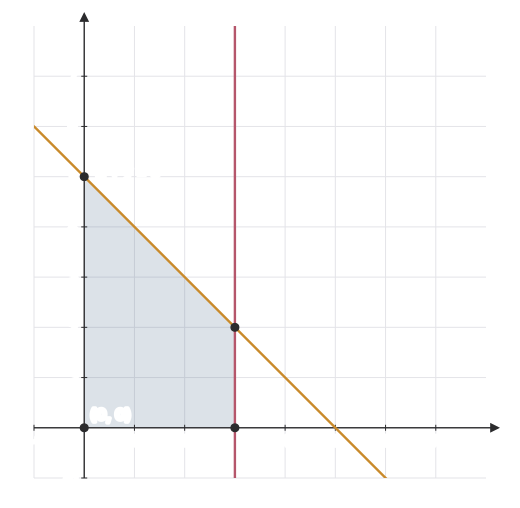
The shaded region in the figure is a feasible region. Which system of constraints gives it?

A shaded region in the first quadrant with corners (0, 0), (3, 0), (3, 2), (0, 5), bounded by the lines x + y = 5 and x = 3 and the axes.
Options for question 24

Show the explanationHide the explanation

AnswerD · x+y≤5, x≤3, x≥0, y≥0x + y \le 5,\ x \le 3,\ x \ge 0,\ y \ge 0

  1. The region contains the origin, so both boundary lines are '≤\le' toward it.

  2. Its corners (0,0)(0, 0), (3,0)(3, 0), (3,2)(3, 2), (0,5)(0, 5) lie on x+y=5x + y = 5, x=3x = 3 and the axes.

Worth noting

'x+y≥5x + y \ge 5' would put the region on the far side of the line, away from the origin.

Is the feasible region of x+y≥3x + y \ge 3, x≤4x \le 4, y≤5y \le 5, x≥0x \ge 0, y≥0y \ge 0 bounded?

Options for question 25

Show the explanationHide the explanation

AnswerA · Yes, it is bounded

  1. x≤4x \le 4 and y≤5y \le 5 keep every point inside the box 0≤x≤40 \le x \le 4, 0≤y≤50 \le y \le 5.

  2. x+y≥3x + y \ge 3 only cuts off the corner near the origin, so the region is a bounded polygon.

Worth noting

A '≥\ge' constraint does not by itself make a region unbounded; here the box closes it.

Which region does the constraint x−y≥2x - y \ge 2 describe?

Options for question 26

Show the explanationHide the explanation

AnswerC · The line x−y=2x - y = 2 and the side of it away from the origin

  1. Test the origin: 0−0≥20 - 0 \ge 2 is false, so the origin is not in the region.

  2. The region is the half-plane on the far side of the line, and '≥\ge' includes the line itself.

Worth noting

A strict '>>' would leave the line out; '≥\ge' keeps it.

How many corner points does the feasible region of x+2y≤12x + 2y \le 12, x≤6x \le 6, y≤5y \le 5, x≥0x \ge 0, y≥0y \ge 0 have?

Options for question 27

Show the explanationHide the explanation

AnswerC · 55

  1. The corners are (0,0)(0, 0), (6,0)(6, 0), (6,3)(6, 3), (2,5)(2, 5), (0,5)(0, 5).

  2. The line x+2y=12x + 2y = 12 cuts off the corner (6,5)(6, 5) of the box, leaving 5 corners.

Worth noting

4 counts the box x≤6x \le 6, y≤5y \le 5 alone; (6,5)(6, 5) is not feasible, since 6+10>126 + 10 > 12.

Which of these is a corner point of the feasible region of x+y≤6x + y \le 6, x≥yx \ge y, x≥0x \ge 0, y≥0y \ge 0?

Options for question 28

Show the explanationHide the explanation

AnswerB · (3,3)(3, 3)

  1. The lines x+y=6x + y = 6 and y=xy = x meet at (3,3)(3, 3), which satisfies every constraint.

  2. (0,6)(0, 6) and (2,4)(2, 4) break x≥yx \ge y; (6,6)(6, 6) breaks x+y≤6x + y \le 6. The corners are (0,0)(0, 0), (6,0)(6, 0), (3,3)(3, 3).

Worth noting

(0,6)(0, 6) is where x+y=6x + y = 6 meets the yy-axis, but x≥yx \ge y cuts that part away.

The corner-point method

18 questions

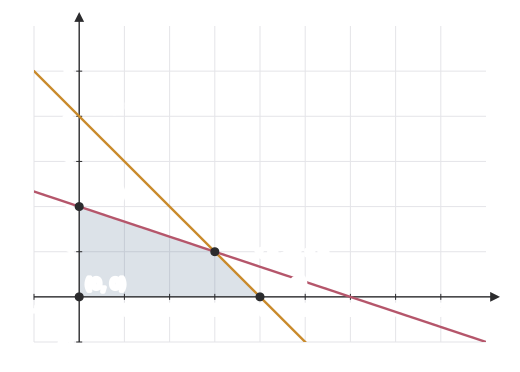
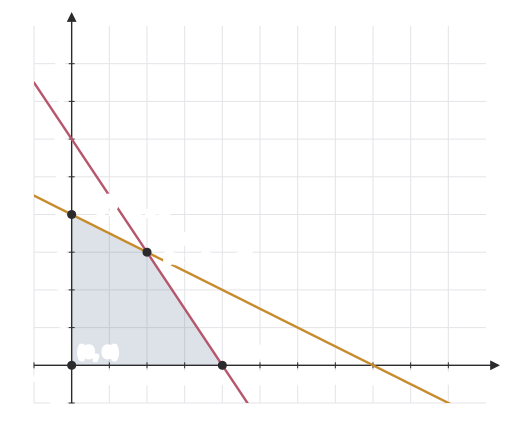
The shaded region in the figure is the feasible region for x+y≤4,x+3y≤6,x≥0,y≥0x + y \le 4, x + 3y \le 6, x \ge 0, y \ge 0. What is the maximum value of Z=3x+2yZ = 3x + 2y?

The feasible region, shaded, is a polygon with corners (0, 0), (0, 2), (3, 1), (4, 0), bounded by the lines x + y = 4, x + 3y = 6 and the axes.
Options for question 29

Show the explanationHide the explanation

AnswerD · 1212

  1. The corner points of the feasible region are (0,0)(0, 0), (0,2)(0, 2), (3,1)(3, 1), (4,0)(4, 0).

  2. Values of ZZ: 00 at (0,0)(0, 0), 44 at (0,2)(0, 2), 1111 at (3,1)(3, 1), 1212 at (4,0)(4, 0).

  3. The region is bounded, so the maximum is the largest of these: 1212, at (4,0)(4, 0).

Worth noting

00 is the minimum, at the opposite end.

The corner points of a bounded feasible region are (0,0)(0, 0), (5,0)(5, 0), (3,4)(3, 4) and (0,6)(0, 6). What is the maximum of Z=4x+3yZ = 4x + 3y?

Options for question 30

Show the explanationHide the explanation

AnswerC · 2424

  1. For a bounded region, the maximum is at a corner: work out ZZ at each.

  2. Z=0Z = 0, 20, 12+12=2412 + 12 = 24 and 18, so the maximum is 24, at (3,4)(3, 4).

Worth noting

20 is ZZ at (5,0)(5, 0), the corner with the largest xx; the largest ZZ can be elsewhere.

The corner points of a bounded feasible region are (0,2)(0, 2), (4,0)(4, 0), (6,3)(6, 3) and (2,6)(2, 6). What is the minimum value of Z=5x+2yZ = 5x + 2y?

Options for question 31

Show the explanationHide the explanation

AnswerA · 44

  1. Evaluate ZZ at each corner: 44 at (0,2)(0, 2), 2020 at (4,0)(4, 0), 3636 at (6,3)(6, 3), 2222 at (2,6)(2, 6).

  2. The smallest is 4, at (0,2)(0, 2).

Worth noting

36 is the maximum, at (6,3)(6, 3).

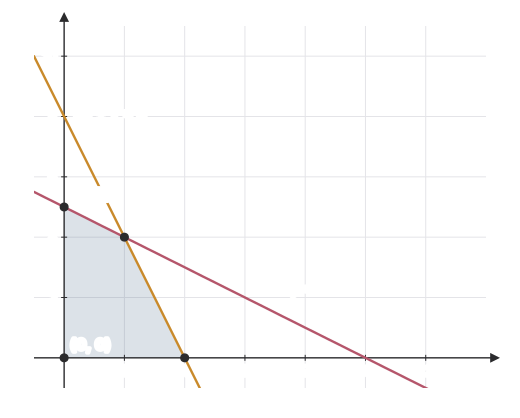
The shaded region in the figure is the feasible region for 2x+y≤8,x+2y≤10,x≥0,y≥02x + y \le 8, x + 2y \le 10, x \ge 0, y \ge 0. What is the maximum value of Z=5x+4yZ = 5x + 4y?

The feasible region, shaded, is a polygon with corners (0, 0), (0, 5), (2, 4), (4, 0), bounded by the lines 2x + y = 8, x + 2y = 10 and the axes.
Options for question 32

Show the explanationHide the explanation

AnswerC · 2626

  1. The corner points of the feasible region are (0,0)(0, 0), (0,5)(0, 5), (2,4)(2, 4), (4,0)(4, 0).

  2. Values of ZZ: 00 at (0,0)(0, 0), 2020 at (0,5)(0, 5), 2626 at (2,4)(2, 4), 2020 at (4,0)(4, 0).

  3. The region is bounded, so the maximum is the largest of these: 2626, at (2,4)(2, 4).

Worth noting

00 is the minimum, at the opposite end.

What is the minimum value of Z=x+2yZ = x + 2y subject to 2x+3y≤12,x+y≥2,x≥0,y≥02x + 3y \le 12, x + y \ge 2, x \ge 0, y \ge 0?

Options for question 33

Show the explanationHide the explanation

AnswerB · 22

  1. The corner points of the feasible region are (0,2)(0, 2), (0,4)(0, 4), (2,0)(2, 0), (6,0)(6, 0).

  2. Values of ZZ: 44 at (0,2)(0, 2), 88 at (0,4)(0, 4), 22 at (2,0)(2, 0), 66 at (6,0)(6, 0).

  3. The region is bounded, so the minimum is the smallest of these: 22, at (2,0)(2, 0).

Worth noting

88 is the maximum, at the opposite end.

At which point does Z=2x+3yZ = 2x + 3y reach its maximum, subject to x+y≤7,2x+y≤10,x≥0,y≥0x + y \le 7, 2x + y \le 10, x \ge 0, y \ge 0?

Options for question 34

Show the explanationHide the explanation

AnswerA · (0,7)(0, 7)

  1. Corners: (0,0)(0, 0), (0,7)(0, 7), (3,4)(3, 4), (5,0)(5, 0).

  2. ZZ there: 00, 2121, 1818, 1010; the largest is at (0,7)(0, 7).

Worth noting

The corner where the two constraint lines cross is not always the best; here ZZ is larger on the yy-axis.

Maximise Z=2x+2yZ = 2x + 2y subject to x+y≤5x + y \le 5, x≥0x \ge 0, y≥0y \ge 0. How many optimal solutions are there?

Options for question 35

Show the explanationHide the explanation

AnswerD · Infinitely many

  1. At the corners (0,0)(0, 0), (5,0)(5, 0) and (0,5)(0, 5), Z=0Z = 0, 10 and 10: the maximum 10 is reached at two corners.

  2. Then every point of the edge joining them gives Z=2(x+y)=10Z = 2(x + y) = 10 as well, so there are infinitely many optimal solutions.

Worth noting

Two optimal corners is not 'exactly two': the whole edge between them is optimal.

A company makes two products, P and Q, earning ₹30 and ₹40 a unit. Each unit of P uses 1 hour of machine time and each unit of Q 2 hours; 40 hours are available. At most 30 units can be made in all. What is the largest profit, in rupees?

Options for question 36

Show the explanationHide the explanation

AnswerC · 1,0001{,}000

  1. With xx of P and yy of Q: maximise Z=30x+40yZ = 30x + 40y subject to x+2y≤40x + 2y \le 40, x+y≤30x + y \le 30, x,y≥0x, y \ge 0.

  2. At the corners: (0,0)→0(0, 0) \to 0, (30,0)→900(30, 0) \to 900, (20,10)→1000(20, 10) \to 1000, (0,20)→800(0, 20) \to 800.

  3. The largest profit is ₹1,000, making 20 of P and 10 of Q.

Worth noting

₹1,200 makes 30 units of Q, which needs 60 machine hours; only 40 are available.

Assertion (A): The optimal value of a linear objective function on a bounded feasible region occurs at a corner point.

Reason (R): A linear function on a segment takes its largest and smallest values at the ends of the segment.

Options for question 37

Show the explanationHide the explanation

AnswerA · Both A and R are true, and R is the correct explanation of A.

  1. A is the corner point theorem.

  2. R is true, and applied edge by edge it pushes the optimum to the corners: it explains A.

What is the maximum value of Z=4x+3yZ = 4x + 3y subject to x+y≤6,2x+y≤8,x≥0,y≥0x + y \le 6, 2x + y \le 8, x \ge 0, y \ge 0?

Options for question 38

Show the explanationHide the explanation

AnswerD · 2020

  1. The corner points of the feasible region are (0,0)(0, 0), (0,6)(0, 6), (2,4)(2, 4), (4,0)(4, 0).

  2. Values of ZZ: 00 at (0,0)(0, 0), 1818 at (0,6)(0, 6), 2020 at (2,4)(2, 4), 1616 at (4,0)(4, 0).

  3. The region is bounded, so the maximum is the largest of these: 2020, at (2,4)(2, 4).

Worth noting

00 is the minimum, at the opposite end.

The shaded region in the figure is the feasible region for x+2y≤8,3x+2y≤12,x≥0,y≥0x + 2y \le 8, 3x + 2y \le 12, x \ge 0, y \ge 0. What is the maximum value of Z=4x+5yZ = 4x + 5y?

The feasible region, shaded, is a polygon with corners (0, 0), (0, 4), (2, 3), (4, 0), bounded by the lines x + 2y = 8, 3x + 2y = 12 and the axes.
Options for question 39

Show the explanationHide the explanation

AnswerD · 2323

  1. The corner points of the feasible region are (0,0)(0, 0), (0,4)(0, 4), (2,3)(2, 3), (4,0)(4, 0).

  2. Values of ZZ: 00 at (0,0)(0, 0), 2020 at (0,4)(0, 4), 2323 at (2,3)(2, 3), 1616 at (4,0)(4, 0).

  3. The region is bounded, so the maximum is the largest of these: 2323, at (2,3)(2, 3).

Worth noting

00 is the minimum, at the opposite end.

At which point does Z=x+3yZ = x + 3y reach its maximum, subject to 2x+y≤12,x+2y≤12,x≥0,y≥02x + y \le 12, x + 2y \le 12, x \ge 0, y \ge 0?

Options for question 40

Show the explanationHide the explanation

AnswerB · (0,6)(0, 6)

  1. Corners: (0,0)(0, 0), (0,6)(0, 6), (4,4)(4, 4), (6,0)(6, 0); ZZ there is 00, 1818, 1616, 66.

  2. The largest, 18, is at (0,6)(0, 6).

Worth noting

(4,4)(4, 4) is where the two lines cross, but ZZ weights yy three times as much as xx, so the top corner wins. (0,12)(0, 12) is not feasible.

Maximise Z=3x+6yZ = 3x + 6y subject to x+2y≤8,x≤6,x≥0,y≥0x + 2y \le 8, x \le 6, x \ge 0, y \ge 0. How many optimal solutions are there?

Options for question 41

Show the explanationHide the explanation

AnswerD · Infinitely many

  1. Corners: (0,0)(0, 0), (0,4)(0, 4), (6,0)(6, 0), (6,1)(6, 1); ZZ is 00, 2424, 1818, 2424.

  2. The maximum, 24, comes at both (0,4)(0, 4) and (6,1)(6, 1), because Z=3(x+2y)Z = 3(x + 2y) is parallel to the edge x+2y=8x + 2y = 8; every point of that edge is optimal.

Worth noting

'Exactly two' counts only the corners, but every point between them on the edge gives 24 too.

What is the maximum value of Z=3x+4yZ = 3x + 4y subject to x+y≤10,x+3y≤18,x≥0,y≥0x + y \le 10, x + 3y \le 18, x \ge 0, y \ge 0?

Options for question 42

Show the explanationHide the explanation

AnswerC · 3434

  1. The corner points of the feasible region are (0,0)(0, 0), (0,6)(0, 6), (6,4)(6, 4), (10,0)(10, 0).

  2. Values of ZZ: 00 at (0,0)(0, 0), 2424 at (0,6)(0, 6), 3434 at (6,4)(6, 4), 3030 at (10,0)(10, 0).

  3. The region is bounded, so the maximum is the largest of these: 3434, at (6,4)(6, 4).

Worth noting

00 is the minimum, at the opposite end.

Z=px+qyZ = px + qy, with p,q>0p, q > 0, takes its maximum at both (3,0)(3, 0) and (1,1)(1, 1). Which relation holds?

Options for question 43

Show the explanationHide the explanation

AnswerB · q=2pq = 2p

  1. Equal maximum values: 3p+0q=p+q3p + 0q = p + q.

  2. That gives q=2pq = 2p.

Worth noting

p=2qp = 2q has the two letters the wrong way round; put (3,0)(3, 0) and (1,1)(1, 1) in to check.

What is the minimum value of Z=2x+5yZ = 2x + 5y subject to x+y≥3,x+2y≤10,3x+y≤15,x≥0,y≥0x + y \ge 3, x + 2y \le 10, 3x + y \le 15, x \ge 0, y \ge 0?

Options for question 44

Show the explanationHide the explanation

AnswerA · 66

  1. The corner points of the feasible region are (0,3)(0, 3), (0,5)(0, 5), (3,0)(3, 0), (4,3)(4, 3), (5,0)(5, 0).

  2. Values of ZZ: 1515 at (0,3)(0, 3), 2525 at (0,5)(0, 5), 66 at (3,0)(3, 0), 2323 at (4,3)(4, 3), 1010 at (5,0)(5, 0).

  3. The region is bounded, so the minimum is the smallest of these: 66, at (3,0)(3, 0).

Worth noting

2525 is the maximum, at the opposite end.

A shopkeeper buys fans at ₹300 and lamps at ₹150, with ₹6,000 to spend and room for 30 items. He makes ₹40 on a fan and ₹25 on a lamp. What is his largest possible profit?

Options for question 45

Show the explanationHide the explanation

AnswerC · ₹900

  1. With xx fans and yy lamps: 300x+150y≤6,000300x + 150y \le 6{,}000, that is 2x+y≤402x + y \le 40, and x+y≤30x + y \le 30; maximise Z=40x+25yZ = 40x + 25y.

  2. Corners: (0,0)(0, 0), (0,30)(0, 30), (10,20)(10, 20), (20,0)(20, 0), where ZZ is 00, 750750, 900900, 800800.

  3. The largest is ₹900, with 10 fans and 20 lamps.

Worth noting

₹1,200 fills all 30 places with fans, which needs ₹9,000, more than the budget.

For which value of kk does Z=kx+2yZ = kx + 2y take the same value at the corner points (4,0)(4, 0) and (2,3)(2, 3)?

Options for question 46

Show the explanationHide the explanation

AnswerC · 33

  1. Z(4,0)=4kZ(4, 0) = 4k and Z(2,3)=2k+6Z(2, 3) = 2k + 6.

  2. 4k=2k+64k = 2k + 6 gives k=3k = 3.

Worth noting

6 is 2k2k, the difference before dividing by 2.

Unbounded and infeasible problems

13 questions

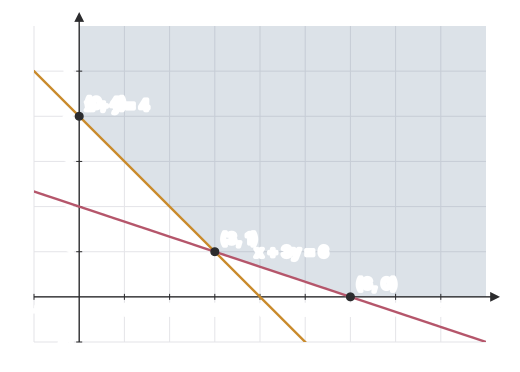
The shaded region in the figure, which is unbounded, is the feasible region for x+y≥4,x+3y≥6,x≥0,y≥0x + y \ge 4, x + 3y \ge 6, x \ge 0, y \ge 0. What is the minimum value of Z=2x+3yZ = 2x + 3y?

An unbounded shaded region in the first quadrant above the lines x + y = 4, x + 3y = 6, with corners (0, 4), (3, 1), (6, 0).
Options for question 47

Show the explanationHide the explanation

AnswerA · 99

  1. Corners: (0,4)(0, 4), (3,1)(3, 1), (6,0)(6, 0); ZZ there is 1212, 99, 1212.

  2. The region is unbounded, so check that 2x+3y<92x + 3y < 9 has no point in common with it: the line 2x+3y=92x + 3y = 9 touches the region only at (3,1)(3, 1).

  3. So the minimum is 99.

Worth noting

On an unbounded region the largest corner value is not a maximum: ZZ can grow without limit.

For x+y≥4x + y \ge 4, x≥0x \ge 0, y≥0y \ge 0, what is the maximum of Z=3x+2yZ = 3x + 2y?

Options for question 48

Show the explanationHide the explanation

AnswerD · No maximum exists

  1. The region is everything on or above the line x+y=4x + y = 4 in the first quadrant, which is unbounded.

  2. Points like (100,0)(100, 0) are feasible and give Z=300Z = 300; ZZ has no upper limit.

Worth noting

12 is the largest corner value, but on an unbounded region that settles nothing.

What can be said about the problem: maximise Z=x+yZ = x + y subject to x+y≤2x + y \le 2, x+y≥5x + y \ge 5, x≥0x \ge 0, y≥0y \ge 0?

Options for question 49

Show the explanationHide the explanation

AnswerC · It has no feasible solution

  1. No point can have x+yx + y at most 2 and at least 5 at the same time.

  2. So the feasible region is empty and the problem has no solution at all.

Read the two statements and choose the correct option.

I. If the feasible region is bounded, the objective function has both a maximum and a minimum on it.

II. If the feasible region is unbounded, the objective function has no minimum on it.

Options for question 50

Show the explanationHide the explanation

AnswerA · Only I

  1. On a bounded region both optimum values exist and occur at corner points, so I is true.

  2. An unbounded region can still have a minimum (or a maximum); it has to be checked, so II is false.

For x+2y≥6x + 2y \ge 6, x≥0x \ge 0, y≥0y \ge 0, what is the minimum of Z=x+3yZ = x + 3y?

Options for question 51

Show the explanationHide the explanation

AnswerC · 66

  1. The corners of this unbounded region are (6,0)(6, 0) and (0,3)(0, 3), with Z=6Z = 6 and Z=9Z = 9.

  2. The half-plane x+3y<6x + 3y < 6 has no point in common with the region, so the minimum is 6.

Worth noting

0 is at the origin, which is not in the region.

Which is true of Z=3x+5yZ = 3x + 5y over the region x+y≥2x + y \ge 2, x≥0x \ge 0, y≥0y \ge 0?

Options for question 52

Show the explanationHide the explanation

AnswerD · It has minimum 6 and no maximum

  1. The corners are (2,0)(2, 0) and (0,2)(0, 2), where Z=6Z = 6 and 10. The half-plane 3x+5y<63x + 5y < 6 holds no feasible point, so 6 is the minimum.

  2. The region is unbounded upward: (100,0)(100, 0) gives Z=300Z = 300, so there is no maximum.

Worth noting

10 is the value at the other corner, (0,2)(0, 2), not the least.

Read the two statements and choose the correct option.

I. If the feasible region is unbounded, the objective function may still have a minimum.

II. If the feasible region is empty, the problem has no optimal solution.

Options for question 53

Show the explanationHide the explanation

AnswerC · Both I and II

  1. I: a cost such as Z=2x+3yZ = 2x + 3y over x+y≥4x + y \ge 4 has the minimum 8, though the region is unbounded. True.

  2. II: with no feasible point there is nothing to optimise. True.

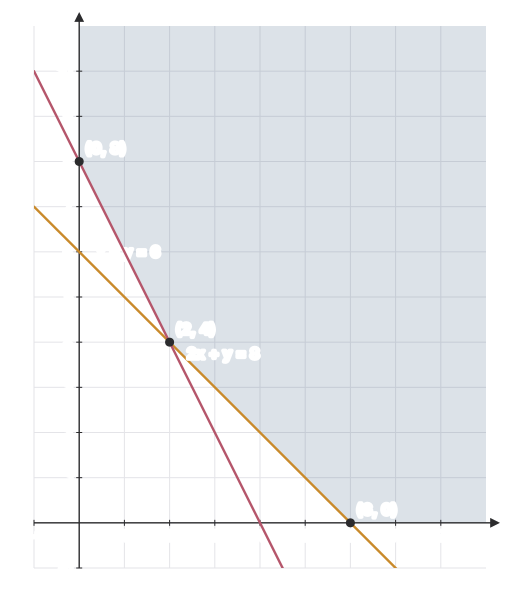
The shaded region in the figure, which is unbounded, is the feasible region for x+y≥6,2x+y≥8,x≥0,y≥0x + y \ge 6, 2x + y \ge 8, x \ge 0, y \ge 0. What is the minimum value of Z=4x+3yZ = 4x + 3y?

An unbounded shaded region in the first quadrant above the lines x + y = 6, 2x + y = 8, with corners (0, 8), (2, 4), (6, 0).
Options for question 54

Show the explanationHide the explanation

AnswerB · 2020

  1. Corners: (0,8)(0, 8), (2,4)(2, 4), (6,0)(6, 0); ZZ there is 2424, 2020, 2424.

  2. The region is unbounded, so check that 4x+3y<204x + 3y < 20 has no point in common with it: the line 4x+3y=204x + 3y = 20 touches the region only at (2,4)(2, 4).

  3. So the minimum is 2020.

Worth noting

On an unbounded region the largest corner value is not a maximum: ZZ can grow without limit.

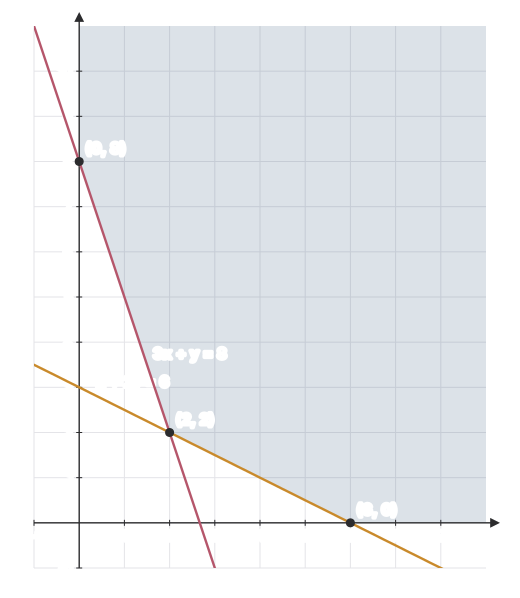
The shaded region in the figure, which is unbounded, is the feasible region for x+2y≥6,3x+y≥8,x≥0,y≥0x + 2y \ge 6, 3x + y \ge 8, x \ge 0, y \ge 0. What is the minimum value of Z=3x+2yZ = 3x + 2y?

An unbounded shaded region in the first quadrant above the lines x + 2y = 6, 3x + y = 8, with corners (0, 8), (2, 2), (6, 0).
Options for question 55

Show the explanationHide the explanation

AnswerB · 1010

  1. Corners: (0,8)(0, 8), (2,2)(2, 2), (6,0)(6, 0); ZZ there is 1616, 1010, 1818.

  2. The region is unbounded, so check that 3x+2y<103x + 2y < 10 has no point in common with it: the line 3x+2y=103x + 2y = 10 touches the region only at (2,2)(2, 2).

  3. So the minimum is 1010.

Worth noting

On an unbounded region the largest corner value is not a maximum: ZZ can grow without limit.

A diet mixes food A (xx kg) costing ₹60 a kg and food B (yy kg) costing ₹80 a kg. It needs at least 8 units of protein (A gives 2 a kg, B gives 4) and at least 6 units of iron (A gives 3 a kg, B gives 1). What is the least cost of the diet, in rupees?

Options for question 56

Show the explanationHide the explanation

AnswerB · 192192

  1. Minimise Z=60x+80yZ = 60x + 80y subject to 2x+4y≥82x + 4y \ge 8, 3x+y≥63x + y \ge 6, x,y≥0x, y \ge 0: an unbounded region.

  2. Corners: (0,6)→480(0, 6) \to 480, (85,65)→96+96=192\left(\frac{8}{5}, \frac{6}{5}\right) \to 96 + 96 = 192, (4,0)→240(4, 0) \to 240.

  3. The half-plane 60x+80y<19260x + 80y < 192 misses the region, so the least cost is ₹192.

Worth noting

₹240 checks only the corners on the axes; the cheapest mix is where the two requirement lines cross.

What can be said about: maximise Z=x+yZ = x + y subject to x+y≤3x + y \le 3, 2x+3y≥122x + 3y \ge 12, x≥0x \ge 0, y≥0y \ge 0?

Options for question 57

Show the explanationHide the explanation

AnswerB · It has no feasible solution

  1. On x+y≤3x + y \le 3 in the first quadrant, 2x+3y2x + 3y is largest at (0,3)(0, 3), where it is 9.

  2. 9 is less than 12, so no point satisfies both constraints: the feasible region is empty.

Worth noting

(0,3)(0, 3) satisfies x+y≤3x + y \le 3 but gives 2x+3y=9<122x + 3y = 9 < 12; (0,4)(0, 4) breaks x+y≤3x + y \le 3.

What is the minimum value of Z=5x+4yZ = 5x + 4y subject to x+2y≥10,3x+y≥15,x≥0,y≥0x + 2y \ge 10, 3x + y \ge 15, x \ge 0, y \ge 0?

Options for question 58

Show the explanationHide the explanation

AnswerA · 3232

  1. Corners: (0,15)(0, 15), (4,3)(4, 3), (10,0)(10, 0); ZZ there is 6060, 3232, 5050.

  2. The region is unbounded, so check that 5x+4y<325x + 4y < 32 has no point in common with it: the line 5x+4y=325x + 4y = 32 touches the region only at (4,3)(4, 3).

  3. So the minimum is 3232.

Worth noting

On an unbounded region the largest corner value is not a maximum: ZZ can grow without limit.

Food X costs ₹50 a kg and gives 1 unit of vitamin A and 2 of vitamin B per kg; food Y costs ₹70 a kg and gives 2 units of A and 1 of B. A mix needs at least 8 units of A and 10 of B. What is the least cost?

Options for question 59

Show the explanationHide the explanation

AnswerB · ₹340

  1. With xx kg of X and yy kg of Y: x+2y≥8x + 2y \ge 8, 2x+y≥102x + y \ge 10; minimise Z=50x+70yZ = 50x + 70y.

  2. Corners: (0,10)(0, 10), (4,2)(4, 2), (8,0)(8, 0), where ZZ is 700700, 340340, 400400.

  3. 50x+70y<34050x + 70y < 340 has no point in the region, so the least cost is ₹340, with 4 kg of X and 2 kg of Y.

Worth noting

₹400 buys only food X, 8 kg; mixing in some Y is cheaper.

NTA's Mathematics / Applied Mathematics syllabus has three sections: Section A1, which every candidate answers, then Section B1 (Mathematics) or Section B2 (Applied Mathematics), of which a candidate answers one. Each section lists units and topics but no chapters, so the chapters here are ours. Where both B sections list a topic that Section A also lists, its questions sit once, in Section A.