EduFarming
Your list · 0हिं

Type at least two letters. Press Esc to close.

↑↓ navigate↵ openTAB cycle filter

Normal Distribution for CUET Applied Maths

About 5 min to learn · 68 questions

The normal distribution is part of Section B2 of CUET Maths, the Applied Mathematics section you answer if you choose Applied Mathematics instead of Section B1. CUET prints the table areas a question needs, so what it tests is whether you can turn a value into z and add and subtract areas correctly. Learn each idea here, from the shape of the normal curve to the standard normal variate, areas under the curve and the 68, 95 and 99.7 per cent rule, with worked examples, time-saving shortcuts and the traps CUET sets, then practise on free questions in CUET's own formats, each fully solved.

Syllabus area
Section B2: Applied Mathematics
On this page · 9 sections
  1. 01The normal curve
  2. 02The standard normal variate
  3. 03Areas under the curve
  4. 04Using the normal distribution
  5. 05How CUET asks this chapter
  6. 06Exam shortcuts
  7. 07Common mistakes
  8. 08Quick revision
  9. 09Check your understanding

The normal curve

The heights of the girls in a large school bunch around an average of 160 cm, with fewer and fewer very short or very tall girls. Plotted, they make a bell: the normal curve. So do measurement errors, exam marks in a big exam and the weights of packets from a machine, which is why this one distribution matters so much.

What does the normal curve look like?

It is bell-shaped and symmetric about its mean μ\mu, where it is highest, so the mean, median and mode are equal. Its spread is set by the standard deviation σ\sigma: a larger σ\sigma gives a lower, wider bell. The total area under it is 1, half on each side of the mean, and its tails come ever closer to the axis without touching it.

The standard normal variate

What is the standard normal variate z?

z=x−μσz = \frac{x - \mu}{\sigma} counts how many standard deviations a value xx lies above or below the mean. It turns any normal variable into the standard normal variable ZZ, which has mean 0 and standard deviation 1, so one table of areas serves every normal distribution.

Example 1 · A height as z

Heights are normal with mean 160 cm and standard deviation 6 cm. Find zz for 163 cm and for 148 cm.

  1. z=163−1606=0.5z = \frac{163 - 160}{6} = 0.5.

  2. z=148−1606=−2z = \frac{148 - 160}{6} = -2: two standard deviations below the mean.

Answer

z=0.5z = 0.5 and z=−2z = -2.

Going back, x=μ+zσx = \mu + z\sigma. And because zz is unit-free, it compares scores from different tests fairly: the higher zz, the better the score against its own group.

Areas under the curve

How do you find a probability from the normal curve?

Change each value to zz, then build the area you need from the table area between 0 and zz, using two facts: the curve is symmetric about 0, and each half has area 0.5. Areas on the same side of 0 are subtracted; areas on opposite sides are added.

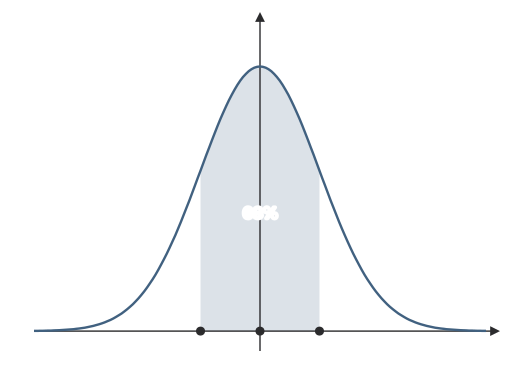
About 68% of the area lies within one standard deviation of the mean, about 95% within two and about 99.7% within three.

A normal curve with the band from μ − σ to μ + σ shaded and marked 68%.
About 68% of a normal distribution lies within one standard deviation of the mean.

Example 2 · Shorter than 163 cm

With heights normal, mean 160 cm and standard deviation 6 cm, what proportion of girls are shorter than 163 cm? Take P(0<Z<0.5)=0.1915P(0 < Z < 0.5) = 0.1915.

  1. z=0.5z = 0.5, so we need P(Z<0.5)P(Z < 0.5).

  2. The left half is 0.5, and 0.1915 more lies between 0 and 0.5: 0.5+0.1915=0.69150.5 + 0.1915 = 0.6915.

Answer

0.6915, about 69% of the girls.

Watch out

The table area runs from 0, not from the far left. P(Z>z)P(Z > z) is 0.50.5 minus the table area, not 11 minus it.

Using the normal distribution

How do you answer a "what percentage" or "how many" question?

Find the probability as above, then multiply by 100 for a percentage, or by the size of the group for a count. By the 68% rule, about 68% of the girls are between 160−6=154160 - 6 = 154 and 160+6=166160 + 6 = 166 cm tall.

How CUET asks this chapter

  • The curve: its properties, which of two curves has the larger spread, its total area.
  • z: a value to zz, zz back to a value, comparing scores, μ\mu and σ\sigma from two values.
  • Areas: to the left or right of zz, between two values, often with the region drawn.
  • Applications: a percentage, a count in a group, a probability, the middle 95%.

Exam shortcuts

  • z=x−μσz = \frac{x - \mu}{\sigma}; x=μ+zσx = \mu + z\sigma.
  • P(Z<z)=0.5+A(z)P(Z < z) = 0.5 + A(z) and P(Z>z)=0.5−A(z)P(Z > z) = 0.5 - A(z) for z>0z > 0.
  • Same side of 0: subtract the areas; opposite sides: add them.
  • 68%, 95%, 99.7% within 1, 2, 3 standard deviations.

Common mistakes

  • Dropping the minus sign of a value below the mean.
  • Taking the table area as the whole left side.
  • Adding areas on the same side of 0.
  • Giving a proportion when a percentage or a count is asked.

Quick revision

The curve

  • Symmetric about μ\mu; total area 1
  • Larger σ\sigma: lower, wider

Using z

  • z=x−μσz = \frac{x - \mu}{\sigma}, mean 0, SD 1
  • Build areas from 0.5 and the table

Next in Section B2: data that change over time, in time series and trend.

Next · 08Quick revision

Check your understanding

68 questions, grouped by type, easy to hard. Pick an answer and check it. The worked solution opens when you ask for it.

The normal curveQ1 of 68Q1

The normal curve

9 questions

Which of these is true of every normal curve?

Options for question 1

Show the explanationHide the explanation

AnswerB · It is symmetric about its mean

  1. The normal curve is bell-shaped and symmetric about the mean μ\mu, so its mean, median and mode coincide.

  2. Its tails come ever closer to the axis but never meet it.

Worth noting

Beyond three standard deviations the curve is very close to the axis, but it never touches it.
What is the total area under a normal curve?

Options for question 2

Show the explanationHide the explanation

AnswerD · 11

  1. The area under the curve is the total probability.

  2. Total probability is always 1, whatever μ\mu and σ\sigma are.

Worth noting

0.5 is the area on one side of the mean.

Read the two statements and choose the correct option.

I. The normal distribution is a continuous distribution.

II. The normal curve is highest at its mean.

Options for question 3

Show the explanationHide the explanation

AnswerC · Both I and II

  1. I: a normal variable can take any value in an interval, such as a height or a weight. True.

  2. II: the peak of the bell is at the mean, which is also the mode. True.

XX is normal with mean 50. What is P(X<50)P(X < 50)?

Options for question 4

Show the explanationHide the explanation

AnswerC · 0.50.5

  1. The normal curve is symmetric about its mean.

  2. So exactly half the area lies below the mean: 0.5.

Worth noting

0 confuses 'below the mean' with 'exactly at the mean', which has probability 0.

Assertion (A): For every normal distribution, P(X>μ)=0.5P(X > \mu) = 0.5.

Reason (R): The normal curve is symmetric about its mean.

Options for question 5

Show the explanationHide the explanation

AnswerA · Both A and R are true, and R is the correct explanation of A.

  1. R is a defining property of the normal curve. True.

  2. Symmetry splits the total area of 1 into two equal halves at μ\mu, so A is true because of R.

Which of the following are true of a normal distribution?

I. Its mean, median and mode are equal.

II. Its curve never touches the horizontal axis.

III. The area to the left of the mean is 0.5.

IV. Its standard deviation can be negative.

Options for question 6

Show the explanationHide the explanation

AnswerA · I, II and III only

  1. Symmetry puts the mean, median and mode together (I) and half the area on each side of the mean (III); the tails only approach the axis (II).

  2. IV is false: a standard deviation measures spread and is never negative.

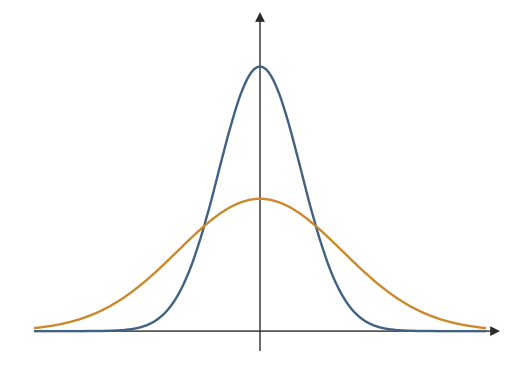
The figure shows two normal curves, A and B, with the same mean. Which statement is true?

Two bell-shaped normal curves with the same centre: curve A is tall and narrow, curve B is lower and wider.
Options for question 7

Show the explanationHide the explanation

AnswerC · B has the larger standard deviation

  1. Both curves enclose an area of 1, so a wider curve must be lower.

  2. B is lower and more spread out, so its standard deviation is larger.

Worth noting

A is taller, but height shows how bunched the values are: a taller curve has the smaller spread.

Two normal curves, A and B, have the same standard deviation. A has mean 40 and B has mean 60. Which statement is true?

Options for question 8

Show the explanationHide the explanation

AnswerB · They have the same shape, and B is A moved 20 to the right

  1. The standard deviation sets the shape; equal standard deviations mean identical shapes.

  2. The mean sets the position: B's centre is 20 units to the right of A's.

Worth noting

Every normal curve encloses area exactly 1.

Which of the following are true of a normal distribution?

I. A larger standard deviation gives a flatter, wider curve.

II. The curve is highest at the mean.

III. The curve is skewed to the right.

IV. The probability that XX equals one exact value is 0.

Options for question 9

Show the explanationHide the explanation

AnswerD · I, II and IV only

  1. I: the total area stays 1, so a wider spread means a lower peak. II: the peak is at the mean. IV: a single point has no width, so no area.

  2. III is false: the normal curve is symmetric, not skewed.

The standard normal variate

16 questions

A variable is normal with mean 60 and standard deviation 8. What is the standard normal variate zz for x=72x = 72?

Options for question 10

Show the explanationHide the explanation

AnswerB · 1.51.5

  1. z=x−μσz = \frac{x - \mu}{\sigma}.

  2. z=72−608=128=1.5z = \frac{72 - 60}{8} = \frac{12}{8} = 1.5.

Worth noting

12 is the distance from the mean in marks; z counts it in standard deviations.

A variable is normal with mean 50 and standard deviation 4. What is the standard normal variate zz for x=42x = 42?

Options for question 11

Show the explanationHide the explanation

AnswerB · −2-2

  1. z=x−μσz = \frac{x - \mu}{\sigma}.

  2. z=42−504=−2z = \frac{42 - 50}{4} = -2.

Worth noting

-8 is the distance from the mean in units, not in standard deviations.

A variable is normal with mean 65 and standard deviation 6. What is the standard normal variate zz for x=74x = 74?

Options for question 12

Show the explanationHide the explanation

AnswerC · 1.51.5

  1. z=x−μσz = \frac{x - \mu}{\sigma}.

  2. z=74−656=1.5z = \frac{74 - 65}{6} = 1.5.

Worth noting

9 is the distance from the mean in units, not in standard deviations.

In a board's Mathematics exam the marks are normal with mean 60 and standard deviation 8; in its English exam they are normal with mean 55 and standard deviation 10. Aman scores 76 in Mathematics and 70 in English. (Take P(0<Z<1)=0.3413P(0 < Z < 1) = 0.3413.)

What is Aman's zz-score in Mathematics?

Options for question 13

Show the explanationHide the explanation

AnswerC · 22

  1. z=76−608z = \frac{76 - 60}{8}.

  2. 168=2\frac{16}{8} = 2.

Worth noting

1.5 is his English zz-score.

In a board's Mathematics exam the marks are normal with mean 60 and standard deviation 8; in its English exam they are normal with mean 55 and standard deviation 10. Aman scores 76 in Mathematics and 70 in English. (Take P(0<Z<1)=0.3413P(0 < Z < 1) = 0.3413.)

What Mathematics mark has a zz-score of −1.5-1.5?

Options for question 14

Show the explanationHide the explanation

AnswerA · 4848

  1. x=μ+zσx = \mu + z\sigma.

  2. 60+(−1.5)(8)=60−12=4860 + (-1.5)(8) = 60 - 12 = 48.

Worth noting

72 adds the 12 marks; a negative zz lies below the mean.

A variable is normal with mean 50 and standard deviation 5. Which value of xx has z=−1.2z = -1.2?

Options for question 15

Show the explanationHide the explanation

AnswerA · 4444

  1. x=μ+zσx = \mu + z\sigma.

  2. x=50+(−1.2)(5)=50−6=44x = 50 + (-1.2)(5) = 50 - 6 = 44.

Worth noting

56 adds the 6 instead of subtracting it: a negative z lies below the mean.

What are the mean and the standard deviation of the standard normal variate ZZ?

Options for question 16

Show the explanationHide the explanation

AnswerD · Mean 0, standard deviation 1

  1. Z=X−μσZ = \frac{X - \mu}{\sigma} shifts the mean to 0 and scales the spread to 1.

  2. So ZZ has mean 0 and standard deviation 1, whatever XX was.

Worth noting

μ\mu and σ\sigma belong to the original variable XX, not to ZZ.

Asha scored 72 in a test whose marks have mean 60 and standard deviation 8. Ravi scored 80 in another test with mean 70 and standard deviation 10. Who did better compared with their own class?

Options for question 17

Show the explanationHide the explanation

AnswerB · Asha, with z=1.5z = 1.5 against 1

  1. Asha: z=72−608=1.5z = \frac{72 - 60}{8} = 1.5. Ravi: z=80−7010=1z = \frac{80 - 70}{10} = 1.

  2. Asha is 1.5 standard deviations above her class, Ravi only 1, so Asha did better.

Worth noting

Ravi's 80 is the higher mark, but marks from different tests can only be compared after standardising.

A variable is normal with mean 80, and x=92x = 92 has z=1.5z = 1.5. What is the standard deviation?

Options for question 18

Show the explanationHide the explanation

AnswerC · 88

  1. 1.5=92−80σ1.5 = \frac{92 - 80}{\sigma}.

  2. σ=121.5=8\sigma = \frac{12}{1.5} = 8.

Worth noting

18 multiplies 12 by 1.5 instead of dividing.

A variable is normal with mean 120 and standard deviation 15. Which value of xx has z=0.8z = 0.8?

Options for question 19

Show the explanationHide the explanation

AnswerD · 132132

  1. x=μ+zσx = \mu + z\sigma.

  2. 120+0.8×15=132120 + 0.8 \times 15 = 132.

Worth noting

108 goes 0.8 standard deviations below the mean; zz is positive.

XX is normal with mean μ\mu and standard deviation σ\sigma. Which of these has the standard normal distribution?

Options for question 20

Show the explanationHide the explanation

AnswerB · X−μσ\frac{X - \mu}{\sigma}

  1. Subtracting μ\mu moves the mean to 0; dividing by σ\sigma makes the standard deviation 1.

  2. So Z=X−μσZ = \frac{X - \mu}{\sigma} has mean 0 and standard deviation 1.

Worth noting

X−μX - \mu has mean 0 but keeps the standard deviation σ\sigma.

Neha scored 68 in Physics, where the marks have mean 60 and standard deviation 5, and 75 in Chemistry, where they have mean 65 and standard deviation 8. In which subject did she do better compared with the others?

Options for question 21

Show the explanationHide the explanation

AnswerD · Physics, since z=1.6z = 1.6 against z=1.25z = 1.25

  1. Physics: z=68−605=1.6z = \frac{68 - 60}{5} = 1.6. Chemistry: z=75−658=1.25z = \frac{75 - 65}{8} = 1.25.

  2. The higher zz is the better relative score: Physics.

Worth noting

10 marks above the mean is less impressive when the marks are spread wider, with standard deviation 8.

In a board's Mathematics exam the marks are normal with mean 60 and standard deviation 8; in its English exam they are normal with mean 55 and standard deviation 10. Aman scores 76 in Mathematics and 70 in English. (Take P(0<Z<1)=0.3413P(0 < Z < 1) = 0.3413.)

In which subject did Aman do better compared with the other candidates?

Options for question 22

Show the explanationHide the explanation

AnswerB · Mathematics: his zz-score is 2, against 1.5 in English

  1. Mathematics: z=76−608=2z = \frac{76 - 60}{8} = 2. English: z=70−5510=1.5z = \frac{70 - 55}{10} = 1.5.

  2. A higher zz-score means a better standing, so Mathematics.

Worth noting

Raw marks cannot be compared across exams with different means and spreads.

In a board's Mathematics exam the marks are normal with mean 60 and standard deviation 8; in its English exam they are normal with mean 55 and standard deviation 10. Aman scores 76 in Mathematics and 70 in English. (Take P(0<Z<1)=0.3413P(0 < Z < 1) = 0.3413.)

What percentage of candidates score below 52 in Mathematics?

Options for question 23

Show the explanationHide the explanation

AnswerA · 15.87%

  1. z=52−608=−1z = \frac{52 - 60}{8} = -1.

  2. 0.5−0.3413=0.15870.5 - 0.3413 = 0.1587, so 15.87%.

Worth noting

84.13% is the share scoring 52 or more.

In a normal distribution, x=65x = 65 has z=1.5z = 1.5 and x=45x = 45 has z=−0.5z = -0.5. What are the mean and the standard deviation?

Options for question 24

Show the explanationHide the explanation

AnswerD · μ=50, σ=10\mu = 50,\ \sigma = 10

  1. 65=μ+1.5σ65 = \mu + 1.5\sigma and 45=μ−0.5σ45 = \mu - 0.5\sigma. Subtracting: 20=2σ20 = 2\sigma, so σ=10\sigma = 10.

  2. Then μ=45+5=50\mu = 45 + 5 = 50.

Worth noting

μ=55\mu = 55 is the midpoint of 45 and 65, but the two values are not equally far from the mean.

In a normal distribution, x=70x = 70 has z=2z = 2 and x=40x = 40 has z=−1z = -1. What are the mean and the standard deviation?

Options for question 25

Show the explanationHide the explanation

AnswerA · Mean 50, standard deviation 10

  1. 70=μ+2σ70 = \mu + 2\sigma and 40=μ−σ40 = \mu - \sigma.

  2. Subtracting: 30=3σ30 = 3\sigma, so σ=10\sigma = 10 and μ=50\mu = 50.

Worth noting

Mean 55 is the midpoint of 40 and 70, which would need the two zz-values to be opposites.

Areas under the curve

21 questions

About what percentage of a normal distribution lies within one standard deviation of the mean?

Options for question 26

Show the explanationHide the explanation

AnswerB · 68%

  1. The areas within 1, 2 and 3 standard deviations of the mean are about 68%, 95% and 99.7%.

  2. So about 68% lies between μ−σ\mu - \sigma and μ+σ\mu + \sigma.

Worth noting

95% is the share within two standard deviations.

Given P(0<Z<0.8)=0.2881P(0 < Z < 0.8) = 0.2881, what is P(Z<0.8)P(Z < 0.8)?

Options for question 27

Show the explanationHide the explanation

AnswerD · 0.78810.7881

  1. The left half has area 0.5, and 0.2881 lies between 0 and 0.8.

  2. 0.5+0.2881=0.78810.5 + 0.2881 = 0.7881.

Worth noting

0.2881 is only the part from 0 to 0.8.

Given P(0<Z<1.96)=0.475P(0 < Z < 1.96) = 0.475, what is P(−1.96<Z<1.96)P(-1.96 < Z < 1.96)?

Options for question 28

Show the explanationHide the explanation

AnswerC · 0.950.95

  1. By symmetry, the area from −1.96-1.96 to 0 is also 0.475.

  2. 2×0.475=0.952 \times 0.475 = 0.95.

Worth noting

0.475 covers only one side of 0.

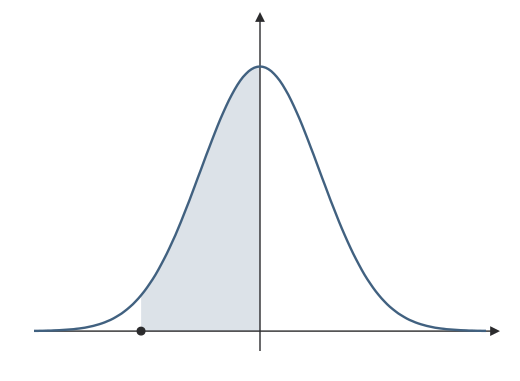
The figure shows the standard normal curve with the area from z=−2z = -2 to z=0z = 0 shaded. Given P(0<Z<2)=0.4772P(0 < Z < 2) = 0.4772, what is the shaded area?

The standard normal curve with the area from z = −2 to z = 0 shaded.
Options for question 29

Show the explanationHide the explanation

AnswerB · 0.47720.4772

  1. By symmetry, the area from −2-2 to 0 equals the area from 0 to 2.

  2. So it is 0.4772.

Worth noting

0.0228 is the tail beyond −2-2, outside the shaded part.

About what percentage of a normal distribution lies more than 2 standard deviations from the mean, on either side?

Options for question 30

Show the explanationHide the explanation

AnswerB · 5%

  1. About 95% lies within 2 standard deviations of the mean.

  2. So about 100%−95%=5%100\% - 95\% = 5\% lies beyond, split between the two tails.

Worth noting

2.5% is one tail only; 'either side' counts both.

The heights of 15-year-old girls in a city are normally distributed with mean 150 cm and standard deviation 10 cm. (Take P(0<Z<0.5)=0.1915P(0 < Z < 0.5) = 0.1915, P(0<Z<1)=0.3413P(0 < Z < 1) = 0.3413, P(0<Z<1.5)=0.4332P(0 < Z < 1.5) = 0.4332 and P(0<Z<1.96)=0.4750P(0 < Z < 1.96) = 0.4750.)

What is the zz-score of a girl in the city who is 165 cm tall?

Options for question 31

Show the explanationHide the explanation

AnswerC · 1.51.5

  1. z=x−μσz = \frac{x - \mu}{\sigma}.

  2. 165−15010=1.5\frac{165 - 150}{10} = 1.5.

Worth noting

15 is the distance from the mean in cm, before dividing by the standard deviation.

For the standard normal variate, P(0<Z<1.5)=0.4332P(0 < Z < 1.5) = 0.4332. What is P(Z<1.5)P(Z < 1.5)?

Options for question 32

Show the explanationHide the explanation

AnswerC · 0.93320.9332

  1. The area to the left of 0 is 0.5, by symmetry.

  2. P(Z<1.5)=0.5+0.4332=0.9332P(Z < 1.5) = 0.5 + 0.4332 = 0.9332.

Worth noting

0.4332 is only the part from 0 to 1.5; the whole left half comes too.

For the standard normal variate, P(0<Z<2)=0.4772P(0 < Z < 2) = 0.4772. What is P(Z>2)P(Z > 2)?

Options for question 33

Show the explanationHide the explanation

AnswerA · 0.02280.0228

  1. The area to the right of 0 is 0.5, and 0.4772 of it lies between 0 and 2.

  2. P(Z>2)=0.5−0.4772=0.0228P(Z > 2) = 0.5 - 0.4772 = 0.0228.

Worth noting

0.5228 takes 0.4772 away from 1, but 0.4772 is measured from 0, not from the far left.

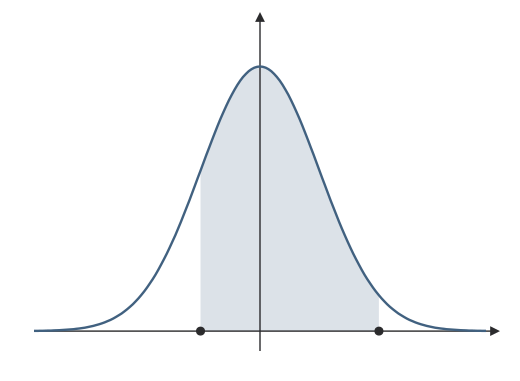
The figure shows the standard normal curve with the area from z=−1z = -1 to z=2z = 2 shaded. Given P(0<Z<1)=0.3413P(0 < Z < 1) = 0.3413 and P(0<Z<2)=0.4772P(0 < Z < 2) = 0.4772, what is the shaded area?

The standard normal curve with the area under it from z = −1 to z = 2 shaded.
Options for question 34

Show the explanationHide the explanation

AnswerC · 0.81850.8185

  1. The shaded region straddles 0: by symmetry, the part from −1-1 to 0 equals the part from 0 to 1, 0.3413.

  2. Shaded area =0.3413+0.4772=0.8185= 0.3413 + 0.4772 = 0.8185.

Worth noting

0.1359 subtracts the two areas, which is right only when both z-values are on the same side of 0.

Given P(0<Z<1)=0.3413P(0 < Z < 1) = 0.3413, what is P(Z<−1)P(Z < -1)?

Options for question 35

Show the explanationHide the explanation

AnswerA · 0.15870.1587

  1. By symmetry, P(Z<−1)=P(Z>1)P(Z < -1) = P(Z > 1).

  2. =0.5−0.3413=0.1587= 0.5 - 0.3413 = 0.1587.

Worth noting

0.8413 is P(Z<1)P(Z < 1), everything to the left of +1+1.

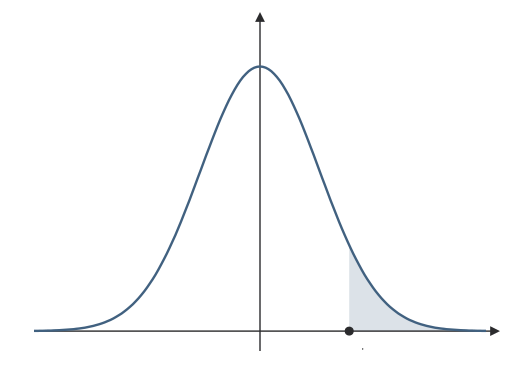
The figure shows the standard normal curve with the area to the right of z=1.5z = 1.5 shaded. Given P(0<Z<1.5)=0.4332P(0 < Z < 1.5) = 0.4332, what is the shaded area?

The standard normal curve with the small area to the right of z = 1.5 shaded.
Options for question 36

Show the explanationHide the explanation

AnswerB · 0.06680.0668

  1. The whole right half has area 0.5, and 0.4332 of it lies between 0 and 1.5.

  2. Shaded tail =0.5−0.4332=0.0668= 0.5 - 0.4332 = 0.0668.

Worth noting

0.4332 is the unshaded part between 0 and 1.5.

Given P(0<Z<0.4)=0.1554P(0 < Z < 0.4) = 0.1554 and P(0<Z<2.4)=0.4918P(0 < Z < 2.4) = 0.4918, what is P(0.4<Z<2.4)P(0.4 < Z < 2.4)?

Options for question 37

Show the explanationHide the explanation

AnswerA · 0.33640.3364

  1. Both z-values are right of 0: subtract the smaller area from the larger.

  2. 0.4918−0.1554=0.33640.4918 - 0.1554 = 0.3364.

Worth noting

0.6472 adds the areas, as if the z-values were on opposite sides of 0.

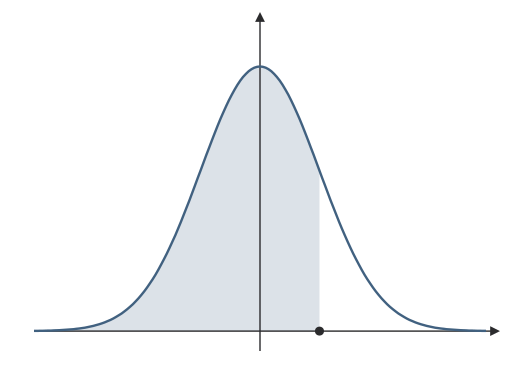
The figure shows the standard normal curve with the area to the left of z=1z = 1 shaded. Given P(0<Z<1)=0.3413P(0 < Z < 1) = 0.3413, what is the shaded area?

The standard normal curve with the whole area to the left of z = 1 shaded.
Options for question 38

Show the explanationHide the explanation

AnswerD · 0.84130.8413

  1. The shaded area is everything to the left of z=1z = 1: the left half, 0.5, plus 0.3413.

  2. 0.5+0.3413=0.84130.5 + 0.3413 = 0.8413.

Worth noting

0.3413 is only the part from 0 to 1.

Given P(0<Z<1.2)=0.3849P(0 < Z < 1.2) = 0.3849, what is P(Z>1.2)P(Z > 1.2)?

Options for question 39

Show the explanationHide the explanation

AnswerA · 0.11510.1151

  1. The right half has area 0.5, of which 0.3849 lies between 0 and 1.2.

  2. 0.5−0.3849=0.11510.5 - 0.3849 = 0.1151.

Worth noting

0.6151 takes 0.3849 from 1, but it is measured from 0, not from the far left.

Given P(0<Z<0.6)=0.2257P(0 < Z < 0.6) = 0.2257 and P(0<Z<1.8)=0.4641P(0 < Z < 1.8) = 0.4641, what is P(−0.6<Z<1.8)P(-0.6 < Z < 1.8)?

Options for question 40

Show the explanationHide the explanation

AnswerC · 0.68980.6898

  1. The interval straddles 0: the part from −0.6-0.6 to 0 equals the part from 0 to 0.6, 0.2257.

  2. 0.2257+0.4641=0.68980.2257 + 0.4641 = 0.6898.

Worth noting

0.2384 subtracts the areas, which is for two z-values on the same side of 0.

The heights of 15-year-old girls in a city are normally distributed with mean 150 cm and standard deviation 10 cm. (Take P(0<Z<0.5)=0.1915P(0 < Z < 0.5) = 0.1915, P(0<Z<1)=0.3413P(0 < Z < 1) = 0.3413, P(0<Z<1.5)=0.4332P(0 < Z < 1.5) = 0.4332 and P(0<Z<1.96)=0.4750P(0 < Z < 1.96) = 0.4750.)

What percentage of the city's girls are shorter than 145 cm?

Options for question 41

Show the explanationHide the explanation

AnswerB · 30.85%

  1. z=145−15010=−0.5z = \frac{145 - 150}{10} = -0.5.

  2. P(Z<−0.5)=0.5−0.1915=0.3085P(Z < -0.5) = 0.5 - 0.1915 = 0.3085, so 30.85%.

Worth noting

19.15% is the share between 145 cm and the mean.

The heights of 15-year-old girls in a city are normally distributed with mean 150 cm and standard deviation 10 cm. (Take P(0<Z<0.5)=0.1915P(0 < Z < 0.5) = 0.1915, P(0<Z<1)=0.3413P(0 < Z < 1) = 0.3413, P(0<Z<1.5)=0.4332P(0 < Z < 1.5) = 0.4332 and P(0<Z<1.96)=0.4750P(0 < Z < 1.96) = 0.4750.)

What percentage of the city's girls are between 140 cm and 165 cm tall?

Options for question 42

Show the explanationHide the explanation

AnswerD · 77.45%

  1. z=−1z = -1 at 140 cm and z=1.5z = 1.5 at 165 cm, on opposite sides of the mean.

  2. 0.3413+0.4332=0.77450.3413 + 0.4332 = 0.7745, so 77.45%.

Worth noting

9.19% subtracts the areas, which is right only when both values lie on the same side of the mean.

Given P(0<Z<1.25)=0.3944P(0 < Z < 1.25) = 0.3944, what is P(Z<−1.25)P(Z < -1.25)?

Options for question 43

Show the explanationHide the explanation

AnswerB · 0.10560.1056

  1. By symmetry, P(Z<−1.25)=P(Z>1.25)P(Z < -1.25) = P(Z > 1.25).

  2. 0.5−0.3944=0.10560.5 - 0.3944 = 0.1056.

Worth noting

0.8944 is P(Z<1.25)P(Z < 1.25); the minus sign puts the value in the left tail.

Given P(0<Z<0.25)=0.0987P(0 < Z < 0.25) = 0.0987, what is P(Z>−0.25)P(Z > -0.25)?

Options for question 44

Show the explanationHide the explanation

AnswerD · 0.59870.5987

  1. P(Z>−0.25)P(Z > -0.25) is the whole right half plus the part from −0.25-0.25 to 0, which equals 0.0987.

  2. 0.5+0.0987=0.59870.5 + 0.0987 = 0.5987.

Worth noting

0.4013 is P(Z<−0.25)P(Z < -0.25), the other side.

Given P(0<Z<0.5)=0.1915P(0 < Z < 0.5) = 0.1915 and P(0<Z<1.5)=0.4332P(0 < Z < 1.5) = 0.4332, what is P(0.5<Z<1.5)P(0.5 < Z < 1.5)?

Options for question 45

Show the explanationHide the explanation

AnswerA · 0.24170.2417

  1. Both z-values are on the right of 0, so the area between them is the larger area minus the smaller.

  2. 0.4332−0.1915=0.24170.4332 - 0.1915 = 0.2417.

Worth noting

0.6247 adds the two areas, which is for z-values on opposite sides of 0.

The heights of 15-year-old girls in a city are normally distributed with mean 150 cm and standard deviation 10 cm. (Take P(0<Z<0.5)=0.1915P(0 < Z < 0.5) = 0.1915, P(0<Z<1)=0.3413P(0 < Z < 1) = 0.3413, P(0<Z<1.5)=0.4332P(0 < Z < 1.5) = 0.4332 and P(0<Z<1.96)=0.4750P(0 < Z < 1.96) = 0.4750.)

Above what height are the tallest 2.5% of the city's girls?

Options for question 46

Show the explanationHide the explanation

AnswerC · 169.6 cm

  1. The top 2.5% lie above z=1.96z = 1.96, since 0.5−0.4750=0.0250.5 - 0.4750 = 0.025.

  2. x=150+1.96×10=169.6x = 150 + 1.96 \times 10 = 169.6 cm.

Worth noting

130.4 cm marks off the shortest 2.5%.

Using the normal distribution

22 questions

Reaction times are normal with mean 72 ms and standard deviation 9 ms. Between which two times do the middle 68% roughly lie?

Options for question 47

Show the explanationHide the explanation

AnswerD · 63 ms and 81 ms

  1. About 68% lie within one standard deviation of the mean.

  2. 72−9=6372 - 9 = 63 and 72+9=8172 + 9 = 81.

Worth noting

54 to 90 ms is two standard deviations each way, about 95%.

Delivery times are normal with mean 30 minutes and standard deviation 4 minutes. Between which two times do about 95% of deliveries fall?

Options for question 48

Show the explanationHide the explanation

AnswerA · 22 and 38 minutes

  1. About 95% lie within two standard deviations of the mean.

  2. 30−8=2230 - 8 = 22 and 30+8=3830 + 8 = 38 minutes.

Worth noting

26 to 34 minutes is one standard deviation each way, about 68%.

A machine fills packets of sugar. The weights are normally distributed with mean 500 g and standard deviation 5 g. (Take P(0<Z<1)=0.3413P(0 < Z < 1) = 0.3413, P(0<Z<2)=0.4772P(0 < Z < 2) = 0.4772 and P(0<Z<2.5)=0.4938P(0 < Z < 2.5) = 0.4938.)

What percentage of the sugar packets weigh less than 490 g?

Options for question 49

Show the explanationHide the explanation

AnswerA · 2.28%

  1. z=490−5005=−2z = \frac{490 - 500}{5} = -2.

  2. 0.5−0.4772=0.02280.5 - 0.4772 = 0.0228, so 2.28%.

Worth noting

4.56% counts both tails, light and heavy.

A machine fills packets of sugar. The weights are normally distributed with mean 500 g and standard deviation 5 g. (Take P(0<Z<1)=0.3413P(0 < Z < 1) = 0.3413, P(0<Z<2)=0.4772P(0 < Z < 2) = 0.4772 and P(0<Z<2.5)=0.4938P(0 < Z < 2.5) = 0.4938.)

What percentage of the sugar packets weigh between 495 g and 505 g?

Options for question 50

Show the explanationHide the explanation

AnswerB · 68.26%

  1. 495 g and 505 g are z=−1z = -1 and z=1z = 1.

  2. 2×0.3413=0.68262 \times 0.3413 = 0.6826, so 68.26%.

Worth noting

34.13% is only one side of the mean.

A food-delivery app's delivery times are normally distributed with mean 40 minutes and standard deviation 8 minutes. (Take P(0<Z<0.5)=0.1915P(0 < Z < 0.5) = 0.1915, P(0<Z<0.75)=0.2734P(0 < Z < 0.75) = 0.2734, P(0<Z<1.645)=0.45P(0 < Z < 1.645) = 0.45 and P(0<Z<2)=0.4772P(0 < Z < 2) = 0.4772.)

What percentage of the app's deliveries take more than 46 minutes?

Options for question 51

Show the explanationHide the explanation

AnswerB · 22.66%

  1. z=46−408=0.75z = \frac{46 - 40}{8} = 0.75.

  2. 0.5−0.2734=0.22660.5 - 0.2734 = 0.2266, so 22.66%.

Worth noting

27.34% is the share between 40 and 46 minutes.

Marks in an exam are normal with mean 60 and standard deviation 10. What percentage of students score more than 75? (Take P(0<Z<1.5)=0.4332P(0 < Z < 1.5) = 0.4332.)

Options for question 52

Show the explanationHide the explanation

AnswerA · 6.68%

  1. z=75−6010=1.5z = \frac{75 - 60}{10} = 1.5.

  2. P(Z>1.5)=0.5−0.4332=0.0668P(Z > 1.5) = 0.5 - 0.4332 = 0.0668, so 6.68% of students.

Worth noting

93.32% is the share scoring less than 75.

Heights of adults in a town are normal with mean 160 cm and standard deviation 5 cm. What percentage are between 155 cm and 170 cm? (Take P(0<Z<1)=0.3413P(0 < Z < 1) = 0.3413 and P(0<Z<2)=0.4772P(0 < Z < 2) = 0.4772.)

Options for question 53

Show the explanationHide the explanation

AnswerD · 81.85%

  1. z=155−1605=−1z = \frac{155 - 160}{5} = -1 and z=170−1605=2z = \frac{170 - 160}{5} = 2.

  2. P(−1<Z<2)=0.3413+0.4772=0.8185P(-1 < Z < 2) = 0.3413 + 0.4772 = 0.8185, so 81.85%.

Worth noting

68.26% is −1<Z<1-1 < Z < 1, which stops at 165 cm.

IQ scores are normal with mean 100 and standard deviation 15. Between which two scores does the middle 95% roughly lie?

Options for question 54

Show the explanationHide the explanation

AnswerD · 70 and 130

  1. About 95% lies within two standard deviations of the mean.

  2. 100±2×15100 \pm 2 \times 15: from 70 to 130.

Worth noting

85 to 115 is one standard deviation each way, about 68%.

Weights of a group are normal with mean 70 kg and standard deviation 8 kg. What percentage weigh less than 62 kg? (Take P(0<Z<1)=0.3413P(0 < Z < 1) = 0.3413.)

Options for question 55

Show the explanationHide the explanation

AnswerA · 15.87%

  1. z=62−708=−1z = \frac{62 - 70}{8} = -1.

  2. P(Z<−1)=0.5−0.3413=0.1587P(Z < -1) = 0.5 - 0.3413 = 0.1587, that is 15.87%.

Worth noting

84.13% is the share above 62 kg.

Marks in a test are normal with mean 55 and standard deviation 10. What percentage of students score more than 75? (Take P(0<Z<2)=0.4772P(0 < Z < 2) = 0.4772.)

Options for question 56

Show the explanationHide the explanation

AnswerA · 2.28%

  1. z=75−5510=2z = \frac{75 - 55}{10} = 2.

  2. P(Z>2)=0.5−0.4772=0.0228P(Z > 2) = 0.5 - 0.4772 = 0.0228, that is 2.28%.

Worth noting

47.72% is the share between 55 and 75.

Scores are normal with mean 500 and standard deviation 50. What percentage score between 450 and 600? (Take P(0<Z<1)=0.3413P(0 < Z < 1) = 0.3413 and P(0<Z<2)=0.4772P(0 < Z < 2) = 0.4772.)

Options for question 57

Show the explanationHide the explanation

AnswerC · 81.85%

  1. 450 gives z=−1z = -1 and 600 gives z=2z = 2.

  2. 0.3413+0.4772=0.81850.3413 + 0.4772 = 0.8185, that is 81.85%.

Worth noting

13.59% subtracts the areas; the interval straddles the mean, so they add.

Daily sales are normal with mean 50 units and standard deviation 4. What is the probability that a day's sales are more than 46 units? (Take P(0<Z<1)=0.3413P(0 < Z < 1) = 0.3413.)

Options for question 58

Show the explanationHide the explanation

AnswerD · 0.84130.8413

  1. z=46−504=−1z = \frac{46 - 50}{4} = -1.

  2. P(Z>−1)=0.5+0.3413=0.8413P(Z > -1) = 0.5 + 0.3413 = 0.8413.

Worth noting

0.1587 is the chance of fewer than 46 units.

A machine fills packets of sugar. The weights are normally distributed with mean 500 g and standard deviation 5 g. (Take P(0<Z<1)=0.3413P(0 < Z < 1) = 0.3413, P(0<Z<2)=0.4772P(0 < Z < 2) = 0.4772 and P(0<Z<2.5)=0.4938P(0 < Z < 2.5) = 0.4938.)

Out of 20,000 sugar packets, about how many weigh between 490 g and 510 g?

Options for question 59

Show the explanationHide the explanation

AnswerD · 19,08819{,}088

  1. 490 g to 510 g is z=−2z = -2 to z=2z = 2: 2×0.4772=0.95442 \times 0.4772 = 0.9544.

  2. 0.9544×20,000=19,0880.9544 \times 20{,}000 = 19{,}088 packets.

Worth noting

912 is the number outside that range.

A food-delivery app's delivery times are normally distributed with mean 40 minutes and standard deviation 8 minutes. (Take P(0<Z<0.5)=0.1915P(0 < Z < 0.5) = 0.1915, P(0<Z<0.75)=0.2734P(0 < Z < 0.75) = 0.2734, P(0<Z<1.645)=0.45P(0 < Z < 1.645) = 0.45 and P(0<Z<2)=0.4772P(0 < Z < 2) = 0.4772.)

What percentage of the app's deliveries take between 36 and 56 minutes?

Options for question 60

Show the explanationHide the explanation

AnswerD · 66.87%

  1. 36 minutes is z=−0.5z = -0.5 and 56 minutes is z=2z = 2.

  2. 0.1915+0.4772=0.66870.1915 + 0.4772 = 0.6687, so 66.87%.

Worth noting

28.57% subtracts the two areas, though the values lie on opposite sides of the mean.

A food-delivery app's delivery times are normally distributed with mean 40 minutes and standard deviation 8 minutes. (Take P(0<Z<0.5)=0.1915P(0 < Z < 0.5) = 0.1915, P(0<Z<0.75)=0.2734P(0 < Z < 0.75) = 0.2734, P(0<Z<1.645)=0.45P(0 < Z < 1.645) = 0.45 and P(0<Z<2)=0.4772P(0 < Z < 2) = 0.4772.)

Out of 5,000 of the app's deliveries, about how many take more than 46 minutes?

Options for question 61

Show the explanationHide the explanation

AnswerA · 1,1331{,}133

  1. 22.66% of deliveries take more than 46 minutes.

  2. 0.2266×5,000=1,1330.2266 \times 5{,}000 = 1{,}133.

Worth noting

1,367 uses 27.34%, the share between 40 and 46 minutes.

The life of a battery is normal with mean 1,000 hours and standard deviation 100 hours. What is the probability that a battery lasts between 900 and 1,100 hours? (Take P(0<Z<1)=0.3413P(0 < Z < 1) = 0.3413.)

Options for question 62

Show the explanationHide the explanation

AnswerC · 0.68260.6826

  1. 900 and 1,100 give z=−1z = -1 and z=1z = 1.

  2. 2×0.3413=0.68262 \times 0.3413 = 0.6826.

Worth noting

0.3413 covers only 1,000 to 1,100 hours.

10,000 students take a test whose marks are normal with mean 50 and standard deviation 10. About how many score below 40? (Take P(0<Z<1)=0.3413P(0 < Z < 1) = 0.3413.)

Options for question 63

Show the explanationHide the explanation

AnswerC · 1,5871{,}587

  1. z=40−5010=−1z = \frac{40 - 50}{10} = -1, and P(Z<−1)=0.5−0.3413=0.1587P(Z < -1) = 0.5 - 0.3413 = 0.1587.

  2. 0.1587×10,000=1,5870.1587 \times 10{,}000 = 1{,}587 students.

Worth noting

3,413 is the number between 40 and 50, not below 40.

The life of a bulb is normal with mean 800 hours and standard deviation 40 hours. What is the probability that a bulb lasts more than 880 hours? (Take P(0<Z<2)=0.4772P(0 < Z < 2) = 0.4772.)

Options for question 64

Show the explanationHide the explanation

AnswerB · 0.02280.0228

  1. z=880−80040=2z = \frac{880 - 800}{40} = 2.

  2. P(Z>2)=0.5−0.4772=0.0228P(Z > 2) = 0.5 - 0.4772 = 0.0228.

Worth noting

0.4772 is the chance of lasting between 800 and 880 hours.

Marks are normal with mean 65 and standard deviation 7. The top 2.28% of students get an A. What is the least mark for an A? (Take P(0<Z<2)=0.4772P(0 < Z < 2) = 0.4772.)

Options for question 65

Show the explanationHide the explanation

AnswerC · 7979

  1. A tail of 2.28% means P(Z>z)=0.0228=0.5−0.4772P(Z > z) = 0.0228 = 0.5 - 0.4772, so z=2z = 2.

  2. x=65+2×7=79x = 65 + 2 \times 7 = 79.

Worth noting

51 goes 2 standard deviations below the mean: that marks the bottom 2.28%.

2,000 students take a test whose marks are normal with mean 60 and standard deviation 12. About how many score more than 78? (Take P(0<Z<1.5)=0.4332P(0 < Z < 1.5) = 0.4332.)

Options for question 66

Show the explanationHide the explanation

AnswerB · 134134

  1. z=78−6012=1.5z = \frac{78 - 60}{12} = 1.5, and P(Z>1.5)=0.5−0.4332=0.0668P(Z > 1.5) = 0.5 - 0.4332 = 0.0668.

  2. 0.0668×2,000=133.60.0668 \times 2{,}000 = 133.6, about 134 students.

Worth noting

866 uses 0.4332, the share between 60 and 78.

A machine fills packets of sugar. The weights are normally distributed with mean 500 g and standard deviation 5 g. (Take P(0<Z<1)=0.3413P(0 < Z < 1) = 0.3413, P(0<Z<2)=0.4772P(0 < Z < 2) = 0.4772 and P(0<Z<2.5)=0.4938P(0 < Z < 2.5) = 0.4938.)

The machine is adjusted so that the standard deviation falls to 4 g, with the same mean. What percentage of sugar packets now weigh less than 490 g?

Options for question 67

Show the explanationHide the explanation

AnswerA · 0.62%

  1. z=490−5004=−2.5z = \frac{490 - 500}{4} = -2.5.

  2. 0.5−0.4938=0.00620.5 - 0.4938 = 0.0062, so 0.62%.

Worth noting

2.28% keeps the old standard deviation of 5 g.

A food-delivery app's delivery times are normally distributed with mean 40 minutes and standard deviation 8 minutes. (Take P(0<Z<0.5)=0.1915P(0 < Z < 0.5) = 0.1915, P(0<Z<0.75)=0.2734P(0 < Z < 0.75) = 0.2734, P(0<Z<1.645)=0.45P(0 < Z < 1.645) = 0.45 and P(0<Z<2)=0.4772P(0 < Z < 2) = 0.4772.)

The app wants to promise a delivery time that only 5% of its deliveries exceed. What time should it promise?

Options for question 68

Show the explanationHide the explanation

AnswerC · 53.16 minutes

  1. The top 5% lie above z=1.645z = 1.645, since 0.5−0.45=0.050.5 - 0.45 = 0.05.

  2. 40+1.645×8=53.1640 + 1.645 \times 8 = 53.16 minutes.

Worth noting

55.68 minutes uses z=1.96z = 1.96, which leaves 2.5% above.

NTA's Mathematics / Applied Mathematics syllabus has three sections: Section A1, which every candidate answers, then Section B1 (Mathematics) or Section B2 (Applied Mathematics), of which a candidate answers one. Each section lists units and topics but no chapters, so the chapters here are ours. Where both B sections list a topic that Section A also lists, its questions sit once, in Section A.