Time, Speed and Distance for CUET General Aptitude
About 10 min to learn · 71 questions
Every time, speed and distance question in CUET's General Aptitude Test is a version of one relation: speed equals distance divided by time. What catches students is rarely the formula but a slip in units or reading. This lesson covers unit conversion, average speed, late-and-early problems, relative speed and chases, meeting points and circular tracks, trains crossing poles, platforms and each other, and boats and streams, with worked examples and traps.
Speed is distance divided by time, and every question in this chapter rearranges that one relation. Before using it, put all three quantities in matching units: km/h with kilometres and hours, m/s with metres and seconds. Most wrong answers here come from mixed units, not hard mathematics.
Two proportion facts save time. For a fixed distance, speed and time are inversely proportional: speeds in 3:5 mean times in 5:3. For a fixed time, distance is directly proportional to speed.
Multiply km/h by 185 to get m/s, and multiply m/s by 518 to get km/h. The factor comes from 1 km = 1,000 m and 1 hour = 3,600 s, so 1 km/h is 36001000=185 m/s.
km/h
18
36
54
72
90
108
m/s
5
10
15
20
25
30
Example 1 · Converting units
A metro train runs at 81 km/h. How far does it go in 40 seconds?
Speed: 81×185=22.5 m/s.
Distance: 22.5×40=900 m.
Answer
900 m
Watch out
Divide minutes by 60: 2 hours 24 minutes is 2+6024=2.4 hours, but 2 hours 15 minutes is 2.25 hours, not 2.15. And 1 m/s is 3.6 km/h, so the km/h figure is always the bigger one.
Average speed is total distance divided by total time. It is almost never the plain average of the speeds, because more time is spent at the slower speed. For the same distance at speeds x and y, the average is x+y2xy; only for the same time at each speed is it 2x+y.
Average speed, equal distances
Average speed=x+y2xy
Example 2 · There and back
Sunita drives to her office at 30 km/h and returns along the same road at 45 km/h. Find her average speed.
Equal distances, so use x+y2xy.
30+452×30×45=752700=36 km/h.
Answer
36 km/h
The tempting 37.5 km/h is the plain average and is wrong.
Exam shortcut
For three equal distances, take each part as the LCM of the speeds, find each time, and divide total distance by total time.
90 km at 45 km/h and 70 km at 35 km/h take 2 hours each, so the average is 160÷4=40 km/h. It equals the plain mean only because the times happen to be equal. Always check.
A target average fixes the total time allowed. Subtract the time already used to find the speed needed for the rest.
Find the difference between the two travel times, then write distance over one speed minus distance over the other equals that difference. Late by p minutes and early by q minutes lie on opposite sides of the right time, so the difference is p+q; late by both means p−q.
Example 3 · Late and early
At 6 km/h Farhan reaches the bus stop 8 minutes late; at 8 km/h he is 7 minutes early. How far is the stop?
Time difference: 8+7=15 minutes, which is 41 hour.
6d−8d=41, so 24d=41.
d=6.
Answer
6 km
Exam shortcut
At a fraction of the usual speed, say 54, the time becomes 45 of the usual, so the extra time is 41 of the usual time.
Relative speed is how fast the gap between two moving objects changes. In opposite directions, towards or away from each other, add the speeds. In the same direction, subtract the smaller from the larger.
Situation
Relative speed
Time taken
Moving towards each other
a+b
gap ÷ (a+b)
Moving apart from one point
a+b
separation ÷ (a+b)
One chasing the other
a−b
head start ÷ (a−b)
Example 4 · A late start
A tractor leaves a farm at 6:00 a.m. at 16 km/h. A jeep leaves the same farm at 7:15 a.m. at 36 km/h on the same road. When does the jeep catch the tractor?
By 7:15 the tractor is 16×141=20 km ahead.
The jeep gains 36−16=20 km an hour, so it needs 1 hour.
Answer
8:15 a.m.
Meetings and tracks
Two people starting together from the ends of a road meet at a point that divides it in the ratio of their speeds. With speeds 3:2, the faster has covered 53 of the road.
If after meeting they need t1 and t2 more hours, their speeds are in the ratio t2:t1.
On a circular track, runners in the same direction first meet after track ÷ (a−b), in opposite directions after track ÷ (a+b). To meet again at the start, take the LCM of the lap times.
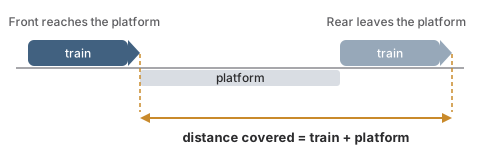
A train has length, so while crossing something it covers its own length plus the length of whatever it crosses. Then use the right speed: its own for a still object, the sum for something coming the other way, the difference for something going the same way.
To clear a platform, the front of the train travels the platform's length plus its own length.
The train crosses
Distance covered
A pole, signal or standing person
The train's length
A platform, bridge or tunnel
Train length + platform length
Another train
The sum of the two lengths
Example 5 · Overtaking
A 250 m train at 63 km/h overtakes a 200 m train running at 45 km/h on a parallel track. How long does overtaking take?
Same direction: 63−45=18 km/h, which is 5 m/s.
Distance: 250+200=450 m.
Time: 450÷5=90 s.
Answer
90 seconds
Example 6 · Pole and tunnel
A train passes a pole in 15 s and a 300 m tunnel in 27 s. Find its length.
The extra 12 s are spent covering the tunnel's 300 m, so the speed is 300÷12=25 m/s.
Length: 25×15=375 m.
Answer
375 m
Exam shortcut
The two-crossings pattern is common: the difference in times is the time to cover the difference in distances. And a passenger sitting in another train is a point moving at that train's speed, so only the first train's length is covered.
With the boat's still-water speed b and the stream's speed s, downstream speed is b+s and upstream speed is b−s. So the still-water speed is half their sum, and the stream speed is half their difference.
Boats and streams
b=2down+ups=2down−up
Example 7 · Still water and stream
A boat goes 42 km downstream in 3 hours and 20 km upstream in 2 hours. Find the speed in still water and the stream's speed.
Downstream: 42÷3=14 km/h. Upstream: 20÷2=10 km/h.
Still water: (14+10)÷2=12 km/h. Stream: (14−10)÷2=2 km/h.
Answer
12 km/h and 2 km/h
Exam shortcut
For a round trip, find the upstream and downstream times separately and add: b−sd+b+sd = total time.
An object floating in the river is at rest relative to the water, so a rower who goes away from it for 15 minutes and turns back at the same effort takes 15 minutes to return, whatever the stream.
Know the conversions. 18 km/h is 5 m/s, and multiples follow.
Equal distances. Average speed x+y2xy.
Late and early. Add the minutes for opposite sides, subtract for the same side.
Trains. Add the lengths of everything crossed.
Sense checks. An average speed lies between the speeds, nearer the slower one for equal distances. A still-water speed lies between upstream and downstream.
Joseph and Fatima cycle the same route to college. Joseph takes 40 minutes and Fatima takes 50 minutes. If Joseph rides at 15 km/h, what is Fatima's speed?
Show the explanationHide the explanation
AnswerA · 12 km/h
Route length =15×6040=10 km.
Fatima's speed =50/6010=12 km/h.
Worth noting
For a fixed distance, speed is inversely proportional to time. Scaling 15 by 4050 gives 18.75 km/h, which wrongly makes the slower rider faster.
A hiker covers three equal stretches of a trail: uphill at 10 km/h, on the flat at 20 km/h and downhill at 60 km/h. What is her average speed for the whole trail?
Show the explanationHide the explanation
AnswerB · 18 km/h
Let each stretch be 60 km (any convenient length works).
Times: 1060+2060+6060=6+3+1=10 h.
Average speed =10180=18 km/h.
Worth noting
30 km/h is the mean of the three speeds. Average speed is always total distance ÷ total time.
Two friends walk the same distance. Their speeds are in the ratio 3:4, and the slower friend takes 20 minutes longer. How long does the faster friend take?
Show the explanationHide the explanation
AnswerD · 60 min
Times are in the inverse ratio 4:3.
The difference 4−3=1 part = 20 minutes.
Faster friend's time = 3 parts = 60 minutes.
Worth noting
20 minutes is only the difference between the two times, which is one part of the ratio. The faster friend's time is 3 such parts.
A cyclist rides 6 km uphill at 9 km/h, then 6 km downhill at 18 km/h, and finally 12 km on a level road at 12 km/h. What is his average speed for the ride?
Show the explanationHide the explanation
AnswerA · 12 km/h
Uphill time =96=32 h; downhill =186=31 h; level =1212=1 h.
Total time = 2 h; total distance = 24 km.
Average speed =224=12 km/h.
Worth noting
13 km/h is the mean of 9, 18 and 12. The distances and times are unequal, so that mean means nothing here.
If Nikhil travelled 4 km/h faster he would take 1 hour less for a journey; if he travelled 4 km/h slower he would take 1 hour 30 minutes more. How long is the journey?
Show the explanationHide the explanation
AnswerD · 120 km
Faster: vd−v+4d=1 gives 4d=v(v+4).
Slower: v−4d−vd=23 gives 4d=23v(v−4).
So v+4=23(v−4), giving v=20 km/h.
d=420×24=120 km. Check: 6 h at 20, 5 h at 24, 7.5 h at 16.
Worth noting
The two changes in speed are equal but the time changes are not, because time depends on speed inversely.
Kavya jogs at 8 km/h and Rohan cycles at 14 km/h. Both start from the same gate at the same time along the same road in the same direction. How far apart are they after 45 minutes?
Show the explanationHide the explanation
AnswerA · 4.5 km
Same direction: relative speed = 14−8=6 km/h.
Gap after 45 min =6×43=4.5 km.
Worth noting
16.5 km uses the sum of speeds, which is only right if they go in opposite directions.
From a crossing, Anjali cycles north at 12 km/h and Irfan cycles south at 18 km/h, both starting together. How far apart are they after 2 hours 30 minutes?
Show the explanationHide the explanation
AnswerD · 75 km
Opposite directions: they separate at 12+18=30 km/h.
Distance apart =30×2.5=75 km.
Worth noting
15 km uses the difference of speeds; 45 km is how far Irfan alone has gone.
A pickpocket running at 10 km/h is spotted by a constable 200 m behind him, who immediately gives chase at 12 km/h. How long does the constable take to catch him?
Show the explanationHide the explanation
AnswerC · 6 min
Same direction: the constable gains at 12−10=2 km/h.
Gap = 200 m=0.2 km. Time =20.2=0.1h=6 min.
Worth noting
Dividing 0.2 km by 12 km/h (1 min) forgets that the pickpocket is also running away.
Two buses leave Pune and Nashik, 210 km apart, at 8:00 a.m. and travel towards each other at 40 km/h and 30 km/h. The Pune bus is the faster one. How far from Pune do they meet?
Show the explanationHide the explanation
AnswerC · 120 km
Closing speed = 40+30=70 km/h, so they meet after 70210=3 h.
The Pune bus covers 40×3=120 km in that time.
Worth noting
90 km is the Nashik bus's share, measured from Nashik. The distances split in the ratio of speeds, 4:3.
A cyclist leaves a dhaba at 7:00 a.m. riding at 12 km/h. A motorcyclist leaves the same dhaba at 8:30 a.m. on the same road at 30 km/h. At what time does the motorcyclist overtake the cyclist?
Show the explanationHide the explanation
AnswerD · 9:30 a.m.
By 8:30 a.m. the cyclist is 12×1.5=18 km ahead.
The motorcyclist gains at 30−12=18 km/h.
Time to close the gap =1818=1 h, so the overtaking happens at 9:30 a.m.
Worth noting
9:06 a.m. comes from dividing the 18 km head start by 30 km/h, as if the cyclist had stopped.
Mohit and Sneha start together from the same point on a 400 m circular track and run in the same direction at 5 m/s and 3 m/s. After how many seconds do they first meet again?
Show the explanationHide the explanation
AnswerC · 200 s
Same direction: Mohit gains 5−3=2 m every second.
They meet when he has gained one full lap of 400 m.
Time =2400=200 s.
Worth noting
50 s is the answer if they run in opposite directions, where the relative speed is 5+3=8 m/s.
Two friends 6 km apart walk towards each other at 4 km/h and 5 km/h. Their dog starts with one of them and runs back and forth between them at 12 km/h until the friends meet. How far does the dog run in all?
Show the explanationHide the explanation
AnswerA · 8 km
The friends meet after 4+56=32 h.
The dog runs non-stop for that whole time.
Dog's distance =12×32=8 km.
Worth noting
There is no need to add up the separate legs: the dog's running time equals the friends' meeting time. 18 km wrongly uses 1.5 h, the time the slower friend alone would need for the whole 6 km.
Priya's brother leaves home walking at 5 km/h. Ten minutes later Priya follows on a bicycle at 15 km/h along the same road. How long after she sets off does she catch him?
Show the explanationHide the explanation
AnswerB · 5 min
In 10 min her brother walks 5×61=65 km.
Priya gains at 15−5=10 km/h.
Time =105/6=121h=5 min.
Worth noting
2.5 minutes comes from adding the speeds. When one follows the other, the speeds subtract.
Towns P and Q are 260 km apart. Car A leaves P for Q at 9:00 a.m. at 50 km/h. Car B leaves Q for P at 10:00 a.m. at 55 km/h. At what time do the cars meet?
Show the explanationHide the explanation
AnswerB · 12:00 noon
By 10:00 a.m. car A has gone 50 km, leaving a gap of 210 km.
From then they close the gap at 50+55=105 km/h.
Time =105210=2 h after 10:00 a.m., so they meet at 12:00 noon.
Worth noting
11:00 a.m. adds the 2 hours to car A's start instead of to 10:00 a.m., when both cars are moving.
Rekha walks from village X towards Y and Sunil walks from Y towards X, starting together. After they meet, Rekha needs 9 more hours to reach Y and Sunil needs 4 more hours to reach X. What is the ratio of Rekha's speed to Sunil's speed?
Show the explanationHide the explanation
AnswerB · 2:3
If they meet after t hours, Rekha's part after meeting (9 h of her walking) equals Sunil's part before meeting (t h of his).
So 9a=tb and 4b=ta, where a, b are their speeds.
Dividing: 4b9a=ab, so b2a2=94.
a:b=2:3.
Worth noting
The shortcut is ba=tRekhatSunil. Writing 4:9 forgets the square root; 3:2 flips the ratio.
On a 1.2 km circular track, Rahul runs at 9 km/h and Sana at 15 km/h, starting together from the same point in opposite directions. After how many minutes do they first meet again at the starting point?
Show the explanationHide the explanation
AnswerD · 24 min
Rahul's lap time =91.2h=8 min; Sana's =151.2h=4.8 min.
Both are back at the start together at a common multiple of 8 and 4.8 minutes.
Multiples of 8: 8, 16, 24 … ; 24=5×4.8. The first common one is 24 min.
Worth noting
3 minutes is when they first meet anywhere on the track (1.2 km at 24 km/h). The starting point needs the LCM of the lap times.
A car is stolen at 2:00 p.m. and driven away at 60 km/h. The owner discovers the theft at 2:30 p.m. and sets off after it from that spot, along the same highway, at 75 km/h. How far from the spot of the theft is the car caught?
Show the explanationHide the explanation
AnswerD · 150 km
By 2:30 p.m. the thief is 60×21=30 km ahead.
The owner gains at 75−60=15 km/h, so he needs 1530=2 h.
In 2 h the owner covers 75×2=150 km (the thief: 30+120=150 km, the same point).
Worth noting
120 km is only the distance the thief drives during the chase; he already had 30 km in hand.
Ishaan and Zoya start at the same time from towns A and B and walk towards each other at steady speeds. They first meet 60 km from A. Each continues to the far town, turns back at once, and they meet again 40 km from B. How far apart are A and B?
Show the explanationHide the explanation
AnswerA · 140 km
At the first meeting they have together covered the distance AB once; Ishaan has done 60 km.
At the second meeting they have together covered 3×AB, so Ishaan has done 3×60=180 km.
Ishaan has walked AB and then 40 km back, so AB+40=180.
AB=140 km.
Worth noting
180 km is Ishaan's total walk, not the gap; the 40 km he walked back from B must come off it.
Two trains 120 m and 180 m long run on parallel tracks in opposite directions at 50 km/h and 58 km/h. How long do they take to cross each other completely?
A 200 m long passenger train at 70 km/h overtakes a 150 m long goods train moving at 52 km/h on a parallel track in the same direction. How long does the overtaking take?
Show the explanationHide the explanation
AnswerC · 70 s
Same direction: relative speed = 70−52=18 km/h=5 m/s.
To pass completely, the faster train covers both lengths: 200+150=350 m.
Time =5350=70 s.
Worth noting
40 s and 30 s use only one train's length. Overtaking is complete only when the passenger train's last coach clears the goods engine.
A 300 m long train running at 72 km/h passes a cyclist riding at 18 km/h in the same direction beside the track. How long does the train take to pass her?
Show the explanationHide the explanation
AnswerC · 20 s
Same direction: relative speed = 72−18=54 km/h=15 m/s.
The train covers its own length relative to her: 300 m.
Time =15300=20 s.
Worth noting
12 s is the answer if she rides towards the train (relative speed 90 km/h). 15 s treats her as standing still.
Two trains 160 m and 200 m long, running in opposite directions on parallel tracks, cross each other in 12 seconds. If one train runs at 45 km/h, what is the speed of the other?
Show the explanationHide the explanation
AnswerD · 63 km/h
Combined length = 360 m, so relative speed =12360=30m/s=108 km/h.
Opposite directions: speeds add, so the other train runs at 108−45=63 km/h.
Worth noting
17.5 is the second train's speed in m/s (30−12.5). The question asks for km/h.
Two trains, each 150 m long, run in opposite directions and cross each other in 9 seconds. One train is twice as fast as the other. What is the speed of the faster train?
Show the explanationHide the explanation
AnswerC · 80 km/h
Relative speed =9300=3100 m/s =3100×518=120 km/h.
Speeds are x and 2x, so 3x=120, x=40.
The faster train runs at 80 km/h.
Worth noting
120 km/h is the combined speed; 40 km/h is the slower train.
A train overtakes two people walking beside the track in its direction of travel. It passes one, walking at 3 km/h, in 20 seconds and the other, walking at 6 km/h, in 21 seconds. What is the speed of the train?
Show the explanationHide the explanation
AnswerD · 66 km/h
Let the speed be v km/h. The train's length is the same both times.
(v−3)×20=(v−6)×21 (the unit conversion cancels on both sides).
20v−60=21v−126, so v=66 km/h.
Check: 63 km/h=17.5 m/s, and 17.5×20=350 m; 60 km/h×21 s also gives 350 m.
Worth noting
63 km/h is the train's speed relative to the first walker, not its actual speed.
Two trains run in the same direction on parallel tracks at 45 km/h and 36 km/h. A passenger sitting in the slower train notices that the faster train takes 30 seconds to pass him completely. How long is the faster train?
Show the explanationHide the explanation
AnswerA · 75 m
The passenger moves with the slower train, so the relative speed is 45−36=9 km/h=2.5 m/s.
The faster train passes a point (the passenger), so it covers only its own length.
Length =2.5×30=75 m.
Worth noting
675 m adds the speeds (81 km/h); 375 m uses 45 km/h as if the passenger were standing on the ground.
A boat's speed in still water is 8 km/h and the stream flows at 2 km/h. A round trip to a temple on the riverbank and back takes 8 hours in all. How far is the temple?
Show the explanationHide the explanation
AnswerB · 30 km
Upstream = 6 km/h, downstream = 10 km/h.
6d+10d=8, so 305d+3d=8.
8d=240, d=30 km.
Worth noting
60 km is the length of the whole round trip. 32 km wrongly assumes the boat moves at 8 km/h both ways.
A boat's speed in still water is 12 km/h. It takes twice as long to go a certain distance upstream as to go the same distance downstream. What is the speed of the stream?
Show the explanationHide the explanation
AnswerB · 4 km/h
Twice the time means half the speed: downstream speed = 2 × upstream speed.
12+s=2(12−s), so 3s=12.
s=4 km/h.
Worth noting
6 km/h simply halves 12. Check it: downstream 18 and upstream 6 is a ratio of 3, not 2.
A boat's speed in still water is 20 km/h. Going 60 km upstream takes 1 hour 36 minutes longer than going 60 km downstream. What is the speed of the stream?
Show the explanationHide the explanation
AnswerD · 5 km/h
1 h 36 min = 1.6 h. We need 20−s60−20+s60=1.6.
Try s=5: 1560−2560=4−2.4=1.6. It fits.
A slower stream gives a smaller gap (for s=4: 3.75−2.5=1.25 h), so 5 km/h is the only answer.
Worth noting
Writing 1 h 36 min as 1.36 h makes the equation impossible to satisfy neatly. Always convert minutes by dividing by 60.
A boat goes 24 km upstream and 36 km downstream in 6 hours. It goes 36 km upstream and 24 km downstream in 6 hours 30 minutes. What is the speed of the stream?
Show the explanationHide the explanation
AnswerB · 2 km/h
Let x=u1 and y=d1 for upstream and downstream speeds u, d.
24x+36y=6 and 36x+24y=6.5.
Adding: 60(x+y)=12.5, so x+y=245. Subtracting: 12(x−y)=0.5, so x−y=241.
x=81, y=121: upstream 8 km/h, downstream 12 km/h.
Stream =212−8=2 km/h.
Worth noting
10 km/h is the boat's speed in still water; 4 km/h is the difference before halving.
Rowing upstream, Tenzin drops his cap into the river. He notices 20 minutes later, turns round at once and rows downstream at the same effort. He picks up the cap 2 km downstream of where it fell. What is the speed of the river?
Show the explanationHide the explanation
AnswerA · 3 km/h
Relative to the water, the cap is still and Tenzin rows at the same speed away and back.
So he takes 20 minutes to get back to the cap: 40 minutes in all after the drop.
In those 40 minutes the cap drifts 2 km with the current.
River speed =2÷6040=3 km/h.
Worth noting
6 km/h divides 2 km by 20 minutes only. The cap drifts for the whole 40 minutes, and the rowing speed never matters.
The area names are NTA's. The chapters inside them are EduFarming's own division, not NTA's.