Question 1
Open this question's page →Evaluate .
Show the explanationHide the explanation
AnswerB ·
An antiderivative is .
By the fundamental theorem, the integral is .
Worth noting
subtracts the wrong way, .
Definite integrals and the area under a curve are part of Section A of CUET Maths, the section every candidate answers, whether you take Mathematics or Applied Mathematics. They turn an integral into a number, and a handful of properties turn long calculations into one-line answers. Learn each rule here, from the fundamental theorem and changing the limits to the odd, even and a − x properties and the area under a simple curve, with worked examples, time-saving shortcuts and the traps CUET sets, then practise on free questions in CUET's own formats, each fully solved.
The ball's velocity is m/s. How far does it rise in its first 2 seconds? Its height is plus a constant, so the rise is the height at minus the height at : metres. The constant cancels. That subtraction is a definite integral.
A definite integral is a number, not a function: the integral of f from a to b. For a function that stays above the x-axis, it is the area between the graph and the axis from a to b. It is worked out from any antiderivative F as F(b) minus F(a), and the constant of integration always cancels. It is written .
It comes in two parts. The first: the area function has derivative , so integrating and then differentiating gives back the function. The second: for any antiderivative of , which is how every definite integral is evaluated.
Example 1 · The second fundamental theorem
Evaluate .
An antiderivative is .
.
34
Example 2 · The first fundamental theorem
Find .
The integral is , the area function evaluated at .
Differentiate with the chain rule: .
: the integrand at the upper limit, times the derivative of the limit.
Watch out
Subtract in the right order, top minus bottom. Writing gives the right number with the wrong sign, and forgetting altogether is just as common.
When you put , change the limits too: the new lower limit is and the new upper limit is . Then finish in , with no need to go back to .
Example 3 · New variable, new limits
Evaluate .
Put , so . At , ; at , .
The integral is .
By parts works the same way with limits: .
Example 4 · By parts with limits
Evaluate .
, : an antiderivative is .
At : . At 0: .
These properties often replace a long calculation with a single line.
The properties CUET uses
It is 0. An odd function satisfies , so its graph is symmetric about the origin, and the area below the axis on one side exactly cancels the area above it on the other. So with no working at all.
A product is odd when one factor is odd and the other even: is odd, while is even.
Example 5 · Using a − x
Evaluate .
Replace by : .
.
Key idea
The same idea settles a whole family at once. For , replacing by swaps and ; adding the two forms gives , so whatever is.
Example 6 · An absolute value
Evaluate .
for and for , so split at 0.
.
For a curve that stays above the -axis between and , the area of the region between the curve, the axis and those two lines is . If the curve is below the axis, the integral comes out negative and the area is its absolute value; if it crosses the axis, split at the crossing and add the sizes of the parts.
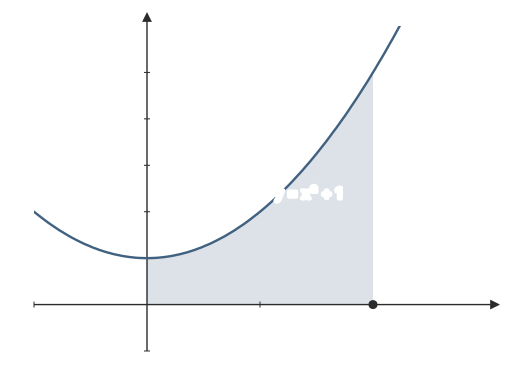
Example 7 · The shaded area
Find the area between , the -axis, and .
The curve is above the axis throughout, so the area is .
.
square units
Watch out
An integral can be 0 while the area is not. , but the region between and the axis on has area 2: the part below the axis counts with a plus sign in an area.
A region against the -axis, between and the lines and , has area . And integrating over a quarter and multiplying by 4 gives the two areas worth remembering: a circle of radius has area , and the ellipse has area .
Evaluating
Properties
Area
An equation that contains a derivative is solved by integrating: differential equations.
71 questions, grouped by type, easy to hard. Pick an answer and check it. The worked solution opens when you ask for it.
Evaluate .
AnswerB ·
An antiderivative is .
By the fundamental theorem, the integral is .
Worth noting
subtracts the wrong way, .
Evaluate .
AnswerC ·
An antiderivative is .
By the fundamental theorem, the integral is .
Worth noting
subtracts the wrong way, .
Evaluate .
AnswerC ·
An antiderivative is .
By the fundamental theorem, the integral is .
Worth noting
subtracts the wrong way, .
Evaluate .
AnswerD ·
An antiderivative is .
By the fundamental theorem, the integral is .
Worth noting
subtracts the wrong way, .
Evaluate .
AnswerD ·
An antiderivative is .
By the fundamental theorem, the integral is .
Worth noting
is alone: was not subtracted.
Evaluate .
AnswerD ·
An antiderivative is .
By the fundamental theorem, the integral is .
Worth noting
is alone: was not subtracted.
Evaluate .
AnswerB ·
An antiderivative is .
By the fundamental theorem, the integral is .
Worth noting
subtracts the wrong way, .
If and , what is ?
AnswerB ·
.
gives , so .
Worth noting
forgets to subtract the value at the lower limit, .
If , what is ?
AnswerD ·
By the first fundamental theorem, : the area function's derivative is the integrand at the upper limit.
.
Worth noting
is , the integral itself, not its derivative.
Which of the following statements are true?
I. A definite integral is a number, not a function of .
II. for any defined at .
III. The constant of the antiderivative changes the value of .
IV. .
AnswerA · I, II and IV only
The limits are numbers, so the result is a number (I); with equal limits (II); and the letter used for the variable does not matter (IV).
III is false: , so cancels.
Evaluate .
AnswerB ·
An antiderivative is .
By the fundamental theorem, the integral is .
Worth noting
is alone: was not subtracted.
What is ?
AnswerB ·
, and .
So the derivative is .
Worth noting
forgets that is the lower limit, which turns the sign.
Evaluate .
AnswerD ·
An antiderivative is .
By the fundamental theorem, the integral is .
Worth noting
subtracts the wrong way, .
Evaluate .
AnswerC ·
An antiderivative is .
By the fundamental theorem, the integral is .
Worth noting
is alone: was not subtracted.
If and , what is ?
AnswerA ·
.
, so ; with , .
Worth noting
drops the and solves .
What is ?
AnswerA ·
The integral is , since .
By the chain rule its derivative is .
Worth noting
puts the upper limit into the integrand but forgets the derivative of the limit, .
What is ?
AnswerD ·
.
.
Worth noting
puts the limits into but forgets to multiply by their derivatives.
Evaluate .
AnswerC ·
Put , ; the limits become 0 and 1.
.
Worth noting
1 forgets to halve when integrating .
Evaluate .
AnswerC ·
An antiderivative is .
By the fundamental theorem, the integral is .
Worth noting
is alone: was not subtracted.
Evaluate .
AnswerD ·
An antiderivative is .
By the fundamental theorem, the integral is .
Worth noting
subtracts the wrong way, .
Evaluate .
AnswerB ·
An antiderivative is .
By the fundamental theorem, the integral is .
Worth noting
subtracts the wrong way, .
Evaluate .
AnswerC ·
An antiderivative is .
By the fundamental theorem, the integral is .
Worth noting
is alone: was not subtracted.
With the substitution , what does become?
AnswerA ·
, so .
The limits change too: gives and gives . So the integral is .
Worth noting
Keeping the old limits 0 and 2 for is the usual slip: they belong to .
Evaluate .
AnswerB ·
By parts, .
.
Worth noting
integrates as if it were or forgets the .
Evaluate .
AnswerC ·
The top is the derivative of the bottom, so an antiderivative is .
.
Worth noting
1 treats the integral as , ignoring the denominator.
Evaluate .
AnswerA ·
Put , ; , .
.
Worth noting
forgets the from .
Evaluate .
AnswerD ·
Put , ; , .
.
Worth noting
takes ; the derivative of is .
Evaluate .
AnswerC ·
, so an antiderivative is .
.
Worth noting
2 is the antiderivative at the upper limit alone; must be subtracted.
Evaluate .
AnswerA ·
Put , ; the limits become 0 and .
.
Worth noting
is the new upper limit, not the value of the integral.
Evaluate .
AnswerD ·
An antiderivative is .
By the fundamental theorem, the integral is .
Worth noting
is alone: was not subtracted.
Evaluate .
AnswerB ·
An antiderivative is .
By the fundamental theorem, the integral is .
Worth noting
is alone: was not subtracted.
Evaluate .
AnswerA ·
By parts with , : .
.
Worth noting
is : the term was dropped.
Evaluate .
AnswerB ·
By parts with , : .
From 0 to 1: .
Worth noting
stops at and leaves out .
If , what is ?
AnswerA ·
Swapping the limits changes the sign: .
So the answer is .
and . What is ?
AnswerD ·
.
So .
Worth noting
2 adds the two given values instead of subtracting one from the other.
Evaluate .
AnswerA ·
for : the function is odd.
The integral of an odd function over is 0: the area below the axis cancels the area above it.
Worth noting
Doubling is the rule for an even function.
If and , what is ?
AnswerC ·
The integral is linear: .
.
Worth noting
3 is , leaving out the multipliers 3 and 2.
Evaluate .
AnswerA ·
: the integrand is odd.
An odd function over integrates to 0.
Worth noting
2 doubles the integral from 0, which is the rule for an even function.
If , what is ?
AnswerC ·
Split: .
That is 8.
Worth noting
7 takes as 1; it is the length of the interval, 2.
Evaluate .
AnswerC ·
is even: , so .
, so the integral is .
Worth noting
0 is the rule for odd functions; an even function's two halves add.
Evaluate .
AnswerB ·
for and for , so split at .
.
Worth noting
0 integrates without the absolute value, so the part below the axis cancels the part above.
Which of the following statements are true?
I. whenever is odd.
II. whenever is even.
III. .
IV. .
AnswerD · I, II and III only
I, II and III are properties of definite integrals: the odd and even rules, and the reflection , which only reverses the direction of travel across .
IV is false: on with , , but .
Evaluate .
AnswerC ·
is odd, so its part over is 0; is even.
.
Worth noting
is ; the even part must be doubled over .
Assertion (A): .
Reason (R): is an odd function.
AnswerA · Both A and R are true, and R is the correct explanation of A.
R: , so the function is odd. True.
An odd function over integrates to 0, so A is true because of R.
Evaluate .
AnswerD ·
is even, so the integral is .
.
Worth noting
is , which ignores the absolute value.
Evaluate .
AnswerD ·
Split at : .
.
Worth noting
is , which lets the part below the axis cancel.
Which of the following statements are true?
I. .
II. .
III. for every .
IV. .
AnswerD · I, II and IV only
I: the name of the variable does not matter. II: an interval of length 0 has no area. IV: reversing the limits changes the sign.
III holds only when ; for on , but .
Evaluate .
AnswerA ·
for : the function is odd, since and .
The integral of an odd function over is 0: the area below the axis cancels the area above it.
Worth noting
Doubling is the rule for an even function.
Evaluate .
AnswerB ·
Call the integral . By , replacing by swaps and : .
Adding the two forms, the integrand becomes 1, so and .
Worth noting
is ; the last step halves it.
Using , evaluate .
AnswerA ·
Replacing by : .
.
Worth noting
integrates only the term and drops .
Evaluate .
AnswerA ·
By with , .
Adding, , so .
Worth noting
3 is , the length of the interval; the integral is half of it.
Evaluate .
AnswerB ·
With , .
Adding: , so .
Worth noting
is the answer for , a different use of the same property.
Evaluate .
AnswerB ·
With , becomes , and .
Adding the two forms: , so .
Worth noting
is , the length of the interval; the integral is half of it.
The figure shows the region bounded by , the -axis and the lines and . What is its area?
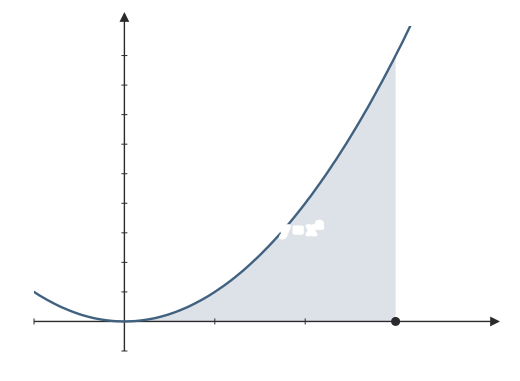
AnswerC ·
The curve stays above the -axis on , so the area is .
That is square units.
The figure shows the region bounded by , the -axis and the lines and . What is its area?
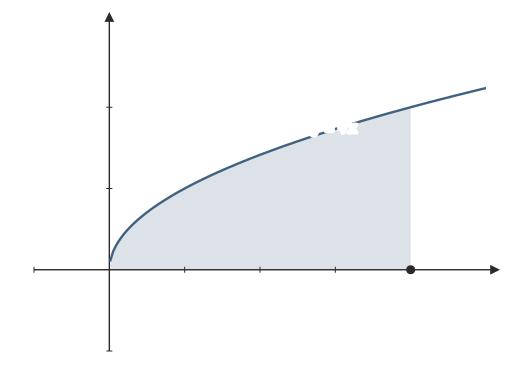
AnswerB ·
The curve stays above the -axis on , so the area is .
That is square units.
The figure shows the region bounded by , the -axis and the lines and . What is its area?
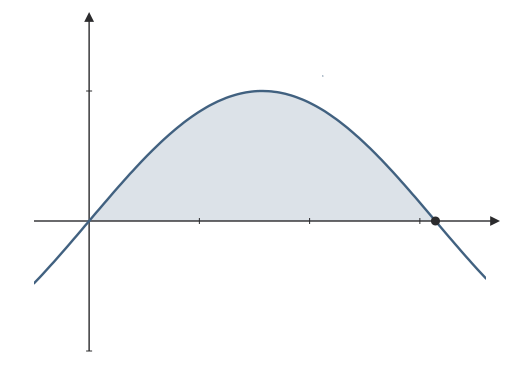
AnswerC ·
The curve stays above the -axis on , so the area is .
That is square units.
The figure shows the region bounded by , the -axis and the lines and . What is its area?
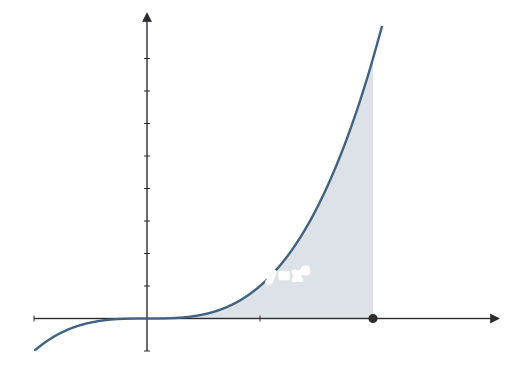
AnswerB ·
The curve stays above the -axis on , so the area is .
That is square units.
The figure shows the region bounded by , the -axis and the lines and . What is its area?
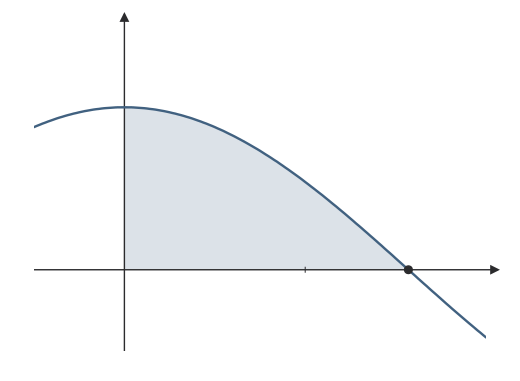
AnswerC ·
The curve stays above the -axis on , so the area is .
That is square units.
The figure shows the region bounded by , the -axis and the lines and . What is its area?
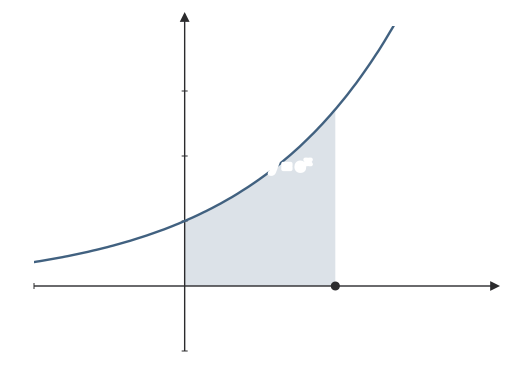
AnswerB ·
The curve stays above the -axis on , so the area is .
That is square units.
The figure shows the region bounded by , the -axis and the lines and . What is its area?
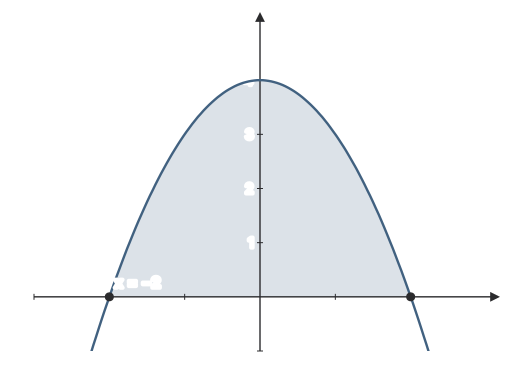
AnswerC ·
The curve stays above the -axis on , so the area is .
That is square units.
What is the area bounded by , the -axis and the lines and ?
AnswerB ·
On the curve lies below the -axis, so the integral comes out negative: .
An area is never negative: it is square units.
Worth noting
is the value of the integral, not the area.
What is the area enclosed by the ellipse ?
AnswerA ·
By symmetry the area is 4 times the part in the first quadrant: .
is a quarter circle of radius 3, , so the area is , that is with , .
Worth noting
uses and , the denominators, instead of and .
Assertion (A): , so the line encloses no area with the -axis between and .
Reason (R): A definite integral counts area below the -axis as negative.
AnswerD · A is false, but R is true.
The two triangles each have area , so the region's area is 1, not 0: A is false.
R is true, and it is exactly why the integral is 0 while the area is not.
What is the area bounded by , the -axis and the lines and ?
AnswerC ·
On the curve lies below the -axis, so the integral comes out negative: .
An area is never negative: it is square units.
Worth noting
is the value of the integral, not the area.
The figure shows the region bounded by , the -axis and the lines and . What is its area?
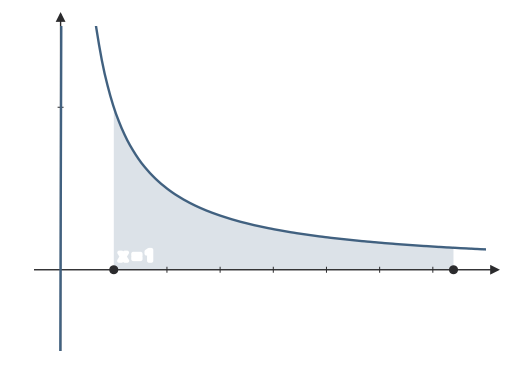
AnswerC ·
The curve stays above the -axis on , so the area is .
That is square units.
What is the total area between the line and the -axis from to ?
AnswerB ·
The line is below the axis on and above it on : find each area separately.
.
Worth noting
is , where the part below the axis cancels some of the rest.
Using integration, what is the area enclosed by the circle ?
AnswerD ·
By symmetry the area is , four quarter-circles.
, so the area is .
Worth noting
is one quarter: the integral from 0 to 4 covers only the first quadrant.
What is the area of the region bounded by the parabola and the line ?
AnswerC ·
The region is symmetric about the -axis; the upper half lies under from 0 to 1.
.
Worth noting
is only the half above the -axis.
What is the area bounded by and the -axis?
AnswerD ·
The curve meets the -axis at and lies below it in between.
, so the area is square units.
Worth noting
is the integral; an area is its absolute value.
What is the total area between and the -axis from to ?
AnswerD ·
The curve crosses the axis at : above it on , below it on . Take the two parts separately.
and , so the total area is 4 square units.
Worth noting
0 is the single integral from 0 to , in which the two parts cancel.
What is the area of the region bounded by the curve , the -axis and the lines and ?
AnswerA ·
The region is between the curve and the -axis, so integrate along : Area .
square units.
Worth noting
3 multiplies the width 1 by the height ; the curve is not a straight line, so the integral is needed.
NTA's Mathematics / Applied Mathematics syllabus has three sections: Section A1, which every candidate answers, then Section B1 (Mathematics) or Section B2 (Applied Mathematics), of which a candidate answers one. Each section lists units and topics but no chapters, so the chapters here are ours. Where both B sections list a topic that Section A also lists, its questions sit once, in Section A.