EduFarming
Your list · 0हिं

Type at least two letters. Press Esc to close.

↑↓ navigate↵ openTAB cycle filter

Inverse Trigonometric Functions for CUET Maths

About 5 min to learn · 120 questions

Inverse trigonometric functions are a short, scoring chapter of CUET Maths Section B1. Almost every question comes down to one idea: each inverse function gives back an angle from one fixed interval, its principal branch. Learn each rule here, from the domains and ranges of the six inverse functions to principal values, their graphs and the value of expressions built from them, with worked examples, time-saving shortcuts and the traps CUET sets, then practise on free questions in CUET's own formats, each fully solved.

Syllabus area
Section B1: Mathematics
On this page · 10 sections
  1. 01Why an inverse needs a branch
  2. 02Domains and ranges
  3. 03Principal values
  4. 04Graphs of the inverse functions
  5. 05Values of expressions
  6. 06How CUET asks this chapter
  7. 07Exam shortcuts
  8. 08Common mistakes
  9. 09Quick revision
  10. 10Check your understanding

Why an inverse needs a branch

A ramp rises 1 m for every 3\sqrt{3} m it runs. Its angle θ\theta has tan⁡θ=13\tan \theta = \frac{1}{\sqrt{3}}, and we want θ\theta itself. But tan⁡\tan repeats every π\pi: π6\frac{\pi}{6}, 7π6\frac{7\pi}{6}, −5π6-\frac{5\pi}{6} all have that tangent. To undo tan⁡\tan we must agree on one interval where it takes each value once. That interval is the principal branch, and the angle it gives, tan⁡−113=π6\tan^{-1} \frac{1}{\sqrt{3}} = \frac{\pi}{6}, is the principal value.

What does sin⁻¹ x mean?

sin⁡−1x\sin^{-1} x is the angle in [−π2,π2]\left[-\frac{\pi}{2}, \frac{\pi}{2}\right] whose sine is xx. It is not 1sin⁡x\frac{1}{\sin x}; that is cosec⁡x\operatorname{cosec} x.

Domains and ranges

What are the domain and range of each inverse function?

FunctionDomainRange (principal branch)
sin⁡−1x\sin^{-1} x[−1,1][-1, 1][−π2,π2]\left[-\frac{\pi}{2}, \frac{\pi}{2}\right]
cos⁡−1x\cos^{-1} x[−1,1][-1, 1][0,π][0, \pi]
tan⁡−1x\tan^{-1} xR\mathbb{R}(−π2,π2)\left(-\frac{\pi}{2}, \frac{\pi}{2}\right)
cot⁡−1x\cot^{-1} xR\mathbb{R}(0,π)(0, \pi)
sec⁡−1x\sec^{-1} xR−(−1,1)\mathbb{R} - (-1, 1)[0,π]−{π2}[0, \pi] - \left\{\frac{\pi}{2}\right\}
cosec⁡−1x\operatorname{cosec}^{-1} xR−(−1,1)\mathbb{R} - (-1, 1)[−π2,π2]−{0}\left[-\frac{\pi}{2}, \frac{\pi}{2}\right] - \{0\}

The domain of an inverse is the range of the function it undoes, and the other way round.

Example 1 · The domain of a composite

What is the domain of sin⁡−1(3x−2)\sin^{-1}(3x - 2)?

  1. The input must lie in [−1,1][-1, 1]: −1≤3x−2≤1-1 \le 3x - 2 \le 1.

  2. Add 2: 1≤3x≤31 \le 3x \le 3; divide by 3: 13≤x≤1\frac{1}{3} \le x \le 1.

Answer
[13,1]\left[\frac{1}{3}, 1\right]

Principal values

How do you find a principal value?

Find an angle with the right trigonometric value, then make sure it lies on the branch. For a negative input, sin⁡−1\sin^{-1}, tan⁡−1\tan^{-1} and cosec⁡−1\operatorname{cosec}^{-1} give a negative angle; cos⁡−1\cos^{-1}, cot⁡−1\cot^{-1} and sec⁡−1\sec^{-1} give an angle between π2\frac{\pi}{2} and π\pi, because their branch never goes below 0.

Example 2 · A negative input on two branches

Find cosec⁡−1(−2)\operatorname{cosec}^{-1}(-2) and cot⁡−1(−13)\cot^{-1}\left(-\frac{1}{\sqrt{3}}\right).

  1. cosec⁡(−π6)=−2\operatorname{cosec}\left(-\frac{\pi}{6}\right) = -2, and −π6-\frac{\pi}{6} is in [−π2,π2]\left[-\frac{\pi}{2}, \frac{\pi}{2}\right].

  2. cot⁡π3=13\cot \frac{\pi}{3} = \frac{1}{\sqrt{3}}, so the angle in (0,π)(0, \pi) with cotangent −13-\frac{1}{\sqrt{3}} is π−π3=2π3\pi - \frac{\pi}{3} = \frac{2\pi}{3}.

Answer

−π6-\frac{\pi}{6} and 2π3\frac{2\pi}{3}

Watch out

cos⁡−1\cos^{-1}, cot⁡−1\cot^{-1} and sec⁡−1\sec^{-1} never return a negative angle. cos⁡−1(−x)=π−cos⁡−1x\cos^{-1}(-x) = \pi - \cos^{-1} x, while sin⁡−1(−x)=−sin⁡−1x\sin^{-1}(-x) = -\sin^{-1} x.

Graphs of the inverse functions

How is the graph of an inverse function drawn?

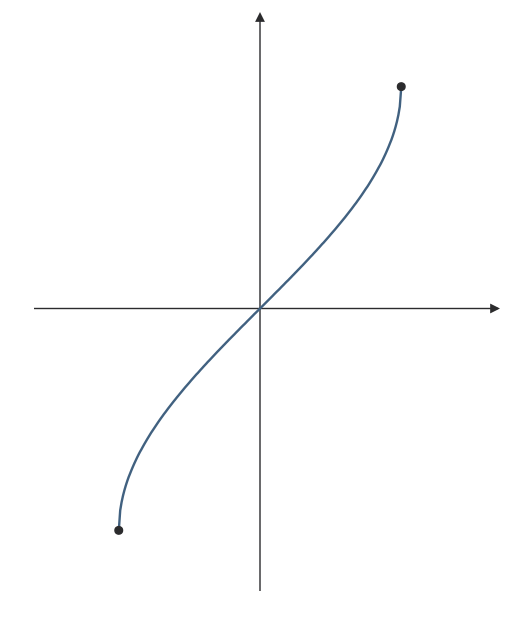
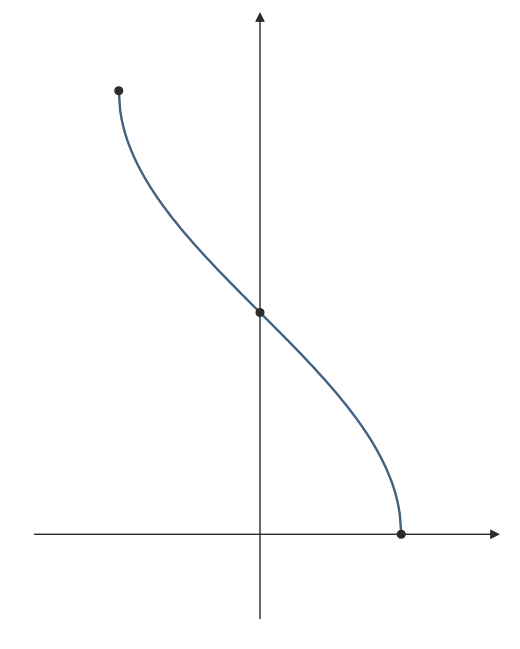
Reflect the principal branch of the original function in the line y=xy = x. So y=sin⁡−1xy = \sin^{-1} x rises from (−1,−π2)\left(-1, -\frac{\pi}{2}\right) to (1,π2)\left(1, \frac{\pi}{2}\right); y=cos⁡−1xy = \cos^{-1} x falls from (−1,π)(-1, \pi) to (1,0)(1, 0); y=tan⁡−1xy = \tan^{-1} x rises through the origin between the lines y=±π2y = \pm\frac{\pi}{2}, which it never touches.

Values of expressions

How do you evaluate an expression built from principal values?

Replace each inverse function by its principal value, then do the arithmetic. For sin⁡−1(sin⁡θ)\sin^{-1}(\sin \theta), the answer is θ\theta only when θ\theta is on the branch; otherwise find the angle on the branch with the same sine.

Example 3 · A sum of principal values

Find tan⁡−1(−3)+cos⁡−1(−1)\tan^{-1}\left(-\sqrt{3}\right) + \cos^{-1}(-1).

  1. tan⁡−1(−3)=−π3\tan^{-1}\left(-\sqrt{3}\right) = -\frac{\pi}{3} and cos⁡−1(−1)=π\cos^{-1}(-1) = \pi.

  2. −π3+π=2π3-\frac{\pi}{3} + \pi = \frac{2\pi}{3}.

Answer
2π3\frac{2\pi}{3}

Example 4 · A trigonometric value of a principal value

Find sin⁡(cos⁡−1817)\sin\left(\cos^{-1} \frac{8}{17}\right).

  1. Let θ=cos⁡−1817\theta = \cos^{-1} \frac{8}{17}: an acute angle with adjacent 8 and hypotenuse 17.

  2. The opposite side is 289−64=15\sqrt{289 - 64} = 15, so sin⁡θ=1517\sin \theta = \frac{15}{17}, positive on [0,π][0, \pi].

Answer
1517\frac{15}{17}

Example 5 · An angle off the branch

Find cos⁡−1(cos⁡5π4)\cos^{-1}\left(\cos \frac{5\pi}{4}\right).

  1. 5π4\frac{5\pi}{4} is not in [0,π][0, \pi]. cos⁡5π4=−12\cos \frac{5\pi}{4} = -\frac{1}{\sqrt{2}}.

  2. The angle in [0,π][0, \pi] with cosine −12-\frac{1}{\sqrt{2}} is 3π4\frac{3\pi}{4}.

Answer
3π4\frac{3\pi}{4}

How CUET asks this chapter

  • Domains and ranges: of the six functions, of a composite like sin⁡−1(ax+b)\sin^{-1}(ax + b), or of a multiple or shift of one.
  • Principal values: of a single inverse function, usually at a negative input, or the input that gives a stated value.
  • Expressions: a sum of principal values, sin⁡−1(sin⁡θ)\sin^{-1}(\sin \theta) for θ\theta off the branch, or cos⁡(sin⁡−1x)\cos\left(\sin^{-1} x\right) by a right triangle.
  • Graphs: which function a curve shows, which points it passes through, and whether it is increasing.

Exam shortcuts

  • Branches: sin⁡−1,cosec⁡−1\sin^{-1}, \operatorname{cosec}^{-1} around 0 and closed; tan⁡−1\tan^{-1} around 0 and open; cos⁡−1,sec⁡−1\cos^{-1}, \sec^{-1} on [0,π][0, \pi]; cot⁡−1\cot^{-1} on (0,π)(0, \pi).
  • sin⁡−1x+cos⁡−1x=π2\sin^{-1} x + \cos^{-1} x = \frac{\pi}{2} for ∣x∣≤1\lvert x \rvert \le 1, as the principal values show.
  • The largest value of sin⁡−1\sin^{-1} is π2\frac{\pi}{2} and of cos⁡−1\cos^{-1} is π\pi: a sum that reaches its maximum forces every term to its maximum.

Common mistakes

  • Reading sin⁡−1x\sin^{-1} x as 1sin⁡x\frac{1}{\sin x}.
  • Giving a negative angle for cos⁡−1\cos^{-1}, cot⁡−1\cot^{-1} or sec⁡−1\sec^{-1}.
  • Writing sin⁡−1(sin⁡θ)=θ\sin^{-1}(\sin \theta) = \theta for an angle outside the branch.
  • Closing the range of tan⁡−1\tan^{-1} at ±π2\pm\frac{\pi}{2}.

Quick revision

Branches

  • sin⁡−1\sin^{-1}: [−π2,π2]\left[-\frac{\pi}{2}, \frac{\pi}{2}\right]; cos⁡−1\cos^{-1}: [0,π][0, \pi]
  • tan⁡−1\tan^{-1}: (−π2,π2)\left(-\frac{\pi}{2}, \frac{\pi}{2}\right); cot⁡−1\cot^{-1}: (0,π)(0, \pi)

Negative inputs

  • sin⁡−1(−x)=−sin⁡−1x\sin^{-1}(-x) = -\sin^{-1} x
  • cos⁡−1(−x)=π−cos⁡−1x\cos^{-1}(-x) = \pi - \cos^{-1} x

Graphs

  • Reflect the branch in y=xy = x
  • tan⁡−1\tan^{-1} between y=±π2y = \pm\frac{\pi}{2}

Next in Section B1, when a function has no breaks and no corners: continuity and differentiability.

Next · 09Quick revision

Check your understanding

120 questions, grouped by type, easy to hard. Pick an answer and check it. The worked solution opens when you ask for it.

Domains and rangesQ1 of 120Q1

Domains and ranges

31 questions

What is the domain of sin⁡−1x\sin^{-1} x?

Options for question 1

Show the explanationHide the explanation

AnswerB · [−1,1][-1, 1]

  1. sin⁡−1x\sin^{-1} x undoes sin⁡\sin, so its inputs are the values sin⁡\sin takes.

  2. Those are [−1,1][-1, 1].

Worth noting

[−π2,π2]\left[-\frac{\pi}{2}, \frac{\pi}{2}\right] is the range, the angles it gives back.

What is the range of cos⁡−1x\cos^{-1} x?

Options for question 2

Show the explanationHide the explanation

AnswerD · [0,π][0, \pi]

  1. The principal branch of cos⁡\cos is [0,π][0, \pi], where it falls from 1 to −1-1 and takes each value once.

  2. So cos⁡−1x\cos^{-1} x takes values in [0,π][0, \pi].

Worth noting

[−π2,π2]\left[-\frac{\pi}{2}, \frac{\pi}{2}\right] is the branch of sin⁡−1\sin^{-1}; cos⁡\cos is not one-one there.

What is the range of tan⁡−1x\tan^{-1} x?

Options for question 3

Show the explanationHide the explanation

AnswerA · (−π2,π2)\left(-\frac{\pi}{2}, \frac{\pi}{2}\right)

  1. tan⁡\tan is one-one on (−π2,π2)\left(-\frac{\pi}{2}, \frac{\pi}{2}\right) and takes every real value there.

  2. The ends are left out: tan⁡π2\tan \frac{\pi}{2} is not defined.

Worth noting

The closed interval wrongly takes in ±π2\pm\frac{\pi}{2}, where tan⁡\tan has no value.

What is the domain of sin⁡−1(x2)\sin^{-1}\left(\frac{x}{2}\right)?

Options for question 4

Show the explanationHide the explanation

AnswerD · [−2,2][-2, 2]

  1. Each inverse function must get an input from its domain: −1≤x2≤1-1 \le \frac{x}{2} \le 1.

  2. So −2≤x≤2-2 \le x \le 2.

Worth noting

[−12,12]\left[-\frac{1}{2}, \frac{1}{2}\right] divides by 2 where it should multiply.

Let f(x)=sin⁡−1(2x−1)f(x) = \sin^{-1}(2x - 1).

What is f(1)f(1) for this f(x)=sin⁡−1(2x−1)f(x) = \sin^{-1}(2x - 1)?

Options for question 5

Show the explanationHide the explanation

AnswerC · π2\frac{\pi}{2}

  1. f(1)=sin⁡−1(2−1)=sin⁡−11f(1) = \sin^{-1}(2 - 1) = \sin^{-1} 1.

  2. π2\frac{\pi}{2}.

Worth noting

1 is the input to sin⁡−1\sin^{-1}, not its value.

Let f(x)=sin⁡−1(2x−1)f(x) = \sin^{-1}(2x - 1).

What is the domain of this f(x)=sin⁡−1(2x−1)f(x) = \sin^{-1}(2x - 1)?

Options for question 6

Show the explanationHide the explanation

AnswerD · [0,1][0, 1]

  1. −1≤2x−1≤1-1 \le 2x - 1 \le 1.

  2. 0≤x≤10 \le x \le 1.

Worth noting

[−π2,π2]\left[-\frac{\pi}{2}, \frac{\pi}{2}\right] is the range.

Let f(x)=sin⁡−1(2x−1)f(x) = \sin^{-1}(2x - 1).

What is the range of this f(x)=sin⁡−1(2x−1)f(x) = \sin^{-1}(2x - 1)?

Options for question 7

Show the explanationHide the explanation

AnswerC · [−π2,π2]\left[-\frac{\pi}{2}, \frac{\pi}{2}\right]

  1. As xx runs over [0,1][0, 1], 2x−12x - 1 runs over all of [−1,1][-1, 1].

  2. So ff takes every value of sin⁡−1\sin^{-1}: [−π2,π2]\left[-\frac{\pi}{2}, \frac{\pi}{2}\right].

Worth noting

The inner 2x−12x - 1 changes the domain, not the range, because it covers [−1,1][-1, 1] exactly.

What is the range of f(x)=sin⁡−1x+cos⁡−1xf(x) = \sin^{-1} x + \cos^{-1} x?

Options for question 8

Show the explanationHide the explanation

AnswerD · {π2}\left\{\frac{\pi}{2}\right\}

  1. sin⁡−1x+cos⁡−1x=π2\sin^{-1} x + \cos^{-1} x = \frac{\pi}{2} at every xx of the domain, −1≤x≤1-1 \le x \le 1.

  2. So ff takes the single value π2\frac{\pi}{2}: its range is {π2}\left\{\frac{\pi}{2}\right\}.

Worth noting

[−π2,3π2]\left[-\frac{\pi}{2}, \frac{3\pi}{2}\right] adds the two ranges as if the terms could be chosen apart; they move together, one up as the other goes down.

What is the domain of tan⁡−1(1x)\tan^{-1}\left(\frac{1}{x}\right)?

Options for question 9

Show the explanationHide the explanation

AnswerD · R−{0}\mathbb{R} - \{0\}

  1. tan⁡−1\tan^{-1} accepts every real number, so the only condition is that 1x\frac{1}{x} exists.

  2. That needs x≠0x \ne 0: the domain is R−{0}\mathbb{R} - \{0\}.

Worth noting

R\mathbb{R} is the domain of tan⁡−1\tan^{-1} itself; the inner 1x\frac{1}{x} must be defined first.

Read the two statements and choose the correct option.

I. cot⁡−10\cot^{-1} 0 is defined, and equals π2\frac{\pi}{2}.

II. cosec⁡−112\operatorname{cosec}^{-1} \frac{1}{2} is defined, and equals π6\frac{\pi}{6}.

Options for question 10

Show the explanationHide the explanation

AnswerA · Only I

  1. I: cot⁡−1\cot^{-1} is defined on all of R\mathbb{R}, and cot⁡π2=0\cot \frac{\pi}{2} = 0 with π2\frac{\pi}{2} in (0,π)(0, \pi). True.

  2. II: cosec⁡−1\operatorname{cosec}^{-1} needs ∣x∣≥1\lvert x \rvert \ge 1, and 12\frac{1}{2} lies in (−1,1)(-1, 1); π6\frac{\pi}{6} is cosec⁡−12\operatorname{cosec}^{-1} 2. False.

Worth noting

II reads cosec⁡−112\operatorname{cosec}^{-1} \frac{1}{2} as sin⁡−112\sin^{-1} \frac{1}{2}; in fact cosec⁡−1x=sin⁡−11x\operatorname{cosec}^{-1} x = \sin^{-1} \frac{1}{x}, which here would be sin⁡−12\sin^{-1} 2.

What is the domain of sin⁡−1(2x−1)\sin^{-1}(2x - 1)?

Options for question 11

Show the explanationHide the explanation

AnswerC · [0,1][0, 1]

  1. The input of the inverse function must lie in its domain: −1≤2x−1≤1-1 \le 2x - 1 \le 1.

  2. 0≤2x≤20 \le 2x \le 2, so 0≤x≤10 \le x \le 1.

Worth noting

[−1,1][-1, 1] is the range allowed for 2x−12x - 1, not for xx.

What is the range of 3cos⁡−1x3\cos^{-1} x?

Options for question 12

Show the explanationHide the explanation

AnswerB · [0,3π][0, 3\pi]

  1. cos⁡−1x\cos^{-1} x runs over [0,π][0, \pi].

  2. Multiplying by 3 stretches it to [0,3π][0, 3\pi].

Worth noting

[−3,3][-3, 3] scales the domain; the 3 multiplies the angle, so it scales the range.

Read the two statements and choose the correct option.

I. sin⁡−1x\sin^{-1} x is defined for every real xx.

II. tan⁡−1x\tan^{-1} x is defined for every real xx.

Options for question 13

Show the explanationHide the explanation

AnswerB · Only II

  1. I is false: sin⁡−12\sin^{-1} 2 is not defined, since sin⁡\sin never reaches 2.

  2. II is true: tan⁡\tan takes every real value on (−π2,π2)\left(-\frac{\pi}{2}, \frac{\pi}{2}\right).

What is the range of cot⁡−1x\cot^{-1} x?

Options for question 14

Show the explanationHide the explanation

AnswerC · (0,π)(0, \pi)

  1. cot⁡\cot is one-one on (0,π)(0, \pi), falling through every real value.

  2. cot⁡0\cot 0 and cot⁡π\cot \pi are not defined, so the ends are left out.

Worth noting

(−π2,π2)\left(-\frac{\pi}{2}, \frac{\pi}{2}\right) is the branch of tan⁡−1\tan^{-1}; cot⁡\cot is undefined at 0, in its middle.

What is the domain of cos⁡−1(x3)\cos^{-1}\left(\frac{x}{3}\right)?

Options for question 15

Show the explanationHide the explanation

AnswerB · [−3,3][-3, 3]

  1. The input of the inverse function must lie in its domain: −1≤x3≤1-1 \le \frac{x}{3} \le 1.

  2. −3≤x≤3-3 \le x \le 3.

Worth noting

[−13,13]\left[-\frac{1}{3}, \frac{1}{3}\right] divides by 3 where it should multiply.

What is the domain of sec⁡−1x\sec^{-1} x?

Options for question 16

Show the explanationHide the explanation

AnswerB · R−(−1,1)\mathbb{R} - (-1, 1)

  1. sec⁡θ=1cos⁡θ\sec \theta = \frac{1}{\cos \theta}, and ∣cos⁡θ∣≤1\lvert\cos \theta\rvert \le 1, so ∣sec⁡θ∣≥1\lvert\sec \theta\rvert \ge 1.

  2. So sec⁡−1x\sec^{-1} x is defined for ∣x∣≥1\lvert x \rvert \ge 1, that is R−(−1,1)\mathbb{R} - (-1, 1).

Worth noting

[−1,1][-1, 1] is the domain of cos⁡−1\cos^{-1}; its reciprocal lives outside it.

What is the domain of cos⁡−1(1−x)\cos^{-1}(1 - x)?

Options for question 17

Show the explanationHide the explanation

AnswerC · [0,2][0, 2]

  1. The input of the inverse function must lie in its domain: −1≤1−x≤1-1 \le 1 - x \le 1.

  2. −2≤−x≤0-2 \le -x \le 0, so 0≤x≤20 \le x \le 2.

Worth noting

[−2,0][-2, 0] forgets to turn the inequalities round when multiplying by −1-1.

What is the range of cosec⁡−1x\operatorname{cosec}^{-1} x?

Options for question 18

Show the explanationHide the explanation

AnswerD · [−π2,π2]−{0}\left[-\frac{\pi}{2}, \frac{\pi}{2}\right] - \{0\}

  1. cosec⁡\operatorname{cosec} uses the branch of sin⁡\sin, [−π2,π2]\left[-\frac{\pi}{2}, \frac{\pi}{2}\right].

  2. cosec⁡0\operatorname{cosec} 0 is not defined, so 0 is removed.

Worth noting

[0,π]−{π2}[0, \pi] - \left\{\frac{\pi}{2}\right\} is the range of sec⁡−1\sec^{-1}.

What is the range of sec⁡−1x\sec^{-1} x?

Options for question 19

Show the explanationHide the explanation

AnswerA · [0,π]−{π2}[0, \pi] - \left\{\frac{\pi}{2}\right\}

  1. sec⁡\sec uses the branch of cos⁡\cos, [0,π][0, \pi].

  2. sec⁡π2\sec \frac{\pi}{2} is not defined, so π2\frac{\pi}{2} is removed.

Worth noting

[0,π][0, \pi] keeps π2\frac{\pi}{2}, where cos⁡\cos is 0 and sec⁡\sec has no value.

Let f(x)=sin⁡−1(2x−1)f(x) = \sin^{-1}(2x - 1).

What is f(14)f\left(\frac{1}{4}\right) for this f(x)=sin⁡−1(2x−1)f(x) = \sin^{-1}(2x - 1)?

Options for question 20

Show the explanationHide the explanation

AnswerB · −π6- \frac{\pi}{6}

  1. 2×14−1=−122 \times \frac{1}{4} - 1 = -\frac{1}{2}.

  2. sin⁡−1(−12)=−π6\sin^{-1}\left(-\frac{1}{2}\right) = -\frac{\pi}{6}.

Worth noting

π6\frac{\pi}{6} loses the sign of −12-\frac{1}{2}.

What is the range of 2tan⁡−1x2\tan^{-1} x?

Options for question 21

Show the explanationHide the explanation

AnswerB · (−π,π)(-\pi, \pi)

  1. tan⁡−1x\tan^{-1} x runs over the open interval (−π2,π2)\left(-\frac{\pi}{2}, \frac{\pi}{2}\right).

  2. Doubling gives (−π,π)(-\pi, \pi), still open.

Worth noting

[−π,π][-\pi, \pi] closes the ends, but tan⁡−1\tan^{-1} never reaches ±π2\pm\frac{\pi}{2}.

What is the domain of cos⁡−1(2x+1)\cos^{-1}(2x + 1)?

Options for question 22

Show the explanationHide the explanation

AnswerB · [−1,0][-1, 0]

  1. Each inverse function must get an input from its domain: −1≤2x+1≤1-1 \le 2x + 1 \le 1.

  2. So −2≤2x≤0-2 \le 2x \le 0, so −1≤x≤0-1 \le x \le 0.

Worth noting

[−1,1][-1, 1] is the allowed range of 2x+12x + 1, not of xx.

What is the domain of sin⁡−1x+tan⁡−1x\sin^{-1} x + \tan^{-1} x?

Options for question 23

Show the explanationHide the explanation

AnswerD · [−1,1][-1, 1]

  1. Each inverse function must get an input from its domain: sin⁡−1x\sin^{-1} x needs −1≤x≤1-1 \le x \le 1; tan⁡−1x\tan^{-1} x needs nothing.

  2. So the sum is defined where both are: −1≤x≤1-1 \le x \le 1.

Worth noting

R\mathbb{R} is the domain of tan⁡−1\tan^{-1} alone; a sum needs both parts defined.

What is the range of f(x)=sin⁡−1x+π2f(x) = \sin^{-1} x + \frac{\pi}{2}?

Options for question 24

Show the explanationHide the explanation

AnswerD · [0,π][0, \pi]

  1. sin⁡−1x\sin^{-1} x runs over [−π2,π2]\left[-\frac{\pi}{2}, \frac{\pi}{2}\right].

  2. Adding π2\frac{\pi}{2} shifts it to [0,π][0, \pi].

Worth noting

[π2,π]\left[\frac{\pi}{2}, \pi\right] shifts only the top end.

Match each function in List I with its range in List II.

List IList II
A. sin⁡−1x\sin^{-1} xI. (−π2,π2)\left(-\frac{\pi}{2}, \frac{\pi}{2}\right)
B. cos⁡−1x\cos^{-1} xII. [−π2,π2]\left[-\frac{\pi}{2}, \frac{\pi}{2}\right]
C. tan⁡−1x\tan^{-1} xIII. (0,π)(0, \pi)
D. cot⁡−1x\cot^{-1} xIV. [0,π][0, \pi]
Options for question 25

Show the explanationHide the explanation

AnswerA · A-II, B-IV, C-I, D-III

  1. sin⁡−1\sin^{-1} and tan⁡−1\tan^{-1} live around 0, closed and open; cos⁡−1\cos^{-1} and cot⁡−1\cot^{-1} live in [0,π][0, \pi], closed and open.

  2. tan⁡\tan and cot⁡\cot blow up at the ends, so their ranges are open.

What is the domain of sin⁡−1(x2)\sin^{-1}(x^{2})?

Options for question 26

Show the explanationHide the explanation

AnswerD · [−1,1][-1, 1]

  1. The input of the inverse function must lie in its domain: −1≤x2≤1-1 \le x^{2} \le 1.

  2. x2≥0x^{2} \ge 0 always, so it means x2≤1x^{2} \le 1: −1≤x≤1-1 \le x \le 1.

Worth noting

[0,1][0, 1] forgets that a negative xx has a positive square.

What is the domain of sec⁡−1(2x)\sec^{-1}(2x)?

Options for question 27

Show the explanationHide the explanation

AnswerA · (−∞,−12]∪[12,∞)\left(-\infty, -\frac{1}{2}\right] \cup \left[\frac{1}{2}, \infty\right)

  1. The input of the inverse function must lie in its domain: ∣2x∣≥1\lvert 2x \rvert \ge 1.

  2. ∣x∣≥12\lvert x \rvert \ge \frac{1}{2}.

Worth noting

[−12,12]\left[-\frac{1}{2}, \frac{1}{2}\right] is the domain of cos⁡−1(2x)\cos^{-1}(2x); sec⁡−1\sec^{-1} needs the outside.

As xx runs over [0,1][0, 1], which values does cos⁡−1x\cos^{-1} x take?

Options for question 28

Show the explanationHide the explanation

AnswerD · [0,π2]\left[0, \frac{\pi}{2}\right]

  1. cos⁡−1\cos^{-1} is decreasing: cos⁡−10=π2\cos^{-1} 0 = \frac{\pi}{2} and cos⁡−11=0\cos^{-1} 1 = 0.

  2. So it takes every value from 0 to π2\frac{\pi}{2}.

Worth noting

[π2,π]\left[\frac{\pi}{2}, \pi\right] is what the negative inputs [−1,0][-1, 0] give.

What is the domain of cos⁡−1(x2−1)\cos^{-1}(x^{2} - 1)?

Options for question 29

Show the explanationHide the explanation

AnswerB · [−2,2]\left[-\sqrt{2}, \sqrt{2}\right]

  1. Each inverse function must get an input from its domain: −1≤x2−1≤1-1 \le x^{2} - 1 \le 1.

  2. So 0≤x2≤20 \le x^{2} \le 2, so −2≤x≤2-\sqrt{2} \le x \le \sqrt{2}.

Worth noting

[0,2]\left[0, \sqrt{2}\right] forgets that negative xx have the same square.

What is the range of f(x)=tan⁡−1(x2)f(x) = \tan^{-1}\left(x^{2}\right)?

Options for question 30

Show the explanationHide the explanation

AnswerA · [0,π2)\left[0, \frac{\pi}{2}\right)

  1. x2x^{2} takes every value in [0,∞)[0, \infty), including 0 at x=0x = 0.

  2. tan⁡−1\tan^{-1} is increasing, so ff runs from tan⁡−10=0\tan^{-1} 0 = 0 up towards π2\frac{\pi}{2} without reaching it: [0,π2)\left[0, \frac{\pi}{2}\right).

Worth noting

[0,π2]\left[0, \frac{\pi}{2}\right] closes the top end, but tan⁡−1\tan^{-1} never reaches π2\frac{\pi}{2}, however large x2x^{2} is.

What is the domain of cos⁡−1x+sec⁡−1x\cos^{-1} x + \sec^{-1} x?

Options for question 31

Show the explanationHide the explanation

AnswerD · {−1,1}\{-1, 1\}

  1. cos⁡−1x\cos^{-1} x needs −1≤x≤1-1 \le x \le 1; sec⁡−1x\sec^{-1} x needs x≤−1x \le -1 or x≥1x \ge 1.

  2. The sum needs both, and only the ends x=−1x = -1 and x=1x = 1 satisfy both: the domain is {−1,1}\{-1, 1\}.

Worth noting

∅\varnothing forgets that ±1\pm 1 belong to both domains: sec⁡−1\sec^{-1} leaves out only the open interval (−1,1)(-1, 1).

Principal values

33 questions

What is the principal value of sin⁡−1(−12)\sin^{-1}\left(- \frac{1}{2}\right)?

Options for question 32

Show the explanationHide the explanation

AnswerB · −π6- \frac{\pi}{6}

  1. Find the angle θ\theta in the branch [−π2,π2]\left[-\frac{\pi}{2}, \frac{\pi}{2}\right] with sin⁡θ=−12\sin \theta = - \frac{1}{2}.

  2. That angle is −π6- \frac{\pi}{6}.

Worth noting

7π6\frac{7\pi}{6} has sine −12-\frac{1}{2} too, but lies outside [−π2,π2]\left[-\frac{\pi}{2}, \frac{\pi}{2}\right].

If cos⁡−1x=2π3\cos^{-1} x = \frac{2\pi}{3}, what is xx?

Options for question 33

Show the explanationHide the explanation

AnswerB · −12- \frac{1}{2}

  1. cos⁡−1x=2π3\cos^{-1} x = \frac{2\pi}{3} means x=cos⁡2π3x = \cos \frac{2\pi}{3}, and 2π3\frac{2\pi}{3} is on the branch.

  2. cos⁡2π3=−12\cos \frac{2\pi}{3} = -\frac{1}{2}.

Worth noting

12\frac{1}{2} is cos⁡π3\cos \frac{\pi}{3}; an angle past π2\frac{\pi}{2} has a negative cosine.

What is the principal value of tan⁡−1(−1)\tan^{-1}\left(-1\right)?

Options for question 34

Show the explanationHide the explanation

AnswerB · −π4- \frac{\pi}{4}

  1. Find the angle θ\theta in the branch (−π2,π2)\left(-\frac{\pi}{2}, \frac{\pi}{2}\right) with tan⁡θ=−1\tan \theta = -1.

  2. That angle is −π4- \frac{\pi}{4}.

Worth noting

tan⁡3π4=−1\tan \frac{3\pi}{4} = -1, but 3π4\frac{3\pi}{4} is outside (−π2,π2)\left(-\frac{\pi}{2}, \frac{\pi}{2}\right).

What is the principal value of sec⁡−1(2)\sec^{-1}\left(2\right)?

Options for question 35

Show the explanationHide the explanation

AnswerC · π3\frac{\pi}{3}

  1. Find the angle θ\theta in the branch [0,π]−{π2}[0, \pi] - \left\{\frac{\pi}{2}\right\} with sec⁡θ=2\sec \theta = 2.

  2. That angle is π3\frac{\pi}{3}.

Worth noting

π6\frac{\pi}{6} has cosecant 2; secant 2 means cosine 12\frac{1}{2}.

What is the principal value of tan⁡−1(3)\tan^{-1}\left(\sqrt{3}\right)?

Options for question 36

Show the explanationHide the explanation

AnswerC · π3\frac{\pi}{3}

  1. Find the angle θ\theta in the branch (−π2,π2)\left(-\frac{\pi}{2}, \frac{\pi}{2}\right) with tan⁡θ=3\tan \theta = \sqrt{3}.

  2. That angle is π3\frac{\pi}{3}.

Worth noting

tan⁡π6=13\tan \frac{\pi}{6} = \frac{1}{\sqrt{3}}; 3\sqrt{3} is tan⁡π3\tan \frac{\pi}{3}.

What is the principal value of cosec⁡−1(2)\operatorname{cosec}^{-1}\left(2\right)?

Options for question 37

Show the explanationHide the explanation

AnswerB · π6\frac{\pi}{6}

  1. Find the angle θ\theta in the branch [−π2,π2]−{0}\left[-\frac{\pi}{2}, \frac{\pi}{2}\right] - \{0\} with cosec⁡θ=2\operatorname{cosec} \theta = 2.

  2. That angle is π6\frac{\pi}{6}.

Worth noting

5π6\frac{5\pi}{6} has sine 12\frac{1}{2} too, but lies outside [−π2,π2]\left[-\frac{\pi}{2}, \frac{\pi}{2}\right].

If sin⁡−1x=−π3\sin^{-1} x = -\frac{\pi}{3}, what is xx?

Options for question 38

Show the explanationHide the explanation

AnswerA · −32- \frac{\sqrt{3}}{2}

  1. x=sin⁡(−π3)x = \sin\left(-\frac{\pi}{3}\right), and −π3-\frac{\pi}{3} is on the branch.

  2. x=−32x = -\frac{\sqrt{3}}{2}.

Worth noting

−12-\frac{1}{2} is sin⁡(−π6)\sin\left(-\frac{\pi}{6}\right).

What is the principal value of sin⁡−1(−1)\sin^{-1}\left(-1\right)?

Options for question 39

Show the explanationHide the explanation

AnswerB · −π2- \frac{\pi}{2}

  1. Find the angle θ\theta in the branch [−π2,π2]\left[-\frac{\pi}{2}, \frac{\pi}{2}\right] with sin⁡θ=−1\sin \theta = -1.

  2. That angle is −π2- \frac{\pi}{2}.

Worth noting

3π2\frac{3\pi}{2} has sine −1-1 too, but lies outside [−π2,π2]\left[-\frac{\pi}{2}, \frac{\pi}{2}\right].

What is the principal value of cot⁡−1(3)\cot^{-1}\left(\sqrt{3}\right)?

Options for question 40

Show the explanationHide the explanation

AnswerB · π6\frac{\pi}{6}

  1. Find the angle θ\theta in the branch (0,π)(0, \pi) with cot⁡θ=3\cot \theta = \sqrt{3}.

  2. That angle is π6\frac{\pi}{6}.

Worth noting

π3\frac{\pi}{3} has cotangent 13\frac{1}{\sqrt{3}}; 3\sqrt{3} belongs to π6\frac{\pi}{6}.

What is the principal value of sin⁡−1(−22)\sin^{-1}\left(- \frac{\sqrt{2}}{2}\right)?

Options for question 41

Show the explanationHide the explanation

AnswerB · −π4- \frac{\pi}{4}

  1. Find the angle θ\theta in the branch [−π2,π2]\left[-\frac{\pi}{2}, \frac{\pi}{2}\right] with sin⁡θ=−22\sin \theta = - \frac{\sqrt{2}}{2}.

  2. That angle is −π4- \frac{\pi}{4}.

Worth noting

5π4\frac{5\pi}{4} has sine −12-\frac{1}{\sqrt{2}} too, but lies outside the branch.

What is the principal value of cos⁡−1(32)\cos^{-1}\left(\frac{\sqrt{3}}{2}\right)?

Options for question 42

Show the explanationHide the explanation

AnswerB · π6\frac{\pi}{6}

  1. Find the angle θ\theta in the branch [0,π][0, \pi] with cos⁡θ=32\cos \theta = \frac{\sqrt{3}}{2}.

  2. That angle is π6\frac{\pi}{6}.

Worth noting

π3\frac{\pi}{3} has cosine 12\frac{1}{2}; 32\frac{\sqrt{3}}{2} belongs to π6\frac{\pi}{6}.

Let α=sin⁡−1(13)\alpha = \sin^{-1}\left(\frac{1}{3}\right).

What is sin⁡−1(−13)\sin^{-1}\left(-\frac{1}{3}\right) in terms of this α=sin⁡−1(13)\alpha = \sin^{-1}\left(\frac{1}{3}\right)?

Options for question 43

Show the explanationHide the explanation

AnswerA · −α-\alpha

  1. sin⁡(−α)=−sin⁡α=−13\sin(-\alpha) = -\sin \alpha = -\frac{1}{3}, and −α-\alpha lies in [−π2,π2]\left[-\frac{\pi}{2}, \frac{\pi}{2}\right].

  2. So sin⁡−1(−13)=−α\sin^{-1}\left(-\frac{1}{3}\right) = -\alpha.

Worth noting

π−α\pi - \alpha is the rule for cos⁡−1\cos^{-1}; for sin⁡−1\sin^{-1} a negative input just flips the sign.

Which of these angles is a value of tan⁡−1x\tan^{-1} x for some real xx?

Options for question 44

Show the explanationHide the explanation

AnswerB · 2π5\frac{2 \pi}{5}

  1. tan⁡−1x\tan^{-1} x takes exactly the values in the open interval (−π2,π2)\left(-\frac{\pi}{2}, \frac{\pi}{2}\right).

  2. Only 2π5\frac{2\pi}{5} is inside, since 2π5<π2\frac{2\pi}{5} < \frac{\pi}{2}: it is tan⁡−1(tan⁡2π5)\tan^{-1}\left(\tan \frac{2\pi}{5}\right).

Worth noting

π2\frac{\pi}{2} is an end of the branch, which the open interval leaves out: tan⁡π2\tan \frac{\pi}{2} is not defined.

What is the principal value of cos⁡−1(−32)\cos^{-1}\left(- \frac{\sqrt{3}}{2}\right)?

Options for question 45

Show the explanationHide the explanation

AnswerC · 5π6\frac{5 \pi}{6}

  1. Find the angle θ\theta in the branch [0,π][0, \pi] with cos⁡θ=−32\cos \theta = - \frac{\sqrt{3}}{2}.

  2. That angle is 5π6\frac{5 \pi}{6}.

Worth noting

cos⁡−1\cos^{-1} never gives a negative angle: its branch is [0,π][0, \pi], so it is π−π6\pi - \frac{\pi}{6}.

If tan⁡−1x=−π3\tan^{-1} x = -\frac{\pi}{3}, what is xx?

Options for question 46

Show the explanationHide the explanation

AnswerA · −3- \sqrt{3}

  1. x=tan⁡(−π3)x = \tan\left(-\frac{\pi}{3}\right), and −π3-\frac{\pi}{3} is on the branch.

  2. tan⁡(−π3)=−3\tan\left(-\frac{\pi}{3}\right) = -\sqrt{3}.

Worth noting

−13-\frac{1}{\sqrt{3}} is tan⁡(−π6)\tan\left(-\frac{\pi}{6}\right).

What is the principal value of cot⁡−1(−3)\cot^{-1}\left(- \sqrt{3}\right)?

Options for question 47

Show the explanationHide the explanation

AnswerD · 5π6\frac{5 \pi}{6}

  1. Find the angle θ\theta in the branch (0,π)(0, \pi) with cot⁡θ=−3\cot \theta = - \sqrt{3}.

  2. That angle is 5π6\frac{5 \pi}{6}.

Worth noting

cot⁡−1\cot^{-1} lives in (0,π)(0, \pi), so a negative input gives an obtuse angle, π−π6\pi - \frac{\pi}{6}, not −π6-\frac{\pi}{6}.

What is the principal value of cosec⁡−1(−2)\operatorname{cosec}^{-1}\left(- \sqrt{2}\right)?

Options for question 48

Show the explanationHide the explanation

AnswerB · −π4- \frac{\pi}{4}

  1. Find the angle θ\theta in the branch [−π2,π2]−{0}\left[-\frac{\pi}{2}, \frac{\pi}{2}\right] - \{0\} with cosec⁡θ=−2\operatorname{cosec} \theta = - \sqrt{2}.

  2. That angle is −π4- \frac{\pi}{4}.

Worth noting

cosec⁡5π4=−2\operatorname{cosec} \frac{5\pi}{4} = -\sqrt{2} too, but the branch is [−π2,π2]\left[-\frac{\pi}{2}, \frac{\pi}{2}\right].

What is the principal value of sec⁡−1(−2)\sec^{-1}\left(-2\right)?

Options for question 49

Show the explanationHide the explanation

AnswerC · 2π3\frac{2 \pi}{3}

  1. Find the angle θ\theta in the branch [0,π]−{π2}[0, \pi] - \left\{\frac{\pi}{2}\right\} with sec⁡θ=−2\sec \theta = -2.

  2. That angle is 2π3\frac{2 \pi}{3}.

Worth noting

sec⁡−1\sec^{-1} takes the branch of cos⁡−1\cos^{-1}, [0,π][0, \pi], so the angle is π−π3\pi - \frac{\pi}{3}.

What is the principal value of cos⁡−1(−22)\cos^{-1}\left(- \frac{\sqrt{2}}{2}\right)?

Options for question 50

Show the explanationHide the explanation

AnswerC · 3π4\frac{3 \pi}{4}

  1. Find the angle θ\theta in the branch [0,π][0, \pi] with cos⁡θ=−22\cos \theta = - \frac{\sqrt{2}}{2}.

  2. That angle is 3π4\frac{3 \pi}{4}.

Worth noting

A negative input to cos⁡−1\cos^{-1} gives an angle between π2\frac{\pi}{2} and π\pi: π−π4\pi - \frac{\pi}{4}.

What is the principal value of cot⁡−1(33)\cot^{-1}\left(\frac{\sqrt{3}}{3}\right)?

Options for question 51

Show the explanationHide the explanation

AnswerC · π3\frac{\pi}{3}

  1. Find the angle θ\theta in the branch (0,π)(0, \pi) with cot⁡θ=33\cot \theta = \frac{\sqrt{3}}{3}.

  2. That angle is π3\frac{\pi}{3}.

Worth noting

cot⁡π6=3\cot \frac{\pi}{6} = \sqrt{3}; 13\frac{1}{\sqrt{3}} is cot⁡π3\cot \frac{\pi}{3}.

If cot⁡−1x=3π4\cot^{-1} x = \frac{3\pi}{4}, what is xx?

Options for question 52

Show the explanationHide the explanation

AnswerB · −1-1

  1. x=cot⁡3π4x = \cot \frac{3\pi}{4}, and 3π4\frac{3\pi}{4} is in (0,π)(0, \pi).

  2. cot⁡3π4=−1\cot \frac{3\pi}{4} = -1.

Worth noting

1 is cot⁡π4\cot \frac{\pi}{4}; past π2\frac{\pi}{2} the cotangent is negative.

What is the principal value of sec⁡−1(233)\sec^{-1}\left(\frac{2 \sqrt{3}}{3}\right)?

Options for question 53

Show the explanationHide the explanation

AnswerB · π6\frac{\pi}{6}

  1. Find the angle θ\theta in the branch [0,π]−{π2}[0, \pi] - \left\{\frac{\pi}{2}\right\} with sec⁡θ=233\sec \theta = \frac{2 \sqrt{3}}{3}.

  2. That angle is π6\frac{\pi}{6}.

Worth noting

π3\frac{\pi}{3} has secant 2; 23\frac{2}{\sqrt{3}} means cosine 32\frac{\sqrt{3}}{2}.

What is the principal value of cosec⁡−1(−233)\operatorname{cosec}^{-1}\left(- \frac{2 \sqrt{3}}{3}\right)?

Options for question 54

Show the explanationHide the explanation

AnswerA · −π3- \frac{\pi}{3}

  1. Find the angle θ\theta in the branch [−π2,π2]−{0}\left[-\frac{\pi}{2}, \frac{\pi}{2}\right] - \{0\} with cosec⁡θ=−233\operatorname{cosec} \theta = - \frac{2 \sqrt{3}}{3}.

  2. That angle is −π3- \frac{\pi}{3}.

Worth noting

cosec⁡4π3=−23\operatorname{cosec}\frac{4\pi}{3} = -\frac{2}{\sqrt{3}} too, but the branch is [−π2,π2]\left[-\frac{\pi}{2}, \frac{\pi}{2}\right].

Which of these has the greatest principal value?

Options for question 55

Show the explanationHide the explanation

AnswerD · cot⁡−1(−3)\cot^{-1}\left(-\sqrt{3}\right)

  1. cot⁡−1(−3)=5π6\cot^{-1}\left(-\sqrt{3}\right) = \frac{5\pi}{6}, cos⁡−1(−12)=2π3\cos^{-1}\left(-\frac{1}{2}\right) = \frac{2\pi}{3} and sin⁡−1(1)=π2\sin^{-1}(1) = \frac{\pi}{2}.

  2. tan⁡−1(1000)\tan^{-1}(1000) stays below π2\frac{\pi}{2}, however large the input; so 5π6\frac{5\pi}{6} is the greatest.

Worth noting

A huge input does not give a huge angle: every value of tan⁡−1\tan^{-1} is below π2\frac{\pi}{2}.

Let α=sin⁡−1(13)\alpha = \sin^{-1}\left(\frac{1}{3}\right).

What is cosec⁡−13\operatorname{cosec}^{-1} 3 in terms of this α=sin⁡−1(13)\alpha = \sin^{-1}\left(\frac{1}{3}\right)?

Options for question 56

Show the explanationHide the explanation

AnswerC · α\alpha

  1. cosec⁡α=1sin⁡α=3\operatorname{cosec} \alpha = \frac{1}{\sin \alpha} = 3, and α\alpha lies in [−π2,π2]−{0}\left[-\frac{\pi}{2}, \frac{\pi}{2}\right] - \{0\}.

  2. So cosec⁡−13=α\operatorname{cosec}^{-1} 3 = \alpha.

Worth noting

1α\frac{1}{\alpha} reads cosec⁡−1\operatorname{cosec}^{-1} as one over an angle; it is the angle whose cosecant is 3.

Let α=sin⁡−1(13)\alpha = \sin^{-1}\left(\frac{1}{3}\right).

In which interval does this α=sin⁡−1(13)\alpha = \sin^{-1}\left(\frac{1}{3}\right) lie?

Options for question 57

Show the explanationHide the explanation

AnswerA · (0,π6)\left(0, \frac{\pi}{6}\right)

  1. sin⁡−1\sin^{-1} is increasing, and 0<13<120 < \frac{1}{3} < \frac{1}{2}.

  2. So sin⁡−10<α<sin⁡−112\sin^{-1} 0 < \alpha < \sin^{-1} \frac{1}{2}, that is 0<α<π60 < \alpha < \frac{\pi}{6}.

Worth noting

(π3,π2)\left(\frac{\pi}{3}, \frac{\pi}{2}\right) is where cos⁡−1(13)\cos^{-1}\left(\frac{1}{3}\right) lies; cos⁡−1\cos^{-1} is decreasing, sin⁡−1\sin^{-1} increasing.

Assertion (A): cot⁡−1(−1)=3π4\cot^{-1}(-1) = \frac{3\pi}{4}.

Reason (R): cot⁡−1x=tan⁡−11x\cot^{-1} x = \tan^{-1} \frac{1}{x} for every x≠0x \ne 0.

Options for question 58

Show the explanationHide the explanation

AnswerC · A is true, but R is false.

  1. A is true: cot⁡3π4=−1\cot \frac{3\pi}{4} = -1, and 3π4\frac{3\pi}{4} is in (0,π)(0, \pi).

  2. R is false: at x=−1x = -1 it gives tan⁡−1(−1)=−π4\tan^{-1}(-1) = -\frac{\pi}{4}, outside (0,π)(0, \pi); the rule holds only for x>0x > 0.

Worth noting

R swaps cot⁡−1\cot^{-1} for tan⁡−1\tan^{-1} of the reciprocal, which drops a negative input onto the wrong branch.

If x≤−1x \le -1, what is the set of all values that sec⁡−1x\sec^{-1} x takes?

Options for question 59

Show the explanationHide the explanation

AnswerA · (π2,π]\left(\frac{\pi}{2}, \pi\right]

  1. sec⁡−1x=cos⁡−11x\sec^{-1} x = \cos^{-1} \frac{1}{x}, and for x≤−1x \le -1, 1x\frac{1}{x} lies in [−1,0)[-1, 0).

  2. cos⁡−1\cos^{-1} of a number in [−1,0)[-1, 0) lies in (π2,π]\left(\frac{\pi}{2}, \pi\right]; sec⁡−1(−1)=π\sec^{-1}(-1) = \pi is included, π2\frac{\pi}{2} is not.

Worth noting

[−π2,0)\left[-\frac{\pi}{2}, 0\right) gives sec⁡−1\sec^{-1} a negative angle; its branch is [0,π][0, \pi], like that of cos⁡−1\cos^{-1}.

Which of these is NOT a principal value of any inverse trigonometric function at any input?

Options for question 60

Show the explanationHide the explanation

AnswerD · 5π4\frac{5\pi}{4}

  1. Every principal branch lies inside [−π2,π]\left[-\frac{\pi}{2}, \pi\right].

  2. 3π4=cos⁡−1(−12)\frac{3\pi}{4} = \cos^{-1}\left(-\frac{1}{\sqrt{2}}\right), −π4=sin⁡−1(−12)-\frac{\pi}{4} = \sin^{-1}\left(-\frac{1}{\sqrt{2}}\right), π2=cos⁡−10\frac{\pi}{2} = \cos^{-1} 0; but 5π4>π\frac{5\pi}{4} > \pi.

Worth noting

3π4\frac{3\pi}{4} is above π2\frac{\pi}{2} but still in [0,π][0, \pi], the branch of cos⁡−1\cos^{-1}.

Match each expression in List I with its principal value in List II.

List IList II
A. sin⁡−1(32)\sin^{-1}\left(\frac{\sqrt{3}}{2}\right)I. 2π3\frac{2 \pi}{3}
B. cos⁡−1(−12)\cos^{-1}\left(-\frac{1}{2}\right)II. 3π4\frac{3 \pi}{4}
C. tan⁡−1(−13)\tan^{-1}\left(-\frac{1}{\sqrt{3}}\right)III. π3\frac{\pi}{3}
D. cot⁡−1(−1)\cot^{-1}(-1)IV. −π6- \frac{\pi}{6}
Options for question 61

Show the explanationHide the explanation

AnswerA · A-III, B-I, C-IV, D-II

  1. sin⁡−132=π3\sin^{-1}\frac{\sqrt{3}}{2} = \frac{\pi}{3} and tan⁡−1(−13)=−π6\tan^{-1}\left(-\frac{1}{\sqrt{3}}\right) = -\frac{\pi}{6}, on the branches around 0.

  2. cos⁡−1(−12)=2π3\cos^{-1}\left(-\frac{1}{2}\right) = \frac{2\pi}{3} and cot⁡−1(−1)=3π4\cot^{-1}(-1) = \frac{3\pi}{4}, in (0,π)(0, \pi).

Let α=sin⁡−1(13)\alpha = \sin^{-1}\left(\frac{1}{3}\right).

What is cos⁡−1(−13)\cos^{-1}\left(-\frac{1}{3}\right) in terms of this α=sin⁡−1(13)\alpha = \sin^{-1}\left(\frac{1}{3}\right)?

Options for question 62

Show the explanationHide the explanation

AnswerD · π2+α\frac{\pi}{2} + \alpha

  1. cos⁡−1(13)=π2−sin⁡−1(13)=π2−α\cos^{-1}\left(\frac{1}{3}\right) = \frac{\pi}{2} - \sin^{-1}\left(\frac{1}{3}\right) = \frac{\pi}{2} - \alpha.

  2. cos⁡−1(−13)=π−(π2−α)=π2+α\cos^{-1}\left(-\frac{1}{3}\right) = \pi - \left(\frac{\pi}{2} - \alpha\right) = \frac{\pi}{2} + \alpha.

Worth noting

π−α\pi - \alpha applies the rule of cos⁡−1\cos^{-1} to α\alpha, which is a sin⁡−1\sin^{-1} value; first write cos⁡−1(13)\cos^{-1}\left(\frac{1}{3}\right) as π2−α\frac{\pi}{2} - \alpha.

What is the principal value of cot⁡−1(3−2)\cot^{-1}\left(\sqrt{3} - 2\right)?

Options for question 63

Show the explanationHide the explanation

AnswerC · 7π12\frac{7 \pi}{12}

  1. 3−2=−(2−3)\sqrt{3} - 2 = -\left(2 - \sqrt{3}\right), and 2−3=tan⁡π12=cot⁡5π122 - \sqrt{3} = \tan \frac{\pi}{12} = \cot \frac{5\pi}{12}.

  2. On (0,π)(0, \pi), a negative cotangent needs the angle π−5π12=7π12\pi - \frac{5\pi}{12} = \frac{7\pi}{12}.

Worth noting

−5π12-\frac{5\pi}{12} has the right cotangent but is negative; cot⁡−1\cot^{-1} never returns a negative angle.

Which of the following statements are true?

I. tan⁡−1(−x)=−tan⁡−1x\tan^{-1}(-x) = -\tan^{-1} x for every real xx.

II. cot⁡−1(−x)=−cot⁡−1x\cot^{-1}(-x) = -\cot^{-1} x for every real xx.

III. sec⁡−1(−x)=π−sec⁡−1x\sec^{-1}(-x) = \pi - \sec^{-1} x for ∣x∣≥1\lvert x \rvert \ge 1.

IV. cosec⁡−1(−x)=π−cosec⁡−1x\operatorname{cosec}^{-1}(-x) = \pi - \operatorname{cosec}^{-1} x for ∣x∣≥1\lvert x \rvert \ge 1.

Options for question 64

Show the explanationHide the explanation

AnswerC · I and III only

  1. tan⁡−1\tan^{-1} and cosec⁡−1\operatorname{cosec}^{-1} have branches symmetric about 0, so a negative input just flips the sign: I is true, IV is false (cosec⁡−1(−1)=−π2\operatorname{cosec}^{-1}(-1) = -\frac{\pi}{2}, not π2\frac{\pi}{2}).

  2. cot⁡−1\cot^{-1} and sec⁡−1\sec^{-1} have branches inside [0,π][0, \pi], so a negative input gives π\pi minus the angle: III is true, II is false (cot⁡−1(−1)=3π4\cot^{-1}(-1) = \frac{3\pi}{4}, not −π4-\frac{\pi}{4}).

Worth noting

IV gives cosec⁡−1\operatorname{cosec}^{-1} the rule of sec⁡−1\sec^{-1}; its branch is the one of sin⁡−1\sin^{-1}, around 0.

Graphs of the inverse functions

19 questions

The figure shows the graph of a function defined only on [−1,1][-1, 1], rising from (−1,−π2)\left(-1, -\frac{\pi}{2}\right) to (1,π2)\left(1, \frac{\pi}{2}\right). Which function is it?

A curve rising from (−1, −π/2) to (1, π/2)
Options for question 65

Show the explanationHide the explanation

AnswerD · y=sin⁡−1xy = \sin^{-1} x

  1. Domain [−1,1][-1, 1] and values from −π2-\frac{\pi}{2} to π2\frac{\pi}{2}, rising.

  2. That is sin⁡−1x\sin^{-1} x, the mirror image of sin⁡x\sin x on [−π2,π2]\left[-\frac{\pi}{2}, \frac{\pi}{2}\right] in the line y=xy = x.

Worth noting

sin⁡x\sin x itself is defined for every xx and takes values only in [−1,1][-1, 1]: the roles of the axes are swapped.

What is the greatest value of yy on the curve y=sin⁡−1xy = \sin^{-1} x?

Options for question 66

Show the explanationHide the explanation

AnswerC · π2\frac{\pi}{2}

  1. sin⁡−1\sin^{-1} is increasing on [−1,1][-1, 1], so its greatest value is at x=1x = 1.

  2. sin⁡−11=π2\sin^{-1} 1 = \frac{\pi}{2}.

Worth noting

1 is the greatest xx, not the greatest yy.

Consider the curve y=cot⁡−1xy = \cot^{-1} x, defined for every real xx, with its values on the principal branch (0,π)(0, \pi).

How does this curve y=cot⁡−1xy = \cot^{-1} x behave as xx increases?

Options for question 67

Show the explanationHide the explanation

AnswerC · It falls all the way as xx increases.

  1. On (0,π)(0, \pi), cot⁡θ\cot \theta falls as θ\theta grows, taking each real value once.

  2. So a larger xx needs a smaller angle: cot⁡−1x\cot^{-1} x falls as xx increases, everywhere.

Worth noting

The rising curve is y=tan⁡−1xy = \tan^{-1} x; cot⁡−1\cot^{-1} undoes a falling function, so it falls too.

The point (p,π3)\left(p, \frac{\pi}{3}\right) lies on the curve y=sin⁡−1xy = \sin^{-1} x. Which point is its mirror image in the line y=xy = x, on the curve y=sin⁡xy = \sin x, −π2≤x≤π2-\frac{\pi}{2} \le x \le \frac{\pi}{2}?

Options for question 68

Show the explanationHide the explanation

AnswerC · (π3,32)\left(\frac{\pi}{3}, \frac{\sqrt{3}}{2}\right)

  1. sin⁡−1p=π3\sin^{-1} p = \frac{\pi}{3} gives p=sin⁡π3=32p = \sin \frac{\pi}{3} = \frac{\sqrt{3}}{2}.

  2. Reflecting in y=xy = x swaps the coordinates: (π3,32)\left(\frac{\pi}{3}, \frac{\sqrt{3}}{2}\right), and indeed sin⁡π3=32\sin \frac{\pi}{3} = \frac{\sqrt{3}}{2}.

Worth noting

(32,π3)\left(\frac{\sqrt{3}}{2}, \frac{\pi}{3}\right) is the point on y=sin⁡−1xy = \sin^{-1} x itself; its mirror image swaps the coordinates.

Which of the following statements are true?

I. sin⁡−1x\sin^{-1} x is increasing on [−1,1][-1, 1].

II. cos⁡−1x\cos^{-1} x is decreasing on [−1,1][-1, 1].

III. The curve y=cot⁡−1xy = \cot^{-1} x passes through the origin.

IV. The curve y=sin⁡−1xy = \sin^{-1} x is the mirror image of y=sin⁡xy = \sin x, −π2≤x≤π2-\frac{\pi}{2} \le x \le \frac{\pi}{2}, in the line y=xy = x.

Options for question 69

Show the explanationHide the explanation

AnswerA · I, II and IV only

  1. I, II and IV are true: an inverse keeps the direction of the branch it undoes, and its graph is that branch reflected in y=xy = x.

  2. III is false: cot⁡−10=π2\cot^{-1} 0 = \frac{\pi}{2}, so the graph meets the yy-axis at (0,π2)\left(0, \frac{\pi}{2}\right).

Worth noting

III mixes cot⁡−1\cot^{-1} with tan⁡−1\tan^{-1}, which does pass through the origin.

Read the two statements and choose the correct option.

I. The curve y=cos⁡−1xy = \cos^{-1} x passes through (0,π2)\left(0, \frac{\pi}{2}\right).

II. The curve y=sec⁡−1xy = \sec^{-1} x passes through (0,π2)\left(0, \frac{\pi}{2}\right).

Options for question 70

Show the explanationHide the explanation

AnswerA · Only I

  1. I is true: cos⁡−10=π2\cos^{-1} 0 = \frac{\pi}{2}.

  2. II is false: 0 is not in the domain of sec⁡−1\sec^{-1}, which needs ∣x∣≥1\lvert x \rvert \ge 1.

Worth noting

The graph of sec⁡−1\sec^{-1} has a gap over (−1,1)(-1, 1).

Assertion (A): The curve y=tan⁡−1xy = \tan^{-1} x never meets the line y=π2y = \frac{\pi}{2}.

Reason (R): The range of tan⁡−1x\tan^{-1} x is the open interval (−π2,π2)\left(-\frac{\pi}{2}, \frac{\pi}{2}\right).

Options for question 71

Show the explanationHide the explanation

AnswerA · Both A and R are true, and R is the correct explanation of A.

  1. A is true: the graph gets ever closer to y=π2y = \frac{\pi}{2} as xx grows.

  2. R is true and explains A: π2\frac{\pi}{2} is not a value of tan⁡−1\tan^{-1}.

The figure shows the graph of a function through (−1,π)(-1, \pi), (0,π2)\left(0, \frac{\pi}{2}\right) and (1,0)(1, 0), defined only on [−1,1][-1, 1]. Which function is it?

A curve falling from (−1, π) through (0, π/2) to (1, 0)
Options for question 72

Show the explanationHide the explanation

AnswerD · y=cos⁡−1xy = \cos^{-1} x

  1. Defined only on [−1,1][-1, 1]: sin⁡−1\sin^{-1} or cos⁡−1\cos^{-1}.

  2. It falls from π\pi to 0, and cos⁡−11=0\cos^{-1} 1 = 0, cos⁡−1(−1)=π\cos^{-1}(-1) = \pi: it is cos⁡−1x\cos^{-1} x.

Worth noting

sin⁡−1x\sin^{-1} x rises, from −π2-\frac{\pi}{2} to π2\frac{\pi}{2}.

The figure shows the graph of a function defined for every real xx, passing through the origin and rising between the lines y=−π2y = -\frac{\pi}{2} and y=π2y = \frac{\pi}{2} without reaching them. Which function is it?
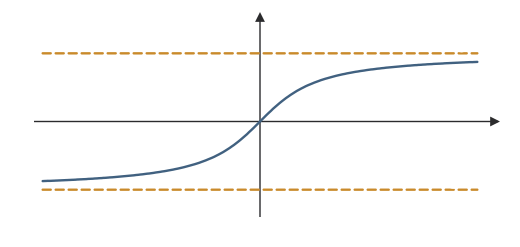
A curve rising through the origin between the dashed lines y = −π/2 and y = π/2
Options for question 73

Show the explanationHide the explanation

AnswerA · y=tan⁡−1xy = \tan^{-1} x

  1. Defined for every real xx with values in (−π2,π2)\left(-\frac{\pi}{2}, \frac{\pi}{2}\right): that is tan⁡−1\tan^{-1}.

  2. It passes through the origin, since tan⁡−10=0\tan^{-1} 0 = 0.

Worth noting

cot⁡−1x\cot^{-1} x is also defined everywhere, but it falls, between 0 and π\pi, and cot⁡−10=π2\cot^{-1} 0 = \frac{\pi}{2}.

The figure shows the graph of a function defined for every real xx, falling through (0,π2)\left(0, \frac{\pi}{2}\right) between the lines y=0y = 0 and y=πy = \pi without reaching them. Which function is it?
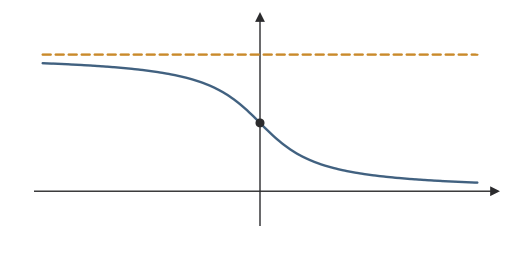
A curve falling through (0, π/2) between the x-axis and the dashed line y = π
Options for question 74

Show the explanationHide the explanation

AnswerD · y=cot⁡−1xy = \cot^{-1} x

  1. Defined everywhere, with values in (0,π)(0, \pi), and falling: that is cot⁡−1\cot^{-1}.

  2. It crosses the yy-axis at cot⁡−10=π2\cot^{-1} 0 = \frac{\pi}{2}.

Worth noting

π2+tan⁡−1x\frac{\pi}{2} + \tan^{-1} x has the same range, but it rises.

Consider the curve y=cot⁡−1xy = \cot^{-1} x, defined for every real xx, with its values on the principal branch (0,π)(0, \pi).

At which point does this curve y=cot⁡−1xy = \cot^{-1} x meet the curve y=tan⁡−1xy = \tan^{-1} x?

Options for question 75

Show the explanationHide the explanation

AnswerD · (1,π4)\left(1, \frac{\pi}{4}\right)

  1. At a common point tan⁡−1x=cot⁡−1x=θ\tan^{-1} x = \cot^{-1} x = \theta, so tan⁡θ=x=cot⁡θ\tan \theta = x = \cot \theta and tan⁡2θ=1\tan^{2} \theta = 1.

  2. θ\theta lies in both branches, so in (0,π2)\left(0, \frac{\pi}{2}\right): θ=π4\theta = \frac{\pi}{4} and x=1x = 1.

Worth noting

At x=−1x = -1, tan⁡−1(−1)=−π4\tan^{-1}(-1) = -\frac{\pi}{4} but cot⁡−1(−1)=3π4\cot^{-1}(-1) = \frac{3\pi}{4}: the curves do not meet there.

Consider the curve y=cot⁡−1xy = \cot^{-1} x, defined for every real xx, with its values on the principal branch (0,π)(0, \pi).

About which point is this curve y=cot⁡−1xy = \cot^{-1} x symmetric?

Options for question 76

Show the explanationHide the explanation

AnswerC · (0,π2)\left(0, \frac{\pi}{2}\right)

  1. cot⁡−1(−x)=π−cot⁡−1x\cot^{-1}(-x) = \pi - \cot^{-1} x, so with (x,y)(x, y) the curve also passes through (−x,π−y)(-x, \pi - y).

  2. The midpoint of those two points is (0,π2)\left(0, \frac{\pi}{2}\right) for every xx: that is the centre of symmetry.

Worth noting

(0,0)(0, 0) is the centre for y=tan⁡−1xy = \tan^{-1} x, where tan⁡−1(−x)=−tan⁡−1x\tan^{-1}(-x) = -\tan^{-1} x.

Which of the following statements about the curve y=cosec⁡−1xy = \operatorname{cosec}^{-1} x are true?

I. It passes through the point (−1,−π2)\left(-1, -\frac{\pi}{2}\right).

II. It passes through the point (2,π3)\left(2, \frac{\pi}{3}\right).

III. It falls as xx increases on [1,∞)[1, \infty).

IV. It falls as xx increases on (−∞,−1](-\infty, -1].

Options for question 77

Show the explanationHide the explanation

AnswerD · I, III and IV only

  1. cosec⁡(−π2)=−1\operatorname{cosec}\left(-\frac{\pi}{2}\right) = -1, so I is true; cosec⁡π3=23\operatorname{cosec} \frac{\pi}{3} = \frac{2}{\sqrt{3}}, not 2, so II is false.

  2. cosec⁡−1x=sin⁡−11x\operatorname{cosec}^{-1} x = \sin^{-1} \frac{1}{x}: on each piece 1x\frac{1}{x} falls as xx increases and sin⁡−1\sin^{-1} keeps that order, so the curve falls, from π2\frac{\pi}{2} towards 0 and from near 0 down to −π2-\frac{\pi}{2}. III and IV are true.

Worth noting

II mixes up cosec⁡−1\operatorname{cosec}^{-1} with sec⁡−1\sec^{-1}: sec⁡−12=π3\sec^{-1} 2 = \frac{\pi}{3}, but cosec⁡−12=π6\operatorname{cosec}^{-1} 2 = \frac{\pi}{6}.

Assertion (A): The curve y=cos⁡−1xy = \cos^{-1} x lies on or above the xx-axis.

Reason (R): cos⁡−1x\cos^{-1} x is defined only for −1≤x≤1-1 \le x \le 1.

Options for question 78

Show the explanationHide the explanation

AnswerB · Both A and R are true, but R is not the correct explanation of A.

  1. A is true: every value of cos⁡−1\cos^{-1} lies in [0,π][0, \pi], so y≥0y \ge 0 at every point of the curve.

  2. R is true too, but it limits xx, how far the curve runs left and right; A is about yy and comes from the range.

Worth noting

R is the domain: it explains why the curve stops at x=±1x = \pm 1, not why it stays above the xx-axis.

Read the two statements and choose the correct option.

I. The curves y=sin⁡−1xy = \sin^{-1} x and y=cos⁡−1xy = \cos^{-1} x are mirror images of each other in the line y=xy = x.

II. The curves y=tan⁡−1xy = \tan^{-1} x and y=cot⁡−1xy = \cot^{-1} x are mirror images of each other in the line y=π4y = \frac{\pi}{4}.

Options for question 79

Show the explanationHide the explanation

AnswerB · Only II

  1. I: the mirror image of y=sin⁡−1xy = \sin^{-1} x in y=xy = x is y=sin⁡xy = \sin x, −π2≤x≤π2-\frac{\pi}{2} \le x \le \frac{\pi}{2}, which runs over [−π2,π2]\left[-\frac{\pi}{2}, \frac{\pi}{2}\right], not [−1,1][-1, 1]. False.

  2. II: cot⁡−1x=π2−tan⁡−1x\cot^{-1} x = \frac{\pi}{2} - \tan^{-1} x, so at each xx the two heights are equally far above and below π4\frac{\pi}{4}. True.

Worth noting

Reflecting in y=xy = x turns a curve into the curve of its inverse, and cos⁡−1\cos^{-1} is not the inverse of sin⁡−1\sin^{-1}.

Read the two statements and choose the correct option.

I. The curve y=sec⁡−1xy = \sec^{-1} x has no points with −1<x<1-1 < x < 1.

II. The curve y=cos⁡−1xy = \cos^{-1} x is symmetric about the yy-axis.

Options for question 80

Show the explanationHide the explanation

AnswerA · Only I

  1. I: sec⁡−1\sec^{-1} needs ∣x∣≥1\lvert x \rvert \ge 1. True.

  2. II: cos⁡−1(−x)=π−cos⁡−1x\cos^{-1}(-x) = \pi - \cos^{-1} x, not cos⁡−1x\cos^{-1} x; the curve is symmetric about the point (0,π2)\left(0, \frac{\pi}{2}\right), not the axis. False.

Worth noting

cos⁡x\cos x is symmetric about the yy-axis, but its inverse is not.

Consider the curve y=cot⁡−1xy = \cot^{-1} x, defined for every real xx, with its values on the principal branch (0,π)(0, \pi).

For which values of xx does this curve y=cot⁡−1xy = \cot^{-1} x lie below the line y=π3y = \frac{\pi}{3}?

Options for question 81

Show the explanationHide the explanation

AnswerA · x>13x > \frac{1}{\sqrt{3}}

  1. The curve meets the line where x=cot⁡π3=13x = \cot \frac{\pi}{3} = \frac{1}{\sqrt{3}}.

  2. The curve falls as xx increases, so it is below the line to the right of that point: x>13x > \frac{1}{\sqrt{3}}.

Worth noting

x<13x < \frac{1}{\sqrt{3}} treats the curve as rising; to the left of the meeting point it is above the line.

Match each curve in List I with the horizontal line or lines in List II that it gets ever closer to but never meets.

List IList II
A. y=tan⁡−1xy = \tan^{-1} xI. y=0y = 0 only
B. y=cot⁡−1xy = \cot^{-1} xII. y=π2y = \frac{\pi}{2} only
C. y=sec⁡−1xy = \sec^{-1} xIII. y=0y = 0 and y=πy = \pi
D. y=cosec⁡−1xy = \operatorname{cosec}^{-1} xIV. y=−π2y = -\frac{\pi}{2} and y=π2y = \frac{\pi}{2}
Options for question 82

Show the explanationHide the explanation

AnswerA · A-IV, B-III, C-II, D-I

  1. tan⁡−1\tan^{-1} and cot⁡−1\cot^{-1} are defined for every xx; as x→±∞x \to \pm\infty they approach the open ends of their ranges, ±π2\pm\frac{\pi}{2} and 0,π0, \pi.

  2. As ∣x∣\lvert x \rvert grows, 1x→0\frac{1}{x} \to 0: sec⁡−1x=cos⁡−11x→π2\sec^{-1} x = \cos^{-1} \frac{1}{x} \to \frac{\pi}{2} and cosec⁡−1x=sin⁡−11x→0\operatorname{cosec}^{-1} x = \sin^{-1} \frac{1}{x} \to 0, the one value each range leaves out.

Worth noting

Swapping sec⁡−1\sec^{-1} and cosec⁡−1\operatorname{cosec}^{-1} forgets which value each range leaves out: π2\frac{\pi}{2} for sec⁡−1\sec^{-1}, 0 for cosec⁡−1\operatorname{cosec}^{-1}.

Assertion (A): For 0<x≤10 < x \le 1, the curve y=sin⁡−1xy = \sin^{-1} x lies below the line y=xy = x.

Reason (R): The curve y=sin⁡−1xy = \sin^{-1} x is the mirror image of y=sin⁡xy = \sin x, −π2≤x≤π2-\frac{\pi}{2} \le x \le \frac{\pi}{2}, in the line y=xy = x.

Options for question 83

Show the explanationHide the explanation

AnswerD · A is false, but R is true.

  1. R is true: sin⁡−1\sin^{-1} undoes sin⁡\sin on its branch, which swaps xx and yy.

  2. For 0<x≤π20 < x \le \frac{\pi}{2}, sin⁡x<x\sin x < x, so y=sin⁡xy = \sin x lies below y=xy = x and its mirror image lies above; for example sin⁡−11=π2>1\sin^{-1} 1 = \frac{\pi}{2} > 1. A is false.

Worth noting

Taking A as true forgets that reflecting in y=xy = x turns below into above.

Values of expressions

37 questions

What is the value of cos⁡−1(12)+2sin⁡−1(12)\cos^{-1}\left(\frac{1}{2}\right) + 2\sin^{-1}\left(\frac{1}{2}\right)?

Options for question 84

Show the explanationHide the explanation

AnswerC · 2π3\frac{2 \pi}{3}

  1. Take each principal value on its own branch.

  2. π3+2×π6=2π3\frac{\pi}{3} + 2 \times \frac{\pi}{6} = \frac{2\pi}{3}.

Worth noting

π2\frac{\pi}{2} adds π3+π6\frac{\pi}{3} + \frac{\pi}{6}, forgetting the factor 2.

Let θ=cos⁡−1(−35)\theta = \cos^{-1}\left(-\frac{3}{5}\right).

In which interval does this θ=cos⁡−1(−35)\theta = \cos^{-1}\left(-\frac{3}{5}\right) lie?

Options for question 85

Show the explanationHide the explanation

AnswerD · (π2,π)\left(\frac{\pi}{2}, \pi\right)

  1. cos⁡−1\cos^{-1} takes values in [0,π][0, \pi].

  2. A negative cosine on [0,π][0, \pi] means an obtuse angle: (π2,π)\left(\frac{\pi}{2}, \pi\right).

Worth noting

(−π2,0)\left(-\frac{\pi}{2}, 0\right) is where sin⁡−1\sin^{-1} of a negative number lies, not cos⁡−1\cos^{-1}.

What is the value of 2sin⁡−1(12)+cos⁡−1(−12)2\sin^{-1}\left(\frac{1}{2}\right) + \cos^{-1}\left(-\frac{1}{2}\right)?

Options for question 86

Show the explanationHide the explanation

AnswerD · π\pi

  1. 2×π6=π32 \times \frac{\pi}{6} = \frac{\pi}{3} and cos⁡−1(−12)=2π3\cos^{-1}\left(-\frac{1}{2}\right) = \frac{2\pi}{3}.

  2. π3+2π3=π\frac{\pi}{3} + \frac{2\pi}{3} = \pi.

Worth noting

0 takes cos⁡−1(−12)\cos^{-1}\left(-\frac{1}{2}\right) as −π3-\frac{\pi}{3}.

What is the value of sin⁡(sin⁡−127+cos⁡−127)\sin\left(\sin^{-1} \frac{2}{7} + \cos^{-1} \frac{2}{7}\right)?

Options for question 87

Show the explanationHide the explanation

AnswerC · 11

  1. sin⁡−127+cos⁡−127=π2\sin^{-1} \frac{2}{7} + \cos^{-1} \frac{2}{7} = \frac{\pi}{2}, because 27\frac{2}{7} is in [−1,1][-1, 1].

  2. sin⁡π2=1\sin \frac{\pi}{2} = 1.

Worth noting

2+357\frac{2 + 3\sqrt{5}}{7} takes the sine of each term and adds; the sine of a sum is not the sum of the sines.

What is sin⁡−1(sin⁡2π3)\sin^{-1}\left(\sin \frac{2 \pi}{3}\right)?

Options for question 88

Show the explanationHide the explanation

AnswerB · π3\frac{\pi}{3}

  1. sin⁡2π3=32\sin \frac{2 \pi}{3} = \frac{\sqrt{3}}{2}.

  2. The principal value with that sin is π3\frac{\pi}{3}.

Worth noting

2π3\frac{2\pi}{3} is outside [−π2,π2]\left[-\frac{\pi}{2}, \frac{\pi}{2}\right], so sin⁡−1\sin^{-1} cannot return it.

What is the value of cos⁡(sin⁡−135)\cos\left(\sin^{-1} \frac{3}{5}\right)?

Options for question 89

Show the explanationHide the explanation

AnswerD · 45\frac{4}{5}

  1. Let θ=sin⁡−135\theta = \sin^{-1} \frac{3}{5}, so sin⁡θ=35\sin \theta = \frac{3}{5} with θ\theta in [−π2,π2]\left[-\frac{\pi}{2}, \frac{\pi}{2}\right], where cos⁡θ≥0\cos \theta \ge 0.

  2. cos⁡θ=1−925=45\cos \theta = \sqrt{1 - \frac{9}{25}} = \frac{4}{5}.

Worth noting

−45-\frac{4}{5} picks the wrong sign; on the branch of sin⁡−1\sin^{-1} the cosine is never negative.

What is the value of tan⁡−1(1)+cos⁡−1(−12)+sin⁡−1(−12)\tan^{-1}(1) + \cos^{-1}\left(-\frac{1}{2}\right) + \sin^{-1}\left(-\frac{1}{2}\right)?

Options for question 90

Show the explanationHide the explanation

AnswerC · 3π4\frac{3 \pi}{4}

  1. Take each principal value on its own branch.

  2. π4+2π3−π6=3π+8π−2π12=3π4\frac{\pi}{4} + \frac{2\pi}{3} - \frac{\pi}{6} = \frac{3\pi + 8\pi - 2\pi}{12} = \frac{3\pi}{4}.

Worth noting

π4\frac{\pi}{4} takes cos⁡−1(−12)\cos^{-1}\left(-\frac{1}{2}\right) as −π3-\frac{\pi}{3}; on [0,π][0, \pi] it is 2π3\frac{2\pi}{3}.

What is tan⁡−1(tan⁡3π4)\tan^{-1}\left(\tan \frac{3 \pi}{4}\right)?

Options for question 91

Show the explanationHide the explanation

AnswerA · −π4- \frac{\pi}{4}

  1. tan⁡3π4=−1\tan \frac{3 \pi}{4} = -1.

  2. The principal value with that tan is −π4- \frac{\pi}{4}.

Worth noting

3π4\frac{3\pi}{4} is outside (−π2,π2)\left(-\frac{\pi}{2}, \frac{\pi}{2}\right); tan⁡\tan repeats every π\pi, so subtract π\pi.

What is the value of tan⁡(cos⁡−1513)\tan\left(\cos^{-1} \frac{5}{13}\right)?

Options for question 92

Show the explanationHide the explanation

AnswerD · 125\frac{12}{5}

  1. Let θ=cos⁡−1513\theta = \cos^{-1} \frac{5}{13}: adjacent 5, hypotenuse 13, so opposite 169−25=12\sqrt{169 - 25} = 12.

  2. tan⁡θ=125\tan \theta = \frac{12}{5}, positive since θ\theta is acute.

Worth noting

512\frac{5}{12} is adjacent over opposite, the cotangent.

What is the value of sin⁡−1(−12)+cos⁡−1(−12)\sin^{-1}\left(-\frac{1}{2}\right) + \cos^{-1}\left(-\frac{1}{2}\right)?

Options for question 93

Show the explanationHide the explanation

AnswerC · π2\frac{\pi}{2}

  1. Take each principal value on its own branch.

  2. −π6+2π3=π2-\frac{\pi}{6} + \frac{2\pi}{3} = \frac{\pi}{2}.

Worth noting

−π2-\frac{\pi}{2} takes both values as negative; cos⁡−1(−12)=2π3\cos^{-1}\left(-\frac{1}{2}\right) = \frac{2\pi}{3}.

If sin⁡−1x=π5\sin^{-1} x = \frac{\pi}{5} for some xx in [−1,1][-1, 1], what is cos⁡−1x\cos^{-1} x?

Options for question 94

Show the explanationHide the explanation

AnswerC · 3π10\frac{3 \pi}{10}

  1. sin⁡−1x+cos⁡−1x=π2\sin^{-1} x + \cos^{-1} x = \frac{\pi}{2} for every xx in [−1,1][-1, 1].

  2. cos⁡−1x=π2−π5=3π10\cos^{-1} x = \frac{\pi}{2} - \frac{\pi}{5} = \frac{3\pi}{10}.

Worth noting

4π5\frac{4\pi}{5} uses π\pi in place of π2\frac{\pi}{2} as the total.

What is sin⁡−1(sin⁡4π5)\sin^{-1}\left(\sin \frac{4 \pi}{5}\right)?

Options for question 95

Show the explanationHide the explanation

AnswerB · π5\frac{\pi}{5}

  1. sin⁡4π5=58−58\sin \frac{4 \pi}{5} = \sqrt{\frac{5}{8} - \frac{\sqrt{5}}{8}}.

  2. The principal value with that sin is π5\frac{\pi}{5}.

Worth noting

4π5\frac{4\pi}{5} is outside the branch; the angle with the same sine on it is π−4π5\pi - \frac{4\pi}{5}.

What is the value of tan⁡(sin⁡−1513)\tan\left(\sin^{-1} \frac{5}{13}\right)?

Options for question 96

Show the explanationHide the explanation

AnswerB · 512\frac{5}{12}

  1. Let θ=sin⁡−1513\theta = \sin^{-1} \frac{5}{13}: opposite 5, hypotenuse 13, so adjacent 169−25=12\sqrt{169 - 25} = 12.

  2. tan⁡θ=512\tan \theta = \frac{5}{12}.

Worth noting

125\frac{12}{5} is adjacent over opposite.

What is tan⁡−1(tan⁡7π6)\tan^{-1}\left(\tan \frac{7 \pi}{6}\right)?

Options for question 97

Show the explanationHide the explanation

AnswerB · π6\frac{\pi}{6}

  1. tan⁡7π6=33\tan \frac{7 \pi}{6} = \frac{\sqrt{3}}{3}.

  2. The principal value with that tan is π6\frac{\pi}{6}.

Worth noting

tan⁡\tan repeats every π\pi: 7π6−π=π6\frac{7\pi}{6} - \pi = \frac{\pi}{6} is on the branch.

What is the value of cos⁡(2sin⁡−112)\cos\left(2\sin^{-1} \frac{1}{2}\right)?

Options for question 98

Show the explanationHide the explanation

AnswerB · 12\frac{1}{2}

  1. sin⁡−112=π6\sin^{-1} \frac{1}{2} = \frac{\pi}{6}, so the angle is π3\frac{\pi}{3}.

  2. cos⁡π3=12\cos \frac{\pi}{3} = \frac{1}{2}.

Worth noting

32\frac{\sqrt{3}}{2} is cos⁡π6\cos \frac{\pi}{6}, forgetting the factor 2.

Let θ=cos⁡−1(−35)\theta = \cos^{-1}\left(-\frac{3}{5}\right).

What is sin⁡θ\sin \theta for this θ=cos⁡−1(−35)\theta = \cos^{-1}\left(-\frac{3}{5}\right)?

Options for question 99

Show the explanationHide the explanation

AnswerD · 45\frac{4}{5}

  1. sin⁡2θ=1−925=1625\sin^{2} \theta = 1 - \frac{9}{25} = \frac{16}{25}.

  2. θ\theta is in (0,π)(0, \pi), where sine is positive: 45\frac{4}{5}.

Worth noting

−45-\frac{4}{5} copies the minus sign from the cosine; on [0,π][0, \pi] the sine is never negative.

Let θ=cos⁡−1(−35)\theta = \cos^{-1}\left(-\frac{3}{5}\right).

What is tan⁡θ\tan \theta for this θ=cos⁡−1(−35)\theta = \cos^{-1}\left(-\frac{3}{5}\right)?

Options for question 100

Show the explanationHide the explanation

AnswerA · −43- \frac{4}{3}

  1. tan⁡θ=sin⁡θcos⁡θ=4/5−3/5\tan \theta = \frac{\sin \theta}{\cos \theta} = \frac{4/5}{-3/5}.

  2. −43-\frac{4}{3}.

Worth noting

43\frac{4}{3} loses the sign: an obtuse angle has a negative tangent.

Which of the following statements are true?

I. sin⁡−1(sin⁡x)=x\sin^{-1}(\sin x) = x for every real xx.

II. sin⁡(sin⁡−1x)=x\sin\left(\sin^{-1} x\right) = x for every xx with −1≤x≤1-1 \le x \le 1.

III. cos⁡−1(cos⁡x)=x\cos^{-1}(\cos x) = x for every xx with −π2≤x≤π2-\frac{\pi}{2} \le x \le \frac{\pi}{2}.

IV. tan⁡(tan⁡−1x)=x\tan\left(\tan^{-1} x\right) = x for every real xx.

Options for question 101

Show the explanationHide the explanation

AnswerA · II and IV only

  1. A function applied to its own inverse gives back xx wherever the inverse is defined: II and IV are true.

  2. The other order gives back xx only on the branch: sin⁡−1(sin⁡π)=0\sin^{-1}(\sin \pi) = 0, so I is false; cos⁡−1(cos⁡(−π4))=π4\cos^{-1}\left(\cos\left(-\frac{\pi}{4}\right)\right) = \frac{\pi}{4}, so III is false.

Worth noting

III uses the branch of sin⁡−1\sin^{-1}; cos⁡−1\cos^{-1} returns only angles in [0,π][0, \pi], never a negative one.

What is the value of tan⁡−1(−5)+cot⁡−1(−5)\tan^{-1}(-5) + \cot^{-1}(-5)?

Options for question 102

Show the explanationHide the explanation

AnswerC · π2\frac{\pi}{2}

  1. Let θ=tan⁡−1(−5)\theta = \tan^{-1}(-5), in (−π2,0)\left(-\frac{\pi}{2}, 0\right). Then π2−θ\frac{\pi}{2} - \theta lies in (0,π)(0, \pi) and cot⁡(π2−θ)=tan⁡θ=−5\cot\left(\frac{\pi}{2} - \theta\right) = \tan \theta = -5.

  2. So cot⁡−1(−5)=π2−θ\cot^{-1}(-5) = \frac{\pi}{2} - \theta, and the sum is π2\frac{\pi}{2}, as it is for every real input.

Worth noting

−π2-\frac{\pi}{2} writes cot⁡−1(−5)\cot^{-1}(-5) as tan⁡−1(−15)\tan^{-1}\left(-\frac{1}{5}\right), a negative angle off the branch (0,π)(0, \pi).

Read the two statements and choose the correct option.

I. sin⁡−1x+cos⁡−1x=π2\sin^{-1} x + \cos^{-1} x = \frac{\pi}{2} for every xx with ∣x∣≤1\lvert x \rvert \le 1.

II. sec⁡−1x+cosec⁡−1x=π2\sec^{-1} x + \operatorname{cosec}^{-1} x = \frac{\pi}{2} for every xx with ∣x∣≥1\lvert x \rvert \ge 1.

Options for question 103

Show the explanationHide the explanation

AnswerC · Both I and II

  1. I: if sin⁡−1x=θ\sin^{-1} x = \theta, then cos⁡(π2−θ)=x\cos\left(\frac{\pi}{2} - \theta\right) = x with π2−θ\frac{\pi}{2} - \theta in [0,π][0, \pi], so cos⁡−1x=π2−θ\cos^{-1} x = \frac{\pi}{2} - \theta. True.

  2. II: sec⁡−1x=cos⁡−11x\sec^{-1} x = \cos^{-1} \frac{1}{x} and cosec⁡−1x=sin⁡−11x\operatorname{cosec}^{-1} x = \sin^{-1} \frac{1}{x}, and 1x\frac{1}{x} is in [−1,1][-1, 1]; so II is I applied to 1x\frac{1}{x}. True.

Worth noting

Doubting II misses that sec⁡−1\sec^{-1} and cosec⁡−1\operatorname{cosec}^{-1} are cos⁡−1\cos^{-1} and sin⁡−1\sin^{-1} of the reciprocal.

If cos⁡−1x=2sin⁡−1x\cos^{-1} x = 2\sin^{-1} x, what is xx?

Options for question 104

Show the explanationHide the explanation

AnswerB · 12\frac{1}{2}

  1. cos⁡−1x=π2−sin⁡−1x\cos^{-1} x = \frac{\pi}{2} - \sin^{-1} x, so π2−sin⁡−1x=2sin⁡−1x\frac{\pi}{2} - \sin^{-1} x = 2\sin^{-1} x and sin⁡−1x=π6\sin^{-1} x = \frac{\pi}{6}.

  2. So x=sin⁡π6=12x = \sin \frac{\pi}{6} = \frac{1}{2}; check: cos⁡−112=π3=2×π6\cos^{-1} \frac{1}{2} = \frac{\pi}{3} = 2 \times \frac{\pi}{6}.

Worth noting

12\frac{1}{\sqrt{2}} solves cos⁡−1x=sin⁡−1x\cos^{-1} x = \sin^{-1} x, dropping the factor 2.

For −1≤x≤1-1 \le x \le 1, what is sin⁡(cos⁡−1x)\sin\left(\cos^{-1} x\right)?

Options for question 105

Show the explanationHide the explanation

AnswerD · 1−x2\sqrt{1 - x^{2}}

  1. Let θ=cos⁡−1x\theta = \cos^{-1} x, so cos⁡θ=x\cos \theta = x and θ\theta is in [0,π][0, \pi], where sin⁡θ≥0\sin \theta \ge 0.

  2. sin⁡θ=1−cos⁡2θ=1−x2\sin \theta = \sqrt{1 - \cos^{2} \theta} = \sqrt{1 - x^{2}}, the positive root.

Worth noting

xx treats sin⁡\sin as undoing cos⁡−1\cos^{-1}; only cos⁡\cos undoes it.

What is the value of sec⁡2(tan⁡−12)+cosec⁡2(cot⁡−13)\sec^{2}\left(\tan^{-1} 2\right) + \operatorname{cosec}^{2}\left(\cot^{-1} 3\right)?

Options for question 106

Show the explanationHide the explanation

AnswerD · 1515

  1. sec⁡2θ=1+tan⁡2θ\sec^{2} \theta = 1 + \tan^{2} \theta, so sec⁡2(tan⁡−12)=1+4=5\sec^{2}\left(\tan^{-1} 2\right) = 1 + 4 = 5.

  2. cosec⁡2ϕ=1+cot⁡2ϕ\operatorname{cosec}^{2} \phi = 1 + \cot^{2} \phi, so cosec⁡2(cot⁡−13)=1+9=10\operatorname{cosec}^{2}\left(\cot^{-1} 3\right) = 1 + 9 = 10; the sum is 15.

Worth noting

13 adds only tan⁡2\tan^{2} and cot⁡2\cot^{2}, 4+94 + 9, dropping the 1 in each identity.

If sin⁡−1x+sin⁡−1y=π\sin^{-1} x + \sin^{-1} y = \pi, what is x+yx + y?

Options for question 107

Show the explanationHide the explanation

AnswerD · 22

  1. Each principal value is at most π2\frac{\pi}{2}, so a sum of π\pi needs both to be π2\frac{\pi}{2}.

  2. So x=y=1x = y = 1 and x+y=2x + y = 2.

Worth noting

0 treats the equation like one about angles that can be anything; the branch caps each at π2\frac{\pi}{2}.

Assertion (A): sin⁡−1(sin⁡5π6)=π6\sin^{-1}\left(\sin \frac{5\pi}{6}\right) = \frac{\pi}{6}.

Reason (R): sin⁡−1(sin⁡θ)=θ\sin^{-1}(\sin \theta) = \theta only for θ\theta in [−π2,π2]\left[-\frac{\pi}{2}, \frac{\pi}{2}\right].

Options for question 108

Show the explanationHide the explanation

AnswerA · Both A and R are true, and R is the correct explanation of A.

  1. A is true: sin⁡5π6=12\sin \frac{5\pi}{6} = \frac{1}{2}, and the angle on the branch with sine 12\frac{1}{2} is π6\frac{\pi}{6}.

  2. R is true and explains why the answer is not 5π6\frac{5\pi}{6} itself.

Read the two statements and choose the correct option.

I. cos⁡−1(−12)=π−cos⁡−112\cos^{-1}\left(-\frac{1}{2}\right) = \pi - \cos^{-1} \frac{1}{2}.

II. sin⁡−1(−12)=π−sin⁡−112\sin^{-1}\left(-\frac{1}{2}\right) = \pi - \sin^{-1} \frac{1}{2}.

Options for question 109

Show the explanationHide the explanation

AnswerA · Only I

  1. I: 2π3=π−π3\frac{2\pi}{3} = \pi - \frac{\pi}{3}. True.

  2. II: the left side is −π6-\frac{\pi}{6}, the right 5π6\frac{5\pi}{6}. False; for sin⁡−1\sin^{-1} a negative input just flips the sign.

Worth noting

The rule π−…\pi - \ldots belongs to the branch [0,π][0, \pi], not to [−π2,π2]\left[-\frac{\pi}{2}, \frac{\pi}{2}\right].

What is the value of tan⁡−1(3)−sec⁡−1(−2)\tan^{-1}\left(\sqrt{3}\right) - \sec^{-1}(-2)?

Options for question 110

Show the explanationHide the explanation

AnswerA · −π3- \frac{\pi}{3}

  1. Take each principal value on its own branch.

  2. π3−2π3=−π3\frac{\pi}{3} - \frac{2\pi}{3} = -\frac{\pi}{3}.

Worth noting

2π3\frac{2\pi}{3} takes sec⁡−1(−2)\sec^{-1}(-2) as −π3-\frac{\pi}{3}; on [0,π][0, \pi] it is 2π3\frac{2\pi}{3}.

What is cos⁡−1(cos⁡7π6)\cos^{-1}\left(\cos \frac{7 \pi}{6}\right)?

Options for question 111

Show the explanationHide the explanation

AnswerC · 5π6\frac{5 \pi}{6}

  1. cos⁡7π6=−32\cos \frac{7 \pi}{6} = - \frac{\sqrt{3}}{2}.

  2. The principal value with that cos is 5π6\frac{5 \pi}{6}.

Worth noting

7π6\frac{7\pi}{6} is more than π\pi, off the branch of cos⁡−1\cos^{-1}.

What is the value of sin⁡(π3−sin⁡−1(−12))\sin\left(\frac{\pi}{3} - \sin^{-1}\left(-\frac{1}{2}\right)\right)?

Options for question 112

Show the explanationHide the explanation

AnswerD · 11

  1. sin⁡−1(−12)=−π6\sin^{-1}\left(-\frac{1}{2}\right) = -\frac{\pi}{6}, so the angle is π3+π6=π2\frac{\pi}{3} + \frac{\pi}{6} = \frac{\pi}{2}.

  2. sin⁡π2=1\sin \frac{\pi}{2} = 1.

Worth noting

12\frac{1}{2} is sin⁡π6\sin\frac{\pi}{6}, from subtracting π6\frac{\pi}{6} where the minus sign turns it into an addition.

If cos⁡−1x+cos⁡−1y+cos⁡−1z=3π\cos^{-1} x + \cos^{-1} y + \cos^{-1} z = 3\pi, what is x+y+zx + y + z?

Options for question 113

Show the explanationHide the explanation

AnswerA · −3-3

  1. Each cos⁡−1\cos^{-1} is at most π\pi, so all three must equal π\pi.

  2. cos⁡−1x=π\cos^{-1} x = \pi gives x=−1x = -1; so x+y+z=−3x + y + z = -3.

Worth noting

3 takes cos⁡−11=π\cos^{-1} 1 = \pi; in fact cos⁡−11=0\cos^{-1} 1 = 0 and cos⁡−1(−1)=π\cos^{-1}(-1) = \pi.

What is the value of cot⁡−1(−1)+tan⁡−1(−1)\cot^{-1}(-1) + \tan^{-1}(-1)?

Options for question 114

Show the explanationHide the explanation

AnswerC · π2\frac{\pi}{2}

  1. Take each principal value on its own branch.

  2. 3π4−π4=π2\frac{3\pi}{4} - \frac{\pi}{4} = \frac{\pi}{2}.

Worth noting

0 takes cot⁡−1(−1)\cot^{-1}(-1) as −π4-\frac{\pi}{4}, off its branch (0,π)(0, \pi).

What is the value of cos⁡(tan⁡−134)\cos\left(\tan^{-1} \frac{3}{4}\right)?

Options for question 115

Show the explanationHide the explanation

AnswerC · 45\frac{4}{5}

  1. Let θ=tan⁡−134\theta = \tan^{-1} \frac{3}{4}: opposite 3, adjacent 4, hypotenuse 5.

  2. cos⁡θ=45\cos \theta = \frac{4}{5}.

Worth noting

35\frac{3}{5} is the sine of the same angle.

Let θ=cos⁡−1(−35)\theta = \cos^{-1}\left(-\frac{3}{5}\right).

How is cos⁡−1(35)\cos^{-1}\left(\frac{3}{5}\right) related to this θ=cos⁡−1(−35)\theta = \cos^{-1}\left(-\frac{3}{5}\right)?

Options for question 116

Show the explanationHide the explanation

AnswerA · cos⁡−1(35)=π−θ\cos^{-1}\left(\frac{3}{5}\right) = \pi - \theta

  1. cos⁡−1(−x)=π−cos⁡−1x\cos^{-1}(-x) = \pi - \cos^{-1} x, so θ=π−cos⁡−1(35)\theta = \pi - \cos^{-1}\left(\frac{3}{5}\right).

  2. Hence cos⁡−1(35)=π−θ\cos^{-1}\left(\frac{3}{5}\right) = \pi - \theta.

Worth noting

−θ-\theta is the rule for sin⁡−1\sin^{-1}, not cos⁡−1\cos^{-1}.

What is cos⁡−1(cos⁡(−π3))\cos^{-1}\left(\cos \left(- \frac{\pi}{3}\right)\right)?

Options for question 117

Show the explanationHide the explanation

AnswerB · π3\frac{\pi}{3}

  1. cos⁡(−π3)=12\cos \left(- \frac{\pi}{3}\right) = \frac{1}{2}.

  2. The principal value with that cos is π3\frac{\pi}{3}.

Worth noting

−π3-\frac{\pi}{3} is negative, and cos⁡−1\cos^{-1} never returns a negative angle; cos⁡(−π3)=cos⁡π3\cos\left(-\frac{\pi}{3}\right) = \cos \frac{\pi}{3}.

For −1≤x≤1-1 \le x \le 1, what is the least value of (sin⁡−1x)2+(cos⁡−1x)2\left(\sin^{-1} x\right)^{2} + \left(\cos^{-1} x\right)^{2}?

Options for question 118

Show the explanationHide the explanation

AnswerB · π28\frac{\pi^{2}}{8}

  1. Let s=sin⁡−1xs = \sin^{-1} x, in [−π2,π2]\left[-\frac{\pi}{2}, \frac{\pi}{2}\right]; then cos⁡−1x=π2−s\cos^{-1} x = \frac{\pi}{2} - s.

  2. s2+(π2−s)2=2(s−π4)2+π28s^{2} + \left(\frac{\pi}{2} - s\right)^{2} = 2\left(s - \frac{\pi}{4}\right)^{2} + \frac{\pi^{2}}{8}.

  3. It is least when s=π4s = \frac{\pi}{4}, that is at x=12x = \frac{1}{\sqrt{2}}: the least value is π28\frac{\pi^{2}}{8}.

Worth noting

π24\frac{\pi^{2}}{4} makes one term 0, at x=0x = 0 or x=1x = 1, but the other is then (π2)2\left(\frac{\pi}{2}\right)^{2}; two equal parts give less.

Match each expression in List I with its value in List II.

List IList II
A. sin⁡−1(sin⁡3)\sin^{-1}(\sin 3)I. 2π−42\pi - 4
B. cos⁡−1(cos⁡4)\cos^{-1}(\cos 4)II. π−3\pi - 3
C. tan⁡−1(tan⁡2)\tan^{-1}(\tan 2)III. π−1\pi - 1
D. cot⁡−1(cot⁡(−1))\cot^{-1}\left(\cot(-1)\right)IV. 2−π2 - \pi
Options for question 119

Show the explanationHide the explanation

AnswerA · A-II, B-I, C-IV, D-III

  1. sin⁡(π−3)=sin⁡3\sin(\pi - 3) = \sin 3 with π−3\pi - 3 in [−π2,π2]\left[-\frac{\pi}{2}, \frac{\pi}{2}\right]; cos⁡(2π−4)=cos⁡4\cos(2\pi - 4) = \cos 4 with 2π−42\pi - 4 in [0,π][0, \pi].

  2. tan⁡(2−π)=tan⁡2\tan(2 - \pi) = \tan 2 with 2−π2 - \pi in (−π2,π2)\left(-\frac{\pi}{2}, \frac{\pi}{2}\right); cot⁡(π−1)=cot⁡(−1)\cot(\pi - 1) = \cot(-1) with π−1\pi - 1 in (0,π)(0, \pi).

Worth noting

Swapping the values of sin⁡−1(sin⁡3)\sin^{-1}(\sin 3) and cos⁡−1(cos⁡4)\cos^{-1}(\cos 4) forgets where 4 lies: it is between π\pi and 2π2\pi, so the angle on [0,π][0, \pi] with the same cosine is 2π−42\pi - 4.

What is the value of cos⁡(2tan⁡−112)\cos\left(2\tan^{-1} \frac{1}{2}\right)?

Options for question 120

Show the explanationHide the explanation

AnswerB · 35\frac{3}{5}

  1. Let θ=tan⁡−112\theta = \tan^{-1} \frac{1}{2}: opposite 1, adjacent 2, hypotenuse 5\sqrt{5}, so cos⁡θ=25\cos \theta = \frac{2}{\sqrt{5}}.

  2. cos⁡2θ=2cos⁡2θ−1=85−1=35\cos 2\theta = 2\cos^{2} \theta - 1 = \frac{8}{5} - 1 = \frac{3}{5}.

Worth noting

45\frac{4}{5} is sin⁡2θ=2tan⁡θ1+tan⁡2θ\sin 2\theta = \frac{2\tan \theta}{1 + \tan^{2} \theta}, the sine of the double angle, not its cosine.

NTA's Mathematics / Applied Mathematics syllabus has three sections: Section A1, which every candidate answers, then Section B1 (Mathematics) or Section B2 (Applied Mathematics), of which a candidate answers one. Each section lists units and topics but no chapters, so the chapters here are ours. Where both B sections list a topic that Section A also lists, its questions sit once, in Section A.