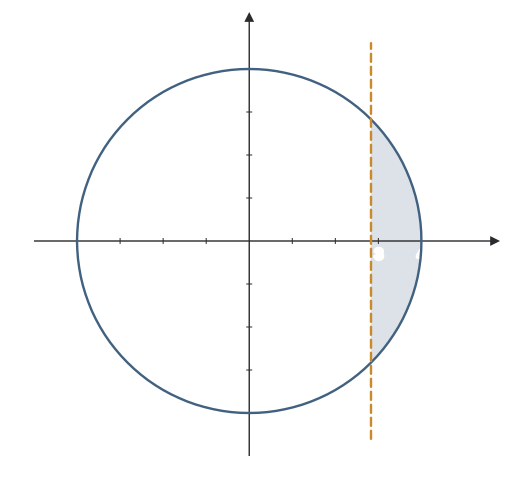
What is the area of the region in the first quadrant bounded by y 2 = 9 x y^{2} = 9x y 2 = 9 x x x x x = 1 x = 1 x = 1 x = 4 x = 4 x = 4
Options for question 56 A Option A 14 3 \frac{14}{3} 3 14 B Option B 14 square units C Option C 16 square units D Option D 28 square units
Skip Check Show the explanation Hide the explanation Next question Try again
Show the explanation Hide the explanation Answer B · 14 square units
In the first quadrant y = 3 x y = 3\sqrt{x} y = 3 x ∫ 1 4 3 x d x = 2 [ x 3 / 2 ] 1 4 \int_1^{4} 3\sqrt{x}\,dx = 2\left[x^{3/2}\right]_1^{4} ∫ 1 4 3 x d x = 2 [ x 3/2 ] 1 4
2 ( 8 − 1 ) = 14 2(8 - 1) = 14 2 ( 8 − 1 ) = 14
Worth noting
28 doubles the region, as if both halves of the parabola counted; the question asks for the first quadrant.
What is the area of the region between y = x y = x y = x y = x 2 y = x^{2} y = x 2
Options for question 57 A Option A 1 6 \frac{1}{6} 6 1 B Option B 1 3 \frac{1}{3} 3 1 C Option C 0.5 square units D Option D 5 6 \frac{5}{6} 6 5
Skip Check Show the explanation Hide the explanation Next question Try again
Show the explanation Hide the explanation Answer A · 1 6 \frac{1}{6} 6 1
They meet where x 2 = x x^{2} = x x 2 = x x = 0 x = 0 x = 0 x = 1 x = 1 x = 1
∫ 0 1 ( x − x 2 ) d x = 1 2 − 1 3 = 1 6 \int_0^{1} (x - x^{2})\,dx = \frac{1}{2} - \frac{1}{3} = \frac{1}{6} ∫ 0 1 ( x − x 2 ) d x = 2 1 − 3 1 = 6 1
Worth noting
1 2 \frac{1}{2} 2 1
The parabola y 2 = 4 x y^{2} = 4x y 2 = 4 x ( 1 , 0 ) (1, 0) ( 1 , 0 ) x = 1 x = 1 x = 1
Where does the latus rectum x = 1 x = 1 x = 1 y 2 = 4 x y^{2} = 4x y 2 = 4 x
Options for question 58 A Option A ( 1 , 4 ) (1, 4) ( 1 , 4 ) ( 1 , − 4 ) (1, -4) ( 1 , − 4 ) B Option B ( 2 , 1 ) (2, 1) ( 2 , 1 ) ( − 2 , 1 ) (-2, 1) ( − 2 , 1 ) C Option C ( 1 , 1 ) (1, 1) ( 1 , 1 ) ( 1 , − 1 ) (1, -1) ( 1 , − 1 ) D Option D ( 1 , 2 ) (1, 2) ( 1 , 2 ) ( 1 , − 2 ) (1, -2) ( 1 , − 2 )
Skip Check Show the explanation Hide the explanation Next question Try again
Show the explanation Hide the explanation Answer D · ( 1 , 2 ) (1, 2) ( 1 , 2 ) ( 1 , − 2 ) (1, -2) ( 1 , − 2 )
y 2 = 4 × 1 = 4 y^{2} = 4 \times 1 = 4 y 2 = 4 × 1 = 4
y = ± 2 y = \pm 2 y = ± 2
Worth noting
( 1 , 4 ) (1, 4) ( 1 , 4 ) y 2 = 4 y^{2} = 4 y 2 = 4
What is the area of the region in the first quadrant bounded by y 2 = x y^{2} = x y 2 = x x = 9 x = 9 x = 9
Options for question 59 A Option A 18 square units B Option B 27 square units C Option C 36 square units D Option D 40.5 square units
Skip Check Show the explanation Hide the explanation Next question Try again
Show the explanation Hide the explanation Answer A · 18 square units
In the first quadrant y = x y = \sqrt{x} y = x ∫ 0 9 x d x = 2 3 x 3 / 2 ∣ 0 9 \int_0^{9} \sqrt{x}\,dx = \frac{2}{3}x^{3/2}\Big|_0^{9} ∫ 0 9 x d x = 3 2 x 3/2 0 9
2 3 × 27 = 18 \frac{2}{3} \times 27 = 18 3 2 × 27 = 18
Worth noting
36 doubles the region, counting the part below the x x x
What is the area of the region bounded by y = x 2 y = x^{2} y = x 2 x x x x = 1 x = 1 x = 1 x = 2 x = 2 x = 2
Options for question 60 A Option A 1 square unit B Option B 7 3 \frac{7}{3} 3 7 C Option C 8 3 \frac{8}{3} 3 8 D Option D 3 square units
Skip Check Show the explanation Hide the explanation Next question Try again
Show the explanation Hide the explanation Answer B · 7 3 \frac{7}{3} 3 7
∫ 1 2 x 2 d x = [ x 3 3 ] 1 2 \int_1^{2} x^{2}\,dx = \left[\frac{x^{3}}{3}\right]_1^{2} ∫ 1 2 x 2 d x = [ 3 x 3 ] 1 2
8 3 − 1 3 = 7 3 \frac{8}{3} - \frac{1}{3} = \frac{7}{3} 3 8 − 3 1 = 3 7
Worth noting
8 3 \frac{8}{3} 3 8 x = 0 x = 0 x = 0
The parabola y 2 = 4 x y^{2} = 4x y 2 = 4 x ( 1 , 0 ) (1, 0) ( 1 , 0 ) x = 1 x = 1 x = 1
What is the whole area bounded by y 2 = 4 x y^{2} = 4x y 2 = 4 x
Options for question 61 A Option A 4 3 \frac{4}{3} 3 4 B Option B 2 square units C Option C 8 3 \frac{8}{3} 3 8 D Option D 4 square units
Skip Check Show the explanation Hide the explanation Next question Try again
Show the explanation Hide the explanation Answer C · 8 3 \frac{8}{3} 3 8
Double the half above the axis: 2 × 4 3 2 \times \frac{4}{3} 2 × 3 4
8 3 \frac{8}{3} 3 8 8 3 a 2 \frac{8}{3}a^{2} 3 8 a 2 a = 1 a = 1 a = 1
Worth noting
4 is the rectangle with sides 1 and 4 around the region.
The region bounded by the parabola x 2 = 6 y x^{2} = 6y x 2 = 6 y y = 6 y = 6 y = 6 x x x
Options for question 62 A Option A x = − 6 x = -6 x = − 6 x = 6 x = 6 x = 6 B Option B x = − 6 x = -\sqrt{6} x = − 6 x = 6 x = \sqrt{6} x = 6 C Option C x = 0 x = 0 x = 0 x = 6 x = 6 x = 6 D Option D x = − 36 x = -36 x = − 36 x = 36 x = 36 x = 36
Skip Check Show the explanation Hide the explanation Next question Try again
Show the explanation Hide the explanation Answer A · x = − 6 x = -6 x = − 6 x = 6 x = 6 x = 6
The line meets the parabola where x 2 = 6 × 6 = 36 x^{2} = 6 \times 6 = 36 x 2 = 6 × 6 = 36 x = ± 6 x = \pm 6 x = ± 6
Between them the line lies above the parabola: ∫ − 6 6 ( 6 − x 2 6 ) d x \int_{-6}^{6} \left(6 - \frac{x^{2}}{6}\right)dx ∫ − 6 6 ( 6 − 6 x 2 ) d x
Worth noting
± 6 \pm\sqrt{6} ± 6 x 2 = 6 x^{2} = 6 x 2 = 6 y = 6 y = 6 y = 6 6 × 6 6 \times 6 6 × 6
Using horizontal strips, which integral gives the area of the region bounded by the parabola x 2 = 2 y x^{2} = 2y x 2 = 2 y y = 2 y = 2 y = 2
Options for question 63 A Option A ∫ 0 2 2 y d y \int_0^{2} \sqrt{2y}\,dy ∫ 0 2 2 y d y B Option B ∫ 0 2 2 y d y \int_0^{2} 2\sqrt{y}\,dy ∫ 0 2 2 y d y C Option C ∫ 0 2 y 2 2 d y \int_0^{2} \frac{y^{2}}{2}\,dy ∫ 0 2 2 y 2 d y D Option D ∫ 0 2 2 2 y d y \int_0^{2} 2\sqrt{2y}\,dy ∫ 0 2 2 2 y d y
Skip Check Show the explanation Hide the explanation Next question Try again
Show the explanation Hide the explanation Answer D · ∫ 0 2 2 2 y d y \int_0^{2} 2\sqrt{2y}\,dy ∫ 0 2 2 2 y d y
x 2 = 2 y x^{2} = 2y x 2 = 2 y x = ± 2 y x = \pm\sqrt{2y} x = ± 2 y y y y − 2 y -\sqrt{2y} − 2 y 2 y \sqrt{2y} 2 y 2 2 y 2\sqrt{2y} 2 2 y
The strips run from the vertex, y = 0 y = 0 y = 0 y = 2 y = 2 y = 2 ∫ 0 2 2 2 y d y = 16 3 \int_0^{2} 2\sqrt{2y}\,dy = \frac{16}{3} ∫ 0 2 2 2 y d y = 3 16
Worth noting
∫ 0 2 2 y d y \int_0^{2} \sqrt{2y}\,dy ∫ 0 2 2 y d y y y y
What is the area of the region bounded by the parabola x 2 = − 16 y x^{2} = -16y x 2 = − 16 y y = − 4 y = -4 y = − 4
Options for question 64 A Option A 64 3 \frac{64}{3} 3 64 B Option B 128 3 \frac{128}{3} 3 128 C Option C 64 square units D Option D 256 3 \frac{256}{3} 3 256
Skip Check Show the explanation Hide the explanation Next question Try again
Show the explanation Hide the explanation Answer B · 128 3 \frac{128}{3} 3 128
The line meets the parabola where x 2 = 64 x^{2} = 64 x 2 = 64 x = ± 8 x = \pm 8 x = ± 8 y = − x 2 16 y = -\frac{x^{2}}{16} y = − 16 x 2 y = − 4 y = -4 y = − 4
∫ − 8 8 ( 4 − x 2 16 ) d x = 64 − 64 3 = 128 3 \int_{-8}^{8} \left(4 - \frac{x^{2}}{16}\right)dx = 64 - \frac{64}{3} = \frac{128}{3} ∫ − 8 8 ( 4 − 16 x 2 ) d x = 64 − 3 64 = 3 128 8 3 a 2 \frac{8}{3}a^{2} 3 8 a 2 a = 4 a = 4 a = 4
Worth noting
64 3 \frac{64}{3} 3 64 ∫ − 8 8 x 2 16 d x \int_{-8}^{8} \frac{x^{2}}{16}\,dx ∫ − 8 8 16 x 2 d x 16 × 4 16 \times 4 16 × 4 x x x
What is the area of the region in the first quadrant bounded by x 2 = 4 y x^{2} = 4y x 2 = 4 y y y y y = 1 y = 1 y = 1 y = 4 y = 4 y = 4
Options for question 65 A Option A 14 3 \frac{14}{3} 3 14 B Option B 5.25 square units C Option C 28 3 \frac{28}{3} 3 28 D Option D 56 3 \frac{56}{3} 3 56
Skip Check Show the explanation Hide the explanation Next question Try again
Show the explanation Hide the explanation Answer C · 28 3 \frac{28}{3} 3 28
The region lies against the y y y x = 2 y x = 2\sqrt{y} x = 2 y ∫ 1 4 2 y d y \int_1^{4} 2\sqrt{y}\,dy ∫ 1 4 2 y d y
4 3 [ y 3 / 2 ] 1 4 = 4 3 ( 8 − 1 ) = 28 3 \frac{4}{3}\left[y^{3/2}\right]_1^{4} = \frac{4}{3}(8 - 1) = \frac{28}{3} 3 4 [ y 3/2 ] 1 4 = 3 4 ( 8 − 1 ) = 3 28
Worth noting
21 4 \frac{21}{4} 4 21 x 2 4 \frac{x^{2}}{4} 4 x 2 x x x
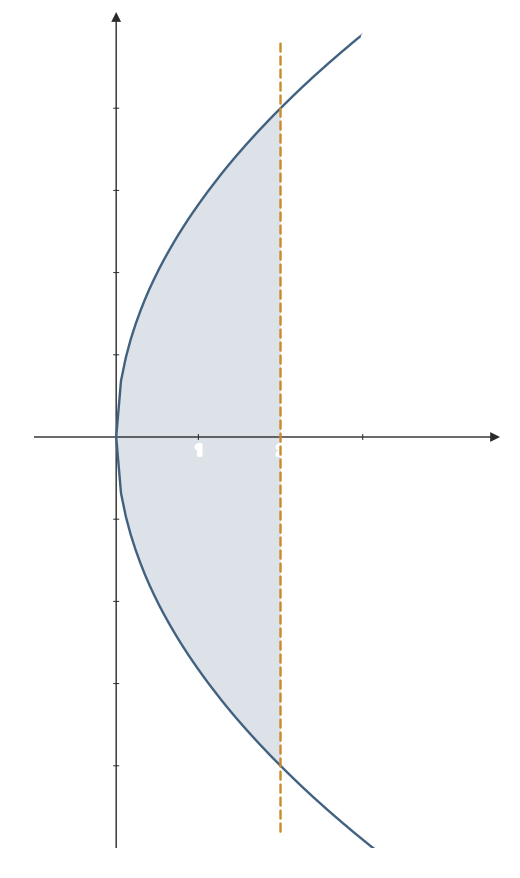
The figure shows the region bounded by the parabola y 2 = 8 x y^{2} = 8x y 2 = 8 x x = 2 x = 2 x = 2
Options for question 66 A Option A 16 3 \frac{16}{3} 3 16 B Option B 8 square units C Option C 32 3 \frac{32}{3} 3 32 D Option D 16 square units
Skip Check Show the explanation Hide the explanation Next question Try again
Show the explanation Hide the explanation Answer C · 32 3 \frac{32}{3} 3 32
The region is symmetric about the x x x 2 ∫ 0 2 8 x d x 2\int_0^{2} \sqrt{8x}\,dx 2 ∫ 0 2 8 x d x
2 8 ⋅ 2 3 x 3 / 2 ∣ 0 2 = 2 × 16 3 = 32 3 2\sqrt{8} \cdot \frac{2}{3}x^{3/2}\Big|_0^{2} = 2 \times \frac{16}{3} = \frac{32}{3} 2 8 ⋅ 3 2 x 3/2 0 2 = 2 × 3 16 = 3 32
Worth noting
16 3 \frac{16}{3} 3 16 x x x
What is the area of the region bounded by the curve y = x 2 y = x^{2} y = x 2 y = 4 y = 4 y = 4
Options for question 67 A Option A 8 3 \frac{8}{3} 3 8 B Option B 16 3 \frac{16}{3} 3 16 C Option C 32 3 \frac{32}{3} 3 32 D Option D 16 square units
Skip Check Show the explanation Hide the explanation Next question Try again
Show the explanation Hide the explanation Answer C · 32 3 \frac{32}{3} 3 32
They meet at x = ± 2 x = \pm 2 x = ± 2 ∫ − 2 2 ( 4 − x 2 ) d x \int_{-2}^{2} (4 - x^{2})\,dx ∫ − 2 2 ( 4 − x 2 ) d x
16 − 16 3 = 32 3 16 - \frac{16}{3} = \frac{32}{3} 16 − 3 16 = 3 32
Worth noting
16 3 \frac{16}{3} 3 16 − 2 -2 − 2
For which a > 0 a > 0 a > 0 y = x 2 y = x^{2} y = x 2 x = 0 x = 0 x = 0 x = a x = a x = a
Options for question 68 A Option A 3 \sqrt{3} 3 B Option B 3 3 3 C Option C 9 9 9 D Option D 27 27 27
Skip Check Show the explanation Hide the explanation Next question Try again
Show the explanation Hide the explanation Answer B · 3 3 3
∫ 0 a x 2 d x = a 3 3 = 9 \int_0^{a} x^{2}\,dx = \frac{a^{3}}{3} = 9 ∫ 0 a x 2 d x = 3 a 3 = 9
a 3 = 27 a^{3} = 27 a 3 = 27 a = 3 a = 3 a = 3
Worth noting
27 is a 3 a^{3} a 3
What is the area of the region between the parabola y 2 = 4 x y^{2} = 4x y 2 = 4 x y = 2 x y = 2x y = 2 x
Options for question 69 A Option A 1 3 \frac{1}{3} 3 1 B Option B 2 3 \frac{2}{3} 3 2 C Option C 1 square unit D Option D 4 3 \frac{4}{3} 3 4
Skip Check Show the explanation Hide the explanation Next question Try again
Show the explanation Hide the explanation Answer A · 1 3 \frac{1}{3} 3 1
4 x 2 = 4 x 4x^{2} = 4x 4 x 2 = 4 x x = 0 , 1 x = 0, 1 x = 0 , 1 y = 2 x y = 2\sqrt{x} y = 2 x y = 2 x y = 2x y = 2 x
∫ 0 1 ( 2 x − 2 x ) d x = 4 3 − 1 = 1 3 \int_0^{1} (2\sqrt{x} - 2x)\,dx = \frac{4}{3} - 1 = \frac{1}{3} ∫ 0 1 ( 2 x − 2 x ) d x = 3 4 − 1 = 3 1
Worth noting
4 3 \frac{4}{3} 3 4
What is the area of the region bounded by y 2 = 4 x y^{2} = 4x y 2 = 4 x x = 4 x = 4 x = 4
Options for question 70 A Option A 32 3 \frac{32}{3} 3 32 B Option B 16 square units C Option C 64 3 \frac{64}{3} 3 64 D Option D 32 square units
Skip Check Show the explanation Hide the explanation Next question Try again
Show the explanation Hide the explanation Answer C · 64 3 \frac{64}{3} 3 64
By symmetry, 2 ∫ 0 4 2 x d x = 4 × 2 3 x 3 / 2 ∣ 0 4 2\int_0^{4} 2\sqrt{x}\,dx = 4 \times \frac{2}{3}x^{3/2}\Big|_0^{4} 2 ∫ 0 4 2 x d x = 4 × 3 2 x 3/2 0 4
4 × 2 3 × 8 = 64 3 4 \times \frac{2}{3} \times 8 = \frac{64}{3} 4 × 3 2 × 8 = 3 64
Worth noting
32 3 \frac{32}{3} 3 32 x x x
What is the area of the region bounded by x 2 = 4 y x^{2} = 4y x 2 = 4 y y = 1 y = 1 y = 1
Options for question 71 A Option A 4 3 \frac{4}{3} 3 4 B Option B 8 3 \frac{8}{3} 3 8 C Option C 4 square units D Option D 16 3 \frac{16}{3} 3 16
Skip Check Show the explanation Hide the explanation Next question Try again
Show the explanation Hide the explanation Answer B · 8 3 \frac{8}{3} 3 8
They meet at x = ± 2 x = \pm 2 x = ± 2 y = x 2 4 y = \frac{x^{2}}{4} y = 4 x 2 ∫ − 2 2 ( 1 − x 2 4 ) d x \int_{-2}^{2} \left(1 - \frac{x^{2}}{4}\right)dx ∫ − 2 2 ( 1 − 4 x 2 ) d x
4 − 16 12 = 8 3 4 - \frac{16}{12} = \frac{8}{3} 4 − 12 16 = 3 8
Worth noting
4 3 \frac{4}{3} 3 4
The parabola y 2 = 4 x y^{2} = 4x y 2 = 4 x ( 1 , 0 ) (1, 0) ( 1 , 0 ) x = 1 x = 1 x = 1
What is the area of the part of this region above the x x x
Options for question 72 A Option A 2 3 \frac{2}{3} 3 2 B Option B 4 3 \frac{4}{3} 3 4 C Option C 2 square units D Option D 8 3 \frac{8}{3} 3 8
Skip Check Show the explanation Hide the explanation Next question Try again
Show the explanation Hide the explanation Answer B · 4 3 \frac{4}{3} 3 4
∫ 0 1 2 x d x = 2 × 2 3 \int_0^{1} 2\sqrt{x}\,dx = 2 \times \frac{2}{3} ∫ 0 1 2 x d x = 2 × 3 2
4 3 \frac{4}{3} 3 4
Worth noting
2 3 \frac{2}{3} 3 2 x \sqrt{x} x y = 2 x y = 2\sqrt{x} y = 2 x
Read the two statements and choose the correct option.
I. When a region lies below the x x x
II. If a line y = g ( x ) y = g(x) y = g ( x ) y = f ( x ) y = f(x) y = f ( x ) ∫ ( f − g ) d x \int (f - g)\,dx ∫ ( f − g ) d x
Options for question 73 A Option A Only I B Option B Only II C Option C Both I and II D Option D Neither I nor II
Skip Check Show the explanation Hide the explanation Next question Try again
Show the explanation Hide the explanation Answer C · Both I and II
I: ∫ 0 3 ( x − 3 ) d x = − 9 2 \int_0^{3} (x - 3)\,dx = -\frac{9}{2} ∫ 0 3 ( x − 3 ) d x = − 2 9 9 2 \frac{9}{2} 2 9
II: for example ∫ 0 1 ( x − x 2 ) d x \int_0^{1} (x - x^{2})\,dx ∫ 0 1 ( x − x 2 ) d x y = x y = x y = x y = x 2 y = x^{2} y = x 2
Read the two statements and choose the correct option.
I. For c > 0 c > 0 c > 0 y 2 = 4 x y^{2} = 4x y 2 = 4 x x = c x = c x = c 2 3 \frac{2}{3} 3 2 0 ≤ x ≤ c 0 \le x \le c 0 ≤ x ≤ c − 2 c ≤ y ≤ 2 c -2\sqrt{c} \le y \le 2\sqrt{c} − 2 c ≤ y ≤ 2 c
II. The region bounded by y = x 2 y = x^{2} y = x 2 y = 1 y = 1 y = 1 y = x 2 y = x^{2} y = x 2 x x x x = − 1 x = -1 x = − 1 x = 1 x = 1 x = 1
Options for question 74 A Option A Only I B Option B Only II C Option C Both I and II D Option D Neither I nor II
Skip Check Show the explanation Hide the explanation Next question Try again
Show the explanation Hide the explanation Answer C · Both I and II
I: 2 ∫ 0 c 2 x d x = 8 3 c 3 / 2 2\int_0^{c} 2\sqrt{x}\,dx = \frac{8}{3}c^{3/2} 2 ∫ 0 c 2 x d x = 3 8 c 3/2 c × 4 c = 4 c 3 / 2 c \times 4\sqrt{c} = 4c^{3/2} c × 4 c = 4 c 3/2 2 3 \frac{2}{3} 3 2
II: ∫ − 1 1 ( 1 − x 2 ) d x = 4 3 \int_{-1}^{1} (1 - x^{2})\,dx = \frac{4}{3} ∫ − 1 1 ( 1 − x 2 ) d x = 3 4 ∫ − 1 1 x 2 d x = 2 3 \int_{-1}^{1} x^{2}\,dx = \frac{2}{3} ∫ − 1 1 x 2 d x = 3 2
Worth noting
Doubting II mixes up the two regions: the one inside the parabola is what is left of the 2 × 1 2 \times 1 2 × 1 2 − 2 3 2 - \frac{2}{3} 2 − 3 2
What is the area of the region bounded by the curve y = x 2 + x − 6 y = x^{2} + x - 6 y = x 2 + x − 6 x x x
Options for question 75 A Option A − 125 6 - \frac{125}{6} − 6 125 B Option B 22 3 \frac{22}{3} 3 22 C Option C 125 6 \frac{125}{6} 6 125 D Option D 125 3 \frac{125}{3} 3 125
Skip Check Show the explanation Hide the explanation Next question Try again
Show the explanation Hide the explanation Answer C · 125 6 \frac{125}{6} 6 125
x 2 + x − 6 = ( x + 3 ) ( x − 2 ) x^{2} + x - 6 = (x + 3)(x - 2) x 2 + x − 6 = ( x + 3 ) ( x − 2 ) x x x x = − 3 x = -3 x = − 3 x = 2 x = 2 x = 2
∫ − 3 2 ( x 2 + x − 6 ) d x = − 125 6 \int_{-3}^{2} (x^{2} + x - 6)\,dx = -\frac{125}{6} ∫ − 3 2 ( x 2 + x − 6 ) d x = − 6 125 125 6 \frac{125}{6} 6 125
Worth noting
− 125 6 -\frac{125}{6} − 6 125 x x x
Which expression gives the area of the region in the first quadrant bounded by the curve y = x 2 y = x^{2} y = x 2 x + y = 2 x + y = 2 x + y = 2 x x x
Options for question 76 A Option A ∫ 0 1 x 2 d x + ∫ 1 2 ( 2 − x ) d x \int_0^{1} x^{2}\,dx + \int_1^{2} (2 - x)\,dx ∫ 0 1 x 2 d x + ∫ 1 2 ( 2 − x ) d x B Option B ∫ 0 1 ( 2 − x − x 2 ) d x \int_0^{1} (2 - x - x^{2})\,dx ∫ 0 1 ( 2 − x − x 2 ) d x C Option C ∫ 0 2 x 2 d x \int_0^{2} x^{2}\,dx ∫ 0 2 x 2 d x D Option D ∫ 0 2 ( 2 − x ) d x − ∫ 0 1 x 2 d x \int_0^{2} (2 - x)\,dx - \int_0^{1} x^{2}\,dx ∫ 0 2 ( 2 − x ) d x − ∫ 0 1 x 2 d x
Skip Check Show the explanation Hide the explanation Next question Try again
Show the explanation Hide the explanation Answer A · ∫ 0 1 x 2 d x + ∫ 1 2 ( 2 − x ) d x \int_0^{1} x^{2}\,dx + \int_1^{2} (2 - x)\,dx ∫ 0 1 x 2 d x + ∫ 1 2 ( 2 − x ) d x
y = x 2 y = x^{2} y = x 2 x + y = 2 x + y = 2 x + y = 2 x 2 + x − 2 = 0 x^{2} + x - 2 = 0 x 2 + x − 2 = 0 x = 1 x = 1 x = 1 x x x x = 2 x = 2 x = 2
The top edge is the parabola for 0 ≤ x ≤ 1 0 \le x \le 1 0 ≤ x ≤ 1 1 ≤ x ≤ 2 1 \le x \le 2 1 ≤ x ≤ 2 ∫ 0 1 x 2 d x + ∫ 1 2 ( 2 − x ) d x = 1 3 + 1 2 = 5 6 \int_0^{1} x^{2}\,dx + \int_1^{2} (2 - x)\,dx = \frac{1}{3} + \frac{1}{2} = \frac{5}{6} ∫ 0 1 x 2 d x + ∫ 1 2 ( 2 − x ) d x = 3 1 + 2 1 = 6 5
Worth noting
∫ 0 1 ( 2 − x − x 2 ) d x \int_0^{1} (2 - x - x^{2})\,dx ∫ 0 1 ( 2 − x − x 2 ) d x y y y x x x
For c > 0 c > 0 c > 0 y = x 2 y = x^{2} y = x 2 y = c y = c y = c
Options for question 77 A Option A 4 3 c 3 / 2 \frac{4}{3}c^{3/2} 3 4 c 3/2 B Option B 2 3 c 3 / 2 \frac{2}{3}c^{3/2} 3 2 c 3/2 C Option C 2 c 3 / 2 2c^{3/2} 2 c 3/2 D Option D 4 3 c 2 \frac{4}{3}c^{2} 3 4 c 2
Skip Check Show the explanation Hide the explanation Next question Try again
Show the explanation Hide the explanation Answer A · 4 3 c 3 / 2 \frac{4}{3}c^{3/2} 3 4 c 3/2
y = c y = c y = c y = x 2 y = x^{2} y = x 2 x = ± c x = \pm\sqrt{c} x = ± c
∫ − c c ( c − x 2 ) d x = 2 c 3 / 2 − 2 3 c 3 / 2 = 4 3 c 3 / 2 \int_{-\sqrt{c}}^{\sqrt{c}} (c - x^{2})\,dx = 2c^{3/2} - \frac{2}{3}c^{3/2} = \frac{4}{3}c^{3/2} ∫ − c c ( c − x 2 ) d x = 2 c 3/2 − 3 2 c 3/2 = 3 4 c 3/2
Worth noting
2 3 c 3 / 2 \frac{2}{3}c^{3/2} 3 2 c 3/2 ∫ − c c x 2 d x \int_{-\sqrt{c}}^{\sqrt{c}} x^{2}\,dx ∫ − c c x 2 d x
Let A 1 A_1 A 1 y 2 = 4 x y^{2} = 4x y 2 = 4 x x = 1 x = 1 x = 1 A 2 A_2 A 2 x = 4 x = 4 x = 4 A 2 A 1 \frac{A_2}{A_1} A 1 A 2
Options for question 78 A Option A 2 2 2 B Option B 4 4 4 C Option C 8 8 8 D Option D 16 16 16
Skip Check Show the explanation Hide the explanation Next question Try again
Show the explanation Hide the explanation Answer C · 8 8 8
Up to x = c x = c x = c 2 ∫ 0 c 2 x d x = 8 3 c 3 / 2 2\int_0^{c} 2\sqrt{x}\,dx = \frac{8}{3}c^{3/2} 2 ∫ 0 c 2 x d x = 3 8 c 3/2 A 1 = 8 3 A_1 = \frac{8}{3} A 1 = 3 8 A 2 = 8 3 × 8 = 64 3 A_2 = \frac{8}{3} \times 8 = \frac{64}{3} A 2 = 3 8 × 8 = 3 64
A 2 A 1 = 4 3 / 2 = 8 \frac{A_2}{A_1} = 4^{3/2} = 8 A 1 A 2 = 4 3/2 = 8
Worth noting
4 assumes the area grows like c c c c 3 / 2 c^{3/2} c 3/2
What is the area of the region bounded by the parabola y = x 2 y = x^{2} y = x 2 y = x + 2 y = x + 2 y = x + 2
Options for question 79 A Option A 3 square units B Option B 10 3 \frac{10}{3} 3 10 C Option C 4.5 square units D Option D 7.5 square units
Skip Check Show the explanation Hide the explanation Next question Try again
Show the explanation Hide the explanation Answer C · 4.5 square units
x 2 = x + 2 x^{2} = x + 2 x 2 = x + 2 x = − 1 x = -1 x = − 1 x = 2 x = 2 x = 2
∫ − 1 2 ( x + 2 − x 2 ) d x = [ x 2 2 + 2 x − x 3 3 ] − 1 2 = 10 3 + 7 6 = 9 2 \int_{-1}^{2} (x + 2 - x^{2})\,dx = \left[\frac{x^{2}}{2} + 2x - \frac{x^{3}}{3}\right]_{-1}^{2} = \frac{10}{3} + \frac{7}{6} = \frac{9}{2} ∫ − 1 2 ( x + 2 − x 2 ) d x = [ 2 x 2 + 2 x − 3 x 3 ] − 1 2 = 3 10 + 6 7 = 2 9
Worth noting
15 2 \frac{15}{2} 2 15
For the region bounded by the parabola x 2 = 8 y x^{2} = 8y x 2 = 8 y y = 2 y = 2 y = 2
I. The line meets the parabola at ( − 4 , 2 ) (-4, 2) ( − 4 , 2 ) ( 4 , 2 ) (4, 2) ( 4 , 2 )
II. Its area is 2 ∫ 0 4 ( 2 − x 2 8 ) d x 2\int_0^{4} \left(2 - \frac{x^{2}}{8}\right)dx 2 ∫ 0 4 ( 2 − 8 x 2 ) d x
III. Its area is 32 3 \frac{32}{3} 3 32
IV. Its area is ∫ 0 2 8 y d y \int_0^{2} \sqrt{8y}\,dy ∫ 0 2 8 y d y
Options for question 80 A Option A All four: I, II, III and IV B Option B I and II only C Option C I and IV only D Option D I, II and III only
Skip Check Show the explanation Hide the explanation Next question Try again
Show the explanation Hide the explanation Answer D · I, II and III only
I: x 2 = 16 x^{2} = 16 x 2 = 16 x = ± 4 x = \pm 4 x = ± 4 y y y 2 ∫ 0 4 ( 2 − x 2 8 ) d x = 2 ( 8 − 8 3 ) = 32 3 2\int_0^{4} \left(2 - \frac{x^{2}}{8}\right)dx = 2\left(8 - \frac{8}{3}\right) = \frac{32}{3} 2 ∫ 0 4 ( 2 − 8 x 2 ) d x = 2 ( 8 − 3 8 ) = 3 32
IV: a horizontal strip runs from − 8 y -\sqrt{8y} − 8 y 8 y \sqrt{8y} 8 y 2 8 y 2\sqrt{8y} 2 8 y ∫ 0 2 8 y d y = 16 3 \int_0^{2} \sqrt{8y}\,dy = \frac{16}{3} ∫ 0 2 8 y d y = 3 16
Worth noting
Taking IV as true counts only the right half of each horizontal strip.
The area of the region bounded by y 2 = 4 a x y^{2} = 4ax y 2 = 4 a x x = a x = a x = a 8 3 a 2 \frac{8}{3}a^{2} 3 8 a 2 a > 0 a > 0 a > 0
Options for question 81 A Option A 3 \sqrt{3} 3 B Option B 3 3 3 C Option C 6 6 6 D Option D 9 9 9
Skip Check Show the explanation Hide the explanation Next question Try again
Show the explanation Hide the explanation Answer B · 3 3 3
8 3 a 2 = 24 \frac{8}{3}a^{2} = 24 3 8 a 2 = 24 a 2 = 9 a^{2} = 9 a 2 = 9
a = 3 a = 3 a = 3
Worth noting
9 is a 2 a^{2} a 2
The parabola y 2 = 4 x y^{2} = 4x y 2 = 4 x ( 1 , 0 ) (1, 0) ( 1 , 0 ) x = 1 x = 1 x = 1
What is the area of the region of the parabola y 2 = 4 x y^{2} = 4x y 2 = 4 x x = 1 x = 1 x = 1 x = 4 x = 4 x = 4
Options for question 82 A Option A 28 3 \frac{28}{3} 3 28 B Option B 12 square units C Option C 56 3 \frac{56}{3} 3 56 D Option D 64 3 \frac{64}{3} 3 64
Skip Check Show the explanation Hide the explanation Next question Try again
Show the explanation Hide the explanation Answer C · 56 3 \frac{56}{3} 3 56
2 ∫ 1 4 2 x d x = 4 × 2 3 ( 8 − 1 ) 2\int_1^{4} 2\sqrt{x}\,dx = 4 \times \frac{2}{3}\left(8 - 1\right) 2 ∫ 1 4 2 x d x = 4 × 3 2 ( 8 − 1 )
56 3 \frac{56}{3} 3 56
Worth noting
64 3 \frac{64}{3} 3 64 x = 0 x = 0 x = 0
What is the area of the region bounded by the parabola y 2 = 4 x y^{2} = 4x y 2 = 4 x y = 2 x − 4 y = 2x - 4 y = 2 x − 4
Options for question 83 A Option A 19 3 \frac{19}{3} 3 19 B Option B 9 square units C Option C 32 3 \frac{32}{3} 3 32 D Option D 18 square units
Skip Check Show the explanation Hide the explanation Next question Try again
Show the explanation Hide the explanation Answer B · 9 square units
As x x x y y y x = y 2 4 x = \frac{y^{2}}{4} x = 4 y 2 x = y + 4 2 x = \frac{y + 4}{2} x = 2 y + 4 y 2 − 2 y − 8 = 0 y^{2} - 2y - 8 = 0 y 2 − 2 y − 8 = 0 y = − 2 y = -2 y = − 2 y = 4 y = 4 y = 4
Horizontal strips run from the parabola to the line: ∫ − 2 4 ( y + 4 2 − y 2 4 ) d y \int_{-2}^{4} \left(\frac{y + 4}{2} - \frac{y^{2}}{4}\right)dy ∫ − 2 4 ( 2 y + 4 − 4 y 2 ) d y
[ y 2 4 + 2 y − y 3 12 ] − 2 4 = 20 3 + 7 3 = 9 \left[\frac{y^{2}}{4} + 2y - \frac{y^{3}}{12}\right]_{-2}^{4} = \frac{20}{3} + \frac{7}{3} = 9 [ 4 y 2 + 2 y − 12 y 3 ] − 2 4 = 3 20 + 3 7 = 9
Worth noting
32 3 \frac{32}{3} 3 32 x = 0 x = 0 x = 0 0 ≤ x ≤ 1 0 \le x \le 1 0 ≤ x ≤ 1
What is the area of the region in the first quadrant bounded by the curve y = x y = \sqrt{x} y = x y = x − 2 y = x - 2 y = x − 2 x x x
Options for question 84 A Option A 2 square units B Option B 10 3 \frac{10}{3} 3 10 C Option C 16 3 \frac{16}{3} 3 16 D Option D 22 3 \frac{22}{3} 3 22
Skip Check Show the explanation Hide the explanation Next question Try again
Show the explanation Hide the explanation Answer B · 10 3 \frac{10}{3} 3 10
The curve meets the line where x = x − 2 \sqrt{x} = x - 2 x = x − 2 ( 4 , 2 ) (4, 2) ( 4 , 2 ) x x x ( 2 , 0 ) (2, 0) ( 2 , 0 )
Horizontal strips run from the curve x = y 2 x = y^{2} x = y 2 x = y + 2 x = y + 2 x = y + 2 ∫ 0 2 ( y + 2 − y 2 ) d y = 2 + 4 − 8 3 = 10 3 \int_0^{2} (y + 2 - y^{2})\,dy = 2 + 4 - \frac{8}{3} = \frac{10}{3} ∫ 0 2 ( y + 2 − y 2 ) d y = 2 + 4 − 3 8 = 3 10
Worth noting
16 3 \frac{16}{3} 3 16 x = 4 x = 4 x = 4
For k > 0 k > 0 k > 0 y = k x 2 y = kx^{2} y = k x 2 y = 4 y = 4 y = 4 16 3 \frac{16}{3} 3 16 k k k
Options for question 85 A Option A 1 1 1 B Option B 2 \sqrt{2} 2 C Option C 2 2 2 D Option D 4 4 4
Skip Check Show the explanation Hide the explanation Next question Try again
Show the explanation Hide the explanation Answer D · 4 4 4
The line meets the parabola where k x 2 = 4 kx^{2} = 4 k x 2 = 4 x = ± 2 k x = \pm\frac{2}{\sqrt{k}} x = ± k 2
Area = 2 ∫ 0 2 / k ( 4 − k x 2 ) d x = 2 ( 8 k − 8 3 k ) = 32 3 k = 2\int_0^{2/\sqrt{k}} (4 - kx^{2})\,dx = 2\left(\frac{8}{\sqrt{k}} - \frac{8}{3\sqrt{k}}\right) = \frac{32}{3\sqrt{k}} = 2 ∫ 0 2/ k ( 4 − k x 2 ) d x = 2 ( k 8 − 3 k 8 ) = 3 k 32
32 3 k = 16 3 \frac{32}{3\sqrt{k}} = \frac{16}{3} 3 k 32 = 3 16 k = 2 \sqrt{k} = 2 k = 2 k = 4 k = 4 k = 4
Worth noting
2 is k \sqrt{k} k
The line y = c y = c y = c y = x 2 y = x^{2} y = x 2 y = 4 y = 4 y = 4 c c c
Options for question 86 A Option A 4 3 \sqrt[3]{4} 3 4 B Option B 2 2 2 C Option C 2 2 3 2\sqrt[3]{2} 2 3 2 D Option D 2 2 2\sqrt{2} 2 2
Skip Check Show the explanation Hide the explanation Next question Try again
Show the explanation Hide the explanation Answer C · 2 2 3 2\sqrt[3]{2} 2 3 2
The part below y = c y = c y = c y = x 2 y = x^{2} y = x 2 y = c y = c y = c 4 3 c 3 / 2 \frac{4}{3}c^{3/2} 3 4 c 3/2 c = 4 c = 4 c = 4 32 3 \frac{32}{3} 3 32
4 3 c 3 / 2 = 16 3 \frac{4}{3}c^{3/2} = \frac{16}{3} 3 4 c 3/2 = 3 16 c 3 / 2 = 4 c^{3/2} = 4 c 3/2 = 4 c = 4 2 / 3 = 2 2 3 c = 4^{2/3} = 2\sqrt[3]{2} c = 4 2/3 = 2 3 2
Worth noting
2 halves the height, but the region is wider at the top, so the line that halves the area lies above the middle.
For m > 0 m > 0 m > 0 y = x 2 y = x^{2} y = x 2 y = m x y = mx y = m x 4 3 \frac{4}{3} 3 4 m m m
Options for question 87 A Option A 4 3 \sqrt[3]{4} 3 4 B Option B 2 2 2 C Option C 10 3 \frac{10}{3} 3 10 D Option D 8 8 8
Skip Check Show the explanation Hide the explanation Next question Try again
Show the explanation Hide the explanation Answer B · 2 2 2
x 2 = m x x^{2} = mx x 2 = m x x = 0 x = 0 x = 0 x = m x = m x = m
∫ 0 m ( m x − x 2 ) d x = m 3 2 − m 3 3 = m 3 6 \int_0^{m} (mx - x^{2})\,dx = \frac{m^{3}}{2} - \frac{m^{3}}{3} = \frac{m^{3}}{6} ∫ 0 m ( m x − x 2 ) d x = 2 m 3 − 3 m 3 = 6 m 3
m 3 6 = 4 3 \frac{m^{3}}{6} = \frac{4}{3} 6 m 3 = 3 4 m 3 = 8 m^{3} = 8 m 3 = 8 m = 2 m = 2 m = 2
Worth noting
8 stops at m 3 = 8 m^{3} = 8 m 3 = 8