EduFarming
Your list · 0हिं

Type at least two letters. Press Esc to close.

↑↓ navigate↵ openTAB cycle filter

Mixtures and Alligation for CUET General Aptitude

About 10 min to learn · 60 questions

Mixture questions look as if they are about rice, tea, milk and acid, but they are about one idea: a mixture's value is a weighted average of its ingredients. Alligation is a fast way to find the weights, and repeated replacement is multiplying by the same fraction again and again. This lesson covers the alligation rule, mean prices, solutions and water, averages, profits and speeds, mixtures sold at a profit, replacement, and combining mixtures, with worked examples and traps.

Syllabus area
General Mental Ability, Numerical Ability
On this page · 8 sections
  1. 01The core idea
  2. 02The rule of alligation
  3. 03Solutions and strengths
  4. 04Replacement
  5. 05Exam shortcuts
  6. 06Common mistakes
  7. 07Quick revision
  8. 08Check your understanding

The core idea

A mixture's value, whether a price per kg or a strength in percent, is a weighted average of its ingredients, weighted by how much of each goes in. Every question in this chapter is that one idea seen from a different side.

If you know the amounts and want the mixture's value, multiply, add and divide. If you know the mixture's value and want the amounts, use alligation. And if liquid is drawn out and replaced again and again, multiply by the fraction kept each time.

The rule of alligation

What is the rule of alligation?

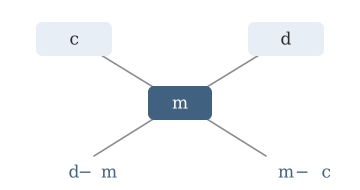
It gives the ratio in which two ingredients must be mixed to reach a given mean value. With the cheaper value cc, the dearer value dd and the mean mm between them, the cheaper part to the dearer part is (d−m):(m−c)(d - m) : (m - c).

Alligation

Cheaper:Dearer=(d−m):(m−c)\text{Cheaper} : \text{Dearer} = (d - m) : (m - c)
The alligation cross: the cheaper value c top left, the dearer value d top right, the mean m in the middle. The difference d minus m sits below c, and m minus c sits below d.
Each ingredient's share is the gap on the other side: the cheaper one gets d − m, the dearer one gets m − c.

Watch out

Swapping the two gaps is the commonest slip. Say it to yourself: the cheaper one gets the dearer side's gap. And the mean must lie between cc and dd; if it does not, a profit or loss is hidden in the price, or something has gone wrong.

Why does alligation work?

Around the mean, the gains and losses must balance. Mixing xx kg at price cc with yy kg at price dd to get price mm means x(m−c)=y(d−m)x(m - c) = y(d - m), which rearranges to x:y=(d−m):(m−c)x : y = (d - m) : (m - c).

Key idea

The balance gives a quick check: the mean sits nearer the ingredient there is more of. A mean of ₹46 between ₹42 and ₹54 is much nearer ₹42, so there must be more of the ₹42 rice.

How do you find the mean price when the mixing ratio is given?

Multiply each price by its quantity, add, and divide by the total quantity. This is alligation in reverse, and it needs no cross.

Example 1 · Mean price

Pooja mixes 4 kg of rice at ₹35 a kg with 6 kg at ₹50 a kg. Find the price of the mixture.

  1. Cost: 4×35+6×50=140+300=4404 \times 35 + 6 \times 50 = 140 + 300 = 440.

  2. Mean price: 440÷10=44440 \div 10 = 44.

Answer

₹44 per kg

The plain average of 35 and 50 is 42.5, right only for equal quantities, and usually among the options.

Solutions and strengths

How do you use alligation to find the ratio of two solutions?

Treat each solution's strength, its percentage of acid, sugar, milk or alcohol, exactly like a price. The two strengths are the two values, and the target strength is the mean.

Example 2 · Two syrups

In what ratio should a 15% sugar syrup and a 45% syrup be mixed to get a 25% syrup?

  1. 15% part to 45% part: (45−25):(25−15)=20:10=2:1(45 - 25) : (25 - 15) = 20 : 10 = 2 : 1.

  2. Check: 2 litres at 15% and 1 litre at 45% hold 0.3+0.45=0.750.3 + 0.45 = 0.75 litres of sugar in 3 litres, which is 25%.

Answer
2:12 : 1
IngredientValue to use
Pure water, in a price question₹0 per litre
Pure water, in a strength question0%
Pure acid, milk or juice100%

Example 3 · Diluting with water

How much water must be added to 30 litres of a 40% salt solution to make it 25%?

  1. Solution to water: (25−0):(40−25)=25:15=5:3(25 - 0) : (40 - 25) = 25 : 15 = 5 : 3.

  2. 5 parts are 30 litres, so 1 part is 6 litres and the water is 3×6=183 \times 6 = 18 litres.

  3. Check: 12 litres of salt in 48 litres is 25%.

Answer

18 litres

Can alligation be used for averages, profit percentages and speeds?

Yes. It works for any weighted average: average marks, salaries, interest rates, profit percentages, speeds. The only question is what the weights are, because the ratio you get is always a ratio of those weights.

SituationThe two valuesThe ratio you get is of
Class averageBoys' and girls' averagesNumber of boys to girls
Profit on parts of a stockThe two profit percentagesThe cost price of each part
Interest on two loansThe two ratesThe two sums lent
Average speedThe two speedsThe two times, not distances

Example 4 · Two loans

Rafiq lends ₹20,000 in two parts at 6% and 11% simple interest and earns ₹1,600 in a year. How much did he lend at 6%?

  1. Average rate: 1,60020,000×100=8%\tfrac{1{,}600}{20{,}000} \times 100 = 8\%.

  2. 6% part to 11% part: (11−8):(8−6)=3:2(11 - 8) : (8 - 6) = 3 : 2.

  3. Amount at 6%: 35×20,000=12,000\tfrac{3}{5} \times 20{,}000 = 12{,}000.

Answer

₹12,000

Check: 720+880=1,600720 + 880 = 1{,}600.

Losses and speeds

  • A loss is a negative profit. Sold partly at a 4% loss and partly at a 12% profit, the values are −4 and +12, so the gap from −4 up to a mean of +6 is 10, not 2.
  • Speeds give times, because average speed is total distance over total time. Averaging 50 km/h from 40 and 70 means time at 40 to time at 70 is (70−50):(50−40)=2:1(70 - 50) : (50 - 40) = 2 : 1. Multiply each time by its speed to get distances.

How do you handle a mixture sold at a profit?

First turn the selling price into the cost price of the mixture, then use alligation on cost prices. Profit is on cost, so divide by 1+profit1001 + \tfrac{\text{profit}}{100}, never multiply by 1−profit1001 - \tfrac{\text{profit}}{100}.

Example 5 · Selling the mixture at a profit

A shopkeeper mixes pulses costing ₹80 and ₹110 a kg and sells the mixture at ₹108 a kg, making a 20% profit. Find the mixing ratio.

  1. Cost of the mixture: 108÷1.2=90108 \div 1.2 = 90 rupees a kg.

  2. Cheaper to dearer: (110−90):(90−80)=20:10=2:1(110 - 90) : (90 - 80) = 20 : 10 = 2 : 1.

Answer
2:12 : 1

Exam shortcut

A milkman who adds free water and sells at the cost price of milk gains water over milk, as a percentage. With milk to water 5:15 : 1 he gains 20%, because he pays for 5 litres and sells 6.

Replacement

What is the formula for repeated removal and replacement?

If a vessel holds VV litres of a pure liquid, and each time xx litres are drawn out and replaced with water, the liquid left after nn operations is V(1−xV)nV(1 - \tfrac{x}{V})^n. Each operation keeps the same fraction of whatever liquid is there.

Replacement

Liquid left=V(1−xV)n\text{Liquid left} = V\left(1 - \frac{x}{V}\right)^n

Example 6 · Three replacements

A 50-litre can is full of milk. 5 litres are drawn out and replaced with water, three times in all. How much milk is left?

  1. Fraction kept each time: 45÷50=0.945 \div 50 = 0.9.

  2. Milk left: 50×0.93=50×0.729=36.4550 \times 0.9^3 = 50 \times 0.729 = 36.45 litres.

Answer

36.45 litres of milk, and 13.55 litres of water

Subtracting 5 litres three times gives 35 litres, which is wrong: after the first draw, what comes out is partly water.

Exam shortcut

  • The formula works for a starting mixture too: apply it to the component that is drawn out and not put back. 40 litres of milk and water in 3:13 : 1 has 30 litres of milk, and after two replacements of 10 litres the milk is 30×0.752=16.87530 \times 0.75^2 = 16.875 litres.
  • Working backwards from a final ratio, the milk's fraction of the whole, not the milk-to-water ratio, equals (1−xV)n(1 - \tfrac{x}{V})^n.

What happens when you replace with another solution instead of water?

Track the pure component step by step: take out its share, then add the new solution's share. There is no single power formula.

Example 7 · Topping up with a stronger acid

A 50-litre tank of 30% acid has 10 litres replaced with a 90% acid solution. Find the new strength.

  1. Acid at first: 15 litres. Removed with the 10 litres: 3 litres. Added: 9 litres.

  2. Acid now: 15−3+9=2115 - 3 + 9 = 21 litres in 50 litres.

Answer

42%

As a check by weighted average, the tank holds old and new solution in 40:1040 : 10, and (4×30+1×90)÷5=42(4 \times 30 + 1 \times 90) \div 5 = 42.

How do you change a ratio by adding water or one ingredient?

Hold the ingredient you are not adding fixed and rebuild the total around it. Adding water or letting it evaporate keeps the solute fixed; adding milk to milk and water keeps the water fixed.

  • 36 litres of milk and water in 7:27 : 2 has 28 litres of milk and 8 of water. For 7:47 : 4 the milk stays at 28, so the water must become 16: add 8 litres.
  • To strengthen by evaporation, new total = solute ÷ new strength, and the drop in total is the water lost.

How do you combine two mixtures with different ratios?

Turn each mixture into actual quantities of each component, add, and simplify. Never add ratio terms unless the two mixtures have the same total.

Exam shortcut

To find the mixing ratio for a target, write one component as a fraction of each whole and use alligation on the fractions. Milk to water 1:11 : 1 is 12\tfrac{1}{2} milk and 5:15 : 1 is 56\tfrac{5}{6}. For 3:13 : 1, which is 34\tfrac{3}{4}: first to second is (56−34):(34−12)=112:14=1:3(\tfrac{5}{6} - \tfrac{3}{4}) : (\tfrac{3}{4} - \tfrac{1}{2}) = \tfrac{1}{12} : \tfrac{1}{4} = 1 : 3.

Exam shortcuts

  • Cross, then check. The mean sits nearer the larger part.
  • Water is 0. Pure solute is 100%.
  • Profit first. Selling price ÷ (1 + profit) gives the mixture's cost.
  • Replacement multiplies. Keep (1−xV)(1 - \tfrac{x}{V}) each time.
  • Put the answer back. Recompute the mean; it takes ten seconds.

Common mistakes

  • Swapping the alligation ratio.
  • The plain average for unequal quantities.
  • Profit on the wrong base. Selling price ÷ 1.25 gives the cost; × 0.75 does not.
  • Subtracting in replacement. Drawing out 10 litres twice does not remove 20 litres of milk.
  • Miscounting the operations. "Replaced, and then repeated twice" is three operations.
  • Answering the wrong quantity. Water added, not the new total; the dearer part, not the cheaper.
  • Forgetting the added volume when water or pure acid goes in.
  • A ratio where a fraction is needed. 3:13 : 1 milk and water is 34\tfrac{3}{4} milk.
  • Distances for speeds. The alligation ratio is of times.
  • Losing the sign of a loss.

Quick revision

Alligation

  • Cheaper : dearer =(d−m):(m−c)= (d - m) : (m - c)
  • The mean is nearer the larger part
  • Water 0, pure 100%

Mean value

  • cx+dyx+y\tfrac{cx + dy}{x + y}
  • Plain average only for equal amounts

Weights

  • Averages: numbers. Profits: cost prices
  • Loans: sums. Speeds: times

Replacement

  • Left =V(1−xV)n= V(1 - \tfrac{x}{V})^n
  • Another solution: track the pure part step by step
  • Change a ratio: hold the other ingredient fixed

The same weighted-average idea runs through averages and ratio and proportion, and cost and selling prices through profit, loss and discount.

Next · 07Quick revision

Check your understanding

60 questions, grouped by type, easy to hard. Pick an answer and check it. The worked solution opens when you ask for it.

The alligation ruleQ1 of 60Q1

The alligation rule

34 questions

Kavya's grocery mixes rice costing ₹42 per kg with rice costing ₹54 per kg so that the mixture is worth ₹46 per kg. In what ratio (cheaper : dearer) must the two be mixed?

Options for question 1

Show the explanationHide the explanation

AnswerD · 2:12 : 1

  1. Cheaper share = dearer price − mean = 54−46=854 - 46 = 8.

  2. Dearer share = mean − cheaper price = 46−42=446 - 42 = 4.

  3. Cheaper : dearer = 8:4=2:18 : 4 = 2 : 1.

Worth noting

The difference on the dearer side belongs to the CHEAPER variety. Swapping them gives 1:21 : 2, the tempting slip.

Tenzin blends two teas, one at ₹180 per kg and the other at ₹240 per kg, in the ratio 2:12 : 1. What is the cost of the blend per kg?

Options for question 2

Show the explanationHide the explanation

AnswerB · ₹200

  1. Cost of 3 kg = 2×180+1×240=6002 \times 180 + 1 \times 240 = 600 rupees.

  2. Cost per kg = 6003=200\frac{600}{3} = 200 rupees.

Worth noting

₹210 is the plain average, which ignores the 2:12 : 1 ratio; ₹220 attaches the weight 2 to the wrong price.

A sweet shop mixes 3 kg of sugar at ₹38 per kg with 5 kg of sugar at ₹46 per kg. What is the price of the mixture per kg?

Options for question 3

Show the explanationHide the explanation

AnswerC · ₹43

  1. Total cost = 3×38+5×46=114+230=3443 \times 38 + 5 \times 46 = 114 + 230 = 344 rupees.

  2. Price per kg = 3448=43\frac{344}{8} = 43 rupees.

Worth noting

₹42 is the simple average of 38 and 46; it would be right only for equal quantities. ₹41 comes from swapping the quantities.

A lab assistant has a 20% acid solution and a 50% acid solution. In what ratio should they be mixed to get a 30% acid solution?

Options for question 4

Show the explanationHide the explanation

AnswerA · 2:12 : 1

  1. 20% part : 50% part = (50−30):(30−20)(50 - 30) : (30 - 20).

  2. = 20:10=2:120 : 10 = 2 : 1.

Worth noting

The mean 30% sits closer to 20%, so more of the 20% solution is needed. That check rules out 1:21 : 2.

In a class test, the boys averaged 62 marks and the girls averaged 74 marks. The whole class averaged 70 marks. What is the ratio of boys to girls?

Options for question 5

Show the explanationHide the explanation

AnswerD · 1:21 : 2

  1. Boys : girls = (74−70):(70−62)(74 - 70) : (70 - 62).

  2. = 4:8=1:24 : 8 = 1 : 2.

Worth noting

The class average is nearer the girls' average, so there must be more girls. 2:12 : 1 is the reversed ratio.

How many kg of dal costing ₹30 per kg must be mixed with 12 kg of dal costing ₹45 per kg so that the mixture is worth ₹36 per kg?

Options for question 6

Show the explanationHide the explanation

AnswerC · 18 kg

  1. Cheaper : dearer = (45−36):(36−30)=9:6=3:2(45 - 36) : (36 - 30) = 9 : 6 = 3 : 2.

  2. 2 parts = 12 kg, so 1 part = 6 kg.

  3. Cheaper dal = 3×6=183 \times 6 = 18 kg.

Worth noting

8 kg comes from reversing the ratio to 2:32 : 3.

A jeweller melts together two alloys containing 70% gold and 85% gold in the ratio 1:21 : 2 by weight. What percentage of the new alloy is gold?

Options for question 7

Show the explanationHide the explanation

AnswerC · 80%

  1. Gold in 3 units = 1×70%+2×85%=70+170=2401 \times 70\% + 2 \times 85\% = 70 + 170 = 240 (percent-units).

  2. Gold percentage = 2403=80%\frac{240}{3} = 80\%.

Worth noting

77.5% is the simple average; 75% attaches the larger weight to the 70% alloy.

Meenakshi mixes 10 litres of a 25% mango-pulp drink with 15 litres of a 40% mango-pulp drink. What is the mango-pulp percentage of the mixture?

Options for question 8

Show the explanationHide the explanation

AnswerC · 34%

  1. Pulp = 0.25×10+0.40×15=2.5+6=8.50.25 \times 10 + 0.40 \times 15 = 2.5 + 6 = 8.5 litres.

  2. Percentage = 8.525×100=34%\frac{8.5}{25} \times 100 = 34\%.

Worth noting

32.5% is the plain average of 25% and 40%; 31% swaps the two volumes.

A milkman buys milk at ₹60 per litre. In what ratio (water : milk) must he add water, which costs nothing, so that the mixture costs him ₹48 per litre?

Options for question 9

Show the explanationHide the explanation

AnswerB · 1:41 : 4

  1. Treat water as a liquid priced ₹0 per litre.

  2. Water : milk = (60−48):(48−0)=12:48(60 - 48) : (48 - 0) = 12 : 48.

  3. = 1:41 : 4.

Worth noting

4:14 : 1 is the reversed ratio — it would make the mixture mostly water.

Gurpreet mixes 2 kg of cashews at ₹900 per kg with 3 kg of a second variety. The mixture is worth ₹1,080 per kg. What is the price of the second variety per kg?

Options for question 10

Show the explanationHide the explanation

AnswerC · ₹1,200

  1. Cost of 5 kg of mixture = 5×1080=54005 \times 1080 = 5400 rupees.

  2. Cost of the 2 kg = 2×900=18002 \times 900 = 1800 rupees.

  3. Second variety: 5400−18003=1200\frac{5400 - 1800}{3} = 1200 rupees per kg.

Worth noting

₹1,260 comes from assuming the mean is the plain average, so the second price is 2×1,080−9002 \times 1{,}080 - 900.

A sports hostel has 30 students with an average weight of 48 kg and 20 students with an average weight of 58 kg. What is the average weight of all 50 students?

Options for question 11

Show the explanationHide the explanation

AnswerB · 52 kg

  1. Total weight = 30×48+20×58=1440+1160=260030 \times 48 + 20 \times 58 = 1440 + 1160 = 2600 kg.

  2. Average = 260050=52\frac{2600}{50} = 52 kg.

Worth noting

53 kg is the simple average of 48 and 58, which ignores that the groups are of different sizes.

A café blends coffee beans costing ₹800 per kg with beans costing ₹500 per kg to make a blend worth ₹620 per kg. What is the ratio of the ₹800 beans to the ₹500 beans?

Options for question 12

Show the explanationHide the explanation

AnswerB · 2:32 : 3

  1. ₹800 beans : ₹500 beans = (620−500):(800−620)(620 - 500) : (800 - 620).

  2. = 120:180=2:3120 : 180 = 2 : 3.

Worth noting

3:23 : 2 reverses the ratio. The mean ₹620 is nearer ₹500, so there are more of the ₹500 beans.

Arjun sells 50 kg of rice, part of it at a 10% profit and the rest at a 25% profit. Overall he makes a 16% profit. How many kg did he sell at a 10% profit?

Options for question 13

Show the explanationHide the explanation

AnswerC · 30 kg

  1. Treat the profit percentages like prices: 10% and 25% around a mean of 16%.

  2. 10% part : 25% part = (25−16):(16−10)=9:6=3:2(25 - 16) : (16 - 10) = 9 : 6 = 3 : 2.

  3. Quantity at 10%=35×50=3010\% = \frac{3}{5} \times 50 = 30 kg.

Worth noting

20 kg is the quantity sold at 25% — it is what you get if the ratio is reversed.

Fatima mixes two teas costing ₹120 per kg and ₹150 per kg. She sells the mixture at ₹165 per kg and makes a 25% profit. In what ratio (cheaper : dearer) did she mix them?

Options for question 14

Show the explanationHide the explanation

AnswerD · 3:23 : 2

  1. Cost price of the mixture = 1651.25=132\frac{165}{1.25} = 132 rupees per kg.

  2. Cheaper : dearer = (150−132):(132−120)=18:12(150 - 132) : (132 - 120) = 18 : 12.

  3. = 3:23 : 2.

Worth noting

Taking the cost as 75% of ₹165 (₹123.75) is the common error — profit is on cost, so divide by 1.25. That error leads to 7:17 : 1.

A dairy has 20 litres of a mixture that is 60% milk. How many litres of a mixture that is 90% milk must be added to get a mixture that is 80% milk?

Options for question 15

Show the explanationHide the explanation

AnswerD · 40 litres

  1. 60%:90%=(90−80):(80−60)=10:20=1:260\% : 90\% = (90 - 80) : (80 - 60) = 10 : 20 = 1 : 2.

  2. So the 90% mixture must be twice the 60% mixture.

  3. Needed = 2×20=402 \times 20 = 40 litres.

Worth noting

10 litres comes from reversing the ratio. Check: milk = 12+36=4812 + 36 = 48 out of 60 litres = 80%.

A company has 120 employees with an average salary of ₹30,000 a month. Managers average ₹50,000 and all other employees average ₹25,000. How many managers are there?

Options for question 16

Show the explanationHide the explanation

AnswerA · 24

  1. Managers : others = (30,000−25,000):(50,000−30,000)=5,000:20,000=1:4(30{,}000 - 25{,}000) : (50{,}000 - 30{,}000) = 5{,}000 : 20{,}000 = 1 : 4.

  2. Total parts = 1+4=51 + 4 = 5.

  3. Managers = 15×120=24\frac{1}{5} \times 120 = 24.

Worth noting

30 comes from taking one-fourth of 120 — a ratio of 1:41 : 4 means one part in FIVE. 96 is the number of other employees.

Lalremsiami lends ₹12,000 in two parts, one at 8% simple interest a year and the other at 12% a year. Her total interest for one year is ₹1,140. How much did she lend at 8%?

Options for question 17

Show the explanationHide the explanation

AnswerD · ₹7,500

  1. Average rate = 114012000×100=9.5%\frac{1140}{12000} \times 100 = 9.5\%.

  2. 8% part : 12% part = (12−9.5):(9.5−8)=2.5:1.5=5:3(12 - 9.5) : (9.5 - 8) = 2.5 : 1.5 = 5 : 3.

  3. Amount at 8%=58×12000=75008\% = \frac{5}{8} \times 12000 = 7500 rupees.

Worth noting

₹4,500 is the amount at 12% (the ratio reversed). Check: 8% of 7,500+12% of 4,500=600+5408\% \text{ of } 7{,}500 + 12\% \text{ of } 4{,}500 = 600 + 540 = ₹1,140.

Alloy P has copper and zinc in the ratio 3:13 : 1; alloy Q has them in the ratio 1:31 : 3. In what ratio must P and Q be melted together to get an alloy with copper and zinc in the ratio 5:35 : 3?

Options for question 18

Show the explanationHide the explanation

AnswerD · 3:13 : 1

  1. Copper fraction: P = 34=75%\frac{3}{4} = 75\%, Q = 14=25%\frac{1}{4} = 25\%, target = 58=62.5%\frac{5}{8} = 62.5\%.

  2. P:Q=(62.5−25):(75−62.5)=37.5:12.5P : Q = (62.5 - 25) : (75 - 62.5) = 37.5 : 12.5.

  3. = 3:13 : 1.

Worth noting

Alligation works on the fraction of ONE component in each mixture, not on the ratios themselves. Convert each ratio to a fraction of the whole first.

Joseph mixes almonds costing ₹640 per kg and ₹800 per kg in the ratio 5:35 : 3 and sells the mixture at ₹840 per kg. What is his profit percentage?

Options for question 19

Show the explanationHide the explanation

AnswerC · 20%

  1. Cost of 8 kg = 5×640+3×800=3200+2400=56005 \times 640 + 3 \times 800 = 3200 + 2400 = 5600 rupees, so ₹700 per kg.

  2. Profit per kg = 840−700840 - 700 = ₹140.

  3. Profit % = 140700×100=20%\frac{140}{700} \times 100 = 20\%.

Worth noting

16⅔% divides the profit by the selling price; profit % is always on cost price.

A shop has 30 litres of mustard oil at ₹150 per litre. How many litres of groundnut oil at ₹190 per litre must be mixed with it so that the blend costs ₹166 per litre?

Options for question 20

Show the explanationHide the explanation

AnswerB · 20 litres

  1. Mustard : groundnut = (190−166):(166−150)=24:16=3:2(190 - 166) : (166 - 150) = 24 : 16 = 3 : 2.

  2. 3 parts = 30 litres, so 1 part = 10 litres.

  3. Groundnut oil = 2×10=202 \times 10 = 20 litres.

Worth noting

45 litres comes from reversing the ratio to 2:32 : 3.

A coaching batch of 45 students averaged 64 marks in a mock test. The boys averaged 60 and the girls averaged 69. How many girls are in the batch?

Options for question 21

Show the explanationHide the explanation

AnswerA · 20

  1. Boys : girls = (69−64):(64−60)=5:4(69 - 64) : (64 - 60) = 5 : 4.

  2. Total parts = 9, so 1 part = 45÷9=545 \div 9 = 5 students.

  3. Girls = 4×5=204 \times 5 = 20.

Worth noting

25 is the number of boys. Check: 25×60+20×69=1,500+1,380=2,880=45×6425 \times 60 + 20 \times 69 = 1{,}500 + 1{,}380 = 2{,}880 = 45 \times 64.

How many litres of water must be added to 24 litres of a 35% acid solution to make it a 21% acid solution?

Options for question 22

Show the explanationHide the explanation

AnswerB · 16 litres

  1. Water is a 0% acid solution.

  2. Solution : water = (21−0):(35−21)=21:14=3:2(21 - 0) : (35 - 21) = 21 : 14 = 3 : 2.

  3. 3 parts = 24 litres, so water = 2×8=162 \times 8 = 16 litres.

Worth noting

40 litres is the final volume, not the water added. Check: acid = 0.35×24=8.40.35 \times 24 = 8.4 litres, and 8.4÷40=21%8.4 \div 40 = 21\%.

Ramesh buys milk at ₹54 per litre, mixes water with it in the ratio milk : water = 4:14 : 1, and sells the mixture at 10% above ₹54 per litre. What is his profit percentage?

Options for question 23

Show the explanationHide the explanation

AnswerD · 37.5%

  1. Cost of 5 litres of mixture = cost of 4 litres of milk = 4×54=2164 \times 54 = 216 rupees, so ₹43.20 per litre.

  2. Selling price = 1.1×54=59.401.1 \times 54 = 59.40 rupees per litre.

  3. Profit % = 59.40−43.2043.20×100=16.2043.20×100=37.5%\frac{59.40 - 43.20}{43.20} \times 100 = \frac{16.20}{43.20} \times 100 = 37.5\%.

Worth noting

The gains multiply, they do not add: 1.25 (from the free water) × 1.1 (from the higher price) = 1.375. Adding 25%+10%25\% + 10\% gives the tempting 35%, and 30% adds 10% to the 20% share of water in the mixture.

A goldsmith has 22-carat gold and 18-carat gold. She wants to make 60 g of 21-carat gold. How many grams of 18-carat gold should she use?

Options for question 24

Show the explanationHide the explanation

AnswerA · 15 g

  1. 22-carat : 18-carat = (21−18):(22−21)=3:1(21 - 18) : (22 - 21) = 3 : 1.

  2. 18-carat gold = 14×60=15\frac{1}{4} \times 60 = 15 g.

Worth noting

45 g is the 22-carat part. The target 21 is much closer to 22, so most of the mix must be 22-carat.

Deepa mixes 15 litres of a 40% sugar syrup with 10 litres of a second syrup. The mixture is 34% sugar. What is the sugar percentage of the second syrup?

Options for question 25

Show the explanationHide the explanation

AnswerB · 25%

  1. Sugar in the mixture = 0.34×25=8.50.34 \times 25 = 8.5 litres.

  2. Sugar from the first syrup = 0.40×15=60.40 \times 15 = 6 litres.

  3. Second syrup: 8.5−610=0.25\frac{8.5 - 6}{10} = 0.25, i.e. 25%.

Worth noting

28% assumes 34% is the simple average of the two strengths; the volumes are unequal. 10% divides the 2.5 litres of sugar by 25 litres instead of 10.

A kirana store mixes three grades of rice costing ₹30, ₹36 and ₹45 per kg in the ratio 2:3:12 : 3 : 1. What is the cost of the mixture per kg?

Options for question 26

Show the explanationHide the explanation

AnswerA · ₹35.50

  1. Cost of 6 kg = 2×30+3×36+1×45=60+108+45=2132 \times 30 + 3 \times 36 + 1 \times 45 = 60 + 108 + 45 = 213 rupees.

  2. Cost per kg = 2136=35.50\frac{213}{6} = 35.50 rupees.

Worth noting

₹37 is the plain average of the three prices. ₹38 attaches the weights 2 and 1 to the wrong prices.

Shalini bought a phone and a tablet for ₹8,000 in all. She sold the phone at a 10% loss and the tablet at a 15% profit, and made a 5% profit overall. What did the phone cost her?

Options for question 27

Show the explanationHide the explanation

AnswerB · ₹3,200

  1. Write the loss as −10% and apply alligation to −10% and +15% around +5%.

  2. Phone : tablet = (15−5)(15 - 5) : (5−(−10))=10:15=2:3(5 - (-10)) = 10 : 15 = 2 : 3.

  3. Phone = 25×8000=3200\frac{2}{5} \times 8000 = 3200 rupees.

Worth noting

Check: −10% of 3,200=−320-10\% \text{ of } 3{,}200 = -320 and +15% of 4,800 = +720, net +400=5% of 8,000400 = 5\% \text{ of } 8{,}000. ₹4,800 is the tablet's cost.

A milkman buys pure milk at ₹56 per litre. He adds water and sells the mixture at ₹60 per litre, making a profit of 25%. In what ratio (water : milk) is the mixture?

Options for question 28

Show the explanationHide the explanation

AnswerC · 1:61 : 6

  1. Cost price of the mixture = 601.25=48\frac{60}{1.25} = 48 rupees per litre.

  2. Water costs ₹0. Water : milk = (56−48):(48−0)=8:48(56 - 48) : (48 - 0) = 8 : 48.

  3. = 1:61 : 6.

Worth noting

1:41 : 4 wrongly says 25% of the mixture's volume is water. 11:4511 : 45 comes from taking cost as 75% of the selling price (₹45) instead of dividing by 1.25. 1:71 : 7 compares the ₹8 gap with ₹56 instead of ₹48.

Harish has 36 litres of a 30% acid solution. How many litres of pure acid must he add to raise the strength to 40%?

Options for question 29

Show the explanationHide the explanation

AnswerC · 6 litres

  1. Pure acid is a 100% solution.

  2. Solution : pure acid = (100−40):(40−30)=60:10=6:1(100 - 40) : (40 - 30) = 60 : 10 = 6 : 1.

  3. Pure acid = 366=6\frac{36}{6} = 6 litres.

Worth noting

Adding pure acid also increases the total volume. 3.6 litres simply takes 10% of 36; 4 litres makes the added acid 10% of the final volume, forgetting that the old acid already counts toward the 40%. Check: (10.8+6)÷42=40%(10.8 + 6) \div 42 = 40\%.

Venkat sells 80 kg of onions. He sells some of them at a 5% loss (they were going soft) and the rest at a 15% profit. Overall he gains 9%. How many kg did he sell at a loss?

Options for question 30

Show the explanationHide the explanation

AnswerA · 24 kg

  1. Write the loss as −5%, and apply alligation to −5% and +15% around +9%.

  2. Loss part : profit part = (15−9)(15 - 9) : (9−(−5))=6:14=3:7(9 - (-5)) = 6 : 14 = 3 : 7.

  3. Quantity sold at a loss = 310×80=24\frac{3}{10} \times 80 = 24 kg.

Worth noting

Using +5% instead of −5% gives 6:46 : 4 and the wrong answer 48 kg. 56 kg is the quantity sold at a profit.

In a college quiz, the boys averaged 68 points and the girls averaged 78 points; the overall average was 72. There were 12 more boys than girls. How many students took the quiz?

Options for question 31

Show the explanationHide the explanation

AnswerD · 60

  1. Boys : girls = (78−72):(72−68)=6:4=3:2(78 - 72) : (72 - 68) = 6 : 4 = 3 : 2.

  2. The difference of 3−2=13 - 2 = 1 part is 12 students.

  3. Total = 5×12=605 \times 12 = 60 students (36 boys and 24 girls).

Worth noting

36 and 24 are the boys and the girls separately. Check: 36×68+24×78=2,448+1,872=4,320=60×7236 \times 68 + 24 \times 78 = 2{,}448 + 1{,}872 = 4{,}320 = 60 \times 72.

When two teas are mixed in the ratio 3:23 : 2, the blend costs ₹176 per kg. When they are mixed in the ratio 2:32 : 3, the blend costs ₹184 per kg. What is the price per kg of the cheaper tea?

Options for question 32

Show the explanationHide the explanation

AnswerA · ₹160

  1. Let the prices be aa (cheaper) and bb. Then 3a+2b=5×176=8803a + 2b = 5 \times 176 = 880 and 2a+3b=5×184=9202a + 3b = 5 \times 184 = 920.

  2. Adding: 5a+5b=18005a + 5b = 1800, so a+b=360a + b = 360.

  3. Subtracting: a−b=−40a - b = -40.

  4. So a=160a = 160 and b=200b = 200; the cheaper tea costs ₹160 per kg.

Worth noting

₹180 is the average of the two blend prices — it equals the average of the two teas, not the cheaper one. ₹176 is just the first blend's price.

A bus covers 330 km in 6 hours. It travels part of the way at 40 km/h and the rest at 60 km/h. How many km does it travel at 40 km/h?

Options for question 33

Show the explanationHide the explanation

AnswerA · 60 km

  1. Average speed = 3306=55\frac{330}{6} = 55 km/h.

  2. Time at 40 : time at 60=(60−55):(55−40)=5:15=1:360 = (60 - 55) : (55 - 40) = 5 : 15 = 1 : 3.

  3. Time at 40 km/h = 14×6=1.5\frac{1}{4} \times 6 = 1.5 hours.

  4. Distance = 40×1.5=6040 \times 1.5 = 60 km.

Worth noting

With speeds, alligation gives the ratio of TIMES, because average speed is total distance ÷ total time. Applying 1:31 : 3 to the distance gives the wrong 82.5 km; 90 km uses 60 km/h for the 1.5 hours.

A tank holds a 40% sugar solution. Some of it is drained off and replaced with the same amount of a 16% sugar solution. The tank now holds a 25% solution. What fraction of the solution was replaced?

Options for question 34

Show the explanationHide the explanation

AnswerD · 5/85/8

  1. After replacement the tank is a mix of old 40% solution and new 16% solution, averaging 25%.

  2. Old : new = (25−16):(40−25)=9:15=3:5(25 - 16) : (40 - 25) = 9 : 15 = 3 : 5.

  3. Replaced fraction = 53+5=58\frac{5}{3 + 5} = \frac{5}{8}.

Worth noting

3/83/8 is the fraction that stayed, and 3/53/5 is the ratio old : new read as a fraction. Check: 3/8×40+5/8×16=15+10=253/8 \times 40 + 5/8 \times 16 = 15 + 10 = 25.

Mixtures and replacement

26 questions

A can holds 50 litres of pure milk. Kiran takes out 10 litres and pours in 10 litres of water. What is the ratio of milk to water in the can now?

Options for question 35

Show the explanationHide the explanation

AnswerC · 4:14 : 1

  1. Milk left = 50−10=4050 - 10 = 40 litres.

  2. Water = 10 litres (the amount poured in).

  3. Milk : water = 40:10=4:140 : 10 = 4 : 1.

Worth noting

5:15 : 1 compares the original 50 litres with the 10 litres of water, forgetting that 10 litres of milk went out.

A 60-litre mixture of milk and water has milk and water in the ratio 7:37 : 3. How much water must be added so that the ratio becomes 7:57 : 5?

Options for question 36

Show the explanationHide the explanation

AnswerA · 12 litres

  1. Milk = 710×60=42\frac{7}{10} \times 60 = 42 litres; water = 18 litres.

  2. Milk does not change, so in the new ratio 7 parts = 42 litres and 1 part = 6 litres.

  3. New water = 5×6=305 \times 6 = 30 litres, so add 30−18=1230 - 18 = 12 litres.

Worth noting

30 litres is the new total of water, not the amount to be added. 18 litres is the water already there.

Neha has 30 litres of a 20% salt solution. How much water must she add to bring the salt concentration down to 12%?

Options for question 37

Show the explanationHide the explanation

AnswerD · 20 litres

  1. Salt = 0.20×30=60.20 \times 30 = 6 litres, and adding water does not change it.

  2. For 6 litres to be 12%, the total must be 60.12=50\frac{6}{0.12} = 50 litres.

  3. Water to add = 50−30=2050 - 30 = 20 litres.

Worth noting

Keep the salt fixed and find the new total. 8 litres just subtracts the percentages (20−12)(20 - 12), which has no meaning here.

A jug holds 45 litres of a milk–water mixture in the ratio 7:27 : 2. Asha adds 5 litres of water. What percentage of the new mixture is water?

Options for question 38

Show the explanationHide the explanation

AnswerB · 30%

  1. Water at first = 29×45=10\frac{2}{9} \times 45 = 10 litres.

  2. After adding: water = 15 litres, total = 50 litres.

  3. Water % = 1550×100=30%\frac{15}{50} \times 100 = 30\%.

Worth noting

33⅓% divides 15 by the OLD total of 45 litres; the added water also enlarges the total.

A tank holds 64 litres of pure milk. 16 litres are taken out and replaced with water. This is done once more. How much milk is left in the tank?

Options for question 39

Show the explanationHide the explanation

AnswerC · 36 litres

  1. Each operation leaves 64−1664=34\frac{64 - 16}{64} = \frac{3}{4} of the milk.

  2. After two operations: 64×(34)2=64×916=3664 \times \left(\frac{3}{4}\right)^2 = 64 \times \frac{9}{16} = 36 litres.

Worth noting

32 litres wrongly subtracts 16 litres of milk twice; the second time the 16 litres taken out is only three-quarters milk.

A 40-litre mixture is 25% water and the rest milk. How much milk must be added so that water makes up only 20% of the mixture?

Options for question 40

Show the explanationHide the explanation

AnswerA · 10 litres

  1. Water = 0.25×40=100.25 \times 40 = 10 litres, and it does not change.

  2. For 10 litres to be 20%, the total must be 100.20=50\frac{10}{0.20} = 50 litres.

  3. Milk to add = 50−40=1050 - 40 = 10 litres.

Worth noting

50 litres is the new total, and 40 litres is the milk in the final mixture — neither is the amount added.

A 56-litre mixture contains milk and water in the ratio 5:25 : 2. How much milk must be added to make the ratio 3:13 : 1?

Options for question 41

Show the explanationHide the explanation

AnswerA · 8 litres

  1. Milk = 57×56=40\frac{5}{7} \times 56 = 40 litres; water = 16 litres.

  2. Water stays 16, so milk must become 3×16=483 \times 16 = 48 litres.

  3. Milk to add = 48−40=848 - 40 = 8 litres.

Worth noting

48 litres is the milk needed in the end, not the milk to be added.

A tray holds 40 kg of brine that is 5% salt. How many kg of water must evaporate for the brine to become 8% salt?

Options for question 42

Show the explanationHide the explanation

AnswerA · 15 kg

  1. Salt = 0.05×40=20.05 \times 40 = 2 kg, which stays the same.

  2. For 2 kg to be 8%, the total must be 20.08=25\frac{2}{0.08} = 25 kg.

  3. Water evaporated = 40−25=1540 - 25 = 15 kg.

Worth noting

25 kg is what remains, not what evaporates. 64 kg multiplies 40 by 8÷58 \div 5 — the right idea for adding water, backwards here.

A beaker has 20 litres of a 60% acid solution. 5 litres are removed and replaced with water. What is the acid concentration now?

Options for question 43

Show the explanationHide the explanation

AnswerB · 45%

  1. Acid at first = 0.60×20=120.60 \times 20 = 12 litres.

  2. Removing 5 of 20 litres removes 14\frac{1}{4} of the acid, leaving 12×34=912 \times \frac{3}{4} = 9 litres.

  3. The volume is back to 20 litres, so concentration = 920=45%\frac{9}{20} = 45\%.

Worth noting

48% adds the water without removing anything (12÷25)(12 \div 25). 55% just subtracts 5 from 60.

A vessel contains 40 litres of pure milk. Each time, 4 litres are drawn out and replaced with water. How much milk remains after two such operations?

Options for question 44

Show the explanationHide the explanation

AnswerC · 32.4 litres

  1. Each operation keeps 40−440=910\frac{40 - 4}{40} = \frac{9}{10} of the milk.

  2. After two operations: 40×(910)2=40×0.81=32.440 \times \left(\frac{9}{10}\right)^2 = 40 \times 0.81 = 32.4 litres.

Worth noting

32 litres subtracts 4 litres of milk twice; 29.16 litres is the result after THREE operations.

A drum holds 80 litres of pure coconut oil. 8 litres are removed and replaced with a cheaper oil, and this is done three times in all. How much coconut oil is left in the drum?

Options for question 45

Show the explanationHide the explanation

AnswerB · 58.32 litres

  1. Each operation keeps 80−880=0.9\frac{80 - 8}{80} = 0.9 of the coconut oil.

  2. After three operations: 80×0.93=80×0.729=58.3280 \times 0.9^3 = 80 \times 0.729 = 58.32 litres.

Worth noting

56 litres subtracts 8 litres three times, ignoring that later removals carry some cheaper oil. 64.8 litres stops after two operations.

A container is filled with 60 litres of pure milk. 12 litres are drawn out and replaced with water, and then this is repeated once. What is the ratio of milk to water now?

Options for question 46

Show the explanationHide the explanation

AnswerD · 16:916 : 9

  1. Each operation keeps 4860=45\frac{48}{60} = \frac{4}{5} of the milk.

  2. Milk = 60×(45)2=38.460 \times \left(\frac{4}{5}\right)^2 = 38.4 litres; water = 60−38.4=21.660 - 38.4 = 21.6 litres.

  3. Milk : water = 38.4:21.6=384:216=16:938.4 : 21.6 = 384 : 216 = 16 : 9.

Worth noting

Shortcut: milk fraction = (4/5)(4/5)² = 16/2516/25, so milk : water = 16:(25−16)=16:916 : (25 - 16) = 16 : 9. 3:23 : 2 comes from subtracting 12 litres of milk twice; 4:14 : 1 is the ratio after one operation.

Jar P has milk and water in the ratio 5:35 : 3, and jar Q has them in the ratio 7:17 : 1. In what ratio should the contents of P and Q be mixed to get milk and water in the ratio 2:12 : 1?

Options for question 47

Show the explanationHide the explanation

AnswerC · 5:15 : 1

  1. Milk fractions: P = 58\frac{5}{8}, Q = 78\frac{7}{8}, target = 23\frac{2}{3}.

  2. P:Q=(78−23):(23−58)=524:124P : Q = \left(\frac{7}{8} - \frac{2}{3}\right) : \left(\frac{2}{3} - \frac{5}{8}\right) = \frac{5}{24} : \frac{1}{24}.

  3. = 5:15 : 1.

Worth noting

Write every mixture as the fraction of milk in the WHOLE before applying alligation. 1:51 : 5 is the reversed ratio; the target 2/32/3 is much nearer P's 5/85/8.

A vessel is full of pure milk. 9 litres are drawn out and replaced with water, and the operation is repeated once. The milk and water are now in the ratio 16:916 : 9. What is the capacity of the vessel?

Options for question 48

Show the explanationHide the explanation

AnswerD · 45 litres

  1. Milk fraction now = 1616+9=1625\frac{16}{16 + 9} = \frac{16}{25}.

  2. So (1−9C)2=1625\left(1 - \frac{9}{C}\right)^2 = \frac{16}{25}, giving 1−9C=451 - \frac{9}{C} = \frac{4}{5}.

  3. 9C=15\frac{9}{C} = \frac{1}{5}, so C=45C = 45 litres.

Worth noting

Take the square root of 16/2516/25, not of 16:916 : 9 — the formula uses milk as a fraction of the WHOLE. Using 4:34 : 3 leads to 21 litres.

A 90-litre can holds milk and water in the ratio 7:27 : 2. Priya draws out 18 litres of the mixture and pours in 18 litres of water. What is the new ratio of milk to water?

Options for question 49

Show the explanationHide the explanation

AnswerB · 28:1728 : 17

  1. At first: milk = 70 litres, water = 20 litres.

  2. The 18 litres drawn out are in the ratio 7:27 : 2: milk 14 litres, water 4 litres.

  3. Left: milk 56, water 16. After adding 18 litres of water: milk 56, water 34.

  4. Milk : water = 56:34=28:1756 : 34 = 28 : 17.

Worth noting

26:1926 : 19 treats the 18 litres drawn out as pure milk; 28:1928 : 19 forgets that 4 litres of water also left the can.

A chemist pours 12 litres of a solution with acid and water in the ratio 2:32 : 3 into 8 litres of a solution with acid and water in the ratio 4:14 : 1. What percentage of the combined solution is acid?

Options for question 50

Show the explanationHide the explanation

AnswerB · 56%

  1. Acid from the first = 25×12=4.8\frac{2}{5} \times 12 = 4.8 litres.

  2. Acid from the second = 45×8=6.4\frac{4}{5} \times 8 = 6.4 litres.

  3. Acid % = 4.8+6.420×100=11.220×100=56%\frac{4.8 + 6.4}{20} \times 100 = \frac{11.2}{20} \times 100 = 56\%.

Worth noting

60% is the average of 40% and 80%, correct only for equal volumes. 64% swaps the volumes; 44% is the water percentage.

Mohan has 12 litres of hand sanitiser that is 75% alcohol. How much water should he add to bring it down to 60% alcohol?

Options for question 51

Show the explanationHide the explanation

AnswerB · 3 litres

  1. Alcohol = 0.75×12=90.75 \times 12 = 9 litres, which stays fixed.

  2. For 9 litres to be 60%, the total must be 90.60=15\frac{9}{0.60} = 15 litres.

  3. Water to add = 15−12=315 - 12 = 3 litres.

Worth noting

1.8 litres takes 15% (75−60)(75 - 60) of 12 litres, which is not how dilution works. 15 litres is the final volume.

A tank holds 60 litres of a 40% acid solution. 15 litres are removed and replaced with 15 litres of an 80% acid solution. What is the strength of the solution now?

Options for question 52

Show the explanationHide the explanation

AnswerC · 50%

  1. Acid at first = 0.40×60=240.40 \times 60 = 24 litres.

  2. Removed: 0.40×15=60.40 \times 15 = 6 litres of acid; added: 0.80×15=120.80 \times 15 = 12 litres.

  3. Acid now = 24−6+12=3024 - 6 + 12 = 30 litres in 60 litres, i.e. 50%.

Worth noting

48% adds the 80% solution without removing the 15 litres first. 60% is the plain average of 40% and 80%, and 30% treats the added liquid as water.

A can holds 40 litres of pure juice. Some juice is drawn out and replaced with water, and the operation is repeated with the same amount. The can now has 25.6 litres of juice. How many litres were drawn out each time?

Options for question 53

Show the explanationHide the explanation

AnswerA · 8 litres

  1. 40×(1−x40)2=25.640 \times \left(1 - \frac{x}{40}\right)^2 = 25.6, so (1−x40)2=0.64\left(1 - \frac{x}{40}\right)^2 = 0.64.

  2. 1−x40=0.81 - \frac{x}{40} = 0.8, so x40=0.2\frac{x}{40} = 0.2.

  3. x=0.2×40=8x = 0.2 \times 40 = 8 litres.

Worth noting

14.4 litres is the total juice lost (40−25.6)(40 - 25.6), as if there were only one operation. 12.8 litres halves 25.6 instead of taking a square root.

A 50-litre mixture has milk and water in the ratio 3:23 : 2. By mistake, 10 litres of water are added. How much milk must now be added to bring the ratio back to 3:23 : 2?

Options for question 54

Show the explanationHide the explanation

AnswerA · 15 litres

  1. At first: milk 30 litres, water 20 litres. After the mistake: water 30 litres.

  2. For 3:23 : 2, milk must be 32×30=45\frac{3}{2} \times 30 = 45 litres.

  3. Milk to add = 45−30=1545 - 30 = 15 litres.

Worth noting

45 litres is the total milk needed, not the amount to add. Adding 10 litres of milk does not undo 10 litres of water, because the ratio is not 1:11 : 1.

Sunita pours 20 litres of a milk–water mixture in the ratio 3:13 : 1 and 30 litres of a milk–water mixture in the ratio 3:23 : 2 into one large pot. What is the ratio of milk to water in the pot?

Options for question 55

Show the explanationHide the explanation

AnswerA · 33:1733 : 17

  1. First mixture: milk = 34×20=15\frac{3}{4} \times 20 = 15, water = 5 litres.

  2. Second mixture: milk = 35×30=18\frac{3}{5} \times 30 = 18, water = 12 litres.

  3. Total: milk 33, water 17, so milk : water = 33:1733 : 17.

Worth noting

2:12 : 1 adds the ratio terms (3+3:1+2)(3 + 3 : 1 + 2), which ignores the volumes. 69:3169 : 31 swaps the two volumes.

A 60-litre mixture has milk and water in the ratio 4:14 : 1. How many litres of the mixture must be drawn off and replaced with water so that milk and water are in the ratio 1:11 : 1?

Options for question 56

Show the explanationHide the explanation

AnswerD · 22.5 litres

  1. Milk now = 48 litres. For 1:11 : 1 in 60 litres, milk must fall to 30 litres.

  2. Drawing xx litres removes the fraction x60\frac{x}{60} of the milk: 48(1−x60)=3048\left(1 - \frac{x}{60}\right) = 30.

  3. 1−x60=581 - \frac{x}{60} = \frac{5}{8}, so x=60×38=22.5x = 60 \times \frac{3}{8} = 22.5 litres.

Worth noting

18 litres (48−30)(48 - 30) assumes the liquid drawn off is pure milk; it is four-fifths milk, so more must be drawn. Check: 22.5 litres carries 18 litres of milk away.

A drum holds 125 litres of pure milk. 25 litres are drawn out and replaced with water; this is done three times in all. What is the final ratio of milk to water?

Options for question 57

Show the explanationHide the explanation

AnswerD · 64:6164 : 61

  1. Each operation keeps 125−25125=45\frac{125 - 25}{125} = \frac{4}{5} of the milk.

  2. Milk after three operations = 125×(45)3=125×64125=64125 \times \left(\frac{4}{5}\right)^3 = 125 \times \frac{64}{125} = 64 litres.

  3. Water = 125−64=61125 - 64 = 61 litres, so milk : water = 64:6164 : 61.

Worth noting

2:32 : 3 comes from subtracting 25 litres of milk three times (leaving 50 litres). 16:916 : 9 is the ratio after only two operations.

A 32-litre can is full of pure juice. Each time, 8 litres are drawn out and replaced with water. What is the fewest number of such operations after which juice makes up less than half of the can?

Options for question 58

Show the explanationHide the explanation

AnswerB · 3

  1. Each operation keeps 34\frac{3}{4} of the juice.

  2. After 1 operation: 24 litres; after 2: 18 litres — still more than half of 32 (16 litres).

  3. After 3 operations: 18×34=13.518 \times \frac{3}{4} = 13.5 litres, which is less than 16.

Worth noting

Two operations would be the answer only if 8 litres of JUICE left each time (32−16=16)(32 - 16 = 16). After the first operation the 8 litres drawn out are partly water.

Mixture A has milk and water in the ratio 3:13 : 1 and mixture B has them in the ratio 1:11 : 1. How many litres of A must be mixed with 18 litres of B to get a mixture with milk and water in the ratio 2:12 : 1?

Options for question 59

Show the explanationHide the explanation

AnswerD · 36 litres

  1. Milk fractions: A = 34\frac{3}{4}, B = 12\frac{1}{2}, target = 23\frac{2}{3}.

  2. A:B=(23−12):(34−23)=16:112=2:1A : B = \left(\frac{2}{3} - \frac{1}{2}\right) : \left(\frac{3}{4} - \frac{2}{3}\right) = \frac{1}{6} : \frac{1}{12} = 2 : 1.

  3. A = 2×18=362 \times 18 = 36 litres.

Worth noting

9 litres comes from reversing the ratio. Check: milk = 27+9=3627 + 9 = 36, water = 9+9=189 + 9 = 18, and 36:18=2:136 : 18 = 2 : 1.

A 40-litre can holds milk and water in the ratio 3:13 : 1. Anil draws out 8 litres and replaces them with water, then does the same once more. What percentage of the can is now water?

Options for question 60

Show the explanationHide the explanation

AnswerC · 52%

  1. Milk at first = 34×40=30\frac{3}{4} \times 40 = 30 litres.

  2. Each operation keeps 40−840=45\frac{40 - 8}{40} = \frac{4}{5} of the milk.

  3. Milk left = 30×(45)2=19.230 \times \left(\frac{4}{5}\right)^2 = 19.2 litres, so water = 40−19.2=20.840 - 19.2 = 20.8 litres.

  4. Water % = 20.840×100=52%\frac{20.8}{40} \times 100 = 52\%.

Worth noting

The formula applies to the milk even though the can did not start as pure milk. 48% is the milk percentage; 40% is the water after only one operation; 55% subtracts 6 litres of milk each time.

The area names are NTA's. The chapters inside them are EduFarming's own division, not NTA's.